REVIEW 3 major objections 7 minor 16 references
GL-ICNN: An End-To-End Interpretable Convolutional Neural Network for the Diagnosis and Prediction of Alzheimer's Disease
T0 review · 3 major / 7 minor · reviewed 2026-08-10 · deepseek-v4-flash
Pith's one-line read The paper proposes GL-ICNN, an end-to-end interpretable convolutional network that combines CNN feature extraction with an explainable boosting machine, and claims it matches black-box models on Alzheimer's diagnosis while providing…
desk verdict Worth a careful peer review, but the end-to-end training claim rests on an unspecified gradient path through a tree ensemble. read the letter →
The pith
A machine-rendered reading of the paper's core claim, the machinery that carries it, and where it could break.
The reading
What carries the argument
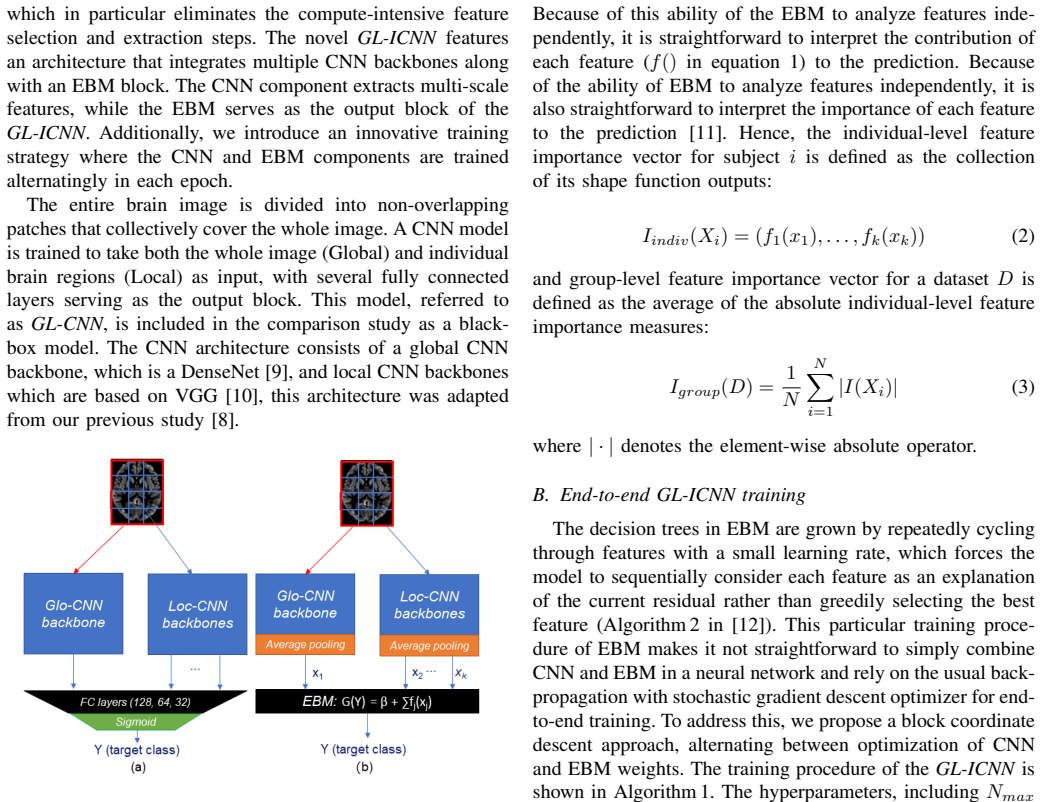
The load-bearing object is the EBM shape-function sum, $g(y)=\beta+\sum_j f_j(x_j)$, where each $f_j$ is a gradient-boosted ensemble of bagged decision trees operating on a single CNN-extracted feature $x_j$. Because the shape functions are univariate and additive, each subject's prediction decomposes into a vector of per-feature contributions, giving individual-level importance, and averaging absolute contributions over a cohort gives group-level importance. The training strategy is block-coordinate descent: in each epoch the EBM is retrained on the current CNN features, then the CNN is updated while the EBM stays fixed, with early stopping on validation loss.
What would settle it
Run Algorithm 1 on a small labeled MRI set, record the gradient norm of the CNN weights during step 3; if every gradient is zero or the CNN weights never change while the EBM is fixed, then the end-to-end training claim is false as stated and the reported performance must come from the warm-start or some unstated surrogate.
Extended reading notes
Core claim
The central discovery is that an EBM can act as a transparent output block for a CNN and that the whole stack can be trained end-to-end by alternating the optimization: freeze the CNN and fit the EBM to its features, then freeze the EBM and update the CNN, repeating each epoch. The model is called GL-ICNN; it takes whole-image and region-level patches, learns image features with convolutional backbones, and expresses each prediction as an additive sum of per-feature contribution functions. The paper reports that this glass-box model performs statistically on par with the black-box GL-CNN, VGG, and DenseNet baselines, and that its training time is about ten times shorter than the earlier non-end-to-end version because the separate feature-selection stage is removed.
Load-bearing premise
The training loop assumes gradients can flow from the EBM's loss back into the CNN through the EBM, but the EBM's shape functions are ensembles of decision trees, and tree outputs are piecewise constant with zero gradient almost everywhere, so the CNN-update step as written may be impossible without a surrogate.
Editorial extensions
If this is right
- A clinician can see exactly which brain regions pushed a given patient's score, because the EBM output is an additive sum of per-patch contributions.
- End-to-end training removes the expensive feature-selection stage, cutting training time from 81.3 hours to 7.8 hours on the AD-CN ADNI task.
- The interpretable model need not cost accuracy: its AUC was statistically indistinguishable from black-box baselines on all four diagnosis and prediction tasks.
- External-cohort testing on PND suggests the interpretable model generalizes beyond the training population.
- The top-ranked regions, including temporal lobe, hippocampus, and amygdala, provide a clinically plausible anatomical check on model behavior.
Reading between the lines
- A natural extension: the shape functions explain features produced by the CNN, not the gray-matter voxels directly; whether this counts as a clinical explanation depends on how stably the CNN maps anatomy into those features.
- Because the EBM is additive, the comparable accuracy suggests that pairwise and higher-order interactions among CNN features are not critical for these tasks; one could test this by adding interaction terms or comparing with a non-additive glass-box model.
- The alternating training as written requires gradients to flow through the EBM, whose decision trees have zero gradients almost everywhere; if backpropagation is used unmodified, step 3 cannot change the CNN, so an implementable version must rely on a surrogate, a different update rule, or a detail not stated in the paper.
- A testable practical claim: if the training procedure is implemented as described, the CNN weights will be frozen during the EBM phase, making reported performance reproducible from the code; checking the released code would settle this.
Signed reviews
Editorial analysis
A structured set of objections, weighed in public.
Referee Report
Summary. The paper introduces GL-ICNN, an interpretable model that replaces the fully connected output block of a CNN with an Explainable Boosting Machine (EBM), aiming to provide end-to-end learning from raw MRI while retaining glass-box interpretability. The authors propose a block-coordinate alternating training scheme (Algorithm 1) in which the CNN acts as a feature extractor and the EBM as the output block. Validation is performed on the ADNI cohort (AD vs. CN classification and MCI-to-AD conversion prediction) and on the PND cohort as external testing. The reported AUCs are 0.956 for AD/CN and 0.694 for MCI conversion on ADNI, with feature importance maps highlighting temporal lobe regions. The model is compared against several black-box baselines and two interpretable baselines, and the authors report a large reduction in training time relative to their earlier non-end-to-end Glo&Loc-EBM.
Significance. If the proposed training procedure is well-defined and executable, GL-ICNN would be a valuable contribution to interpretable medical image analysis, offering both decisions and feature importance measures without sacrificing accuracy relative to black-box models. The strengths of the paper include the use of an external validation cohort, the public availability of code, and the clear experimental protocol with bootstrap confidence intervals and DeLong tests. However, the central methodological claim of end-to-end training is currently undermined by an incomplete specification of the gradient path from the EBM output to the CNN parameters. The paper's significance is therefore conditional on resolving this algorithmic gap.
major comments (3)
- [II-B (Algorithm 1, step 3)] The instruction to 'train the CNN component of GL-ICNN while keeping EBM weights fixed' is not executable as stated. The EBM shape functions in Eq. (1) are gradient-boosted ensembles of bagged decision trees, which are piecewise constant functions of their inputs. Consequently, the gradient of the EBM output with respect to the CNN output vector x_j is zero almost everywhere, so standard backpropagation supplies no learning signal to the CNN. The paper does not describe a differentiable surrogate (e.g., soft-tree relaxation, straight-through estimator, or finite-difference approximation) or any alternative loss for updating the CNN in step 3. Please specify the exact update rule used and justify how gradients are obtained; without this, the central claim of an end-to-end model trained by alternating optimization is unsupported.
- [II-B (block coordinate descent)] Related to the previous point, the alternating scheme as described is degenerate: step 2 trains the EBM on the current CNN features, but if step 3 cannot propagate gradients through the EBM, the CNN features never change in response to the EBM loss. In that case the CNN parameters are only updated during the warm-up phase, and the EBM is trained once on fixed features, which is not end-to-end learning. Please clarify whether the CNN is actually updated during the alternating loop and, if so, by what mechanism. If the CNN is updated using a surrogate or a separate objective, describe it explicitly and justify its use.
- [IV-A (performance comparison)] The abstract and conclusion claim that GL-ICNN achieves 'comparable performance with other state-of-the-art black-box models.' However, the comparison study only includes the authors' own GL-CNN, VGG, DenseNet, and GL-ICNN-L. No published state-of-the-art results on ADNI or PND are cited or compared, and the DeLong test only establishes non-significant differences relative to these baselines. Please either add comparisons with recently published state-of-the-art models on the same cohorts or temper the claim to 'comparable performance with the included black-box baselines.'
minor comments (7)
- [II-B (Algorithm 1, lines 5-7)] The early stopping condition compares loss_i to loss_{i-1} rather than to the best loss encountered so far. This can save a model that is worse than a previously seen model. Consider storing a loss_best variable and comparing to it.
- [II-A (Eq. 1 and surrounding text)] The dataset notation D = {(X_i, y_i)}_1^N uses N for the number of subjects, while N is also used for the number of features in the same line ('i ∈ [1, N]' and 'x_j is the jth feature'). Use distinct symbols to avoid ambiguity.
- [III-B] The model named 'GL-ICNN-L' is not an EBM-based model; it is a CNN with a linear output block. The name may confuse readers because it suggests a variant of GL-ICNN rather than a different architecture. Consider renaming it (e.g., GL-CNN-L or GL-Linear).
- [II-A] The description of the patch-based local inputs is vague: 'The entire brain image is divided into non-overlapping patches that collectively cover the whole image.' Please specify the number of patches, patch sizes, and how the global and local CNNs are combined.
- [Fig. 2 and Section III-C] The text states that error bars represent confidence intervals but does not state the type (e.g., 95% bootstrap CIs). Also, the PND AUC values are not reported numerically; please include them in the text or a table.
- [IV-B] The phrase 'the GL-ICNN based the diagnosis mostly on regions of the temporal lobes, especially all regions containing the hippocampus and amygdala appeared' is awkward and slightly unclear; please rephrase for clarity.
- [References] Reference [8] is to an arXiv preprint; if it has been published in the meantime, please cite the published version.
Circularity Check
No significant circularity: the reported AUCs are empirical outcomes of supervised training with external validation, and the self-citation to prior work is not load-bearing.
full rationale
The paper's derivation chain is a standard supervised learning pipeline. The CNN feature extractor is trained on labeled MRI data, the EBM is fit to those features and labels, and performance is measured on a held-out ADNI test set and an external PND cohort. The AUC values in Fig. 2 are empirical measurements, not consequences implied by the model definition. The interpretability outputs are explicitly defined in Eqs. (2) and (3) as shape-function values and their averages; they are not presented as predictions derived from an independent source. The only self-citation, reference [8], supplies the architectural starting point and one comparison baseline, but it does not inject any parameter, theorem, or fitted value that would force the reported results. The most serious concern in the paper is a possible executability problem in Algorithm 1: step 3 requires training the CNN while keeping EBM weights fixed, and EBM shape functions are ensembles of piecewise-constant decision trees, so gradients through the EBM are zero almost everywhere. However, this is a completeness or correctness issue about whether the described training step can be implemented as written, not a circularity: no quantity in the paper is defined in terms of the result it is supposed to predict. Because no circular step can be exhibited from the text, the circularity score is 0.
Assumptions & free parameters
free parameters (4)
- Nmax (maximum epochs)
- Ntolerate (early stopping patience)
- Warm-up epochs for GL-CNN pre-training
- Patch size / number of patches
assumptions (4)
- domain assumption Patches of the brain image are non-overlapping and collectively cover the whole brain.
- domain assumption Each patch can be labeled by a brain region from the Hammers atlas with sufficient accuracy.
- domain assumption EBM's additive model without interactions adequately represents the relationship between CNN features and the diagnosis.
- standard math DenseNet and VGG backbones are suitable feature extractors for MRI-based AD classification.
Cite this review
Pith. "Pith review of GL-ICNN: An End-To-End Interpretable Convolutional Neural Network for the Diagnosis and Prediction of Alzheimer's Disease." pith.science (2026). https://pith.science/paper/CRS2RHRC
@misc{pith2026250111715,
  author       = {Pith},
  title        = {Pith review of: GL-ICNN: An End-To-End Interpretable Convolutional Neural Network for the Diagnosis and Prediction of Alzheimer's Disease},
  year         = {2026},
  howpublished = {\url{https://pith.science/paper/CRS2RHRC}},
  note         = {Machine review of arXiv:2501.11715}
}
read the original abstract
Deep learning methods based on Convolutional Neural Networks (CNNs) have shown great potential to improve early and accurate diagnosis of Alzheimer's disease (AD) dementia based on imaging data. However, these methods have yet to be widely adopted in clinical practice, possibly due to the limited interpretability of deep learning models. The Explainable Boosting Machine (EBM) is a glass-box model but cannot learn features directly from input imaging data. In this study, we propose a novel interpretable model that combines CNNs and EBMs for the diagnosis and prediction of AD. We develop an innovative training strategy that alternatingly trains the CNN component as a feature extractor and the EBM component as the output block to form an end-to-end model. The model takes imaging data as input and provides both predictions and interpretable feature importance measures. We validated the proposed model on the Alzheimer's Disease Neuroimaging Initiative (ADNI) dataset and the Health-RI Parelsnoer Neurodegenerative Diseases Biobank (PND) as an external testing set. The proposed model achieved an area-under-the-curve (AUC) of 0.956 for AD and control classification, and 0.694 for the prediction of conversion of mild cognitive impairment (MCI) to AD on the ADNI cohort. The proposed model is a glass-box model that achieves a comparable performance with other state-of-the-art black-box models. Our code is publicly available at: https://anonymous.4open.science/r/GL-ICNN.
Figures


Reference graph
Works this paper leans on
-
[1]
Brain imaging in differential diagnosis of dementia,
M. R. Ayers, D. Svaldi, and L. G. Apostolova, “Brain imaging in differential diagnosis of dementia,” Practical Neurology, 2019
work page 2019
-
[2]
J. Wen, E. Thibeau-Sutre, M. Diaz-Melo, J. Samper-Gonz ´alez, A. Routier, S. Bottani, D. Dormont, S. Durrleman, N. Burgos, O. Colliot et al. , “Convolutional neural networks for classification of Alzheimer’s disease: Overview and reproducible evaluation,”Medical image analysis, vol. 63, p. 101694, 2020
work page 2020
-
[3]
Interpretable machine learning for dementia: a systematic review,
S. A. Martin, F. J. Townend, F. Barkhof, and J. H. Cole, “Interpretable machine learning for dementia: a systematic review,” Alzheimer’s & Dementia, vol. 19, no. 5, pp. 2135–2149, 2023
work page 2023
-
[4]
Challenges of implementing computer-aided diagnostic models for neuroimages in a clinical setting,
M. J. Leming, E. E. Bron, R. Bruffaerts, Y . Ou, J. E. Iglesias, R. L. Gol- lub, and H. Im, “Challenges of implementing computer-aided diagnostic models for neuroimages in a clinical setting,” NPJ Digital Medicine , vol. 6, no. 1, p. 129, 2023
work page 2023
-
[5]
A. B. Arrieta, N. D ´ıaz-Rodr´ıguez, J. Del Ser, A. Bennetot, S. Tabik, A. Barbado, S. Garc ´ıa, S. Gil-L ´opez, D. Molina, R. Benjamins et al. , “Explainable Artificial Intelligence (XAI): Concepts, taxonomies, op- portunities and challenges toward responsible AI,” Information fusion , vol. 58, pp. 82–115, 2020. Fig. 2. The AUC score of models on 4 tasks...
work page 2020
-
[6]
The (un) reliability of saliency methods,
P.-J. Kindermans, S. Hooker, J. Adebayo, M. Alber, K. T. Sch ¨utt, S. D ¨ahne, D. Erhan, and B. Kim, “The (un) reliability of saliency methods,” Explainable AI: Interpreting, explaining and visualizing deep learning, pp. 267–280, 2019
work page 2019
-
[7]
Intelligible models for classification and regression,
Y . Lou, R. Caruana, and J. Gehrke, “Intelligible models for classification and regression,” in Proceedings of the 18th ACM SIGKDD international conference on Knowledge discovery and data mining , 2012, pp. 150– 158
work page 2012
-
[8]
W. Kang, B. Li, J. M. Papma, L. C. Jiskoot, P. P. De Deyn, G. J. Biessels, J. A. Claassen, H. A. Middelkoop, W. M. van der Flier, I. H. Ramakers et al., “An Interpretable Machine Learning Model with Deep Learning- based Imaging Biomarkers for Diagnosis of Alzheimer’s Disease,” arXiv preprint arXiv:2308.07778, 2023
work page Pith review arXiv 2023
Show all 16 references
-
[9]
Densely connected convolutional networks,
G. Huang, Z. Liu, L. Van Der Maaten, and K. Q. Weinberger, “Densely connected convolutional networks,” in Proceedings of the IEEE confer- ence on computer vision and pattern recognition , 2017, pp. 4700–4708
2017
-
[10]
Very deep convolutional networks for large-scale image recognition,
K. Simonyan and A. Zisserman, “Very deep convolutional networks for large-scale image recognition,” arXiv preprint arXiv:1409.1556 , 2014
2014 arXiv
-
[11]
Intelligible models for healthcare: Predicting pneumonia risk and hospital 30-day readmission,
R. Caruana, Y . Lou, J. Gehrke, P. Koch, M. Sturm, and N. Elhadad, “Intelligible models for healthcare: Predicting pneumonia risk and hospital 30-day readmission,” in Proceedings of the 21th ACM SIGKDD international conference on knowledge discovery and data mining , 2015, pp....
2015
-
[12]
Accuracy, interpretability, and differential privacy via explainable boosting,
H. Nori, R. Caruana, Z. Bu, J. H. Shen, and J. Kulkarni, “Accuracy, interpretability, and differential privacy via explainable boosting,” in International conference on machine learning . PMLR, 2021, pp. 8227– 8237
2021
-
[13]
The Parelsnoer Institute: a national network of standardized clinical biobanks in the Netherlands,
J. Manni ¨en, T. Ledderhof, H. W. Verspaget, R. R. Snijder, E. F. Flikkenschild, N. P. van Scherrenburg, R. P. Stolk, and G. A. Zielhuis, “The Parelsnoer Institute: a national network of standardized clinical biobanks in the Netherlands,” 2017
2017
-
[14]
Cross-cohort generalizability of deep and conventional machine learn- ing for MRI-based diagnosis and prediction of Alzheimer’s disease,
E. E. Bron, S. Klein, J. M. Papma, L. C. Jiskoot, V . Venkatraghavan, J. Linders, P. Aalten, P. P. De Deyn, G. J. Biessels, J. A. Claassen et al., “Cross-cohort generalizability of deep and conventional machine learn- ing for MRI-based diagnosis and prediction of Alzheimer’s d...
2021
-
[15]
Three-dimensional maximum probability atlas of the human brain, with particular reference to the temporal lobe,
A. Hammers, R. Allom, M. J. Koepp, S. L. Free, R. Myers, L. Lemieux, T. N. Mitchell, D. J. Brooks, and J. S. Duncan, “Three-dimensional maximum probability atlas of the human brain, with particular reference to the temporal lobe,” Human brain mapping , vol. 19, no. 4, pp. 224–...
2003
-
[16]
Towards a biological definition of Alzheimer disease,
K. Jellinger, “Towards a biological definition of Alzheimer disease,” Int J Neurol Neurother , vol. 7, no. 1, p. 095, 2020
2020
Reviewed August 10, 2026 · model on record in the stance chip above.
Discussion (0). Continue with ORCID to comment.