REVIEW 4 major objections 5 minor 84 references
An Empirically-grounded tool for Automatic Prompt Linting and Repair: A Case Study on Bias, Vulnerability, and Optimization in Developer Prompts
T0 review · 4 major / 5 minor · reviewed 2026-08-10 · deepseek-v4-flash
Pith's one-line read Developer Prompts embedded in open-source code carry measurable bias, injection, and sub-optimality risks, and an LLM-based rewrite pipeline fixes a substantial share of each without fine-tuning.
desk verdict The paper's bias and de-biasing headline numbers are not supported by its own detector F1 scores (race 0.46, sexuality 0.13 vs baseline 0.59), but the Dev Prompt artifact, dataset, and gender-bias results are real contributions worth refereeing. read the letter →
The pith
A machine-rendered reading of the paper's core claim, the machinery that carries it, and where it could break.
The reading
What carries the argument
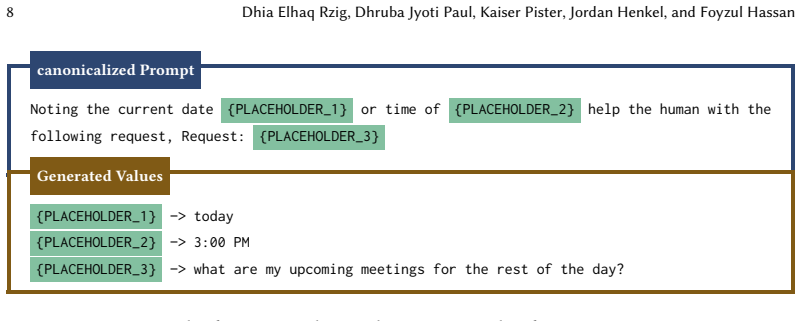
The central mechanism is the generate-and-evaluate loop applied to a canonicalized Developer Prompt. Each prompt is first canonicalized so every runtime interpolation becomes a marked hole of the form '{placeholder}', and each hole is then 'patched' with an LLM-generated value, produced sequentially so later values are consistent with earlier ones. Bias handling uses a hand-crafted multi-shot LLM prompt that classifies a patched prompt as explicitly biased, bias-prone, or clean, and remediation rewrites the prompt at most ten times, keeping only rewrites the classifier passes. Injection handling injects each of 42 known attacks into each hole and checks whether the model emits the attack's expected target string; hardening rewrites the prompt until no attack succeeds. For optimization, the patching process is extended into a synthetic dataset, seed prompts are drawn from 26 prompt-engineering principles, and a self-improving search keeps the highest-scoring $n$ candidate prompts at each step, scoring them with BLEU for translation, GLEU for grammar correction, embedding cosine similarity for summarization, and an LLM-as-judge for question answering.
What would settle it
Repatch the paper's 2,173 Dev Prompts using real runtime values captured from instrumented deployments instead of LLM-generated mock values, then rerun the identical bias, injection, and optimization pipelines; if the prevalence figures (3.46%, 10.75%, 36%) or the repair rates (68.29%, 41.81%, 37.1%) move materially, the empirical claims are an artifact of the patching step.
Extended reading notes
Core claim
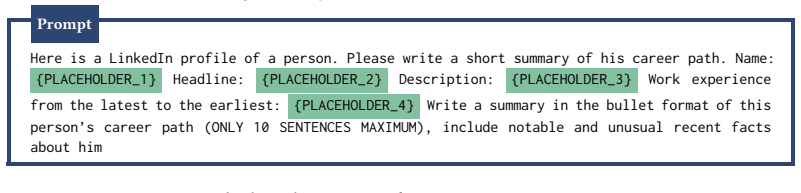
Developer Prompts are a distinct software artifact: natural-language instructions with programmatic holes whose values are interpolated at runtime. The paper establishes empirically that these artifacts fail in measurable, tool-detectable ways. Analyzing a stratified random sample of 2,173 Dev Prompts from the cleaned 40,573-prompt corpus, it reports that 3.46% are explicitly biased or bias-prone along gender, race, or sexuality dimensions; that 10.75% contain at least one prompt hole that yields to at least one of 42 tested injection attacks; and that 36% of question-answering prompts under-perform against synthetic test data. It then shows that a generation-evaluation loop, capped at ten iterations, repairs a substantial fraction of these flaws: 68.29% of biased prompts are rewritten to pass the bias checks, 41.81% of vulnerable prompts are hardened so all 42 attacks fail, and 37.1% of sub-optimal QA prompts improve on held-out data, with translation, summarization, and grammar-correction prompts improving consistently.
Load-bearing premise
The prevalence and repair figures assume that the LLM-generated mock values used to patch prompt holes behave like the values real users supply at runtime, but the paper does not validate this against deployed traffic or a corpus of actual interpolations.
Editorial extensions
If this is right
- Prompt quality becomes a lintable software property: developers can catch bias, injection, and sub-optimality in the IDE before the prompt ships.
- Teams using API-only LLMs they cannot fine-tune still gain a repair path for these three failure modes.
- The prevalence figures—3.46% biased, 10.75% injection-vulnerable, 36% of QA prompts sub-optimal—serve as a measuring stick for future prompt-safety tools and studies.
- The per-category repair rates (82.81% for gender bias but 12.50% for race bias) show where automatic rewriting is already sufficient and where it needs stronger methods.
Reading between the lines
- The reported numbers depend on the patch values that fill prompt holes; re-running the same pipelines with real runtime values captured from deployed software would test whether the 3.46% and 10.75% figures hold in production.
- The same generate-and-evaluate machinery could be pointed at other prompt faults the paper does not measure, such as leaking the prompt's hidden instructions or drifting off-task on long inputs.
- Because an LLM judge both detects bias and scores question-answering rewrites, the repair rates could partly reflect the judge's own blind spots; an adversarial audit of the judge against known biased outputs would clarify what the rates mean.
- Adoption of the VS Code extension is untested; a user study of whether developers accept and keep the rewrites would show whether the repair rates translate into shipped behavior.
Editorial analysis
A structured set of objections, weighed in public.
Referee Report
Summary. The paper presents PromptDoctor, an LLM-based tool for detecting and repairing three classes of problems in Developer Prompts (prompts embedded in source code): bias, injection vulnerability, and sub-optimal performance. The tool uses LLM-based detectors and generation-evaluation loops to rewrite prompts. The authors evaluate on a stratified sample of 2,173 Dev Prompts from PromptSet, reporting 3.46% bias-proneness, 10.75% injection vulnerability, and (in the introduction) 36% QA under-performance, with repair rates of 68.29% (de-biasing), 41.81% (hardening), and 37.1% (QA optimization using GPT-4o). They also provide a VSCode extension and a replication package.
Significance. If the empirical findings hold, this is a substantial contribution to an emerging area of software engineering: it would be the first large-scale study of these issues in embedded prompts and would demonstrate that a fine-tuning-free rewriting approach can mitigate a meaningful fraction of them. The paper's strengths include the focus on a novel artifact, the scale of the dataset, and the release of code and data. However, the central quantitative claims are currently supported only in part: the bias prevalence and repair numbers rest on detectors whose performance is near chance for two of three categories, and the vulnerability results rely on an undisclosed attack suite without validation. The QA optimization results lack external benchmarking. These gaps are load-bearing and must be addressed before the numbers can be accepted.
major comments (4)
- [§4.1.1, §4.1.2, Finding 1] The aggregate bias prevalence (3.46%) and de-biasing success (68.29%) are not supported by the detector validation reported in §4.1.1. The gender detector is credible (F1=0.93), but the race and sexuality detectors achieve F1=0.46 and 0.13, respectively, both below the 0.59 fine-tuned baseline. Using these near-chance detectors to report the 0.75% race-bias and 0.09% sexuality-bias prevalence, and to accept rewrites as 'de-biased' when the same detector passes them (§3.2.2), propagates detector error directly into the headline repair rate. Moreover, the category percentages in §4.1.2 do not sum to the reported 3.46% aggregate (3.03% gender + 0.75% race + 0.09% sexuality = 3.87%, or more if sexuality-proneness is counted), so the aggregate needs to be reconciled. The authors should either restrict the prevalence and repair claims to the gender category, or provide precision-recall operating points at the scanning threshold for the weak detectors and recalibrate the aggregate accordingly.
- [§3.3.1, §4.2, Finding 2] The vulnerability prevalence (10.75%) and hardening rate (41.81%) are measured against an undisclosed 42-attack suite, with no false-positive or false-negative analysis for the detection procedure. Because hardening success is defined as all 42 attacks failing on a rewrite, the reported rates are entirely conditional on the composition of this suite. Without releasing the suite, showing its coverage of known attack families, and validating the detection against a labeled set of vulnerable and benign prompts, the headline vulnerability numbers are not empirically grounded. The footnote that 'Double blind policy forbids from being specific' does not satisfy the need for a reproducible attack corpus.
- [§3.1.3] The patching process that fills prompt holes with LLM-generated mock values is not validated against real user inputs. Since the bias and vulnerability analyses are executed exclusively on patched prompts (Sections 3.2 and 3.3), the prevalence estimates (3.46% and 10.75%) are conditional on a synthetic value distribution. If real interpolated values differ in length, topic, or adversarial intent, both the prevalence and the repair rates could change materially. The authors should either validate patching against a sample of real usage data or explicitly rephrase the claims as 'with our generated values' and add this as a limitation with a concrete sensitivity analysis.
- [Introduction, §4.3.1, Figure 16a] The introduction claims that '36% of Question-Answering Dev Prompts quantitatively under-performed when tested against real-world benchmarks,' but RQ3's evaluation (§4.3.1) uses synthetic test data and an LLM-as-judge scorer derived from the original prompt, with no real-world benchmark for QA. No definition or measurement of the '36%' figure is given anywhere in the paper, and the 37.1% improvement rate for GPT-4o is also based solely on the synthetic set. The paper should either remove the unsupported 36% claim, or add an external QA benchmark evaluation, and should discuss the risk of self-confirmation in using the same synthetic distribution for training and evaluation.
minor comments (5)
- [§4.1.2] The sentence about sexuality bias says responses are 'likely to generate Race-Biased responses'; this appears to be a typo for Sexuality-Biased responses, and the sentence should be repaired.
- [§3.1.1, §3.3.1] There are several grammatical slips, such as 'added at interpolated before being sent' (§3.1.1) and 'values shaped by by users' (§3.3.1); a proofreading pass is needed.
- [§4.2.1, §4.3.1] Labels such as 'Figure 1212.a' and 'Figure 1616.a' should be corrected to 'Figure 12a' and 'Figure 16a' respectively.
- [§4.3.1] The model name appears inconsistently as 'LLama3.1' and 'Llama3.1'; please standardize the spelling.
- [§7] Section 7 states that human validation was performed, but no details or results are reported; either add a description of the human validation protocol and findings, or remove the claim.
Circularity Check
Central repair claims re-measure PromptDoctor's own instruments: de-bias success is defined as the same detector that flagged the prompt (race/sexuality halves at F1=0.46/0.13) flipping to 'clean', and the QA 37.1% optimization rate is the LLM-as-judge objective from Eq. 8 re-applied to same-family synthetic data and rewrites; injection hardening (41.81%) is externally anchored and not circular.
-
self definitional
[Section 3.2.2 (Bias Remediation) and Section 4.1.3 (Bias Remediation results)]
"Third, we evaluate each of these rewrites for bias. If we determine some of them is also biased or bias-prone, we isolate them and run the same generation-evaluation loop on each of them. We stop this process when we have at least five new non-biased and non-bias-prone Dev Prompts. ... Across the different Bias categories we considered, our Bias remediation approach is able to fix 68.29% of the Biased and Bias-prone Dev Prompts overall"
A rewrite counts as successfully de-biased iff the Section 3.2.1 GPT-4o detection prompt, the same instrument whose verdicts define the 3.46% prevalence in Section 4.1.2, returns 'non-biased and non-bias-prone'; the loop's stopping rule is literally that the detector accepts the rewrite. The 68.29% repair figure is therefore a detector-verdict-flip rate by construction: the repair outcome X is defined as detector verdict Y, so both headline RQ1 numbers are two readings of one instrument.
-
fitted input called prediction
[Section 3.4.2 (Equations 4 and 8) and Section 4.3.1 (Q&A prompt optimization results)]
"We utilize the “LLM as a judge” technique to score QA tasks due to their highly varied nature [66]. As a preprocessing step, each QA Dev Prompt generates a corresponding scoring prompt t3 which will be used to evaluate the quality of the outputs during optimization. ... Our approach improves Dev Prompt performance on the synthetic test dataset in 71% of cases when using Llama3.1 8B as the scorer and Llama3.1 70B as the generator, and 37.1% of cases when using GPT-4o as the scorer and generator."
For QA tasks, 'performance' (Equation 8) is defined as M3's LLM-judge verdict on M2 outputs over synthetic dataset D, where D is produced by the Section 3.1.3 LLM patching process and the judge prompt t3 is derived from the very prompt being optimized. The optimizer (Equation 4) retains the highest-scoring candidates under this same score, and the Section 4.3.1 '37.1% improved' headline re-measures exactly that objective on synthetic test data.
full rationale
Three headline claims: bias (3.46% prevalence, 68.29% de-biased), injection (10.75% vulnerable, 41.81% hardened), and QA optimization (37.1% improved). The injection claim is not circular: vulnerability is defined against a fixed set of 42 external attacks from a corporate dataset and the open web, and 'hardened' means the same attacks now fail after rewriting, a well-scoped metric anchored outside the tool. The QA optimization claim is partially circular: Equation 8 defines QA performance as an LLM-judge verdict on synthetic data generated by the same LLM family, the optimizer selects on that score (Equation 4), and the 37.1% headline re-reads the same objective on synthetic test data. The bias claims are the most circular: Section 3.2.2 defines de-bias success as the Section 3.2.1 detector's 'non-biased' verdict, so 68.29% is a verdict-flip rate of the identical instrument that produced the 3.46% prevalence; Section 4.1.1 reports the race and sexuality halves of that instrument at F1=0.46 and 0.13, below the 0.59 baseline, making the paper's statement that these results 'give credence to the accuracy of these prompts' internally contradicted by the reported numbers. That contradiction is primarily a measurement-validity failure, but it directly aggravates the self-definitional repair metric. PromptSet [5] is a self-citation (authors Pister and Paul are co-authors), but it functions as data provenance rather than load-bearing argument: the dataset is public, and all prevalence and repair numbers are computed in this paper rather than imported from [5]. Because two of the three central empirical claims reduce to the tool's own instruments and objectives, while the hardening evaluation and the gold-dataset spot checks for grounded tasks retain independent content, the appropriate score is 6: partial, construction-level circularity in central claims rather than complete equivalence.
Assumptions & free parameters
free parameters (7)
- Prompt length cutoff for dataset cleaning =
31 characters
- QA optimization prompt length filter =
20-200 characters
- Number of seed prompts =
16
- Number of prompts generated per optimization step =
20
- Synthetic training set size =
30
- Bias remediation loop limits =
5 rewrites, 10 iterations, 5 final rewrites
- Hardening loop limits =
5 rewrites, 10 iterations
assumptions (5)
- domain assumption LLM-generated patch values are representative of runtime user inputs.
- domain assumption The hand-crafted LLM bias-detection prompt provides valid bias labels.
- domain assumption The 42-attack suite is representative and its success signal is reliable.
- domain assumption LLM-as-judge scores on synthetic data are a valid proxy for real task performance.
- ad hoc to paper All Dev Prompts are assumed suboptimal by default.
Cite this review
Pith. "Pith review of An Empirically-grounded tool for Automatic Prompt Linting and Repair: A Case Study on Bias, Vulnerability, and Optimization in Developer Prompts." pith.science (2026). https://pith.science/paper/573IWVUO
@misc{pith2026250112521,
  author       = {Pith},
  title        = {Pith review of: An Empirically-grounded tool for Automatic Prompt Linting and Repair: A Case Study on Bias, Vulnerability, and Optimization in Developer Prompts},
  year         = {2026},
  howpublished = {\url{https://pith.science/paper/573IWVUO}},
  note         = {Machine review of arXiv:2501.12521}
}
read the original abstract
The tidal wave of advancements in Large Language Models (LLMs) has led to their swift integration into application-level logic. Many software systems now use prompts to interact with these black-box models, combining natural language with dynamic values interpolated at runtime, to perform tasks ranging from sentiment analysis to question answering. Due to the programmatic and structured natural language aspects of these prompts, we refer to them as Developer Prompts. Unlike traditional software artifacts, Dev Prompts blend natural language instructions with artificial languages such as programming and markup languages, thus requiring specialized tools for analysis, distinct from classical software evaluation methods. In response to this need, we introduce PromptDoctor, a tool explicitly designed to detect and correct issues of Dev Prompts. PromptDoctor identifies and addresses problems related to bias, vulnerability, and sub-optimal performance in Dev Prompts, helping mitigate their possible harms. In our analysis of 2,173 Dev Prompts, selected as a representative sample of 40,573 Dev Prompts, we found that 3.46% contained one or more forms of bias, 10.75% were vulnerable to prompt injection attacks. Additionally, 3,310 were amenable to automated prompt optimization. To address these issues, we applied PromptDoctor to the flawed Dev Prompts we discovered. PromptDoctor de-biased 68.29% of the biased Dev Prompts, hardened 41.81% of the vulnerable Dev Prompts, and improved the performance of 37.1% sub-optimal Dev Prompts. Finally, we developed a PromptDoctor VSCode extension, enabling developers to easily enhance Dev Prompts in their existing development workflows. The data and source code for this work are available at
Figures


Figures from the paper (14 more)



Reference graph
Works this paper leans on
-
[1]
Available: https://figshare.com/s/930b08c981b41f28470c
[Online]. Available: https://figshare.com/s/930b08c981b41f28470c
-
[2]
Large language models as software components: A taxonomy for llm-integrated applications,
I. Weber, “Large language models as software components: A taxonomy for llm-integrated applications, ” 2024. [Online]. Available: https://arxiv.org/abs/2406.10300
arXiv 2024
-
[3]
Large language models: A comprehensive survey of its applications, challenges, limitations, and future prospects
M. U. Hadi, al tashi, R. Qureshi, A. Shah, M. Irfan, A. Zafar, M. B. Shaikh, N. Akhtar, J. Wu, S. Mirjalili, Q. Al-Tashi, A. Muneer, M. A. Al-garadi, G. Cnn, and T. RoBERTa, “Large language models: A comprehensive survey of its applications, challenges, limitations, and future prospects. ” [Online]. Available: https://api.semanticscholar.org/ CorpusID:266378240
-
[4]
Technique improves the reasoning capabilities of large language models,
“Technique improves the reasoning capabilities of large language models, ” https://news.mit.edu/2024/technique- improves-reasoning-capabilities-large-language-models-0614, 2024, [Online; accessed 19-August-2024]
2024
-
[5]
PromptSet: A Programmer's Prompting Dataset
K. Pister, D. J. Paul, P. Brophy, and I. Joshi, “Promptset: A programmer’s prompting dataset, ” arXiv preprint arXiv:2402.16932, 2024
work page Pith review arXiv 2024
-
[6]
Auto-debias: Debiasing masked language models with automated biased prompts,
Y. Guo, Y. Yang, and A. Abbasi, “Auto-debias: Debiasing masked language models with automated biased prompts, ” in Proceedings of the 60th Annual Meeting of the Association for Computational Linguistics (Volume 1: Long Papers) , 2022, pp. 1012–1023
2022
-
[7]
C. Clemmer, J. Ding, and Y. Feng, “Precisedebias: An automatic prompt engineering approach for generative ai to mitigate image demographic biases, ” in2024 IEEE/CVF Winter Conference on Applications of Computer Vision (W ACV), 2024, pp. 8581–8590
work page 2024
-
[8]
Automatic prompt optimization with
R. Pryzant, D. Iter, J. Li, Y. T. Lee, C. Zhu, and M. Zeng, “Automatic prompt optimization with" gradient descent" and beam search, ”arXiv preprint arXiv:2305.03495, 2023
arXiv 2023
Show all 84 references
-
[9]
Plan-and-solve prompting: Improving zero-shot chain-of-thought reasoning by large language models,
L. Wang, W. Xu, Y. Lan, Z. Hu, Y. Lan, R. K.-W. Lee, and E.-P. Lim, “Plan-and-solve prompting: Improving zero-shot chain-of-thought reasoning by large language models, ” no. arXiv:2305.04091, May 2023, arXiv:2305.04091 [cs]. [Online]. Available: http://arxiv.org/abs/2305.04091
2023 arXiv
-
[10]
Language models get a gender makeover: Mitigating gender bias with few-shot data interventions,
H. Thakur, A. Jain, P. Vaddamanu, P. P. Liang, and L.-P. Morency, “Language models get a gender makeover: Mitigating gender bias with few-shot data interventions, ” in Proceedings of the 61st Annual Meeting of the Association for Computational Linguistics (Volume 2: Short Pape...
2023
-
[11]
Formalizing and benchmarking prompt injection attacks and defenses,
Y. Liu, Y. Jia, R. Geng, J. Jia, and N. Z. Gong, “Formalizing and benchmarking prompt injection attacks and defenses, ” in 33rd USENIX Security Symposium (USENIX Security 24) , 2024, pp. 1831–1847
2024
-
[12]
Promptcare: Prompt copyright protection by watermark injection and verification,
H. Yao, J. Lou, Z. Qin, and K. Ren, “Promptcare: Prompt copyright protection by watermark injection and verification, ” in 2024 IEEE Symposium on Security and Privacy (SP) . IEEE, 2024, pp. 845–861
2024
-
[13]
Don’t stop pretraining? make prompt-based fine-tuning powerful learner,
Z. Shi and A. Lipani, “Don’t stop pretraining? make prompt-based fine-tuning powerful learner, ”Advances in Neural Information Processing Systems, vol. 36, pp. 5827–5849, 2023
2023
-
[14]
An analysis of large language models: their impact and potential applications,
G. Bharathi Mohan, R. Prasanna Kumar, P. Vishal Krishh, A. Keerthinathan, G. Lavanya, M. K. U. Meghana, S. Sulthana, and S. Doss, “An analysis of large language models: their impact and potential applications, ”Knowledge and Information Systems , vol. 66, no. 9, p. 5047–5070, ...
2024 doi
-
[15]
Large language models: Their success and impact,
S. Makridakis, F. Petropoulos, and Y. Kang, “Large language models: Their success and impact, ”Forecasting, vol. 5, no. 3, p. 536–549, Aug. 2023. [Online]. Available: https://www.mdpi.com/2571-9394/5/3/30
2023
-
[16]
Gpt-4 technical report,
OpenAI, “Gpt-4 technical report, ” no. arXiv:2303.08774, Mar. 2024, arXiv:2303.08774 [cs]. [Online]. Available: http://arxiv.org/abs/2303.08774
2024 arXiv
-
[17]
The llama 3 herd of models,
M. AI, “The llama 3 herd of models, ” no. arXiv:2407.21783, Aug. 2024, arXiv:2407.21783 [cs]. [Online]. Available: http://arxiv.org/abs/2407.21783
2024 arXiv
-
[18]
True few-shot learning with prompts – a real-world perspective,
T. Schick and H. Schütze, “True few-shot learning with prompts – a real-world perspective, ” no. arXiv:2111.13440, Nov. 2021, arXiv:2111.13440 [cs]. [Online]. Available: http://arxiv.org/abs/2111.13440
2021 arXiv
-
[19]
How to prompt? opportunities and challenges of zero- and few-shot learning for human-ai interaction in creative applications of generative models,
H. Dang, L. Mecke, F. Lehmann, S. Goller, and D. Buschek, “How to prompt? opportunities and challenges of zero- and few-shot learning for human-ai interaction in creative applications of generative models, ” no. arXiv:2209.01390, Sep. 2022, arXiv:2209.01390 [cs]. [Online]. Ava...
2022 arXiv
-
[20]
Fair models in credit: Intersectional discrimination and the amplification of inequity,
S. Kim, S. Lessmann, G. Andreeva, and M. Rovatsos, “Fair models in credit: Intersectional discrimination and the amplification of inequity, ” no. arXiv:2308.02680, Aug. 2023, arXiv:2308.02680 [cs]. [Online]. Available: http://arxiv.org/abs/2308.02680
2023 arXiv
-
[21]
Evaluating racial bias in large language models: The necessity for “smoky
J. Breckenridge, “Evaluating racial bias in large language models: The necessity for “smoky”, ” 2024. [Online]. Available: https://www.ssrn.com/abstract=4880025
2024
-
[22]
Bias and fairness in large language models: A survey,
I. O. Gallegos, R. A. Rossi, J. Barrow, M. M. Tanjim, S. Kim, F. Dernoncourt, T. Yu, R. Zhang, and N. K. Ahmed, “Bias and fairness in large language models: A survey, ” no. arXiv:2309.00770, Jul. 2024, arXiv:2309.00770 [cs]. [Online]. Available: http://arxiv.org/abs/2309.00770...
2024 arXiv
-
[23]
Marked personas: Using natural language prompts to measure stereotypes in language models,
M. Cheng, E. Durmus, and D. Jurafsky, “Marked personas: Using natural language prompts to measure stereotypes in language models, ” inProceedings of the 61st Annual Meeting of the Association for Computational Linguistics (Volume 1: Long Papers), A. Rogers, J. Boyd-Graber, and...
2023
-
[24]
Large language models propagate race-based medicine,
J. A. Omiye, J. C. Lester, S. Spichak, V. Rotemberg, and R. Daneshjou, “Large language models propagate race-based medicine, ” npj Digital Medicine , vol. 6, no. 1, p. 195, Oct. 2023. [Online]. Available: https: //www.nature.com/articles/s41746-023-00939-z
2023
-
[25]
Dialect prejudice predicts ai decisions about people’s character, employability, and criminality,
V. Hofmann, P. R. Kalluri, D. Jurafsky, and S. King, “Dialect prejudice predicts ai decisions about people’s character, employability, and criminality, ” no. arXiv:2403.00742, Mar. 2024, arXiv:2403.00742 [cs]. [Online]. Available: http://arxiv.org/abs/2403.00742
2024 arXiv
-
[26]
An early categorization of prompt injection attacks on large language models,
S. Rossi, A. M. Michel, R. R. Mukkamala, and J. B. Thatcher, “An early categorization of prompt injection attacks on large language models, ” no. arXiv:2402.00898, Jan. 2024, arXiv:2402.00898 [cs]. [Online]. Available: http://arxiv.org/abs/2402.00898
2024 arXiv
-
[27]
How strangers got my email address from chatgpt’s model,
J. White, “How strangers got my email address from chatgpt’s model, ” The New York Times , Dec. 2023. [Online]. Available: https://www.nytimes.com/interactive/2023/12/22/technology/openai-chatgpt-privacy-exploit.html
2023
-
[28]
Pleak: Prompt leaking attacks against large language model applications,
B. Hui, H. Yuan, N. Gong, P. Burlina, and Y. Cao, “Pleak: Prompt leaking attacks against large language model applications, ” no. arXiv:2405.06823, May 2024, arXiv:2405.06823 [cs]. [Online]. Available: http://arxiv.org/abs/2405.06823
2024 arXiv
-
[29]
Prompt injection attacks and defenses in llm-integrated applications,
Y. Liu, Y. Jia, R. Geng, J. Jia, and N. Z. Gong, “Prompt injection attacks and defenses in llm-integrated applications, ” no. arXiv:2310.12815, Oct. 2023, arXiv:2310.12815 [cs]. [Online]. Available: http://arxiv.org/abs/2310.12815
2023
-
[30]
Prompt injection attack against llm-integrated applications,
Y. Liu, G. Deng, Y. Li, K. Wang, Z. Wang, X. Wang, T. Zhang, Y. Liu, H. Wang, Y. Zheng, and Y. Liu, “Prompt injection attack against llm-integrated applications, ” no. arXiv:2306.05499, Mar. 2024, arXiv:2306.05499 [cs]. [Online]. Available: http://arxiv.org/abs/2306.05499
2024 arXiv
-
[31]
Assessing prompt injection risks in 200+ custom gpts,
J. Yu, Y. Wu, D. Shu, M. Jin, and X. Xing, “Assessing prompt injection risks in 200+ custom gpts, ” no. arXiv:2311.11538, Nov. 2023, arXiv:2311.11538 [cs]. [Online]. Available: http://arxiv.org/abs/2311.11538
2023 arXiv
-
[32]
Not what you’ve signed up for: Compromising real-world llm-integrated applications with indirect prompt injection,
K. Greshake, S. Abdelnabi, S. Mishra, C. Endres, T. Holz, and M. Fritz, “Not what you’ve signed up for: Compromising real-world llm-integrated applications with indirect prompt injection, ” no. arXiv:2302.12173, May 2023, arXiv:2302.12173 [cs]. [Online]. Available: http://arxi...
2023 arXiv
-
[33]
Arb: Advanced reasoning benchmark for large language models,
T. Sawada, D. Paleka, A. Havrilla, P. Tadepalli, P. Vidas, A. Kranias, J. J. Nay, K. Gupta, and A. Komatsuzaki, “Arb: Advanced reasoning benchmark for large language models, ” no. arXiv:2307.13692, Jul. 2023, arXiv:2307.13692 [cs]. [Online]. Available: http://arxiv.org/abs/2307.13692
2023 arXiv
-
[34]
Benchmarking large language models for math reasoning tasks,
K. Sebler, Y. Rong, E. Gozluklu, and E. Kasneci, “Benchmarking large language models for math reasoning tasks, ” no. arXiv:2408.10839, Aug. 2024, arXiv:2408.10839 [cs]. [Online]. Available: http://arxiv.org/abs/2408.10839
2024 arXiv
-
[35]
A prompt pattern catalog to enhance prompt engineering with chatgpt,
J. White, Q. Fu, S. Hays, M. Sandborn, C. Olea, H. Gilbert, A. Elnashar, J. Spencer-Smith, and D. C. Schmidt, “A prompt pattern catalog to enhance prompt engineering with chatgpt, ” no. arXiv:2302.11382, Feb. 2023, arXiv:2302.11382 [cs]. [Online]. Available: http://arxiv.org/a...
2023 arXiv
-
[36]
Prompt design and engineering: Introduction and advanced methods,
X. Amatriain, “Prompt design and engineering: Introduction and advanced methods, ” no. arXiv:2401.14423, May 2024, arXiv:2401.14423 [cs]. [Online]. Available: http://arxiv.org/abs/2401.14423
2024 arXiv
-
[37]
A systematic survey of prompt engineering in large language models: Techniques and applications,
P. Sahoo, A. K. Singh, S. Saha, V. Jain, S. Mondal, and A. Chadha, “A systematic survey of prompt engineering in large language models: Techniques and applications, ” no. arXiv:2402.07927, Feb. 2024, arXiv:2402.07927 [cs]. [Online]. Available: http://arxiv.org/abs/2402.07927
2024 arXiv
-
[38]
Synthetic data (almost) from scratch: Generalized instruction tuning for language models,
H. Li, Q. Dong, Z. Tang, C. Wang, X. Zhang, H. Huang, S. Huang, X. Huang, Z. Huang, D. Zhang, Y. Gu, X. Cheng, X. Wang, S.-Q. Chen, L. Dong, W. Lu, Z. Sui, B. Wang, W. Lam, and F. Wei, “Synthetic data (almost) from scratch: Generalized instruction tuning for language models, ” 2024
2024
-
[39]
spaCy: Industrial-strength Natural Language Processing in Python,
M. Honnibal, I. Montani, S. Van Landeghem, and A. Boyd, “spaCy: Industrial-strength Natural Language Processing in Python, ” 2020
2020
-
[40]
Gender bias in big data analysis,
T. J. Misa, “Gender bias in big data analysis, ”Information & Culture, vol. 57, pp. 283 – 306, 2022. [Online]. Available: https://api.semanticscholar.org/CorpusID:253371931
2022
-
[41]
Available: https://ssir.org/articles/entry/when_good_algorithms_go_sexist_why_and_how_to_advance_ai_ gender_equity
[Online]. Available: https://ssir.org/articles/entry/when_good_algorithms_go_sexist_why_and_how_to_advance_ai_ gender_equity
-
[42]
From gender biases to gender-inclusive design: An empirical investigation,
M. Vorvoreanu, L. Zhang, Y.-H. Huang, C. Hilderbrand, Z. Steine-Hanson, and M. Burnett, “From gender biases to gender-inclusive design: An empirical investigation, ” in Proceedings of the 2019 CHI Conference on Human Factors in Computing Systems . Glasgow Scotland Uk: ACM, May...
2019
-
[43]
Mind the gap: gender, micro-inequities and barriers in software development,
E. Guzmán, R. A.-L. Fischer, and J. Kok, “Mind the gap: gender, micro-inequities and barriers in software development, ” Empirical Software Engineering , vol. 29, no. 1, p. 17, Jan. 2024. [Online]. Available: https: //link.springer.com/10.1007/s10664-023-10379-8 , Vol. 1, No. ...
2024 doi
-
[44]
Gender differences and bias in open source: pull request acceptance of women versus men,
J. Terrell, A. Kofink, J. Middleton, C. Rainear, E. Murphy-Hill, C. Parnin, and J. Stallings, “Gender differences and bias in open source: pull request acceptance of women versus men, ” PeerJ Computer Science , vol. 3, p. e111, May 2017. [Online]. Available: https://peerj.com/...
2017
-
[45]
All the ways hiring algorithms can introduce bias,
M. Bogen, “All the ways hiring algorithms can introduce bias, ”Harvard Business Review, May 2019. [Online]. Available: https://hbr.org/2019/05/all-the-ways-hiring-algorithms-can-introduce-bias
2019
-
[46]
The risk of racial bias in hate speech detection,
M. Sap, D. Card, S. Gabriel, Y. Choi, and N. A. Smith, “The risk of racial bias in hate speech detection, ” inProceedings of the 57th Annual Meeting of the Association for Computational Linguistics . Florence, Italy: Association for Computational Linguistics, 2019, p. 1668–167...
2019
-
[47]
Dissecting racial bias in an algorithm used to manage the health of populations,
Z. Obermeyer, B. Powers, C. Vogeli, and S. Mullainathan, “Dissecting racial bias in an algorithm used to manage the health of populations, ” 2019
2019
-
[48]
Lgbtq+ in workplace: a systematic review and reconsideration,
S. Maji, N. Yadav, and P. Gupta, “Lgbtq+ in workplace: a systematic review and reconsideration, ” Equality, Diversity and Inclusion: An International Journal , vol. 43, no. 2, p. 313–360, Mar. 2024. [Online]. Available: https://www.emerald.com/insight/content/doi/10.1108/EDI-0...
2024 doi
-
[49]
Identifying the prevalence of gender biases among the computing organizations,
S. Sultana, L. A. Cavaletto, and A. Bosu, “Identifying the prevalence of gender biases among the computing organizations, ” no. arXiv:2107.00212, Jul. 2021, arXiv:2107.00212 [cs]. [Online]. Available: http://arxiv.org/abs/2107.00212
2021 arXiv
-
[50]
Winoqueer: A community-in-the-loop benchmark for anti-lgbtq+ bias in large language models,
V. K. Felkner, H.-C. H. Chang, E. Jang, and J. May, “Winoqueer: A community-in-the-loop benchmark for anti-lgbtq+ bias in large language models, ” no. arXiv:2306.15087, Jun. 2023, arXiv:2306.15087 [cs]. [Online]. Available: http://arxiv.org/abs/2306.15087
2023 arXiv
-
[51]
Language models are unsupervised multitask learners
A. Radford, J. Wu, R. Child, D. Luan, D. Amodei, and I. Sutskever, “Language models are unsupervised multitask learners. ”
-
[52]
Language models are few-shot learners,
T. B. Brown, B. Mann, N. Ryder, M. Subbiah, J. Kaplan, P. Dhariwal, A. Neelakantan, P. Shyam, G. Sastry, A. Askell, S. Agarwal, A. Herbert-Voss, G. Krueger, T. Henighan, R. Child, A. Ramesh, D. M. Ziegler, J. Wu, C. Winter, C. Hesse, M. Chen, E. Sigler, M. Litwin, S. Gray, B. ...
2020
-
[53]
Large language models as optimizers,
C. Yang, X. Wang, Y. Lu, H. Liu, Q. V. Le, D. Zhou, and X. Chen, “Large language models as optimizers, ” no. arXiv:2309.03409, Apr. 2024, arXiv:2309.03409 [cs]. [Online]. Available: http://arxiv.org/abs/2309.03409
2024 arXiv
-
[54]
Promptbreeder: Self-referential self-improvement via prompt evolution,
C. Fernando, D. Banarse, H. Michalewski, S. Osindero, and T. Rocktäschel, “Promptbreeder: Self-referential self-improvement via prompt evolution, ” no. arXiv:2309.16797, Sep. 2023, arXiv:2309.16797 [cs]. [Online]. Available: http://arxiv.org/abs/2309.16797
2023 arXiv
-
[55]
Promptwizard: Task-aware agent-driven prompt optimization framework,
E. Agarwal, V. Dani, T. Ganu, and A. Nambi, “Promptwizard: Task-aware agent-driven prompt optimization framework, ” no. arXiv:2405.18369, May 2024, arXiv:2405.18369 [cs]. [Online]. Available: http://arxiv.org/abs/2405.18369
2024 arXiv
-
[56]
Choice over control: How users write with large language models using diegetic and non-diegetic prompting,
H. Dang, S. Goller, F. Lehmann, and D. Buschek, “Choice over control: How users write with large language models using diegetic and non-diegetic prompting, ” inProceedings of the 2023 CHI Conference on Human Factors in Computing Systems . Hamburg Germany: ACM, Apr. 2023, p. 1–...
2023
-
[57]
Signed-prompt: A new approach to prevent prompt injection attacks against llm-integrated applications,
X. Suo, “Signed-prompt: A new approach to prevent prompt injection attacks against llm-integrated applications, ” 2024
2024
-
[58]
Benchmarking and defending against indirect prompt injection attacks on large language models,
J. Yi, Y. Xie, B. Zhu, E. Kiciman, G. Sun, X. Xie, and F. Wu, “Benchmarking and defending against indirect prompt injection attacks on large language models, ” no. arXiv:2312.14197, Mar. 2024, arXiv:2312.14197 [cs]. [Online]. Available: http://arxiv.org/abs/2312.14197
2024 arXiv
-
[59]
Prompt shields in azure ai content safety - azure ai services,
PatrickFarley, “Prompt shields in azure ai content safety - azure ai services, ” Aug. 2024. [Online]. Available: https://learn.microsoft.com/en-us/azure/ai-services/content-safety/concepts/jailbreak-detection
2024
-
[60]
Why johnny can’t prompt: How non-ai experts try (and fail) to design llm prompts,
J. Zamfirescu-Pereira, R. Y. Wong, B. Hartmann, and Q. Yang, “Why johnny can’t prompt: How non-ai experts try (and fail) to design llm prompts, ” inProceedings of the 2023 CHI Conference on Human Factors in Computing Systems . Hamburg Germany: ACM, Apr. 2023, p. 1–21. [Online]...
2023
-
[61]
Prompt engineering,
OpenAI, “Prompt engineering, ” https://platform.openai.com/docs/guides/prompt-engineering, accessed: 2024-09-10
2024
-
[62]
Prompt engineering overview,
Anthropic, “Prompt engineering overview, ” https://docs.anthropic.com/en/docs/build-with-claude/prompt- engineering/overview, accessed: 2024-09-10
2024
-
[63]
Bleu: a method for automatic evaluation of machine translation,
K. Papineni, S. Roukos, T. Ward, and W.-J. Zhu, “Bleu: a method for automatic evaluation of machine translation, ” in Proceedings of the 40th Annual Meeting on Association for Computational Linguistics , ser. ACL ’02. USA: Association for Computational Linguistics, 2002, p. 31...
2002
-
[64]
Sentence-bert: Sentence embeddings using siamese bert-networks,
N. Reimers and I. Gurevych, “Sentence-bert: Sentence embeddings using siamese bert-networks, ” inProceedings of the 2019 Conference on Empirical Methods in Natural Language Processing . Association for Computational Linguistics, 11
2019
-
[65]
GLEU: Automatic evaluation of sentence-level fluency,
A. Mutton, M. Dras, S. Wan, and R. Dale, “GLEU: Automatic evaluation of sentence-level fluency, ” in Proceedings of the 45th Annual Meeting of the Association of Computational Linguistics , A. Zaenen and A. van den Bosch, Eds. Prague, Czech Republic: Association for Computatio...
2007
-
[66]
Judging llm-as-a-judge with mt-bench and chatbot arena,
L. Zheng, W.-L. Chiang, Y. Sheng, S. Zhuang, Z. Wu, Y. Zhuang, Z. Lin, Z. Li, D. Li, E. P. Xing, H. Zhang, J. E. Gonzalez, and I. Stoica, “Judging llm-as-a-judge with mt-bench and chatbot arena, ” in Proceedings of the 37th International Conference on Neural Information Proces...
2024
-
[67]
“call me sexist, but
M. Samory, I. Sen, J. Kohne, F. Flöck, and C. Wagner, ““call me sexist, but... ”: Revisiting sexism detection using psychological scales and adversarial samples, ”Proceedings of the International AAAI Conference on Web and Social Media, vol. 15, p. 573–584, May 2021. [Online]....
2021
-
[68]
Xhate-999: Analyzing and detecting abusive language across domains and languages,
G. Glavaš, M. Karan, and I. Vulić, “Xhate-999: Analyzing and detecting abusive language across domains and languages, ” in Proceedings of the 28th International Conference on Computational Linguistics . Barcelona, Spain (Online): International Committee on Computational Lingui...
2020
-
[69]
What disease does this patient have? a large-scale open domain question answering dataset from medical exams,
D. Jin, E. Pan, N. Oufattole, W.-H. Weng, H. Fang, and P. Szolovits, “What disease does this patient have? a large-scale open domain question answering dataset from medical exams, ”arXiv preprint arXiv:2009.13081, 2020
2009 arXiv
-
[70]
Pubmedqa: A dataset for biomedical research question answering,
Q. Jin, B. Dhingra, Z. Liu, W. Cohen, and X. Lu, “Pubmedqa: A dataset for biomedical research question answering, ” in Proceedings of the 2019 Conference on Empirical Methods in Natural Language Processing and the 9th International Joint Conference on Natural Language Processi...
2019
-
[71]
Training verifiers to solve math word problems,
K. Cobbe, V. Kosaraju, M. Bavarian, M. Chen, H. Jun, L. Kaiser, M. Plappert, J. Tworek, J. Hilton, R. Nakano, C. Hesse, and J. Schulman, “Training verifiers to solve math word problems, ”arXiv preprint arXiv:2110.14168, 2021
2021 arXiv
-
[72]
Ethos: Rectifying language models in orthogonal parameter space,
L. Gao, Y. Niu, T. Tang, S. Avestimehr, and M. Annavaram, “Ethos: Rectifying language models in orthogonal parameter space, ” inFindings of the Association for Computational Linguistics: NAACL 2024 . Mexico City, Mexico: Association for Computational Linguistics, 2024, p. 2054...
2024
-
[73]
Get to the point: Summarization with pointer-generator networks,
A. See, P. J. Liu, and C. D. Manning, “Get to the point: Summarization with pointer-generator networks, ” in Proceedings of the 55th Annual Meeting of the Association for Computational Linguistics (Volume 1: Long Papers) . Vancouver, Canada: Association for Computational Lingu...
2017
-
[74]
English-spanish translation dataset,
L. Qin, “English-spanish translation dataset, ” 2024. [Online]. Available: https://www.kaggle.com/datasets/lonnieqin/ englishspanish-translation-dataset/data%7D
2024
-
[75]
Mining & mastering the art of english corrections,
S. Gunjal, “Mining & mastering the art of english corrections, ” Dec 2023. [Online]. Available: https: //www.kaggle.com/code/satishgunjal/mining-mastering-the-art-of-english-corrections/notebook%7D
2023
-
[76]
Decoding symbolism in language models,
M. Guo, R. Hwa, and A. Kovashka, “Decoding symbolism in language models, ” in Proceedings of the 61st Annual Meeting of the Association for Computational Linguistics (Volume 1: Long Papers) , A. Rogers, J. Boyd-Graber, and N. Okazaki, Eds. Toronto, Canada: Association for Comp...
2023
-
[77]
Universal and transferable adversarial attacks on aligned language models,
A. Zou, Z. Wang, N. Carlini, M. Nasr, J. Z. Kolter, and M. Fredrikson, “Universal and transferable adversarial attacks on aligned language models, ” 2023
2023
-
[78]
Jailbreaking black box large language models in twenty queries,
P. Chao, A. Robey, E. Dobriban, H. Hassani, G. J. Pappas, and E. Wong, “Jailbreaking black box large language models in twenty queries, ” no. arXiv:2310.08419, Oct. 2023, arXiv:2310.08419 [cs]. [Online]. Available: http://arxiv.org/abs/2310.08419
2023 arXiv
-
[79]
Ignore previous prompt: Attack techniques for language models,
F. Perez and I. Ribeiro, “Ignore previous prompt: Attack techniques for language models, ” no. arXiv:2211.09527, Nov. 2022, arXiv:2211.09527 [cs]. [Online]. Available: http://arxiv.org/abs/2211.09527
2022 arXiv
-
[80]
Copiloting the copilots: Fusing large language models with completion engines for automated program repair,
Y. Wei, C. S. Xia, and L. Zhang, “Copiloting the copilots: Fusing large language models with completion engines for automated program repair, ” inProceedings of the 31st ACM Joint European Software Engineering Conference and Symposium on the Foundations of Software Engineering...
2023
-
[82]
Automatic semantic augmentation of language model prompts (for code summarization),
T. Ahmed, K. S. Pai, P. Devanbu, and E. Barr, “Automatic semantic augmentation of language model prompts (for code summarization), ” in Proceedings of the IEEE/ACM 46th International Conference on Software Engineering, ser. ICSE ’24. New York, NY, USA: Association for Computin...
2024
-
[83]
Prompting is all you need: Automated android bug replay with large language models,
S. Feng and C. Chen, “Prompting is all you need: Automated android bug replay with large language models, ” in Proceedings of the IEEE/ACM 46th International Conference on Software Engineering , ser. ICSE ’24. New York, NY, USA: Association for Computing Machinery, 2024. [Onli...
2024
-
[84]
Gpt-4o system card,
OpenAI, “Gpt-4o system card, ” Aug. 2024. , Vol. 1, No. 1, Article . Publication date: January 2025
2024
-
[2019]
Available: https://arxiv.org/abs/1908.10084
[Online]. Available: https://arxiv.org/abs/1908.10084
1908 arXiv
Reviewed August 10, 2026 · model on record in the stance chip above.
Discussion (0). Continue with ORCID to comment.