REVIEW 4 major objections 6 minor 1 cited by
VIGS SLAM: IMU-based Large-Scale 3D Gaussian Splatting SLAM
T0 review · 4 major / 6 minor · reviewed 2026-08-10 · deepseek-v4-flash
Pith's one-line read VIGS SLAM claims that seeding GICP tracking with IMU preintegration lets 3D Gaussian Splatting SLAM scale to large indoor environments.
desk verdict A plausible engineering result—IMU preintegration as an ICP initial guess—makes 3DGS SLAM work in large scenes, but the novelty claim is overstated and the IMU derivation needs cleanup. read the letter →
The pith
A machine-rendered reading of the paper's core claim, the machinery that carries it, and where it could break.
The reading
What carries the argument
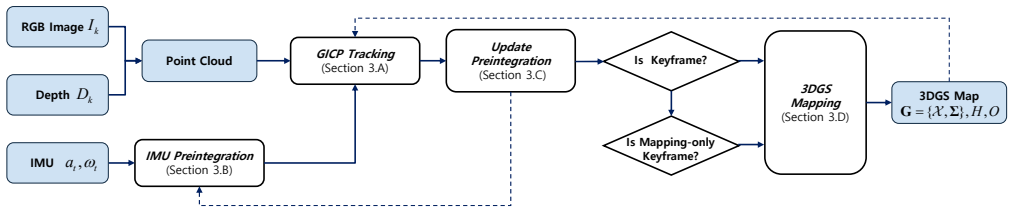
The load-bearing object is the IMU preintegration triplet $(\alpha^k_{k+1}, \beta^k_{k+1}, \gamma^k_{k+1})$ of Eqs. (10)–(12), which summarizes all IMU measurements between two RGB-D frames into a relative motion. That relative motion is transformed into camera coordinates and composed with the previous pose to give GICP's starting transformation (Eqs. (13)–(14)). Under the GICP framework, each point is modeled as a Gaussian with covariance from k-nearest neighbors, and the matching cost weighs correspondences by those covariances (Eqs. (1)–(4)); starting close to the optimum is what prevents the nearest-neighbor search from snapping to a wrong surface. After tracking, the optimized pose is fed back to reset the preintegration state (Eq. (16)), keeping the inertial prior from drifting over the run.
What would settle it
Run VIGS on an uHumansV1 sequence with the IMU signals replaced by a constant-velocity prior while keeping the Eq. (16) update; if the ATE remains near 35.35 cm on Humans12 the inertial prior is not the cause, whereas degradation toward the 677.87 cm GS-ICP baseline would confirm the paper's mechanism.
Extended reading notes
Core claim
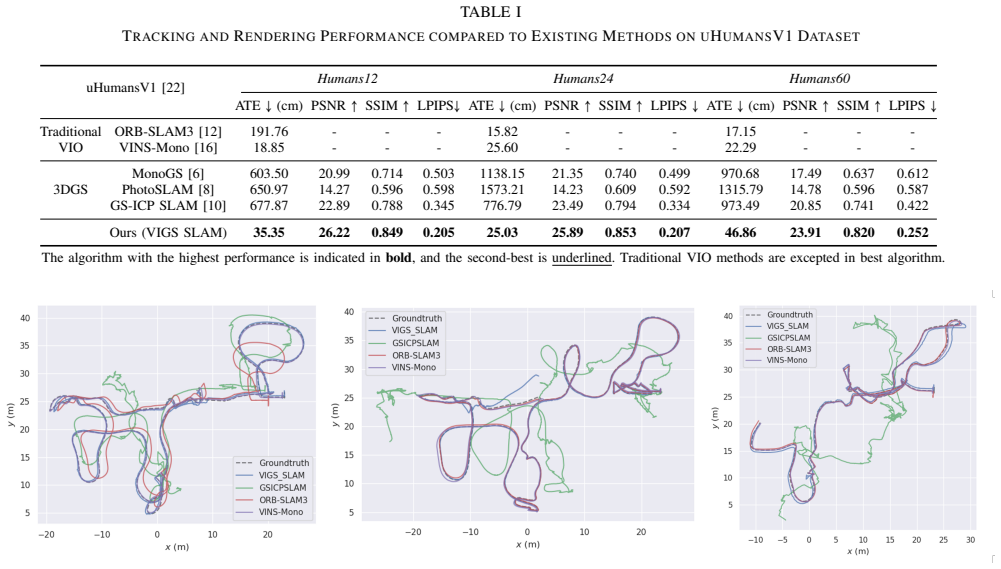
VIGS SLAM claims that replacing the default initialization of GICP tracking with IMU preintegration is sufficient to make 3DGS SLAM accurate and scalable in large indoor environments. The relative transformation from IMU preintegration, converted to camera coordinates via the extrinsic $T^C_I$, seeds the correspondence search at each frame; only after GICP converges are the IMU position, velocity, and rotation reset to the optimized values (Eq. (16)). With this mechanism, VIGS is reported to outperform the GS-ICP SLAM baseline by a large margin—ATE 35.35 cm vs 677.87 cm on uHumansV1 Humans12, 25.03 cm vs 776.79 cm on Humans24, and 46.86 cm vs 973.49 cm on Humans60—and to approach VINS-Mono's trajectory accuracy while additionally producing a photorealistic 3DGS map with better PSNR, SSIM, and LPIPS than prior 3DGS SLAM systems. On the uHumansV2 office scene, ATE drops from 674.38 cm to 144.72 cm. The paper's explanation is that a good initial guess keeps GICP from converging to wrong point correspondences in low-overlap, dynamic scenes, and those correct poses are what let the Gaussian map render cleanly.
Load-bearing premise
The gain rests on the IMU preintegration between consecutive frames being an accurate enough initial guess for GICP to find correct correspondences in large, dynamic scenes; this in turn assumes the camera–IMU extrinsic is accurate and the un-reset accelerometer and gyroscope biases stay small over each preintegration interval.
Editorial extensions
If this is right
- 3DGS SLAM can shed its room-scale requirement: because GICP with an inertial prior tolerates much larger spacing between keyframes than photometric-loss tracking, the number of stored keyframes and memory use drop substantially.
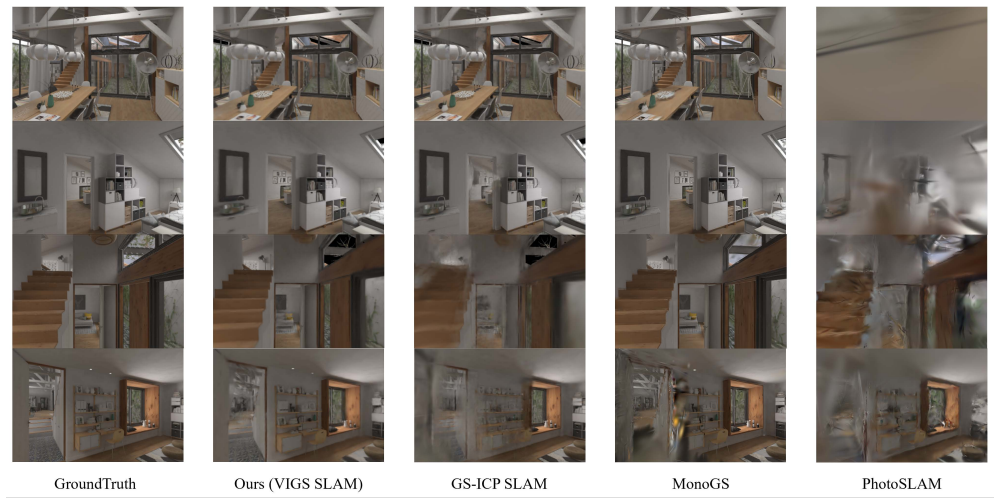
- Tracking accuracy becomes the gating factor for photorealistic mapping: once poses are accurate, the 3DGS renderer produces clean images, including correctly excluding moving humans from the reconstructed map.
- VIGS reaches trajectory accuracy comparable to traditional visual-inertial odometry (e.g., 35.35 cm vs VINS-Mono's 18.85 cm ATE on uHumansV1 Humans12) while also maintaining a photorealistic radiance-field map, shifting the usual accuracy-versus-realism tradeoff.
- The front-end gain is orthogonal to back-end improvements, so adding loop closure and a tightly-coupled visual-inertial optimization—listed as future work—should stack with this initial-guess mechanism rather than replace it.
Reading between the lines
- Editorial: the principle generalizes to any geometric tracker sensitive to its initialization—NDT, point-to-plane ICP, or feature-based odometry—so the core insight is not specific to Gaussian Splatting.
- Editorial: because Eq. (16) resets only pose and velocity, not the accelerometer and gyroscope biases, slow bias drift is the predicted long-term failure mode; bias re-estimation or a tightly-coupled formulation would be the natural next step to suppress low-speed drift.
- Editorial: a clean ablation would run VIGS with a constant-velocity initial guess instead of IMU preintegration on the same keyframe schedule; the ATE gap between that variant and VIGS would isolate how much of the improvement comes from the inertial prior itself.
- Editorial: perturbing the extrinsic calibration $T^C_I$ on the same datasets should produce a graceful ATE increase back toward the GS-ICP baseline, providing a direct sensitivity test of the paper's mechanism.
Editorial analysis
A structured set of objections, weighed in public.
Referee Report
Summary. The paper proposes VIGS SLAM, a 3D Gaussian Splatting SLAM system that fuses RGB-D and IMU measurements for large-scale indoor environments. The key idea is to use IMU preintegration between consecutive frames as the initial guess for GICP-based point-cloud tracking, which is claimed to prevent the tracking failures seen in GS-ICP SLAM in large, dynamic scenes. The mapping stage is a 3DGS back-end with photometric, SSIM, and depth losses. The experiments on uHumansV1 and uHumansV2 report ATE reductions from hundreds of centimeters to tens of centimeters compared with GS-ICP SLAM, with improved rendering metrics, and the authors claim parity with classical visual-inertial odometry and superiority over existing 3DGS SLAM methods.
Significance. If the claims hold, the paper offers a simple and potentially practical insight: a good IMU-preintegrated initial guess can stabilize GICP-based tracking for 3DGS SLAM in large dynamic environments, reducing ATE by an order of magnitude relative to GS-ICP SLAM on uHumansV1 while also improving rendering metrics. The use of external datasets and comparison with standard classical and 3DGS baselines is a strength, and the proposed mechanism is falsifiable in principle. However, the significance is currently tempered by the absence of an ablation separating the IMU contribution from other changes, the lack of comparison to the most closely related visual-inertial 3DGS baseline (MM3DGS), and equation-level inconsistencies in the preintegration derivation that make the mechanism not yet fully verified.
major comments (4)
- [Section III-B, Eqs. (5)-(12)] The preintegration definition is inconsistent with the kinematic model. Eq. (5) states that the accelerometer measurement is a_hat = a + wR wg + b_a + n_a, so Eq. (7) correctly subtracts the gravity term wR wg. However, the preintegrated terms alpha and beta in Eqs. (10)-(11) use only (a_hat - b_a) and drop the gravity term. If these preintegrated values are then used in Eqs. (13)-(14) to form the relative pose initial guess, a gravity-induced error that grows quadratically with the interval is introduced. Either the gravity term must appear in the relative pose formula (as in the standard preintegration model, e.g., Delta p = 1/2 g Delta t^2 + R_i alpha), or the notation must be clarified to show that the gravity contribution is handled separately.
- [Section III-C, Eq. (16)] The update step resets position, rotation, and velocity but never estimates or resets the accelerometer and gyroscope biases b_a and b_g. Since the preintegrated measurements in Eqs. (10)-(12) depend on these biases, a frozen or zero bias assumption is required; the paper neither states this assumption nor demonstrates its validity on long intervals. This matters because the central claim is that the IMU preintegration provides an accurate initial guess for GICP. Please either add bias estimation or provide evidence that the intervals are short enough for bias drift to be negligible, and report sensitivity to the extrinsic parameter C_I T.
- [Section IV and Tables I-III] The evaluation does not yet support the load-bearing claim that the IMU preintegration, rather than other implementation changes, causes the improvement. There is no comparison to MM3DGS [9], which is the closest visual-inertial 3DGS method; there is no ablation that runs GS-ICP SLAM with VIGS's mapping and keyframe settings but without the IMU initial guess; and the reported ATE and PSNR values are single runs with no error bars or repeated-trial statistics. An ablation separating the IMU contribution is necessary to validate the mechanism described in Section III-A.
- [Section III-A, Eq. (4)] The optimization objective is written with the wrong sign. For Gaussian distributions, log p(d_m) is proportional to -1/2 d_m^T (Sigma_tgt + T Sigma_src T^T)^-1 d_m plus a constant, so maximizing the sum of d_m^T Sigma^-1 d_m is not equivalent to maximum likelihood; the correct formulation is an argmin over the Mahalanobis distances. This technical error in the derivation should be corrected.
minor comments (6)
- [Abstract and Introduction] The claim that the method is 'the first to propose that Gaussian Splatting-based SLAM can be effectively performed in large-scale environments by integrating IMU sensor measurements' conflicts with the existence of MM3DGS [9], which is cited but not discussed in the introduction; please temper the novelty claim.
- [Section III-B, Eqs. (5)-(6)] Equations (5) and (6) are labeled as 'corrected' measurements but include bias and noise terms; rename them as raw measurement models or clarify the wording.
- [Section III-B, notation] The rotation notation is ambiguous: wR, R_k^t, and the rotation in Eq. (13) are not all defined consistently. Please define the world frame, the IMU body frame, and the camera frame explicitly, and state which rotation transforms between which frames.
- [Fig. 2 and Section III-D] The framework diagram includes 'Is Keyframe?' and 'Is Mapping-only Keyframe?' branches, but the criteria for keyframe selection are never given in the text; please add the keyframe selection rule.
- [Section III-D, Eq. (17)] The Gaussian definition in Eq. (17) omits the normalization constant; while this may be intentional for rendering, the mathematical expression as written is not a proper probability density, so please add a note or the constant.
- [Throughout] There are many typographical and language errors ('breifly', 'intial', 'vy provinding', 'tracnsformation', 'higer', 'meausrements', 'significanty', and others); a careful proofread is needed.
Circularity Check
No significant circularity: VIGS SLAM's IMU-initialized GICP tracking is validated on external datasets against independent baselines, with no fitted quantity renamed as a prediction.
full rationale
The paper's central claim is that an IMU-preintegration initial guess improves GICP tracking in large-scale 3DGS SLAM. The derivation chain is self-contained: the IMU preintegration model (Eqs. 5-12) follows standard formulations from Forster et al. and VINS-Mono, the GICP objective (Eqs. 1-4) is the textbook maximum-likelihood point-cloud registration, and the mapping loss (Eq. 20) is the same photometric/SSIM/depth loss used by prior 3DGS SLAM. The reported ATE/PSNR improvements over MonoGS, PhotoSLAM, and GS-ICP SLAM are measured on the external uHumansV1/V2 datasets; no parameter is fitted to those benchmark values, and the IMU initial guess does not by construction determine the GICP output. There are no load-bearing self-citations: the only heavily used prior work, GS-ICP SLAM [10], is an independent baseline, and the IMU formulation is cited to prior external work. The equations in Section III-B contain an apparent inconsistency with the measurement model in Eqs. (5)-(6) regarding the gravity term and bias handling; however, that is a correctness or reproducibility risk, not a circularity, because it does not make any predicted quantity equal to an input by definition. Overall, no circular step can be exhibited, so the circularity score is 0.
Assumptions & free parameters
free parameters (3)
- Mapping loss weights lambda_I and lambda_D =
not given
- GICP registration parameters (voxel size, correspondence distance, iterations) =
not given
- Keyframe selection criterion =
not given
assumptions (6)
- standard math GICP probabilistic point cloud registration model from Koide et al. [21]
- standard math IMU measurement model with additive biases and noise, and the kinematic model from Forster et al. [18] and Qin et al. [16]
- domain assumption Known, accurate extrinsic calibration C_I T between IMU and camera
- domain assumption IMU biases are available or negligible and are not estimated online
- domain assumption Depth images are metric and aligned with RGB, and point clouds mostly represent static structure despite moving people
- standard math 3DGS rendering model and losses from Kerbl et al. [2] and scale normalization from GS-ICP SLAM [10] are used without modification
Cite this review
Pith. "Pith review of VIGS SLAM: IMU-based Large-Scale 3D Gaussian Splatting SLAM." pith.science (2026). https://pith.science/paper/JK6H35W4
@misc{pith2026250113402,
  author       = {Pith},
  title        = {Pith review of: VIGS SLAM: IMU-based Large-Scale 3D Gaussian Splatting SLAM},
  year         = {2026},
  howpublished = {\url{https://pith.science/paper/JK6H35W4}},
  note         = {Machine review of arXiv:2501.13402}
}
read the original abstract
Recently, map representations based on radiance fields such as 3D Gaussian Splatting and NeRF, which excellent for realistic depiction, have attracted considerable attention, leading to attempts to combine them with SLAM. While these approaches can build highly realistic maps, large-scale SLAM still remains a challenge because they require a large number of Gaussian images for mapping and adjacent images as keyframes for tracking. We propose a novel 3D Gaussian Splatting SLAM method, VIGS SLAM, that utilizes sensor fusion of RGB-D and IMU sensors for large-scale indoor environments. To reduce the computational load of 3DGS-based tracking, we adopt an ICP-based tracking framework that combines IMU preintegration to provide a good initial guess for accurate pose estimation. Our proposed method is the first to propose that Gaussian Splatting-based SLAM can be effectively performed in large-scale environments by integrating IMU sensor measurements. This proposal not only enhances the performance of Gaussian Splatting SLAM beyond room-scale scenarios but also achieves SLAM performance comparable to state-of-the-art methods in large-scale indoor environments.
Figures

Figures from the paper (2 more)
Forward citations
Cited by 1 Pith paper
-
LongSplat: Online Generalizable 3D Gaussian Splatting from Long Sequence Images
A feed-forward 3D Gaussian Splatting pipeline that incrementally fuses and compresses historical Gaussians using a 2D image-like representation.
Reference graph
Works this paper leans on
-
[9]
L. C. Sun, N. P. Bhatt, J. C. Liu, Z. Fan, Z. Wang, T. E. Humphreys, and U. Topcu, “Mm3dgs slam: Multi-modal 3d gaussian splatting for slam using vision, depth, and inertial measurements,” arXiv preprint arXiv:2404.00923, 2024
work page Pith review arXiv 2024
-
[1]
Nerf: Representing scenes as neural radiance fields for view synthesis,
B. Mildenhall, P. P. Srinivasan, M. Tancik, J. T. Barron, R. Ramamoor- thi, and R. Ng, “Nerf: Representing scenes as neural radiance fields for view synthesis,” Communications of the ACM , vol. 65, no. 1, pp. 99–106, 2021
2021
-
[2]
3d gaussian splatting for real-time radiance field rendering
B. Kerbl, G. Kopanas, T. Leimk ¨uhler, and G. Drettakis, “3d gaussian splatting for real-time radiance field rendering.” ACM Trans. Graph., vol. 42, no. 4, pp. 139–1, 2023
2023
-
[3]
Nerf-slam: Real-time dense monocular slam with neural radiance fields,
A. Rosinol, J. J. Leonard, and L. Carlone, “Nerf-slam: Real-time dense monocular slam with neural radiance fields,” in 2023 IEEE/RSJ International Conference on Intelligent Robots and Systems (IROS) . IEEE, 2023, pp. 3437–3444
2023
-
[4]
Eslam: Efficient dense slam system based on hybrid representation of signed distance fields,
M. M. Johari, C. Carta, and F. Fleuret, “Eslam: Efficient dense slam system based on hybrid representation of signed distance fields,” in Proceedings of the IEEE/CVF Conference on Computer Vision and Pattern Recognition, 2023, pp. 17 408–17 419
2023
-
[5]
Splatam: Splat track & map 3d gaussians for dense rgb-d slam,
N. Keetha, J. Karhade, K. M. Jatavallabhula, G. Yang, S. Scherer, D. Ramanan, and J. Luiten, “Splatam: Splat track & map 3d gaussians for dense rgb-d slam,” in Proceedings of the IEEE/CVF Conference on Computer Vision and Pattern Recognition , 2024, pp. 21 357–21 366
2024
-
[6]
Gaussian splatting slam,
H. Matsuki, R. Murai, P. H. Kelly, and A. J. Davison, “Gaussian splatting slam,” in Proceedings of the IEEE/CVF Conference on Computer Vision and Pattern Recognition , 2024, pp. 18 039–18 048
2024
-
[7]
Gs- slam: Dense visual slam with 3d gaussian splatting,
C. Yan, D. Qu, D. Xu, B. Zhao, Z. Wang, D. Wang, and X. Li, “Gs- slam: Dense visual slam with 3d gaussian splatting,” in Proceedings of the IEEE/CVF Conference on Computer Vision and Pattern Recog- nition, 2024, pp. 19 595–19 604
2024
Show all 24 references
-
[8]
Photo-slam: Real-time simultaneous localization and photorealistic mapping for monocular stereo and rgb-d cameras,
H. Huang, L. Li, H. Cheng, and S.-K. Yeung, “Photo-slam: Real-time simultaneous localization and photorealistic mapping for monocular stereo and rgb-d cameras,” in Proceedings of the IEEE/CVF Confer- ence on Computer Vision and Pattern Recognition , 2024, pp. 21 584– 21 593
2024
-
[10]
Rgbd gs-icp slam,
S. Ha, J. Yeon, and H. Yu, “Rgbd gs-icp slam,” arXiv preprint arXiv:2403.12550, 2024
2024 arXiv
-
[11]
Robust real-time visual odometry for dense rgb-d mapping,
T. Whelan, H. Johannsson, M. Kaess, J. J. Leonard, and J. McDonald, “Robust real-time visual odometry for dense rgb-d mapping,” in 2013 IEEE International Conference on Robotics and Automation . IEEE, 2013, pp. 5724–5731
2013
-
[12]
Orb-slam2: An open-source slam system for monocular, stereo, and rgb-d cameras,
R. Mur-Artal and J. D. Tard ´os, “Orb-slam2: An open-source slam system for monocular, stereo, and rgb-d cameras,” IEEE transactions on robotics, vol. 33, no. 5, pp. 1255–1262, 2017
2017
-
[13]
Liv-gaussmap: Lidar-inertial-visual fusion for real-time 3d radiance field map render- ing,
S. Hong, J. He, X. Zheng, C. Zheng, and S. Shen, “Liv-gaussmap: Lidar-inertial-visual fusion for real-time 3d radiance field map render- ing,” IEEE Robotics and Automation Letters , 2024
2024
-
[14]
Lvi-sam: Tightly-coupled lidar-visual-inertial odometry via smoothing and mapping,
T. Shan, B. Englot, C. Ratti, and D. Rus, “Lvi-sam: Tightly-coupled lidar-visual-inertial odometry via smoothing and mapping,” in 2021 IEEE international conference on robotics and automation (ICRA) . IEEE, 2021, pp. 5692–5698
2021
-
[15]
Gaussian-lic: Photo-realistic lidar-inertial-camera slam with 3d gaussian splatting,
X. Lang, L. Li, H. Zhang, F. Xiong, M. Xu, Y . Liu, X. Zuo, and J. Lv, “Gaussian-lic: Photo-realistic lidar-inertial-camera slam with 3d gaussian splatting,” arXiv preprint arXiv:2404.06926 , 2024
2024 arXiv
-
[16]
Vins-mono: A robust and versatile monoc- ular visual-inertial state estimator,
T. Qin, P. Li, and S. Shen, “Vins-mono: A robust and versatile monoc- ular visual-inertial state estimator,” IEEE transactions on robotics , vol. 34, no. 4, pp. 1004–1020, 2018
2018
-
[17]
Openvins: A research platform for visual-inertial estimation,
P. Geneva, K. Eckenhoff, W. Lee, Y . Yang, and G. Huang, “Openvins: A research platform for visual-inertial estimation,” in 2020 IEEE International Conference on Robotics and Automation (ICRA). IEEE, 2020, pp. 4666–4672
2020
-
[18]
Imu preinte- gration on manifold for efficient visual-inertial maximum-a-posteriori estimation,
C. Forster, L. Carlone, F. Dellaert, and D. Scaramuzza, “Imu preinte- gration on manifold for efficient visual-inertial maximum-a-posteriori estimation,” in Robotics: Science and Systems XI , 2015
2015
-
[19]
Kimera: from SLAM to spatial perception with 3D dynamic scene graphs,
A. Rosinol, A. Violette, M. Abate, N. Hughes, Y . Chang, J. Shi, A. Gupta, and L. Carlone, “Kimera: from SLAM to spatial perception with 3D dynamic scene graphs,” Intl. J. of Robotics Research, vol. 40, no. 12–14, pp. 1510–1546, 2021, arXiv preprint: 2101.06894, PDF
2021 arXiv
-
[20]
Orb-slam3: An accurate open-source library for visual, visual–inertial, and multimap slam,
C. Campos, R. Elvira, J. J. G. Rodr ´ıguez, J. M. Montiel, and J. D. Tard ´os, “Orb-slam3: An accurate open-source library for visual, visual–inertial, and multimap slam,” IEEE Transactions on Robotics , vol. 37, no. 6, pp. 1874–1890, 2021
2021
-
[21]
V oxelized gicp for fast and accurate 3d point cloud registration,
K. Koide, M. Yokozuka, S. Oishi, and A. Banno, “V oxelized gicp for fast and accurate 3d point cloud registration,” in 2021 IEEE International Conference on Robotics and Automation (ICRA). IEEE, 2021, pp. 11 054–11 059
2021
-
[22]
3d dynamic scene graphs: Actionable spatial perception with places, objects, and humans,
A. Rosinol, A. Gupta, M. Abate, J. Shi, and L. Carlone, “3d dynamic scene graphs: Actionable spatial perception with places, objects, and humans,” arXiv preprint arXiv:2002.06289 , 2020
2002 arXiv
-
[23]
evo: Python package for the evaluation of odometry and slam
M. Grupp, “evo: Python package for the evaluation of odometry and slam.” https://github.com/MichaelGrupp/evo, 2017
2017
-
[24]
PyPose: A library for robot learning with physics-based optimization,
C. Wang, D. Gao, K. Xu, J. Geng, Y . Hu, Y . Qiu, B. Li, F. Yang, B. Moon, A. Pandey, Aryan, J. Xu, T. Wu, H. He, D. Huang, Z. Ren, S. Zhao, T. Fu, P. Reddy, X. Lin, W. Wang, J. Shi, R. Talak, K. Cao, Y . Du, H. Wang, H. Yu, S. Wang, S. Chen, A. Kashyap, R. Bandaru, K. Dantu, ...
2023
Reviewed August 10, 2026 · model on record in the stance chip above.
Discussion (0). Continue with ORCID to comment.