REVIEW 4 major objections 4 minor 20 references
Adaptive Few-Shot Learning (AFSL): Tackling Data Scarcity with Stability, Robustness, and Versatility
T0 review · 4 major / 4 minor · reviewed 2026-08-10 · deepseek-v4-flash
Pith's one-line read The paper proposes a modular framework, AFSL, that tackles four main failure modes of few-shot learning—initialization instability, domain shift, label noise, and single-modality data—with four dedicated mechanisms.
desk verdict A clearly written concept sketch with no algorithm, equations, experiments, or code; the claimed 'benchmark' is unsupported and the framework is largely defined by the outcomes it claims to achieve. read the letter →
The pith
A machine-rendered reading of the paper's core claim, the machinery that carries it, and where it could break.
The reading
What carries the argument
The machinery is the four-module pipeline and its integration order: group tasks by complexity, stabilize initialization, align domains, filter noise, then fuse modalities. The named mechanisms are dynamic ensemble optimization, adversarial alignment with hierarchical feature alignment and contrastive domain embeddings, noise-aware attention networks with a dual-loss consistency regularization, and cross-attention transformers over shared embedding spaces. The paper's argument works by decomposing the problem so each module can specialize while contributing to the same end-to-end framework.
What would settle it
Implement the four-module AFSL pipeline on a standard few-shot image benchmark such as miniImageNet, in five-way one-shot mode, and compare mean accuracy and seed-to-seed variance against MAML, Prototypical Networks, and a simple ensemble of the four named components; AFSL's central claim fails if it does not beat those baselines on clean and artificially noisy labeled sets.
Extended reading notes
Core claim
The core claim is that the four failure modes of FSL are separable and jointly addressable. AFSL's Dynamic Stability Module selects and weights meta-models according to task embeddings, reducing sensitivity to random initialization and sampling. The Contextual Domain Alignment Module uses adversarial learning and hierarchical feature alignment to bring source and target distributions together while keeping domain-specific information separable. The Noise-Adaptive Resilience Module re-weights training samples by estimated reliability and adds a consistency-based dual loss. The Multi-Modal Fusion Module aligns images, text, and audio through cross-attention in shared embedding spaces. The intended result is a single framework that is stable, robust to noise, adaptable across domains, and multimodal.
Load-bearing premise
The claim rests on the assumption that the four modules can be concretely implemented as described and combined without harmful interactions, yet the paper gives no pseudocode, architecture details, hyperparameters, or experimental results to show that this premise holds.
Editorial extensions
If this is right
- If AFSL works as described, few-shot models can be re-run with different random seeds or task samplings without large swings in accuracy.
- Domain-aligned FSL would generalize to new hospitals, new populations, or new robotic environments where the training and deployment data distributions differ.
- Attention-weighted noise filtering would let models train on real-world datasets with mislabeled or outlier examples instead of requiring expensive manual cleaning.
- Multi-modal fusion would allow textual descriptions or audio to supply context for vision-only few-shot tasks, expanding the range of usable signals.
- A modular design permits domain-specific customization: swapping or retuning one module for healthcare, robotics, or low-resource language processing.
Reading between the lines
- Inference beyond the paper: the framework's success depends on module interactions, not just individual module performance; an obvious test is to ablate each module while holding the others fixed.
- Inference: domain alignment and noise filtering may conflict, since mislabeled examples can distort learned domain alignments; the order of pipeline steps could be as important as the modules themselves.
- Inference: because the paper names known ingredients (meta-learning, adversarial alignment, attentive noise weighting, cross-attention), a concrete baseline could be assembled from existing methods and tested immediately without waiting for new theory.
- Inference: the author places explainability in future work, but the claimed high-stakes applications (medical diagnosis, finance, autonomous driving) generally require transparency before deployment, so explainability may be a precondition for the impact claim rather than a later add-on.
Editorial analysis
A structured set of objections, weighed in public.
Referee Report
Summary. The paper proposes Adaptive Few-Shot Learning (AFSL), a modular framework comprising a Dynamic Stability Module, a Contextual Domain Alignment Module, a Noise-Adaptive Resilience Module, and a Multi-Modal Fusion Module. The manuscript argues that existing few-shot learning suffers from initialization sensitivity, domain shift, and label noise, and claims that AFSL integrates meta-learning, domain alignment, noise resilience, and multi-modal learning to address these challenges and 'set a new benchmark' for few-shot learning. The paper contains no experimental evaluation, no formal derivations, no pseudocode, no datasets, and no code; Sections 3 describes modules only at a conceptual level, Section 4 surveys existing strategies, Section 5 lists potential applications, and Section 6 outlines future directions.
Significance. The paper correctly identifies real and timely limitations of current few-shot learning methods and provides a reasonable high-level survey of related literature, which gives the manuscript some expository value. However, the central contribution, AFSL, is not concretely specified or evaluated. There is no machinery by which the claimed stability, robustness, versatility, or benchmark-setting performance could be verified: no objective functions, update rules, architecture definitions, hyperparameters, training procedures, experiments, baselines, or reproducibility artifacts are provided. The claimed advances are therefore assertions rather than results. The paper may be useful as a brief position statement if substantially rewritten, but in its current form it does not constitute a research contribution to a serious journal.
major comments (4)
- [Section 1] The paper's central claim that AFSL 'sets a new benchmark for Few-Shot Learning' and 'demonstrates its capability to deliver scalable, reliable, and impactful solutions' is completely unsupported by evidence. No experimental section, dataset, baseline, evaluation metric, or comparison with existing methods appears anywhere in the manuscript. Sections 4-6 are a survey of prior strategies, a list of applications, and future-work suggestions, not empirical validation. This is a load-bearing gap because the abstract and introduction present AFSL as a demonstrated framework rather than a proposal.
- [Sections 3.1-3.4] The four AFSL modules are specified only by named mechanisms ('dynamic ensemble optimization', 'hierarchical adversarial alignment', 'attention-guided noise filtering', 'cross-attention transformers') and by the outcomes they are said to achieve. No equations, loss functions, update rules, architectural specifics, or algorithmic procedures are provided. Consequently, the framework is not reproducible and cannot be tested, so the claimed advantages of stability, domain alignment, noise resilience, and multimodal fusion are not verifiable from the manuscript.
- [Section 3] There is a circularity in the presentation: each module is defined in terms of the property it is supposed to deliver. For instance, the Noise-Adaptive Resilience Module 'mitigates noise effects' because Noise-Aware Attention Networks 'filter out' noisy samples, and the Dynamic Stability Module 'ensures consistent performance' because it uses 'dynamic ensemble optimization'. The conclusion that AFSL provides stability, robustness, and versatility therefore restates the module definitions rather than following from any measured behavior. A concrete test, such as evaluating a specified instantiation on noisy or domain-shifted few-shot benchmarks, would be needed to break this circularity, but no such test is reported.
- [Sections 3.1 and 4.1] The claimed improvement in stability over existing meta-learning methods is not supported by any variance analysis, ablation, or comparison with established approaches like MAML, Reptile, or Prototypical Networks. The manuscript asserts that task-aware dynamic embeddings and ensemble weighting reduce sensitivity to initialization and sampling, but it provides no formal argument or empirical evidence. This claim is testable in principle, but the manuscript supplies no test.
minor comments (4)
- [Throughout] There are several typographical errors, including 'F usion' in the Introduction and Section 6.6, which should read 'Fusion'. The manuscript would benefit from a careful proofreading pass.
- [Section 4.2 and 4.3] The text refers to 'studies in 2024' and 'as explored in 2023' without providing citations or specifics. These claims should either be removed or supported with proper references.
- [Figures] Figures 1-4 are captioned in the text (e.g., 'Figure 1: Comparison of Few-Shot Learning Techniques across Key Dimensions') but no actual figure content appears in the manuscript. The figures appear to be placeholder descriptions, and no data or illustration is provided to back the captions.
- [References] Several references are incomplete or inconsistently formatted. For example, reference [4] lacks a DOI or URL, reference [10] contains an ellipsis in the author list that may be a formatting artifact, and reference [18] does not include the full publication venue details. These should be corrected for consistency.
Circularity Check
AFSL's central benchmark claim is definitional: each module is named and described by the exact property the conclusion says AFSL achieves, with no independent derivation or evaluation.
-
self definitional
[Section 3, 'Advantages of AFSL'; supported by Sections 3.1 and 3.3]
"By addressing the challenges of stability, domain alignment, noise resilience, and multi-modal learning, AFSL sets a new benchmark for Few-Shot Learning, paving the way for scalable, reliable applications across diverse fields. ... The Dynamic Stability Module mitigates this issue ... ensuring reproducible and stable results across diverse tasks. ... This module utilizes attention-guided noise filtering ... to mitigate noise effects."
The conclusion that AFSL 'sets a new benchmark' is supported only by the module descriptions, and those descriptions build the target property into the module's name and purpose: the Dynamic Stability Module exists to deliver stability, and the Noise-Adaptive Resilience Module exists to mitigate noise. No objective function, update rule, architecture, dataset, baseline, or evaluation is provided that measures stability, domain alignment, noise resilience, or fusion independently. Thus the claimed achievements are restatements of the module definitions rather than derived results. The framework is described exclusively by the outcomes it is said to produce, so the central claim reduces by construction to 'the modules address what the modules are defined to address.'
full rationale
This paper contains no equations, no fitted parameters, no experiments, and no external benchmark against which AFSL is evaluated. The derivation chain in Section 3 is therefore not an empirical or mathematical chain at all: the four modules are specified by their intended effects, and the conclusion that AFSL achieves stability, robustness, and versatility is read directly back from those module names and one-sentence purpose statements. For example, the Dynamic Stability Module 'ensures reproducible and stable results' and the Noise-Adaptive Resilience Module 'mitigates noise effects,' and then the paper concludes that 'by addressing the challenges of stability, domain alignment, noise resilience, and multi-modal learning, AFSL sets a new benchmark.' This is a self-definitional structure: the success predicate is installed in the module's definition, so the claimed benchmark is not a prediction or a derived outcome but a restatement of the input design. The absence of experiments or baselines makes the claim unfalsifiable as written, but the circularity is more specific than mere lack of evidence: the only 'support' for the central claim is the naming and intended-purpose description of the modules themselves. I therefore assign a score of 7, reflecting that the central claim reduces by construction to its own definitions, while noting that this is not a fitted-parameter circularity because the paper reports no parameters at all.
Assumptions & free parameters
assumptions (3)
- domain assumption The four modules can be implemented as described and integrated without adverse interactions.
- domain assumption Established FSL, domain adaptation, and noise-robustness techniques retain their benefits when combined in the proposed modular framework.
- domain assumption The qualitative benefits described for each module translate into quantitative gains on the claimed applications.
invented entities (5)
-
Dynamic Stability Module
-
Contextual Domain Alignment Module
-
Noise-Adaptive Resilience Module
-
Multi-Modal Fusion Module
-
Noise-Aware Attention Networks (NANets)
Cite this review
Pith. "Pith review of Adaptive Few-Shot Learning (AFSL): Tackling Data Scarcity with Stability, Robustness, and Versatility." pith.science (2026). https://pith.science/paper/DEVMFYWO
@misc{pith2026250113479,
  author       = {Pith},
  title        = {Pith review of: Adaptive Few-Shot Learning (AFSL): Tackling Data Scarcity with Stability, Robustness, and Versatility},
  year         = {2026},
  howpublished = {\url{https://pith.science/paper/DEVMFYWO}},
  note         = {Machine review of arXiv:2501.13479}
}
read the original abstract
Few-shot learning (FSL) enables machine learning models to generalize effectively with minimal labeled data, making it crucial for data-scarce domains such as healthcare, robotics, and natural language processing. Despite its potential, FSL faces challenges including sensitivity to initialization, difficulty in adapting to diverse domains, and vulnerability to noisy datasets. To address these issues, this paper introduces Adaptive Few-Shot Learning (AFSL), a framework that integrates advancements in meta-learning, domain alignment, noise resilience, and multi-modal integration. AFSL consists of four key modules: a Dynamic Stability Module for performance consistency, a Contextual Domain Alignment Module for domain adaptation, a Noise-Adaptive Resilience Module for handling noisy data, and a Multi-Modal Fusion Module for integrating diverse modalities. This work also explores strategies such as task-aware data augmentation, semi-supervised learning, and explainable AI techniques to enhance the applicability and robustness of FSL. AFSL provides scalable, reliable, and impactful solutions for real-world, high-stakes domains.
Figures
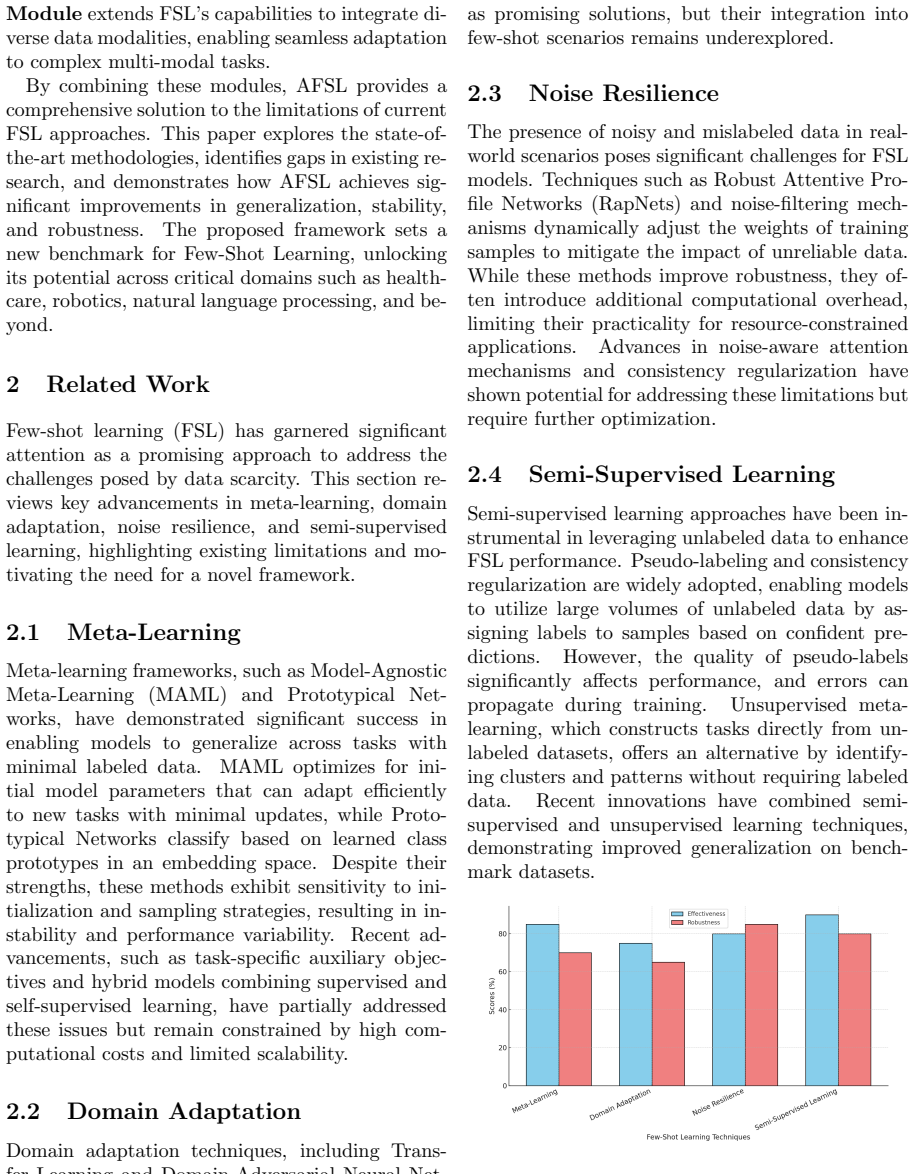


Figures from the paper (1 more)

Reference graph
Works this paper leans on
-
[1]
Wang, Y., Yao, Q., Kwok, J. T., & Ni, L. M. (2020). Generalizing from a Few Examples: A Survey on Few-Shot Learning. ACM Com- puting Surveys (CSUR), 53(3), 1-34. https: //doi.org/10.1145/3386252
doi:10.1145/3386252 2020
-
[2]
Finn, C., Abbeel, P., & Levine, S. (2017). Model-Agnostic Meta-Learning for Fast Adap- tation of Deep Networks. In Proceedings of the 34th International Conference on Machine Learning (ICML). https://arxiv.org/abs/ 1703.03400
arXiv 2017
-
[3]
Ganin, Y., & Lempitsky, V. (2015). Unsu- pervised Domain Adaptation by Backpropaga- tion. In Proceedings of the 32nd International Conference on Machine Learning (ICML) . https://arxiv.org/abs/1505.07818
arXiv 2015
-
[4]
Li, C., Zhu, X., & Ding, Z. (2021). Ro- bust Attentive Profile Networks for Few-Shot Learning with Noisy Labels. IEEE Transac- 7 tions on Neural Networks and Learning Sys- tems (TNNLS)
work page 2021
-
[5]
Zhang, H., Cisse, M., Dauphin, Y. N., & Lopez-Paz, D. (2018). Mixup: Beyond Empir- ical Risk Minimization. In International Con- ference on Learning Representations (ICLR). https://arxiv.org/abs/1710.09412
arXiv 2018
-
[6]
Vaswani, A., Shazeer, N., Parmar, N., Uszko- reit, J., Jones, L., Gomez, A. N., & Polo- sukhin, I. (2017). Attention Is All You Need. In Advances in Neural Information Process- ing Systems (NeurIPS). https://arxiv.org/ abs/1706.03762
arXiv 2017
-
[7]
Snell, J., Swersky, K., & Zemel, R. S. (2017). Prototypical Networks for Few-Shot Learning. In Advances in Neural Information Process- ing Systems (NeurIPS). https://arxiv.org/ abs/1703.05175
arXiv 2017
-
[8]
Berthelot, D., Carlini, N., Goodfellow, I., Pa- pernot, N., Oliver, A., & Raffel, C. (2019). MixMatch: A Holistic Approach to Semi- Supervised Learning. In Advances in Neural Information Processing Systems (NeurIPS) . https://arxiv.org/abs/1905.02249
arXiv 2019
Show all 20 references
-
[9]
T., Singh, S., & Guestrin, C
Ribeiro, M. T., Singh, S., & Guestrin, C. (2016). ”Why Should I Trust You?” Explain- ing the Predictions of Any Classifier. Pro- ceedings of the 22nd ACM SIGKDD Inter- national Conference on Knowledge Discovery and Data Mining (KDD) . https://arxiv. org/abs/1602.04938
2016 arXiv
-
[10]
L., Zhu, K., Yang, B., Mehta, H.,
Rajpurkar, P., Irvin, J., Ball, R. L., Zhu, K., Yang, B., Mehta, H., ... & Ng, A. Y. (2018). Deep Learning for Chest Radiograph Diagnosis: A Retrospective Comparison of the CheXNeXt Algorithm to Practicing Radiolo- gists. PLOS Medicine, 15(11). https://doi. org/10.1371/journal...
2018 doi
-
[11]
Finn, C., Yu, T., Zhang, T., Abbeel, P., & Levine, S. (2017). One-Shot Visual Imita- tion Learning via Meta-Learning. Conference on Robot Learning (CoRL). https://arxiv. org/abs/1709.04905
2017 arXiv
-
[12]
L., Kaack, L
Rolnick, D., Donti, P. L., Kaack, L. H., Kochanski, K., Lacoste, A., Sankaran, K., ... & Bengio, Y. (2019). Tackling Climate Change with Machine Learning. arXiv preprint . https://arxiv.org/abs/1906.05433
2019 arXiv
-
[13]
Sun, Q., Liu, Y., Zhou, Q., & Bao, H. (2021). Few-Shot Learning with Transformer-Based Architectures. Neural Networks, 144, 123-135
2021
-
[14]
D., Dhariwal, P.,
Brown, T., Mann, B., Ryder, N., Subbiah, M., Kaplan, J. D., Dhariwal, P., ... & Amodei, D. (2020). Language Models are Few-Shot Learn- ers. In Advances in Neural Information Pro- cessing Systems (NeurIPS). https://arxiv. org/abs/2005.14165
2020 arXiv
-
[15]
Nichol, A., Achiam, J., & Schulman, J. (2018). On First-Order Meta-Learning Algo- rithms. arXiv preprint. https://arxiv.org/ abs/1803.02999
2018 arXiv
-
[16]
H., & Hospedales, T
Sung, F., Yang, Y., Zhang, L., Xiang, T., Torr, P. H., & Hospedales, T. M. (2018). Learn- ing to Compare: Relation Network for Few- Shot Learning. In Proceedings of the IEEE Conference on Computer Vision and Pat- tern Recognition (CVPR). https://arxiv. org/abs/1711.06025
2018 arXiv
-
[17]
Antoniou, A., Edwards, H., & Storkey, A. (2018). Data Augmentation Generative Ad- versarial Networks. arXiv preprint. https:// arxiv.org/abs/1711.04340
2018 arXiv
-
[18]
Li, Z., Zhou, F., Chen, F., & Li, H. (2019). Episodic Memory-Based Meta-Learning for Few-Shot Image Recognition. InProceedings of the IEEE International Conference on Com- puter Vision (ICCV)
2019
-
[19]
& Bengio, Y
Triantafillou, E., Zhu, T., Dumoulin, V., Lam- blin, P., Evci, U., Xu, K., ... & Bengio, Y. (2020). Meta-Dataset: A Dataset of Datasets for Learning to Learn from Few Examples. In Proceedings of the 8th International Confer- ence on Learning Representations (ICLR)
2020
-
[20]
Hu, X., Zheng, Y., & Song, D. (2021). Meta- Augmentation: Few-Shot Learning with Aux- iliary Augmentations. In Advances in Neural Information Processing Systems (NeurIPS) . https://arxiv.org/abs/2106.07955. 8
2021 arXiv
Reviewed August 10, 2026 · model on record in the stance chip above.
Discussion (0). Continue with ORCID to comment.