REVIEW 5 major objections 5 minor 54 references
A Fast, Scalable, and Robust Deep Learning-based Iterative Reconstruction Framework for Accelerated Industrial Cone-beam X-ray Computed Tomography
T0 review · 5 major / 5 minor · reviewed 2026-08-10 · deepseek-v4-flash
Pith's one-line read An iterative algorithm alternating an artifact-removal CNN with a conjugate-gradient data-consistency step reconstructs dense-metal cone-beam XCT volumes from sparse, low-dose scans in a few iterations and generalizes to unseen…
desk verdict A practical PnP/adaptive-beta framework with real runtime gains, but the headline outperformance is reference-dependent and needs a fix before the claim is solid. read the letter →
The pith
A machine-rendered reading of the paper's core claim, the machinery that carries it, and where it could break.
The reading
What carries the argument
The central object is the alternating loop of Algorithm 1: a pre-trained artifact-removal CNN $D_\theta$ takes the current iterate $x_{k-1}$ and outputs $z_k$; a regularization-selection subroutine reconstructs a few center slices for 14 candidate $\beta$ values on a geometric progression and chooses the one with the lowest BRISQUE score; and ten conjugate-gradient iterations solve the quadratic data-consistency subproblem $(A^\top A + \beta_k I)x = A^\top y + \beta_k z_k$. The CNN is a 2D residual U-Net trained on paired 256-by-256 patches extracted from sparse-view FDK reconstructions and dense-view MBIR volumes, which keeps training memory independent of volume size.
What would settle it
Take a sparse-view scan with a known reference volume, run Algorithm 1 for K=4 outer iterations, and record PSNR and SSIM of each iterate against the reference; if the metrics do not improve from iteration 1 to 4, or if $D_\theta(x_{k-1})$ has higher error on the intermediate iterates than on the FDK initialization, the CNN-as-proximal assumption is not holding.
Extended reading notes
Core claim
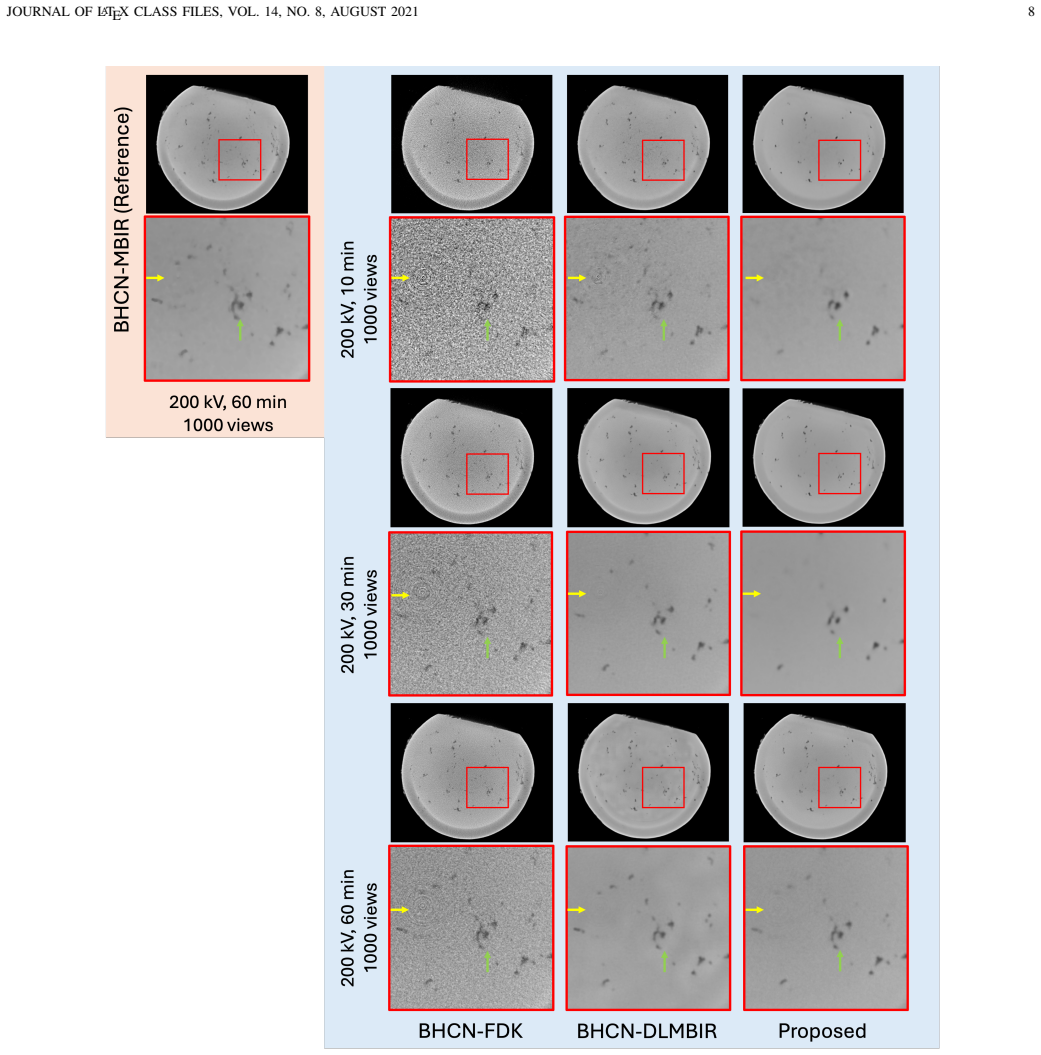
The paper's central claim is that a CNN trained only to remove artifacts from FDK reconstructions can act as the prior inside an iterative reconstruction loop, provided the regularization parameter is re-selected at every iteration; the result is clean reconstructions in three or fewer outer iterations, with better out-of-distribution generalization than single-step supervised deep learning. Concretely, Algorithm 1 initializes with FDK, applies the artifact-removal CNN, chooses $\beta$ by a BRISQUE-guided grid search on center slices, and solves the quadratic data-consistency subproblem with ten conjugate-gradient iterations; repeating this loop suppresses streaks, rings, and noise that single-step DLMBIR leaves behind. The experimental evidence is on real 3D-printed steel at 160–200 kV and 0.6–3.6 s integration times, on steel at twice the training sparsity, and on AlCe and Inconel parts, with PSNR gains of roughly 1–3 dB over DLMBIR in out-of-distribution settings and essentially tied performance on in-distribution settings.
Load-bearing premise
The load-bearing premise is that the artifact-removal CNN, trained on FDK reconstructions, also acts as a stable and valid prior on the intermediate iterates that have already been partially corrected by the data-consistency step; the paper gives no analysis of that domain shift.
Editorial extensions
If this is right
- Industrial XCT can move toward in-line inspection: the proposed algorithm reconstructs roughly 1500-by-1800-by-1800 volumes in about 27 minutes on four GPUs, compared with about 7.5 hours for MBIR.
- The method keeps image quality on acquisition settings the CNN never saw, including lower source voltage, shorter integration time, and higher view sparsity, where single-step DLMBIR leaves residual rings and streaks.
- Training on 2D patches and storing a single network keeps memory complexity at $O(1)$ rather than $O(K)$ for unrolled networks, so the approach can scale to very large volumes.
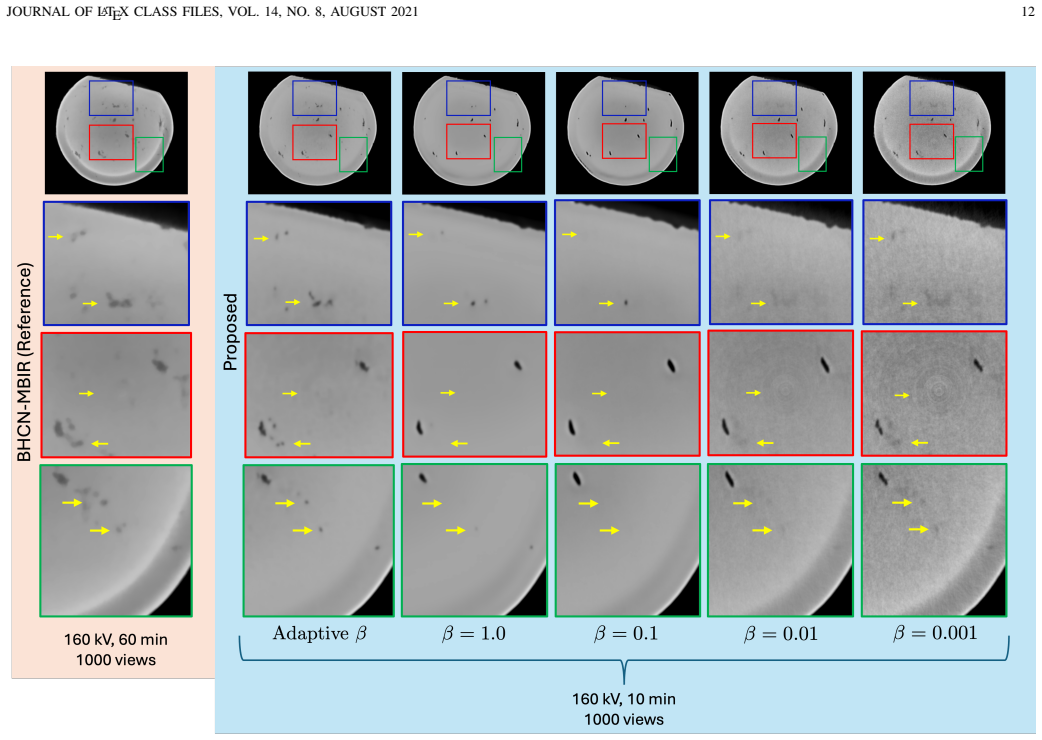
- The adaptive $\beta$ selection outperforms every fixed regularization parameter tested in the paper and preserves small pores better than fixed choices.
- The alternating structure is presented as a general recipe for large-scale inverse imaging problems beyond cone-beam XCT.
Reading between the lines
- The paper does not examine how the artifact-removal CNN behaves on intermediate iterates that are no longer FDK-like; a direct test would be to measure the CNN's output error on $x_{k-1}$ across outer iterations, since an unstable prior there could make the loop diverge even if each step looks plausible.
- The BRISQUE-based $\beta$ selection assumes center slices represent the full volume; for parts with strong axial material or geometry variation, the optimal parameter might differ by slice, which is a testable extension.
- The runtime advantage rests on stopping after three outer iterations; if harder out-of-distribution conditions require more outer loops, the gap to single-step deep learning narrows, so deployment studies should report quality versus iteration count.
- Because the data-consistency step and $\beta$ selection are not specific to cone-beam geometry, the same alternating framework could be retrained for other artifact types such as motion or metal artifacts in medical CT.
Editorial analysis
A structured set of objections, weighed in public.
Referee Report
Summary. The paper proposes an iterative reconstruction framework for industrial cone-beam X-ray computed tomography that combines a pre-trained artifact-removal CNN as a prior within a half-quadratic splitting (HQS) plug-and-play formulation, an adaptive regularization parameter selected by a BRISQUE-based grid search on center slices, and a conjugate-gradient data-consistency step. The framework is tested on real scans of steel, AlCe, and Inconel parts under out-of-distribution acquisition conditions (varying voltage, integration time, sparsity, and material). The authors report that the method outperforms a single-step deep-learning baseline (DLMBIR) on most OOD settings, reconstructs volumes of industrial size in a few outer iterations, and reduces runtime by an order of magnitude compared with MBIR.
Significance. If the reported results hold, this is a practically relevant contribution: it addresses the three-way trade-off between reconstruction quality, runtime, and memory scalability that has limited deep-learning iterative reconstruction in industrial XCT. The use of real large-scale industrial scans with realistic OOD settings, the memory-efficient 2D-patch training for 3D volumes, and the automated β-selection strategy are valuable strengths. The paper also demonstrates an order-of-magnitude runtime reduction over MBIR while maintaining competitive PSNR/SSIM. However, the quantitative evidence for the central outperformance claim is undermined by reference-dependent metrics and an internal inconsistency in Table II, so the significance hinges on a re-analysis of those numbers.
major comments (5)
- [Table II (top vs. middle sub-tables)] The same scan condition (ST, 200 kV, 0.6 s integration time) is evaluated against two different MBIR references and yields contradictory margins: with the 180 kV, 3.6 s reference, BHCN-DLMBIR gives 38.89 dB and the proposed method 38.91 dB (margin 0.02 dB); with the 200 kV, 3.6 s reference, the same methods give 33.70 dB and 34.56 dB (margin 0.86 dB). Since PSNR/SSIM are computed against MBIR reconstructions rather than a true ground truth, the size and even the sign of the claimed improvement depend heavily on the selected reference. The central claim that the method surpasses DLMBIR on OOD voltage scans is therefore not supported by the current numbers. The authors should recompute all metrics against a single consistent reference (or report multiple references per row) and discuss the sensitivity of the ranking to that choice.
- [Section IV-A and Section V (metrics vs. pore preservation)] All PSNR/SSIM comparisons in Tables II and III use dense-view MBIR reconstructions as the reference, not true ground truth. The paper acknowledges in Section IV-A and Section V that the proposed method loses some smaller pores. A method that smooths away small pores can score higher on PSNR/SSIM against a noisy or structured MBIR reference without being more accurate for defect detection, which is a primary industrial use case. The authors should quantify pore-level fidelity (e.g., detection rate, size error) or validate on a phantom with known ground truth to substantiate the claim that their method outperforms DLMBIR on tasks that matter in practice.
- [Section II-B, Eq. (4)] The artifact-removal CNN Dθ is trained on sparse-view FDK reconstructions paired with MBIR targets, but in Algorithm 1 it is applied to intermediate iterates x_{k-1} that have already undergone one or more CG data-consistency updates. The paper does not analyze whether these iterates lie in the training distribution of Dθ, nor does it provide any stability or fixed-point analysis of the iteration. The empirical PSNR curves in Fig. 4 show no divergence for the one tested case, but this is insufficient to support the robustness claim for other OOD settings. I recommend adding a distribution-shift analysis (e.g., statistics of intermediate iterates vs. training inputs) or an ablation replacing Dθ with a Gaussian denoiser trained for the noise levels encountered in the iterates, to validate the proximal-operator assumption.
- [Abstract and Section IV-D, Table III] The abstract states that the method surpasses state-of-the-art supervised learning methods trained on the same data, but Table III shows that for the out-of-distribution materials ALC and IN the proposed method is slightly worse than BHCN-DLMBIR in PSNR (35.27 vs. 35.45 dB for ALC; 37.56 vs. 37.63 dB for IN) and the text says the methods perform 'at par'. The claim in the abstract overstates the material-generalization results and should be qualified to specify that the gains are on voltage, integration-time, and sparsity variations, while material transfer is at best at par with the baseline.
- [Section IV-E, Fig. 4] The benefit of the adaptive regularization parameter strategy over fixed β is demonstrated on a single sample (ST, 160 kV, 0.6 s). Given that the adaptive β selection is a key contribution and is used in all experiments, the authors should validate it on additional OOD conditions (e.g., varying integration time or sparsity) and, if possible, show that the BRISQUE-based selection correlates with the evaluation metrics PSNR/SSIM or with defect-preservation measures. Without such validation, the claims that the selection strategy is 'automated' and generally beneficial remain supported by only one case.
minor comments (5)
- [Figure 8 caption vs. Section IV-E] The caption of Fig. 8 says the reference is BHCN-MBIR at 160 kV, 3.6 s, while Section IV-E states the reference is BHCN-MBIR at 180 kV, 3.6 s. One of these is inconsistent and should be corrected.
- [Algorithm 2] The symbol r is used both for the geometric ratio (Param. r = 0.5) and for the CNN output (Input: CNN output r). Rename one of them to avoid ambiguity, for example use ρ for the ratio.
- [Table II top sub-table] The top sub-table is labeled 'Variation in Source Voltage' but includes a 200 kV row, which is the training voltage and not a variation; moreover this same 200 kV / 0.6 s condition appears with different PSNR/SSIM values in the middle sub-table. The authors should clarify how rows are grouped and ensure the 200 kV condition is either not labeled as a variation or is excluded from the voltage-variation comparison.
- [Section IV-D] There is a typo: 'manufactured with with out-of-distribution materials' should read 'manufactured with out-of-distribution materials'.
- [Section IV-G and Table IV] The text says the proposed method requires 'three or fewer iterations (≤ 1600 seconds)', while Table IV reports 1612 s. These numbers should be reconciled.
Circularity Check
No significant circularity: the iterative reconstruction is tested on out-of-distribution acquisitions, and the Table II reference inconsistency is a benchmark issue, not a circular reduction.
full rationale
The paper's derivation chain is self-contained against its benchmarks. Algorithm 1 alternates (4) z_k = D_theta(x_{k-1}), (5) beta_k selected by a BRISQUE-based grid search on center slices, and (6) a conjugate-gradient data-consistency update; this is a standard HQS/PnP construction rather than a quantity defined in terms of the reported predictions. The CNN is trained on paired sparse-view FDK inputs and dense-view MBIR targets, while the reported reconstructions are evaluated on out-of-distribution acquisitions (different voltage, integration time, sparsity, and materials) against high-quality MBIR references that were not the training targets for those test samples. No reported PSNR/SSIM number is obtained by plugging a fitted parameter back into the same formula: BRISQUE selection does not use the evaluation labels, and the CNN weights are fixed before inference. The self-citations ([1], [12], [53]) provide the DLMBIR baseline, the beam-hardening correction, and the MBIR runtime measurement; these are external published components and are not the load-bearing premise of the claimed improvement, which rests on the OOD experiments. The acknowledged limitation of losing small pores and the reference-dependent metric values in Table II are correctness and benchmark-consistency concerns, not circular reductions: an inconsistent reference choice can change the reported margins, but it does not make any output equivalent to its input by construction. Therefore no significant circularity is found.
Assumptions & free parameters
free parameters (6)
- Beta grid initial value a =
2
- Beta grid ratio r =
0.5
- Number of beta candidates n =
14
- BRISQUE quality threshold q =
100
- CG iterations per data-consistency solve =
10
- Number of outer iterations K =
3-4 (runtime uses 3)
assumptions (5)
- domain assumption The cone-beam CT acquisition is modeled as y = Ax with exactly known forward operator A and log-normalized projections.
- ad hoc to paper A CNN trained on sparse-view FDK reconstructions can substitute for the proximal operator of a prior in the HQS iteration.
- ad hoc to paper BRISQUE score is a reliable proxy for reconstruction quality across the varied noise and artifact levels in this study.
- domain assumption Center slices of the 3D volume are representative of the whole volume for the purpose of beta selection.
- domain assumption Dense-view MBIR reconstructions are valid reference ground truths for computing PSNR and SSIM.
Cite this review
Pith. "Pith review of A Fast, Scalable, and Robust Deep Learning-based Iterative Reconstruction Framework for Accelerated Industrial Cone-beam X-ray Computed Tomography." pith.science (2026). https://pith.science/paper/7LRGNC4M
@misc{pith2026250113961,
  author       = {Pith},
  title        = {Pith review of: A Fast, Scalable, and Robust Deep Learning-based Iterative Reconstruction Framework for Accelerated Industrial Cone-beam X-ray Computed Tomography},
  year         = {2026},
  howpublished = {\url{https://pith.science/paper/7LRGNC4M}},
  note         = {Machine review of arXiv:2501.13961}
}
read the original abstract
Cone-beam X-ray Computed Tomography (XCT) with large detectors and corresponding large-scale 3D reconstruction plays a pivotal role in micron-scale characterization of materials and parts across various industries. In this work, we present a novel deep neural network-based iterative algorithm that integrates an artifact reduction-trained CNN as a prior model with automated regularization parameter selection, tailored for large-scale industrial cone-beam XCT data. Our method achieves high-quality 3D reconstructions even for extremely dense thick metal parts - which traditionally pose challenges to industrial CT images - in just a few iterations. Furthermore, we show the generalizability of our approach to out-of-distribution scans obtained under diverse scanning conditions. Our method effectively handles significant noise and streak artifacts, surpassing state-of-the-art supervised learning methods trained on the same data.
Figures


Figures from the paper (6 more)




Reference graph
Works this paper leans on
-
[1]
A. Ziabari et al. , “Enabling rapid X-ray CT characterisation for additive manufacturing using CAD models and deep learning-based reconstruction,” npj Computational Materials , vol. 9, no. 1, p. 91, 2023
work page 2023
-
[2]
B. S. Rupal, N. Anwer, M. Secanell, and A. J. Qureshi, “Geometric tolerance and manufacturing assemblability estimation of metal additive manufacturing (AM) processes,” Materials & Design, vol. 194, p. 108842, 2020
work page 2020
-
[3]
Assembly analysis of titanium dental implants using X-ray computed tomography,
F. Zanini, S. Carmignato, E. Savio et al., “Assembly analysis of titanium dental implants using X-ray computed tomography,” in Proceedings of the 17th International Conference of the European Society for Precision Engineering and Nanotechnology . euspen, 2017, pp. 489–490
work page 2017
-
[4]
On the use of x-ray computed tomography in assessment of 3d-printed components,
M. R. Khosravani and T. Reinicke, “On the use of x-ray computed tomography in assessment of 3d-printed components,” Journal of Nondestructive Evaluation, vol. 39, pp. 1–17, 2020
work page 2020
-
[5]
K. Naresh, K. Khan, R. Umer, and W. J. Cantwell, “The use of x-ray computed tomography for design and process modeling of aerospace composites: A review,” Materials & Design , vol. 190, p. 108553, 2020
work page 2020
-
[6]
Practical cone-beam algorithm,
L. A. Feldkamp, L. C. Davis, and J. W. Kress, “Practical cone-beam algorithm,” Josa a, vol. 1, no. 6, pp. 612–619, 1984
1984
-
[7]
K. A. Mohan, A. K. Ziabari, and C. A. Bouman, “Algorithm-driven advances for scientific ct instruments: From model-based to deep learning- based approaches,” IEEE Signal Processing Magazine , vol. 39, no. 1, pp. 32–43, 2021
work page 2021
-
[8]
Fast model-based X-ray CT reconstruction using spatially nonhomogeneous ICD optimization,
Z. Yu, J.-B. Thibault, C. A. Bouman, K. D. Sauer, and J. Hsieh, “Fast model-based X-ray CT reconstruction using spatially nonhomogeneous ICD optimization,” IEEE Transactions on image processing , vol. 20, no. 1, pp. 161–175, 2010. JOURNAL OF LATEX CLASS FILES, VOL. 14, NO. 8, AUGUST 2021 12 Fig. 8: Performance comparison of the proposed method for adaptiv...
work page 2010
Show all 54 references
-
[9]
A generalized gaussian image model for edge- preserving map estimation,
C. Bouman and K. Sauer, “A generalized gaussian image model for edge- preserving map estimation,” IEEE Transactions on image processing , vol. 2, no. 3, pp. 296–310, 1993
1993
-
[10]
Bayesian estimation of transmission tomo- grams using segmentation based optimization,
K. Sauer and C. Bouman, “Bayesian estimation of transmission tomo- grams using segmentation based optimization,” IEEE Transactions on Nuclear Science, vol. 39, no. 4, pp. 1144–1152, 1992
1992
-
[11]
A three- dimensional statistical approach to improved image quality for multislice helical CT,
J.-B. Thibault, K. D. Sauer, C. A. Bouman, and J. Hsieh, “A three- dimensional statistical approach to improved image quality for multislice helical CT,” Medical physics, vol. 34, no. 11, pp. 4526–4544, 2007
2007
-
[12]
Deep learning based workflow for accelerated industrial X-ray Computed Tomography,
O. Rahman et al. , “Deep learning based workflow for accelerated industrial X-ray Computed Tomography,” in 2023 IEEE International Conference on Image Processing (ICIP) . IEEE, 2023, pp. 2990–2994
2023
-
[13]
Learning proximal operators: Using denoising networks for regularizing inverse imaging problems,
T. Meinhardt, M. Moller, C. Hazirbas, and D. Cremers, “Learning proximal operators: Using denoising networks for regularizing inverse imaging problems,” in Proceedings of the IEEE International Conference on Computer Vision , 2017, pp. 1781–1790
2017
-
[14]
Denoising prior driven deep neural network for image restoration,
W. Dong et al. , “Denoising prior driven deep neural network for image restoration,” IEEE transactions on pattern analysis and machine intelligence, vol. 41, no. 10, pp. 2305–2318, 2018
2018
-
[15]
Learning deep cnn denoiser prior for image restoration,
K. Zhang, W. Zuo, S. Gu, and L. Zhang, “Learning deep cnn denoiser prior for image restoration,” in Proceedings of the IEEE conference on computer vision and pattern recognition , 2017, pp. 3929–3938
2017
-
[16]
Deep convolutional neural network for inverse problems in imaging,
K. H. Jin, M. T. McCann, E. Froustey, and M. Unser, “Deep convolutional neural network for inverse problems in imaging,” IEEE transactions on image processing, vol. 26, no. 9, pp. 4509–4522, 2017
2017
-
[17]
A deep convolutional neural network using directional wavelets for low-dose X-ray CT reconstruction,
E. Kang, J. Min, and J. C. Ye, “A deep convolutional neural network using directional wavelets for low-dose X-ray CT reconstruction,” Medical physics, vol. 44, no. 10, pp. e360–e375, 2017
2017
-
[18]
Low-dose CT with a residual encoder-decoder convolu- tional neural network,
H. Chen et al., “Low-dose CT with a residual encoder-decoder convolu- tional neural network,” IEEE transactions on medical imaging , vol. 36, no. 12, pp. 2524–2535, 2017
2017
-
[19]
Convolutional neural networks for inverse problems in imaging: A review,
M. T. McCann, K. H. Jin, and M. Unser, “Convolutional neural networks for inverse problems in imaging: A review,” IEEE Signal Processing Magazine, vol. 34, no. 6, pp. 85–95, 2017
2017
-
[20]
Using deep neural networks for inverse problems in imaging: beyond analytical methods,
A. Lucas, M. Iliadis, R. Molina, and A. K. Katsaggelos, “Using deep neural networks for inverse problems in imaging: beyond analytical methods,” IEEE Signal Processing Magazine , vol. 35, no. 1, pp. 20–36, 2018
2018
-
[21]
U-net: Convolutional networks for biomedical image segmentation,
O. Ronneberger, P. Fischer, and T. Brox, “U-net: Convolutional networks for biomedical image segmentation,” in Medical Image Computing and Computer-Assisted Intervention–MICCAI 2015: 18th International Conference, Munich, Germany, October 5-9, 2015, Proceedings, Part III
2015
-
[22]
Springer, 2015, pp. 234–241
2015
-
[23]
Deep convolutional neural network for inverse problems in imaging,
K. H. Jin, M. T. McCann, E. Froustey, and M. Unser, “Deep convolutional neural network for inverse problems in imaging,” IEEE Transactions on Image Processing, vol. 26, no. 9, pp. 4509–4522, 2017
2017
-
[24]
Learned primal-dual reconstruction,
J. Adler and O. Öktem, “Learned primal-dual reconstruction,” IEEE transactions on medical imaging , vol. 37, no. 6, pp. 1322–1332, 2018
2018
-
[25]
End-to-end memory-efficient reconstruction for cone beam CT,
N. Moriakov, J.-J. Sonke, and J. Teuwen, “End-to-end memory-efficient reconstruction for cone beam CT,” Medical Physics, vol. 50, no. 12, pp. 7579–7593, 2023
2023
-
[26]
3D Helical CT Reconstruction with a Memory Efficient Learned Primal-Dual Architecture,
J. Rudzusika, B. Baji ´c, T. Koehler, and O. Öktem, “3D Helical CT Reconstruction with a Memory Efficient Learned Primal-Dual Architecture,” IEEE Transactions on Computational Imaging , 2024
2024
-
[27]
Algorithm unrolling: Interpretable, efficient deep learning for signal and image processing,
V . Monga, Y . Li, and Y . C. Eldar, “Algorithm unrolling: Interpretable, efficient deep learning for signal and image processing,” IEEE Signal Processing Magazine, vol. 38, no. 2, pp. 18–44, 2021
2021
-
[28]
Zhang and B
J. Zhang and B. Ghanem, “ISTA-Net: Interpretable optimization-inspired JOURNAL OF LATEX CLASS FILES, VOL. 14, NO. 8, AUGUST 2021 13 1 FDK BHCN-FDK BHCN-DLMBIR Proposed Dense-view MBIR AlCe (AL) Sparse: 145 Views Dense: 580 Views Inconel 718 (IN) Sparse: 143 Views Dense: 2132 V...
2021
-
[29]
Deep generalization of structured low-rank algorithms (Deep-SLR),
A. Pramanik, H. K. Aggarwal, and M. Jacob, “Deep generalization of structured low-rank algorithms (Deep-SLR),” IEEE transactions on medical imaging, vol. 39, no. 12, pp. 4186–4197, 2020
2020
-
[30]
Plug-and-play priors for model based reconstruction,
S. V . Venkatakrishnan, C. A. Bouman, and B. Wohlberg, “Plug-and-play priors for model based reconstruction,” in 2013 IEEE global conference on signal and information processing . IEEE, 2013, pp. 945–948
2013
-
[31]
Plug-and-play priors for bright field electron tomog- raphy and sparse interpolation,
S. Sreehari et al., “Plug-and-play priors for bright field electron tomog- raphy and sparse interpolation,” IEEE Transactions on Computational Imaging, vol. 2, no. 4, pp. 408–423, 2016
2016
-
[32]
Deep plug-and-play super-resolution for arbitrary blur kernels,
K. Zhang, W. Zuo, and L. Zhang, “Deep plug-and-play super-resolution for arbitrary blur kernels,” in Proceedings of the IEEE/CVF Conference on Computer Vision and Pattern Recognition , 2019, pp. 1671–1681
2019
-
[33]
Plug-and-play image restoration with deep denoiser prior,
K. Zhang et al., “Plug-and-play image restoration with deep denoiser prior,” IEEE Transactions on Pattern Analysis and Machine Intelligence , vol. 44, no. 10, pp. 6360–6376, 2021
2021
-
[34]
Plug-and-play methods for integrating physical and learned models in computational imaging: Theory, algorithms, and applications,
U. S. Kamilov, C. A. Bouman, G. T. Buzzard, and B. Wohlberg, “Plug-and-play methods for integrating physical and learned models in computational imaging: Theory, algorithms, and applications,” IEEE Signal Processing Magazine , vol. 40, no. 1, pp. 85–97, 2023
2023
-
[35]
Plug-and-play ADMM for image restoration: Fixed-point convergence and applications,
S. H. Chan, X. Wang, and O. A. Elgendy, “Plug-and-play ADMM for image restoration: Fixed-point convergence and applications,” IEEE Transactions on Computational Imaging , vol. 3, no. 1, pp. 84–98, 2016
2016
-
[36]
An online plug-and-play algorithm for regularized image reconstruction,
Y . Sun, B. Wohlberg, and U. S. Kamilov, “An online plug-and-play algorithm for regularized image reconstruction,” IEEE Transactions on Computational Imaging, vol. 5, no. 3, pp. 395–408, 2019
2019
-
[37]
Plug-and-play methods provably converge with properly trained denoisers,
E. Ryu et al., “Plug-and-play methods provably converge with properly trained denoisers,” in International Conference on Machine Learning . PMLR, 2019, pp. 5546–5557
2019
-
[38]
Recovery analysis for plug-and-play priors using the restricted eigenvalue condition,
J. Liu, S. Asif, B. Wohlberg, and U. Kamilov, “Recovery analysis for plug-and-play priors using the restricted eigenvalue condition,” Advances in Neural Information Processing Systems , vol. 34, pp. 5921–5933, 2021
2021
-
[39]
The little engine that could: Regularization by denoising (RED),
Y . Romano, M. Elad, and P. Milanfar, “The little engine that could: Regularization by denoising (RED),” SIAM Journal on Imaging Sciences , vol. 10, no. 4, pp. 1804–1844, 2017
2017
-
[40]
Regularization by denoising: Clarifi- cations and new interpretations,
E. T. Reehorst and P. Schniter, “Regularization by denoising: Clarifi- cations and new interpretations,” IEEE transactions on computational imaging, vol. 5, no. 1, pp. 52–67, 2018
2018
-
[41]
Multi-slice fusion for sparse-view and limited-angle 4D CT reconstruc- tion,
S. Majee, T. Balke, C. A. Kemp, G. T. Buzzard, and C. A. Bouman, “Multi-slice fusion for sparse-view and limited-angle 4D CT reconstruc- tion,” IEEE Transactions on Computational Imaging, vol. 7, pp. 448–462, 2021
2021
-
[42]
Sparse-view cone beam CT reconstruction using data-consistent supervised and adversarial learning from scarce training data,
A. Lahiri, G. Maliakal, M. L. Klasky, J. A. Fessler, and S. Ravis- hankar, “Sparse-view cone beam CT reconstruction using data-consistent supervised and adversarial learning from scarce training data,” IEEE Transactions on Computational Imaging , vol. 9, pp. 13–28, 2023
2023
-
[43]
A Restoration Network as an Implicit Prior,
Y . Hu, M. Delbracio, P. Milanfar, and U. Kamilov, “A Restoration Network as an Implicit Prior,” in The Twelfth International Conference on Learning Representations
-
[44]
RARE: Image reconstruction using deep priors learned without groundtruth,
J. Liu et al., “RARE: Image reconstruction using deep priors learned without groundtruth,” IEEE Journal of Selected Topics in Signal Processing, vol. 14, no. 6, pp. 1088–1099, 2020
2020
-
[45]
Plug- and-play unplugged: Optimization-free reconstruction using consensus equilibrium,
G. T. Buzzard, S. H. Chan, S. Sreehari, and C. A. Bouman, “Plug- and-play unplugged: Optimization-free reconstruction using consensus equilibrium,” SIAM Journal on Imaging Sciences, vol. 11, no. 3, pp. 2001– 2020, 2018. [Online]. Available: https://doi.org/10.1137/17M1122451
2001 doi
-
[46]
No-reference image quality assessment in the spatial domain,
A. Mittal, A. K. Moorthy, and A. C. Bovik, “No-reference image quality assessment in the spatial domain,” IEEE Transactions on image processing, vol. 21, no. 12, pp. 4695–4708, 2012
2012
-
[47]
Optimal short scan convolution reconstruction for fan beam ct,
D. L. Parker, “Optimal short scan convolution reconstruction for fan beam ct,” Medical physics, vol. 9, no. 2, pp. 254–257, 1982
1982
-
[48]
Model based iterative reconstruction with spatially adaptive sinogram weights for wide-cone cardiac CT,
A. Ziabari et al., “Model based iterative reconstruction with spatially adaptive sinogram weights for wide-cone cardiac CT,” arXiv preprint arXiv:1812.08364, 2018
2018 arXiv
-
[49]
Adam: a method for stochastic optimization,
D. Kingma, “Adam: a method for stochastic optimization,” in Int Conf Learn Represent, 2014
2014
-
[50]
The ASTRA Toolbox: A platform for advanced algorithm development in electron tomography,
W. Van Aarle et al., “The ASTRA Toolbox: A platform for advanced algorithm development in electron tomography,” Ultramicroscopy, vol. 157, pp. 35–47, 2015
2015
-
[51]
Performance improve- ments for iterative electron tomography reconstruction using graphics processing units (gpus),
W. J. Palenstijn, K. J. Batenburg, and J. Sijbers, “Performance improve- ments for iterative electron tomography reconstruction using graphics processing units (gpus),” Journal of structural biology , vol. 176, no. 2, pp. 250–253, 2011
2011
-
[52]
Fast and flexible X-ray tomography using the ASTRA toolbox,
W. Van Aarle et al. , “Fast and flexible X-ray tomography using the ASTRA toolbox,” Optics express, vol. 24, no. 22, pp. 25 129–25 147, 2016
2016
-
[53]
Image quality assessment: from error visibility to structural similarity,
Z. Wang, A. C. Bovik, H. R. Sheikh, and E. P. Simoncelli, “Image quality assessment: from error visibility to structural similarity,” IEEE transactions on image processing , vol. 13, no. 4, pp. 600–612, 2004
2004
-
[54]
S. V . Venkatakrishnan, “pyMBIR,” Oak Ridge National Lab.(ORNL), Oak Ridge, TN (United States), Tech. Rep., 2019
2019
Reviewed August 10, 2026 · model on record in the stance chip above.
Discussion (0). Continue with ORCID to comment.