REVIEW 3 major objections 6 minor 1 cited by
Transfer Learning of Surrogate Models via Domain Affine Transformation Across Synthetic and Real-World Benchmarks
T0 review · 3 major / 6 minor · reviewed 2026-08-10 · deepseek-v4-flash
Pith's one-line read A random forest surrogate trained on one function can be reused on an unknown rotated and translated version of the same function using only tens of target samples.
desk verdict A clean, reproducible extension of affine transfer learning to random forests, but the real-world benchmarks never test the affine assumption, so the title overclaims. read the letter →
The pith
A machine-rendered reading of the paper's core claim, the machinery that carries it, and where it could break.
The reading
What carries the argument
The machinery is an affine reparameterization of the source model, $\hat{f}_T(x)=\hat{f}_S(Wx+v)$, with the rotation searched in the Lie algebra $\mathfrak{so}(d)$: a vector of $d(d-1)/2$ real numbers is packed into a skew-symmetric matrix $A$, and the rotation is $W=\exp(A)$. This converts a constrained search over the rotation group into an unconstrained Euclidean search that CMA-ES can handle, while the translation $v$ is searched directly. The same transfer loss is used as in the differentiable case, but the optimizer no longer requires gradients.
What would settle it
Take a source-target pair generated by a scaling such as $f_T(x)=f_S(2x)$ or $f_S(x/2)$, so the domain map is not in $\mathrm{SO}(d)$, and run the transfer with 50 samples: if the transferred model does not beat scratch training on most instances, the rotation-only affine assumption is the limiting condition.
Extended reading notes
Core claim
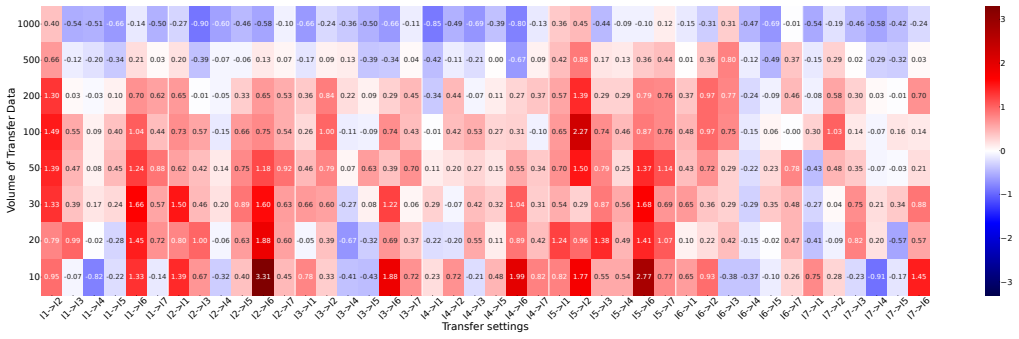
The paper's central claim is that non-differentiable surrogates, specifically random forest regression, can be transferred under an affine domain shift by solving $\min_{W \in \mathrm{SO}(d), v \in \mathbb{R}^d} \frac{1}{|T|}\sum_{x \in T}(\hat{f}_S(Wx+v) - f_T(x))^2$, where $\hat{f}_S$ is the source-trained model and $T$ is a small transfer set from the target. Because random forests have no gradients, the paper replaces the Riemannian gradient optimizer used for Gaussian process regression with CMA-ES, representing rotations in the Lie algebra $\mathfrak{so}(d)$ of skew-symmetric matrices and recovering $W$ by the matrix exponential. It reports that the transferred random forest achieves lower symmetric mean absolute percentage error than a scratch-trained model with as few as 50 to 100 transfer samples, especially in higher dimensions, and that this advantage shrinks as transfer data grows.
Load-bearing premise
The method assumes the target function is exactly the source function composed with a rotation and translation of its input domain, and the real-world benchmarks do not verify that relation.
Editorial extensions
If this is right
- At transfer sizes of 50 to 100 samples, the transferred random forest is reported to beat the scratch-trained model on most BBOB functions, with the gap larger in ten dimensions than in two dimensions.
- The benefit of transfer shrinks as the transfer set grows, with scratch-trained models catching up once hundreds of target samples are available.
- Transfer is ineffective when the source surrogate is a poor fit to its own source function, as with F23, and is limited on complex multimodal functions such as F16 and F21 through F24.
- Real-world porkchop plot, robot arm, and MarioGAN tasks show transferred random forests winning in low-data regimes, while the vehicle dynamics benchmark largely violates the affine assumption and transfer fails there.
Reading between the lines
- An extension not tested in the paper: because CMA-ES only needs function evaluations, the same wrapper should apply to other non-differentiable surrogates, such as k-nearest-neighbor models or decision tree ensembles beyond random forests.
- The paper's failure on vehicle dynamics suggests a cheap diagnostic: fit the affine transfer and compare its loss on the transfer set to a scratch model's loss; if the transfer loss does not drop, the affine assumption is likely violated.
- A testable improvement would be to allow scaling or reflection in the affine map, for example $W \in \mathrm{GL}(d)$ or orthogonal matrices with determinant $-1$, since the paper restricts to rotations and lists nonlinear warping as future work.
- If confirmed, the method changes the economics of simulation-driven design: one expensive training run can serve many related configurations, with only a tiny target sample needed for adaptation.
Signed reviews
Editorial analysis
A structured set of objections, weighed in public.
Referee Report
Summary. The paper proposes a method for transferring random forest regression (RFR) surrogate models from a source function to a target function assumed to be related by an input-domain transformation f_T(x) = f_S(Wx + v), where W is a rotation in SO(d) and v is a translation. The transformation parameters are optimized on a small transfer set using CMA-ES over the Lie algebra representation of SO(d). The method is evaluated on BBOB synthetic benchmarks and on four real-world transfer learning problems (porkchop plots, SARCOS robot arm torques, vehicle dynamics, and MarioGAN). The reported results show that the transferred RFR often outperforms an RFR trained from scratch when the transfer set is small, especially on BBOB, with notable exceptions on several BBOB functions and on the vehicle dynamics benchmark.
Significance. If the central claim holds, the paper extends affine-domain transfer learning, previously limited to differentiable surrogates such as Gaussian processes, to non-differentiable random forest surrogates. This is a useful practical contribution because random forests are common in low-data engineering settings. The paper is honest in reporting failure cases, and it provides ten repetitions, statistical significance testing, and a Zenodo repository for reproducibility. However, the strongest evidence is obtained on synthetic BBOB tasks where the affine assumption is enforced by construction. The real-world benchmarks are presented as validation but do not verify the affine symmetry, and at least one benchmark appears to violate it. The significance of the real-world results is therefore conditional on an unmeasured assumption.
major comments (3)
- [Section IV.A, V.B] The synthetic BBOB targets are constructed by randomly generating rotation matrices and translation vectors applied to the source function, so the affine symmetry f_T(x) = f_S(Wx+v) holds exactly by construction. The positive results in Section V.A therefore validate only that CMA-ES can recover the transformation under the method's own assumption; they provide no evidence that the assumption is plausible for any real-world task. The real-world benchmarks in Section V.B are the only external evidence, yet no diagnostic is reported that checks whether any source-target pair actually satisfies the affine relation. This gap is load-bearing for the title's and abstract's claim of transferring 'across synthetic and real-world benchmarks' and for the conclusion that the method offers 'significant practical advantages.' The authors should either add a validation analysis for the real-world benchmarks (e.g., fit the transformation on a held-out subset and measure residual SMAPE against a no-transfer baseline, or inspect the recovered W and v for consistency with domain knowledge), or explicitly reclassify the real-world results as exploratory evidence that does not establish the affine assumption.
- [Section IV.B.2, Fig. 4] For the SARCOS robot arm benchmark, the source and target functions share the same 21-dimensional input space (joint positions, velocities, accelerations) and differ only in which joint's torque is predicted. Under an exact input-domain affine symmetry, the only admissible transformation is W=I and v=0, making the transfer equivalent to using the source model without adaptation. The mixed results, most notably torque7→torque1 losing to scratch-trained RFR at every transfer size, are therefore unlikely to be explained by an input-domain affine shift. The paper should either justify why this benchmark is a meaningful test of the affine domain transformation assumption, or report and analyze the optimized W and v to show what structure the method actually exploits. Without this, the robot arm experiment does not support the paper's central claim.
- [Section III] The paper uses the term 'affine transformation' but restricts W to the special orthogonal group SO(d), which together with a translation vector v gives only rigid motions (rotations and translations), not general affine transformations that include scaling, shear, and reflection. Real-world surrogate modeling tasks often have different unit scales, input ranges, or parameterizations between source and target, so the restriction to SO(d) may be exactly the wrong symmetry for those tasks. The conclusion acknowledges nonlinear domain changes in Vehicle Dynamics but does not acknowledge the scaling/reflection limitation. At minimum, the authors should explicitly state that the method handles only rotation-translation shifts, and ideally they should compare against a version that allows a general linear map (e.g., full GL(d)) to determine whether the SO(d) restriction is a practical bottleneck.
minor comments (6)
- [Section V.B.3] The text contains a typo: 'instacne' should be 'instance' in the sentence 'The results underscore the unique difficulty of transferring from instacne3 to other instances.'
- [Section I] The Introduction uses the phrase 'non-differential models' and 'differential models' where 'non-differentiable models' and 'differentiable models' are meant; this terminology should be corrected for consistency with Section III.
- [Algorithm 1] Line 12 of Algorithm 1 reads 'Update m, C and σ with and {xi}λ i=1 and {yi}λ i=1'; the word 'and' appears to be a typo, and the sentence should be rephrased to 'Update m, C and σ using {xi} and {yi}'.
- [Section III] The displayed equation for the loss L(v, W) is rendered as 'L(v, W) = n−1 T P ...', which is hard to read; it should be typeset as n_T^{-1} \sum ... for clarity.
- [Fig. 2] The caption of Fig. 2 does not define the color scale; please state explicitly that red indicates positive percentage difference (transfer better) and blue indicates negative, since the reader cannot infer the mapping from the grayscale version.
- [Section V.A] The comparison with transferred GPR results from [13] would be more informative if the experimental settings (transfer set sizes, dimensions, number of repetitions) were aligned; as reported, the comparison is only qualitative and should be labeled as such.
Circularity Check
No significant circularity: the affine assumption is explicitly stated and tested on synthetic data constructed under it, but transfer parameters are fit on training points and evaluated on held-out points, and the real-world benchmarks are external.
full rationale
The paper's derivation chain is self-contained and does not reduce to its inputs. The affine symmetry f_T(x)=f_S(Wx+v) is an explicit assumption in Section III, and the BBOB targets are constructed by randomly generated rotations and translations in Section IV.A, so those experiments are a controlled test of the optimizer under the method's own premise rather than an independent validation of the premise. This is a standard synthetic benchmark design and not a circular step: the transfer parameters W and v are optimized on a small transfer set and evaluated on a separate test set, so the reported SMAPE improvements are not forced by construction. The real-world benchmarks (porkchop plots, SARCOS robot arm, vehicle dynamics, MarioGAN) are external datasets; the paper does not verify the affine assumption on them, and indeed reports failures (e.g., vehicle dynamics, torque7 to torque1), which is a correctness or external-validity concern, not circularity. Self-citations to [13] (the prior GPR transfer method) and [32] (vehicle dynamics benchmark) are normal and not load-bearing: the current paper's contribution is the CMA-ES-based optimization for non-differentiable RFR, which is stated and implemented in the paper itself. No quoted equation or result is equivalent to its own input by construction.
Assumptions & free parameters
free parameters (4)
- Affine rotation matrix W (d(d-1)/2 parameters) =
Varies per task; not reported as values
- Affine translation vector v (d parameters) =
Varies per task
- CMA-ES bounds and initial step size =
Rotation bounds [-pi, pi]; translation bounds [-1.5, 1.5]; initial step one-fifth of average range; BIPOP-CMA-ES with…
- RFR hyperparameters for vehicle dynamics =
Tree count [100, 1500], depth [10, 60], split/leaf samples [2, 20] and [1, 10], features fraction [0.1, 1.0]
assumptions (3)
- domain assumption Source and target functions satisfy f_T(x) = f_S(Wx + v) for some unknown W in SO(d) and v in R^d.
- domain assumption The transfer dataset, sampled uniformly, is informative enough that minimizing empirical squared loss over W and v yields parameters that generalize to the target function.
- domain assumption BBOB target instances are related to source instances by rotations and translations.
Cite this review
Pith. "Pith review of Transfer Learning of Surrogate Models via Domain Affine Transformation Across Synthetic and Real-World Benchmarks." pith.science (2026). https://pith.science/paper/GD4IB22J
@misc{pith2026250114012,
  author       = {Pith},
  title        = {Pith review of: Transfer Learning of Surrogate Models via Domain Affine Transformation Across Synthetic and Real-World Benchmarks},
  year         = {2026},
  howpublished = {\url{https://pith.science/paper/GD4IB22J}},
  note         = {Machine review of arXiv:2501.14012}
}
read the original abstract
Surrogate models are frequently employed as efficient substitutes for the costly execution of real-world processes. However, constructing a high-quality surrogate model often demands extensive data acquisition. A solution to this issue is to transfer pre-trained surrogate models for new tasks, provided that certain invariances exist between tasks. This study focuses on transferring non-differentiable surrogate models (e.g., random forests) from a source function to a target function, where we assume their domains are related by an unknown affine transformation, using only a limited amount of transfer data points evaluated on the target. Previous research attempts to tackle this challenge for differentiable models, e.g., Gaussian process regression, which minimizes the empirical loss on the transfer data by tuning the affine transformations. In this paper, we extend the previous work to the random forest and assess its effectiveness on a widely-used artificial problem set - Black-Box Optimization Benchmark (BBOB) testbed, and on four real-world transfer learning problems. The results highlight the significant practical advantages of the proposed method, particularly in reducing both the data requirements and computational costs of training surrogate models for complex real-world scenarios.
Figures


Figures from the paper (18 more)



Forward citations
Cited by 1 Pith paper
-
Transfer Learning of Surrogate Models: Integrating Domain Warping and Affine Transformations
Transfer learning of Gaussian process surrogates is improved by fitting nonlinear beta-CDF input warping plus affine transformations on small target datasets.
Reference graph
Works this paper leans on
-
[14]
Learn on source, refine on target: A model transfer learning framework with random forests,
N. Segev, M. Harel, S. Mannor, K. Crammer, and R. El-Yaniv, “Learn on source, refine on target: A model transfer learning framework with random forests,” IEEE Transactions on Pattern Analysis and Machine Intelligence, vol. 39, no. 9, pp. 1811–1824, 2017. [Online]. Available: https://doi.org/10.1109/TPAMI.2016.2618118
-
[1]
A. I. J. Forrester, A. Sobester, and A. J. Keane, Engineering Design via Surrogate Modelling - A Practical Guide . Wiley, 2008. [Online]. Available: https://doi.org/10.1002/9780470770801
-
[2]
Recent advances in surrogate-based optimization,
A. I. Forrester and A. J. Keane, “Recent advances in surrogate-based optimization,” Progress in Aerospace Sciences , vol. 45, no. 1-3, pp. 50–79, 2009
work page 2009
-
[3]
Advances in surrogate based modeling, feasibility analysis, and optimization: A review,
A. Bhosekar and M. Ierapetritou, “Advances in surrogate based modeling, feasibility analysis, and optimization: A review,” Computers & Chemical Engineering, vol. 108, pp. 250–267, 2018. [Online]. Available: https://doi.org/10.1016/j.compchemeng.2017.09.017
-
[4]
H. Tong, C. Huang, L. L. Minku, and X. Yao, “Surrogate models in evolutionary single-objective optimization: A new taxonomy and experimental study,” Information Sciences, vol. 562, pp. 414–437, 2021. [Online]. Available: https://doi.org/10.1016/j.ins.2021.03.002
-
[5]
Convolutional neural network surrogate-assisted GOMEA,
A. Dushatskiy, A. M. Mendrik, T. Alderliesten, and P. A. N. Bosman, “Convolutional neural network surrogate-assisted GOMEA,” in Proceedings of the Genetic and Evolutionary Computation Conference, GECCO 2019, Prague, Czech Republic, July 13-17, 2019 , A. Auger and T. St ¨utzle, Eds. ACM, 2019, pp. 753–761. [Online]. Available: https://doi.org/10.1145/33217...
arXiv 2019
-
[6]
A constrained competitive swarm optimizer with an svm-based surrogate model for feature selection,
B. H. Nguyen, B. Xue, and M. Zhang, “A constrained competitive swarm optimizer with an svm-based surrogate model for feature selection,” IEEE Transactions on Evolutionary Computation , vol. 28, no. 1, pp. 2–16,
-
[7]
Adaptive bayesian support vector regression model for structural reliability analysis,
K. Cheng and Z. Lu, “Adaptive bayesian support vector regression model for structural reliability analysis,” Reliability Engineering & System Safety , vol. 206, p. 107286, 2021. [Online]. Available: https://doi.org/10.1016/j.ress.2020.107286
arXiv 2021
Show all 46 references
-
[8]
A random forest-assisted evolutionary algorithm for data-driven constrained multiobjective combinatorial optimization of trauma systems,
H. Wang and Y . Jin, “A random forest-assisted evolutionary algorithm for data-driven constrained multiobjective combinatorial optimization of trauma systems,” IEEE Transactions on Cybernetics , vol. 50, no. 2, pp. 536–549, 2020. [Online]. Available: https: //doi.org/10.1109/T...
2020
-
[9]
Random forests for global sensitivity analysis: A selective review,
A. Antoniadis, S. Lambert-Lacroix, and J. Poggi, “Random forests for global sensitivity analysis: A selective review,” Reliability Engineering & System Safety , vol. 206, p. 107312, 2021. [Online]. Available: https://doi.org/10.1016/j.ress.2020.107312
2021
-
[10]
Gaussian process surrogate model with composite kernel learning for engineering design,
P. Satria Palar, L. Rizki Zuhal, and K. Shimoyama, “Gaussian process surrogate model with composite kernel learning for engineering design,” American Institute of Aeronautics and Astronautics (AIAA) journal , vol. 58, no. 4, pp. 1864–1880, 2020
2020
-
[11]
Deep gaussian process enabled surrogate models for aerodynamic flows,
D. Rajaram, T. G. Puranik, A. Renganathan, W. J. Sung, O. J. Pinon- Fischer, D. N. Mavris, and A. Ramamurthy, “Deep gaussian process enabled surrogate models for aerodynamic flows,” in American Institute of Aeronautics and Astronautics (AIAA) scitech 2020 forum , 2020, p. 1640
2020
-
[12]
R. B. Gramacy, Surrogates: Gaussian process modeling, design, and optimization for the applied sciences . Chapman and Hall/CRC, 2020
2020
-
[13]
Transfer learning of surrogate models via domain affine transformation,
S. Pan, D. Vermetten, M. L ´opez-Ib´a˜nez, T. B ¨ack, and H. Wang, “Transfer learning of surrogate models via domain affine transformation,” in Proceedings of the Genetic and Evolutionary Computation Conference, GECCO 2024, Melbourne, VIC, Australia, July 14-18, 2024, X. Li an...
2024
-
[15]
Transfer learning in classification based on manifolc. models and its relation to tangent metric learning,
S. Saralajew and T. Villmann, “Transfer learning in classification based on manifolc. models and its relation to tangent metric learning,” in 2017 International Joint Conference on Neural Networks, IJCNN 2017, Anchorage, AK, USA, May 14-19, 2017 . IEEE, 2017, pp. 1756–1765. [O...
2017
-
[16]
Improved versions of learning vector quantization,
T. Kohonen, “Improved versions of learning vector quantization,” in IJCNN 1990, International Joint Conference on Neural Networks, San Diego, CA, USA, June 17-21, 1990 . IEEE, 1990, pp. 545–550. [Online]. Available: https://doi.org/10.1109/IJCNN.1990.137622
1990
-
[17]
Aspects in classification learning – review of recent developments in learning vector quantization,
M. Kaden, M. Lange, D. Nebel, M. Riedel, T. Geweniger, and T. Villmann, “Aspects in classification learning – review of recent developments in learning vector quantization,” Foundations of Computing and Decision Sciences, vol. 39, no. 2, pp. 79–105, 2014
2014
-
[18]
Pose-dependent tool tip dynamics prediction using transfer learning,
G. Chen, Y . Li, and X. Liu, “Pose-dependent tool tip dynamics prediction using transfer learning,” International Journal of Machine Tools and Manufacture, vol. 137, pp. 30–41, 2019
2019
-
[19]
Affine transfor- mations accelerate the training of physics-informed neural networks of a one-dimensional consolidation problem,
L. Mandl, A. Mielke, S. M. Seyedpour, and T. Ricken, “Affine transfor- mations accelerate the training of physics-informed neural networks of a one-dimensional consolidation problem,” Scientific Reports, vol. 13, no. 1, p. 15566, 2023
2023
-
[20]
Evolution strategies,
M. Emmerich, O. M. Shir, and H. Wang, “Evolution strategies,” in Handbook of Heuristics , R. Mart ´ı, P. M. Pardalos, and M. G. C. Resende, Eds. Springer, 2018, pp. 89–119. [Online]. Available: https://doi.org/10.1007/978-3-319-07124-4 13
2018 doi
-
[21]
The CMA evolution strategy: A comparing review,
N. Hansen, “The CMA evolution strategy: A comparing review,” in Towards a New Evolutionary Computation - Advances in the Estimation of Distribution Algorithms , ser. Studies in Fuzziness and Soft Computing, J. A. Lozano, P. Larra ˜naga, I. Inza, and E. Bengoetxea, Eds. Springe...
2006 doi
-
[22]
The CMA evolution strategy: A tutorial,
——, “The CMA evolution strategy: A tutorial,” CoRR, vol. abs/1604.00772, 2016. [Online]. Available: http://arxiv.org/abs/1604. 00772
2016 arXiv
-
[23]
Integration of new evolutionary approach with artificial neural network for solving short term load forecast problem,
P. Singh and P. Dwivedi, “Integration of new evolutionary approach with artificial neural network for solving short term load forecast problem,” Applied Energy, vol. 217, pp. 537–549, 2018
2018
-
[24]
A recommender system for metaheuristic algorithms for continuous optimization based on deep recurrent neural networks,
Y . Tian, S. Peng, X. Zhang, T. Rodemann, K. C. Tan, and Y . Jin, “A recommender system for metaheuristic algorithms for continuous optimization based on deep recurrent neural networks,” IEEE Transactions on Artificial Intelligence , vol. 1, no. 1, pp. 5–18, 2020. [Online]. Av...
2020
-
[25]
Towards learning universal hyperparameter optimizers with transformers,
Y . Chen, X. Song, C. Lee, Z. Wang, R. Zhang, D. Dohan, K. Kawakami, G. Kochanski, A. Doucet, M. Ranzato, S. Perel, and N. de Freitas, “Towards learning universal hyperparameter optimizers with transformers,” in Advances in Neural Information Processing Systems ,
-
[26]
Surrogate-assisted multi-objective optimization via genetic programming based symbolic regression,
K. Yang and M. Affenzeller, “Surrogate-assisted multi-objective optimization via genetic programming based symbolic regression,” in Evolutionary Multi-Criterion Optimization - 12th International Conference, EMO 2023, Leiden, The Netherlands, March 20-24, 2023, Proceedings, ser...
2023
-
[27]
COCO: a platform for comparing continuous optimizers in a black-box setting,
N. Hansen, A. Auger, R. Ros, O. Mersmann, T. Tusar, and D. Brockhoff, “COCO: a platform for comparing continuous optimizers in a black-box setting,” Optimization Methods and Software, vol. 36, no. 1, pp. 114–144, 2021. [Online]. Available: https://doi.org/10.1080/10556788.2020.1808977
2021
-
[28]
Revisiting lambert’s problem,
D. Izzo, “Revisiting lambert’s problem,” Celestial Mechanics and Dynamical Astronomy, vol. 121, pp. 1–15, 2015
2015
-
[29]
Mars science laboratory launch-arrival space study: a pork chop plot analysis,
A. D. Cianciolo, R. Powell, and M. K. Lockwood, “Mars science laboratory launch-arrival space study: a pork chop plot analysis,” in 2006 IEEE Aerospace Conference . IEEE, 2006, pp. 10–pp
2006
-
[30]
On the nature of Earth-Mars porkchop plots,
R. C. Woolley and C. W. Whetsel, “On the nature of Earth-Mars porkchop plots,” 2013. [Online]. Available: https://hdl.handle.net/2014/44336
2013
-
[31]
C. E. Rasmussen and C. K. I. Williams, Gaussian processes for machine learning, ser. Adaptive computation and machine learning. MIT Press,
-
[32]
Real-world optimization benchmark from vehicle dynamics: Specification of problems in 2d and methodology for transferring (meta-)optimized algorithm parameters,
A. Thomaser, M. V ogt, T. B ¨ack, and A. V . Kononova, “Real-world optimization benchmark from vehicle dynamics: Specification of problems in 2d and methodology for transferring (meta-)optimized algorithm parameters,” in Proceedings of the 15th International Joint Conference o...
2023
-
[33]
Single- and multi-objective game-benchmark for evolutionary algorithms,
V . V olz, B. Naujoks, P. Kerschke, and T. Tusar, “Single- and multi-objective game-benchmark for evolutionary algorithms,” in Proceedings of the Genetic and Evolutionary Computation Conference, GECCO 2019, Prague, Czech Republic, July 13-17, 2019 , A. Auger and T. St ¨utzle, ...
2019
-
[34]
A pragmatic view of accuracy measurement in forecasting,
B. E. Flores, “A pragmatic view of accuracy measurement in forecasting,” Omega, vol. 14, no. 2, pp. 93–98, 1986
1986
-
[35]
Iohexperimenter: Benchmarking platform for iterative optimization heuristics,
J. de Nobel, F. Ye, D. Vermetten, H. Wang, C. Doerr, and T. B ¨ack, “Iohexperimenter: Benchmarking platform for iterative optimization heuristics,” Evolutionary Computation , vol. 32, no. 3, pp. 205–210,
-
[36]
Scikit-learn: Machine learning in Python,
F. Pedregosa, G. Varoquaux, A. Gramfort, V . Michel, B. Thirion, O. Grisel, M. Blondel, P. Prettenhofer, R. Weiss, V . Dubourg, J. Vanderplas, A. Passos, D. Cournapeau, M. Brucher, M. Perrot, and E. Duchesnay, “Scikit-learn: Machine learning in Python,” Journal of Machine Lear...
2011
-
[37]
CMA-ES/pycma on Github,
N. Hansen, Y . Akimoto, and P. Baudis, “CMA-ES/pycma on Github,” Zenodo, DOI:10.5281/zenodo.2559634, Feb. 2019. [Online]. Available: https://doi.org/10.5281/zenodo.2559634
2019 doi
-
[38]
SMAC3: A versatile bayesian optimization package for hyperparameter optimization,
M. Lindauer, K. Eggensperger, M. Feurer, A. Biedenkapp, D. Deng, C. Benjamins, T. Ruhkopf, R. Sass, and F. Hutter, “SMAC3: A versatile bayesian optimization package for hyperparameter optimization,” Journal of Machine Learning Research , vol. 23, pp. 54:1–54:9, 2022. [Online]....
2022
-
[39]
Available: https://doi.org/10.1162/evco a 00342
[Online]. Available: https://doi.org/10.1162/evco a 00342
-
[40]
poliastro/poliastro: poliastro 0.17.0 (scipy us ’22 edition),
J. L. C. Rodr ´ıguez, Y . Gondhalekar, A. Hidalgo, S. Bapat, N. Astrakhantsev, C. Eleftheria, K. Charls, Meu, Dani, A. Chaurasia, A. L. M ´arquez, D. Sondhi, T. Mrugalski, E. Selwood, M. L ´opez-Ib´a˜nez, O. Ousoultzoglou, P. R. Robles, G. Lindahl, S. O. Hussain, andrea carbal...
2022 doi
-
[41]
Transfer learning of surrogate models via domain affine transformation across synthetic and real- world benchmarks: Supplementary material,
S. Pan, D. Vermetten, M. L ´opez-Ib´a˜nez, T. B ¨ack, and H. Wang, “Transfer learning of surrogate models via domain affine transformation across synthetic and real- world benchmarks: Supplementary material,” Feb. 2025. [Online]. Available: https://doi.org/10.5281/zenodo.14651837
2025 doi
-
[42]
Input warping for Bayesian optimization of non-stationary functions,
J. Snoek, K. Swersky, R. Zemel, and R. Adams, “Input warping for Bayesian optimization of non-stationary functions,” in Proceedings of the 31st International Conference on Machine Learning , ser. Proceedings of Machine Learning Research, E. P. Xing and T. Jebara, Eds., vol. 32...
2014
-
[43]
Transfer learning with affine model transformation,
S. Minami, K. Fukumizu, Y . Hayashi, and R. Yoshida, “Transfer learning with affine model transformation,” in Advances in Neural Information Processing Systems 36: Annual Conference on Neural Information Processing Systems 2023, NeurIPS 2023, New Orleans, LA, USA, December 10 ...
2023
-
[2006]
Available: https://www.worldcat.org/oclc/61285753
[Online]. Available: https://www.worldcat.org/oclc/61285753
-
[2022]
Available: http://papers.nips.cc/paper files/paper/2022/ hash/cf6501108fced72ee5c47e2151c4e153-Abstract-Conference.html
[Online]. Available: http://papers.nips.cc/paper files/paper/2022/ hash/cf6501108fced72ee5c47e2151c4e153-Abstract-Conference.html
2022
-
[2024]
Available: https://doi.org/10.1109/TEVC.2022.3197427
[Online]. Available: https://doi.org/10.1109/TEVC.2022.3197427
2022
Reviewed August 10, 2026 · model on record in the stance chip above.
Discussion (0). Continue with ORCID to comment.