Private Minimum Hellinger Distance Estimation via Hellinger Distance Differential Privacy
Pith reviewed 2026-05-23 05:11 UTC · model grok-4.3
The pith
Minimum Hellinger distance estimators can be made private under a new Hellinger differential privacy constraint while retaining robustness to contamination and asymptotic efficiency.
A machine-rendered reading of the paper's core claim, the machinery that carries it, and where it could break.
Core claim
The central claim is that private minimum Hellinger distance estimators satisfy Hellinger differential privacy while retaining the robustness and efficiency properties of the non-private versions, with Hellinger differential privacy allowing sharper inference than standard differential privacy.
What carries the argument
Hellinger differential privacy, a privacy constraint based on the Hellinger distance that is imposed on minimum Hellinger distance estimators to produce private versions.
If this is right
- The estimators remain robust under gross-error contamination.
- Asymptotic efficiency of the original estimators is preserved.
- Hellinger differential privacy permits sharper inference than standard differential privacy.
- Private gradient descent and Newton-Raphson algorithms enable practical computation of the estimators.
Where Pith is reading between the lines
- The Hellinger privacy approach could be applied to other divergence-based robust estimators to achieve similar privacy-robustness tradeoffs.
- In data settings with both contamination and privacy regulations, this method may support more reliable parameter estimates than standard private estimators.
- Extensions to models with dependent data or to nonparametric settings could test whether the retained efficiency generalizes.
Load-bearing premise
It is possible to enforce Hellinger differential privacy on minimum Hellinger distance estimators without destroying their robustness to gross-error contamination or their asymptotic efficiency.
What would settle it
A theoretical derivation or finite-sample simulation in which the private estimators exhibit either loss of robustness to contamination or slower rates of convergence than the non-private minimum Hellinger distance estimators.
Figures



read the original abstract
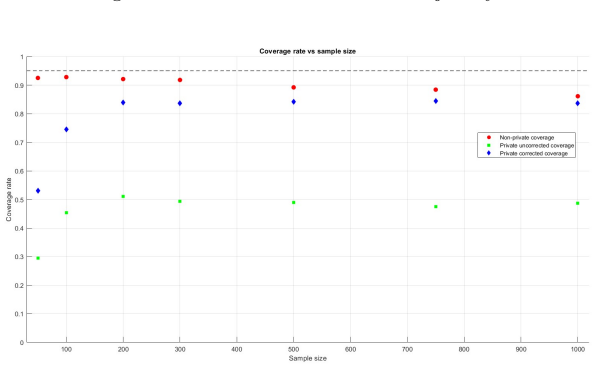
Objective functions based on Hellinger distance yield robust and efficient estimators of model parameters. Motivated by privacy and regulatory requirements encountered in contemporary applications, we derive in this paper \emph{private minimum Hellinger distance estimators}. The estimators satisfy a new privacy constraint, namely, Hellinger differential privacy, while retaining the robustness and efficiency properties. We demonstrate that Hellinger differential privacy shares several features of standard differential privacy while allowing for sharper inference. Additionally, for computational purposes, we also develop Hellinger differentially private gradient descent and Newton-Raphson algorithms. We illustrate the behavior of our estimators in finite samples using numerical experiments and verify that they retain robustness properties under gross-error contamination.
Editorial analysis
A structured set of objections, weighed in public.
Referee Report
Summary. The paper derives private minimum Hellinger distance estimators that satisfy a new Hellinger differential privacy constraint while retaining the robustness to gross-error contamination and asymptotic efficiency of the classical minimum Hellinger distance estimators. It introduces Hellinger-DP variants of gradient descent and Newton-Raphson algorithms for computation and validates the approach via numerical experiments under contamination.
Significance. If the derivations hold, the work provides a privacy mechanism tailored to Hellinger-based robust estimation that preserves key statistical properties and permits sharper inference than standard differential privacy. The explicit construction of private optimization algorithms and the numerical confirmation of robustness under gross-error models are concrete strengths.
minor comments (3)
- The abstract and introduction would benefit from an explicit statement of the precise definition of Hellinger differential privacy (including the role of the Hellinger distance in the privacy loss) before the main theorems.
- In the numerical experiments section, the contamination levels and sample sizes used to demonstrate retention of robustness should be tabulated for reproducibility.
- Notation for the Hellinger-DP gradient and Newton steps should be aligned with the non-private versions to make the modifications immediately visible.
Simulated Author's Rebuttal
We thank the referee for the positive assessment of the manuscript, the recognition of its strengths in deriving Hellinger-DP estimators that preserve robustness and efficiency, and the recommendation for minor revision. No specific major comments appear in the report, so we have no individual points to address.
Circularity Check
No significant circularity
full rationale
The paper introduces Hellinger differential privacy as a new constraint and derives private minimum Hellinger distance estimators plus associated algorithms (gradient descent, Newton-Raphson) that are stated to satisfy the constraint while retaining robustness and efficiency. No load-bearing step reduces by construction to a fitted input, self-citation, or renamed known result; the abstract and description present the privacy mechanism and retention properties as outcomes of explicit derivations verified by numerical experiments on gross-error contamination. The derivation chain is therefore self-contained against external benchmarks.
Axiom & Free-Parameter Ledger
Reference graph
Works this paper leans on
-
[1]
M. Avella-Medina, C. Bradshaw, and P.-L. Loh. Differentially private inference via noisy optimization. The Annals of Statistics , 51(5):2067–2092,
work page 2067
-
[2]
R. Bassily, A. Smith, and A. Thakurta. Private empirical risk minimization: Efficient algorithms and tight error bounds. In 2014 IEEE 55th annual symposium on foundations of computer science , pages 464–473. IEEE,
work page 2014
-
[3]
K. Chaudhuri and D. Hsu. Convergence rates for differentially private statistical estimation. In Proceed- ings of the... International Conference on Machine Learning. International Conference on Machine Learning, volume 2012, page
work page 2012
-
[4]
C. Chen, J. Lee, and D. Kifer. Renyi differentially private erm for smooth objectives. In The 22nd international conference on artificial intelligence and statistics , pages 2037–2046. PMLR,
work page 2037
-
[5]
A.-l. Cheng and A. N. Vidyashankar. Minimum hellinger distance estimation for randomized play the winner design. Journal of statistical planning and inference , 136(6):1875–1910,
work page 1910
-
[6]
Concentrated Differential Privacy
C. Dwork and G. N. Rothblum. Concentrated differential privacy. arXiv preprint arXiv:1603.01887 ,
work page internal anchor Pith review Pith/arXiv arXiv
- [7]
-
[8]
70 I. Mironov. R´ enyi differential privacy. In 2017 IEEE 30th computer security foundations symposium (CSF), pages 263–275. IEEE,
work page 2017
-
[9]
A. Narayanan and V. Shmatikov. Robust de-anonymization of large sparse datasets. In 2008 IEEE Symposium on Security and Privacy (sp
work page 2008
-
[10]
doi: 10.1007/978-1-4899- 3324-9
ISBN 0-412-24620-1. doi: 10.1007/978-1-4899- 3324-9. URL https://doi.org/10.1007/978-1-4899-3324-9. A. Slavkovic and R. Molinari. Perturbed m-estimation: A further investigation of robust statistics for differential privacy. In Statistics in the Public Interest: In Memory of Stephen E. Fienberg , pages 337–361. Springer,
-
[11]
S. Song, K. Chaudhuri, and A. D. Sarwate. Stochastic gradient descent with differentially private updates. In 2013 IEEE global conference on signal and information processing , pages 245–248. IEEE,
work page 2013
-
[12]
Y. Wang, D. Kifer, and J. Lee. Differentially private confidence intervals for empirical risk minimization. arXiv preprint arXiv:1804.03794 ,
work page internal anchor Pith review Pith/arXiv arXiv
discussion (0)
Sign in with ORCID, Apple, or X to comment. Anyone can read and Pith papers without signing in.