REVIEW 4 major objections 5 minor 149 references
Expert-Free Online Transfer Learning in Multi-Agent Reinforcement Learning
T0 review · 4 major / 5 minor · reviewed 2026-08-10 · deepseek-v4-flash
Pith's one-line read Online transfer learning works between imperfect agents, no expert needed
desk verdict A promising but not yet established framework for expert-free online experience sharing; the core mechanism rests on an unverified cross-agent comparability of uncertainty scores. read the letter →
The pith
A machine-rendered reading of the paper's core claim, the machinery that carries it, and where it could break.
The reading
What carries the argument
The load-bearing component is the Transfer Core Engine, a per-agent module that exchanges transfer buffers, chooses a temporary source by Source Selection Criteria (lowest average uncertainty or best recent performance), and filters the incoming buffer by Transfer Content Selection Criteria based on delta-confidence and expected surprise approximated by TD-error. The second load-bearing component is sars-RND, an estimator that distils a random target network and reports prediction error conditioned on state, action, reward, and next state, which gives finer-grained epistemic uncertainty than state-only RND during online learning.
What would settle it
Run the same task with two agents whose sars-RND networks are initialised to produce deliberately different uncertainty scales, for example by initialising one predictor near zero and the other with large weights; if EF-OnTL's source selection or tuple ranking shifts substantially and performance degrades, the cross-agent comparability assumption fails. A second check is to compute delta-confidence after normalising each agent's uncertainties to a common distribution and measure how much the selected transferred batch changes; if the selected tuples differ, the raw scores are not doing the claimed work.
Extended reading notes
Core claim
EF-OnTL is an online experience-sharing framework where no agent is assumed to be an expert. At transfer steps every agent publishes its uncertainty-labelled interaction buffer; a common source is selected using either lowest average epistemic uncertainty or best recent cumulative reward. Each target then scores the source's tuples by delta-confidence, defined as target uncertainty minus source uncertainty on the same tuple, or by a combined normalised loss-and-confidence measure, and optimises its policy on the top B tuples. The thesis also introduces sars-RND, a Random Network Distillation variant that estimates epistemic uncertainty from the full state-action-reward-next-state tuple rather than from the state alone, so that rarely tried actions in familiar states still register as uncertain. Experiments across Cart-Pole, Multi-Team Predator-Prey, Half Field Offense, and a ride-sharing simulator show better or equal performance against no-transfer, OCMAS action-advice sharing, and RCMP expert-advice baselines, with improvements growing with environment complexity.
Load-bearing premise
The framework assumes that the uncertainty numbers produced by different agents' sars-RND estimators can be compared directly, so that a large gap between a target's and a source's uncertainty on the same tuple reliably marks the knowledge the target is missing.
Editorial extensions
If this is right
- Agents can transfer knowledge online without any fixed expert, so target performance is not capped by a single teacher's policy quality.
- Experience sharing can match or beat action-advice methods, meaning targets do not need their policies overridden to benefit from others' knowledge.
- The reported performance gap between EF-OnTL and baselines grows with environment complexity, so the framework matters most where exploration is hardest.
- sars-RND provides a usable fine-grained uncertainty signal during online training, unlike state-visit counters or state-only RND.
- Each target receives a personalised batch tailored to its own knowledge gaps rather than a uniform broadcast from the source.
Reading between the lines
- Beyond the paper: a direct test of the cross-agent comparability assumption would be to calibrate each agent's sars-RND uncertainty to a common scale before computing delta-confidence; if the transferred-batch ranking changes materially, the raw gap is not measuring the intended knowledge gap.
- Beyond the paper: EF-OnTL could be extended to heterogeneous agents with different reward models by inserting a state and reward mapping function, a direction the thesis leaves open.
- Beyond the paper: in large fleets, global source selection could be localised to communication neighbourhoods, and whether the loss in source quality is acceptable is an empirical question the thesis does not answer.
- Beyond the paper: because the reported benefit scales with task difficulty, one would expect EF-OnTL to show its largest advantage in sparse-reward, high-dimensional MARL problems, which the four benchmarks only partially cover.
Signed reviews
Editorial analysis
A structured set of objections, weighed in public.
Referee Report
Summary. The thesis proposes Expert-Free Online Transfer Learning (EF-OnTL), a framework for online experience sharing among homogeneous RL agents without a fixed expert. Each agent maintains a transfer buffer of (s,a,r,s') tuples labelled by a new uncertainty estimator, sars-RND. At regular transfer steps, a source agent is chosen by average uncertainty or best performance, and each target samples B tuples selected by delta-confidence and/or TD-error (TCS). The thesis also introduces sars-RND, an extension of RND that takes action, reward, and next state into account. The evaluation compares EF-OnTL against no-transfer, OCMAS, RCMP, QMIX, and multi-agent PA-DDPG in Cart-Pole, MT-PP, HFO, and 3R2S, reporting better or equal convergence and final performance in these benchmarks.
Significance. EF-OnTL addresses a real gap: agent-to-agent transfer learning has mostly been teacher-student action advice, often with an expert, while experience sharing has mostly been offline pretraining. Showing that imperfect agents can mutually accelerate learning through filtered experience, with a public code repository (Section 5.3) and ablations of SS, TCS, and B (Section 6.3.2), would be a useful empirical contribution, especially for the real-world 3R2S demand scenario. No machine-checked proofs or parameter-free derivations are involved; the contribution is algorithmic and empirical, and the code is openly available. The claim is not derived from fitted equations, so the external circularity burden is low; the main concerns are internal validity: the uncertainty-filtering mechanism is not isolated from data-quantity effects, and the cross-agent comparability of sars-RND outputs is assumed rather than demonstrated.
major comments (4)
- [Section 4.5.2 and Eq. (4.1)] The central mechanism presupposes that raw sars-RND outputs from different agents are directly comparable, but no evidence establishes this. In Eq. (4.1) the source is selected by minimizing average uncertainty u_i, and in Section 4.5.2 the content filter is delta-confidence = u_target(oi_s) - u_source(oi_s). Each agent runs its own sars-RND predictor/target pair, initialized randomly and trained only on that agent's experience; RND-type prediction errors are uncalibrated and their scale depends on network initialization, optimizer trajectory, and data distribution. A 'common uncertainty estimator methodology' (Section 1.3) and a 'standardised architecture' (Section 4.5.2) do not by themselves put the estimators on a common scale. If one agent's estimator is systematically lower, that agent will always be selected as source and tuples will be filtered by estimator scale rather than by a transferable knowledge gap. Section 7.2 flags communication and homogeneity limitations but does not flag this calibration assumption. The internal comparison of sars-RND and RND in Section 3.4.1 only shows sensitivity to action changes within one estimator; it never checks whether scores are comparable across agents. I request either a cross-agent calibration study (for example, evaluating all estimators on a common held-out tuple set and reporting the scale distributions) or an explicit normalization step, together with a validation that delta-confidence ordering correlates with measured transfer utility.
- [Section 6.3.1, Figures 6.5-6.10] No random-experience transfer control is included. EF-OnTL is compared with no-transfer, OCMAS, RCMP, QMIX, and multi-agent PA-DDPG, but none of these isolates the effect of TCS-based uncertainty filtering from the simple effect of adding B extra tuples to the target's learning process. A control that transfers B uniformly random tuples from the source buffer would show whether delta-confidence and sars-RND provide benefit beyond data quantity or implicit regularization. Because the central claim is specifically that uncertainty-filtered experience accelerates convergence, this control is load-bearing and should be added.
- [Section 6.1.2 and Figures 6.5-6.10] The headline comparisons do not report confidence intervals or significance tests. Figure 6.7 reports evaluation metrics on 500 test episodes but no variance or seed-level test, and the number of independent runs used in Chapter 6 is not stated in the reviewed text. With per-environment tuned configurations in Table 6.3, point-estimate learning curves are insufficient to support the abstract's 'better or equal performance' claim across four benchmarks. The 50-run average curves in Section 3.3 show that the authors can compute such statistics; they should do so for the Chapter 6 comparisons.
- [Tables 6.3-6.4 and Section 6.3.2] EF-OnTL's hyperparameters are tuned per environment, and the sensitivity analysis covers only Cart-Pole and MT-PP. Transfer budget B varies from 5,000 to 100 across environments, and TF, SS, and TCS also change; for HFO and 3R2S only one configuration is evaluated. The ablation in Section 6.3.2 therefore does not establish that the reported improvements are robust to B and TF in the more complex environments, which weakens the generality of the 'better or equal' claim as stated in the abstract.
minor comments (5)
- [Section 3.4.1] The normalization used in Figure 3.12 is not defined; the text should state exactly how RND and sars-RND uncertainties are aligned before comparison, because the two estimators have different input dimensions and are not obviously on the same scale.
- [Abstract and throughout] There are numerous spacing and typographical errors, such as 'inEF-OnTL' and 'frameworkEF-OnTL' in the abstract, and inconsistent rendering of 'sars-RND' across the text; a careful copy-edit is needed.
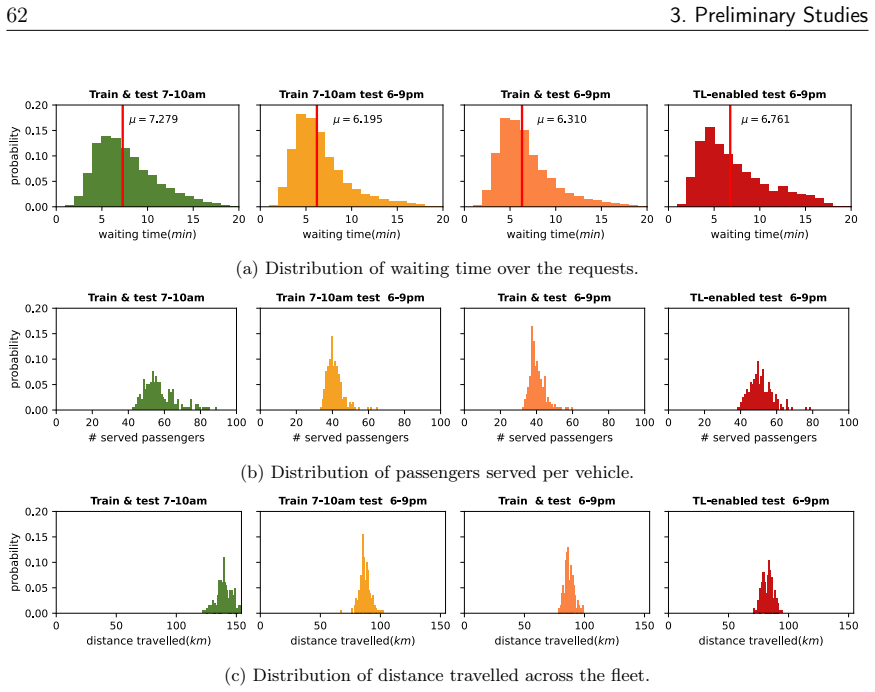
- [Table 3.2] The column header 'sigma pass' is not defined; it appears to denote the standard deviation of passengers served per vehicle, but this should be stated explicitly in the caption or text.
- [Section 5.1.1] The sentence 'which is more than doubled on the server' is ambiguous: if the MT-PP training and testing phase takes about 7 hours on the laptop, the server should take less time, so either the direction or the wording needs correction.
- [Section 2.4 and Section 6.1.1] The RCMP baseline is described in Section 2.4 as a modification that replaces the single optimal teacher with multiple trained agents and majority voting, but Section 6.1.1 does not restate this modification; the evaluation section should define the exact RCMP setup used so the comparison is reproducible.
Circularity Check
No circularity: EF-OnTL's transfer criteria are heuristics evaluated against external baselines; sars-RND is an estimator tested by a synthetic experiment, not a predicted quantity derived from itself.
full rationale
The thesis reports an empirical framework rather than a derivation chain that reduces to its own inputs. Source selection uses average uncertainty (Eq. 4.1) or best performance (Eq. 4.2), and content selection uses delta-confidence or surprise; these are stated design heuristics, not parameters fitted to the target result. The central claim—that EF-OnTL achieves better or equal performance than TL baselines—is supported by comparisons against OCMAS, RCMP, no-transfer, and other baselines on Cart-Pole, MT-PP, HFO, and 3R2S. No equation in the paper defines successful transfer in terms of delta-confidence itself, and no fitted value is later renamed as a prediction. The sars-RND estimator is introduced and tested in §3.4.1 through an artificial action-sensitivity experiment; that experiment is a sanity check of the estimator's behaviour, not a circular validation of EF-OnTL's final performance. Self-citations appear only in the dissemination section (§1.5) and are not load-bearing in any technical claim. The concern about cross-agent comparability of sars-RND uncertainty values is a legitimate assumption/validity issue, but it is not circularity: the paper does not define the transfer benefit to be identical to the delta-confidence score. Therefore no specific circular step can be exhibited, and the appropriate finding is no significant circularity.
Assumptions & free parameters
free parameters (6)
- Transfer budget B per benchmark =
Cart-Pole 5000, MT-PP 500, HFO 100, 3R2S 500 (Figs. 6.5-6.10, Table 6.3)
- Transfer frequency TF =
Set per environment in the EF-OnTL configuration
- sars-RND encoder size =
1024 features
- Delta-confidence median threshold (rnd delta-conf TCS) =
Median of incoming batch
- Offline transfer uncertainty thresholds =
0.05, 0.02, 0.015 plus mean and median
- Loss and confidence equal weighting =
0.5 / 0.5 after normalization
assumptions (5)
- domain assumption Agents are homogeneous: same state and action space, same reward model, and equal learning capacity.
- domain assumption Communication among agents is fault-free and effectively unlimited (n-to-n) with fixed cost.
- ad hoc to paper sars-RND uncertainty values are comparable across agents, so delta-conf is a meaningful knowledge-gap signal.
- domain assumption TD-error is a valid operationalization of expected surprise for selecting transferable tuples.
- domain assumption Off-policy updates with transferred external tuples do not systematically destabilize the target DQN or PA-DDPG.
invented entities (1)
-
State Action Reward Next-state Random Network Distillation (sars-RND)
Cite this review
Pith. "Pith review of Expert-Free Online Transfer Learning in Multi-Agent Reinforcement Learning." pith.science (2026). https://pith.science/paper/5L46BCDE
@misc{pith2026250115495,
  author       = {Pith},
  title        = {Pith review of: Expert-Free Online Transfer Learning in Multi-Agent Reinforcement Learning},
  year         = {2026},
  howpublished = {\url{https://pith.science/paper/5L46BCDE}},
  note         = {Machine review of arXiv:2501.15495}
}
read the original abstract
Reinforcement Learning (RL) enables an intelligent agent to optimise its performance in a task by continuously taking action from an observed state and receiving a feedback from the environment in form of rewards. RL typically uses tables or linear approximators to map state-action tuples that maximises the reward. Combining RL with deep neural networks (DRL) significantly increases its scalability and enables it to address more complex problems than before. However, DRL also inherits downsides from both RL and deep learning. Despite DRL improves generalisation across similar state-action pairs when compared to simpler RL policy representations like tabular methods, it still requires the agent to adequately explore the state-action space. Additionally, deep methods require more training data, with the volume of data escalating with the complexity and size of the neural network. As a result, deep RL requires a long time to collect enough agent-environment samples and to successfully learn the underlying policy. Furthermore, often even a slight alteration to the task invalidates any previous acquired knowledge. To address these shortcomings, Transfer Learning (TL) has been introduced, which enables the use of external knowledge from other tasks or agents to enhance a learning process. The goal of TL is to reduce the learning complexity for an agent dealing with an unfamiliar task by simplifying the exploration process. This is achieved by lowering the amount of new information required by its learning model, resulting in a reduced overall convergence time...
Figures


Figures from the paper (48 more)







Reference graph
Works this paper leans on
-
[1]
Demand-responsive zone gen- eration for real-time vehicle rebalancing in ride-sharing fleets,
A. Castagna, M. Guériau, G. Vizzari, and I. Dusparic, “Demand-responsive zone gen- eration for real-time vehicle rebalancing in ride-sharing fleets,” in11th International Workshop on Agents in Traffic and Transportation (ATT 2020) at ECAI 2020, 2020
2020
-
[2]
Demand-responsive rebalancing zone generation for reinforcement learning- based on-demand mobility,
——, “Demand-responsive rebalancing zone generation for reinforcement learning- based on-demand mobility,”AI Communications, vol. 34, no. 1, pp. 73–88, 2021
2021
-
[3]
Multi-agent transfer learning in reinforcement learning- based ride-sharing systems,
A. Castagna and I. Dusparic, “Multi-agent transfer learning in reinforcement learning- based ride-sharing systems,” inInternational Conference on Agents and Artificial In- telligence (ICAART), 2022
2022
-
[4]
Expert-free online transfer learning in multi-agent reinforcement learning,
——, “Expert-free online transfer learning in multi-agent reinforcement learning,” in (Accepted to) European Conference on Artificial Intelligence ECAI 2023, 2023
2023
-
[5]
Continual model-based reinforcement learning for data efficient wireless network optimisation,
C. Hasan, A. Agapitos, D. Lynch, A. Castagna, G. Cruciata, H. Wang, and A. Milen- ovic, “Continual model-based reinforcement learning for data efficient wireless network optimisation,” in(Accepted to) European Conference on Machine Learning and Prin- ciples and Practice of Knowledge Discovery in Databases, 06 2023
2023
-
[6]
R. S. Sutton and A. G. Barto,Reinforcement learning: An introduction. MIT press, 2018
2018
-
[7]
Proximal policy optimization algorithms,
J. Schulman, F. Wolski, P. Dhariwal, A. Radford, and O. Klimov, “Proximal policy optimization algorithms,” arXiv preprint arXiv:1707.06347, 2017
arXiv 2017
-
[8]
Deep reinforcement learning in parameterized action space,
M. Hausknecht and P. Stone, “Deep reinforcement learning in parameterized action space,” arXiv preprint arXiv:1511.04143, 2015
arXiv 2015
Show all 149 references
-
[9]
Tlc trip record data,
NYC Taxi and Limousine Commission, “Tlc trip record data,” 2020. [Online]. Available: https://www1.nyc.gov/site/tlc/about/tlc-trip-record-data.page
2020
-
[10]
Openai gym,
G. Brockman, V. Cheung, L. Pettersson, J. Schneider, J. Schulman, J. Tang, and W. Zaremba, “Openai gym,” 2016
2016
-
[11]
Sim-to-real transfer in deep reinforce- ment learning for robotics: a survey,
W. Zhao, J. P. Queralta, and T. Westerlund, “Sim-to-real transfer in deep reinforce- ment learning for robotics: a survey,” in2020 IEEE symposium series on computa- tional intelligence (SSCI). IEEE, 2020, pp. 737–744
2020
-
[12]
Reinforcement learning in robotics: A survey,
J. Kober, J. A. Bagnell, and J. Peters, “Reinforcement learning in robotics: A survey,” The International Journal of Robotics Research, vol. 32, no. 11, pp. 1238–1274, 2013
2013
-
[13]
Survey of model-based reinforcement learning: Applications on robotics,
A. S. Polydoros and L. Nalpantidis, “Survey of model-based reinforcement learning: Applications on robotics,”Journal of Intelligent & Robotic Systems, vol. 86, no. 2, pp. 153–173, 2017. Alberto Castagna PhD Thesis 150 BIBLIOGRAPHY
2017
-
[14]
Reinforcement learning in economics and finance,
A. Charpentier, R. Elie, and C. Remlinger, “Reinforcement learning in economics and finance,” Computational Economics, pp. 1–38, 2021
2021
-
[15]
Recent advances in reinforcement learning in finance,
B. M. Hambly, R. Xu, and H. Yang, “Recent advances in reinforcement learning in finance,” Recent Advances in Reinforcement Learning in Finance (November 24, 2021), 2021
2021
-
[16]
Multi-agent reinforcement learning for traffic light con- trol,
M. A. Wiering et al., “Multi-agent reinforcement learning for traffic light con- trol,” in Machine Learning: Proceedings of the Seventeenth International Conference (ICML’2000), 2000, pp. 1151–1158
2000
-
[17]
Recent advances in reinforcement learning for traffic signal control: A survey of models and evaluation,
H. Wei, G. Zheng, V. Gayah, and Z. Li, “Recent advances in reinforcement learning for traffic signal control: A survey of models and evaluation,”ACM SIGKDD Explorations Newsletter, vol. 22, no. 2, pp. 12–18, 2021
2021
-
[18]
Shared autonomous mobilityondemand: Alearning-basedapproachanditsperformanceinthepresenceof traffic congestion,
M. Guériau, F. Cugurullo, R. A. Acheampong, and I. Dusparic, “Shared autonomous mobilityondemand: Alearning-basedapproachanditsperformanceinthepresenceof traffic congestion,”IEEE Intelligent Transportation Systems Magazine, vol. 12, no. 4, pp. 208–218, 2020
2020
-
[19]
Deep reinforce- ment learning for mobile 5g and beyond: Fundamentals, applications, and challenges,
Z. Xiong, Y. Zhang, D. Niyato, R. Deng, P. Wang, and L.-C. Wang, “Deep reinforce- ment learning for mobile 5g and beyond: Fundamentals, applications, and challenges,” IEEE Vehicular Technology Magazine, vol. 14, no. 2, pp. 44–52, 2019
2019
-
[20]
Rl-nsb: Reinforcement learning- based 5g network slice broker,
V. Sciancalepore, X. Costa-Perez, and A. Banchs, “Rl-nsb: Reinforcement learning- based 5g network slice broker,” IEEE/ACM Transactions on Networking, vol. 27, no. 4, pp. 1543–1557, 2019
2019
-
[21]
Deep reinforcement learning in medical imaging: A literature review,
S. K. Zhou, H. N. Le, K. Luu, H. V. Nguyen, and N. Ayache, “Deep reinforcement learning in medical imaging: A literature review,”Medical image analysis, vol. 73, p. 102193, 2021
2021
-
[22]
Reinforcement learning for intelligent healthcare applications: A survey,
A. Coronato, M. Naeem, G. De Pietro, and G. Paragliola, “Reinforcement learning for intelligent healthcare applications: A survey,”Artificial Intelligence in Medicine, vol. 109, p. 101964, 2020
2020
-
[23]
Deep reinforcement learning in medicine,
A. Jonsson, “Deep reinforcement learning in medicine,”Kidney diseases, vol. 5, no. 1, pp. 18–22, 2019
2019
-
[24]
Literature survey of statistical, deep and reinforce- ment learning in natural language processing,
A. R. Sharma and P. Kaushik, “Literature survey of statistical, deep and reinforce- ment learning in natural language processing,” in2017 International Conference on Computing, Communication and Automation (ICCCA). IEEE, 2017, pp. 350–354
2017
-
[25]
Survey on reinforcement learning for language processing,
V. Uc-Cetina, N. Navarro-Guerrero, A. Martin-Gonzalez, C. Weber, and S. Wermter, “Survey on reinforcement learning for language processing,”Artificial Intelligence Re- view, pp. 1–33, 2022
2022
-
[26]
Progressive neural networks,
A. A. Rusu, N. C. Rabinowitz, G. Desjardins, H. Soyer, J. Kirkpatrick, K. Kavuk- cuoglu, R. Pascanu, and R. Hadsell, “Progressive neural networks,”arXiv preprint arXiv:1606.04671, 2016
2016 arXiv
-
[27]
Progress & compress: A scalable framework for continual learning,
J.Schwarz, W.Czarnecki, J.Luketina, A.Grabska-Barwinska, Y.W.Teh, R.Pascanu, and R. Hadsell, “Progress & compress: A scalable framework for continual learning,” in International conference on machine learning. PMLR, 2018, pp. 4528–4537. PhD Thesis Your Name BIBLIOGRAPHY 151
2018
-
[28]
Deep reinforcement learning with knowledge transfer for online rides order dispatching,
Z. Wang, Z. Qin, X. Tang, J. Ye, and H. Zhu, “Deep reinforcement learning with knowledge transfer for online rides order dispatching,” in2018 IEEE International Conference on Data Mining (ICDM). IEEE, 2018, pp. 617–626
2018
-
[29]
Sharing knowledge in multi-task deep reinforcement learning,
C. D’Eramo, D. Tateo, A. Bonarini, M. Restelli, J. Peterset al., “Sharing knowledge in multi-task deep reinforcement learning,” in8th International Conference on Learning Representations,{ICLR} 2020, Addis Ababa, Ethiopia, April 26-30, 2020. OpenRe- view. net, 2020, pp. 1–11
2020
-
[30]
Learning modular neural network policies for multi-task and multi-robot transfer,
C. Devin, A. Gupta, T. Darrell, P. Abbeel, and S. Levine, “Learning modular neural network policies for multi-task and multi-robot transfer,” in2017 IEEE international conference on robotics and automation (ICRA). IEEE, 2017, pp. 2169–2176
2017
-
[31]
Deep successor reinforce- ment learning,
T. D. Kulkarni, A. Saeedi, S. Gautam, and S. J. Gershman, “Deep successor reinforce- ment learning,”arXiv preprint arXiv:1606.02396, 2016
2016 arXiv
-
[32]
Overcoming cata- strophic forgetting in neural networks,
J. Kirkpatrick, R. Pascanu, N. Rabinowitz, J. Veness, G. Desjardins, A. A. Rusu, K. Milan, J. Quan, T. Ramalho, A. Grabska-Barwinska et al., “Overcoming cata- strophic forgetting in neural networks,”Proceedings of the national academy of sci- ences, vol. 114, no. 13, pp. 3521–...
2017
-
[33]
Towards knowledge transfer in deep re- inforcement learning,
R. Glatt, F. L. Da Silva, and A. H. R. Costa, “Towards knowledge transfer in deep re- inforcement learning,” in2016 5th Brazilian Conference on Intelligent Systems (BRA- CIS). IEEE, 2016, pp. 91–96
2016
-
[34]
Knowledge transfer for deep reinforcement learning with hier- archical experience replay,
H. Yin and S. Pan, “Knowledge transfer for deep reinforcement learning with hier- archical experience replay,” inProceedings of the AAAI Conference on Artificial In- telligence, vol. 31, no. 1, 2017
2017
-
[35]
Policy distillation,
A. A. Rusu, S. G. Colmenarejo, C. Gulcehre, G. Desjardins, J. Kirkpatrick, R. Pas- canu, V. Mnih, K. Kavukcuoglu, and R. Hadsell, “Policy distillation,”arXiv preprint arXiv:1511.06295, 2015
2015 arXiv
-
[36]
Discorl: Continual reinforcement learning via policy distillation,
R. Traoré, H. Caselles-Dupré, T. Lesort, T. Sun, G. Cai, N. Díaz-Rodríguez, and D. Filliat, “Discorl: Continual reinforcement learning via policy distillation,”arXiv preprint arXiv:1907.05855, 2019
1907 arXiv
-
[37]
Successor features for transfer in reinforcement learning,
A. Barreto, W. Dabney, R. Munos, J. J. Hunt, T. Schaul, H. P. van Hasselt, and D. Sil- ver, “Successor features for transfer in reinforcement learning,”Advances in neural information processing systems, vol. 30, 2017
2017
-
[38]
Deep q-learning from demonstrations,
T. Hester, M. Vecerik, O. Pietquin, M. Lanctot, T. Schaul, B. Piot, D. Horgan, J. Quan, A. Sendonaris, I. Osbandet al., “Deep q-learning from demonstrations,” in Proceedings of the AAAI Conference on Artificial Intelligence, vol. 32, no. 1, 2018
2018
-
[39]
Transfer of samples in batch reinforcement learning,
A. Lazaric, M. Restelli, and A. Bonarini, “Transfer of samples in batch reinforcement learning,” in Proceedings of the 25th international conference on Machine learning, 2008, pp. 544–551
2008
-
[40]
Don’t start from scratch: Leveraging prior data to automate robotic reinforcement learning,
H. R. Walke, J. H. Yang, A. Yu, A. Kumar, J. Orbik, A. Singh, and S. Levine, “Don’t start from scratch: Leveraging prior data to automate robotic reinforcement learning,” in Conference on Robot Learning. PMLR, 2023, pp. 1652–1662. Your Name PhD Thesis 152 BIBLIOGRAPHY
2023
-
[41]
Reinforcement learning agents providing advice in complex video games,
M. E. Taylor, N. Carboni, A. Fachantidis, I. Vlahavas, and L. Torrey, “Reinforcement learning agents providing advice in complex video games,”Connection Science, vol. 26, no. 1, pp. 45–63, 2014
2014
-
[42]
Uncertainty-aware action advising for deep reinforcement learning agents,
F. L. Da Silva, P. Hernandez-Leal, B. Kartal, and M. E. Taylor, “Uncertainty-aware action advising for deep reinforcement learning agents,” inProceedings of the AAAI conference on artificial intelligence, vol. 34, no. 04, 2020, pp. 5792–5799
2020
-
[43]
Learning by reusing previous advice in teacher-student paradigm,
C. Zhu, Y. Cai, H.-f. Leung, and S. Hu, “Learning by reusing previous advice in teacher-student paradigm,” in Proceedings of the 19th International Conference on Autonomous Agents and MultiAgent Systems, 2020, pp. 1674–1682
2020
-
[44]
Experience classification for transfer learning in traffic signal control,
M. Norouzi, M. Abdoos, and A. L. Bazzan, “Experience classification for transfer learning in traffic signal control,”The Journal of Supercomputing, vol. 77, pp. 780– 795, 2021
2021
-
[45]
Teaching on a budget: Agents advising agents in reinforce- ment learning,
L. Torrey and M. Taylor, “Teaching on a budget: Agents advising agents in reinforce- ment learning,” in Proceedings of the 2013 international conference on Autonomous agents and multi-agent systems, 2013, pp. 1053–1060
2013
-
[46]
A q-values sharing framework for multi-agent reinforcement learning under budget constraint,
C. Zhu, H.-F. Leung, S. Hu, and Y. Cai, “A q-values sharing framework for multi-agent reinforcement learning under budget constraint,”ACM Transactions on Autonomous and Adaptive Systems (TAAS), vol. 15, no. 2, pp. 1–28, 2021
2021
-
[47]
Parallel knowledge transfer in multi-agent reinforcement learn- ing,
Y. Liang and B. Li, “Parallel knowledge transfer in multi-agent reinforcement learn- ing,” arXiv preprint arXiv:2003.13085, 2020
2003 arXiv
-
[48]
Simultaneously learning and advising in multiagent reinforcement learning,
F. L. Da Silva, R. Glatt, and A. H. R. Costa, “Simultaneously learning and advising in multiagent reinforcement learning,” inProceedings of the 16th conference on autonom- ous agents and multiagent systems, 2017, pp. 1100–1108
2017
-
[49]
Parallel transfer learning in multi- agent systems: What, when and how to transfer?
A. Taylor, I. Dusparic, M. Guériau, and S. Clarke, “Parallel transfer learning in multi- agent systems: What, when and how to transfer?” in2019 International Joint Con- ference on Neural Networks (IJCNN). IEEE, 2019, pp. 1–8
2019
-
[50]
Knowledge transfer in multi-agent reinforcement learning with incremental number of agents,
W. Liu, L. Dong, J. Liu, and C. Sun, “Knowledge transfer in multi-agent reinforcement learning with incremental number of agents,” Journal of Systems Engineering and Electronics, vol. 33, no. 2, pp. 447–460, 2022
2022
-
[51]
Multi-agent advisor q-learning,
S. G. Subramanian, M. E. Taylor, K. Larson, and M. Crowley, “Multi-agent advisor q-learning,” Journal of Artificial Intelligence Research, vol. 74, pp. 1–74, 2022
2022
-
[52]
Teaching on a budget in multi-agent deep reinforcement learning,
E. Ilhan, J. Gow, and D. Perez-Liebana, “Teaching on a budget in multi-agent deep reinforcement learning,” in 2019 IEEE Conference on Games (CoG). IEEE, 2019, pp. 1–8
2019
-
[53]
Selectively sharing experiences improves multi-agent reinforcement learning,
M. Gerstgrasser, T. Danino, and S. Keren, “Selectively sharing experiences improves multi-agent reinforcement learning,” 2022
2022
-
[54]
Ferber,Multi-Agent Systems: An Introduction to Distributed Artificial Intelligence, 1st ed
J. Ferber,Multi-Agent Systems: An Introduction to Distributed Artificial Intelligence, 1st ed. USA: Addison-Wesley Longman Publishing Co., Inc., 1999
1999
-
[55]
Multi-agent deep reinforcement learning for large-scale traffic signal control,
T. Chu, J. Wang, L. Codecà , and Z. Li, “Multi-agent deep reinforcement learning for large-scale traffic signal control,”IEEE Transactions on Intelligent Transportation Systems, vol. 21, no. 3, pp. 1086–1095, 2020. PhD Thesis Your Name BIBLIOGRAPHY 153
2020
-
[56]
Tar- mac: Targeted multi-agent communication,
A. Das, T. Gervet, J. Romoff, D. Batra, D. Parikh, M. Rabbat, and J. Pineau, “Tar- mac: Targeted multi-agent communication,” inInternational Conference on Machine Learning. PMLR, 2019, pp. 1538–1546
2019
-
[57]
Learning attentional communication for multi-agent cooperation,
J. Jiang and Z. Lu, “Learning attentional communication for multi-agent cooperation,” Advances in neural information processing systems, vol. 31, 2018
2018
-
[58]
⨿⌈-learning: A collaborative distributed strategy for multi-agent reinforcement learning through consensus + innovations,
S. Kar, J. M. Moura, and H. V. Poor, “ ⨿⌈-learning: A collaborative distributed strategy for multi-agent reinforcement learning through consensus + innovations,” IEEE Transactions on Signal Processing, vol. 61, no. 7, pp. 1848–1862, 2013
2013
-
[59]
Monotonic value function factorisation for deep multi-agent reinforcement learning,
T. Rashid, M. Samvelyan, C. S. De Witt, G. Farquhar, J. Foerster, and S. Whiteson, “Monotonic value function factorisation for deep multi-agent reinforcement learning,” The Journal of Machine Learning Research, vol. 21, no. 1, pp. 7234–7284, 2020
2020
-
[60]
Value-decomposition networks for cooperative multi-agent learning,
P. Sunehag, G. Lever, A. Gruslys, W. M. Czarnecki, V. Zambaldi, M. Jaderberg, M. Lanctot, N. Sonnerat, J. Z. Leibo, K. Tuylset al., “Value-decomposition networks for cooperative multi-agent learning,”arXiv preprint arXiv:1706.05296, 2017
2017 arXiv
-
[61]
Multi-agent actor-critic for mixed cooperative-competitive environments,
R.Lowe, Y.I.Wu, A.Tamar, J.Harb, O.PieterAbbeel, andI.Mordatch, “Multi-agent actor-critic for mixed cooperative-competitive environments,”Advances in neural in- formation processing systems, vol. 30, 2017
2017
-
[62]
Q-rts: a real-time swarm intelligence based on multi-agent q-learning,
M. Matta, G. C. Cardarilli, L. Di Nunzio, R. Fazzolari, D. Giardino, M. Re, F. Sil- vestri, and S. Spanò, “Q-rts: a real-time swarm intelligence based on multi-agent q-learning,” Electronics Letters, vol. 55, no. 10, pp. 589–591, 2019
2019
-
[63]
Multi-agent reinforcement learning: Independent vs. cooperative agents,
M. Tan, “Multi-agent reinforcement learning: Independent vs. cooperative agents,” in Proceedings of the tenth international conference on machine learning, 1993, pp. 330–337
1993
-
[64]
A data-driven multi-agent autonomous voltage control framework using deep reinforcement learn- ing,
S. Wang, J. Duan, D. Shi, C. Xu, H. Li, R. Diao, and Z. Wang, “A data-driven multi-agent autonomous voltage control framework using deep reinforcement learn- ing,” IEEE Transactions on Power Systems, vol. 35, no. 6, pp. 4644–4654, 2020
2020
-
[65]
A centralized reinforcement learning method for multi-agent job schedul- ing in grid,
M. Moradi, “A centralized reinforcement learning method for multi-agent job schedul- ing in grid,” in2016 6th International Conference on Computer and Knowledge En- gineering (ICCKE). IEEE, 2016, pp. 171–176
2016
-
[66]
A new framework for multi-agent reinforcement learning–centralized train- ingandexplorationwithdecentralizedexecutionviapolicydistillation,
G. Chen, “A new framework for multi-agent reinforcement learning–centralized train- ingandexplorationwithdecentralizedexecutionviapolicydistillation,” arXiv preprint arXiv:1910.09152, 2019
1910 arXiv
-
[67]
Counterfactual multi-agent policy gradients,
J. Foerster, G. Farquhar, T. Afouras, N. Nardelli, and S. Whiteson, “Counterfactual multi-agent policy gradients,” inProceedings of the AAAI conference on artificial in- telligence, vol. 32, no. 1, 2018
2018
-
[68]
Scalable central- ized deep multi-agent reinforcement learning via policy gradients,
A. Khan, C. Zhang, D. D. Lee, V. Kumar, and A. Ribeiro, “Scalable central- ized deep multi-agent reinforcement learning via policy gradients,” arXiv preprint arXiv:1805.08776, 2018
2018 arXiv
-
[69]
Cooperative multi-agent control us- ing deep reinforcement learning,
J. K. Gupta, M. Egorov, and M. Kochenderfer, “Cooperative multi-agent control us- ing deep reinforcement learning,” in Autonomous Agents and Multiagent Systems: AAMAS 2017 Workshops, Best Papers, São Paulo, Brazil, May 8-12, 2017, Revised Selected Papers 16. Springer, 2017, pp...
2017
-
[70]
Exploration by random network distillation,
Y. Burda, H. Edwards, A. Storkey, and O. Klimov, “Exploration by random network distillation,” arXiv preprint arXiv:1810.12894, 2018
2018 arXiv
-
[71]
Surprise and curiosity for big data robotics,
A. White, J. Modayil, and R. S. Sutton, “Surprise and curiosity for big data robotics,” in Workshops at the Twenty-Eighth AAAI Conference on Artificial Intelligence, 2014
2014
-
[72]
Minigrid & miniworld: Modular & custom- izable reinforcement learning environments for goal-oriented tasks,
M. Chevalier-Boisvert, B. Dai, M. Towers, R. de Lazcano, L. Willems, S. Lahlou, S. Pal, P. S. Castro, and J. Terry, “Minigrid & miniworld: Modular & custom- izable reinforcement learning environments for goal-oriented tasks,” CoRR, vol. abs/2306.13831, 2023
2023 arXiv
-
[73]
Half field offense: An environment for multiagent learning and ad hoc teamwork,
M. Hausknecht, P. Mupparaju, S. Subramanian, S. Kalyanakrishnan, and P. Stone, “Half field offense: An environment for multiagent learning and ad hoc teamwork,” in AAMAS Adaptive Learning Agents (ALA) Workshop, vol. 3. sn, 2016
2016
-
[74]
Microscopic traffic simulation using sumo,
P. A. Lopez, M. Behrisch, L. Bieker-Walz, J. Erdmann, Y.-P. Flötteröd, R. Hilbrich, L. Lücken, J. Rummel, P. Wagner, and E. Wießner, “Microscopic traffic simulation using sumo,” inThe 21st IEEE International Conference on Intelligent Transportation Systems. IEEE, 2018. [Online...
2018
-
[75]
Multi-agent transfer learning in reinforcement learning- based ride-sharing systems,
A. Castagna and I. Dusparic, “Multi-agent transfer learning in reinforcement learning- based ride-sharing systems,”arXiv preprint arXiv:2112.00424, 2021
2021 arXiv
-
[76]
Markov decision processes,
M. L. Puterman, “Markov decision processes,”Handbooks in operations research and management science, vol. 2, pp. 331–434, 1990
1990
-
[77]
Planning and acting in partially observable stochastic domains,
L. P. Kaelbling, M. L. Littman, and A. R. Cassandra, “Planning and acting in partially observable stochastic domains,”Artificial intelligence, vol. 101, no. 1-2, pp. 99–134, 1998
1998
-
[78]
Actor-critic algorithms,
V. Konda and J. Tsitsiklis, “Actor-critic algorithms,”Advances in neural information processing systems, vol. 12, 1999
1999
-
[79]
Q-learning,
C. J. Watkins and P. Dayan, “Q-learning,”Machine learning, vol. 8, pp. 279–292, 1992
1992
-
[80]
Robot juggling: implementation of memory-based learn- ing,
S. Schaal and C. G. Atkeson, “Robot juggling: implementation of memory-based learn- ing,” IEEE Control Systems Magazine, vol. 14, no. 1, pp. 57–71, 1994
1994
-
[81]
Automatic programming of behavior-based robots using reinforcement learning,
S. Mahadevan and J. Connell, “Automatic programming of behavior-based robots using reinforcement learning,” Artificial intelligence, vol. 55, no. 2-3, pp. 311–365, 1992
1992
-
[82]
Q-learning for robot control,
C. Gaskettet al., “Q-learning for robot control,” 2002
2002
-
[83]
Reinforcement learning in the multi-robot domain,
M. J. Matarić, “Reinforcement learning in the multi-robot domain,”Robot colonies, pp. 73–83, 1997
1997
-
[84]
A reinforcement learning algorithm to train a tetris playing agent,
P. Thiam, V. Kessler, and F. Schwenker, “A reinforcement learning algorithm to train a tetris playing agent,” inArtificial Neural Networks in Pattern Recognition: 6th IAPR TC 3 International Workshop, ANNPR 2014, Montreal, QC, Canada, October 6-8,
2014
-
[85]
Predicting how people play games: Reinforcement learning in experimental games with unique, mixed strategy equilibria,
I. Erev and A. E. Roth, “Predicting how people play games: Reinforcement learning in experimental games with unique, mixed strategy equilibria,”American economic review, pp. 848–881, 1998. PhD Thesis Your Name BIBLIOGRAPHY 155
1998
-
[86]
Samod: Shared autonomous mobility-on-demand using decentralized reinforcement learning,
M. Gueriau and I. Dusparic, “Samod: Shared autonomous mobility-on-demand using decentralized reinforcement learning,” inThe 21st IEEE International Conference on Intelligent Transportation Systems, 2018
2018
-
[87]
Openai gym,
G. Brockman, V. Cheung, L. Pettersson, J. Schneider, J. Schulman, J. Tang, and W. Zaremba, “Openai gym,”arXiv preprint arXiv:1606.01540, 2016
2016 arXiv
-
[88]
Challenges of real-world reinforcement learning: definitions, benchmarks and analysis,
G. Dulac-Arnold, N. Levine, D. J. Mankowitz, J. Li, C. Paduraru, S. Gowal, and T. Hester, “Challenges of real-world reinforcement learning: definitions, benchmarks and analysis,”Machine Learning, vol. 110, no. 9, pp. 2419–2468, 2021
2021
-
[89]
Challenges of real-world reinforce- ment learning,
G. Dulac-Arnold, D. Mankowitz, and T. Hester, “Challenges of real-world reinforce- ment learning,”arXiv preprint arXiv:1904.12901, 2019
1904 arXiv
-
[90]
A logical calculus of the ideas immanent in nervous activity,
W. S. McCulloch and W. Pitts, “A logical calculus of the ideas immanent in nervous activity,” The bulletin of mathematical biophysics, vol. 5, pp. 115–133, 1943
1943
-
[91]
Learning representations by back-propagating errors,
D. E. Rumelhart, G. E. Hinton, and R. J. Williams, “Learning representations by back-propagating errors,”nature, vol. 323, no. 6088, pp. 533–536, 1986
1986
-
[92]
State-of-the-art in artificial neural network applications: A survey,
O.I.Abiodun, A.Jantan, A.E.Omolara, K.V.Dada, N.A.Mohamed, andH.Arshad, “State-of-the-art in artificial neural network applications: A survey,”Heliyon, vol. 4, no. 11, p. e00938, 2018
2018
-
[93]
Deep sparse rectifier neural networks,
X. Glorot, A. Bordes, and Y. Bengio, “Deep sparse rectifier neural networks,” in Proceedings of the fourteenth international conference on artificial intelligence and statistics. JMLR Workshop and Conference Proceedings, 2011, pp. 315–323
2011
-
[94]
A fast learning algorithm for deep belief nets,
G. E. Hinton, S. Osindero, and Y.-W. Teh, “A fast learning algorithm for deep belief nets,” Neural computation, vol. 18, no. 7, pp. 1527–1554, 2006
2006
-
[95]
Gradient-based learning applied to document recognition,
Y. LeCun, L. Bottou, Y. Bengio, and P. Haffner, “Gradient-based learning applied to document recognition,”Proceedings of the IEEE, vol. 86, no. 11, pp. 2278–2324, 1998
1998
-
[96]
Probabilistic interpretation of feedforward classification network outputs, with relationships to statistical pattern recognition,
J. S. Bridle, “Probabilistic interpretation of feedforward classification network outputs, with relationships to statistical pattern recognition,” inNeurocomputing: Algorithms, architectures and applications. Springer, 1990, pp. 227–236
1990
-
[97]
Adadelta: an adaptive learning rate method,
M. D. Zeiler, “Adadelta: an adaptive learning rate method,” arXiv preprint arXiv:1212.5701, 2012
2012 arXiv
-
[98]
Adam: A method for stochastic optimization,
D. P. Kingma and J. Ba, “Adam: A method for stochastic optimization,”arXiv pre- print arXiv:1412.6980, 2014
2014 arXiv
-
[99]
Neural networks for machine learning lecture 6a overview of mini-batch gradient descent,
G. Hinton, N. Srivastava, and K. Swersky, “Neural networks for machine learning lecture 6a overview of mini-batch gradient descent,”Cited on, vol. 14, no. 8, p. 2, 2012
2012
-
[100]
Deep learning,
Y. LeCun, Y. Bengio, and G. Hinton, “Deep learning,”nature, vol. 521, no. 7553, pp. 436–444, 2015
2015
-
[101]
Playing atari with deep reinforcement learning,
V. Mnih, K. Kavukcuoglu, D. Silver, A. Graves, I. Antonoglou, D. Wierstra, and M. Riedmiller, “Playing atari with deep reinforcement learning,” arXiv preprint arXiv:1312.5602, 2013. Your Name PhD Thesis 156 BIBLIOGRAPHY
2013 arXiv
-
[102]
Human-level con- trol through deep reinforcement learning,
V. Mnih, K. Kavukcuoglu, D. Silver, A. A. Rusu, J. Veness, M. G. Bellemare, A. Graves, M. Riedmiller, A. K. Fidjeland, G. Ostrovskiet al., “Human-level con- trol through deep reinforcement learning,” nature, vol. 518, no. 7540, pp. 529–533, 2015
2015
-
[103]
Deep reinforcement learning with double q-learning,
H. Van Hasselt, A. Guez, and D. Silver, “Deep reinforcement learning with double q-learning,” in Proceedings of the AAAI conference on artificial intelligence, vol. 30, no. 1, 2016
2016
-
[104]
Prioritized experience replay,
T. Schaul, J. Quan, I. Antonoglou, and D. Silver, “Prioritized experience replay,”arXiv preprint arXiv:1511.05952, 2015
2015 arXiv
-
[105]
Dueling network architectures for deep reinforcement learning,
Z. Wang, T. Schaul, M. Hessel, H. Hasselt, M. Lanctot, and N. Freitas, “Dueling network architectures for deep reinforcement learning,” inInternational conference on machine learning. PMLR, 2016, pp. 1995–2003
2016
-
[106]
Continuous control with deep reinforcement learning,
T. P. Lillicrap, J. J. Hunt, A. Pritzel, N. Heess, T. Erez, Y. Tassa, D. Silver, and D. Wierstra, “Continuous control with deep reinforcement learning,”arXiv preprint arXiv:1509.02971, 2015
2015 arXiv
-
[107]
Transfer in reinforcement learning: a framework and a survey,
A. Lazaric, “Transfer in reinforcement learning: a framework and a survey,”Reinforce- ment Learning: State-of-the-Art, pp. 143–173, 2012
2012
-
[108]
Playing games in the dark: An approach for cross-modality transfer in reinforcement learning,
R. Silva, M. Vasco, F. S. Melo, A. Paiva, and M. Veloso, “Playing games in the dark: An approach for cross-modality transfer in reinforcement learning,”arXiv preprint arXiv:1911.12851, 2019
1911 arXiv
-
[109]
Transferring instances for model-based reinforcement learning,
M. E. Taylor, N. K. Jong, and P. Stone, “Transferring instances for model-based reinforcement learning,” inMachine Learning and Knowledge Discovery in Databases: European Conference, ECML PKDD 2008, Antwerp, Belgium, September 15-19, 2008, Proceedings, Part II 19. Springer, 20...
2008
-
[110]
Using advice to transfer knowledge acquired in one reinforcement learning task to another,
L. Torrey, T. Walker, J. Shavlik, and R. Maclin, “Using advice to transfer knowledge acquired in one reinforcement learning task to another,” inMachine Learning: ECML 2005: 16th European Conference on Machine Learning, Porto, Portugal, October 3-7,
2005
-
[111]
Integrating reinforcement learning with human demonstrations of varying ability,
M. E. Taylor, H. B. Suay, and S. Chernova, “Integrating reinforcement learning with human demonstrations of varying ability,” inThe 10th International Conference on Autonomous Agents and Multiagent Systems-Volume 2, 2011, pp. 617–624
2011
-
[112]
Improving reinforcement learning with human input
M. E. Taylor and A. Borealis, “Improving reinforcement learning with human input.” in IJCAI, vol. 328, 2018, pp. 5724–5728
2018
-
[113]
Reinforcement learning from demonstration through shaping,
T. Brys, A. Harutyunyan, H. B. Suay, S. Chernova, M. E. Taylor, and A. Nowé, “Reinforcement learning from demonstration through shaping,” inTwenty-fourth in- ternational joint conference on artificial intelligence, 2015
2015
-
[114]
Interactive reinforcement learning with dynamic reuse of prior knowledge from human/agent’s demonstration,
Z. Wang and M. E. Taylor, “Interactive reinforcement learning with dynamic reuse of prior knowledge from human/agent’s demonstration,” arXiv preprint arXiv:1805.04493, 2018
2018 arXiv
-
[115]
Improving reinforcement learning with confidence-based demonstrations
——, “Improving reinforcement learning with confidence-based demonstrations.” in IJCAI, 2017, pp. 3027–3033. PhD Thesis Your Name BIBLIOGRAPHY 157
2017
-
[116]
Active deep q-learning with demonstration,
S.-A. Chen, V. Tangkaratt, H.-T. Lin, and M. Sugiyama, “Active deep q-learning with demonstration,” Machine Learning, vol. 109, pp. 1699–1725, 2020
2020
-
[117]
Overcoming ex- ploration in reinforcement learning with demonstrations,
A. Nair, B. McGrew, M. Andrychowicz, W. Zaremba, and P. Abbeel, “Overcoming ex- ploration in reinforcement learning with demonstrations,” in2018 IEEE international conference on robotics and automation (ICRA). IEEE, 2018, pp. 6292–6299
2018
-
[118]
Leveraging demonstrations for deep reinforcement learning on robotics problems with sparse rewards,
M. Vecerik, T. Hester, J. Scholz, F. Wang, O. Pietquin, B. Piot, N. Heess, T. Rothörl, T. Lampe, and M. Riedmiller, “Leveraging demonstrations for deep reinforcement learning on robotics problems with sparse rewards,”arXiv preprint arXiv:1707.08817, 2017
2017 arXiv
-
[119]
Learningcomplexdexterousmanipulationwithdeepreinforcementlearning and demonstrations,
A. Rajeswaran, V. Kumar, A. Gupta, G. Vezzani, J. Schulman, E. Todorov, and S.Levine, “Learningcomplexdexterousmanipulationwithdeepreinforcementlearning and demonstrations,” arXiv preprint arXiv:1709.10087, 2017
2017 arXiv
-
[120]
Pre-training neural networks with human demonstrations for deep reinforcement learning,
G. V. Cruz Jr, Y. Du, and M. E. Taylor, “Pre-training neural networks with human demonstrations for deep reinforcement learning,” arXiv preprint arXiv:1709.04083, 2017
2017 arXiv
-
[121]
Pre-training with non-expert human demon- stration for deep reinforcement learning,
V. Gabriel, Y. Du, and M. E. Taylor, “Pre-training with non-expert human demon- stration for deep reinforcement learning,”The Knowledge Engineering Review, vol. 34, 2019
2019
-
[122]
Reinforcement learning from imperfect demonstrations,
Y. Gao, H. Xu, J. Lin, F. Yu, S. Levine, and T. Darrell, “Reinforcement learning from imperfect demonstrations,” arXiv preprint arXiv:1802.05313, 2018
2018 arXiv
-
[123]
Decaf: A deep convolutional activation feature for generic visual recognition,
J. Donahue, Y. Jia, O. Vinyals, J. Hoffman, N. Zhang, E. Tzeng, and T. Darrell, “Decaf: A deep convolutional activation feature for generic visual recognition,” in International conference on machine learning. PMLR, 2014, pp. 647–655
2014
-
[124]
Deep learning of representations for unsupervised and transfer learning,
Y. Bengio, “Deep learning of representations for unsupervised and transfer learning,” in Proceedings of ICML workshop on unsupervised and transfer learning. JMLR Workshop and Conference Proceedings, 2012, pp. 17–36
2012
-
[125]
Deep neural network with generative adversarial networks pre-training for brain tumor classification based on mr images,
N. Ghassemi, A. Shoeibi, and M. Rouhani, “Deep neural network with generative adversarial networks pre-training for brain tumor classification based on mr images,” Biomedical Signal Processing and Control, vol. 57, p. 101678, 2020
2020
-
[126]
Distributed rep- resentations of words and phrases and their compositionality,
T. Mikolov, I. Sutskever, K. Chen, G. S. Corrado, and J. Dean, “Distributed rep- resentations of words and phrases and their compositionality,”Advances in neural information processing systems, vol. 26, 2013
2013
-
[127]
Glove: Global vectors for word rep- resentation,
J. Pennington, R. Socher, and C. D. Manning, “Glove: Global vectors for word rep- resentation,” in Proceedings of the 2014 conference on empirical methods in natural language processing (EMNLP), 2014, pp. 1532–1543
2014
-
[128]
Reinforcement learning with action-free pre-training from videos,
Y. Seo, K. Lee, S. L. James, and P. Abbeel, “Reinforcement learning with action-free pre-training from videos,” in Proceedings of the 39th International Conference on Machine Learning, ser. Proceedings of Machine Learning Research, K. Chaudhuri, S. Jegelka, L. Song, C. Szepesv...
2022
-
[129]
Decoupling representation learning from reinforcement learning,
A. Stooke, K. Lee, P. Abbeel, and M. Laskin, “Decoupling representation learning from reinforcement learning,” inInternational Conference on Machine Learning. PMLR, 2021, pp. 9870–9879
2021
-
[130]
Faster reinforcement learning after pre- training deep networks to predict state dynamics,
C. W. Anderson, M. Lee, and D. L. Elliott, “Faster reinforcement learning after pre- training deep networks to predict state dynamics,” in2015 International Joint Con- ference on Neural Networks (IJCNN). IEEE, 2015, pp. 1–7
2015
-
[131]
Pretraining representations for data-efficient rein- forcement learning,
M. Schwarzer, N. Rajkumar, M. Noukhovitch, A. Anand, L. Charlin, R. D. Hjelm, P. Bachman, and A. C. Courville, “Pretraining representations for data-efficient rein- forcement learning,”Advances in Neural Information Processing Systems, vol. 34, pp. 12686–12699, 2021
2021
-
[132]
Awac: Accelerating online reinforcement learning with offline datasets,
A. Nair, A. Gupta, M. Dalal, and S. Levine, “Awac: Accelerating online reinforcement learning with offline datasets,”arXiv preprint arXiv:2006.09359, 2020
2006 arXiv
-
[133]
Aw-opt: Learning robotic skills with imitation andreinforcement at scale,
Y. Lu, K. Hausman, Y. Chebotar, M. Yan, E. Jang, A. Herzog, T. Xiao, A. Irpan, M. Khansari, D. Kalashnikovet al., “Aw-opt: Learning robotic skills with imitation andreinforcement at scale,” in Conference on Robot Learning. PMLR, 2022, pp. 1078–1088
2022
-
[134]
Offline-to-online reinforcement learning via balanced replay and pessimistic q-ensemble,
S. Lee, Y. Seo, K. Lee, P. Abbeel, and J. Shin, “Offline-to-online reinforcement learning via balanced replay and pessimistic q-ensemble,” inConference on Robot Learning. PMLR, 2022, pp. 1702–1712
2022
-
[135]
Deep exploration via boot- strapped dqn,
I. Osband, C. Blundell, A. Pritzel, and B. Van Roy, “Deep exploration via boot- strapped dqn,” Advances in neural information processing systems, vol. 29, 2016
2016
-
[136]
Unifying count-based exploration and intrinsic motivation,
M. Bellemare, S. Srinivasan, G. Ostrovski, T. Schaul, D. Saxton, and R. Munos, “Unifying count-based exploration and intrinsic motivation,”Advances in neural in- formation processing systems, vol. 29, 2016
2016
-
[137]
# exploration: A study of count-based exploration for deep reinforcement learning,
H.Tang, R.Houthooft, D.Foote, A.Stooke, O.XiChen, Y.Duan, J.Schulman, F.De- Turck, and P. Abbeel, “# exploration: A study of count-based exploration for deep reinforcement learning,” Advances in neural information processing systems, vol. 30, 2017
2017
-
[138]
Noisy networks for exploration,
M. Fortunato, M. G. Azar, B. Piot, J. Menick, I. Osband, A. Graves, V. Mnih, R. Munos, D. Hassabis, O. Pietquinet al., “Noisy networks for exploration,”arXiv preprint arXiv:1706.10295, 2017
2017 arXiv
-
[139]
Curiosity-driven exploration by self-supervised prediction,
D. Pathak, P. Agrawal, A. A. Efros, and T. Darrell, “Curiosity-driven exploration by self-supervised prediction,” in Proceedings of the 34th International Conference on Machine Learning, ser. Proceedings of Machine Learning Research, D. Precup and Y. W. Teh, Eds., vol. 70. PML...
2017
-
[140]
The orgins and evolution of predator-prey theory,
A. A. Berryman, “The orgins and evolution of predator-prey theory,”Ecology, vol. 73, no. 5, pp. 1530–1535, 1992
1992
-
[141]
Minimalistic gridworld environment for openai gym,
M. Chevalier-Boisvert, L. Willems, and S. Pal, “Minimalistic gridworld environment for openai gym,” https://github.com/maximecb/gym-minigrid, 2018
2018
-
[142]
Introduction to reinforcement learning,
R. S. Sutton, A. G. Bartoet al., “Introduction to reinforcement learning,” 1998. PhD Thesis Your Name BIBLIOGRAPHY 159
1998
-
[143]
Algorithm as 136: A k-means clustering algorithm,
J. A. Hartigan and M. A. Wong, “Algorithm as 136: A k-means clustering algorithm,” Journal of the royal statistical society. series c (applied statistics), vol. 28, no. 1, pp. 100–108, 1979
1979
-
[144]
Deeppool: Distributed model-free algorithm for ride-sharing using deep reinforcement learning,
A. O. Al-Abbasi, A. Ghosh, and V. Aggarwal, “Deeppool: Distributed model-free algorithm for ride-sharing using deep reinforcement learning,”IEEE Transactions on Intelligent Transportation Systems, vol. 20, no. 12, pp. 4714–4727, 2019
2019
-
[145]
On-demand high-capacity ride-sharing via dynamic trip-vehicle assignment,
J. Alonso-Mora, S. Samaranayake, A. Wallar, E. Frazzoli, and D. Rus, “On-demand high-capacity ride-sharing via dynamic trip-vehicle assignment,” Proceedings of the National Academy of Sciences, vol. 114, no. 3, pp. 462–467, 2017. [Online]. Available: https://www.pnas.org/conte...
2017
-
[146]
Proactive rebalancing and speed-up techniques for on-demand high capacity vehicle pooling,
Y. Liu and S. Samaranayake, “Proactive rebalancing and speed-up techniques for on-demand high capacity vehicle pooling,” CoRR, 2019. [Online]. Available: http://arxiv.org/abs/1902.03374
2019 arXiv
-
[147]
Larg/hfo: Robocup 2d half field offense,
DurgeshSamant, “Larg/hfo: Robocup 2d half field offense,” ht- tps://github.com/LARG/HFO/blob/master/doc/manual.pdf, Accessed: 22 May 2023. Alberto Castagna PhD Thesis
2023
-
[2005]
Springer, 2005, pp
Proceedings 16. Springer, 2005, pp. 412–424
2005
-
[2014]
Springer, 2014, pp
Proceedings 6. Springer, 2014, pp. 165–170
2014
Reviewed August 10, 2026 · model on record in the stance chip above.
Discussion (0). Continue with ORCID to comment.