REVIEW 5 major objections 6 minor 28 references
Controllable Hand Grasp Generation for HOI and Efficient Evaluation Methods
T0 review · 5 major / 6 minor · reviewed 2026-08-10 · deepseek-v4-flash
Pith's one-line read A diffusion model fed a 2D image and a location mask generates hand grasps at the user's chosen spot, with graph-derived descriptors powering both the generation and the evaluation metric.
desk verdict Promising 2D grasp-generation idea and fast f-FID metrics, but the 'outperforms SOTA' claim is unsupported and the evaluation metrics are partly circular. read the letter →
The pith
A machine-rendered reading of the paper's core claim, the machinery that carries it, and where it could break.
The reading
What carries the argument
The carrying object is the higher-order geometric representation (HOR): a descriptor function $f$ that maps a hand-pose graph to a fixed-length vector. For DenseT the vector lists every pairwise joint distance; for Geometric it lists wrist-relative distances, fourteen bone lengths, and sine-of-angle values between adjacent phalanges; for Spectral it lists the eigenvalues and eigenvectors of a weighted graph Laplacian whose off-diagonal weights are negative inter-joint distances and whose diagonal makes the rows sum to zero. The descriptors do double duty: in the training loss $L = \lambda_1 L_{\text{diffusion}} + \lambda_2 L_{\text{pose}}$, the pose term is the squared distance between descriptor vectors of predicted and ground-truth poses, and in evaluation the same vectors are reduced to means and covariances to form f-FID scores. This single representation is what ties the controllable generation model to the proposed fast evaluation framework.
What would settle it
Take a fixed set of test objects and generate grasps with models trained under Identity, DenseT, and Geometric losses; compute DenseT-FID and also measure physical plausibility (for example, penetration depth between hand and object, or human preference ratings). If a model with worse f-FID is judged more plausible by those external measures, the claim that f-FID is unbiased fails.
Extended reading notes
Core claim
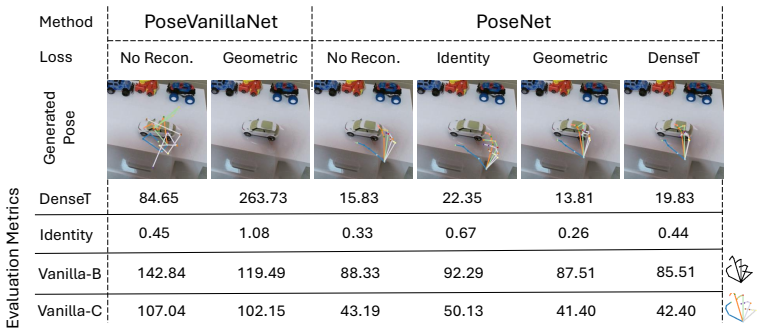
The paper's central claim is that a 21-point hand pose, viewed as a graph with joints as nodes and bones as edges, contains enough geometric structure for both generation and evaluation. Three descriptor functions are proposed or adapted: DenseT, the set of Euclidean distances between every pair of points; Geometric, combining distances from the wrist, bone lengths, and the sine of the angle between adjacent phalanges; and Spectral, the eigenvalues and eigenvectors of a weighted graph Laplacian whose off-diagonal weights are negative inter-joint distances. These descriptors enter the diffusion training objective as a pose reconstruction loss, and they define evaluation scores f-FID by computing Fréchet distance between descriptor-population means and covariances. On the HOI4D grasp and carry split, the paper reports that its PoseNet and latent-diffusion variants beat its PoseVanillaNet baseline under every metric, that HOR-based losses beat identity and no-reconstruction losses, and that the new metrics are roughly a hundred times faster than FID and MMD while staying stable when rendering color changes. The paper presents this as a first framework of hand-grasp-specific evaluation metrics and states that the overall approach outperforms existing state-of-the-art grasp generators by removing their dependence on 3D geometry and adding user-specified placement.
Load-bearing premise
The argument assumes that the proposed pose descriptors measure grasp quality even though they are also the training objective, and that beating the paper's own baseline establishes superiority over prior methods.
Editorial extensions
If this is right
- A grasp generator can be conditioned on a 2D image and a location mask, removing the need for 3D object scans when producing affordance interactions.
- The same HOR loss can be attached to any diffusion-style pose decoder, because the descriptors are computed directly from the output pose.
- f-FID evaluation of 360 samples takes about two seconds after precomputation, versus minutes for FID, making iterative comparison of generators practical.
- Geometric descriptors ignore rendering color, so evaluation ranks no longer flip between grayscale and colored hand skeletons as standard FID does in the paper.
- Using HOR-based reconstruction loss yields better visual contact and generalization to unseen grasp orientations than identity loss or no reconstruction loss.
Reading between the lines
- A check the paper does not run: correlate f-FID with contact-penetration error or human ratings. If the correlation is weak, the unbiasedness claim would need qualification.
- Because the descriptor framework is plug-and-play, other graph signatures (such as heat-kernel statistics or curvature filtrations) could be dropped into the same loss and f-FID machinery without changing the architecture.
- The mask control is demonstrated for single poses on one dataset; the same conditioning could extend to whole-body poses or to temporal grasp sequences, but the paper does not test those.
- Standard FID's color sensitivity shown here suggests that any appearance-based generative metric should be reported alongside a geometry-only metric, an inference the paper does not draw.
Signed reviews
Editorial analysis
A structured set of objections, weighed in public.
Referee Report
Summary. The paper proposes a conditional diffusion model for generating 2D hand grasps from a single RGB image and a location/orientation mask, using "higher-order representations" (HORs) of the hand pose graph: DenseT, Geometric, Spectral, and Identity. These descriptors are used in a pose reconstruction loss (Eq. 7-8). The paper also proposes f-FID evaluation metrics computed on these same descriptors (Eq. 9-11) and claims they are efficient, stable, and unbiased compared with FID and MMD. Experiments on HOI4D compare four internal model variants against a PoseVanillaNet baseline using f-FID, FID, and MMD; no published grasp-generation method is quantitatively compared.
Significance. If the proposed 2D controllable generation and fast evaluation metrics worked as claimed, they would address a real bottleneck in HOI synthesis: controllability of hand placement without 3D object geometry, and cheaper evaluation of grasp generators. The efficiency numbers in Table 1 are a useful practical contribution, and the idea of evaluating hand poses through geometric descriptors is worth exploring. However, the evidence as presented is not sufficient: the SOTA claim has no external quantitative baseline, the f-FID metrics use the same descriptors as the training loss, and no external validity check is provided. The paper is therefore currently more a framework proposal than a validated method.
major comments (5)
- [Abstract; §6, Table 2] The claim that the proposed diffusion model "outperforms the state of the art" is not supported by the experiments. Table 2, the only quantitative comparison, evaluates only the authors' own variants (PoseVanillaNet, PoseNet, PoseNetD, PoseNetLdm, PoseNetLdmD). No score for GrabNet, D-Grasp, GraspTTA, HOIDiffusion, or Affordance Diffusion appears anywhere; the only external comparison is the qualitative Figure 4, which cannot substantiate a quantitative superiority claim. Since the central contribution is this outperformance, this is a load-bearing gap.
- [§5, Eq. (7)-(8), Eq. (11), Table 2] The evaluation-metric contribution is undermined by the overlap between the metric space and the training objective. The f-FID descriptors are exactly the descriptor functions f used in Lpose in Eq. (7)-(8), so DenseT-FID, Geometric-FID, and Spectral-FID measure proximity in the same representation space the model was trained to match. The claim that these metrics are "unbiased" (Sec. 5, Sec. 7) is not supported: no independent human rating, contact/physics consistency measure, or comparison against a known ground-truth ranking is provided. The stability analysis in Fig. 3 is qualitative visual inspection, not a bias test. Please add external validation and report results for models trained without reconstruction losses.
- [§4.1.3, Eq. (4)-(5)] The definition of the Spectral descriptor is internally inconsistent. In Eq. (4), w(u,v) is set to -d(u,v) on graph edges and to dv on the diagonal; this matrix already has the structure of a graph Laplacian. The subsequent text then defines the Laplacian as L = D - W, which is ambiguous if W is taken to be the matrix defined in Eq. (4). Please clarify whether the descriptor uses Eq. (4) directly or the Laplacian computed from a nonnegative adjacency matrix; without this, Spectral-FID and the Spectral-based generation cannot be reproduced.
- [§4.1.2; §1] DenseT is introduced as a higher-order representation, but it consists of all pairwise Euclidean distances between joints; pairwise distances are first-order graph statistics, not higher-order dependencies. The paper's central claim that "higher order contextual dependency among the points improves the quality of the results" (Sec. 1) is therefore not supported by the DenseT descriptor, which is one of the two novel HORs. The authors should either justify the terminology or reframe the contribution around multi-scale geometric descriptors.
- [§6, Table 2, Fig. 3] All quantitative results in Table 2 are single runs on 360 generated samples with no error bars, standard deviations, or significance tests. The "stability" conclusion in Sec. 6.2 is based on inspecting one pair of FID values (97.65 vs 97.60), which is not a stability analysis. Please report multiple seeds and statistical comparison of the reported rankings.
minor comments (6)
- [§4.3.1, Eq. (7)] The variable ŷ is not defined in Eq. (7); please state that it is the denoised predicted hand pose and specify the distribution over which the expectation is taken.
- [§4.3.2, Eq. (8)] The hyperparameters λ1 and λ2 are never given, nor is the diffusion schedule (β_t, T) or the latent dimension for PoseNetLdm; these details are needed for reproducibility.
- [Table 1] The header of Table 1 is ambiguous about which columns correspond to precomputation of 2k/20k samples and which correspond to evaluation of 360 samples; please clarify the timing methodology, including number of runs and hardware.
- [Throughout] There are typos and grammatical issues, including "Appedix" in Sec. 5 and Sec. 6, and the incomplete abstract sentence "Overcoming the limitations of existing methods: like lacking of controllability and dependency on 3D information."
- [Fig. 3] The numerical values in the rows of Fig. 3 are difficult to read in the typeset figure; please enlarge them or provide the same information in a table.
- [Reproducibility] No code or data release statement is provided; please add one or state that the code will be made available.
Circularity Check
The f-FID evaluation metrics are computed on the same HOR descriptors used as training losses, so the main quantitative claim that HOR losses improve quality partly restates the training objective.
-
fitted input called prediction
[Sec. 5 (Eqs. 9-11), Sec. 4.3 (Eqs. 7-8), and Table 2]
"We use the HOR's of hand poses to derive the evaluation metrics. For a descriptor function f, we represent the evaluation metric as f-FID. ... Following is the formula to compute the pose reconstruction loss for a given descriptor function f. Lpose = Ey,ˆy [ f (y) − ˆf (y) 2 ] ... L = λ1Ldiffusion + λ2Lpose ... it is evident that our HOR's representation-based loss performs better than the Identity representation for all evaluation metrics showing its efficacy to capture higher order geometric interactions."
The same descriptor function f is both the training target (Eq. 7-8) and the feature map for the evaluation metric (Eq. 9-11). Models tagged Geometric-loss or DenseT-loss are optimized to minimize per-sample ||f(y)-f(ŷ)||^2, while f-FID measures the Frechet distance between the real and generated distributions of f. Minimizing per-sample f-error moves the generated f-mean and f-covariance toward the real ones, lowering f-FID relative to models trained with Identity or no reconstruction loss. Thus the Table 2 claim that HOR losses outperform Identity 'for all evaluation metrics' is partly a restatement of the training objective rather than an independent validation of grasp quality.
full rationale
This paper does not rely on a self-citation chain or an imported uniqueness theorem; the generative model and HOR descriptors are defined from the hand-pose graph, with external citations for the diffusion objective, spectral graph theory, and the geometric-loss adaptation. The principal circularity is in the evaluation framework: the f-FID metrics of Section 5 are FID statistics over the same HOR descriptors f that appear in the pose reconstruction loss of Eq. 7-8. Consequently, the quantitative comparison in Table 2 showing that Geometric/DenseT losses beat Identity is partly an artifact of metric-objective matching, not an independent measurement of grasp quality. The circularity is partial because the paper also includes qualitative comparisons and vanilla-FID columns, and because some table entries (e.g., No-Recon PoseNet's DenseT-FID of 15.83) do not strictly follow the training-loss ordering. Separate from circularity, the abstract's 'outperforms SOTA' claim is unsupported by the experiments, which compare only the authors' own PoseNet variants against PoseVanillaNet; that is a correctness/evidence gap, not a circular step, and is not counted in the score.
Assumptions & free parameters
free parameters (2)
- loss weights lambda1, lambda2 =
not reported
- diffusion schedule beta_t and number of steps T =
not reported
assumptions (5)
- domain assumption Hand pose graph structure with 21 joints and bone edges captures grasp-relevant geometry.
- domain assumption HOI4D 2D annotations for Grasp and Carry actions are accurate enough for training and metric computation.
- standard math The graph Laplacian spectrum is a valid and stable descriptor for hand poses.
- ad hoc to paper f-FID computed on geometric descriptors is an unbiased metric of generated grasp quality.
- domain assumption The 5-parameter shape mask of [25] controls hand location and orientation as required.
Cite this review
Pith. "Pith review of Controllable Hand Grasp Generation for HOI and Efficient Evaluation Methods." pith.science (2026). https://pith.science/paper/JATDDD6O
@misc{pith2026250115839,
  author       = {Pith},
  title        = {Pith review of: Controllable Hand Grasp Generation for HOI and Efficient Evaluation Methods},
  year         = {2026},
  howpublished = {\url{https://pith.science/paper/JATDDD6O}},
  note         = {Machine review of arXiv:2501.15839}
}
read the original abstract
Controllable affordance Hand-Object Interaction (HOI) generation has become an increasingly important area of research in computer vision. In HOI generation, the hand grasp generation is a crucial step for effectively controlling the geometry of the hand. Current hand grasp generation methods rely on 3D information for both the hand and the object. In addition, these methods lack controllability concerning the hand's location and orientation. We treat the hand pose as the discrete graph structure and exploit the geometric priors. It is well established that higher order contextual dependency among the points improves the quality of the results in general. We propose a framework of higher order geometric representations (HOR's) inspired by spectral graph theory and vector algebra to improve the quality of generated hand poses. We demonstrate the effectiveness of our proposed HOR's in devising a controllable novel diffusion method (based on 2D information) for hand grasp generation that outperforms the state of the art (SOTA). Overcoming the limitations of existing methods: like lacking of controllability and dependency on 3D information. Once we have the generated pose, it is very natural to evaluate them using a metric. Popular metrics like FID and MMD are biased and inefficient for evaluating the generated hand poses. Using our proposed HOR's, we introduce an efficient and stable framework of evaluation metrics for grasp generation methods, addressing inefficiencies and biases in FID and MMD.
Figures


Figures from the paper (1 more)

Reference graph
Works this paper leans on
-
[1]
Geometric deep learning: going beyond euclidean data
Michael M Bronstein, Joan Bruna, Yann LeCun, Arthur Szlam, and Pierre Vandergheynst. Geometric deep learning: going beyond euclidean data. IEEE Signal Processing Mag- azine, 34(4):18–42, 2017. 1
work page 2017
-
[2]
gsdf: Geometry-driven signed distance functions for 3d hand-object reconstruction
Zerui Chen, Shizhe Chen, Cordelia Schmid, and Ivan Laptev. gsdf: Geometry-driven signed distance functions for 3d hand-object reconstruction. In Proceedings of the IEEE/CVF conference on computer vision and pattern recognition , pages 12890–12900, 2023. 1
work page 2023
-
[3]
D-grasp: Physically plausible dynamic grasp synthesis for hand-object interac- tions
Sammy Christen, Muhammed Kocabas, Emre Aksan, Jemin Hwangbo, Jie Song, and Otmar Hilliges. D-grasp: Physically plausible dynamic grasp synthesis for hand-object interac- tions. In Proceedings of the IEEE/CVF Conference on Com- puter Vision and Pattern Recognition , pages 20577–20586,
-
[4]
Fan RK Chung. Spectral graph theory . American Mathe- matical Soc., 1997. 1, 3, 4
work page 1997
-
[5]
Ganhand: Predicting human grasp affordances in multi-object scenes
Enric Corona, Albert Pumarola, Guillem Alenya, Francesc Moreno-Noguer, and Gr ´egory Rogez. Ganhand: Predicting human grasp affordances in multi-object scenes. InProceed- ings of the IEEE/CVF conference on computer vision and pattern recognition, pages 5031–5041, 2020. 2
2020
-
[6]
Posi- tion information in transformers: An overview
Philipp Dufter, Martin Schmitt, and Hinrich Sch ¨utze. Posi- tion information in transformers: An overview. Computa- tional Linguistics, 48(3):733–763, 2022. 4
work page 2022
-
[7]
Learning joint reconstruction of hands and manipulated ob- jects
Yana Hasson, Gul Varol, Dimitrios Tzionas, Igor Kale- vatykh, Michael J Black, Ivan Laptev, and Cordelia Schmid. Learning joint reconstruction of hands and manipulated ob- jects. In Proceedings of the IEEE/CVF conference on com- puter vision and pattern recognition , pages 11807–11816,
-
[8]
Gans trained by a two time-scale update rule converge to a local nash equilib- rium
Martin Heusel, Hubert Ramsauer, Thomas Unterthiner, Bernhard Nessler, and Sepp Hochreiter. Gans trained by a two time-scale update rule converge to a local nash equilib- rium. Advances in neural information processing systems , 30, 2017. 2
2017
Show all 28 references
-
[9]
Denoising dif- fusion probabilistic models
Jonathan Ho, Ajay Jain, and Pieter Abbeel. Denoising dif- fusion probabilistic models. In Advances in Neural Informa- tion Processing Systems, 2020. 2
2020
-
[10]
Hand-object contact consistency reasoning for human grasps generation
Hanwen Jiang, Shaowei Liu, Jiashun Wang, and Xiaolong Wang. Hand-object contact consistency reasoning for human grasps generation. In Proceedings of the IEEE/CVF interna- tional conference on computer vision , pages 11107–11116,
-
[11]
Dall- e-bot: Introducing web-scale diffusion models to robotics
Ivan Kapelyukh, Vitalis V osylius, and Edward Johns. Dall- e-bot: Introducing web-scale diffusion models to robotics. IEEE Robotics and Automation Letters , 8(7):3956–3963,
-
[12]
Hoi4d: A 4d egocentric dataset for category-level human- object interaction
Yunze Liu, Yun Liu, Che Jiang, Kangbo Lyu, Weikang Wan, Hao Shen, Boqiang Liang, Zhoujie Fu, He Wang, and Li Yi. Hoi4d: A 4d egocentric dataset for category-level human- object interaction. In Proceedings of the IEEE/CVF Confer- ence on Computer Vision and Pattern Recognition ...
2022
-
[13]
Graphs and geometry
L ´aszl´o Lov´asz. Graphs and geometry. American Mathemat- ical Soc., 2019. 2
2019
-
[14]
A geometry loss combina- tion for 3d human pose estimation
Ai Matsune, Shichen Hu, Guangquan Li, Sihan Wen, Xi- antan Zhu, and Zhiming Tan. A geometry loss combina- tion for 3d human pose estimation. In Proceedings of the IEEE/CVF Winter Conference on Applications of Computer Vision, pages 3272–3281, 2024. 1, 3
2024
-
[15]
Evaluation metrics for graph generative models: Problems, pitfalls, and practical solutions
Leslie O’Bray, Max Horn, Bastian Rieck, and Karsten Borg- wardt. Evaluation metrics for graph generative models: Problems, pitfalls, and practical solutions. arXiv preprint arXiv:2106.01098, 2021. 2, 3, 5
2021 arXiv
-
[16]
Higher-order implicit fair- ing networks for 3d human pose estimation
Jianning Quan and A Ben Hamza. Higher-order implicit fair- ing networks for 3d human pose estimation. arXiv preprint arXiv:2111.00950, 2021. 1, 3
2021 arXiv
-
[17]
Conditional frechet inception distance
Michael Soloveitchik, Tzvi Diskin, Efrat Morin, and Ami Wiesel. Conditional frechet inception distance. arXiv preprint arXiv:2103.11521, 2021. 2
2021 arXiv
-
[18]
Curvature filtrations for graph generative model evaluation
Joshua Southern, Jeremy Wayland, Michael Bronstein, and Bastian Rieck. Curvature filtrations for graph generative model evaluation. Advances in Neural Information Process- ing Systems, 36, 2024. 2
2024
-
[19]
Mmd graph kernel: Effective met- ric learning for graphs via maximum mean discrepancy
Yan Sun and Jicong Fan. Mmd graph kernel: Effective met- ric learning for graphs via maximum mean discrepancy. In The Twelfth International Conference on Learning Represen- tations, 2024. 2
2024
-
[20]
Grab: A dataset of whole-body human grasp- ing of objects
Omid Taheri, Nima Ghorbani, Michael J Black, and Dim- itrios Tzionas. Grab: A dataset of whole-body human grasp- ing of objects. In Computer Vision–ECCV 2020: 16th Eu- ropean Conference, Glasgow, UK, August 23–28, 2020, Pro- ceedings, Part IV 16, pages 581–600. Springer, 2020. 1, 2, 5
2020
-
[21]
Capturing hands in action using discriminative salient points and physics sim- ulation
Dimitrios Tzionas, Luca Ballan, Abhilash Srikantha, Pablo Aponte, Marc Pollefeys, and Juergen Gall. Capturing hands in action using discriminative salient points and physics sim- ulation. International Journal of Computer Vision, 118:172– 193, 2016. 2
2016
-
[22]
3d hand pose estimation and reconstruction based on multi-feature fusion
Jiye Wang, Xuezhi Xiang, Shuai Ding, and Abdulmotaleb El Saddik. 3d hand pose estimation and reconstruction based on multi-feature fusion. Journal of Visual Communication and Image Representation, 101:104160, 2024. 1
2024
-
[23]
Hoi-swap: Swapping objects in videos with hand-object in- teraction awareness
Zihui Xue, Mi Luo, Changan Chen, and Kristen Grauman. Hoi-swap: Swapping objects in videos with hand-object in- teraction awareness. arXiv preprint arXiv:2406.07754, 2024. 1
2024 arXiv
-
[24]
Learn- ing interactive real-world simulators
Mengjiao Yang, Yilun Du, Kamyar Ghasemipour, Jonathan Tompson, Dale Schuurmans, and Pieter Abbeel. Learn- ing interactive real-world simulators. arXiv preprint arXiv:2310.06114, 2023. 1
2023 arXiv
-
[25]
Affordance diffusion: Synthesizing hand-object interac- tions
Yufei Ye, Xueting Li, Abhinav Gupta, Shalini De Mello, Stan Birchfield, Jiaming Song, Shubham Tulsiani, and Sifei Liu. Affordance diffusion: Synthesizing hand-object interac- tions. In Proceedings of the IEEE/CVF Conference on Com- puter Vision and Pattern Recognition , pages ...
-
[26]
Hoidiffusion: Generating real- istic 3d hand-object interaction data
Mengqi Zhang, Yang Fu, Zheng Ding, Sifei Liu, Zhuowen Tu, and Xiaolong Wang. Hoidiffusion: Generating real- istic 3d hand-object interaction data. In Proceedings of the IEEE/CVF Conference on Computer Vision and Pattern Recognition, pages 8521–8531, 2024. 1, 2 9
2024
-
[27]
Toward human-like grasp: Dexterous grasping via semantic repre- sentation of object-hand
Tianqiang Zhu, Rina Wu, Xiangbo Lin, and Yi Sun. Toward human-like grasp: Dexterous grasping via semantic repre- sentation of object-hand. In Proceedings of the IEEE/CVF International Conference on Computer Vision, pages 15741– 15751, 2021. 1, 2
2021
-
[28]
Learning to esti- mate 3d hand pose from single rgb images
Christian Zimmermann and Thomas Brox. Learning to esti- mate 3d hand pose from single rgb images. InProceedings of the IEEE international conference on computer vision, pages 4903–4911, 2017. 3 10
2017
Reviewed August 10, 2026 · model on record in the stance chip above.
Discussion (0). Continue with ORCID to comment.