REVIEW 4 major objections 5 minor 40 references
Rethinking the Bias of Foundation Model under Long-tailed Distribution
T0 review · 4 major / 5 minor · reviewed 2026-08-10 · deepseek-v4-flash
Pith's one-line read Foundation models carry hidden bias from pre-training data that ordinary re-balancing cannot fix; the paper proposes a causal backdoor adjustment that averages three models and lifts accuracy ~1.67% per dataset.
desk verdict Useful empirical decomposition of upstream vs downstream imbalance in fine-tuned foundation models, but the 'backdoor adjustment' is really an equal-weight ensemble and the causal story should be cut or substantially rewritten. read the letter →
The pith
A machine-rendered reading of the paper's core claim, the machinery that carries it, and where it could break.
The reading
What carries the argument
The key machinery is backdoor adjustment from causal inference. The paper models an incomplete semantic factor $C$ — a partial feature captured by a biased pre-trained model, such as focusing on a dog's head instead of its whole body — as a confounder that opens the spurious path $X\leftarrow C\rightarrow Y$. By estimating $P(Y|\operatorname{do}(x)) = \sum_c P(Y|b,c)P(c)$ with balanced representation $b$, the method removes the confounding effect; with $P(c)=1/M$ and $M=3$ models, the operation is an equal-weight fusion of three fine-tuned, logit-adjusted models.
What would settle it
A simple test construction is given by the paper's own E.9 setup: train the same model on data generated with unbalanced incomplete semantic factors (e.g. 90 percent dog-head images) and observe a large performance drop on a balanced test set, which would confirm the confounder effect; conversely, if varying the prior of the incomplete semantic factors across models produces no drop and averaging three arbitrary models gives the same gain, the causal mechanism is not needed.
Extended reading notes
Core claim
The paper finds that fine-tuning a foundation model on a long-tailed task inherits two separate biases: data imbalance from the downstream data and parameter imbalance from the pre-training data. Parameter imbalance, measured by the estimated label prior of the inaccessible pre-training data, persists after fine-tuning and is not mitigated by logit adjustment or other re-balancing losses applied during training. The proposed remedy is a backdoor adjustment that estimates $P(Y|\operatorname{do}(x))$ instead of $P(Y|x)$, treating the incomplete semantic factor $C$ as a confounder on the path $X\leftarrow C\rightarrow Y$. Concretely, the method fine-tunes three CLIP-family models (CLIP, OpenCLIP, MetaCLIP) with a re-balanced loss, treats each as an instantiation of an incomplete semantic factor, and averages their predictions under a uniform prior $P(c)=1/M$. The paper reports that this adjustment yields an average gain of about 1.67% per dataset over the strongest baselines on ImageNet-LT, Places365-LT, and iNaturalist2018.
Load-bearing premise
The entire causal interpretation rests on treating CLIP, OpenCLIP, and MetaCLIP as three draws from the confounder distribution $C$ with equal prior; if they are not exchangeable instantiations of the same incomplete semantic factor, the backdoor adjustment is just an equal-weight ensemble.
Editorial extensions
If this is right
- If parameter imbalance is the dominant bias in fine-tuned foundation models, then improving tail-class performance on a downstream task requires acting on pre-trained weights, not just on the downstream loss or classifier.
- Logit adjustment and similar re-balancing techniques should be re-evaluated for PEFT-based long-tailed learning: they help data imbalance by improving the classifier but leave parameter imbalance largely untouched.
- Ensembling multiple foundation models that have different pre-training data biases becomes a practical way to deconfound downstream predictions, with gains that grow as more diverse models are added.
- The backdoor adjustment gives a concrete way to improve fairness across head and tail classes simultaneously, without the trade-off usually seen when re-balancing only the classifier.
- The causal framing suggests that any future foundation model with known different pre-training imbalance could be plugged into this adjustment without retraining.
Reading between the lines
- Editorial inference: the uniform prior $P(c)=1/M$ makes the method an equal-weight ensemble; if the three models are not exchangeable draws from the confounder distribution, the causal language is not strictly needed to describe the result — averaging three logit-adjusted models may still work as an ensembling trick.
- Editorial inference: the method could be tested against a cheaper alternative, e.g. fine-tuning one model with three different re-balancing seeds or three different PEFT adapters, to see whether the gains come from model diversity or from the causal adjustment itself.
- Editorial inference: the paper's own E.4 experiments suggest that adding more tail data can mitigate parameter imbalance in the Reverse setting, implying a testable conjecture that data augmentation for tail classes could substitute for extra foundation models.
- Editorial inference: because the method averages three fine-tuned models, its FLOPs in the paper grow linearly with $M$; the evaluation of trade-off between compute and accuracy gains is left open.
Signed reviews
Editorial analysis
A structured set of objections, weighed in public.
Referee Report
Summary. The paper studies how pretraining imbalance in foundation models affects long-tailed downstream classification. It distinguishes parameter imbalance (bias inherited from imbalanced pretraining data, estimated through a GLA-based prior) from data imbalance (bias from the downstream long-tailed training set), and argues empirically that parameter imbalance is more influential and cannot be fixed by logit adjustment. The proposed method, framed as a backdoor adjustment, treats an 'incomplete semantic factor' C as a confounder and averages LA-adjusted predictions from CLIP, OpenCLIP, and MetaCLIP. Experiments on ImageNet-LT, Places365-LT, and iNaturalist2018 show consistent accuracy gains over PEFT baselines, with additional ablations over M and PEFT variants.
Significance. The paper contains a useful and reproducible empirical study: the finding that logit-adjustment improves the classifier more than the representation (Tab. 4), and the observation that GLA-Train does not remove the pretraining bias (Tab. 3), are informative for practitioners. The proposed method is simple, code is released, and the reported gains are consistent across three large long-tailed benchmarks and two PEFT methods. However, the central advertised contribution is the causal claim that the method 'learns the true causal effect between input samples and labels.' That claim is not supported: the estimator in Eq. (7) reduces to an equal-weight ensemble of LA-adjusted models, and no identification argument for C or the uniform prior is provided. The empirical method may still be valuable as a diversified ensemble, but the causal interpretation is the load-bearing part of the paper's framing and is currently unsubstantiated.
major comments (4)
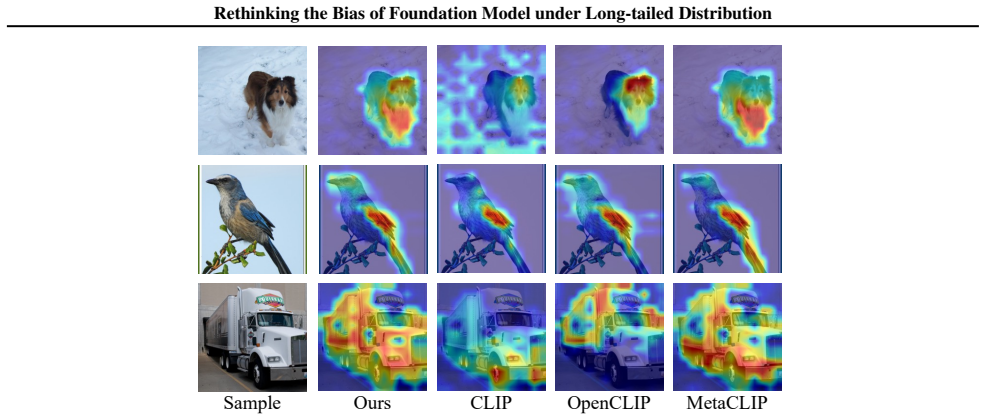
- [Sec. 4.2, Eq. (7)] The backdoor adjustment in Eq. (7) requires C to be a well-defined confounder with a known distribution, but no constructive definition or measurement model for C is given. The three foundation models are treated as instantiations of C, yet model identity is not a value of a semantic factor; the Grad-CAM evidence in Fig. 4 and Sec. E.6 shows differential attention, which demonstrates diversity, not identification. Consequently, with P(c)=1/M, Eq. (7) is an equal-weight average of LA-adjusted logits, and the Abstract's claim that the method 'learns the true causal effect' is not established. A necessary control is a baseline that applies the same LA adjustment to each of the three models and simply averages their logits, without the causal framing.
- [Sec. 4.2 and Tab. 8] The uniform prior P(c)=1/M and the exchangeability of CLIP, OpenCLIP, and MetaCLIP are load-bearing assumptions, but they are not tested or defended. The M-ablation in Tab. 8 only shows that adding more foundation models improves accuracy, which is also the generic behavior of an ensemble and is compatible with a model in which C has no causal role. Without a check of the prior or an identification argument for C, the method cannot be described as a backdoor adjustment; it is an ensemble with equal weights.
- [Sec. 3.1, Def. 3.1, Eq. (3)] The empirical decomposition into parameter imbalance and data imbalance relies entirely on the GLA-estimated prior bPP(Y), both for the P-Many/P-Medium/P-Few groupings and for Definition 3.1. Since bPP(Y) is fitted on the validation set (Eq. 3) and the true PP(Y) is inaccessible, the paper should provide a sensitivity analysis showing that the qualitative conclusions in Fig. 3 and Tab. 2 are robust to errors in bPP(Y); otherwise the central claim that parameter imbalance 'plays a more critical role' could be an artifact of the estimator rather than a property of pretraining data.
- [Appendix E.9] The synthetic experiment intended to verify that C is a confounder defines C explicitly as an object part in generated images, so it cannot validate the real-world identification of C across CLIP, OpenCLIP, and MetaCLIP. Moreover, the statement that a model trained on Atrain estimates P(Y|do(X)) is asserted rather than derived; balanced training over C is not an intervention in the causal sense, so the experiment does not supply the missing identification argument.
minor comments (5)
- [Abstract and Sec. 5] The claimed 'average performance increase of about 1.67%' is not precisely defined; please specify which baselines and datasets are averaged, and report variance or significance if available.
- [Appendix A.1] The line 'It contains a total of 12.21K images' for ImageNet-LT is a factual error; ImageNet-LT has approximately 115.8K training images.
- [Tab. 5] The Decoder row reports '21.26 34' under Params and Epochs; this appears to be a formatting error with missing units (presumably 21.26M and 34).
- [Appendix E.7] The sentence 'As shown in Fig. 8, the result verifies our point' appears to refer to Fig. 9, which is the figure showing the comparison between training from scratch and fine-tuning.
- [Tabs. 3, 11, 13] There are several typographical errors in table captions and text, including 'Ther performance' in Tabs. 3 and 11 and 'Resverse' in Tab. 13; these should be corrected.
Circularity Check
The backdoor adjustment in Eq. (7) is an equal-weight ensemble over three open checkpoints; the 'true causal effect' is defined, not derived, so the causal claim is circular even though the benchmark gains are empirical.
-
renaming known result
[Sec. 4.2, Eq. (7); Sec. 4.2 'Backdoor adjustment'; Ablation Tab. 8]
"P(Y=y|do(x)) = Σ_{b∈B} Σ_{c∈C} P(Y=y|b,c)P(c)P(b|x) = Σ_{c∈C} P(Y=y|b,c)P(c) (7) ... For simplicity, we assume P(c) = 1/M, where M is the number of incomplete semantic factors. ... Since iterating over all possible incomplete semantic factors is impractical, we approximate these factors using models like CLIP, OpenCLIP, and MetaCLIP, thereby addressing Eq. 7 and simplifying the process of balancing both parameter and data imbalances simultaneously."
Eq. (7) is the complete estimator: the injective B mapping gives P(b|x)=1, so P(Y|do(x)) is defined as Σ_c P(Y|b,c)P(c), and with P(c)=1/M the only operational values of c are the three checkpoints CLIP, OpenCLIP, and MetaCLIP. Hence the 'backdoor-adjusted' score is by construction the equal-weight average of the LA-debiased outputs of those three models. The paper supplies no independent measurement of C, no argument that the three checkpoints are draws from a distribution over incomplete semantic factors, and no test of the uniform prior; the causal interpretation is attached to an ensemble average rather than derived from identification. The monotone M-ablation (Tab.
full rationale
The paper's empirical study of parameter vs data imbalance (Sec. 3) is not circular: it measures accuracy gaps across checkpoints, uses an external GLA prior estimate, and contrasts CE/LA/GLA-Train; those findings can stand on their own. Similarly, the reported 1.67% average gains are genuine benchmark numbers, and the method is self-contained against external baselines. The circularity is confined to the causal claim. Section 4.2 labels a uniform average of LA-adjusted logits from CLIP, OpenCLIP, and MetaCLIP as a backdoor adjustment, assumes P(c)=1/M without identification, and then uses the M-ablation as confirmation. That is a renaming of an equal-weight ensemble into causal language. Since the central advertised contribution is 'learns the true causal effect,' this is partial circularity (score 6): the empirical component is independent, but the causal interpretation is definitional. No load-bearing self-citation chain is present; no fitted parameter is renamed as a prediction beyond the causal label applied to Eq. (7).
Assumptions & free parameters
free parameters (2)
- M (number of incomplete semantic factors) =
3 (CLIP, OpenCLIP, MetaCLIP)
- Estimated pre-training label prior from GLA (Eq. 3) =
per-class estimated priors
assumptions (5)
- domain assumption Incomplete semantic factor C is a confounder with fork X <- C -> Y (Fig. 5).
- domain assumption The mapping X -> B is injective and P(b|x) = 1 for the unique balanced representation b (Eq. 7).
- ad hoc to paper P(c) = 1/M, uniform over incomplete semantic factors.
- ad hoc to paper CLIP, OpenCLIP, and MetaCLIP are exchangeable instantiations of C.
- domain assumption GLA's estimated prior is a valid proxy for the true pre-training label prior.
invented entities (3)
-
Incomplete semantic factor C
-
Parameter imbalance D (causal variable)
-
Inaccessible semantic factor U
Cite this review
Pith. "Pith review of Rethinking the Bias of Foundation Model under Long-tailed Distribution." pith.science (2026). https://pith.science/paper/AFUEXSQA
@misc{pith2026250115955,
  author       = {Pith},
  title        = {Pith review of: Rethinking the Bias of Foundation Model under Long-tailed Distribution},
  year         = {2026},
  howpublished = {\url{https://pith.science/paper/AFUEXSQA}},
  note         = {Machine review of arXiv:2501.15955}
}
abstract
Long-tailed learning has garnered increasing attention due to its practical significance. Among the various approaches, the fine-tuning paradigm has gained considerable interest with the advent of foundation models. However, most existing methods primarily focus on leveraging knowledge from these models, overlooking the inherent biases introduced by the imbalanced training data they rely on. In this paper, we examine how such imbalances from pre-training affect long-tailed downstream tasks. Specifically, we find the imbalance biases inherited in foundation models on downstream task as parameter imbalance and data imbalance. During fine-tuning, we observe that parameter imbalance plays a more critical role, while data imbalance can be mitigated using existing re-balancing strategies. Moreover, we find that parameter imbalance cannot be effectively addressed by current re-balancing techniques, such as adjusting the logits, during training, unlike data imbalance. To tackle both imbalances simultaneously, we build our method on causal learning and view the incomplete semantic factor as the confounder, which brings spurious correlations between input samples and labels. To resolve the negative effects of this, we propose a novel backdoor adjustment method that learns the true causal effect between input samples and labels, rather than merely fitting the correlations in the data. Notably, we achieve an average performance increase of about $1.67\%$ on each dataset. Code is available: https://github.com/JiahaoChen1/Pre-train-Imbalance
Figures


Figures from the paper (8 more)




Reference graph
Works this paper leans on
-
[1]
Adaptformer: Adapting vision transformers for scalable visual recognition
Chen, S., Ge, C., Tong, Z., Wang, J., Song, Y., Wang, J., and Luo, P. Adaptformer: Adapting vision transformers for scalable visual recognition. Advances in Neural Information Processing Systems, 35: 0 16664--16678, 2022
2022
-
[2]
Reproducible scaling laws for contrastive language-image learning
Cherti, M., Beaumont, R., Wightman, R., Wortsman, M., Ilharco, G., Gordon, C., Schuhmann, C., Schmidt, L., and Jitsev, J. Reproducible scaling laws for contrastive language-image learning. In Proceedings of the IEEE/CVF Conference on Computer Vision and Pattern Recognition, pp.\ 2818--2829, 2023
2023
-
[3]
and Hart, P
Cover, T. and Hart, P. Nearest neighbor pattern classification. IEEE transactions on information theory, 13 0 (1): 0 21--27, 1967
1967
-
[4]
Class-balanced loss based on effective number of samples
Cui, Y., Jia, M., Lin, T.-Y., Song, Y., and Belongie, S. Class-balanced loss based on effective number of samples. In Proceedings of the IEEE Conference on Computer Vision and Pattern Recognition, pp.\ 9268--9277, 2019
2019
-
[5]
Imagenet: A large-scale hierarchical image database
Deng, J., Dong, W., Socher, R., Li, L.-J., Li, K., and Fei-Fei, L. Imagenet: A large-scale hierarchical image database. In 2009 IEEE conference on computer vision and pattern recognition, pp.\ 248--255. Ieee, 2009
2009
-
[6]
Lpt: Long-tailed prompt tuning for image classification
Dong, B., Zhou, P., Yan, S., and Zuo, W. Lpt: Long-tailed prompt tuning for image classification. arXiv preprint arXiv:2210.01033, 2022
arXiv 2022
-
[7]
An image is worth 16x16 words: Transformers for image recognition at scale
Dosovitskiy, A., Beyer, L., Kolesnikov, A., Weissenborn, D., Zhai, X., Unterthiner, T., Dehghani, M., Minderer, M., Heigold, G., Gelly, S., et al. An image is worth 16x16 words: Transformers for image recognition at scale. arXiv preprint arXiv:2010.11929, 2020
arXiv 2010
-
[8]
Guo, H. and Wang, S. Long-tailed multi-label visual recognition by collaborative training on uniform and re-balanced samplings. In Proceedings of the IEEE/CVF Conference on Computer Vision and Pattern Recognition, pp.\ 15089--15098, 2021
work page 2021
Show all 40 references
-
[9]
Deep residual learning for image recognition
He, K., Zhang, X., Ren, S., and Sun, J. Deep residual learning for image recognition. In Proceedings of the IEEE conference on computer vision and pattern recognition, pp.\ 770--778, 2016
2016
-
[10]
Parameter-efficient transfer learning for nlp
Houlsby, N., Giurgiu, A., Jastrzebski, S., Morrone, B., De Laroussilhe, Q., Gesmundo, A., Attariyan, M., and Gelly, S. Parameter-efficient transfer learning for nlp. In International Conference on Machine Learning, pp.\ 2790--2799. PMLR, 2019
2019
-
[11]
J., Shen, Y., Wallis, P., Allen-Zhu, Z., Li, Y., Wang, S., Wang, L., and Chen, W
Hu, E. J., Shen, Y., Wallis, P., Allen-Zhu, Z., Li, Y., Wang, S., Wang, L., and Chen, W. Lora: Low-rank adaptation of large language models. arXiv preprint arXiv:2106.09685, 2021
2021 arXiv
-
[12]
Visual prompt tuning
Jia, M., Tang, L., Chen, B.-C., Cardie, C., Belongie, S., Hariharan, B., and Lim, S.-N. Visual prompt tuning. In European Conference on Computer Vision, pp.\ 709--727. Springer, 2022
2022
-
[13]
Decoupling representation and classifier for long-tailed recognition
Kang, B., Xie, S., Rohrbach, M., Yan, Z., Gordo, A., Feng, J., and Kalantidis, Y. Decoupling representation and classifier for long-tailed recognition. arXiv preprint arXiv:1910.09217, 2019
1910 arXiv
-
[14]
D., Jeong, J., and Kim, G
Kim, C. D., Jeong, J., and Kim, G. Imbalanced continual learning with partitioning reservoir sampling. In European Conference on Computer Vision, pp.\ 411--428. Springer, 2020
2020
-
[15]
Liu, Z., Miao, Z., Zhan, X., Wang, J., Gong, B., and Yu, S. X. Large-scale long-tailed recognition in an open world. In Proceedings of the IEEE Conference on Computer Vision and Pattern Recognition, pp.\ 2537--2546, 2019
2019
-
[16]
Retrieval augmented classification for long-tail visual recognition
Long, A., Yin, W., Ajanthan, T., Nguyen, V., Purkait, P., Garg, R., Blair, A., Shen, C., and van den Hengel, A. Retrieval augmented classification for long-tail visual recognition. In 2022 IEEE/CVF Conference on Computer Vision and Pattern Recognition (CVPR), pp.\ 6949--6959, ...
2022
-
[17]
A simple long-tailed recognition baseline via vision-language model
Ma, T., Geng, S., Wang, M., Shao, J., Lu, J., Li, H., Gao, P., and Qiao, Y. A simple long-tailed recognition baseline via vision-language model. arXiv preprint arXiv:2111.14745, 2021
2021 arXiv
-
[18]
K., Jayasumana, S., Rawat, A
Menon, A. K., Jayasumana, S., Rawat, A. S., Jain, H., Veit, A., and Kumar, S. Long-tail learning via logit adjustment. arXiv preprint arXiv:2007.07314, 2020
2007 arXiv
-
[19]
Causality
Pearl, J. Causality. Cambridge university press, 2009
2009
-
[20]
W., Hallacy, C., Ramesh, A., Goh, G., Agarwal, S., Sastry, G., Askell, A., Mishkin, P., Clark, J., et al
Radford, A., Kim, J. W., Hallacy, C., Ramesh, A., Goh, G., Agarwal, S., Sastry, G., Askell, A., Mishkin, P., Clark, J., et al. Learning transferable visual models from natural language supervision. In International conference on machine learning, pp.\ 8748--8763. PMLR, 2021
2021
-
[21]
Balanced meta-softmax for long-tailed visual recognition
Ren, J., Yu, C., Ma, X., Zhao, H., Yi, S., et al. Balanced meta-softmax for long-tailed visual recognition. Advances in Neural Information Processing Systems, 33: 0 4175--4186, 2020
2020
-
[22]
High-resolution image synthesis with latent diffusion models
Rombach, R., Blattmann, A., Lorenz, D., Esser, P., and Ommer, B. High-resolution image synthesis with latent diffusion models. In Proceedings of the IEEE/CVF conference on computer vision and pattern recognition, pp.\ 10684--10695, 2022
2022
-
[23]
Laion-400m: Open dataset of clip-filtered 400 million image-text pairs
Schuhmann, C., Vencu, R., Beaumont, R., Kaczmarczyk, R., Mullis, C., Katta, A., Coombes, T., Jitsev, J., and Komatsuzaki, A. Laion-400m: Open dataset of clip-filtered 400 million image-text pairs. arXiv preprint arXiv:2111.02114, 2021
2021 arXiv
-
[24]
R., Cogswell, M., Das, A., Vedantam, R., Parikh, D., and Batra, D
Selvaraju, R. R., Cogswell, M., Das, A., Vedantam, R., Parikh, D., and Batra, D. Grad-cam: Visual explanations from deep networks via gradient-based localization. In Proceedings of the IEEE international conference on computer vision, pp.\ 618--626, 2017
2017
-
[25]
Parameter-efficient long-tailed recognition
Shi, J.-X., Wei, T., Zhou, Z., Han, X.-Y., Shao, J.-J., and Li, Y.-F. Parameter-efficient long-tailed recognition. arXiv preprint arXiv:2309.10019, 2023
2023 arXiv
-
[26]
Long-tail learning with foundation model: Heavy fine-tuning hurts
Shi, J.-X., Wei, T., Zhou, Z., Shao, J.-J., Han, X.-Y., and Li, Y.-F. Long-tail learning with foundation model: Heavy fine-tuning hurts. In Forty-first International Conference on Machine Learning, 2024
2024
-
[27]
and Seo, S.-W
Suh, M.-K. and Seo, S.-W. Long-tailed recognition by mutual information maximization between latent features and ground-truth labels. In International Conference on Machine Learning, pp.\ 32770--32782. PMLR, 2023
2023
-
[28]
Long-tailed classification by keeping the good and removing the bad momentum causal effect
Tang, K., Huang, J., and Zhang, H. Long-tailed classification by keeping the good and removing the bad momentum causal effect. Advances in neural information processing systems, 33: 0 1513--1524, 2020
2020
-
[29]
Vl-ltr: Learning class-wise visual-linguistic representation for long-tailed visual recognition
Tian, C., Wang, W., Zhu, X., Dai, J., and Qiao, Y. Vl-ltr: Learning class-wise visual-linguistic representation for long-tailed visual recognition. In European Conference on Computer Vision, pp.\ 73--91. Springer, 2022
2022
-
[30]
The inaturalist species classification and detection dataset
Van Horn, G., Mac Aodha, O., Song, Y., Cui, Y., Sun, C., Shepard, A., Adam, H., Perona, P., and Belongie, S. The inaturalist species classification and detection dataset. In Proceedings of the IEEE conference on computer vision and pattern recognition, pp.\ 8769--8778, 2018
2018
-
[31]
Exploring vision-language models for imbalanced learning
Wang, Y., Yu, Z., Wang, J., Heng, Q., Chen, H., Ye, W., Xie, R., Xie, X., and Zhang, S. Exploring vision-language models for imbalanced learning. International Journal of Computer Vision, 132 0 (1): 0 224--237, 2024
2024
-
[32]
Dualprompt: Complementary prompting for rehearsal-free continual learning
Wang, Z., Zhang, Z., Ebrahimi, S., Sun, R., Zhang, H., Lee, C.-Y., Ren, X., Su, G., Perot, V., Dy, J., et al. Dualprompt: Complementary prompting for rehearsal-free continual learning. In European Conference on Computer Vision, pp.\ 631--648. Springer, 2022 a
2022
-
[33]
Learning to prompt for continual learning
Wang, Z., Zhang, Z., Lee, C.-Y., Zhang, H., Sun, R., Ren, X., Su, G., Perot, V., Dy, J., and Pfister, T. Learning to prompt for continual learning. In Proceedings of the IEEE/CVF Conference on Computer Vision and Pattern Recognition, pp.\ 139--149, 2022 b
2022
-
[34]
Generalization beyond data imbalance: A controlled study on clip for transferable insights
Wen, X., Zhao, B., Chen, Y., Pang, J., and Qi, X. Generalization beyond data imbalance: A controlled study on clip for transferable insights. arXiv preprint arXiv:2405.21070, 2024
2024 arXiv
-
[35]
E., Huang, P.-Y., Howes, R., Sharma, V., Li, S.-W., Ghosh, G., Zettlemoyer, L., and Feichtenhofer, C
Xu, H., Xie, S., Tan, X. E., Huang, P.-Y., Howes, R., Sharma, V., Li, S.-W., Ghosh, G., Zettlemoyer, L., and Feichtenhofer, C. Demystifying clip data. arXiv preprint arXiv:2309.16671, 2023 a
2023 arXiv
-
[36]
Learning imbalanced data with vision transformers
Xu, Z., Liu, R., Yang, S., Chai, Z., and Yuan, C. Learning imbalanced data with vision transformers. In IEEE Conference on Computer Vision and Pattern Recognition (CVPR), 2023 b
2023
-
[37]
B., Ravfogel, S., and Goldberg, Y
Zaken, E. B., Ravfogel, S., and Goldberg, Y. Bitfit: Simple parameter-efficient fine-tuning for transformer-based masked language-models. arXiv preprint arXiv:2106.10199, 2021
2021
-
[38]
Generalized logit adjustment: Calibrating fine-tuned models by removing label bias in foundation models
Zhu, B., Tang, K., Sun, Q., and Zhang, H. Generalized logit adjustment: Calibrating fine-tuned models by removing label bias in foundation models. Advances in Neural Information Processing Systems, 36, 2024
2024
-
[39]
P., and Jiang, Y.-G
Zhu, J., Wang, Z., Chen, J., Chen, Y.-P. P., and Jiang, Y.-G. Balanced contrastive learning for long-tailed visual recognition. In Proceedings of the IEEE/CVF Conference on Computer Vision and Pattern Recognition, pp.\ 6908--6917, 2022
2022
-
[40]
write newline
" write newline "" before.all 'output.state := FUNCTION n.dashify 't := "" t empty not t #1 #1 substring "-" = t #1 #2 substring "--" = not "--" * t #2 global.max substring 't := t #1 #1 substring "-" = "-" * t #2 global.max substring 't := while if t #1 #1 substring * t #2 gl...
Reviewed August 10, 2026 · model on record in the stance chip above.
Discussion (0). Continue with ORCID to comment.