REVIEW 2 major objections 6 minor 73 references
Tailored Forecasting from Short Time Series via Meta-learning
T0 review · 2 major / 6 minor · reviewed 2026-08-10 · deepseek-v4-flash
Pith's one-line read METAFORS claims that a short, unlabeled signal from a new dynamical system carries enough information to reconstruct both the forecasting rule and the memory state of a reservoir-computer forecaster, so unseen chaotic systems can be…
desk verdict METAFORS is a genuinely useful cold-start meta-learning method for reservoir forecasters, but its headline claim about 'unseen and unknown dynamics' should be scoped to interpolation within the library families. read the letter →
The pith
A machine-rendered reading of the paper's core claim, the machinery that carries it, and where it could break.
The reading
What carries the argument
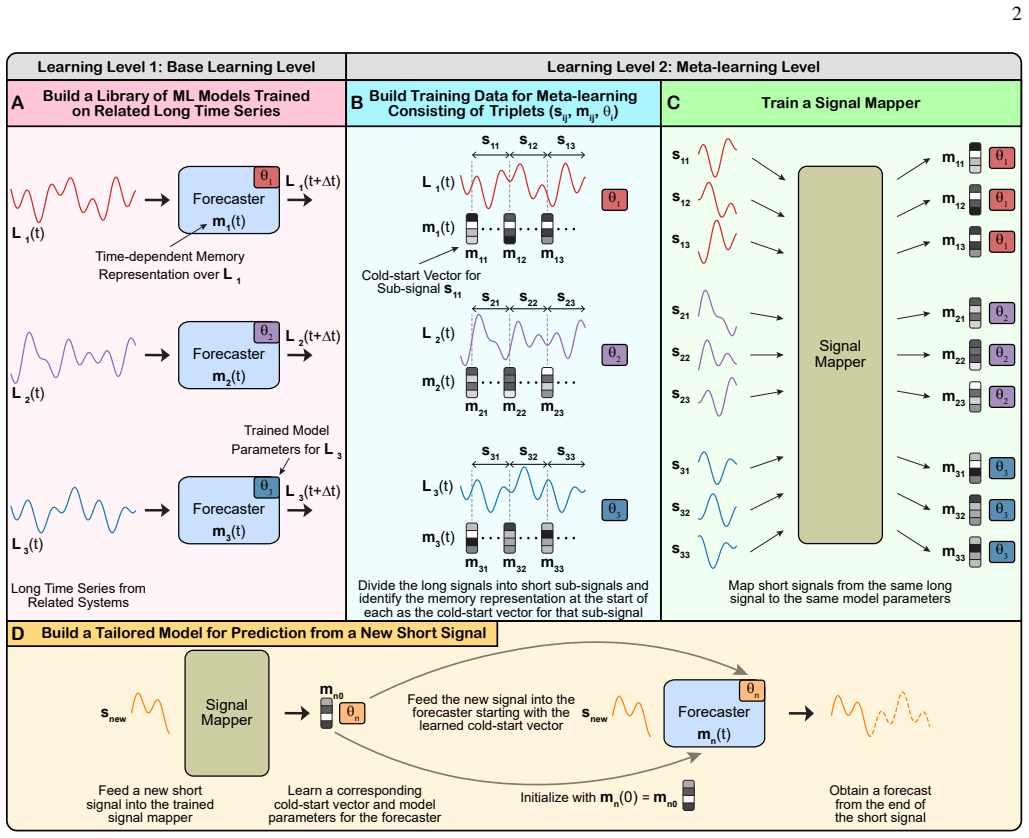
The load-bearing mechanism is the signal mapper: a reservoir computer whose final state after reading a short signal is linearly transformed into a target pair consisting of the forecaster's flattened output layer and its initial reservoir state (the cold-start vector). The forecaster is a standard reservoir computer, where the output layer encodes the dynamics and the reservoir state carries phase and memory; two-level training first fits one output layer per long library signal while recording synchronized reservoir states as cold starts, then solves the ridge regression $W_{\rm SM}=PR^T(RR^T+\alpha I)^{-1}$ to map signal-mapper states to those targets. At deployment the mapper emits both quantities for the new short signal, the forecaster is driven open-loop with that signal, and then closed-loop to generate the forecast.
What would settle it
A controlled probe: fix a library and a short-signal length, then sweep parameters of a smooth family to find two test systems whose short windows give nearly identical final signal-mapper reservoir states but whose one-step continuations differ substantially. METAFORS's predicted continuation can match at most one of them, and the gap between predicted and true one-step maps at those parameter pairs directly measures the cost of the linear-readout premise.
Extended reading notes
Core claim
The paper's central discovery is that a short signal from an unseen system can be mapped, via a fixed nonlinear reservoir followed by a single linear readout, to two things at once: the output-layer weights of a forecaster (what the system's dynamics are) and a cold-start vector (where in the reservoir's state space the forecast should begin). After training on a library of long signals and their trained forecaster reservoirs, this two-output linear readout is shown to generalize to new systems, reproducing bifurcation diagrams for the logistic and Gauss maps and achieving valid prediction times for Lorenz that exceed every tested baseline at short test-signal lengths. The paper also shows that the cold-start part is essential at very short signal lengths: without it, even a forecaster with correctly learned dynamics can land on the wrong attractor or leave the domain of the true trajectory.
Load-bearing premise
The method assumes that one snapshot of the signal-mapper reservoir after reading a short clip carries enough information to read off, by a single linear map, both the right forecast rule and the right starting memory state for any unseen system.
Editorial extensions
If this is right
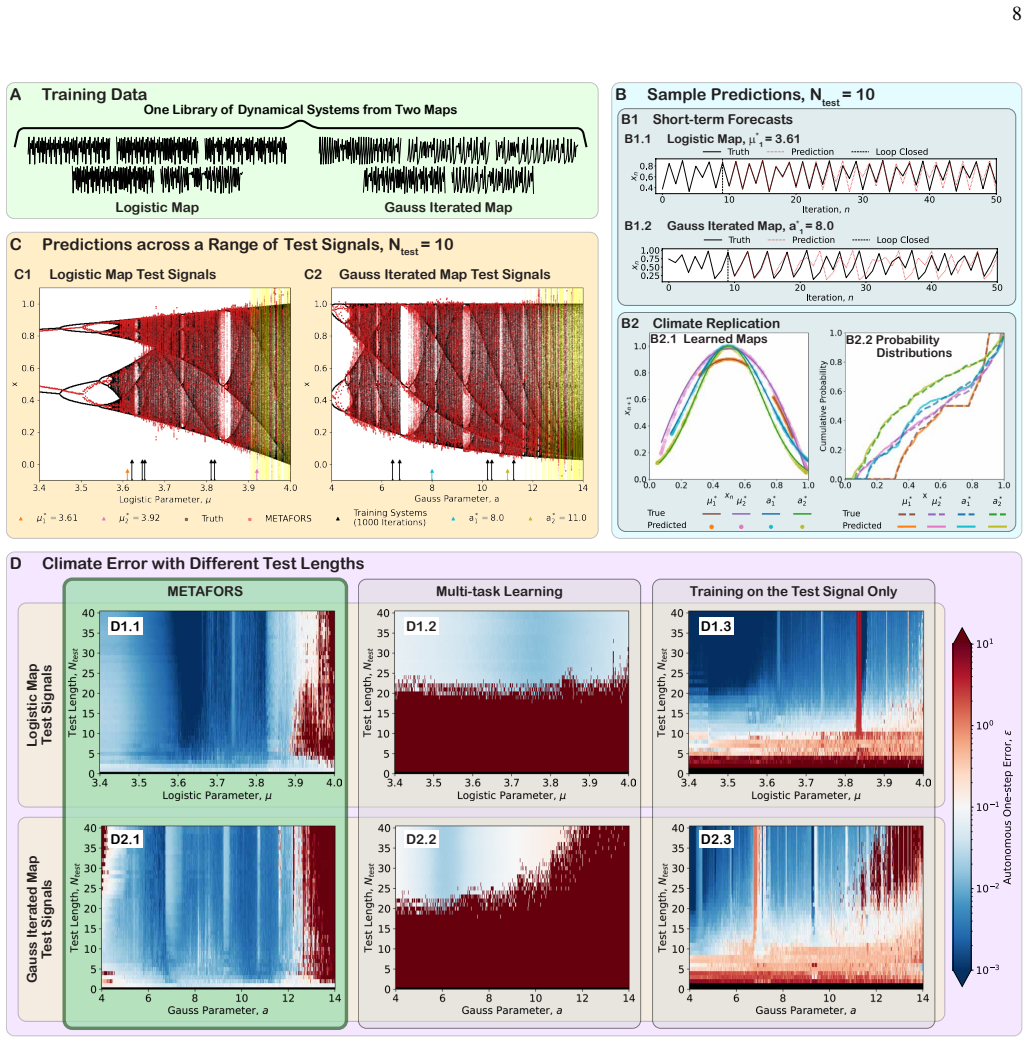
- Short unlabeled signals suffice: with five iterations of the logistic map (and in the logistic family as few as two), METAFORS reconstructs the map's bifurcation diagram across parameter ranges not represented in the library, where zero-starting, multi-task learning, and direct training all fail.
- The method generalizes across functional forms: a single library containing both logistic and Gauss iterated maps lets METAFORS reproduce both maps' climates from unlabeled test signals, a task that parameter-interpolation baselines cannot even pose without extra information.
- Cold starting is numerically essential at short test lengths: comparing METAFORS with its zero-start ablation shows that without a learned initial reservoir state, predictions leave the true state interval or settle onto the wrong attractor.
- Partial observations still work: with Lorenz-63 and only the $x_3$ component observed, METAFORS extends valid prediction time to about seven times the test-signal length at $N_{\rm test}=20$, and it outperforms baselines until test signals become long enough to self-initialize.
- With a single library member and no generalization across dynamics required, the signal mapper still learns to cold-start forecasts from one observed Lorenz state, so the meta-learning machinery reduces to a purpose-built initializer when only one system is available.
Reading between the lines
- An implication left implicit is that the same triplet structure—short signal, trained parameters, recorded initial state—transfers to other memory-based forecasters such as LSTMs or GRUs, with flattened weights and hidden-state vectors playing the roles of parameters and cold-start vectors; the paper demonstrates only reservoir computers.
- Because the signal mapper is trained on fixed-length sub-signals, test signals much longer than the training sub-signals fall outside its training distribution; a practical extension would train the mapper on a range of lengths or use a fixed-size windowed summary.
- A testable recipe for real deployments follows from the weakest premise: before trusting forecasts, hold out some library sub-signals and compare the linear readout's predicted output layers and cold starts against the true ones, using the mismatch as a library-usability diagnostic.
- The method's success on low-dimensional maps suggests a natural stress test—spatiotemporal systems with many degrees of freedom—where the single-linear-readout assumption is more likely to fail; the paper itself lists scalability to high-dimensional data as an open question.
Editorial analysis
A structured set of objections, weighed in public.
Referee Report
Summary. This paper introduces METAFORS, a two-level meta-learning framework for forecasting a dynamical system from a short test signal when longer training signals from related systems are available. In the first learning level, a reservoir computer forecaster is trained on each long library signal, yielding an output layer (model parameters) and a sequence of reservoir states. Short sub-signals are extracted from each long signal, and the reservoir state at each sub-signal's start is recorded as a cold-start vector. In the second learning level, a signal-mapper reservoir computer is trained to map a short signal to the corresponding forecaster output layer and cold-start vector using ridge regression. At test time, the mapper processes the short test signal, the inferred output layer and cold-start vector are used to initialize and synchronize the forecaster, and the forecaster then runs closed-loop to produce short-term and climate forecasts. Experiments on the logistic map, a mixture of logistic and Gauss maps, and partially and fully observed Lorenz-63 systems show that METAFORS outperforms several baselines for short test signals, including regimes where test parameters lie outside the library range. The paper includes code, detailed supplementary methods, and careful baseline descriptions.
Significance. If the results hold, METAFORS is a useful contribution to few-shot forecasting of dynamical systems: it combines two established ideas (reservoir computing and meta-learning) in a simple, model-agnostic way, and the experimental protocol is careful, with held-out test grids, multiple baselines including parameter-aware interpolation, medians over random realizations, and ablations such as zero-starting and a no-generalization cold-start experiment. The demonstration that cold-start vectors matter for short signals, and that the method works with partial observations, is convincing for the low-dimensional systems studied. The paper is also commendably explicit about several limitations, acknowledging that high-dimensional and real-world scalability remains open. The main gap is that the breadth of the central claim ('unseen and unknown dynamics') exceeds the evidence, given the linear-readout mechanism in Eq. (8) and the restricted family coverage of the test systems.
major comments (2)
- [Methods, Eq. (8)] The signal mapper's readout in Eq. (8) is a ridge-regression solution, so for any test signal the predicted pair (cold-start vector, output layer) is a linear combination of the library target vectors: W_SM r_test = P R^T (R R^T + alpha_SM N_short I)^{-1} r_test. Every output layer METAFORS can propose therefore lies in the linear span of the library output layers. The paper demonstrates that this span is sufficient for the tested cases, but the tested systems are all drawn from the same parametric families as the library members (logistic and Gauss maps both appear in the Fig. 4 library, and Fig. 5 uses Lorenz-63 systems with varied parameters). The Abstract and Introduction claim generalization to systems with 'unseen and unknown dynamics,' which is a stronger statement than the evidence supports. This is a load-bearing limitation because the mechanism of generalization is exactly this linear readout: if an unseen system's optimal output layer is not in the library span, the method cannot produce it even if the signal-mapper reservoir state is informationally sufficient. I recommend either qualifying the central claim (for example, 'dynamics related to those in the library' or 'within the span of library dynamics') or adding an experiment in which the test system's functional form is absent from the training library.
- [Results: Simultaneous generalization with logistic and Gauss maps (Fig. 4)] The experiment that most directly supports cross-functional-form generalization does not actually test an unseen functional form: the library contains five logistic and five Gauss trajectories, and the test signals are drawn from the same two maps. Thus Fig. 4 demonstrates that METAFORS can interpolate between two known dynamical forms within a joint library, not that it can forecast a system whose functional form has never been seen in training. The Discussion appropriately states that high-dimensional and real-world scalability is open, but the Introduction's opening claim ('build tailored forecasters for systems with unseen and unknown dynamics using only short signals') is not qualified in the same way. The claim should be adjusted to match the evidence, or the evidence should be extended to include test systems from a functional form absent from the library.
minor comments (6)
- [Fig. 3 caption] The phrase 'stationary signals' is ambiguous; the signals are from systems with fixed dynamical parameters, not stationary stochastic processes, and this should be rephrased.
- [Table I] The multiple values for each hyperparameter are separated by spaces without column headers; a table with separate columns for 'logistic only', 'logistic + Gauss', and 'Lorenz-63' would be substantially easier to read.
- [Eq. (6)] The notation j >= N_trans silently mixes a time index with a sub-signal index; the text should state explicitly that j is the time index of the start of sub-signal s_ij.
- [Code availability] The code repository is given as a URL but without a version or release tag; a persistent DOI or versioned release would improve reproducibility.
- [Section S2.1] The exclusion of periodic trajectories from the library is justified, but the main text should note that this makes the logistic-map experiment a genuine extrapolation test (library is chaotic, test set includes fixed-point, periodic, and chaotic regimes), since that strengthens rather than weakens the result.
- [Section 'Effective cold starting when generalization isn't required'] The statement that the signal mapper 'requires no more training data than is traditionally required' could be read as claiming zero additional data; clarify that it reuses the forecaster's training reservoir trajectories.
Circularity Check
No significant circularity: METAFORS' predictions are genuinely held-out; the signal mapper is trained by supervised regression on library-derived targets, and self-citations are not load-bearing.
full rationale
The derivation chain is: (i) train library forecasters on long signals; (ii) form triplets (short sub-signal, cold-start vector, output layer) from those long signals; (iii) train the signal mapper by ridge regression (Eq. 8) to map a short signal's final reservoir state to the corresponding cold-start vector and output layer; (iv) apply this learned mapping to a new short test signal and forecast. The test signals in Figs. 3-5 come from systems (logistic parameters, Gauss parameters, Lorenz parameters) that are not in the library, so the reported valid prediction times and climate errors are predictions rather than fitted values. The linear form of Eq. (8) means the inferred output layer lies in the span of library output layers, but that is a generalization/capacity property of the method, not a reduction of the claim to its inputs. The paper explicitly acknowledges that scalability to high-dimensional and real-world data remains open, which is a limitation rather than a circularity. Some self-citations appear (refs. 29, 40-45), but they are contextual literature references and are not load-bearing: the method is supported by its own experiments and public code, and no uniqueness theorem or fitted parameter is imported from those citations. Accordingly no circular step is identified; the minor self-citation presence warrants a low non-zero score under the rubric.
Assumptions & free parameters
free parameters (2)
- Forecaster RC hyperparameters (spectral radius, leakage, input strength, regularization) =
rho_F=0.2, lambda_F=0.2, sigma_F=2.5/4.0/0.1, alpha_F=10^-6
- Signal mapper RC hyperparameters (size, spectral radius, leakage, input strength, regularization) =
N_SM=1000, rho_SM=0.9, lambda_SM=0.1, sigma_SM=2.5/4.0/0.1, alpha_SM=10^-8
assumptions (4)
- domain assumption The reservoir satisfies the echo state property for the chosen hyperparameters, so a driven reservoir state eventually depends only on the input history.
- domain assumption The final signal-mapper state is linearly readable into forecaster output layers and cold-start vectors via WSM.
- domain assumption Library signals are long enough and 'related' to the test system.
- standard math Simulated ground truth from the logistic map, Gauss map, and Lorenz-63 equations is correct.
Cite this review
Pith. "Pith review of Tailored Forecasting from Short Time Series via Meta-learning." pith.science (2026). https://pith.science/paper/2PTZCYYD
@misc{pith2026250116325,
  author       = {Pith},
  title        = {Pith review of: Tailored Forecasting from Short Time Series via Meta-learning},
  year         = {2026},
  howpublished = {\url{https://pith.science/paper/2PTZCYYD}},
  note         = {Machine review of arXiv:2501.16325}
}
read the original abstract
Machine learning models can effectively forecast dynamical systems from time-series data, but they typically require large amounts of past data, making forecasting particularly challenging for systems with limited history. To overcome this, we introduce Meta-learning for Tailored Forecasting using Related Time Series (METAFORS), which generalizes knowledge across systems to enable forecasting in data-limited scenarios. By learning from a library of models trained on longer time series from potentially related systems, METAFORS builds and initializes a model tailored to short time-series data from the system of interest. Using a reservoir computing implementation and testing on simulated chaotic systems, we demonstrate that METAFORS can reliably predict both short-term dynamics and long-term statistics without requiring contextual labels. We see this even when test and related systems exhibit substantially different behaviors, highlighting METAFORS' strengths in data-limited scenarios.
Figures


Figures from the paper (2 more)

Reference graph
Works this paper leans on
-
[1]
author author I. Price , author A. Sanchez-Gonzalez , author F. Alet , author T. R. \ Andersson , author A. El-Kadi , author D. Masters , author T. Ewalds , author J. Stott , author S. Mohamed , author P. Battaglia , author R. Lam , \ and\ author M. Willson ,\ title title Probabilistic weather forecasting with machine learning , \ 10.1038/s41586-024-08252...
-
[2]
author author T. Arcomano , author I. Szunyogh , author A. Wikner , author J. Pathak , author B. R. \ Hunt , \ and\ author E. Ott ,\ title title A hybrid approach to atmospheric modeling that combines machine learning with a physics-based numerical model , \ https://doi.org/10.1029/2021MS002712 journal journal Journal of Advances in Modeling Earth Systems...
-
[3]
author author S. Wein , author A. Schüller , author A. M. \ Tomé , author W. M. \ Malloni , author M. W. \ Greenlee , \ and\ author E. W. \ Lang ,\ title title Forecasting brain activity based on models of spatiotemporal brain dynamics: A comparison of graph neural network architectures , \ 10.1162/netn_a_00252 journal journal Network Neuroscience \ volum...
-
[4]
author author M. De Matola \ and\ author C. Miniussi ,\ title title Brain state forecasting for precise brain stimulation: Current approaches and future perspectives , \ https://doi.org/10.1016/j.neuroimage.2025.121050 journal journal NeuroImage \ volume 307 ,\ pages 121050 ( year 2025 ) NoStop
arXiv 2025
-
[5]
author author E. L. \ Ray , author L. C. \ Brooks , author J. Bien , author M. Biggerstaff , author N. I. \ Bosse , author J. Bracher , author E. Y. \ Cramer , author S. Funk , author A. Gerding , author M. A. \ Johansson , author A. Rumack , author Y. Wang , author M. Zorn , author R. J. \ Tibshirani , \ and\ author N. G. \ Reich ,\ title title Comparing...
-
[6]
author author O. B. \ Sezer , author M. U. \ Gudelek , \ and\ author A. M. \ Ozbayoglu ,\ title title Financial time series forecasting with deep learning : A systematic literature review: 2005–2019 , \ https://doi.org/10.1016/j.asoc.2020.106181 journal journal Applied Soft Computing \ volume 90 ,\ pages 106181 ( year 2020 ) NoStop
arXiv 2005
-
[7]
author author S. L. \ Brunton \ and\ author J. N. \ Kutz ,\ 10.1017/9781108380690 title Data-Driven Science and Engineering: Machine Learning, Dynamical Systems, and Control \ ( publisher Cambridge University Press ,\ year 2019 ) NoStop
-
[8]
author author Z. Han , author J. Zhao , author H. Leung , author K. F. \ Ma , \ and\ author W. Wang ,\ title title A review of deep learning models for time series prediction , \ 10.1109/JSEN.2019.2923982 journal journal IEEE Sensors Journal \ volume 21 ,\ pages 7833--7848 ( year 2021 ) NoStop
arXiv 2019
Show all 73 references
-
[9]
author author S. L. \ Brunton , author J. L. \ Proctor , \ and\ author J. N. \ Kutz ,\ title title Discovering governing equations from data by sparse identification of nonlinear dynamical systems , \ 10.1073/pnas.1517384113 journal journal Proceedings of the National Academy ...
-
[10]
author author S. H. \ Rudy , author S. L. \ Brunton , author J. L. \ Proctor , \ and\ author J. N. \ Kutz ,\ title title Data-driven discovery of partial differential equations , \ 10.1126/sciadv.1602614 journal journal Science Advances \ volume 3 ,\ pages e1602614 ( year 2017...
-
[11]
Pathak , author A
author author J. Pathak , author A. Wikner , author R. Fussell , author S. Chandra , author B. R. \ Hunt , author M. Girvan , \ and\ author E. Ott ,\ title title Hybrid forecasting of chaotic processes: Using machine learning in conjunction with a knowledge-based model , \ 10....
-
[12]
Wang , author D
author author R. Wang , author D. Maddix , author C. Faloutsos , author Y. Wang , \ and\ author R. Yu ,\ title title Bridging physics-based and data-driven modeling for learning dynamical systems , \ in\ https://proceedings.mlr.press/v144/wang21a.html booktitle Proceedings of ...
2021
-
[13]
Göring , author F
author author N. Göring , author F. Hess , author M. Brenner , author Z. Monfared , \ and\ author D. Durstewitz ,\ @noop title Out-of-domain generalization in dynamical systems reconstruction , \ ( year 2024 ),\ http://arxiv.org/abs/2402.18377 arXiv:2402.18377 [cs.LG] NoStop
2024 arXiv
-
[14]
Zhang \ and\ author Q
author author Y. Zhang \ and\ author Q. Yang ,\ title title A survey on multi-task learning , \ 10.1109/TKDE.2021.3070203 journal journal IEEE Transactions on Knowledge and Data Engineering \ volume 34 ,\ pages 5586--5609 ( year 2022 ) NoStop
2021
-
[15]
Yang , author Y
author author Q. Yang , author Y. Zhang , author W. Dai , \ and\ author S. J. \ Pan ,\ @noop title Transfer Learning \ ( publisher Cambridge University Press ,\ year 2020 ) NoStop
2020
-
[16]
Hospedales , author A
author author T. Hospedales , author A. Antoniou , author P. Micaelli , \ and\ author A. Storkey ,\ title title Meta-learning in neural networks: A survey , \ 10.1109/TPAMI.2021.3079209 journal journal IEEE Transactions on Pattern Analysis & Machine Intelligence \ volume 44 ,\...
2021
-
[17]
Brazdil , author J
author author P. Brazdil , author J. N. \ van Rijn , author C. Soares , \ and\ author J. Vanschoren ,\ @noop title Metalearning: Applications to Automated Machine Learning and Data Mining ,\ edition 2nd \ ed.\ ( publisher Springer ,\ year 2022 ) NoStop
2022
-
[18]
Lemke , author M
author author C. Lemke , author M. Budka , \ and\ author B. Gabrys ,\ title title Metalearning: A survey of trends and technologies , \ 10.1007/s10462-013-9406-y journal journal Artif. Intell. Rev. \ volume 44 ,\ pages 117–130 ( year 2015 ) NoStop
-
[19]
author author S. J. \ Pan \ and\ author Q. Yang ,\ title title A survey on transfer learning , \ 10.1109/TKDE.2009.191 journal journal IEEE Transactions on Knowledge and Data Engineering \ volume 22 ,\ pages 1345--1359 ( year 2010 ) NoStop
2009 doi
-
[20]
Feurer , author J
author author M. Feurer , author J. Springenberg , \ and\ author F. Hutter ,\ title title Initializing bayesian hyperparameter optimization via meta-learning , \ 10.1609/aaai.v29i1.9354 journal journal Proceedings of the AAAI Conference on Artificial Intelligence \ volume 29 (...
-
[21]
Lemke \ and\ author B
author author C. Lemke \ and\ author B. Gabrys ,\ title title Meta-learning for time series forecasting and forecast combination , \ https://doi.org/10.1016/j.neucom.2009.09.020 journal journal Neurocomputing \ volume 73 ,\ pages 2006--2016 ( year 2010 ) ,\ note subspace Learn...
2009 doi
-
[22]
author author T. S. \ Talagala , author R. J. \ Hyndman , \ and\ author G. Athanasopoulos ,\ title title Meta-learning how to forecast time series , \ https://doi.org/10.1002/for.2963 journal journal Journal of Forecasting \ volume 42 ,\ pages 1476--1501 ( year 2023 ) NoStop
-
[23]
Finn , author P
author author C. Finn , author P. Abbeel , \ and\ author S. Levine ,\ title title Model-agnostic meta-learning for fast adaptation of deep networks , \ in\ https://proceedings.mlr.press/v70/finn17a.html booktitle Proceedings of the 34th International Conference on Machine Lear...
2017
-
[24]
Yao , author Y
author author H. Yao , author Y. Wei , author J. Huang , \ and\ author Z. Li ,\ @noop title Hierarchically structured meta-learning , \ ( year 2019 ),\ http://arxiv.org/abs/1905.05301 arXiv:1905.05301 [cs.LG] NoStop
2019 arXiv
-
[25]
Raghu , author M
author author A. Raghu , author M. Raghu , author S. Bengio , \ and\ author O. Vinyals ,\ title title Rapid learning or feature reuse? towards understanding the effectiveness of maml , \ in\ https://openreview.net/forum?id=rkgMkCEtPB booktitle International Conference on Learn...
2020
-
[26]
author author A. A. \ Rusu , author D. Rao , author J. Sygnowski , author O. Vinyals , author R. Pascanu , author S. Osindero , \ and\ author R. Hadsell ,\ title title Meta-learning with latent embedding optimization , \ in\ https://openreview.net/forum?id=BJgklhAcK7 booktitle...
2019
-
[27]
Wu , author J
author author T. Wu , author J. Peurifoy , author I. L. \ Chuang , \ and\ author M. Tegmark ,\ @noop title Meta-learning autoencoders for few-shot prediction , \ ( year 2018 ),\ http://arxiv.org/abs/1807.09912 arXiv:1807.09912 [cs.LG] NoStop
2018 arXiv
-
[28]
Joshaghani , author S
author author M. Joshaghani , author S. Barak , author A. Asadi , \ and\ author E. Mirafzali ,\ title title Retail time series forecasting using an automated deep meta-learning framework , \ 10.2139/ssrn.4393300 journal journal SSRN Electronic Journal \ ( year 2023 ),\ 10.2139...
- [29]
-
[30]
Kirchmeyer , author Y
author author M. Kirchmeyer , author Y. Yin , author J. Dona , author N. Baskiotis , author A. Rakotomamonjy , \ and\ author P. Gallinari ,\ title title Generalizing to new physical systems via context-informed dynamics model , \ in\ https://proceedings.mlr.press/v162/kirchmey...
2022
-
[31]
Yin , author I
author author Y. Yin , author I. Ayed , author E. de B\' e zenac , author N. Baskiotis , \ and\ author P. Gallinari ,\ title title Leads: Learning dynamical systems that generalize across environments , \ in\ https://proceedings.neurips.cc/paper_files/paper/2021/file/3df1d4b96...
2021
-
[32]
Wang , author R
author author R. Wang , author R. Walters , \ and\ author R. Yu ,\ @noop title Meta-learning dynamics forecasting using task inference , \ ( year 2022 ),\ http://arxiv.org/abs/2102.10271 arXiv:2102.10271 [cs.LG] NoStop
2022 arXiv
-
[33]
Panahi , author L.-W
author author S. Panahi , author L.-W. \ Kong , author B. Glaz , author M. Haile , \ and\ author Y.-C. \ Lai ,\ https://arxiv.org/abs/2501.01579 title Unsupervised learning for anticipating critical transitions , \ ( year 2025 ),\ http://arxiv.org/abs/2501.01579 arXiv:2501.015...
2025 arXiv
-
[34]
author author B. N. \ Oreshkin , author D. Carpov , author N. Chapados , \ and\ author Y. Bengio ,\ title title Meta-learning framework with applications to zero-shot time-series forecasting , \ 10.1609/aaai.v35i10.17115 journal journal Proceedings of the AAAI Conference on Ar...
-
[35]
author author D. J. \ Gauthier , author E. Bollt , author A. Griffith , \ and\ author W. A. S. \ Barbosa ,\ title title Next generation reservoir computing , \ 10.1038/s41467-021-25801-2 journal journal Nature Communications \ volume 12 ( year 2021 ),\ 10.1038/s41467-021-25801...
-
[36]
Zhang \ and\ author S
author author Y. Zhang \ and\ author S. P. \ Cornelius ,\ title title Catch-22s of reservoir computing , \ 10.1103/PhysRevResearch.5.033213 journal journal Phys. Rev. Res. \ volume 5 ,\ pages 033213 ( year 2023 ) NoStop
2023 doi
-
[37]
Lu , author B
author author Z. Lu , author B. R. \ Hunt , \ and\ author E. Ott ,\ title title Attractor reconstruction by machine learning , \ 10.1063/1.5039508 journal journal Chaos: An Interdisciplinary Journal of Nonlinear Science \ volume 28 ,\ pages 061104 ( year 2018 ) NoStop
-
[38]
Grigoryeva , author B
author author L. Grigoryeva , author B. Hamzi , author F. P. \ Kemeth , author Y. Kevrekidis , author G. Manjunath , author J.-P. \ Ortega , \ and\ author M. J. \ Steynberg ,\ @noop title Data-driven cold starting of good reservoirs , \ ( year 2024 ),\ http://arxiv.org/abs/240...
2024 arXiv
-
[39]
author author F. P. \ Kemeth , author T. Bertalan , author N. Evangelou , author T. Cui , author S. Malani , \ and\ author I. G. \ Kevrekidis ,\ title title Initializing LSTM internal states via manifold learning , \ 10.1063/5.0055371 journal journal Chaos: An Interdisciplinar...
-
[40]
Patel , author D
author author D. Patel , author D. Canaday , author M. Girvan , author A. Pomerance , \ and\ author E. Ott ,\ title title Using machine learning to predict statistical properties of non-stationary dynamical processes: System climate,regime transitions, and the effect of stocha...
-
[41]
\ Kong , author H.-W
author author L.-W. \ Kong , author H.-W. \ Fan , author C. Grebogi , \ and\ author Y.-C. \ Lai ,\ title title Machine learning prediction of critical transition and system collapse , \ 10.1103/PhysRevResearch.3.013090 journal journal Phys. Rev. Res. \ volume 3 ,\ pages 013090...
-
[42]
o glmayr \ and\ author C. R \
author author D. K \"o glmayr \ and\ author C. R \"a th ,\ title title Extrapolating tipping points and simulating non-stationary dynamics of complex systems using efficient machine learning , \ 10.1038/s41598-023-50726-9 journal journal Scientific Reports \ volume 14 ,\ pages...
-
[43]
Panahi \ and\ author Y.-C
author author S. Panahi \ and\ author Y.-C. \ Lai ,\ title title Adaptable reservoir computing: A paradigm for model-free data-driven prediction of critical transitions in nonlinear dynamical systems , \ 10.1063/5.0200898 journal journal Chaos: An Interdisciplinary Journal of ...
-
[44]
author author J. J. \ Hopfield ,\ title title Neural networks and physical systems with emergent collective computational abilities. \ 10.1073/pnas.79.8.2554 journal journal Proceedings of the National Academy of Sciences \ volume 79 ,\ pages 2554--2558 ( year 1982 ) NoStop
-
[45]
\ Kong , author G
author author L.-W. \ Kong , author G. A. \ Brewer , \ and\ author Y.-C. \ Lai ,\ title title Reservoir-computing based associative memory and itinerancy for complex dynamical attractors , \ 10.1038/s41467-024-49190-4 journal journal Nature Communications \ volume 15 ,\ pages ...
-
[46]
Lu \ and\ author D
author author Z. Lu \ and\ author D. S. \ Bassett ,\ title title Invertible generalized synchronization: A putative mechanism for implicit learning in neural systems , \ 10.1063/5.0004344 journal journal Chaos: An Interdisciplinary Journal of Nonlinear Science \ volume 30 ,\ p...
-
[47]
author author J. Z. \ Kim , author Z. Lu , author E. Nozari , author G. J. \ Pappas , \ and\ author D. S. \ Bassett ,\ title title Teaching recurrent neural networks to infer global temporal structure from local examples , \ 10.1038/s42256-021-00321-2 journal journal Nature Ma...
-
[48]
Schrauwen , author D
author author B. Schrauwen , author D. Verstraeten , \ and\ author J. Campenhout ,\ title title An overview of reservoir computing: Theory, applications and implementations , \ \ ( year 2007 )\ pp.\ pages 471--482 NoStop
2007
-
[49]
Sun , author M
author author C. Sun , author M. Song , author D. Cai , author B. Zhang , author S. Hong , \ and\ author H. Li ,\ title title A systematic review of echo state networks from design to application , \ 10.1109/TAI.2022.3225780 journal journal IEEE Transactions on Artificial Inte...
2022
-
[50]
Lukoševičius \ and\ author H
author author M. Lukoševičius \ and\ author H. Jaeger ,\ title title Reservoir computing approaches to recurrent neural network training , \ https://doi.org/10.1016/j.cosrev.2009.03.005 journal journal Computer Science Review \ volume 3 ,\ pages 127--149 ( year 2009 ) NoStop
2009 doi
-
[51]
Srinivasan , author N
author author K. Srinivasan , author N. Coble , author J. Hamlin , author T. Antonsen , author E. Ott , \ and\ author M. Girvan ,\ title title Parallel machine learning for forecasting the dynamics of complex networks , \ 10.1103/PhysRevLett.128.164101 journal journal Phys. Re...
-
[52]
Tanaka et al
author author G. Tanaka et al. ,\ title title Recent advances in physical reservoir computing: A review , \ https://doi.org/10.1016/j.neunet.2019.03.005 journal journal Neural Networks \ volume 115 ,\ pages 100--123 ( year 2019 ) NoStop
2019 doi
-
[53]
Lu , author J
author author Z. Lu , author J. Pathak , author B. Hunt , author M. Girvan , author R. Brockett , \ and\ author E. Ott ,\ title title Reservoir observers: Model-free inference of unmeasured variables in chaotic systems , \ 10.1063/1.4979665 journal journal Chaos: An Interdisci...
-
[54]
Krishnagopal , author M
author author S. Krishnagopal , author M. Girvan , author E. Ott , \ and\ author B. R. \ Hunt ,\ title title Separation of chaotic signals by reservoir computing , \ 10.1063/1.5132766 journal journal Chaos: An Interdisciplinary Journal of Nonlinear Science \ volume 30 ,\ pages...
-
[55]
Pathak , author B
author author J. Pathak , author B. Hunt , author M. Girvan , author Z. Lu , \ and\ author E. Ott ,\ title title Model-free prediction of large spatiotemporally chaotic systems from data: A reservoir computing approach , \ 10.1103/PhysRevLett.120.024102 journal journal Phys. R...
-
[56]
Wikner , author J
author author A. Wikner , author J. Pathak , author B. Hunt , author M. Girvan , author T. Arcomano , author I. Szunyogh , author A. Pomerance , \ and\ author E. Ott ,\ title title Combining machine learning with knowledge-based modeling for scalable forecasting and subgrid-sc...
-
[57]
author author E. Bollt ,\ title title On explaining the surprising success of reservoir computing forecaster of chaos? the universal machine learning dynamical system with contrast to var and dmd , \ 10.1063/5.0024890 journal journal Chaos: An Interdisciplinary Journal of Nonl...
-
[58]
Yan , author C
author author M. Yan , author C. Huang , author P. Bienstman , author P. Tino , author W. Lin , \ and\ author J. Sun ,\ title title Emerging opportunities and challenges for the future of reservoir computing , \ 10.1038/s41467-024-45187-1 journal journal Nature Communications ...
-
[59]
Wikner , author J
author author A. Wikner , author J. Harvey , author M. Girvan , author B. R. \ Hunt , author A. Pomerance , author T. Antonsen , \ and\ author E. Ott ,\ title title Stabilizing machine learning prediction of dynamics: Novel noise-inspired regularization tested with reservoir c...
-
[60]
author author E. N. \ Lorenz ,\ title title The problem of deducing the climate from the governing equations , \ 10.3402/tellusa.v16i1.8893 journal journal Tellus \ volume 16 ,\ pages 1--11 ( year 1964 ) NoStop
1964 doi
-
[61]
author author R. C. \ Hilborn ,\ 10.1093/acprof:oso/9780198507239.001.0001 title Chaos and Nonlinear Dynamics: An Introduction for Scientists and Engineers \ ( publisher Oxford University Press ,\ year 2000 ) NoStop
-
[62]
author author E. N. \ Lorenz ,\ title title Deterministic nonperiodic flow , \ 10.1175/1520-0469(1963)020<0130:DNF>2.0.CO;2 journal journal Journal of Atmospheric Sciences \ volume 20 ,\ pages 130 -- 141 ( year 1963 ) NoStop
1963 doi
-
[63]
Tél \ and\ author M
author author T. Tél \ and\ author M. Gruiz ,\ title Chaos in dissipative systems , \ in\ @noop booktitle Chaotic Dynamics: An Introduction Based on Classical Mechanics \ ( publisher Cambridge University Press ,\ year 2006 )\ p.\ pages 113–190 NoStop
2006
-
[64]
Krishnagopal , author Y
author author S. Krishnagopal , author Y. Aloimonos , \ and\ author M. Girvan ,\ title title Similarity learning and generalization with limited data: A reservoir computing approach , \ @noop journal journal Complexity \ volume 2018 ( year 2018 ) NoStop
2018
-
[65]
Schaetti , author M
author author N. Schaetti , author M. Salomon , \ and\ author R. Couturier ,\ title title Echo state networks-based reservoir computing for mnist handwritten digits recognition , \ in\ https://hal.archives-ouvertes.fr/hal-02131170 booktitle International Conference on Computat...
2016
-
[66]
Jaeger \ and\ author H
author author H. Jaeger \ and\ author H. Haas ,\ title title Harnessing nonlinearity: Predicting chaotic systems and saving energy in wireless communication , \ 10.1126/science.1091277 journal journal Science \ volume 304 ,\ pages 78--80 ( year 2004 ) NoStop
-
[67]
Canaday , author D
author author D. Canaday , author D. Kalra , author A. Wikner , author D. A. \ Norton , author B. Hunt , \ and\ author A. Pomerance ,\ title title rescompy 1.0.0: Fundamental Methods for Reservoir Computing in Python , \ @noop journal journal GitHub \ ( year 2024 ) NoStop
2024
-
[68]
author author A. N. \ Tikhonov , author A. V. \ Goncharsky , author V. V. \ Stepanov , \ and\ author A. G. \ Yagola ,\ title Regularization methods , \ in\ 10.1007/978-94-015-8480-7_2 booktitle Numerical Methods for the Solution of Ill-Posed Problems \ ( publisher Springer Net...
-
[69]
echo state
author author H. Jaeger ,\ http://www.faculty.jacobs-university.de/hjaeger/pubs/EchoStatesTechRep.pdf title The "echo state" approach to analysing and training recurrent neural networks , \ type GMD Report \ number 148 \ ( institution GMD - German National Research Institute f...
2001
-
[70]
author author M. Luko s evi c ius ,\ title A practical guide to applying echo state networks , \ in\ 10.1007/978-3-642-35289-8_36 booktitle Neural Networks: Tricks of the Trade: Second Edition ,\ editor edited by\ editor G. Montavon , editor G. B. \ Orr , \ and\ editor K.-R. \...
-
[71]
Cucchi , author S
author author M. Cucchi , author S. Abreu , author G. Ciccone , author D. Brunner , \ and\ author H. Kleemann ,\ title title Hands-on reservoir computing: a tutorial for practical implementation , \ 10.1088/2634-4386/ac7db7 journal journal Neuromorphic Computing and Engineerin...
-
[72]
author author J. A. \ Platt , author A. Wong , author R. Clark , author S. G. \ Penny , \ and\ author H. D. I. \ Abarbanel ,\ title title Robust forecasting using predictive generalized synchronization in reservoir computing , \ 10.1063/5.0066013 journal journal Chaos: An Inte...
-
[73]
author author J. A. \ Platt , author S. G. \ Penny , author T. A. \ Smith , author T.-C. \ Chen , \ and\ author H. D. \ Abarbanel ,\ title title A systematic exploration of reservoir computing for forecasting complex spatiotemporal dynamics , \ https://doi.org/10.1016/j.neunet...
Reviewed August 10, 2026 · model on record in the stance chip above.
Discussion (0). Continue with ORCID to comment.