REVIEW 4 major objections 5 minor 72 references
Active chiral rotors: hydrodynamics and chemotaxis
T0 review · 4 major / 5 minor · reviewed 2026-08-10 · deepseek-v4-flash
Pith's one-line read Two torque-free chiral rotors acquire straight or circular motion purely from their mutual flow, and the same pair hunts or flees a chemical source.
desk verdict Plausible pair-trajectory classification for chiral rotors, but the universal claim is undercut by the l=2, m=0-only truncation and the chemotaxis section is under-specified. read the letter →
The pith
A machine-rendered reading of the paper's core claim, the machinery that carries it, and where it could break.
The reading
What carries the argument
The central object is the chiral rotor's surface-slip expansion, whose far-field flow is reduced to a single rotlet dipole, $u_{\mathrm{lf}}(r) = -\gamma^r_{20}(a^3/r^3)P'_2(\mathbf{t}\cdot\hat{\mathbf{r}})\,\mathbf{t}\times\hat{\mathbf{r}}$, the only retained mode. Pair dynamics are produced by advecting each rotor center with the other rotor's flow field while the orientation axes precess at fixed angular speed. Chemotaxis enters through an adaptation-and-relaxation network of two internal variables that rescales the slip coefficients in response to the local chemical concentration, so the hydrodynamic interaction itself becomes chemically modulated.
What would settle it
Re-run the pair dynamics with the complete first two multipole orders kept in the flow field (including the $\ell=1$ rotlet term and the $\ell=2$, $m\neq 0$ modes) and with vorticity and Faxén corrections added to the pair equations, over center-to-center separations from about $6a$ to $40a$; if same-chirality pairs then curve instead of staying straight, or if the reversal angle moves away from about $7.5\pi/24$, the chirality classification and its $\lambda$-independence fail.
Extended reading notes
Core claim
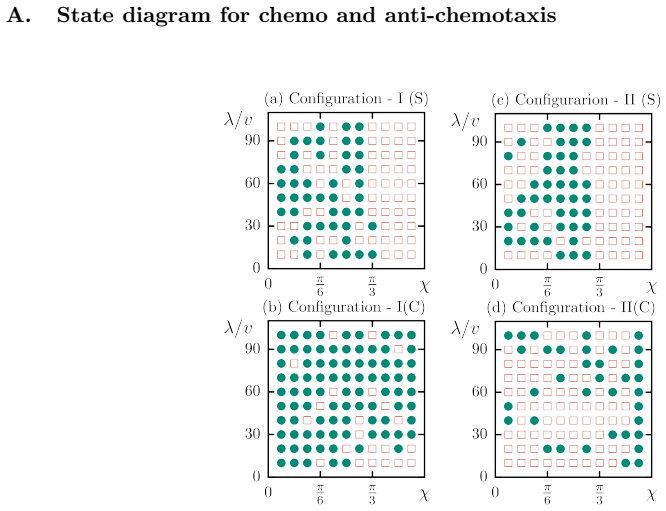
The paper establishes that a pair of chiral rotors, which generate rotational slip flows but cannot translate on their own, gain collective motion purely through their mutual flow fields. Using the far-field rotlet-dipole flow of the chiral squirmer, the paper shows that two rotors with the same chirality advect each other along straight lines, while two rotors of opposite chirality follow circular orbits, for essentially all tilt angles $\chi$ of the rotation axes except $\chi=0$ and $\chi=\pi/2$. The direction of both straight and circular motion reverses at $\chi\approx 7.5\pi/24$, and this reversal angle does not depend on the flow-strength parameter $\lambda$. When the pair is placed in a radial chemical gradient with an adaptation dynamics that modifies the slip coefficients, the same hydrodynamic pair shows chemotaxis, with one rotor reaching the chemical target, or anti-chemotaxis, with both rotors moving away, depending on $\chi$, $\lambda$, and source placement.
Load-bearing premise
The load-bearing premise is that each rotor's flow is fully described by a single axially symmetric rotlet-dipole term and that the other rotor is advected by that flow alone, without corrections from the flow's curl or from finite-size effects; if those neglected contributions matter at separations of about 6a to 40a, the predicted trajectory types can change.
Editorial extensions
If this is right
- Two rotors of the same chirality will translate together along a straight line for every tilt angle except $\chi=0$ and $\chi=\pi/2$, and the direction of travel flips at about $7.5\pi/24$.
- Two rotors of opposite chirality will follow circular orbits, and the sense of circling also reverses at the same tilt angle.
- The mean speed of the pair grows linearly with the slip-strength parameter $\lambda$ and becomes negligible as the initial separation approaches about $40a$.
- In a radial chemical gradient, the same hydrodynamic pair can show chemotaxis, with one rotor reaching the target, or anti-chemotaxis, with both rotors moving away, depending on $\chi$, $\lambda$, and whether the source lies on the pair's centerline.
Reading between the lines
- Editorial inference: if the neglected $\ell=1$ rotlet and $\ell=2$, $m\neq 0$ modes remain small beyond the separations studied, the same chirality-versus-path-type rule should persist in dilute rotor suspensions, so handedness could act as a sorting parameter in larger collections.
- Editorial inference: the reversal angle being independent of $\lambda$ suggests a geometric origin in the rotor axis orientation; mapping the full two-axis tilt plane could reveal additional switch angles for non-identical rotors.
- Editorial inference: a clean experimental test would hold one rotor fixed while releasing a second rotor nearby; the free rotor's measured path type as the first rotor's tilt angle is varied would show whether the straight-versus-circular dichotomy survives real walls and boundary conditions.
Signed reviews
Editorial analysis
A structured set of objections, weighed in public.
Referee Report
Summary. The paper studies the hydrodynamics of pairs of active chiral rotors in a viscous fluid, using a chiral-squirmer-type slip model in which each rotor has a prescribed chiral surface flow. It reports that a single rotor cannot translate, but two hydrodynamically interacting rotors exhibit collective motion: rotors of the same chirality translate along straight lines, while rotors of opposite chirality follow circular orbits, for all flow strengths λ and tilt angles χ except χ = 0 and π/2. The direction of motion is claimed to reverse at a λ-independent angle near χ ≈ π/3. The paper then couples the rotors to a radial chemical gradient through a Barkai-Leibler adaptation model and reports chemotaxis or anti-chemotaxis depending on parameters and source geometry.
Significance. The central idea—chirality-controlled straight versus circular trajectories of hydrodynamically coupled torque-free rotors—is interesting and potentially useful for designing artificial swimmers. The far-field hydrodynamic derivation follows a standard multipole method, and the numerical simulations appear internally consistent for the truncated model considered. The chemotaxis extension is original and could open further studies of chemically responsive rotor collectives. However, the claimed universality of the trajectory classification rests on a specific multipole truncation that is not justified as a generic description of chiral rotors, and the chemotaxis results are not reproducible because key parameters are not specified. These issues limit the significance of the results as stated.
major comments (4)
- [§II, Eq. (6) and §III] The flow field is truncated to the l = 2, m = 0 toroidal mode, with the statement that 'l = 2 modes with m ≠ 0 have been ignored' and 'higher order terms l > 2 are being ignored as their contribution is negligible.' This is not a valid justification for dropping the m ≠ 0 modes: they are of the same multipole order l = 2 and decay with the same 1/r^3 far-field scaling as the retained m = 0 mode. A generic chiral rotor with toroidal l = 2 m ≠ 0 slip (allowed by Eq. 2) would induce velocities of the same algebraic order in separation. Consequently, the claim in Section III that same-chirality rotors move on straight lines and opposite-chirality rotors on circles 'for all λ and χ (except χ = 0 and π/2)' is established only for the minimal truncated model, not for generic chiral rotors. The paper should either provide a symmetry argument that the m ≠ 0 modes vanish in the torque-free chiral rotor, or explicitly restrict the universality claim to the minimal model and discuss how m ≠ 0 contributions could alter the classification.
- [§IV] The Barkai-Leibler model parameters σ, μ, sb, cr, and the perturbed slip coefficients γ1_lm are never given, nor are the initial separations r0 used in the simulations. Without these values, Figs. 10 and 11 and the chemotaxis/anti-chemotaxis state diagram are unreproducible. Please report all parameter values, initial conditions, and numerical integration details (time step, duration, integration scheme) for the chemotaxis simulations.
- [§IV and §IV.A] There is a direct internal contradiction about the existence of systematic parameter dependence. The text after Fig. 10 states 'No systematic dependence of chemotaxis and anti-chemotaxis on the parameters χ and λ is observed,' while Section IV.A immediately describes a systematic crossover: 'Most swimming states above χ = π/3 for the straight-line trajectories are anti-chemotactic, and the majority below χ = π/3 are chemotactic.' Both statements cannot be true simultaneously. This inconsistency undermines the interpretation of the chemotaxis state diagrams and should be resolved.
- [§III, Eq. (8) and the following paragraph] The treatment of vorticity in the torque balance is inconsistent. After Eq. (8) the text states that the vorticity field ∇ × u 'is zero (see Eq. 6)', whereas later the same section states that 'the vorticity (∇ × u_lf) goes as ∼ 1/r^4 corresponding to the flow field (Eq. 6)'. These statements are mutually contradictory. Since the equations of motion for the rotors include the orientation dynamics ˙ni = Ωi × ni, a nonzero vorticity would contribute a torque contribution that is currently dropped. The paper must clarify which statement is correct and, if the vorticity is nonzero, justify the omission of its effect on the rotation rates and assess whether the trajectory classification changes.
minor comments (5)
- [Throughout] There are several typographical errors: 'transnational motion' should be 'translational motion' (near Fig. 7(c)), and 'chemotatic' should be 'chemotactic' (Fig. 10 caption).
- [Abstract and Introduction] The abstract says 'a single isolated rotor is stationary', which may mislead readers because the rotor does rotate in place; it does not translate. Please clarify that the rotor has zero translational velocity.
- [§III, Fig. 5] The state diagram uses symbols to indicate different behaviors, but the caption does not specify the number of parameter values sampled or the ranges for λ and χ. This information is important for assessing the claim that the behavior holds 'for all λ and χ'.
- [§IV] The text uses both 'χ ≈ π/3' and 'near χ ∼ 7.5π/24' for the same crossover; these are numerically different (π/3 ≈ 8π/24). Please choose one precise value and use it consistently.
- [Conclusion] The conclusion refers to 'closed trajectories' and 'open trajectories' without defining these terms earlier in the manuscript. Please introduce this terminology consistently in the results section.
Circularity Check
No significant circularity: pairwise trajectories and chemotaxis outcomes follow from an externally derived flow field, with no fitted parameters or self-citation chain forcing the predictions.
full rationale
The paper's central predictions—straight versus circular pair trajectories, the motion reversal near χ ≈ 7.5π/24, and chemotactic versus anti-chemotactic states—are obtained by integrating the prescribed hydrodynamic equations (Eqs. 6–8) and the Barkai–Leibler chemotaxis response (Eqs. 9–12). The single-rotor flow field in Eq. 6 is taken from the authors' earlier chiral-squirmer papers (Refs. [64,65]); those papers are independent analytical solutions of the Stokes equation with explicitly stated slip-mode assumptions, and they do not already contain the pair-trajectory classification or chemotaxis results claimed here. Therefore the self-citations are legitimate model support rather than a circular premise. No parameter is fitted to the claimed outcomes: λ and χ are free inputs, and the trajectory type and direction-flip angle emerge from the dynamics rather than being used to set any parameter. The truncation to the l=2, m=0 mode and the neglect of vorticity and Faxén corrections are clearly stated modeling assumptions that affect validity and robustness, not circularity. The chemotaxis section contains an apparent internal inconsistency ('No systematic dependence of chemotaxis and anti-chemotaxis on the parameters χ and λ is observed' versus a later statement that most states above χ=π/3 are anti-chemotactic and most below are chemotactic) and omits some parameter values, but these are consistency and reproducibility concerns, not circular reasoning. No self-definition, fitted-input-renamed-as-prediction, or self-citation chain forcing the result was found.
Assumptions & free parameters
free parameters (3)
- flow-field (rotlet-dipole) strength λ = γr20 =
scanned, e.g., 5v (Fig. 3), v(30,30), v(10,10), v(-70,70), v(-10,10) (Fig. 10)
- rotation-axis tilt angle χ =
scanned 0 to π/2, e.g., π/24, 6π/24, 9π/24 (Figs. 3, 10)
- Barkai-Leibler chemotaxis parameters (σ, µ, sb, cr, γ1lm) =
not stated anywhere in Section IV
assumptions (5)
- standard math Stokes equation with no-slip and far-field decay (Eqs. 1 and 5)
- domain assumption The flow advecting a neighbor is the isolated l = 2, m = 0 rotlet-dipole field (Eq. 6); l = 1 and other l = 2, m ≠ 0 modes contribute negligibly
- domain assumption Pair dynamics is pure advection by the other rotor's far field, q̇i = Σ_{j≠i} uj (Eq. 8), with no Faxén corrections, reflections, or vorticity contribution to torque
- domain assumption Barkai-Leibler adaptation-relaxation kinetics with slip coupling (Eqs. 9-11) describes the rotor's chemotactic response
- domain assumption Radial point-source chemical field c = cr/r (Eq. 12)
Cite this review
Pith. "Pith review of Active chiral rotors: hydrodynamics and chemotaxis." pith.science (2026). https://pith.science/paper/3JATGPSH
@misc{pith2026250116835,
  author       = {Pith},
  title        = {Pith review of: Active chiral rotors: hydrodynamics and chemotaxis},
  year         = {2026},
  howpublished = {\url{https://pith.science/paper/3JATGPSH}},
  note         = {Machine review of arXiv:2501.16835}
}
read the original abstract
An active chiral rotor is a spherical object that can generate chiral flows in a fluid by rotating about an axis. For example, if the flow around the upper hemisphere of the chiral rotor is in a clockwise direction, then the flow in the lower hemisphere is in the anti-clockwise direction, and vice versa. In this paper, we aim to study the combined behaviour of hydrodynamically interacting chiral rotors in the presence of an external chemical gradient. While a single isolated rotor is stationary in a fluid, a pair of rotors can move in linear or circular paths as they hydrodynamically interact with each other. It is observed that the emergent linear or circular trajectories depend on the type of rotors and the orientation of their rotation axes. The dynamics of the rotors are altered in a more complex environment, such as in an external chemical field. Interestingly, we observe two types of motion: chemotaxis and anti-chemotaxis. While in the anti-chemotaxis case, both rotors are driving away from the target, in the chemotaxis case, one of the rotors successfully reaches the chemical target. This study helps to understand the collective behavior of self-propelled microorganisms and artificial swimmers.
Figures


Figures from the paper (8 more)


Reference graph
Works this paper leans on
-
[1]
Ramaswamy, The mechanics and statistics of active matter, Annu
S. Ramaswamy, The mechanics and statistics of active matter, Annu. Rev. Condens. Matter Phys., 1(1), 323 (2010)
work page 2010
-
[2]
Lauga, The Fluid Dynamics of Cell Motility
E. Lauga, The Fluid Dynamics of Cell Motility. (Cambridge University Press, 2020). 17
work page 2020
-
[3]
G. De Magistris, and D. Marenduzzo, An introduction to the physics of active matter, Physica A Stat. Mech. Appl. , 418, 65 (2015)
work page 2015
-
[4]
G. Gompper et. al, The 2020 motile active matter roadmap, J. Condens. Matter Phys.,32(19), 193001 (2020)
work page 2020
- [5]
-
[6]
D. R. Brumley, K. Y. Wan, M. Polin, and R. E. Goldstein, Flagellar synchronization through direct hydrodynamic interactions, Elife, 3, e02750 (2014)
work page 2014
-
[7]
H. Zhou, W. Jung, T. I. Farhana, F. Fujimoto, T. Kim, and R. Yokokawa, Durability of aligned microtubules dependent on persistence length determines phase transition and pattern formation in collective motion, ACS Nano, 16(9), 14765 (2022)
work page 2022
-
[8]
K. Drescher, K. C. Leptos, I. Tuval, T. Ishikawa, T. J. Pedley, and R. E. Goldstein, Dancing Volvox: Hydrodynamic Bound States of Swimming Algae, Phys. Rev. Lett. , 102, 168101 (2009)
work page 2009
Show all 72 references
-
[9]
Guasto, V
J. Guasto, V. Kantsler, and M. Polin (private communication). A typically biflagellate algae such as Chlamydomonas reinhardtii exhibits mostly rotational motion when one of the flagella is removed
-
[10]
Petroff, X.-l
A. Petroff, X.-l. Wu, and A. Libchaber, Fast-Moving Bacteria Self-Organize into Active Two- Dimensional Crystals of Rotating Cells, Phys. Rev. Lett. , 114, 158102 (2015)
2015
-
[11]
Theurkauff, C
I. Theurkauff, C. Cottin-Bizonne, J. Palacci, C. Ybert and L. Bocquet, Dynamic Clustering in Active Colloidal Suspensions with Chemical Signaling, Phys. Rev. Lett. , 108, 268303 (2012)
2012
-
[12]
T. Yu, P. Chuphal, S. Thakur, S. Y. Reigh, D. P. Singh, and P. Fischer, Chemical micromo- tors self-assemble and self-propel by spontaneous symmetry breaking, Chem. Comm., 54(84), 11933 (2018)
2018
-
[13]
Thakur, L
S. Thakur, L. Qiao, and R. Kapral, Self-propelled motors in complex fluids and as constituents of active materials. Europhys. Lett., 138(3), 37001 (2022)
2022
-
[14]
Kokot, A
G. Kokot, A. Snezhko and I. S. Aranson, Emergent coherent states and flow rectification in active magnetic colloidal monolayers, Soft Matter , 9, 6757 (2013)
2013
-
[15]
Snezhko and I
A. Snezhko and I. S. Aranson, Velocity statistics of dynamic spinners in out-of-equilibrium magnetic suspensions, Soft Matter , 11, 6055 (2015). 18
2015
-
[16]
Bricard, J
A. Bricard, J. Caussin, N. Desreumaux, O. Dauchot and D. Bartolo, Emergence of macroscopic directed motion in populations of motile colloids, Nature, 503, 95 (2013)
2013
-
[17]
Bricard, et al
A. Bricard, et al. , Emergent vortices in populations of colloidal rollers, Nat. Commun. , 6, 7470 (2015)
2015
-
[18]
D. G. Grier, Optical tweezers in colloid and interface science, Curr. Opin. Colloid Interface Sci., 2(3), 264 (1997)
1997
-
[19]
M. E. J. Friese, T. A. Nieminen, N. R. Heckenberg, H. Rubinsztein-Dunlop, Optical alignment and spinning of laser-trapped microscopic particles, Nature, 394, 348 (1998)
1998
-
[20]
For χ = 0 and π/2, rotors do not influence each other, and as a result, there is no movement
move in the circular trajectories (circle symbols) for all λ and χ (except χ = 0 and π/2). For χ = 0 and π/2, rotors do not influence each other, and as a result, there is no movement. This is because the magnitude of the generated flow field in these cases is not significant ...
-
[21]
Y. Wang, S. Fei, Y. M. Byun, P. E. Lammert, V. H. Crespi, A. Sen, T. E. Mallouk, Dynamic interactions between fast microscale rotors, J. Am. Chem. Soc. , 131(29), 9926 (2009)
2009
-
[22]
Yamamoto, M
T. Yamamoto, M. and Sano, Hydrodynamic rotlet dipole driven by spinning chiral liquid crystal droplets, Phys. Rev. E , 99(2), 022704 (2019)
2019
-
[23]
Y. Zong, J. Liu, R. Liu, H. Guo, M. Yang, Z. Li, and K. Chen, An optically driven bistable Janus rotor with patterned metal coatings. ACS Nano, 9(11), 10844 (2015)
2015
-
[24]
R. Dong, Y. Hu, Y. Wu, W. Gao, B. Ren, Q. Wang, and Y. Cai, 2017. Visible-light-driven BiOI-based Janus micromotor in pure water. J. Am. Chem. Soc. , 139(5), 1722 (2017)
2017
-
[25]
Climent, K
E. Climent, K. Yeo, M. Maxey, GE Karniadakis, Dynamic self-assembly of spinning particles, J. Fluids Eng. , 129(4), 379 (2007)
2007
-
[26]
Mecke, Y
J. Mecke, Y. Gao, C. A. Ram ´ ırez Medinaet al., Simultaneous emergence of active turbulence and odd viscosity in a colloidal chiral active system, Commun Phys , 6, 324 (2023)
2023
-
[27]
Schwarz-Linek, C
J. Schwarz-Linek, C. Valeriani, A. Cacciuto, M. E. Cates, D. Marenduzzo, A. N. Morozov, and W. C. K. Poon, Phase separation and rotor self-assembly in active particle suspensions, Proc. Natl. Acad. Sci. U.S.A. , 109, 4052 (2012)
2012
-
[28]
Llopis, I
I. Llopis, I. Pagonabarraga, Hydrodynamic regimes of active rotators at fluid interfaces, Eur. Phys. J. E , 26, 103 (2008)
2008
-
[29]
F¨ urthauer, M
S. F¨ urthauer, M. Strempel, S. W. Grill, F. J¨ ulicher, Active chiral processes in thin films.Phys. Rev. Lett., 110, 048103 (2013)
2013
-
[30]
Uchida, R
N. Uchida, R. Golestanian, Synchronization in a carpet of hydrodynamically coupled rotors with random intrinsic frequency, Europhys. Lett., 89, 50011 (2010)
2010
-
[31]
K. Yeo, M. R. Maxey, Rheology and ordering transitions of non-Brownian suspensions in a confined shear flow: effects of external torques, Phys. Rev. E , 81, 062501 (2010). 19
2010
-
[32]
Jibuti, S
L. Jibuti, S. Rafai, P. Peyla, Suspensions with a tunable effective viscosity: a numerical study, J. Fluid Mech. , 693, 345 (2012)
2012
-
[33]
Leoni, T
M. Leoni, T. B. Liverpool, Dynamics and interactions of active rotors. Europhys. Lett., 92, 64004 (2010)
2010
-
[34]
Llopis and I
I. Llopis and I. Pagonabarraga, Dynamic regimes of hydrodynamically coupled self-propelling particles, Europhys. Lett., 75, 999 (2006)
2006
-
[35]
N. H. P. Nguyen, D. Klotsa, M. Engel, and S. C. Glotzer, Emergent Collective Phenomena in a Mixture of Hard Shapes Through Active Rotation, Phys. Rev. Lett. , 112, 075701 (2014)
2014
-
[36]
Shen and J
Z. Shen and J. S. Lintuvuori, Hydrodynamic clustering and emergent phase separation of spherical spinners, Phys. Rev. Research, 2, 013358 (2020)
2020
-
[37]
J. X. Chen, J. W. Mao, S. Thakur, J. R. Xu, and F. Y. Liu, Dynamical phase of driven colloidal systems with short-range attraction and long-range repulsion, J. Chem. Phys., 135(9), (2011)
2011
-
[38]
Y. Fily, A. Baskaran, and M. C. Marchetti, Cooperative self-propulsion of active and passive rotors, Soft Matter , 8, 3002 (2012)
2012
-
[39]
Lushi, and P
E. Lushi, and P. M. Vlahovska, Periodic and chaotic orbits of plane-confined micro-rotors in creeping flows, J. Nonlinear Sci. , 25(5), 1111 (2015)
2015
-
[40]
D. Das, D. Saintillan, Electrohydrodynamic interaction of spherical particles under Quincke rotation, Phys. Rev. E , 87, 043014 (2013)
2013
-
[41]
T.H. Tan, A. Amiri, I. Seijo-Barandiaran, M.F. Staddon, A. Materne, S. Tomas, C. Duclut, M. Popovi´ c, A. Grapin-Botton, and Frank J¨ ulicher, Emergent chirality in active solid rotation of pancreas spheres, PRX Life , 2, 033006 (2024)
2024
-
[42]
C. J. Campbell and B. A. Grzybowski, Microfluidic mixers: From microfabricated to self- assembling devices, Philos. Trans. R. Soc. London A , 362, 1069 (2004)
2004
-
[43]
Ballard, D
M. Ballard, D. Owen, Z. G. Mills, P. J. Hesketh, and A. Alexeev, Orbiting magnetic mi- crobeads enable rapid microfluidic mixing, Microfluid. Nanofluid., 20, 88 (2016)
2016
-
[44]
D. L. Kirchman, The uptake of inorganic nutrients by heterotrophic bacteria, Microb. Ecol., 28, 255 (1994)
1994
-
[45]
Saintillan, M
D. Saintillan, M. J. and Shelley, Instabilities and Pattern Formation in Active Particle Suspen- sions: Kinetic Theory and Continuum Simulations, Phys. Rev. Lett. , 100(17),178103 (2008)
2008
-
[46]
M. P. Brenner, L. S. Levitov, E. O. and Budrene, Physical mechanisms for chemotactic pattern formation by bacteria,Biophys. J. , 74(4), 1677 (1998). 20
1998
-
[47]
X. Hong, B. Xu, G. Li, F. Nan, X. Wang, Q. Liang, W. Dong, W. Dong, H. Sun, Y. Zhang, and C. Li, Optoelectronically navigated nano-kirigami microrotors, Sci. Adv. , 10(17), eadn7582 (2024)
2024
-
[48]
Kumar, and P
M.S. Kumar, and P. Philominathan, The physics of flagellar motion of E. coli during chemo- taxis. Biophys. Rev., 2(1), 13 (2010)
2010
-
[49]
Maity and P
R. Maity and P. S. Burada, A hydrodynamic-stochastic model of chemotactic ciliated microor- ganisms, Eur. Phys. J. E , 42 1(2019)
2019
-
[50]
Maity and P
R. Maity and P. S. Burada, Unsteady chiral swimmer and its response to a chemical gradient, J. Fluid Mech , 940 A13(2022)
2022
-
[51]
Maity and P
R. Maity and P. S. Burada, Chemotaxis of two chiral squirmers, Phys. Fluids , 35 043611 (2023)
2023
-
[52]
Thakur, and R
S. Thakur, and R. Kapral, Dynamics of self-propelled nanomotors in chemically active media. J. chem. phys. , 135(2) (2011)
2011
-
[53]
Thakur, J
S. Thakur, J. X. Chen, and R. Kapral, Interaction of a chemically propelled nanomotor with a chemical wave. Angew. Chem., Int. Ed. Engl. , 50(43), 10165 (2011)
2011
-
[54]
B. M. Friedrich and F. J¨ ulicher,Chemotaxis of sperm cells,Proc. Natl. Acad. Sci. U.S.A ,104, 13256 (2007)
2007
-
[55]
L. Qin, M. J. Banholzer, X. Xu, L. Huang, and C. A. Mirkin, Rational design and synthesis of catalytically driven nanorotors, J. Am. Chem. Soc. , 129(48), 14870 (2007)
2007
-
[56]
Y. Wang, S. T. Fei, Y. M. Byun, P. E. Lammert, V. H. Crespi, A. Sen, and T. E. Mal- louk, Dynamic interactions between fast microscale rotors. J. Am. Chem. Soc. , 131(29), 9926 (2009)
2009
-
[57]
Fattah, G
Z. Fattah, G. Loget, V. Lapeyre, P. Garrigue, C. Warakulwit, J. Limtrakul, L. Bouffier, A. Kuhn, Straightforward single-step generation of microswimmers by bipolar electrochemistry. Electrochim. Acta, 56 (28), 10562 (2011)
2011
-
[58]
J. G. Gibbs, S. Sarkar, A. L. Holterhoff, M. Li, J. Castaneda, J. Toller, Engineering the Dynamics of Active Colloids by Targeted Design of Metal-Semiconductor Heterojunctions, Adv. Mater. Interfaces , 6 (6), 1801894 (2019)
2019
-
[59]
J. G. Gibbs, S. Kothari, D. Saintillan, Y. P. Zhao, Geometrically Designing the Kinematic Behavior of Catalytic Nanomotors, Nano Lett., 11 (6), 2543 (2011). 21
2011
-
[60]
J. G. Gibbs, Y. Zhao, Self-Organized Multiconstituent Catalytic Nanomotors, Small, 6 (15), 1656 (2010)
2010
-
[61]
Cheng, W
R. Cheng, W. Huang, L. Huang, B. Yang, L. Mao, K. Jin, Q. ZhuGe, Y. Zhao, Acceleration of Tissue Plasminogen Activator-Mediated Thrombolysis by Magnetically Powered Nanomotors, ACS Nano, 8 (8), 7746 (2014)
2014
-
[62]
Z. Wu, J. Troll, H.-H. Jeong, Q. Wei, M. Stang, F. Ziemssen, Z. Wang, M. Dong, S. Schnichels, T. Qiu, P. Fischer, A swarm of slippery micropropellers penetrates the vitreous body of the eye, Sci. Adv., 4 (11), eaat4388 (2018)
2018
-
[63]
Schamel, A
D. Schamel, A. G. Mark, J. G. Gibbs, C. Miksch, K. I. Morozov, A. M. Leshansky, P. Fischer, Nanopropellers and their actuation in complex viscoelastic media, ACS Nano , 8 (9), 8794 (2014)
2014
-
[64]
Walker, B
D. Walker, B. T. K¨ asdorf, H.-H. Jeong, O. Lieleg, P. Fischer, Enzymatically active biomimetic micropropellers for the penetration of mucin gels, Sci. Adv.,1 (11), e1500501 (2015)
2015
-
[65]
P. S. Burada, R. Maity, and F. J¨ ulicher, Hydrodynamics of chiral squirmers, Phys. Rev. E , 105(2), 024603 (2022)
2022
-
[66]
Maity, and P
R. Maity, and P. S. Burada, Near- and far-field hydrodynamic interaction of two chiral squirm- ers, Phys. Rev. E , 106, 054613 (2022)
2022
-
[67]
Stone and A.D.T
H.A. Stone and A.D.T. Samuel, Phys. Rev. Lett. 77, 4102 (1996)
1996
-
[68]
X. Lyu, J. Chen, R. Zhu, J. Liu, L. Fu, J. L. Moran, and W. Wang, Active Synthetic Micro- rotors: Design Strategies and Applications. ACS nano, 17(13), 11969 (2023)
2023
-
[69]
Alexandre and I
G. Alexandre and I. B. Zhulin, More than one way to sense chemicals, J. Bacteriol., 183(16), 4681 (2001)
2001
-
[70]
Bradshaw, E.A
R.A. Bradshaw, E.A. Dennis, Handbook of Cell Signaling (Academic Press, 2009)
2009
-
[71]
Goy, M.S
M.F. Goy, M.S. Springer, J. Adler, Sensory transduction in Escherichia coli: Role of a protein methylation reaction in sensory adaptation, Proc. Natl. Acad. Sci. U.S.A. , 74, 4964 (1977)
1977
-
[72]
Barkai and S
N. Barkai and S. Leibler, Robustness in simple biochemical networks, Nature, 387(6636), 913 (1997). 22
1997
Reviewed August 10, 2026 · model on record in the stance chip above.
Discussion (0). Continue with ORCID to comment.