REVIEW 3 major objections 7 minor 42 references
Long-term prediction of El Ni\~no-Southern Oscillation using reservoir computing with data-driven realtime filter
T0 review · 3 major / 7 minor · reviewed 2026-08-10 · deepseek-v4-flash
Pith's one-line read A causal, data-driven band-pass filter combined with reservoir computing extends ENSO prediction to about two years.
desk verdict The causal filter is a genuinely new idea, but the headline 24-month ENSO skill is measured on a filtered proxy whose parameters are tuned on the full record including the test window, so the central claim is not supported as presented. read the letter →
The pith
A machine-rendered reading of the paper's core claim, the machinery that carries it, and where it could break.
The reading
What carries the argument
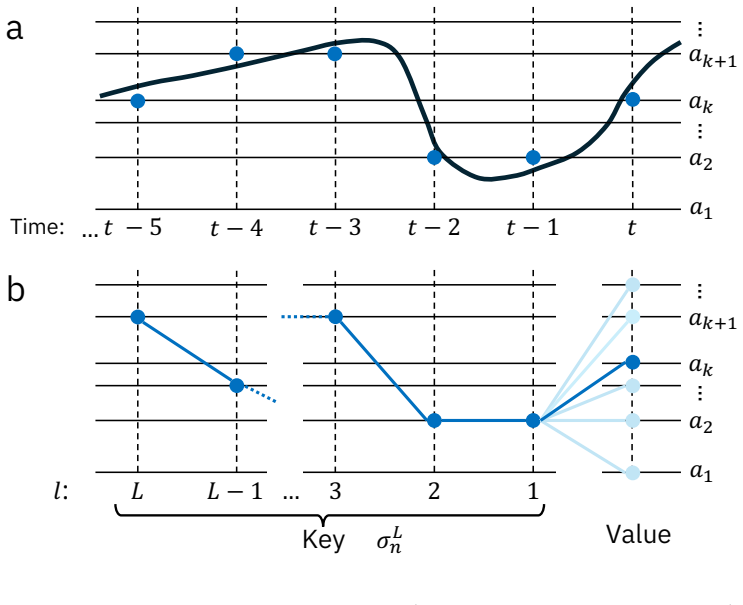
The load-bearing object is the realtime filter, a causal weighted moving average with kernel $\Psi(t) = (d_1 \cos(t/(\pi r_1)) + d_2 \cos(t/(\pi r_2))) (w-t)^c / w^c$ for $t \in [0,w]$ and $\Psi(t)=0$ for $t \ge 0$; convolving it with the monthly SST anomaly suppresses fluctuations shorter than about three years and longer than about eight years while using no future values. Its parameters are selected to maximize a dictionary objective that counts how often discretized length-$L$ patterns (keys) are followed by a single value among a prescribed set, together with the lag correlation between original and filtered series. The filtered series is then fed, through an $M$-dimensional delay-coordinate vector with delay $\Delta\tau$, into an echo-state network whose recurrent and input matrices are kept fixed and whose output matrix is fitted by ridge regression; prediction proceeds by recursively feeding the output back as input. All filter and reservoir hyperparameters are calibrated by Bayesian optimization, which the paper argues is what lets the same workflow transfer to other phenomena.
What would settle it
Evaluate the trained model directly against the conventional 5-month-running-mean Niño-3.4 index over 2001–2015: if the all-season correlation skill at 24 months falls below 0.5, the claimed two-year horizon does not transfer to the standard ENSO index. Alternatively, retrain the filter only on data before January 2001 and repeat the evaluation; a drop below 0.5 would indicate the test period influenced the reported skill.
Extended reading notes
Core claim
The central discovery claimed in the paper is that the main obstacle to long data-driven ENSO forecasts is not the predictor but the preprocessing: standard filters leak future information, and unfiltered data carry fast fluctuations that degrade reservoir training. The authors construct a causal realtime filter—a finite-support convolution kernel supported on $t \in [0,w]$, so that the filtered value at time $t$ depends only on observations at $t, t-1, \dots, t-w$—and tune its parameters together with the reservoir hyperparameters using Bayesian optimization. With the optimized filter and an echo-state network driven by delay-coordinate vectors of the filtered realtime SST anomaly, they report an average all-season correlation skill above 0.5 out to 29 months of lead time, and roughly 24 months once the filter-induced five-month lag is discounted. They interpret this as successfully predicting the multi-year dynamics of ENSO for two years using only past data.
Load-bearing premise
The claim's load-bearing premise is that the filtered realtime SST anomaly faithfully represents ENSO, a stand-in supported by a 0.837 lag correlation with the raw anomaly, while the filter parameters were tuned on a record that includes the test years.
Editorial extensions
If this is right
- The full pipeline—filter construction, model training, and forecasting—can in principle be run in realtime because no future information enters the filtered series.
- On the filtered realtime SST anomaly, skillful forecasts (correlation above 0.5) extend to 29 months of lead time, or about 24 months after accounting for the filter's five-month backward shift.
- Predictions initialized around 2010–2011 capture major warm and cold phases of the filtered index up to about three years ahead, while the strong 2015–2016 El Niño is reproduced with relatively low accuracy.
- The same methodology, with its six filter parameters and nine reservoir parameters tuned by Bayesian optimization, is proposed as a general recipe for multi-year prediction of other high-dimensional climate time series.
Reading between the lines
- Because the skill metric is computed on the filtered index, the paper does not establish the same two-year skill for the conventional Niño-3.4 index; a separate evaluation on the raw running-mean index would be needed before operational use.
- The filter parameters were optimized over the full 1870–2022 record, which includes the 2001–2015 evaluation window, so part of the reported skill may reflect information from the test period; retraining the filter on data ending in 2000 would quantify this.
- The causality property is generic, so the same filter-plus-reservoir workflow is a natural candidate for other oscillatory climate modes such as the Madden–Julian Oscillation or monsoon indices, where future-leaking filters have been a known obstacle.
Editorial analysis
A structured set of objections, weighed in public.
Referee Report
Summary. This paper proposes a causal 'realtime filter', a one-sided weighted moving average whose parameters are tuned by Bayesian optimization, to band-pass the monthly SST anomaly in the Nino-3.4 region; the filtered series is then used as input and output for an echo-state network with delay-coordinate embeddings. The authors report that the all-season correlation skill of the filtered target remains above 0.5 for 29 months over 180 hindcasts initialized monthly between January 2001 and December 2015, and after discounting a claimed ~5-month lag of the filter, they conclude that ENSO can be predicted 24 months ahead using only past data. The paper also provides code and a systematic hyperparameter optimization framework.
Significance. The paper offers a useful methodological contribution: a genuinely causal filter suitable for operational forecasting, combined with Bayesian optimization of filter and reservoir hyperparameters, and publicly available code. If the headline result were established on the standard Nino-3.4 index with a leakage-free calibration, a 24-month skill horizon would be noteworthy. As it stands, however, the evaluation is performed on a filtered proxy and the filter parameters are optimized on the full 1870-2022 record; both issues bear directly on the central claim and must be resolved before the result can be accepted.
major comments (3)
- [IV.A, III.B] The central claim of 24-month ENSO prediction is evaluated on the filtered realtime SST anomaly, not on the standard Nino-3.4 index or the raw monthly SST anomaly. Section IV.A concedes that 'a direct comparison of the prediction horizon to those of previous studies is not possible.' Because the filtered series is a smoothed, phase-shifted transformation of the input, correlation skill on this target can be high even when forecasts of the standard index are poor; the 0.837 maximum lag-correlation at five months does not establish that the two series have the same forecast-relevant dynamics. The abstract and conclusions should either report skill for the conventional Nino-3.4 index or substantially soften the claim that ENSO is predicted for two years.
- [II.B, II.D, Table I] The filter parameters are selected by maximizing Eq. (3) together with the maximum lag-correlation 'when applied to the realtime SST anomaly', with no temporal split described; since the realtime SST anomaly spans 1870-2022, this optimization includes the 2001-2015 evaluation window. The filter kernel itself is causal, but its shape is nevertheless fit using information from the test period, which can inflate the reported 29-month above-0.5 skill. The authors should refit the filter on data prior to 2001 only and re-evaluate on 2001-2015.
- [II.D, III.B] The reservoir hyperparameters and the random seed x are chosen by maximizing C(24) over 120 sequences from January 1986 to December 1995, and the same metric C(mu) is then reported on the separate 2001-2015 period. While this is a legitimate out-of-sample split, the headline 'above 0.5 for 29 months' is a single post-selection realization; reporting only the selected model's curve without uncertainty bands or comparison to a persistence/climatology baseline makes it difficult to assess whether the apparent skill reflects genuine predictability of the filtered signal.
minor comments (7)
- [II.B] The section heading 'Realtime fitering method' should be corrected to 'Realtime filtering method'.
- [Fig. 5 caption] The word 'ecch' in the caption should be 'each'.
- [III.B] The word 'architechture' should be 'architecture'.
- [III.A, III.B] The direction of the five-month shift is described inconsistently ('shifts backward' vs. 'shifted about 5 months into the future'); please clarify with an explicit definition of the lag variable and the implied correction to the prediction horizon.
- [II.D] Please specify the exact data period used for the filter optimization; if the full record is used, state it explicitly and discuss the implications for the reported skill.
- [Eq. (7)] Please define the range of lead months mu and explain how target years are assigned for lead times greater than 12 months.
- [Fig. 7 caption] The phrase 'Tempor al characteristics' should be 'Temporal characteristics'.
Circularity Check
Claimed 24-month ENSO skill is evaluated on a filtered target whose parameters were tuned on the full record, including the 2001-2015 evaluation window, and whose link to the standard Niño-3.4 index is an assumed 0.837 lag correlation.
-
fitted input called prediction
[Section II.D (Bayesian optimization) and Section III.B (Prediction skill); data period in Section II.A]
"The hyperparameters of the realtime filter are chosen to maximize the product of the objective function in Eq. (3) when applied to the realtime SST anomaly, and the maximum lag-correlation between the original and filtered monthly SST anomaly. ... To evaluate the prediction skill of the current method, the sequence of training and prediction is conducted 180 times with different t0 every month between January 2001 and December 2015."
No training/evaluation split is stated for the filter: Section II.A defines the data as 1870-2022, and Fig. 4b reports the lag correlation over the entire data period. The 2001-2015 evaluation window is therefore inside the record used to fit the six filter parameters in Table I. The filtered series y* used as the forecast target is produced by these fitted weights, so the all-season correlation skill in Eq. (7) is computed against a target whose construction already used information from the evaluation period. Moreover, Eq. (3) explicitly selects filter parameters by maximizing how often a pattern in y* is followed by one of its discrete values, i.e., it optimizes the predictability of the target series.
-
self definitional
[Section III.A (filtered index assumption) and Section IV.A (discussion)]
"The maximum correlation is 0.837 with a lag of five months, and we assume that the filtered realtime SST anomaly can be used as an alternative index for the state of ENSO. ... the target time series is the filtered realtime SST anomaly, which is not identical to the conventional Ni˜no 3.4 index. Therefore, a direct comparison of the prediction horizon to those of previous studies is not possible."
The headline claim that the model predicts ENSO dynamics for 24 months is evaluated on this assumed alternative index. The paper redefines the quantity to be predicted as the filtered realtime SST anomaly, justified only by a lag correlation of 0.837, and then subtracts the filter's 5-month phase shift to convert 29 months of skill on the filtered series into 24 months of 'ENSO' prediction. Since the paper concedes that the target is not the conventional Niño-3.4 index and that direct comparison with previous studies is impossible, the ENSO-specific claim reduces to skill on a self-defined filtered target; the link to actual ENSO dynamics is an assumption rather than part of the evaluated prediction.
full rationale
The paper's reservoir-computing component has some independent content: reservoir hyperparameters and random matrices are selected on a 1986-1995 validation period and then evaluated on 2001-2015, so the ESN training itself is not trivially circular. However, the central ENSO skill claim is compromised in two linked ways. First, the realtime filter parameters are optimized on the full 1870-2022 record, which includes the 2001-2015 evaluation window, and the reported skill is computed on the filtered series produced by those parameters; this is information leakage from the test period into the construction of the target. Second, the paper explicitly assumes the filtered realtime SST anomaly is an alternative index for ENSO based on a lag correlation of 0.837, and the 24-month result is obtained by subtracting the filter's 5-month shift from skill on that proxy. The paper itself acknowledges that direct comparison with previous ENSO prediction studies is not possible because the target is not the conventional Niño-3.4 index. The self-citations to Nakai and Saiki (2021) are used only as post-hoc hyperparameter guidance and are not load-bearing for the claimed skill. Overall, the result is partially circular: the target is a fitted, smoothed transformation selected for predictability, and the filter fit includes the evaluation period. A refit of the filter on data before 2001 and scoring the standard Niño-3.4 index would be required to support the 24-month ENSO claim.
Assumptions & free parameters
free parameters (4)
- Filter kernel parameters (r1, r2, d1, d2, c, w) =
r1=39.333, r2=2.789, d1=0.152, d2=0.448, c=1.086, w=65
- ESN hyperparameters (Delta_tau, M, N, beta, p, sigma_in, rho, alpha) =
Delta_tau=4, M=9, N=244, beta=0.759, p=0.290, sigma_in=0.477, rho=0.712, alpha=0.975
- Random seed x for matrices A and Win =
not reported (best selected)
- Discretization parameters K, gamma, Lmin, Lmax =
not reported
assumptions (5)
- ad hoc to paper The parametrized filter kernel (cosine pair times (w-t)^c / w^c) is an appropriate family for extracting 3-8 year variability.
- ad hoc to paper The dictionary/key-value objective in Eq. (3) measures the predictability of the discretized filtered series and is a suitable proxy for filter quality.
- domain assumption The filtered realtime SST anomaly is an acceptable alternative ENSO index.
- standard math Echo state property and reservoir computing training via ridge regression (Eq. 6) yield a valid data-driven model.
- domain assumption Delay-coordinate embedding reconstructs the ENSO attractor.
Cite this review
Pith. "Pith review of Long-term prediction of El Ni\~no-Southern Oscillation using reservoir computing with data-driven realtime filter." pith.science (2026). https://pith.science/paper/BRAM7I6K
@misc{pith2026250117781,
  author       = {Pith},
  title        = {Pith review of: Long-term prediction of El Ni\~no-Southern Oscillation using reservoir computing with data-driven realtime filter},
  year         = {2026},
  howpublished = {\url{https://pith.science/paper/BRAM7I6K}},
  note         = {Machine review of arXiv:2501.17781}
}
read the original abstract
In recent years, the application of machine learning approaches to time-series forecasting of climate dynamical phenomena has become increasingly active. It is known that applying a band-pass filter to a time-series data is a key to obtaining a high-quality data-driven model. Here, to obtain longer-term predictability of machine learning models, we introduce a new type of band-pass filter. It can be applied to realtime operational prediction workflows since it relies solely on past time series. We combine the filter with reservoir computing, which is a machine-learning technique that employs a data-driven dynamical system. As an application, we predict the multi-year dynamics of the El Ni\~{n}o-Southern Oscillation with the prediction horizon of 24 months using only past time series.
Figures


Figures from the paper (4 more)


Reference graph
Works this paper leans on
-
[1]
author author J. Bjerknes ,\ title title Atmospheric teleconnenctions from the equatorial Pacific , \ 10.1175/1520-0493(1969)097<0163:ATFTEP>2.3.CO;2 journal journal Monthly Weather Review \ volume 97 ,\ pages 163 -- 172 ( year 1969 ) NoStop
-
[2]
author author M. J. \ McPhaden , author S. E. \ Zebiak , \ and\ author M. H. \ Glantz ,\ title title ENSO as an integrating concept in Earth science , \ 10.1126/science.1132588 journal journal Science \ volume 314 ,\ pages 1740--1745 ( year 2006 ) ,\ http://arxiv.org/abs/https://www.science.org/doi/pdf/10.1126/science.1132588 https://www.science.org/doi/p...
-
[3]
author author P. S. \ Schopf \ and\ author M. J. \ Suarez ,\ title title Ocean wave dynamics and the time scale of ENSO , \ 10.1175/1520-0485(1990)020<0629:OWDATT>2.0.CO;2 journal journal Journal of Physical Oceanography \ volume 20 ,\ pages 629 -- 645 ( year 1990 ) NoStop
-
[4]
author author D. S. \ Battisti \ and\ author A. C. \ Hirst ,\ title title Interannual variability in a tropical atmosphere–ocean model: Influence of the basic state, ocean geometry and nonlinearity , \ 10.1175/1520-0469(1989)046<1687:IVIATA>2.0.CO;2 journal journal Journal of Atmospheric Sciences \ volume 46 ,\ pages 1687 -- 1712 ( year 1989 ) NoStop
-
[5]
author author K. Wyrtki ,\ title title Water displacements in the Pacific and the genesis of El Ni \ n o cycles , \ https://doi.org/10.1029/JC090iC04p07129 journal journal Journal of Geophysical Research: Oceans \ volume 90 ,\ pages 7129--7132 ( year 1985 ) ,\ http://arxiv.org/abs/https://agupubs.onlinelibrary.wiley.com/doi/pdf/10.1029/JC090iC04p07129 htt...
-
[6]
author author M. A. \ Cane , author M. Münnich , \ and\ author S. F. \ Zebiak ,\ title title A study of self-excited oscillations of the tropical ocean-atmosphere system. Part I: Linear analysis , \ 10.1175/1520-0469(1990)047<1562:ASOSEO>2.0.CO;2 journal journal Journal of Atmospheric Sciences \ volume 47 ,\ pages 1562 -- 1577 ( year 1990 ) NoStop
-
[7]
author author K. E. \ Trenberth \ and\ author T. J. \ Hoar ,\ title title The 1990–1995 El Ni \ n o‐Southern Oscillation event: Longest on record , \ https://api.semanticscholar.org/CorpusID:13651935 journal journal Geophysical Research Letters \ volume 23 ,\ pages 57--60 ( year 1996 ) NoStop
work page 1990
-
[8]
author author B. Grieger \ and\ author M. Latif ,\ title title Reconstruction of the El Ni \ n o attractor with neural networks , \ 10.1007/BF00228027 journal journal Climate Dynamics \ volume 10 ,\ pages 267--276 ( year 1994 ) NoStop
Show all 42 references
-
[9]
\ Luo , author S
author author J.-J. \ Luo , author S. Masson , author S. K. \ Behera , \ and\ author T. Yamagata ,\ title title Extended ENSO predictions using a fully coupled ocean–atmosphere model , \ 10.1175/2007JCLI1412.1 journal journal Journal of Climate \ volume 21 ,\ pages 84 -- 93 ( ...
-
[10]
Guilyardi , author A
author author E. Guilyardi , author A. Wittenberg , author A. Fedorov , author M. Collins , author C. Wang , author A. Capotondi , author G. J. \ van Oldenborgh , \ and\ author T. Stockdale ,\ title title Understanding El Niño in ocean–atmosphere general circulation models: Pr...
-
[11]
Tang , author R.-H
author author Y. Tang , author R.-H. \ Zhang , author T. Liu , author W. Duan , author D. Yang , author F. Zheng , author H. Ren , author T. Lian , author C. Gao , author D. Chen , \ and\ author M. Mu ,\ title title Progress in ENSO prediction and predictability study , \ 10.1...
-
[12]
author author C. L. \ Loi , author C.-C. \ Wu , \ and\ author Y.-C. \ Liang ,\ title title Prediction of tropical cyclogenesis based on machine learning methods and ts SHAP interpretation , \ https://doi.org/10.1029/2023MS003637 journal journal Journal of Advances in Modeling ...
-
[13]
Ludescher , author A
author author J. Ludescher , author A. Gozolchiani , author M. I. \ Bogachev , author A. Bunde , author S. Havlin , \ and\ author H. J. \ Schellnhuber ,\ title title Improved El Ni \ n o forecasting by cooperativity detection , \ @noop journal journal Proceedings of the Nation...
2013
-
[14]
Meng , author J
author author J. Meng , author J. Fan , author J. Ludescher , author A. Agarwal , author X. Chen , author A. Bunde , author J. Kurths , \ and\ author H. J. \ Schellnhuber ,\ title title Complexity-based approach for El Ni \ n o magnitude forecasting before the spring predictab...
2020
-
[15]
Timmermann , author H
author author A. Timmermann , author H. U. \ Voss , \ and\ author R. Pasmanter ,\ title title Empirical dynamical system modeling of ENSO using nonlinear inverse techniques , \ 10.1175/1520-0485(2001)031<1579:EDSMOE>2.0.CO;2 journal journal Journal of Physical Oceanography \ v...
2001 doi
-
[16]
Guardamagna , author C
author author F. Guardamagna , author C. Wieners , author X. Fang , \ and\ author H. A. \ Dijkstra ,\ title title Detection of limit cycle signatures of El Ni \ n o in models and observations using reservoir computing , \ @noop journal journal Journal of Physics: Complexity \ ...
2024
-
[17]
\ Ham , author J.-H
author author Y.-G. \ Ham , author J.-H. \ Kim , \ and\ author J.-J. \ Luo ,\ title title Deep learning for multi-year ENSO forecasts , \ @noop journal journal Nature \ volume 573 ,\ pages 568--572 ( year 2019 ) NoStop
2019
-
[18]
Chen , author F
author author N. Chen , author F. Gilani , \ and\ author J. Harlim ,\ title title A B ayesian machine learning algorithm for predicting ENSO using short observational time series , \ @noop journal journal Geophysical R esearch L etters \ volume 48 ,\ pages e2021GL093704 ( year...
2021
-
[19]
Chen , author X
author author Y. Chen , author X. Huang , author J.-J. \ Luo , author Y. Lin , author J. S. \ Wright , author Y. Lu , author X. Chen , author H. Jiang , \ and\ author P. Lin ,\ title title Prediction of ENSO using multivariable deep learning , \ @noop journal journal Atmospher...
2023
-
[20]
Wang , author S
author author H. Wang , author S. Hu , author C. Guan , \ and\ author X. Li ,\ title title The role of sea surface salinity in ENSO forecasting in the 21st century , \ @noop journal journal npj Climate and Atmospheric Science \ volume 7 ,\ pages 206 ( year 2024 ) NoStop
2024
-
[21]
echo state
author author H. Jaeger ,\ title title The "echo state" approach to analysing and training recurrent neural networks , \ @noop journal journal GMD Report \ volume 148 ,\ pages 13 ( year 2001 ) NoStop
2001
-
[22]
Jaeger \ and\ author H
author author H. Jaeger \ and\ author H. Haas ,\ title title Harnessing nonlinearity: Predicting chaotic systems and saving energy in wireless communication , \ @noop journal journal Science \ volume 304 ,\ pages 78--80 ( year 2004 ) NoStop
2004
-
[23]
Lu , author J
author author Z. Lu , author J. Pathak , author B. Hunt , author M. Girvan , author R. Brockett , \ and\ author E. Ott ,\ title title Reservoir observers: Model-free inference of unmeasured variables in chaotic systems , \ @noop journal journal Chaos \ volume 27 ,\ pages 04110...
2017
-
[24]
Lu , author B
author author Z. Lu , author B. R. \ Hunt , \ and\ author E. Ott ,\ title title Attractor reconstruction by machine learning , \ 10.1063/1.5039508 journal journal Chaos \ volume 28 ,\ pages 061104 ( year 2018 ) NoStop
2018 doi
-
[25]
Nakai \ and\ author Y
author author K. Nakai \ and\ author Y. Saiki ,\ title title Machine-learning inference of fluid variables from data using reservoir computing , \ @noop journal journal Physical Review E \ volume 98 ,\ pages 023111 ( year 2018 ) NoStop
2018
-
[26]
Nakai \ and\ author Y
author author K. Nakai \ and\ author Y. Saiki ,\ title title Machine-learning construction of a model for a macroscopic fluid variable using the delay-coordinate of a scalar observable , \ @noop journal journal Discrete and Continuous Dynamical Systems S \ volume 14 ,\ pages 1...
2021
-
[27]
author author M. U. \ Kobayashi , author K. Nakai , author Y. Saiki , \ and\ author N. Tsutsumi ,\ title title Dynamical system analysis of a data-driven model constructed by reservoir computing , \ 10.1103/PhysRevE.104.044215 journal journal Physical Review E \ volume 104 ,\ ...
-
[28]
Nakai \ and\ author Y
author author K. Nakai \ and\ author Y. Saiki ,\ title title Data-driven modeling from biased small training data using periodic orbits , \ @noop journal journal arXiv:2407.06229 \ ( year 2024 ) NoStop
2024 arXiv
-
[29]
Suematsu , author K
author author T. Suematsu , author K. Nakai , author T. Yoneda , author D. Takasuka , author T. Jinno , author Y. Saiki , \ and\ author H. Miura ,\ title title Machine learning prediction of the MJO extends beyond one month , \ @noop journal journal arXiv:2301.01254 \ ( year 2...
2022 arXiv
-
[30]
Mitsui \ and\ author N
author author T. Mitsui \ and\ author N. Boers ,\ title title Seasonal prediction of Indian summer monsoon onset with echo state networks , \ @noop journal journal Environmental Research Letters \ volume 16 ,\ pages 074024 ( year 2021 ) NoStop
2021
-
[31]
Huang \ and\ author Z
author author Y. Huang \ and\ author Z. Fu ,\ title title Estimating prediction horizon of reservoir computer on L63 system when observed variables are incomplete , \ 10.1088/2632-072X/acd21c journal journal Journal of Physics: Complexity \ volume 4 ,\ pages 025010 ( year 2023...
-
[32]
Hassanibesheli , author J
author author F. Hassanibesheli , author J. Kurths , \ and\ author N. Boers ,\ title title Long-term ENSO prediction with echo-state networks , \ 10.1088/2752-5295/ac7f4c journal journal Environmental Research: Climate \ volume 1 ,\ pages 011002 ( year 2022 ) NoStop
-
[33]
author author M. O. H. \ Centre ,\ @noop title HadISST 1.1 - Global sea-Ice coverage and SST (1870 - Present) , \ type Tech. Rep. \ ( institution NCAS British Atmospheric Data Centre ,\ year 2006 ) NoStop
2006
-
[34]
author author T. Yoneda ,\ @noop title Realtime filter and reservoir computing code , \ ( year 2024 ),\ note accessed: 2025-01-21 ,\ http://arxiv.org/abs/https://github.com/tsuyoshi-yoneda-math https://github.com/tsuyoshi-yoneda-math NoStop
2024
-
[35]
Tanaka , author R
author author G. Tanaka , author R. Nakane , \ and\ author A. Hirose ,\ @noop title Reservoir computing: Theory and hardware of fast machine learning for time series pattern recognition (Japanese) \ ( publisher Morikita Publishing Co., Ltd. ,\ year 2021 ) NoStop
2021
-
[36]
author author M. Luko s evi c ius ,\ title A practical guide to applying echo state networks , \ in\ 10.1007/978-3-642-35289-8_36 booktitle Neural Networks: Tricks of the Trade: Second Edition ,\ editor edited by\ editor G. Montavon , editor G. B. \ Orr , \ and\ editor K.-R. \...
-
[37]
author author I. B. \ Yildiz , author H. Jaeger , \ and\ author S. J. \ Kiebel ,\ title title Re-visiting the echo state property , \ https://doi.org/10.1016/j.neunet.2012.07.005 journal journal Neural Networks \ volume 35 ,\ pages 1--9 ( year 2012 ) NoStop
2012 doi
-
[38]
Takens ,\ title title Detecting strange attractors in turbulence , \ in\ @noop booktitle Dynamical Systems and Turbulence, Warwick 1980 ,\ editor edited by\ editor D
author author F. Takens ,\ title title Detecting strange attractors in turbulence , \ in\ @noop booktitle Dynamical Systems and Turbulence, Warwick 1980 ,\ editor edited by\ editor D. Rand \ and\ editor L.-S. \ Young \ ( publisher Springer Berlin Heidelberg ,\ address Berlin, ...
1980
-
[39]
Sauer \ and\ author J
author author T. Sauer \ and\ author J. Yorke ,\ title title Rigorous verification of trajectories for the computer simulation of dynamical systems , \ @noop journal journal Nonlinearity \ volume 4 ,\ pages 961--979 ( year 1991 ) NoStop
1991
-
[40]
Huang , author L
author author Y. Huang , author L. Yang , \ and\ author Z. Fu ,\ title title Reconstructing coupled time series in climate systems using three kinds of machine-learning methods , \ 10.5194/esd-11-835-2020 journal journal Earth System Dynamics \ volume 11 ,\ pages 835--853 ( ye...
2020 doi
-
[41]
Akiba , author S
author author T. Akiba , author S. Sano , author T. Yanase , author T. Ohta , \ and\ author M. Koyama ,\ title title Optuna: A next-generation hyperparameter optimization framework , \ in\ @noop booktitle Proceedings of the 25th ACM SIGKDD International Conference on Knowledge...
2019
-
[42]
Joy , author M
author author H. Joy , author M. Mattheakis , \ and\ author P. Protopapas ,\ https://arxiv.org/abs/2207.05870 title Rctorch: a pytorch reservoir computing package with automated hyper-parameter optimization , \ ( year 2022 ),\ http://arxiv.org/abs/2207.05870 arXiv:2207.05870 NoStop
2022 arXiv
Reviewed August 10, 2026 · model on record in the stance chip above.
Discussion (0). Continue with ORCID to comment.