REVIEW 3 major objections 4 minor 1 cited by
SSF: Sparse Long-Range Scene Flow for Autonomous Driving
T0 review · 3 major / 4 minor · reviewed 2026-08-10 · deepseek-v4-flash
Pith's one-line read Replacing dense feature grids with sparse convolutions lets scene flow stay accurate and cheap at long range, where object-based perception typically fails.
desk verdict Solid sparse-convolution step for long-range scene flow; the official leaderboard result is credible, but the surprising memory-invariance claim and the box-derived long-range labels need scrutiny before the headline numeric claims are taken at face value. read the letter →
The pith
A machine-rendered reading of the paper's core claim, the machinery that carries it, and where it could break.
The reading
What carries the argument
The load-bearing mechanism is sparse feature fusion with virtual voxels. Two point clouds are voxelized together so the sparse feature maps share one voxel ordering; voxels occupied by only one scan are padded with virtual points, encoded by the dynamic voxel feature encoding layer, and then zeroed out using indicator masks, so channel-wise concatenation of the two sparse maps is well-defined. This feeds a sparse U-Net built from submanifold sparse convolutions, which allocates computation only to occupied voxels, and the range-wise EPE metric divides points into distance bins and static/dynamic classes to expose long-range behavior.
What would settle it
Recompute the long-range dynamic EPE using an independent ground-truth source not derived from box annotations, for example high-resolution radar tracks or manually annotated dense object meshes beyond 50 meters. If SSF's dynamic error is no longer lowest in each range bin, or the gap to the dense baseline narrows sharply, the central long-range claim is refuted.
Extended reading notes
Core claim
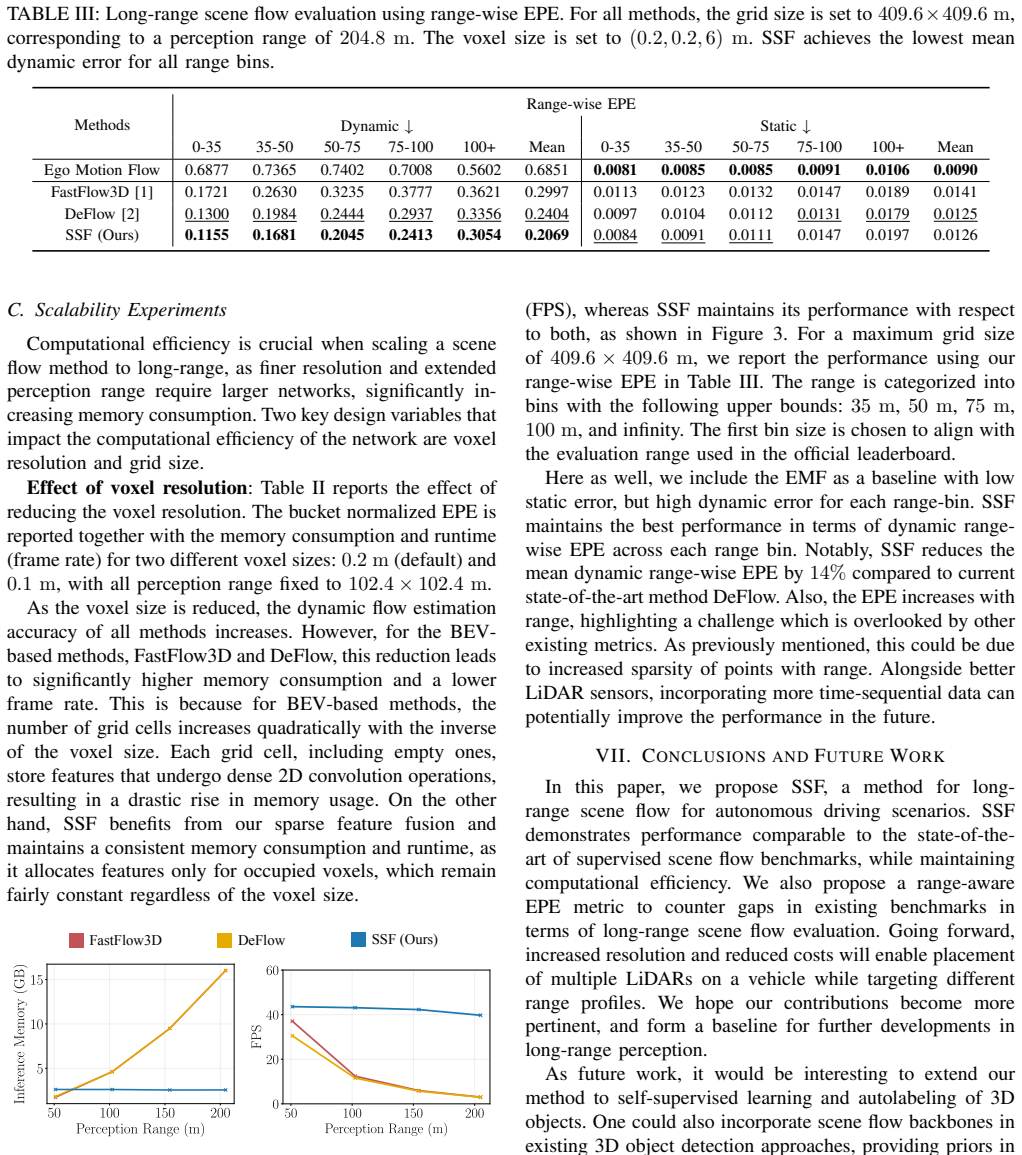
SSF is the first scene flow method the authors know of to report results beyond 50 meters. Its central result is that replacing the dense BEV grid with a sparse convolution backbone, together with a virtual-voxel fusion step that aligns sparse feature maps from two scans, improves accuracy on the standard Argoverse2 leaderboard and yields the lowest dynamic range-wise EPE in every distance bin up to 204.8 meters. The paper also introduces range-wise EPE, a metric that averages per-bin EPE for static and dynamic points separately, making range degradation visible. The authors claim this combination gives state-of-the-art accuracy while keeping inference memory and frame rate insensitive to voxel resolution and perception range.
Load-bearing premise
The long-range numbers rely on ground-truth flow labels built from sequential box annotations, so the load-bearing assumption is that a point inside a tracked box inherits the box's motion accurately even when LiDAR returns beyond 50 meters are extremely sparse; if box-to-point association is noisy at range, the reported range-wise EPE advantage could be an artifact of label noise.
Editorial extensions
If this is right
- Scene flow methods can extend to 200+ meter perception ranges with sparse backbones, enabling earlier detection of fast-moving distant agents.
- Reducing voxel size no longer costs quadratic memory and runtime, so finer resolution can be used where point density allows.
- The range-wise EPE metric makes distance-based degradation a standard measurable quantity that future methods can be compared on.
- The virtual-voxel fusion scheme generalizes to any pair of sparse point sets where ordered feature concatenation is needed, not just scene flow.
- At long range the static-error advantage is small or negative relative to the dense baseline, so the reported gain is concentrated in dynamic points.
Reading between the lines
- If the long-range dynamic EPE advantage persists with independently labeled ground truth, downstream tasks like cut-in prediction could use flow at 150 meters as a prior, something the paper does not test.
- The virtual-voxel ordering trick might also enable sparse cost volumes or cross-attention between asynchronous LiDAR sweeps, not just two adjacent scans.
- Because SSF's static EPE at 100+ meters is slightly worse than the dense baseline's, the long-range claim is specifically about moving points; a test on stationary clutter at range would separate label noise from method behavior.
- One could test whether the constant-memory property extends to much larger grids, such as 1 kilometer, or degrades as the number of occupied voxels grows linearly with range.
Signed reviews
Editorial analysis
A structured set of objections, weighed in public.
Referee Report
Summary. The paper proposes Sparse Scene Flow (SSF), a supervised scene flow method for the Argoverse 2 dataset that replaces dense BEV feature grids with a sparse convolution backbone. To fuse features from two temporally adjacent scans, the authors voxelize both scans jointly, insert virtual voxels at locations occupied by only one of the scans, and concatenate the resulting aligned sparse feature maps. They also introduce a range-wise EPE metric that averages EPE over distance bins for static and dynamic points. Experiments report state-of-the-art results on the official AV2 test leaderboard (mean three-way EPE 0.0273 vs. 0.0343 for DeFlow) and long-range evaluations up to 204.8 m in which SSF obtains the lowest dynamic range-wise EPE in every distance bin while keeping memory and runtime roughly constant.
Significance. If the reported measurements are reliable, the paper makes a useful contribution: it addresses a real scalability gap in scene flow by demonstrating that a sparse convolution backbone can operate at long range with lower memory and runtime than dense BEV methods, and it introduces a range-aware evaluation metric. The authors compare against multiple baselines on the official leaderboard and include runtime/memory measurements, which is a strength. However, the central long-range claim rests on box-derived ground truth whose quality at range is not validated, and the paper lacks ablations that would isolate the effect of the proposed virtual-voxel fusion scheme. The method is therefore promising but not yet fully established.
major comments (3)
- [Section VI-C, Table III; Section I] The long-range evaluation in Table III relies on ground-truth scene flow obtained by leveraging sequential box annotations along a track and applying the box motion to all points within the boxes, as stated in Section I. This procedure assumes that point-to-box association remains accurate at 50-200 m and that the box motions themselves are reliable at that range. At longer ranges, LiDAR returns become sparse, boundary points can be assigned to the wrong box or to background, and box motion estimates are derived from very few points. Because the claim that SSF maintains accuracy beyond 50 m is the paper's central long-range contribution, the authors should provide evidence of label quality at range, for example a precision/recall analysis of box-to-point association versus range, a manually annotated validation subset, or a sensitivity analysis that removes low-confidence points. Without this, the range-wise dynamic EPE comparisons in Table III are comparisons against a target of unknown accuracy.
- [Section IV-B] The virtual-voxel sparse feature fusion scheme is the main technical novelty of the paper, but no ablation isolates its contribution. In particular, there is no comparison against a baseline that fuses the sparse feature maps by zero-padding without virtual voxels, or against a variant that concatenates the two scans' features without the joint voxelization and mask-based alignment. Without such an ablation, it is impossible to tell how much of the reported improvement comes from the fusion mechanism itself rather than from the sparse backbone or other training changes. Please add an ablation study that reports the validation metrics for at least this one variant.
- [Table II] Table II reports exactly 2610 MB of GPU memory for SSF at both 0.2 m and 0.1 m voxel sizes, with frame rates 43.58 and 43.25 FPS. This exact invariance is mechanistically suspicious: reducing the voxel size should increase the number of occupied voxels and hence the size of the sparse feature maps, even if the increase is smaller than for a dense grid. The authors should clarify how memory was measured (peak memory, allocated workspace, or a fixed tensor size) and report the actual occupied-voxel counts at both resolutions. If the measurement only captures a fixed allocation overhead, the scalability claim in the text should be qualified accordingly.
minor comments (4)
- [Section V] The dynamic/static classification uses a threshold of 1.4 m/s motivated by normal walking speed, but no reference or sensitivity analysis is given. Since the proposed range-wise EPE metric depends directly on this threshold, a sentence justifying it and a brief sensitivity check over plausible thresholds would make the metric more robust.
- [Section VI-A] The paper reports a batch size of 384 but does not state how many GPUs were used or the effective per-GPU batch size. This information is needed to reproduce the training setup.
- [Figure 1 and Figure 3] The translucent circles in Figure 1 are difficult to interpret in grayscale, and Figure 3 would benefit from error bars or at least a tabulated companion table, since the claims about memory and runtime are central to the scalability argument.
- [Abstract and Section VI-A] The abstract states that code will be released at the given URL, but as of submission the repository is not available. Please include a commit/version or state the intended release date so that the experiments can be reproduced.
Circularity Check
No circularity found; the long-range claim rests on an external benchmark and the range-wise metric is evaluation-only, with label-noise as a validity caveat.
full rationale
The paper's derivation chain is empirical and self-contained with respect to circularity. SSF is a learned scene flow network trained with supervised regression against Argoverse 2 ground truth and evaluated on the official AV2 test leaderboard (Table I) and on a validation-set long-range protocol (Tables II-III). No parameter is fitted to the proposed range-wise EPE and then reported as a prediction of that same metric; the metric is introduced in Section V and used only for evaluation. The method's sparse feature fusion (virtual voxels, indicator masks) is an architectural construction, not a definitional restatement of the benchmark quantities. Self-citations to DeFlow [2] and SeFlow [17] occur as implementation base and baseline, respectively; they are not invoked as uniqueness theorems or as the sole justification for the central claim, and the comparison is experimental rather than derivational. The one in-scope weakness is the authors' own admission in Section I that long-range scene flow ground truth is derived from sequential box annotations; this affects label accuracy beyond 50 m and hence the validity of Table III, but it is an evaluation/data-quality limitation, not circular reasoning. Under the quoted-reduction standard, no equation reduces to another by construction and no fitted input is renamed as a prediction.
Assumptions & free parameters
free parameters (5)
- Pillar resolution (vx, vy, vz) =
(0.1, 0.1, 6) m in best config; 0.2 m default
- Perception grid size =
102.4 m and 409.6 m
- Learning rate =
8e-3
- Dynamic speed threshold for range-wise EPE =
1.4 m/s
- Range bin boundaries =
[35, 50, 75, 100, inf] m
assumptions (5)
- domain assumption Ego-motion T_t,t+1 is assumed available and accurate
- domain assumption Ground point masks G_t and G_{t+1} are available
- domain assumption Scene flow ground truth from sequential box annotations is accurate at all evaluated ranges
- domain assumption Sparse submanifold convolution outputs maintain consistent voxel ordering when virtual voxels are added
- ad hoc to paper Dynamic threshold 1.4 m/s correctly separates static from dynamic points in the metric
invented entities (1)
-
Virtual voxels
Cite this review
Pith. "Pith review of SSF: Sparse Long-Range Scene Flow for Autonomous Driving." pith.science (2026). https://pith.science/paper/24Z6AJAW
@misc{pith2026250117821,
  author       = {Pith},
  title        = {Pith review of: SSF: Sparse Long-Range Scene Flow for Autonomous Driving},
  year         = {2026},
  howpublished = {\url{https://pith.science/paper/24Z6AJAW}},
  note         = {Machine review of arXiv:2501.17821}
}
read the original abstract
Scene flow enables an understanding of the motion characteristics of the environment in the 3D world. It gains particular significance in the long-range, where object-based perception methods might fail due to sparse observations far away. Although significant advancements have been made in scene flow pipelines to handle large-scale point clouds, a gap remains in scalability with respect to long-range. We attribute this limitation to the common design choice of using dense feature grids, which scale quadratically with range. In this paper, we propose Sparse Scene Flow (SSF), a general pipeline for long-range scene flow, adopting a sparse convolution based backbone for feature extraction. This approach introduces a new challenge: a mismatch in size and ordering of sparse feature maps between time-sequential point scans. To address this, we propose a sparse feature fusion scheme, that augments the feature maps with virtual voxels at missing locations. Additionally, we propose a range-wise metric that implicitly gives greater importance to faraway points. Our method, SSF, achieves state-of-the-art results on the Argoverse2 dataset, demonstrating strong performance in long-range scene flow estimation. Our code will be released at https://github.com/KTH-RPL/SSF.git.
Figures


Forward citations
Cited by 1 Pith paper
-
DoGFlow: Self-Supervised LiDAR Scene Flow via Cross-Modal Doppler Guidance
Radar Doppler velocities, clustered under rigidity assumptions, can be propagated to LiDAR as pseudo scene flow labels, outperforming self-supervised baselines on TruckScenes and improving label efficiency.
Reference graph
Works this paper leans on
-
[1]
Scalable scene flow from point clouds in the real world,
P. Jund, C. Sweeney, N. Abdo, Z. Chen, and J. Shlens, “Scalable scene flow from point clouds in the real world,” IEEE Robotics and Automation Letters, vol. 7, no. 2, pp. 1589–1596, 2021
work page 2021
-
[2]
DeFlow: Decoder of scene flow network in autonomous driving,
Q. Zhang, Y . Yang, H. Fang, R. Geng, and P. Jensfelt, “DeFlow: Decoder of scene flow network in autonomous driving,” in 2024 IEEE International Conference on Robotics and Automation (ICRA) , 2024, pp. 2105–2111
work page 2024
-
[3]
Zeroflow: Scalable scene flow via distillation,
K. Vedder, N. Peri, N. Chodosh, I. Khatri, E. Eaton, D. Jayaraman, Y . Liu, D. Ramanan, and J. Hays, “Zeroflow: Scalable scene flow via distillation,” arXiv preprint arXiv:2305.10424 , 2023
arXiv 2023
-
[4]
Argoverse 2: Next generation datasets for self-driving perception and forecasting,
B. Wilson, W. Qi, T. Agarwal, J. Lambert, J. Singh, S. Khandelwal, B. Pan, R. Kumar, A. Hartnett, J. K. Pontes et al. , “Argoverse 2: Next generation datasets for self-driving perception and forecasting,” in Thirty-fifth Conference on Neural Information Processing Systems Datasets and Benchmarks Track (Round 2)
-
[5]
I Can't Believe It's Not Scene Flow!
I. Khatri, K. Vedder, N. Peri, D. Ramanan, and J. Hays, “I can’t believe it’s not scene flow!” arXiv preprint arXiv:2403.04739 , 2024
work page Pith review arXiv 2024
-
[6]
Spatially-sparse convolutional neural networks
B. Graham, “Spatially-sparse convolutional neural networks,” arXiv preprint arXiv:1409.6070, 2014
work page Pith review arXiv 2014
-
[7]
Three- dimensional scene flow,
S. Vedula, S. Baker, P. Rander, R. Collins, and T. Kanade, “Three- dimensional scene flow,” in Proceedings of the Seventh IEEE Inter- national Conference on Computer Vision , vol. 2. IEEE, 1999, pp. 722–729
work page 1999
-
[8]
Pointpillars: Fast encoders for object detection from point clouds,
A. H. Lang, S. V ora, H. Caesar, L. Zhou, J. Yang, and O. Beijbom, “Pointpillars: Fast encoders for object detection from point clouds,” in Proceedings of the IEEE/CVF conference on computer vision and pattern recognition, 2019, pp. 12 697–12 705
2019
Show all 30 references
-
[9]
U-net: Convolutional networks for biomedical image segmentation,
O. Ronneberger, P. Fischer, and T. Brox, “U-net: Convolutional networks for biomedical image segmentation,” in Medical image computing and computer-assisted intervention–MICCAI 2015: 18th international conference, Munich, Germany, October 5-9, 2015, pro- ceedings, part III 18 ...
2015
-
[10]
V oxelnet: End-to-end learning for point cloud based 3d object detection,
Y . Zhou and O. Tuzel, “V oxelnet: End-to-end learning for point cloud based 3d object detection,” in Proceedings of the IEEE conference on computer vision and pattern recognition , 2018, pp. 4490–4499
2018
-
[11]
Neural scene flow prior,
X. Li, J. Kaesemodel Pontes, and S. Lucey, “Neural scene flow prior,” Advances in Neural Information Processing Systems , vol. 34, pp. 7838–7851, 2021
2021
-
[12]
Fast neural scene flow,
X. Li, J. Zheng, F. Ferroni, J. K. Pontes, and S. Lucey, “Fast neural scene flow,” inProceedings of the IEEE/CVF International Conference on Computer Vision , 2023, pp. 9878–9890
2023
-
[13]
Fast kernel scene flow,
X. Li and S. Lucey, “Fast kernel scene flow,” arXiv preprint arXiv:2403.05896, 2024
2024 arXiv
-
[14]
Multi-body neural scene flow,
K. Vidanapathirana, S.-F. Chng, X. Li, and S. Lucey, “Multi-body neural scene flow,” in 2024 International Conference on 3D Vision (3DV). IEEE, 2024, pp. 126–136
2024
-
[15]
Motion inspired unsupervised perception and prediction in autonomous driving,
M. Najibi, J. Ji, Y . Zhou, C. R. Qi, X. Yan, S. Ettinger, and D. Anguelov, “Motion inspired unsupervised perception and prediction in autonomous driving,” in European Conference on Computer Vision. Springer, 2022, pp. 424–443
2022
-
[16]
Liso: Lidar-only self- supervised 3d object detection,
S. Baur, F. Moosmann, and A. Geiger, “Liso: Lidar-only self- supervised 3d object detection,” arXiv preprint arXiv:2403.07071 , 2024
2024 arXiv
-
[17]
SeFlow: A self-supervised scene flow method in autonomous driving,
Q. Zhang, Y . Yang, P. Li, O. Andersson, and P. Jensfelt, “SeFlow: A self-supervised scene flow method in autonomous driving,” in European Conference on Computer Vision (ECCV) . Springer, 2024, p. 353–369
2024
-
[18]
Submanifold sparse convolutional networks,
B. Graham and L. Van der Maaten, “Submanifold sparse convolutional networks,” arXiv preprint arXiv:1706.01307 , 2017
2017 arXiv
-
[19]
3d semantic segmentation with submanifold sparse convolutional networks,
B. Graham, M. Engelcke, and L. Van Der Maaten, “3d semantic segmentation with submanifold sparse convolutional networks,” in Proceedings of the IEEE conference on computer vision and pattern recognition, 2018, pp. 9224–9232
2018
-
[20]
4d spatio-temporal convnets: Minkowski convolutional neural networks,
C. Choy, J. Gwak, and S. Savarese, “4d spatio-temporal convnets: Minkowski convolutional neural networks,” in Proceedings of the IEEE/CVF conference on computer vision and pattern recognition , 2019, pp. 3075–3084
2019
-
[21]
Second: Sparsely embedded convolutional detection,
Y . Yan, Y . Mao, and B. Li, “Second: Sparsely embedded convolutional detection,” Sensors, vol. 18, no. 10, p. 3337, 2018
2018
-
[22]
Fully sparse 3d object detection,
L. Fan, F. Wang, N. Wang, and Z.-X. Zhang, “Fully sparse 3d object detection,” Advances in Neural Information Processing Systems, vol. 35, pp. 351–363, 2022
2022
-
[23]
V oxelnext: Fully sparse voxelnet for 3d object detection and tracking,
Y . Chen, J. Liu, X. Zhang, X. Qi, and J. Jia, “V oxelnext: Fully sparse voxelnet for 3d object detection and tracking,” in Proceedings of the IEEE/CVF Conference on Computer Vision and Pattern Recognition , 2023, pp. 21 674–21 683
2023
-
[24]
Flownet3d: Learning scene flow in 3d point clouds,
X. Liu, C. R. Qi, and L. J. Guibas, “Flownet3d: Learning scene flow in 3d point clouds,” in Proceedings of the IEEE/CVF conference on computer vision and pattern recognition , 2019, pp. 529–537
2019
-
[25]
Pointpwc-net: Cost volume on point clouds for (self-) supervised scene flow estimation,
W. Wu, Z. Y . Wang, Z. Li, W. Liu, and L. Fuxin, “Pointpwc-net: Cost volume on point clouds for (self-) supervised scene flow estimation,” in Computer Vision–ECCV 2020: 16th European Conference, Glasgow, UK, August 23–28, 2020, Proceedings, Part V 16 . Springer, 2020, pp. 88–107
2020
-
[26]
Hplflownet: Hierarchical permutohedral lattice flownet for scene flow estimation on large-scale point clouds,
X. Gu, Y . Wang, C. Wu, Y . J. Lee, and P. Wang, “Hplflownet: Hierarchical permutohedral lattice flownet for scene flow estimation on large-scale point clouds,” in Proceedings of the IEEE/CVF conference on computer vision and pattern recognition , 2019, pp. 3254–3263
2019
-
[27]
Re-evaluating lidar scene flow,
N. Chodosh, D. Ramanan, and S. Lucey, “Re-evaluating lidar scene flow,” in Proceedings of the IEEE/CVF Winter Conference on Appli- cations of Computer Vision (WACV) , January 2024, pp. 6005–6015
2024
-
[28]
Groundgrid: Lidar point cloud ground segmentation and terrain estimation,
N. Steinke, D. Goehring, and R. Rojas, “Groundgrid: Lidar point cloud ground segmentation and terrain estimation,” IEEE Robotics and Automation Letters, vol. 9, no. 1, pp. 420–426, 2023
2023
-
[29]
Part-aˆ 2 net: 3d part-aware and aggregation neural network for object detection from point cloud,
S. Shi, Z. Wang, X. Wang, and H. Li, “Part-aˆ 2 net: 3d part-aware and aggregation neural network for object detection from point cloud,” arXiv preprint arXiv:1907.03670 , vol. 2, no. 3, 2019
1907 arXiv
-
[30]
Icp-flow: Lidar scene flow estimation with icp,
Y . Lin and H. Caesar, “Icp-flow: Lidar scene flow estimation with icp,” in Proceedings of the IEEE/CVF Conference on Computer Vision and Pattern Recognition, 2024, pp. 15 501–15 511
2024
Reviewed August 10, 2026 · model on record in the stance chip above.
Discussion (0). Continue with ORCID to comment.