REVIEW 4 major objections 7 minor 117 references
Tensor network state methods and quantum information theory for strongly correlated molecular systems
T0 review · 4 major / 7 minor · reviewed 2026-08-10 · deepseek-v4-flash
Pith's one-line read Entanglement-guided orbital choice cuts the cost of molecular simulations.
desk verdict A clear pedagogical review of the authors' own DMRG advances; the central claim that low-D orbital optimization transfers to high-D production is asserted, not tested. read the letter →
The pith
A machine-rendered reading of the paper's core claim, the machinery that carries it, and where it could break.
The reading
What carries the argument
The load-bearing object is the block entropy area, the sum of half-Rényi entropies $S_{1/2}(\rho_{\{1,\ldots,k\}})$ across the bonds of the matrix product state; minimizing it with respect to orbital rotations compresses the entanglement that sets the required bond dimension. Local two-site unitaries $u_{(k,k+1)}$ are optimized during DMRG micro-iterations, and a Walecki construction generates $d/2$ permutations that place every orbital pair as neighbors at least once, implemented as two layers of swap gates that update the MPS in place. The swap-gate step lets the optimizer move along all generators of the unitary group without rebuilding the MPS, avoiding the heuristic Fiedler-vector reordering. Around this core, the paper layers SU(2)-symmetric block-sparse tensor contractions with Wigner-9j prefactors and a task-list-based hybrid CPU-multiGPU kernel to make high-bond-dimension DMRG feasible.
What would settle it
Re-run the chromium-dimer CAS(12,68) calculation optimizing orbitals at $D=4096$ instead of $D=256$ and compare the $D=4096$ ground-state energy and block-entropy profile with the low-$D$-optimized result: if the high-$D$-optimized orbitals give a materially lower energy or lower entropy peak at the same bond dimension, the low-$D$-to-high-$D$ transfer that underpins the reported gains is broken.
Extended reading notes
Core claim
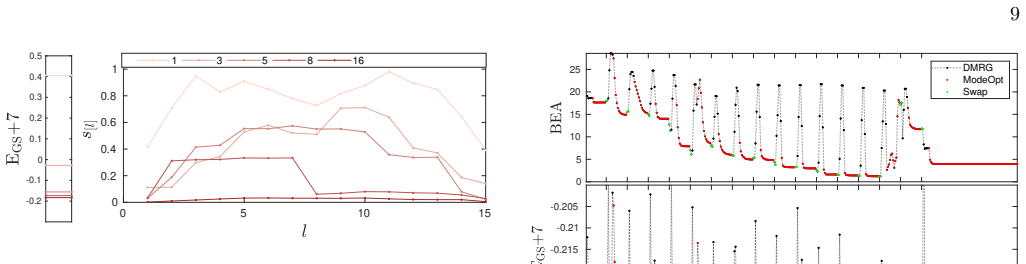
The central discovery is that global fermionic mode optimization transfers from lattice models to ab initio molecules and, combined with hybrid CPU-multiGPU DMRG, makes strongly correlated molecular calculations drastically cheaper. The protocol minimizes the block entropy area $B_\alpha(C)=\sum_{k} S_\alpha(\rho_{\{1,\ldots,k\}})$ by running DMRG-style micro-iterations at small bond dimension ($D \le 256$), interleaved with Walecki-permutation swap layers; after an optimal basis is found, production DMRG runs at large $D$ ($\ge 4096$ or $10000$-$20000$) without further mode optimization. On the $4\times 4$ spinless Hubbard model the maximum block entropy drops by about two orders of magnitude at $D_{\rm opt}=8$. For Cr$_2$ in CAS(12,68), the ground-state energies $-2086.8079$, $-2086.8374$, $-2086.8580$, $-2086.8637$ a.u. at $D=1024$, $2048$, $3072$, $4096$ approach the CCSDT reference, while the DMRG-RAS-X method on 17 selected orbitals yields $-2086.8769$ a.u., below the CCSDTQ value by $8\times10^{-3}$ a.u. Wall-time scaling on eight A100 GPUs shows an exponent near $1.6$ before memory saturation and near $2.9$, close to the theoretical value $p_{\rm th}=3$, at large bond dimension.
Load-bearing premise
The load-bearing premise is that orbital rotations chosen to minimize block entropy at small bond dimension ($D \le 256$) remain essentially optimal for the production run at much larger bond dimension ($D \ge 4096$), so the reported post-optimization energies and speedups reflect truly converged performance; the paper does not test this transfer.
Editorial extensions
If this is right
- For the $4\times 4$ spinless Hubbard model, optimized orbitals at $D_{\rm opt}=8$ reduce the maximum block entropy by about two orders of magnitude, implying that the same accuracy requires far smaller bond dimensions than in the original basis.
- For Cr$_2$ in CAS(12,68), DMRG in the optimized basis gives a monotonically improving ground-state energy with bond dimension, reaching $-2086.8637$ a.u. at $D=4096$ and moving toward the CCSDT value, so the method provides a practical route to benchmark strongly correlated molecules.
- Because the swap-gate protocol systematically covers all mode pairs, the same code also automates orbital ordering, so no separate heuristic ordering step is needed.
- The combination of mode optimization with GPU-accelerated, SU(2)-symmetric DMRG cuts wall time by several orders of magnitude, turning simulations that formerly took weeks into routine daily calculations.
- The DMRG-RAS-X embedding approach gives variational energies below the CCSDTQ reference for Cr$_2$ with only 17 orbitals, and its combination with the GPU kernel opens a path to active spaces with hundreds of orbitals.
Reading between the lines
- A corollary the paper leaves implicit is that if the low-bond-dimension optimized orbitals remain near-optimal at large bond dimension, the same orbital set should also compress other wave-function representations, so entanglement localization could be exported to selected-CI or coupled-cluster calculations on the same molecules.
- Because Walecki permutations are a general graph-theoretic construction, the optimization principle should extend to tree tensor networks and other topologies where a systematic way to bring distant modes together is currently missing; the paper only gestures at this extension.
- The reported scaling exponent near $1.6$ before GPU memory saturation suggests, as an extrapolation rather than a result, that near-linear scaling might persist to much larger bond dimensions on nodes with more memory, which would make $D \sim 10000$-$20000$ routine for molecules.
- The F$_2$ result, where optimized rotation angles are near $0$ or $\pi/2$, indicates that weakly correlated problems mainly need reordering, so a cheap pre-screening step might detect single-reference cases and skip rotation optimization entirely.
Editorial analysis
A structured set of objections, weighed in public.
Referee Report
Summary. The manuscript is a pedagogical overview of tensor-network state methods for strongly correlated molecular systems, centered on global fermionic mode optimization (using swap-gate-generated permutations and a block-entropy-area cost function) followed by large-scale DMRG with a hybrid CPU-multiGPU implementation that exploits SU(2) symmetry. Numerical illustrations are given for the 4x4 spinless Hubbard model, F2, N2 at several bond lengths, and Cr2 in a CAS(12,68) active space. The central practical claim is that low-bond-dimension mode optimization produces orbitals that make high-bond-dimension DMRG dramatically more accurate and faster, with computational time reduced by 'several orders of magnitude'.
Significance. If the central claim holds, the combination of global mode optimization and GPU-accelerated DMRG would be an important practical advance, since it would reduce the bond dimensions, memory, and time needed to converge strongly correlated molecular calculations. The paper is clearly structured and gives a useful pedagogical account of Walecki-construction swap gates, the BEA cost function, SU(2) symmetry in block-sparse tensor operations, and task-based parallelization. The numerical demonstrations are anchored by exact diagonalization for the 4x4 Hubbard model and by CCSD/CCSD(T)/CCSDT/CCSDTQ benchmarks for Cr2. However, the evidence presented does not yet establish the key low-D to high-D transfer assumption on which the headline claims rest, and the scaling exponents are fitted to only four data points.
major comments (4)
- [II.B.1, IV.A] The two-stage protocol assumes that orbitals optimized at D <= 256 remain near-optimal for production DMRG at D >= 4096, but this transfer is never tested. The BEA cost function (Eq. 5) is evaluated on the low-D MPS; at D=256 the discarded tail of the Schmidt spectrum is absent, so the low-D block entropies can differ substantially from those of the near-exact state, and a unitary that minimizes the truncated-state BEA need not minimize the exact-state BEA. In Sec. IV.A all Cr2 energies are obtained in the D=256-optimized basis; there is no comparison calculation with orbitals re-optimized at D=1024 or D=4096, nor a report of BEA at high D for both orbital sets. Without such a control, the claims in Sec. III.A ('far more accurate results') and Sec. II.D ('several orders of magnitude') are not substantiated by the data in this manuscript. I would ask for a direct test, e.g., re-optimizing at D=512 or 1024 and comparing D=4096 energies, or reporting BEA(D=4096) for both orbital sets.
- [IV.A, Fig. 21] The scaling exponents p1 ~ 1.6 and p2 ~ 2.9 are obtained from first-order polynomial fits to only four data points (D=1024, 2048, 3072, 4096). With two fitted lines separated by a break at D=3072, four points cannot determine a slope reliably; no fit residuals, confidence intervals, or alternative scaling models are given. Since the performance claim of near-linear scaling and the transition to a theoretical p=3 regime are quantitative, please provide more data points and uncertainty estimates. The text also calls p1=1.6 'almost linear', which is misleading; linear scaling would give p=1.
- [III.A] The statement that using optimized orbitals 'leads to far more accurate results than the original orbitals' is not directly demonstrated by an energy comparison at fixed bond dimension. Figs. 6 and 8 show that BEA and energy decrease during mode optimization, but the energy decrease coincides with additional DMRG sweeps and, in Fig. 6, a temporary bond-dimension increase to D=32 at the swap gates. A direct comparison between DMRG with the original orbitals and DMRG with the optimized orbitals at the same D and the same number of sweeps is needed to support the claim.
- [IV.A] The DMRG energies for Cr2 are reported without any error estimates or truncation thresholds. The text states that in practice the truncation error is kept fixed, but no value is given. The difference between D=4096 (-2086.8637) and CCSDTQ (-2086.8689) is about 0.005 a.u., which is sizable in the context of chemical accuracy, so the reader cannot tell whether the reported energies are converged with respect to bond dimension. Please report the discarded weight or entropy, and preferably an additional D=8192 point or an extrapolation, to support the convergence claim.
minor comments (7)
- [Abstract/Introduction] The phrase 'ab inito' in the Introduction should be 'ab initio'.
- [II.A] In Eq. (2), the index range of the tensor C is not stated explicitly; the statement that it contains 4^d elements refers to the full Fock space, not the N-electron subspace. Please clarify.
- [II.B] In Eq. (5), the cost function B_alpha(C) uses C, but C is not explicitly defined in this section after Eq. (2). Please define it or use a notation tied to the MPS wave function.
- [IV.A] In the text below Fig. 20, 'singular vale decomposition' should be 'singular value decomposition'.
- [IV.A, Fig. 21] The axes of Fig. 21 are not fully labeled; the text states the ordinate is 'total diagonalization time together with IO overhead for seven sweeps in minutes', but the figure would be clearer with explicit axis labels and symbols for the fitted lines.
- [III.B.2] The sentence 'as summarized in Figs. 12 and 12' should refer to Figs. 12 and 13.
- [IV.B] The phrase 'varios post-DMRG methods' should be 'various post-DMRG methods'.
Circularity Check
No circularity: the optimized-orbital DMRG energies are computed from the Hamiltonian in the rotated basis and are not equal by construction to the BEA cost function that selects the orbitals.
full rationale
The paper's derivation chain is: define the block-entropy area cost function BEA (Eq. 5), optimize two-site unitaries by minimizing S1/2(ρ_{1,...,k}) at low D, generate permutations via Walecki's construction, and then run production DMRG in the optimized basis at large D. The reported Cr2 energies, E = -2086.8079, -2086.8374, -2086.8580, -2086.8637 for D = 1024, 2048, 3072, 4096, are variational energies obtained from the Hamiltonian in the rotated orbital basis; they are not the BEA values and are not fitted parameters. The statement that optimized orbitals lead to far more accurate results at large bond dimensions is an inference from entropy reduction and is not itself the objective being minimized. The low-D-to-high-D transfer (Dopt <= 256 followed by D >= 4096) is an untested assumption, but that is a validation gap rather than a circular reduction: nothing in the low-D minimization mathematically forces the high-D energy differences. The method narrative relies on the authors' prior work (Refs. 46, 57, 58, 63), but the present paper spells out the micro-iteration steps, swap-gate construction, and parallelization details, and no uniqueness theorem or hidden ansatz is imported solely by citation to make the central claim true by definition. The limitation noted in Sec. V, that long-range two-mode unitaries are implemented only for neighboring modes, is an honest scope statement and does not create circularity. Overall, the derivation is self-contained in the relevant sense: outcome quantities are computed, not renamed inputs.
Assumptions & free parameters
free parameters (4)
- scaling exponent p1 =
1.6
- scaling exponent p2 =
2.9
- bond extension factor q =
2
- D_opt (bond dimension during mode optimization) =
8, 64, 80, 256 depending on system
assumptions (5)
- domain assumption Nonrelativistic second-quantized molecular Hamiltonian (Eq. 1)
- domain assumption Block entropy S_alpha relates to required bond dimension as D ~ exp(S_alpha)
- ad hoc to paper Orbitals optimized at low bond dimension remain near-optimal for high-bond-dimension DMRG
- standard math Walecki's construction yields a set of permutations covering all mode pairs at least once
- standard math DMRG with fixed bond dimension converges to the ground state within the MPS submanifold
Cite this review
Pith. "Pith review of Tensor network state methods and quantum information theory for strongly correlated molecular systems." pith.science (2026). https://pith.science/paper/6BEL3LEJ
@misc{pith2026250118263,
  author       = {Pith},
  title        = {Pith review of: Tensor network state methods and quantum information theory for strongly correlated molecular systems},
  year         = {2026},
  howpublished = {\url{https://pith.science/paper/6BEL3LEJ}},
  note         = {Machine review of arXiv:2501.18263}
}
read the original abstract
A brief pedagogical overview of recent advances in tensor network state methods are presented that have the potential to broaden their scope of application radically for strongly correlated molecular systems. These include global fermionic mode optimization, i.e., a general approach to find an optimal matrix product state (MPS) parametrization of a quantum many-body wave function with the minimum number of parameters for a given error margin, the restricted active space DMRG-RAS-X method, multi-orbital correlations and entanglement, developments on hybrid CPU-multiGPU parallelization, and an efficient treatment of non-Abelian symmetries on high-performance computing (HPC) infrastructures. Scaling analysis on NVIDIA DGX-A100 platform is also presented.
Figures


Figures from the paper (13 more)




Reference graph
Works this paper leans on
-
[1]
, αd⟩, (4) where the component tensors are Aαi [i] ∈ CDi−1×Di , with bond dimensions Di, and D0 = Dd = 1
· · ·Aαd [d] |α1, . . . , αd⟩, (4) where the component tensors are Aαi [i] ∈ CDi−1×Di , with bond dimensions Di, and D0 = Dd = 1. It is easy to prove that every state vector of the Fock space Fd can be transformed to an MPS form by applying consecu- tive SVDs [27, 65], using sufficiently large bond dimen- sions. However, in the generic case, this exact MP...
-
[2]
An optimal list of permutations for even d can be generated by Walecki’s method [70] that was introduced first in graph theory
Global mode optimization with swap-gate generated permutations The basic idea behind the recently introduced proto- col [46] is that by generating appropriate permutations of modes all the mode pairs get neighbors at some macro iterations and, thus the global unitary U is optimized in the direction of every generator of the unitary group U (d). An optimal...
-
[3]
10 and 11 we show results for the F 2 dimer at equilibrium bond length r = 2.68797a0, with a0 being the Bohr radius, using split valence basis set [89] (for further details see Ref
F 2 dimer In Figs. 10 and 11 we show results for the F 2 dimer at equilibrium bond length r = 2.68797a0, with a0 being the Bohr radius, using split valence basis set [89] (for further details see Ref. [28]) with Dopt = 256 starting the DMRG simulations by ordering orbitals energetically along the DMRG chain. Here we found that optimized rotation angle par...
-
[4]
Nitrogen dimer As a second example, we present an analysis for the nitrogen dimer in the cc-pVDZ basis [91] for various bond lengths. DMRG benchmark calculations on the full active space by correlating 14 electrons on 28 or- bitals, CAS(14,28), of the stretched nitrogen dimer have been presented in various works of the past decades [44, 69, 92, 93]. Recen...
-
[5]
Chromium dimer For completeness, in this section we show results for the notoriously strongly correlated chromium dimer which is subject to usual benchmark calculations even nowadays [95–101]. Our result for Cr 2 starting with a natural orbital basis obtained from the cc-pVDZ atomic basis (see Ref. [99]) at its equilibrium geometry, d = 1.6788˚A, correspo...
-
[6]
Affleck, T
I. Affleck, T. Kennedy, E. H. Lieb, and H. Tasaki, Rig- orous results on valence-bond ground states in antifer- romagnets, Phys. Rev. Lett. 59, 799 (1987)
1987
-
[7]
Fannes, B
M. Fannes, B. Nachtergaele, and R. F. Werner, Finitely correlated states on quantum spin chains, Communica- tions in Mathematical Physics 144, 443 (1992)
1992
-
[8]
S. R. White, Density matrix formulation for quan- tum renormalization groups, Phys. Rev. Lett. 69, 2863 (1992)
1992
Show all 117 references
-
[9]
S. R. White, Density-matrix algorithms for quantum renormalization groups, Phys. Rev. B 48, 10345 (1993)
1993
-
[10]
Nishino, Density Matrix Renormalization Group Method for 2D Classical Models, Journal of the Physical Society of Japan 64, 3598 (1995)
T. Nishino, Density Matrix Renormalization Group Method for 2D Classical Models, Journal of the Physical Society of Japan 64, 3598 (1995)
1995
-
[11]
¨Ostlund and S
S. ¨Ostlund and S. Rommer, Thermodynamic limit of density matrix renormalization, Phys. Rev. Lett. 75, 3537 (1995)
1995
-
[12]
Rommer and S
S. Rommer and S. ¨Ostlund, Class of ansatz wave func- tions for one-dimensional spin systems and their relation to the density matrix renormalization group, Phys. Rev. B 55, 2164 (1997)
1997
-
[13]
Schollw¨ ock, The density-matrix renormalization group, Rev
U. Schollw¨ ock, The density-matrix renormalization group, Rev. Mod. Phys. 77, 259 (2005)
2005
-
[14]
K. A. Hallberg, New trends in density matrix renor- malization, Advances in Physics 55, 477 (2006), http://dx.doi.org/10.1080/00018730600766432
2006 doi
-
[15]
R. M. Noack and S. R. Manmana, Diagonalization- and numerical renormalization-group-based methods for in- teracting quantum systems, AIP Conference Proceed- ings 789, 93 (2005)
2005
-
[16]
Legeza, R
¨O. Legeza, R. Noack, J. S´ olyom, and L. Tincani, Appli- cations of quantum information in the density-matrix renormalization group, in Computational Many-Particle Physics, Lecture Notes in Physics, Vol. 739, edited by H. Fehske, R. Schneider, and A. Weisse (Springer, Berlin,...
2008
-
[17]
G. K.-L. Chan and D. Zgid, Chapter 7 the density ma- trix renormalization group in quantum chemistry (Else- vier, 2009) pp. 149 – 162
2009
-
[18]
Schollw¨ ock, The density-matrix renormalization group in the age of matrix product states, Annals of Physics 326, 96 (2011), january 2011 Special Issue
U. Schollw¨ ock, The density-matrix renormalization group in the age of matrix product states, Annals of Physics 326, 96 (2011), january 2011 Special Issue
2011
-
[19]
G. K.-L. Chan and S. Sharma, The density ma- trix renormalization group in quantum chemistry, An- nual Review of Physical Chemistry 62, 465 (2011), pMID: 21219144, http://dx.doi.org/10.1146/annurev- physchem-032210-103338
2011 doi
-
[20]
Szalay, M
Sz. Szalay, M. Pfeffer, V. Murg, G. Barcza, F. Ver- straete, R. Schneider, and ¨O. Legeza, Tensor product methods and entanglement optimization for ab initio quantum chemistry, Int. J. Quantum Chem. 115, 1342 (2015)
2015
-
[21]
Or´ us, Tensor networks for complex quantum systems, Nature Reviews Physics 1, 538 (2019)
R. Or´ us, Tensor networks for complex quantum systems, Nature Reviews Physics 1, 538 (2019)
2019
-
[22]
S. R. White and R. L. Martin, Ab initio quantum chem- istry using the density matrix renormalization group, The Journal of Chemical Physics 110, 4127 (1999)
1999
-
[23]
G. K.-L. Chan, J. J. Dorando, D. Ghosh, J. Hachmann, E. Neuscamman, H. Wang, and T. Yanai, An introduc- tion to the density matrix renormalization group ansatz in quantum chemistry, in Frontiers in Quantum Sys- tems in Chemistry and Physics , Progress in Theoreti- cal Chemistr...
2008
-
[24]
Yanai, Y
T. Yanai, Y. Kurashige, D. Ghosh, and G. K.-L. Chan, Accelerating convergence in iterative solution for large- scale complete active space self-consistent-field calcu- lations, International Journal of Quantum Chemistry 109, 2178 (2009)
2009
-
[25]
K. H. Marti and M. Reiher, The density matrix renormalization group algorithm in quantum chemistry, Zeitschrift f¨ ur Physikalische Chemie224, 583 (2010)
2010
-
[26]
Wouters, W
S. Wouters, W. Poelmans, P. W. Ayers, and D. V. Neck, CheMPS2: A free open-source spin-adapted implemen- tation of the density matrix renormalization group for ab initio quantum chemistry, Computer Physics Com- munications 185, 1501 (2014)
2014
-
[27]
Legeza, T
¨O. Legeza, T. Rohwedder, R. Schneider, and Sz. Szalay, Tensor product approximation (DMRG) and coupled cluster method in quantum chemistry, inMany-Electron Approaches in Physics, Chemistry and Mathematics , Mathematical Physics Studies, edited by V. Bach and L. Delle Site (Sp...
2014
-
[28]
G. K.-L. Chan, A. Keselman, N. Nakatani, Z. Li, and S. R. White, Matrix product operators, matrix prod- uct states, and ab initio density matrix renormalization group algorithms, The Journal of Chemical Physics145, 014102 (2016)
2016
-
[29]
Baiardi and M
A. Baiardi and M. Reiher, The density matrix renor- malization group in chemistry and molecular physics: Recent developments and new challenges, The Journal of Chemical Physics 152, 040903 (2020)
2020
-
[30]
Cheng, Z
Y. Cheng, Z. Xie, and H. Ma, Post-density matrix renor- malization group methods for describing dynamic elec- tron correlation with large active spaces, The Journal of Physical Chemistry Letters 13, 904 (2022)
2022
-
[31]
Verstraete, T
F. Verstraete, T. Nishino, U. Schollw¨ ock, M. C. Ba˜ nuls, G. K. Chan, and M. E. Stoudenmire, Density matrix renormalization group, 30 years on, Nature Reviews Physics , 1 (2023)
2023
-
[32]
Roy and S
A. Roy and S. Banerjee, Linear algebra and matrix anal- ysis for statistics (Chapman and Hall/CRC, 2014)
2014
-
[33]
Legeza, J
¨O. Legeza, J. R¨ oder, and B. A. Hess, Controlling the accuracy of the density-matrix renormalization-group method: The dynamical block state selection approach, Phys. Rev. B 67, 125114 (2003)
2003
-
[34]
Holtz, T
S. Holtz, T. Rohwedder, and R. Schneider, On manifolds of tensors of fixed TT-rank, Numerische Mathematik 120, 701 (2012)
2012
-
[35]
Holtz, T
S. Holtz, T. Rohwedder, and R. Schneider, The alternat- ing linear scheme for tensor optimization in the tensor train format, SIAM Journal on Scientific Computing34, A683 (2012)
2012
-
[36]
Legeza and J
¨O. Legeza and J. S´ olyom, Optimizing the density-matrix renormalization group method using quantum informa- tion entropy, Phys. Rev. B 68, 195116 (2003)
2003
-
[37]
Nakatani and G
N. Nakatani and G. K.-L. Chan, Efficient tree ten- sor network states (TTNS) for quantum chemistry: Generalizations of the density matrix renormalization group algorithm, The Journal of Chemical Physics 138, 134113 (2013)
2013
-
[38]
V. Murg, F. Verstraete, R. Schneider, P. R. Nagy, and ¨O. Legeza, Tree tensor network state with vari- able tensor order: An efficient multireference method for strongly correlated systems, Journal of Chemical The- ory and Computation 11, 1027 (2015)
2015
-
[39]
Gunst, F
K. Gunst, F. Verstraete, S. Wouters, ¨O. Legeza, and D. Van Neck, T3NS: Three-legged tree tensor network states, Journal of Chemical Theory and Computation 14, 2026 (2018)
2018
-
[40]
Rissler, R
J. Rissler, R. M. Noack, and S. R. White, Measuring orbital interaction using quantum information theory, Chemical Physics 323, 519 (2006)
2006
-
[41]
V. Murg, F. Verstraete, ¨O. Legeza, and R. M. Noack, Simulating strongly correlated quantum systems with tree tensor networks, Phys. Rev. B 82, 205105 (2010)
2010
-
[42]
C. J. Stein and M. Reiher, Automated selection of active orbital spaces, Journal of Chemical Theory and Com- putation 12, 1760 (2016)
2016
-
[43]
Fertitta, B
E. Fertitta, B. Paulus, G. Barcza, and ¨O. Legeza, Inves- tigation of metal-insulator-like transition through the ab initio density matrix renormalization group approach, Phys. Rev. B 90, 245129 (2014)
2014
-
[44]
Krumnow, L
C. Krumnow, L. Veis, ¨O. Legeza, and J. Eisert, Fermionic orbital optimization in tensor network states, Phys. Rev. Lett. 117, 210402 (2016)
2016
-
[45]
Krumnow, L
C. Krumnow, L. Veis, J. Eisert, and ¨O. Legeza, Effec- tive dimension reduction with mode transformations: Simulating two-dimensional fermionic condensed mat- ter systems with matrix-product states, Phys. Rev. B 104, 075137 (2021)
2021
-
[46]
J. M. Foster and S. F. Boys, Canonical configurational interaction procedure, Rev. Mod. Phys. 32, 300 (1960)
1960
-
[47]
S. F. Boys, Construction of some molecular orbitals to be approximately invariant for changes from one molecule to another, Rev. Mod. Phys. 32, 296 (1960)
1960
-
[48]
Pipek and P
J. Pipek and P. G. Mezey, A fast intrinsic localization procedure applicable for ab initio and semiempirical lin- ear combination of atomic orbital wave functions, The Journal of Chemical Physics 90, 4916 (1989)
1989
-
[49]
M´ at´ e, K
M. M´ at´ e, K. Petrov, S. Szalay, and ¨O. Legeza, Com- pressing multireference character of wave functions via fermionic mode optimization, Journal of Mathematical Chemistry 61, 362 (2023)
2023
-
[50]
Petrov, A
K. Petrov, A. Ganyecz, Z. Benedek, A. Olasz, G. Bar- cza, and ¨O. Legeza, Low-cost generation of optimal molecular orbitals for multireference ci expansion: nat- ural orbitals versus r ´enyi entropy minimized orbitals provided by the density matrix renormalization group, in Ad...
2022
-
[51]
Friesecke, M
G. Friesecke, M. A. Werner, K. Kap´ as, A. Menczer, and ¨Ors Legeza, Global fermionic mode optimization via swap gates (2024), arXiv:2406.03449 [cond-mat.str- el]
2024 arXiv
-
[52]
Hager, E
G. Hager, E. Jeckelmann, H. Fehske, and G. Wellein, Parallelization strategies for density matrix renormal- ization group algorithms on shared-memory systems, Journal of Computational Physics 194, 795 (2004)
2004
-
[53]
E. M. Stoudenmire and S. R. White, Real-space parallel density matrix renormalization group, Phys. Rev. B 87, 155137 (2013)
2013
-
[54]
Nemes, G
C. Nemes, G. Barcza, Z. Nagy, ¨O. Legeza, and P. Szol- gay, The density matrix renormalization group algo- rithm on kilo-processor architectures: Implementation and trade-offs, Computer Physics Communications185, 1570 (2014)
2014
-
[55]
Ganahl, A
M. Ganahl, A. Milsted, S. Leichenauer, J. Hidary, and G. Vidal, Tensornetwork on tensorflow: Entangle- ment renormalization for quantum critical lattice mod- els, arxiv:1906.1203 (2019)
2019
-
[56]
Milsted, M
A. Milsted, M. Ganahl, S. Leichenauer, J. Hidary, and G. Vidal, Tensornetwork on tensorflow: A spin chain application using tree tensor networks, arxiv:1905.01331 (2019)
2019 arXiv
-
[57]
Brabec, J
J. Brabec, J. Brandejs, K. Kowalski, S. Xantheas, ¨O. Legeza, and L. Veis, Massively parallel quantum chemical density matrix renormalization group method, Journal of Computational Chemistry 42, 534 (2021), https://onlinelibrary.wiley.com/doi/pdf/10.1002/jcc.26476
2021 doi
-
[58]
Zhai and G
H. Zhai and G. K.-L. Chan, Low communication high performance ab initio density matrix renormalization group algorithms, Journal of Chemical Physics 154, 0021 (2021)
2021
-
[59]
Gray and S
J. Gray and S. Kourtis, Hyper-optimized ten- 16 sor network contraction, Quantum 5, Doi: https://doi.org/10.22331/q-2021-03-15-410 (2021)
2021 doi
-
[60]
Unfried, J
J. Unfried, J. Hauschild, and F. Pollmann, Fast time evolution of matrix product states using the qr decom- position, Phys. Rev. B 107, 155133 (2023)
2023
-
[61]
Ganahl, J
M. Ganahl, J. Beall, M. Hauru, A. G. Lewis, T. Wo- jno, J. H. Yoo, Y. Zou, and G. Vidal, Density ma- trix renormalization group with tensor processing units, PRX Quantum 4, 010317 (2023)
2023
-
[62]
Menczer and ¨Ors Legeza, Massively parallel tensor network state algorithms on hybrid cpu-gpu based ar- chitectures, arXiv:2305.05581 (2023), arXiv:2305.05581 [quant-ph]
A. Menczer and ¨Ors Legeza, Massively parallel tensor network state algorithms on hybrid cpu-gpu based ar- chitectures, arXiv:2305.05581 (2023), arXiv:2305.05581 [quant-ph]
2023 arXiv
-
[63]
Menczer and O
A. Menczer and O. Legeza, Tensor network state algo- rithms on ai accelerators, Journal of Chemical Theory and Computation 20, 8897 (2024)
2024
-
[64]
Menczer, K
A. Menczer, K. Kap´ as, M. A. Werner, and ¨O. Legeza, Two-dimensional quantum lattice models via mode op- timized hybrid cpu-gpu density matrix renormalization group method, Phys. Rev. B 109, 195148 (2024)
2024
-
[65]
Menczer and ¨Ors Legeza, Cost optimized ab initio tensor network state methods: industrial perspectives (2024), arXiv:2412.04676 [physics.comp-ph]
A. Menczer and ¨Ors Legeza, Cost optimized ab initio tensor network state methods: industrial perspectives (2024), arXiv:2412.04676 [physics.comp-ph]
2024 arXiv
-
[66]
Xiang, W
C. Xiang, W. Jia, W.-H. Fang, and Z. Li, A dis- tributed multi-gpu ab initio density matrix renormaliza- tion group algorithm with applications to the p-cluster of nitrogenase, Journal of Chemical Theory and Com- putation 20, 775–786 (2024), 2311.02854
2024 arXiv
-
[67]
Menczer and ¨O
A. Menczer and ¨O. Legeza, Petaflops density matrix renormalization group method, unpublished (2023), un- published
2023
-
[68]
Menczer, M
A. Menczer, M. van Damme, A. Rask, L. Hunting- ton, J. Hammond, S. S. Xantheas, M. Ganahl, and O. Legeza, Parallel implementation of the Density Ma- trix Renormalization Group method achieving a quarter petaFLOPS performance on a single DGX-H100 GPU node, Journal of Chemical T...
2024
-
[69]
Helgaker, P
T. Helgaker, P. Jorgensen, and J. Olsen, Molecular electronic-structure theory (Wiley New York, 2000)
2000
-
[70]
Vidal, Efficient classical simulation of slightly en- tangled quantum computations, Phys
G. Vidal, Efficient classical simulation of slightly en- tangled quantum computations, Phys. Rev. Lett. 91, 147902 (2003)
2003
-
[71]
Verstraete and J
F. Verstraete and J. I. Cirac, Renormalization al- gorithms for quantum-many body systems in two and higher dimensions, arXiv [cond-mat.str-el] , cond-mat/0407066 (2004), http://arxiv.org/pdf/cond- mat/0407066
2004 arXiv
-
[72]
Verstraete, D
F. Verstraete, D. Porras, and J. I. Cirac, Density ma- trix renormalization group and periodic boundary con- ditions: A quantum information perspective, Phys. Rev. Lett. 93, 227205 (2004)
2004
-
[73]
Szalay, Z
Sz. Szalay, Z. Zimbor´ as, M. M´ at´ e, G. Barcza, C. Schilling, and ¨O. Legeza, Fermionic systems for quan- tum information people, Journal of Physics A: Mathe- matical and Theoretical 54, 393001 (2021)
2021
-
[74]
Boguslawski, P
K. Boguslawski, P. Tecmer, G. Barcza, ¨O. Legeza, and M. Reiher, Orbital entanglement in bond-formation pro- cesses, Journal of Chemical Theory and Computation 9, 2959 (2013)
2013
-
[75]
Lucas, R´ ecr´ eations Math´ ematiques, Vol
´E. Lucas, R´ ecr´ eations Math´ ematiques, Vol. 1 (Gauthier- Villars, 1882)
-
[76]
I. P. McCulloch and M. Gul´ acsi, The non-abelian den- sity matrix renormalization group algorithm, EPL (Eu- rophysics Letters) 57, 852 (2002)
2002
-
[77]
A. I. T´ oth, C. P. Moca,¨O. Legeza, and G. Zar´ and, Den- sity matrix numerical renormalization group for non- abelian symmetries, Phys. Rev. B 78, 245109 (2008)
2008
-
[78]
Sharma and G
S. Sharma and G. K.-L. Chan, Spin-adapted den- sity matrix renormalization group algorithms for quan- tum chemistry, The Journal of Chemical Physics 136, 124121 (2012)
2012
-
[79]
Weichselbaum, Non-abelian symmetries in tensor networks: A quantum symmetry space approach, An- nals of Physics 327, 2972 (2012)
A. Weichselbaum, Non-abelian symmetries in tensor networks: A quantum symmetry space approach, An- nals of Physics 327, 2972 (2012)
2012
-
[80]
Keller and M
S. Keller and M. Reiher, Spin-adapted matrix product states and operators, The Journal of Chemical Physics 144, 134101 (2016)
2016
-
[81]
Gunst, F
K. Gunst, F. Verstraete, and D. V. Neck, Three-legged tree tensor networks with su(2) and molecular point group symmetry, Journal of Chemical Theory and Com- putation 15, 2996 (2019)
2019
-
[82]
M. A. Werner, C. P. Moca, ¨O. Legeza, and G. Zar´ and, Quantum quench and charge oscillations in the su (3) hubbard model: A test of time evolving block decima- tion with general non-abelian symmetries, Physical Re- view B 102, 155108 (2020)
2020
-
[83]
E. P. Wigner, Group Theory and Its Application to the Quantum Mechanics of Atomic Spectra (Academic Press, 1959)
1959
-
[84]
D. A. Varshalovich, A. N. Moskalev, and V. K. Kher- sonskii, Quantum theory of angular momentum (World Scientific, 1988)
1988
-
[85]
pdf (2021)
NVIDIA, Nvidia a100 tensor core gpu, https://www.nvidia.com/content/dam/ en-zz/Solutions/Data-Center/a100/pdf/ nvidia-a100-datasheet-us-nvidia-1758950-r4-web. pdf (2021)
2021
-
[86]
NVIDIA, NVIDIA DGX GH200, https://resources.nvidia.com/en-us-dgx- systems/nvidia-dgx-gh200-datasheet-web-us
-
[87]
AMD, AMD INSTINCT MI300A APU, https://www.amd.com/content/dam/amd/en/documents/instinct- tech-docs/data-sheets/amd-instinct-mi300a-data- sheet.pdf
-
[88]
Menczer, ´A
A. Menczer, ´A. Ganyecz, M. A. Werner, F. Neese, and ¨O. Legeza, Orbital optimization of large active spaces via ai-accelerators, unpublished (2024)
2024
-
[89]
Liang and H
S. Liang and H. Pang, Approximate diagonalization us- ing the density matrix renormalization-group method: A two-dimensional-systems perspective, Physical Re- view B 49, 9214 (1994)
1994
-
[90]
R. M. Noack, S. R. White, and D. J. Scalapino, The density-matrix renormalization group for fermion sys- tems, in Computer Simulation Studies in Condensed- Matter Physics VII: Proceedings of the Seventh Work- shop Athens, GA, USA, 28 February–4 March 1994 (Springer, 1994) pp. 85–98
1994
-
[91]
S. R. White and D. J. Scalapino, Stripes on a 6-leg hub- bard ladder, Physical Review Letters 91, 136403 (2003)
2003
-
[92]
Legeza and J
¨O. Legeza and J. S´ olyom, Optimizing density-matrix renormalization group method using quantum infor- mation entropy, in International Workshop on Recent Progress and Prospects in Density-Matrix Renormaliza- tion (Lorentz Center, Leiden University, The Nether- lands, 2004). 17
2004
-
[93]
Legeza and J
¨O. Legeza and J. S´ olyom, Quantum data compres- sion, quantum information generation, and the density- matrix renormalization-group method, Phys. Rev. B70, 205118 (2004)
2004
-
[94]
Sch¨ afer, H
A. Sch¨ afer, H. Horn, and R. Ahlrichs, Fully optimized contracted gaussian basis sets for atoms Li to Kr, J. Chem. Phys. 97, 2571 (1992)
1992
-
[95]
Barcza, ¨O
G. Barcza, ¨O. Legeza, K. H. Marti, and M. Reiher, Quantum-information analysis of electronic states of dif- ferent molecular structures, Phys. Rev. A 83, 012508 (2011)
2011
-
[96]
T. H. Dunning, Gaussian basis sets for use in correlated molecular calculations. I. The atoms boron through neon and hydrogen, The Journal of Chemical Physics 90, 1007 (1989)
1989
-
[97]
G. K.-L. Chan, M. K´ allay, and J. Gauss, State-of-the- art density matrix renormalization group and coupled cluster theory studies of the nitrogen binding curve, The Journal of Chemical Physics 121, 6110 (2004)
2004
-
[98]
F. M. Faulstich, M. Mate, A. Laestadius, M. A. Csirik, L. Veis, A. Antalik, J. Brabec, R. Schnei- der, J. Pittner, S. Kvaal, and ¨O. Legeza, Numerical and theoretical aspects of the dmrg-tcc method ex- emplified by the nitrogen dimer, Journal of Chem- ical Theory and Computati...
2019 doi
-
[99]
We remark that the initial slight increase of BEA in the first macro iteration is an artefact caused by a non- converged wave function
-
[100]
Kurashige and T
Y. Kurashige and T. Yanai, Second-order perturbation theory with a density matrix renormalization group self- consistent field reference function: Theory and applica- tion to the study of chromium dimer, The Journal of Chemical Physics 135, 094104 (2011)
2011
-
[101]
Y. Ma, S. Knecht, S. Keller, and M. Reiher, Second-order self-consistent-field density-matrix renor- malization group, Journal of Chemical Theory and Computation 13, 2533 (2017), pMID: 28485978, https://doi.org/10.1021/acs.jctc.6b01118
2017 doi
-
[102]
Sharma and G
S. Sharma and G. K.-L. Chan, Spin-adapted den- sity matrix renormalization group algorithms for quan- tum chemistry, The Journal of Chemical Physics 136, 124121 (2012), https://doi.org/10.1063/1.3695642
2012 doi
-
[103]
L. Veis, A. Antalik, J. Brabec, F. Neese, ¨O. Leg- eza, and J. Pittner, Coupled cluster method with single and double excitations tailored by ma- trix product state wave functions, The Journal of Physical Chemistry Letters 7, 4072 (2016), https://doi.org/10.1021/acs.jpclett.6b01908
2016 doi
-
[104]
Barcza, M
G. Barcza, M. A. Werner, G. Zarand, A. Per- shin, Z. Benedek, O. Legeza, and T. Szilvasi, To- ward large-scale restricted active space calculations inspired by the schmidt decomposition, The Jour- nal of Physical Chemistry A 126, 9709 (2022), https://doi.org/10.1021/acs.jpca.2c05952
2022 doi
-
[105]
H. R. Larsson, H. Zhai, K. Gunst, and G. K.-L. Chan, Matrix product states with large sites, Journal of Chem- ical Theory and Computation 18, 749 (2022), pMID: 35060382, https://doi.org/10.1021/acs.jctc.1c00957
2022 doi
-
[106]
H. R. Larsson, H. Zhai, C. J. Umrigar, and G. K.- L. Chan, The chromium dimer: Closing a chap- ter of quantum chemistry, Journal of the American Chemical Society 144, 15932 (2022), pMID: 36001866, https://doi.org/10.1021/jacs.2c06357 [doi.org]
2022 doi
-
[107]
Szalay, Multipartite entanglement measures, Phys
Sz. Szalay, Multipartite entanglement measures, Phys. Rev. A 92, 042329 (2015)
2015
-
[108]
Menczer and ¨O
A. Menczer and ¨O. Legeza, Boosting the effective per- formance of massively parallel tensor network state algorithms on hybrid cpu-gpu based architectures via non-abelian symmetries (2023), arXiv:2309.16724 [physics.comp-ph]
2023 arXiv
-
[109]
Piecuch, R
P. Piecuch, R. Tobol/a, and J. Paldus, Approximate ac- count of connected quadruply excited clusters in single- reference coupled-cluster theory via cluster analysis of the projected unrestricted hartree-fock wave function, Phys. Rev. A 54, 1210 (1996)
1996
-
[110]
F. M. Faulstich, A. Laestadius, ¨O. Legeza, R. Schneider, and S. Kvaal, Analysis of the tailored coupled- cluster method in quantum chemistry, SIAM Journal on Numerical Analysis 57, 2579 (2019), https://doi.org/10.1137/18M1171436
2019 doi
-
[111]
Leszczyk, M
A. Leszczyk, M. Mate, O. Legeza, and K. Boguslawski, Assessing the accuracy of tailored coupled cluster meth- ods corrected by electronic wave functions of polynomial cost, Journal of Chemical Theory and Computation 18, 96 (2022), https://doi.org/10.1021/acs.jctc.1c00284
2022 doi
-
[112]
Kurashige, G
Y. Kurashige, G. K.-L. Chan, and T. Yanai, Entangled quantum electronic wavefunctions of the Mn4CaO5 clus- ter in photosystem II, Nature Chemistry 5, 660 (2013)
2013
-
[113]
Sharma and G
S. Sharma and G. K.-L. Chan, Communication: A flex- ible multi-reference perturbation theory by minimizing the hylleraas functional with matrix product states, The Journal of Chemical Physics 141, 111101 (2014), https://doi.org/10.1063/1.4895977
2014 doi
-
[114]
Saitow, Y
M. Saitow, Y. Kurashige, and T. Yanai, Multireference configuration interaction theory using cumulant recon- struction with internal contraction of density matrix renormalization group wave function, The Journal of Chemical Physics 139, 044118 (2013)
2013
-
[115]
Friesecke, G
G. Friesecke, G. Barcza, and O. Legeza, Predicting the fci energy of large systems to chemical accuracy from restricted active space density matrix renormalization group calculations, Journal of Chemical Theory and Computation 20, 87 (2023)
2023
-
[116]
Zgid and M
D. Zgid and M. Nooijen, The density matrix renormal- ization group self-consistent field method: Orbital opti- mization with the density matrix renormalization group method in the active space, The Journal of Chemical Physics 128, 144116 (2008)
2008
-
[117]
Neese, F
F. Neese, F. Wennmohs, U. Becker, and C. Riplinger, The ORCA quantum chemistry program pack- age, The Journal of Chemical Physics 152, 224108 (2020), eprint: https://pubs.aip.org/aip/jcp/article- pdf/doi/10.1063/5.0004608/16740678/224108 1 online.pdf
2020 doi
Reviewed August 10, 2026 · model on record in the stance chip above.
Discussion (0). Continue with ORCID to comment.