REVIEW 4 major objections 5 minor 32 references
A Fast Periodicity Detection Algorithm Sensitive to Arbitrary Waveforms
T0 review · 4 major / 5 minor · reviewed 2026-08-09 · deepseek-v4-flash
Pith's one-line read The paper claims FPW, a Gaussian-process-derived phase-binning statistic, detects arbitrary periodic waveforms nearly as well as Lomb-Scargle on sinusoids, several times better on narrow eclipses, at a cost that scales as frequencies…
desk verdict A useful, honestly-written phase-binning periodicity method whose printed code disagrees with its own Eq. 1, leaving the chi-square calibration and sensitivity ratios unsupported; deserves a serious referee but needs a corrected code listing and Monte Carlo null test before the numbers can be trusted. read the letter →
The pith
A machine-rendered reading of the paper's core claim, the machinery that carries it, and where it could break.
The reading
What carries the argument
The central object is the phase-binning statistic of Eq. 1, $$S_{\rm FPW} = \sum_{m=1}^M \frac{\left(\sum_{j\in m} x_{m,j}/\sigma_{x_{m,j}}^2\right)^2}{\sum_{j\in m} 1/\sigma_{x_{m,j}}^2 + 1/\$alpha^{2}$},$$ a sum over $M$ phase bins of the squared inverse-variance-weighted bin mean, regularized by a Gaussian prior of width $\alpha$ on the signal in each bin. It is derived from a Gaussian Process model in which the periodic signal is one free amplitude per phase bin, and a standard low-rank matrix update reduces the marginal-likelihood difference to these simple per-bin sums. Because the numerator and denominator are accumulated at the finest binning, every divisor $M$ of $M_{\max}$ can be evaluated from the same sums, so $M=2,4,5,10,20$ come at almost the cost of one bin count. This object carries the argument: all sensitivity and speed claims follow from the form of these accumulated sums.
What would settle it
Generate many Gaussian-noise light curves with the same irregular sampling and per-point error bars as ZTF, run the published FPW code over the same frequency grid, and compare the empirical tail of the statistic with the claimed $\chi^2_{M-1}$ distribution; a factor-of-two offset in the statistic would show up directly as a gross mismatch in false-alarm rates.
Extended reading notes
Core claim
The central claim is that the statistic $S_{\rm FPW}$ defined in Eq. 1 is a valid detection statistic for periodic signals of arbitrary phase-folded shape. For each trial frequency, observations are binned by phase; in each bin, the inverse-variance-weighted sum of mean-subtracted fluxes is squared and normalized by the total inverse-variance, plus a regularization term $1/\alpha^2$ from a Gaussian prior on the phase-bin amplitudes. The paper derives this quantity as a chi-square difference between a phase-binned periodic model and a constant model, compares its significance with Lomb-Scargle at a fixed false-alarm level, and demonstrates on ZTF light curves that it detects both quasi-sinusoidal rotating white dwarfs and an eclipsing double white dwarf. The paper treats $S_{\rm FPW}$ as $\chi^2$ with $M-1$ degrees of freedom under the null, which yields the reported 75% and 3x sensitivity ratios.
Load-bearing premise
Everything hinges on the assumption that $S_{\rm FPW}$ follows a $\chi^2$ distribution with $M-1$ degrees of freedom when the light curve is pure noise, and the published code computes half of Eq. 1, so that calibration has to be verified before the 75% and 3x sensitivity statements can be relied on.
Editorial extensions
If this is right
- A single run with $M_{\max}=20$ gives periodograms for $M=2,4,5,10,20$ at nearly the cost of one bin count, so a survey can search for sinusoids, intermediate waveforms, and eclipses simultaneously.
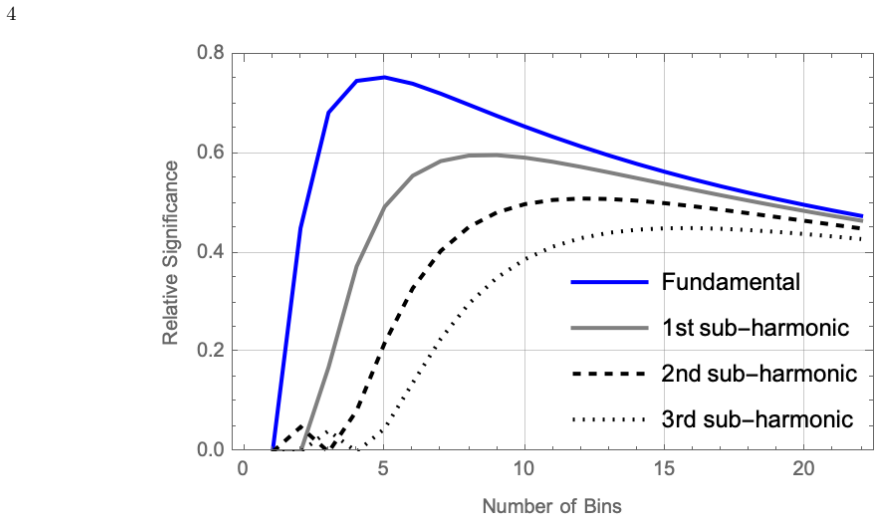
- Sub-harmonic peaks are expected in FPW periodograms, so a detection at a sub-harmonic can reveal a true period shorter than the shortest period explicitly searched, extending effective frequency coverage by a factor of $M/2$ for even $M$.
- For eclipse duty cycles up to about 1/20, FPW's detection distance is about 30% larger than Lomb-Scargle's, implying more eclipsing systems recoverable from the same data.
- For pure sinusoids, FPW's significance is about 75% of Lomb-Scargle's, so the maximum detection distance is about 7.5% smaller, a modest cost for waveform generality.
- With $\mathcal{O}(N_{\rm freqs} N_{\rm data})$ complexity and a small constant, FPW is faster than a fast Lomb-Scargle implementation for light curves with up to roughly 500 points, making billion-source blind searches feasible.
Reading between the lines
- Extension: the same per-bin weighted sums that feed FPW also feed the BLS statistic, so a combined FPW-plus-BLS periodogram could be evaluated with almost no additional arithmetic, giving both a waveform-agnostic scan and a tuned eclipse detector in one pass.
- Extension: because FPW produces sub-harmonic peaks by design, a blind peak-ranking stage must be harmonic-aware; otherwise the true period may be mistaken for one of its sub-harmonics, especially at large $M$.
- Extension: if the $\chi^2_{M-1}$ null calibration is confirmed after correcting the factor-of-two issue in the published code, the waveform-agnostic property makes FPW a plausible building block for multi-band period searches, though the paper defers that step.
- Extension: the paper's connection to Bayesian blocks suggests adaptive bin widths chosen per candidate period could improve sensitivity to extremely narrow eclipses beyond the fixed $M=20$ case.
Editorial analysis
A structured set of objections, weighed in public.
Referee Report
Summary. The paper presents Fast Periodicity Weighting (FPW), a phase-binning statistic for detecting periodicity in irregularly sampled time series. For each trial frequency, data are folded into M phase bins and the statistic is the sum over bins of the squared inverse-variance-weighted bin sum, normalized by the sum of inverse variances plus a regularization term 1/alpha^2. The statistic is derived from a Gaussian Process model with a prior on per-bin signal amplitude (Appendix A). The paper claims FPW is waveform-agnostic, achieves ~75% of Lomb-Scargle's significance for pure sinusoids with M=4-5, and about 3x Lomb-Scargle's significance for narrow eclipses with M=20, while running fast enough for billion-source surveys. It includes C++/Python code, benchmarks against astropy Lomb-Scargle, and demonstrates the algorithm on two ZTF sources. The paper defers a full statistical evaluation and comparison to Paper II.
Significance. The algorithm is simple, computationally efficient, and the GP derivation in Appendix A is clean. If the sensitivity claims are correct, FPW would be a practical workhorse for periodicity searches in ZTF and similar surveys. However, the quantitative claims rest on the null distribution of the statistic and on the code implementing Eq. (1), both of which are problematic: the printed C++ code computes a different quantity (a factor of two and no alpha term), and the chi-square(M-1) null distribution is asserted without derivation or Monte Carlo verification. These issues are fixable but are essential to the paper's main conclusions.
major comments (4)
- [Appendix D, Section 4] The C++ function `deltaChi2` computes `Minv = 1.0/(2*VtCinvV[i])` and accumulates `ytCinvV[i]*Minv*ytCinvV[i]`. This corresponds to a denominator of `2*sum(1/sigma^2)` and omits the `1/alpha^2` term, so the code returns `0.5 * S_FPW` in the alpha->infinity limit of Eq. (1), not Eq. (1) as printed. Consequently, the chi-square(M-1) null distribution invoked in Sections 3.1 and 3.3, the 2e-9 false-alarm threshold, and the relative sensitivity values in Figures 1 and 4 do not apply to the provided code. The authors must reconcile the code with Eq. (1) and recalibrate the statistic's null distribution and sensitivity claims for the actual implementation.
- [Section 3.1, Appendix B] The paper asserts that S_FPW is distributed as chi-square with M-1 degrees of freedom under the null, but this is not derived or tested. The mean subtraction described in Section 3.5 removes a global unweighted mean, while the statistic is built from inverse-variance-weighted sums; the resulting constraint does not automatically reduce the effective degrees of freedom by one. In addition, the finite-alpha form of Eq. (1) makes each bin term a scaled chi-square variable rather than chi-square_1 unless 1/alpha^2 is negligible. The paper should provide either an explicit derivation of the null distribution for the actual pre-processing and weighting, or Monte Carlo simulations demonstrating that the empirical false-alarm rates match the claimed chi-square(M-1) thresholds on realistic ZTF-like sampling.
- [Sections 3.1 and 3.3, Figures 1 and 4] The quantitative claims that FPW achieves ~75% of Lomb-Scargle's significance for sinusoids and ~3x for narrow eclipses are analytic predictions from Appendix B for idealized constant-error data and perfectly aligned phase bins. No simulations or injected-signal tests are presented to validate these ratios, and the two observational examples (Figures 2, 3, 5) are qualitative. Given that the code discrepancy and null-distribution issues affect the calibration, these numbers should be re-derived or replaced with empirical detection-efficiency measurements before the abstract's claims can be accepted.
- [Section 1, Section 5] The paper states that Paper II will 'evaluate the statistics of the algorithm' and provide quantitative comparisons. Since the present paper relies on specific significance values (e.g., 2e-9 false-alarm level and the 75%/3x ratios) to support its central claims, those statistical evaluations need to be included here, or the claims must be explicitly labeled as preliminary and the corresponding quantitative statements removed.
minor comments (5)
- [Section 3.5] The statement 'For exactly equal number of sources in each bin, Nm/Ntot = -1/M' should read '1/M' (positive).
- [Section 3.3] 'ilustrate' should be 'illustrate'.
- [Appendix D, makeIndices] The comment says 'Gets the fractional part' but `static_cast<int>(phase)` truncates; for positive inputs this is the floor, which is fine, but the comment could be more precise for negative phase values.
- [Section 4] The benchmark of FPW versus astropy Lomb-Scargle may not be apples-to-apples because FPW is implemented in C++ while the comparison implementation is Python-based; the text should state explicitly what code path is being timed.
- [Appendix B, Eq. (B22)] The definition of X is implicit; state that X is the threshold corresponding to a tail probability of 2e-9 for chi-square with the relevant DOF.
Circularity Check
No significant circularity: FPW statistic and sensitivity ratios are derived analytically, not fitted; remaining concerns are validation and code-consistency issues.
full rationale
The paper's central object is the statistic defined in Eq. 1 and derived in Appendix A from an explicit Gaussian-process model (baseline plus per-phase-bin signal with prior width alpha, plus noise). The derivation is a mathematical reduction: substituting the sparse P matrix into the Sherman-Morrison update yields Eq. A12, and Eq. 1 follows by dropping the small 1/alpha^2 term. The sensitivity claims in Figures 1 and 4 are analytic computations from assumed waveforms (sinusoid or box) using the relative-significance expression in Eqs. B22-B23, averaged over phase offset; they are not fits to the ZTF light curves. The two real-data examples (ZTF J190132.9+145808.7 and ZTF J1901+5309) are demonstrations, not calibration inputs. There is no load-bearing self-citation: the references to Paper II explicitly defer statistical evaluation and quantitative comparisons, and they are not used to justify the present claims. The paper itself flags this limitation ("Paper II will also evaluate the statistics of the algorithm..."), and the printed C++ code's factor of 1/2 in deltaChi2 (Minv = 1/(2*VtCinvV[i])) means the implemented statistic differs from Eq. 1; these are correctness and validation concerns, not circularity. The chi-square(M-1) null distribution is a distributional assumption inherited from the Gaussian-process derivation and is not a fitted parameter, so no step reduces to its own input by construction.
Assumptions & free parameters
free parameters (2)
- alpha (prior spread of phase-bin signal) =
treated as infinite (1/alpha^2 neglected)
- M (number of phase bins) =
4, 5, 10, 20, 40, 60
assumptions (5)
- domain assumption Gaussian noise with known per-point variances sigma_i^2
- ad hoc to paper Signal in each phase bin is a zero-mean Gaussian with spread alpha
- ad hoc to paper Baseline drift can be pre-subtracted rather than marginalized
- standard math Sherman-Morrison formula and matrix identities
- domain assumption S_FPW follows chi-square with M-1 DOF under the null
Cite this review
Pith. "Pith review of A Fast Periodicity Detection Algorithm Sensitive to Arbitrary Waveforms." pith.science (2026). https://pith.science/paper/B67RG25E
@misc{pith2026250200243,
  author       = {Pith},
  title        = {Pith review of: A Fast Periodicity Detection Algorithm Sensitive to Arbitrary Waveforms},
  year         = {2026},
  howpublished = {\url{https://pith.science/paper/B67RG25E}},
  note         = {Machine review of arXiv:2502.00243}
}
read the original abstract
A reexamination of period finding algorithms is prompted by new large area astronomical sky surveys that can identify billions of individual sources having a thousand or more observations per source. This large increase in data necessitates fast and efficient period detection algorithms. In this paper, we provide an initial description of an algorithm that is being used for detection of periodic behavior in a sample of 1.5 billion objects using light curves generated from Zwicky Transient Facility (ZTF) data (Bellm et al. 2019; Masci et al. 2018). We call this algorithm "Fast Periodicity Weighting" (FPW), derived using a Gaussian Process (GP) formalism. A major advantage of the FPW algorithm for ZTF analysis is that it is agnostic to the details of the phase-folded waveform. Periodic sources in ZTF show a wide variety of waveforms, some quite complex, including eclipsing objects, sinusoidally varying objects also exhibiting eclipses, objects with cyclotron emission at various phases, and accreting objects with complex waveforms. We describe the FPW algorithm and its application to ZTF, and provide efficient code for both CPU and GPU.
Figures


Figures from the paper (4 more)


Reference graph
Works this paper leans on
-
[1]
Astropy Collaboration, Robitaille, T. P., Tollerud, E. J., et al. 2013, A&A, 558, A33, doi: 10.1051/0004-6361/201322068 Astropy Collaboration, Price-Whelan, A. M., Sip˝ ocz, B. M., et al. 2018, AJ, 156, 123, doi: 10.3847/1538-3881/aabc4f Astropy Collaboration, Price-Whelan, A. M., Lim, P. L., et al. 2022, ApJ, 935, 167, doi: 10.3847/1538-4357/ac7c74
- [2]
-
[3]
Bellm, E. C., Kulkarni, S. R., Graham, M. J., et al. 2019, PASP, 131, 018002, doi: 10.1088/1538-3873/aaecbe
-
[4]
Blazek, J. A., Clowe, D., Collett, T. E., et al. 2022, arXiv e-prints, arXiv:2204.01992, doi: 10.48550/arXiv.2204.01992
-
[5]
2016, in Society of Photo-Optical Instrumentation Engineers (SPIE) Conference Series, Vol
Bloemen, S., Groot, P., Woudt, P., et al. 2016, in Society of Photo-Optical Instrumentation Engineers (SPIE) Conference Series, Vol. 9906, Ground-based and Airborne Telescopes VI, ed. H. J. Hall, R. Gilmozzi, & H. K. Marshall, 990664, doi: 10.1117/12.2232522
-
[6]
Burdge, K. B., Prince, T. A., Fuller, J., et al. 2020, ApJ, 905, 32, doi: 10.3847/1538-4357/abc261
-
[7]
Caiazzo, I., Burdge, K. B., Fuller, J., et al. 2021, Nature, 595, 39, doi: 10.1038/s41586-021-03615-y
-
[8]
Chambers, K. C., Magnier, E. A., Metcalfe, N., et al. 2016, arXiv e-prints, arXiv:1612.05560, doi: 10.48550/arXiv.1612.05560
Show all 32 references
-
[9]
M., Mendez, M., & Nunez, J
Cincotta, P. M., Mendez, M., & Nunez, J. A. 1995, ApJ, 449, 231, doi: 10.1086/176050
1995 doi
-
[10]
W., Burdge, K., Duev, D
Coughlin, M. W., Burdge, K., Duev, D. A., et al. 2021, MNRAS, 505, 2954, doi: 10.1093/mnras/stab1502 Dark Energy Survey Collaboration, Abbott, T., Abdalla, F. B., et al. 2016, MNRAS, 460, 1270, doi: 10.1093/mnras/stw641
2021 doi
-
[11]
J., Djorgovski, S
Drake, A. J., Djorgovski, S. G., Mahabal, A., et al. 2009, The Astrophysical Journal, 696, 870–884, doi: 10.1088/0004-637x/696/1/870 Gaia Collaboration, Prusti, T., de Bruijne, J. H. J., et al. 2016, A&A, 595, A1, doi: 10.1051/0004-6361/201629272
2009 doi
-
[12]
J., Drake, A
Graham, M. J., Drake, A. J., Djorgovski, S. G., Mahabal, A. A., & Donalek, C. 2013, Monthly Notices of the Royal Astronomical Society, 434, 2629, doi: 10.1093/mnras/stt1206
2013 doi
-
[13]
1969, Thesis, Virginia Polytechnic Institute Ivezi´ c,ˇZ., Kahn, S
Hutcheson, K. 1969, Thesis, Virginia Polytechnic Institute Ivezi´ c,ˇZ., Kahn, S. M., Tyson, J. A., et al. 2019, The Astrophysical Journal, 873, 111, doi: 10.3847/1538-4357/ab042c
1969 doi
-
[14]
S., Stanek, K
Jayasinghe, T., Kochanek, C. S., Stanek, K. Z., et al. 2018, MNRAS, 477, 3145, doi: 10.1093/mnras/sty838 Kov´ acs, G., Zucker, S., & Mazeh, T. 2002, Astronomy & Astrophysics, 391, 369–377, doi: 10.1051/0004-6361:20020802
2018 doi
-
[15]
M., Kulkarni, S
Law, N. M., Kulkarni, S. R., Dekany, R. G., et al. 2009, PASP, 121, 1395, doi: 10.1086/648598
2009 doi
-
[16]
A., Darbro, W., Elsner, R
Leahy, D. A., Darbro, W., Elsner, R. F., et al. 1983, ApJ, 266, 160, doi: 10.1086/160766
1983 doi
-
[17]
2023, Research in Astronomy and Astrophysics, 23, 035013, doi: 10.1088/1674-4527/acb877
Lei, L., Zhu, Q.-F., Kong, X., et al. 2023, Research in Astronomy and Astrophysics, 23, 035013, doi: 10.1088/1674-4527/acb877
2023 doi
-
[18]
Lomb, N. R. 1976, Ap&SS, 39, 447, doi: 10.1007/BF00648343
1976 doi
-
[19]
J., Laher, R
Masci, F. J., Laher, R. R., Rusholme, B., et al. 2018, Publications of the Astronomical Society of the Pacific, 131, 018003, doi: 10.1088/1538-3873/aae8ac
2018 doi
- [20]
-
[21]
R., Law, N
Rau, A., Kulkarni, S. R., Law, N. M., et al. 2009, Publications of the Astronomical Society of the Pacific, 121, 1334–1351, doi: 10.1086/605911
2009 doi
-
[22]
R., Winn, J
Ricker, G. R., Winn, J. N., Vanderspek, R., et al. 2015, Journal of Astronomical Telescopes, Instruments, and Systems, 1, 014003, doi: 10.1117/1.JATIS.1.1.014003
2015 doi
-
[23]
Scargle, J. D. 1982, ApJ, 263, 835, doi: 10.1086/160554
1982 doi
-
[24]
D., Norris, J
Scargle, J. D., Norris, J. P., Jackson, B., & Chiang, J. 2013, The Astrophysical Journal, 764, 167, doi: 10.1088/0004-637x/764/2/167
2013 doi
-
[25]
1989, MNRAS, 241, 153, doi: 10.1093/mnras/241.2.153 —
Schwarzenberg-Czerny, A. 1989, MNRAS, 241, 153, doi: 10.1093/mnras/241.2.153 —. 1996, ApJL, 460, L107, doi: 10.1086/309985
1989 doi
-
[26]
1997, The Astrophysical Journal, 489, 941
Schwarzenberg-Czerny, A. 1997, The Astrophysical Journal, 489, 941
1997
-
[27]
1999, ApJ, 516, 315, doi: 10.1086/307081
Schwarzenberg-Czerny, A. 1999, ApJ, 516, 315, doi: 10.1086/307081
1999 doi
-
[28]
Stellingwerf, R. F. 1978, ApJ, 224, 953, doi: 10.1086/156444
1978 doi
-
[29]
L., Denneau, L., Heinze, A
Tonry, J. L., Denneau, L., Heinze, A. N., et al. 2018, PASP, 130, 064505, doi: 10.1088/1538-3873/aabadf
2018 doi
-
[30]
VanderPlas, J. T. 2018, The Astrophysical Journal Supplement Series, 236, 16, doi: 10.3847/1538-4365/aab766
2018 doi
-
[31]
T., & Ivezi´ c,ˇZ
VanderPlas, J. T., & Ivezi´ c,ˇZ. 2015, ApJ, 812, 18, doi: 10.1088/0004-637X/812/1/18
2015 doi
-
[32]
T., & Robinson, G
Whittaker, E. T., & Robinson, G. 1924, The calculus of observations: a treatise on numerical mathematics (Blackie and Son limited)
1924
Reviewed August 9, 2026 · model on record in the stance chip above.
Discussion (0). Continue with ORCID to comment.