REVIEW 4 major objections 3 minor 1 cited by
PyLMT: A transient detection pipeline for the 4-m International Liquid Mirror Telescope
T0 review · 4 major / 3 minor · reviewed 2026-08-09 · deepseek-v4-flash
Pith's one-line read This paper presents PyLMT, an automated pipeline that detects transient and variable sources in the nightly images of the 4-m International Liquid Mirror Telescope, using image subtraction and convolutional-neural-network classifiers to…
desk verdict A solid, externally validated transient pipeline for ILMT, but the headline precision figure is in-sample and needs out-of-sample confirmation. read the letter →
The pith
A machine-rendered reading of the paper's core claim, the machinery that carries it, and where it could break.
The reading
What carries the argument
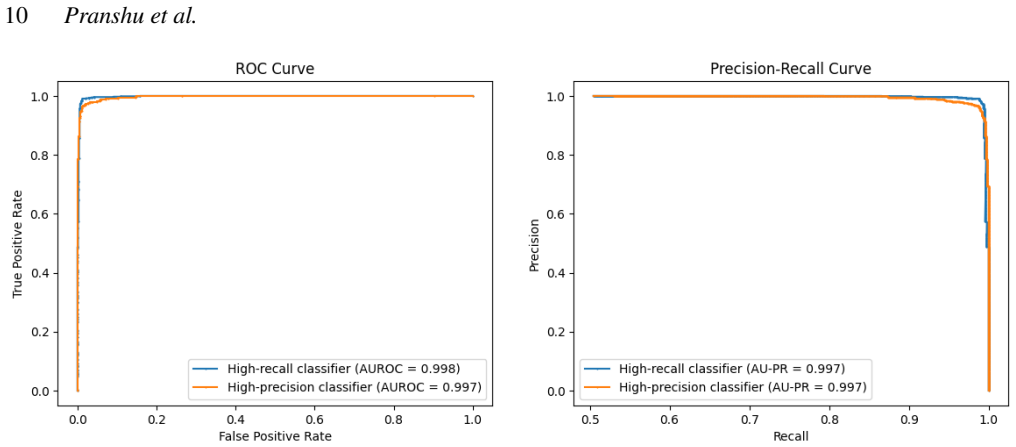
The load-bearing component is the adaptive two-classifier detection strategy. Every source in the subtracted image is first pre-classified as point-host or non-point-host; point-host sources go to a high-precision CNN trained with a deliberately artifact-heavy dataset, while all other sources go to a high-recall CNN. This is what reduces false positives from about 35% to about 10% while keeping faint, extended-host transients visible. Around it sit the image-subtraction module, which fits an optimal convolution kernel to match the point-spread function of the reference frame to the science frame, and the host-morphology ensemble, which combines one 31x31-pixel CNN and two 102x102-pixel CNNs to label candidates as extended-host, point-host, or hostless.
What would settle it
Take a set of ILMT frames from a different observing season or a different filter, run the pipeline exactly as described, and manually vet every alert; if precision on the fresh cycle falls materially below 0.91 or the false-positive fraction rises above the reported 10%, the same-season training assumption is falsified. A narrower check is to repeat the asteroid-recovery test with a coadded reference image and count whether the recovery fraction of 231 out of 293 improves.
Extended reading notes
Core claim
The central claim is that a three-module pipeline can find and classify transients in ILMT images in near real-time with a precision high enough for follow-up. Image subtraction is handled by a module built on delta-basis kernel optimisation, which matches the point-spread functions of the science and reference frames; transient detection then routes sources through two CNN classifiers, a high-recall one for non-point-host candidates and a high-precision one for point-host candidates, because improperly subtracted stars are the dominant false-positive class. This adaptive split raised precision on 30 i-band frames from 0.65 to 0.91. A second CNN ensemble classifies candidates as extended-host, point-host, or hostless, and catalogue cross-matching rejects known solar-system bodies and bright variable stars. Running on 761 frames from the November 2023-May 2024 cycle, the pipeline detected 12 extragalactic transients, including two new discoveries, AT 2023yjc and 2024fxn, reported to the public transient registry.
Load-bearing premise
The load-bearing premise is that the same-season ILMT frames used to train the real/bogus CNNs are representative of the frames the pipeline will see in later observing cycles; if the telescope's seeing, artifacts, or sky background change enough, the 0.91 precision will not transfer.
Editorial extensions
If this is right
- A full night of up to 35 ILMT frames can be processed in roughly 17 hours, making the pipeline fast enough to run continuously between nights.
- The adaptive point-host/non-point-host split cuts the false-positive share in final alerts from about 35% to about 10% without sacrificing faint non-point-host transients.
- Extended-host candidates are prioritized for follow-up, which is where supernovae are most likely to be found; four of the twelve operational detections were confirmed supernovae.
- The same pipeline recovers 231 of 293 visually confirmed catalogued asteroids, including magnitudes fainter than 21, so it serves as a solar-system survey as well.
- Operational use on 761 frames yielded 12 extragalactic transients, including two previously unreported objects, demonstrating that the pipeline is ready for routine use.
Reading between the lines
- The reported performance numbers are computed on ILMT data from the same observing cycle used to train the CNNs, so the paper's key assumption is that those same-season samples represent the operational survey; a fresh cycle in a different filter would test this directly.
- Because the current reference images are single non-coadded frames, building the planned library of coadded references should improve subtraction residuals and push recall for faint transients higher than the values reported here.
- The point-host versus non-point-host routing strategy is tied to ILMT's PSF and its dominant false-positive source; it would be a testable transfer question whether the same two-model scheme improves precision on other survey telescopes without retraining.
- If the 12-transient yield from 761 frames persists, ILMT will become a regular supplier of supernova candidates that need only external spectroscopic confirmation, which would expand the sample of early-time transients available for follow-up.
Editorial analysis
A structured set of objections, weighed in public.
Referee Report
Summary. The paper presents PyLMT, a transient-detection pipeline for the 4-m International Liquid Mirror Telescope. The pipeline performs image subtraction (ILMTDiff), source detection and real/bogus classification with CNNs (TransiSearch), and host-morphology classification of candidates (NovaNet), followed by catalogue cross-matching against SIMBAD, Gaia, and IMCCE/SkyBot. The authors report a pipeline precision of 0.91 measured on 30 i-band images from October 2022, real/bogus classifier test accuracies of 93.97% and 98.07%, a NovaNet candidate-classifier accuracy of 98.6%, and 12 extragalactic transients detected in the November 2023–May 2024 cycle, including two previously unknown transients reported to the TNS. The paper also describes asteroid recovery with MPC cross-matching and gives a median execution time of about 29 minutes per frame.
Significance. If the reported performance holds, PyLMT provides a complete, operational transient-detection capability for a new survey telescope and has already produced externally validated discoveries (AT 2023yjc, AT 2024fxn, plus confirmed SNe). The pipeline's use of TDI imaging, segmented subtraction, adaptive real/bogus classification, and candidate classification is a useful contribution to the time-domain literature. The public availability of the underlying ILMT images is a strength. However, the two central performance figures—the 0.91 precision and the 98.6% NovaNet accuracy—are less well supported than the text implies: the precision is an in-sample estimate from the same season used for training, and the NovaNet accuracy is inconsistent with the published confusion matrix.
major comments (4)
- [§4.2] The reported pipeline precision of 0.91 is computed on 30 i-band images from 28–30 October 2022, and the real/bogus classifiers were trained on cutouts from the same October–November 2022 cycle (Appendix B). This is an in-sample estimate: the validation frames share the PSF, background, artifact morphology, and specific field locations with the training data. The operational 2023–24 cycle is not evaluated for false positives: §4.4 reports 12 extragalactic transients in 761 frames but gives no total candidate count or false-positive rate. Please add an out-of-sample precision measurement—even a small sample of vetted candidates from the 2023–24 cycle—or explicitly state that 0.91 is an in-sample figure and not a demonstrated survey precision.
- [§4.3, Table 8] The claimed classification accuracy of 98.6% does not match the confusion matrix in Table 8. Summing the diagonal gives 14+185+1284 = 1483 correct classifications out of 1518 total, which is 97.7%, not 98.6%. Please correct the stated accuracy or the confusion matrix, and update the abstract, Section 4.3, and Section 5 accordingly.
- [§3.2 vs Table C1] The text states that the TransiSearch module 'extracts all the sources above 4σ significance' (Section 3.2), but Table C1 lists the default detection_threshold as 5 standard deviations above noise. This discrepancy directly affects the reported sensitivity, the precision measurement in Section 4.2, and the interpretation of detections. Please specify which threshold was used for the 30-image validation and for the 2023–24 search.
- [§3.5] The adaptive detection scheme relies on a CNN-based preemptive classification of all sources into 'point-host' and 'non-point-host' before applying the high-precision or high-recall real/bogus classifier. The paper does not specify which CNN performs this split, how it was trained, or what its accuracy is. This is load-bearing because the claimed reduction in false positives (from about 35% to about 10%) depends on this split, yet no evaluation of the split itself is presented. Please identify the classifier and report its training data and performance.
minor comments (3)
- [Appendix A] Appendix A states that only non-coadded single reference images were used because limited imaging data was available. This is an acknowledged limitation, but its impact on subtraction artifacts and hence on precision should be quantified or at least discussed explicitly in the validation section.
- [Table 7] The caption of Table 7 refers to 'true positive class distribution', but the table only includes classifications of visually confirmed real sources; it is unclear whether false negatives from TransiSearch are included. Please clarify whether the entries are conditional on the source having been correctly detected.
- [References] The reference entry 'Makhlouf, K. Turpin, D. Corre, D. Karpov, S. Kann, D. A. Klotz, A. 2022' has an inconsistent author-name formatting that should be brought into line with the journal style.
Circularity Check
No significant circularity: the pipeline evaluation is partly in-sample, but the derivation does not reduce to its inputs.
full rationale
The paper's central claims are (1) an image-subtraction module (ILMTDiff) whose quality is comparable to external codes, (2) CNN real/bogus and host-morphology classifiers with reported validation accuracies, (3) a pipeline precision of 0.91 measured on ILMT frames, and (4) operational detections of 12 extragalactic transients, including two TNS-reported discoveries. None of these reduce by construction to the paper's own inputs. ILMTDiff is a concrete implementation of Bramich (2008) delta-basis kernel optimisation (Eqs. A1-A2) and is benchmarked against HOTPANTS, OIS, and Properimage, which are independent external tools. The CNN classifiers were trained on cutouts from the October-November 2022 ILMT cycle and validated on an 80:20 split of that same dataset; the 0.91 precision was measured by running the full pipeline on 30 i-band images from 28-30 October 2022, i.e., from the same commissioning cycle as the training data. This is a genuine in-sample/generalization limitation and should temper any claim that 0.91 will hold operationally, but it is not a fitted parameter being renamed as a prediction: the precision is a measured pipeline-level statistic, not a quantity forced by the training procedure. The operational 2023-24 detections are supported by TNS reports and confirmed SNe, which are external evidence independent of the in-sample precision. Self-citations (Pranshu et al. 2024a overview; TNS discovery reports) are not load-bearing assumptions: they point to earlier descriptions or announce independent discoveries. Appendix A candidly states that non-coadded single reference images were used because limited data were available; this is an acknowledged sensitivity limitation, not a circular step. No uniqueness theorem is imported from the authors, and no ansatz is smuggled in via citation. Overall, no claim in the derivation chain is equivalent to its own input by definition.
Assumptions & free parameters
free parameters (5)
- detection_threshold =
5 sigma (text says 4 sigma in Section 3.2)
- classification_threshold =
0.5
- selection_thresh =
(30000, 30000, 2, 6)
- flux_c_min =
1000 ADUs
- variable_star_mag_cut =
Gaia G < 19 mag
assumptions (4)
- standard math Least-squares kernel optimisation converges to a PSF-matching kernel that yields accurate subtraction residuals (Bramich 2008, Moré 1978).
- domain assumption The ILMT TDI images, after preprocessing, are astrometrically aligned well enough that residual misalignment is below the source extraction scale.
- domain assumption A single, non-coadded reference image with better seeing is an adequate template for subtraction.
- ad hoc to paper Point-host candidates are predominantly false positives, motivating the adaptive detection split.
Cite this review
Pith. "Pith review of PyLMT: A transient detection pipeline for the 4-m International Liquid Mirror Telescope." pith.science (2026). https://pith.science/paper/I7HA5LLU
@misc{pith2026250200556,
  author       = {Pith},
  title        = {Pith review of: PyLMT: A transient detection pipeline for the 4-m International Liquid Mirror Telescope},
  year         = {2026},
  howpublished = {\url{https://pith.science/paper/I7HA5LLU}},
  note         = {Machine review of arXiv:2502.00556}
}
read the original abstract
The International Liquid Mirror Telescope (ILMT) is a 4-m aperture, zenith-pointing telescope with a field-of-view of 22', situated in the foothills of the Himalayas. The telescope operates in continuous survey mode, making it a useful instrument for time-domain astronomy, particularly for detecting transients, variable stars, active galactic nuclei variability, and asteroids. This paper presents the PyLMT transient detection pipeline to detect such transient/varying sources in the ILMT images. The pipeline utilises the image subtraction technique to compare a pair of images from the same field, identifying such sources in subtracted images with the help of convolutional neural networks (CNN) based real/bogus classifiers. The test accuracies determined for the real/bogus classifiers ranged from 94% to 98%. The resulting precision of the pipeline calculated over candidate alerts in the ILMT frames is 0.91. It also houses a CNN-aided transient candidate classifier that classifies the transient/variable candidates based on host morphology. The test accuracy of the candidate classifier is 98.6%. It has the provision to identify catalogued asteroids and other solar system objects using public databases. The median execution time of the pipeline is approximately 29 minutes per image of 17 minutes exposure. Relevant CNNs have been trained on data acquired with the ILMT during the cycle of October-November 2022. Subsequent tests on those images have confirmed the detection of numerous catalogued asteroids, variable stars, and other uncatalogued sources. The pipeline has been operational and has detected 12 extragalactic transients, including 2 new discoveries in the November 2023-May 2024 observation cycle.
Figures


Figures from the paper (13 more)




Forward citations
Cited by 1 Pith paper
-
SN 2022xus: bridging the gap between Type IIP and IIL supernovae
SN 2022xus is a transitional Type II supernova with a 94.8-day plateau, a decline rate of 1.23 mag per 100 days, mixed IIP/IIL spectral features, and a likely 12-15 solar-mass progenitor.
Reference graph
Works this paper leans on
-
[1]
write newline
" write newline "" before.all 'output.state := FUNCTION fin.entry write newline FUNCTION new.block output.state before.all = 'skip after.block 'output.state := if FUNCTION new.sentence output.state after.block = 'skip output.state before.all = 'skip after.sentence 'output.state := if if FUNCTION not #0 #1 if FUNCTION and 'skip pop #0 if FUNCTION or pop #1...
-
[2]
Abadi M., et al., 2016, TensorFlow: Large-Scale Machine Learning on Heterogeneous Distributed Systems ( @eprint arXiv 1603.04467 )
arXiv 2016
-
[3]
Acero-Cuellar T., Bianco F., Dobler G., Sako M., Qu H., LSST Dark Energy Science Collaboration 2023, @doi [ ] 10.3847/1538-3881/ace9d8 , https://ui.adsabs.harvard.edu/abs/2023AJ....166..115A 166, 115
-
[4]
Ackley K., Eikenberry S. S., Yildirim C., Klimenko S., Garner A., 2019, @doi [ ] 10.3847/1538-3881/ab3c4b , https://ui.adsabs.harvard.edu/abs/2019AJ....158..172A 158, 172
- [5]
-
[6]
Andreoni I., Jacobs C., Hegarty S., Pritchard T., Cooke J., Ryder S., 2017, @doi [ ] 10.1017/pasa.2017.33 , https://ui.adsabs.harvard.edu/abs/2017PASA...34...37A 34, e037
-
[7]
Bailey S., Aragon C., Romano R., Thomas R. C., Weaver B. A., Wong D., 2007, @doi [ ] 10.1086/519832 , https://ui.adsabs.harvard.edu/abs/2007ApJ...665.1246B 665, 1246
-
[8]
Becker A., 2015, HOTPANTS: High Order Transform of PSF ANd Template Subtraction , Astrophysics Source Code Library, record ascl:1504.004
work page 2015
Show all 63 references
-
[9]
C., Kulkarni S
Bellm E. C., Kulkarni S. R., Intermediate Palomar Transient Factory Collaboration 2017, in American Astronomical Society Meeting Abstracts \#229. p. 313.01
2017
-
[10]
C., et al., 2019, @doi [ ] 10.1088/1538-3873/aaecbe , https://ui.adsabs.harvard.edu/abs/2019PASP..131a8002B 131, 018002
Bellm E. C., et al., 2019, @doi [ ] 10.1088/1538-3873/aaecbe , https://ui.adsabs.harvard.edu/abs/2019PASP..131a8002B 131, 018002
2019 doi
-
[11]
B., Sanchez B., 2020, Astroalign: A Python module for astronomical image registration ( @eprint arXiv 1909.02946 )
Beroiz M., Cabral J. B., Sanchez B., 2020, Astroalign: A Python module for astronomical image registration ( @eprint arXiv 1909.02946 )
2020 arXiv
-
[12]
351, Astronomical Data Analysis Software and Systems XV
Berthier J., Vachier F., Thuillot W., Fernique P., Ochsenbein F., Genova F., Lainey V., Arlot J.-E., 2006, in Gabriel C., Arviset C., Ponz D., Enrique S., eds, Astronomical Society of the Pacific Conference Series Vol. 351, Astronomical Data Analysis Software and Systems XV. pp 367--+
2006
-
[13]
F., Hickson P., Surdej J., 2009, @doi [Opt
Borra E. F., Hickson P., Surdej J., 2009, @doi [Opt. Photon. News] 10.1364/OPN.20.4.000028 , 20, 28
2009 doi
-
[14]
Bradley L., et al., 2016, Photutils: Photometry tools , Astrophysics Source Code Library, record ascl:1609.011 ( @eprint ascl 1609.011 )
2016
-
[15]
M., 2008, @doi [Monthly Notices of the Royal Astronomical Society: Letters] 10.1111/j.1745-3933.2008.00464.x , 386, L77
Bramich D. M., 2008, @doi [Monthly Notices of the Royal Astronomical Society: Letters] 10.1111/j.1745-3933.2008.00464.x , 386, L77
2008
-
[16]
W., Poznanski D., Bloom J
Brink H., Richards J. W., Poznanski D., Bloom J. S., Rice J., Negahban S., Wainwright M., 2013, @doi [Monthly Notices of the Royal Astronomical Society] 10.1093/mnras/stt1306 , 435, 1047
2013 doi
-
[17]
A., Maureira J.-C., 2017, @doi [The Astrophysical Journal] 10.3847/1538-4357/836/1/97 , 836, 97
Cabrera-Vives G., Reyes I., Förster F., Estévez P. A., Maureira J.-C., 2017, @doi [The Astrophysical Journal] 10.3847/1538-4357/836/1/97 , 836, 97
2017 doi
-
[18]
E., Kasliwal M
Cao Y., Nugent P. E., Kasliwal M. M., 2016, @doi [ ] 10.1088/1538-3873/128/969/114502 , https://ui.adsabs.harvard.edu/abs/2016PASP..128k4502C 128, 114502
2016 doi
-
[19]
Carrasco-Davis R., et al., 2021, @doi [The Astronomical Journal] 10.3847/1538-3881/ac0ef1 , 162, 231
2021 doi
- [20]
-
[21]
Chollet F., et al., 2015, keras
2015
-
[22]
Denneau L., et al., 2013, @doi [ ] 10.1086/670337 , https://ui.adsabs.harvard.edu/abs/2013PASP..125..357D 125, 357
2013 doi
-
[23]
A., et al., 2019, @doi [Monthly Notices of the Royal Astronomical Society] 10.1093/mnras/stz2357 , 489, 3582
Duev D. A., et al., 2019, @doi [Monthly Notices of the Royal Astronomical Society] 10.1093/mnras/stz2357 , 489, 3582
2019 doi
-
[24]
A., et al., 2021, @doi [ ] 10.3847/1538-3881/abea7b , https://ui.adsabs.harvard.edu/abs/2021AJ....161..218D 161, 218
Duev D. A., et al., 2021, @doi [ ] 10.3847/1538-3881/abea7b , https://ui.adsabs.harvard.edu/abs/2021AJ....161..218D 161, 218
2021 doi
-
[25]
Dukiya N., et al., 2024, @doi [Bulletin de la Societe Royale des Sciences de Liege] 10.25518/0037-9565.11899 , https://ui.adsabs.harvard.edu/abs/2024BSRSL..93..837D 93, 837
2024
-
[26]
A., Egret D., eds, Astrophysics and Space Science Library Vol
Egret D., Wenger M., Dubois P., 1991, in Albrecht M. A., Egret D., eds, Astrophysics and Space Science Library Vol. 171, Databases and On-line Data in Astronomy. pp 79--88, @doi 10.1007/978-94-011-3250-3_9
1991 doi
-
[27]
Gaia Collaboration et al., 2016, @doi [ ] 10.1051/0004-6361/201629272 , https://ui.adsabs.harvard.edu/abs/2016A&A...595A...1G 595, A1
2016 doi
-
[28]
Gavrikov P., 2020, visualkeras, https://github.com/paulgavrikov/visualkeras
2020
-
[29]
K., Hickson P., 1992, @doi [ ] 10.1093/mnras/258.3.543 , https://ui.adsabs.harvard.edu/abs/1992MNRAS.258..543G 258, 543
Gibson B. K., Hickson P., 1992, @doi [ ] 10.1093/mnras/258.3.543 , https://ui.adsabs.harvard.edu/abs/1992MNRAS.258..543G 258, 543
1992 doi
-
[30]
Gieseke F., et al., 2017, @doi [Monthly Notices of the Royal Astronomical Society] 10.1093/mnras/stx2161 , 472, 3101
2017 doi
-
[31]
Ginsburg A., et al., 2019, @doi [ ] 10.3847/1538-3881/aafc33 , https://ui.adsabs.harvard.edu/abs/2019AJ....157...98G 157, 98
2019 doi
-
[32]
H., 1998, @doi [ ] 10.1086/316230 , https://ui.adsabs.harvard.edu/abs/1998PASP..110.1081H 110, 1081
Hickson P., Richardson E. H., 1998, @doi [ ] 10.1086/316230 , https://ui.adsabs.harvard.edu/abs/1998PASP..110.1081H 110, 1081
1998 doi
-
[33]
E., 2014, @doi [MNRAS] 10.1093/mnras/stu835 , 442, 259
Huckvale L., Kerins E., Sale S. E., 2014, @doi [MNRAS] 10.1093/mnras/stu835 , 442, 259
2014 doi
-
[34]
Khazov D., et al., 2016, @doi [The Astrophysical Journal] 10.3847/0004-637X/818/1/3 , 818, 3
2016 doi
-
[35]
Kingma D., Ba J., 2014, International Conference on Learning Representations
2014
-
[36]
L., Pandey S
Kumar B., Pandey K. L., Pandey S. B., Hickson P., Borra E. F., Anupama G. C., Surdej J., 2018, @doi [Monthly Notices of the Royal Astronomical Society] 10.1093/mnras/sty298 , 476, 2075
2018 doi
-
[37]
Kumar B., et al., 2022a, @doi [Journal of Astronomical Instrumentation] 10.1142/S2251171722400037 , https://ui.adsabs.harvard.edu/abs/2022JAI....1140003K 11, 2240003
-
[38]
Kumar B., Negi V., Ailawadhi B., Mishra S., Pradhan B., Misra K., Hickson P., Surdej J., 2022b, @doi [Journal of Astrophysics and Astronomy] 10.1007/s12036-021-09795-3 , https://ui.adsabs.harvard.edu/abs/2022JApA...43...10K 43, 10
-
[39]
M., et al., 2009, @doi [ ] 10.1086/648598 , https://ui.adsabs.harvard.edu/abs/2009PASP..121.1395L 121, 1395
Law N. M., et al., 2009, @doi [ ] 10.1086/648598 , https://ui.adsabs.harvard.edu/abs/2009PASP..121.1395L 121, 1395
2009 doi
-
[40]
Lecun Y., Bottou L., Bengio Y., Haffner P., 1998, @doi [Proceedings of the IEEE] 10.1109/5.726791 , 86, 2278
1998 doi
-
[41]
Mahabal A., et al., 2019, @doi [Publications of the Astronomical Society of the Pacific] 10.1088/1538-3873/aaf3fa , 131, 038002
2019 doi
-
[42]
Turpin, D
Makhlouf, K. Turpin, D. Corre, D. Karpov, S. Kann, D. A. Klotz, A. 2022, @doi [A&A] 10.1051/0004-6361/202142952 , 664, A81
2022 doi
-
[43]
T., Stockman H
McGraw J. T., Stockman H. S., Angel J. R. P., Epps H., Williams J. T., 1982, in Crawford D. L., ed., Vol. 0331, Instrumentation in Astronomy IV. SPIE, pp 137 -- 145, @doi 10.1117/12.933448 , https://doi.org/10.1117/12.933448
1982 doi
-
[44]
J., 1978, in , Vol
Mor \'e J. J., 1978, in , Vol. 630, Lecture Notes in Mathematics, Berlin Springer Verlag. pp 105--116, @doi 10.1007/BFb0067700
1978 doi
-
[45]
pp 807--814
Nair V., Hinton G., 2010. pp 807--814
2010
-
[46]
Negi V., et al., 2024, @doi [Bulletin de la Societe Royale des Sciences de Liege] 10.25518/0037-9565.11904 , https://ui.adsabs.harvard.edu/abs/2024BSRSL..93..863N 93, 863
2024
-
[47]
Pranshu K., et al., 2023, Transient Name Server Discovery Report, https://ui.adsabs.harvard.edu/abs/2023TNSTR3062....1P 2023-3062, 1
2023
-
[48]
Pranshu K., et al., 2024a, @doi [Bulletin de la Societe Royale des Sciences de Liege] 10.25518/0037-9565.11895 , https://ui.adsabs.harvard.edu/abs/2024BSRSL..93..828P 93, 828
-
[49]
Pranshu K., et al., 2024b, Transient Name Server Discovery Report, https://ui.adsabs.harvard.edu/abs/2024TNSTR.964....1P 2024-964, 1
2024
-
[50]
S \' a nchez-S \' a ez P., et al., 2021, @doi [The Astronomical Journal] 10.3847/1538-3881/abd5c1 , 161, 141
2021 doi
-
[51]
O., Cabral J
S \'a nchez B. O., Cabral J. B., Beroiz M., Dom \' nguez M., Lares M., 2019, Properimage: Image coaddition and subtraction , Astrophysics Source Code Library, record ascl:1904.025
2019
-
[52]
S \'a nchez B., Beroiz M., Chalela M., Cabral J., 2020, Two co-addition and image subtraction codes, @doi 10.13140/RG.2.2.11455.23203
2020
-
[53]
Santos A., et al., 2024, @doi [Monthly Notices of the Royal Astronomical Society] 10.1093/mnras/stae466 , 529, 59
2024 doi
-
[54]
Srivastava N., Hinton G., Krizhevsky A., Sutskever I., Salakhutdinov R., 2014, Journal of Machine Learning Research, 15, 1929
2014
-
[55]
Steeghs D., et al., 2022, @doi [Monthly Notices of the Royal Astronomical Society] 10.1093/mnras/stac013 , 511, 2405
2022 doi
-
[56]
M., ed., Society of Photo-Optical Instrumentation Engineers (SPIE) Conference Series Vol
Surdej J., et al., 2006, in Stepp L. M., ed., Society of Photo-Optical Instrumentation Engineers (SPIE) Conference Series Vol. 6267, Ground-based and Airborne Telescopes. p. 626704, @doi 10.1117/12.671695
2006 doi
-
[57]
Surdej J., et al., 2018, @doi [Bulletin de la Société Royale des Sciences de Liège] 10.25518/0037-9565.7498 , pp 68--79
2018
-
[58]
L., et al., 2018, @doi [ ] 10.1088/1538-3873/aabadf , https://ui.adsabs.harvard.edu/abs/2018PASP..130f4505T 130, 064505
Tonry J. L., et al., 2018, @doi [ ] 10.1088/1538-3873/aabadf , https://ui.adsabs.harvard.edu/abs/2018PASP..130f4505T 130, 064505
2018 doi
-
[59]
Turpin D., et al., 2020, @doi [ ] 10.1093/mnras/staa2046 , https://ui.adsabs.harvard.edu/abs/2020MNRAS.497.2641T 497, 2641
2020 doi
-
[60]
Virtanen P., et al., 2020, @doi [Nature Methods] 10.1038/s41592-019-0686-2 , 17, 261
2020 doi
-
[61]
M., et al., 2004, @doi [ ] 10.1016/j.newar.2003.12.056 , https://ui.adsabs.harvard.edu/abs/2004NewAR..48..637W 48, 637
Wood-Vasey W. M., et al., 2004, @doi [ ] 10.1016/j.newar.2003.12.056 , https://ui.adsabs.harvard.edu/abs/2004NewAR..48..637W 48, 637
2004 doi
-
[62]
Ye Q., et al., 2019, @doi [ ] 10.1088/1538-3873/ab1b18 , https://ui.adsabs.harvard.edu/abs/2019PASP..131g8002Y 131, 078002
2019 doi
-
[63]
write newline
" write newline "" before.all 'output.state := FUNCTION fin.entry write newline FUNCTION new.block output.state before.all = 'skip after.block 'output.state := if FUNCTION new.sentence output.state after.block = 'skip output.state before.all = 'skip after.sentence 'output.stat...
Reviewed August 9, 2026 · model on record in the stance chip above.
Discussion (0). Continue with ORCID to comment.