REVIEW 4 major objections 5 minor 15 references
Enhanced Convolutional Neural Networks for Improved Image Classification
T0 review · 4 major / 5 minor · reviewed 2026-08-09 · deepseek-v4-flash
Pith's one-line read The paper claims that an enhanced CNN with three two-layer convolutional blocks, batch normalization, and dropout reaches 84.95% test accuracy on CIFAR-10, outperforming a baseline CNN that scores 72.61%.
desk verdict Plausible accuracy, broken baseline: the paper's central comparison is unverifiable because its own text contradicts Table II. read the letter →
The pith
A machine-rendered reading of the paper's core claim, the machinery that carries it, and where it could break.
The reading
What carries the argument
The load-bearing object is the architecture itself: three convolutional blocks, each with two 3×3 ReLU-activated convolutional layers, batch normalization after each convolution, a 2×2 max-pooling with stride 2, and dropout at 25% after each block, followed by fully connected layers of width 512 and 10. The mechanism that carries the argument is the layered combination of depth, normalization, and stochastic regularization, with the ablation study as the evidence isolating each contribution. The paper's reasoning is that max-pooling preserves salient features while reducing spatial size, batch normalization stabilizes training, and dropout prevents overfitting, and that together they let the network learn hierarchical features without memorizing the training set.
What would settle it
Reproduce the exact setup—three two-layer convolutional blocks (64, 128, 256 filters), batch normalization after each convolution, 25% dropout after each block, Adam at 0.001 for ten epochs, batch size 64, random horizontal flips and 4-pixel random crops—and check whether test accuracy lands near 84.95%. Also train the baseline CNN under identical preprocessing and training conditions; if the baseline scores well above 72.61% or the proposed model scores well below 84.95%, the central comparison fails.
Extended reading notes
Core claim
The paper's central claim is that an enhanced CNN architecture outperforms standard baselines on CIFAR-10 by combining deeper convolutional blocks with batch normalization and dropout. The proposed model stacks three blocks, each containing two 3×3 convolutional layers with 64, 128, and 256 filters respectively, followed by max-pooling and dropout; the final feature maps feed two fully connected layers. Trained for ten epochs with Adam at learning rate 0.001, batch size 64, random horizontal flips, and 4-pixel random crops, the model reaches 84.95% test accuracy, against 72.61% for the baseline CNN reported in Table II. The ablation study attributes the margin to depth (2.0%), batch normalization (1.8%), and dropout (0.5%), claiming each component contributes independently and that their combination is what makes the architecture robust.
Load-bearing premise
The claim depends on the baseline CNN being a fair and typical representative of standard CNNs; the paper reports that baseline at 72.61% while also stating that standard CNNs reach 80–83%, so if the baseline is actually weaker than typical, the demonstrated improvement would shrink or vanish.
Editorial extensions
If this is right
- If the claim holds, a modestly deep CNN with batch normalization and dropout reaches roughly 85% on CIFAR-10 without pretraining, data augmentation beyond flips and crops, or a learning-rate scheduler.
- The ablation ordering suggests depth (2.0 points) is the largest single contributor, batch normalization next (1.8), and dropout a smaller but nonzero addition (0.5).
- The same architectural recipe should transfer to other small-scale image datasets because none of the enhancements depend on CIFAR-10-specific structure.
- The paper's ablation results directly justify the architecture: keeping all three components, rather than any two, is what yields the reported test accuracy.
Reading between the lines
- The paper's own numbers create a tension: a baseline of 72.61% is lower than the 80–83% it attributes to standard CNNs, so the practical takeaway should be 'reproducible ~85% with simple components' rather than 'large margin over strong baselines.'
- The ablations are reported as single runs with no variance estimates; retraining across several seeds would show whether the 2.0, 1.8, and 0.5 percentage-point differences are stable or within noise.
- Because training stops at ten epochs, the architecture's performance ceiling is probably understated; standard practice with longer schedules or cosine decay would likely improve the numbers.
- The pooling-mechanism discussion in the paper sides with max-pooling, but the ablation does not test mean or weighted-sum pooling, so the choice is argued rather than experimentally isolated.
Editorial analysis
A structured set of objections, weighed in public.
Referee Report
Summary. The paper proposes a CNN architecture for CIFAR-10 consisting of three blocks of two 3×3 convolutional layers each, with ReLU activations, batch normalization after every convolution, max-pooling, dropout after each block, and two fully connected layers. It reports a test accuracy of 84.95% on CIFAR-10 after 10 epochs of Adam training, claiming this outperforms baseline CNN architectures. An ablation study reports accuracy drops of 1.8%, 0.5%, and 2.0% when removing batch normalization, dropout, and one convolutional block, respectively. The paper provides an architecture table and qualitative descriptions but no code, no error bars, and only two rows of quantitative comparison.
Significance. If the reported accuracy were independently verified, the architectural contribution would still be incremental: the proposed model is a standard VGG-style stack with batch normalization and dropout, and 84.95% on CIFAR-10 is not state-of-the-art. The paper's main claimed significance, 'superior performance' over baselines, rests entirely on an undocumented and internally inconsistent baseline comparison. The described architecture and training setup are clear enough to be reproduced in principle, but the absence of code, multiple runs, and detailed baseline information prevents verification. The paper ships no machine-checked proofs or reproducible artifacts, and the experimental evidence as written is insufficient to support the central claim.
major comments (4)
- [Section IV.A, Table II] The central comparison is unsupported and internally contradictory. The text states that standard CNN architectures achieve around 80–83% accuracy on CIFAR-10, but Table II reports the 'Baseline CNN' at 72.61%. The baseline architecture, depth, width, regularization, optimizer, and training schedule are never described. The 12.34-percentage-point gap therefore cannot be attributed to the proposed enhancements; it may simply reflect a poorly configured or unrepresentative baseline. The authors must provide a fully specified baseline trained under identical conditions, and ideally include published standard CNN results for context.
- [Section IV.A] The paper reports a single accuracy value of 84.95% with no standard deviation, no number of runs, and no random seed information. In the ablation study, the reported differences are as small as 0.5%, which is within typical run-to-run variation for the described training setup. The authors should report the mean and standard deviation over at least three to five independent runs, and provide code or detailed hyperparameter settings to enable independent reproduction.
- [Section IV.B] The ablation study reports only percentage drops (1.8%, 0.5%, and 2.0%) without a table of the corresponding test accuracies for each variant. This makes it impossible to verify the magnitude of each effect or to assess whether the differences are statistically meaningful. Additionally, the text says dropout was applied after each max-pooling operation and the first fully connected layer, while Table I lists dropout after each convolutional block; these descriptions must be reconciled.
- [Section IV.A and Section V] The paper claims the proposed model achieves 'state-of-the-art accuracy' on CIFAR-10. This is inaccurate: 84.95% is far below well-known published results, such as ResNet-20 (above 91%) and modern architectures (above 95%). This claim should be removed or replaced with a comparison to relevant baselines from the literature. The conclusion's assertion that the model sets 'a new benchmark for performance' is not supportable.
minor comments (5)
- [Abstract / Index Terms] The index terms read 'Speech Emotion Recognition, LSTM, Deep Learning, PyTorch', which are inconsistent with the paper's topic of image classification; these should be corrected to reflect the actual content.
- [References] Several references are irrelevant to the paper, including [10] (RAVDESS speech emotion database), [12] (speaker verification), and [13]–[14] (LSTM), and the related-work discussion of Fuzzy Graph Attention Networks in Section II.B is not connected to the proposed method. These should be removed or properly integrated.
- [Introduction] The introduction contains two consecutive paragraphs that both begin with 'In this paper, we...' and repeat nearly the same content; one should be deleted.
- [Table I] Table I does not list the batch normalization layers or the dropout layers as separate rows, even though they are essential parts of the architecture; the table should be expanded to show these operations.
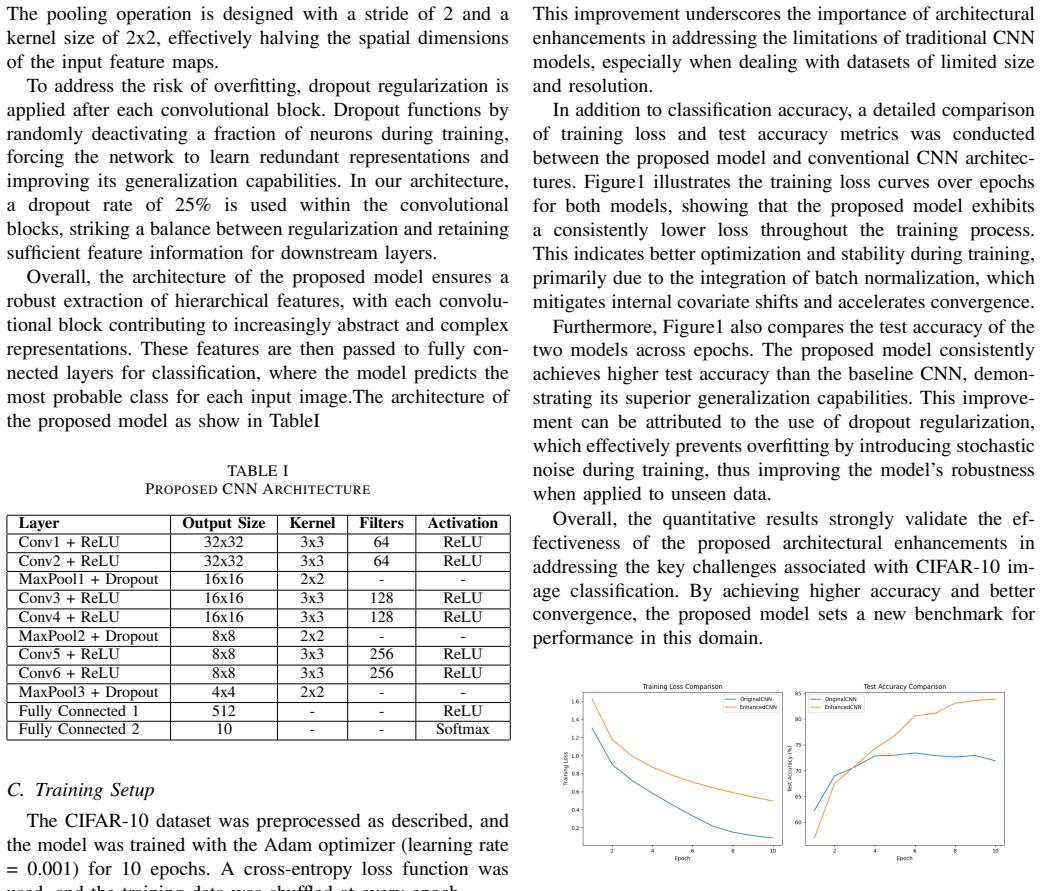
- [Figure 1] Figure 1 is described as 'Performance Comparison Chart' but no actual figure appears in the manuscript; the figure is needed to substantiate the claims about training loss and test accuracy curves.
Circularity Check
No significant circularity: the paper reports an empirical CNN accuracy measurement with no derivation that reduces to its inputs.
full rationale
The paper's central claim is an empirical result: the proposed CNN reaches 84.95% test accuracy on CIFAR-10 after training for 10 epochs with Adam, cross-entropy loss, normalization, augmentation, batching, batch normalization, and dropout. This is a measurement obtained by training a model on a fixed dataset, not a prediction derived from a fitted parameter or from a self-citation chain. The architecture is described concretely in Table I, and the training setup is specified in Section III.C. The comparison against a baseline CNN in Table II is an experimental comparison, not a mathematical derivation; even though the baseline is not described in detail, that is a reproducibility or fairness concern, not a circularity concern. The self-citations in the related work (references [4], [9], [11], [15]) and the pooling discussion are not load-bearing for the reported accuracy: the model is trained and evaluated directly on CIFAR-10, and no uniqueness theorem or prior result by the same authors is invoked to force the architecture or the outcome. The ablation study, while brief, reports accuracy changes when components are removed, which is again empirical measurement. No equation is defined in terms of the result it is supposed to establish, and no fitted quantity is renamed as a prediction. Therefore the paper is not circular; the appropriate score is 0.
Assumptions & free parameters
free parameters (5)
- learning_rate =
0.001
- dropout_rate =
25%
- convolutional filter counts =
64, 128, 256
- batch size =
64
- number of epochs =
10
assumptions (2)
- domain assumption CIFAR-10 is a representative benchmark for small-scale image classification.
- domain assumption The reported test accuracy is from a single correctly conducted evaluation.
Cite this review
Pith. "Pith review of Enhanced Convolutional Neural Networks for Improved Image Classification." pith.science (2026). https://pith.science/paper/4RERM4EE
@misc{pith2026250200663,
  author       = {Pith},
  title        = {Pith review of: Enhanced Convolutional Neural Networks for Improved Image Classification},
  year         = {2026},
  howpublished = {\url{https://pith.science/paper/4RERM4EE}},
  note         = {Machine review of arXiv:2502.00663}
}
read the original abstract
Image classification is a fundamental task in computer vision with diverse applications, ranging from autonomous systems to medical imaging. The CIFAR-10 dataset is a widely used benchmark to evaluate the performance of classification models on small-scale, multi-class datasets. Convolutional Neural Networks (CNNs) have demonstrated state-of-the-art results; however, they often suffer from overfitting and suboptimal feature representation when applied to challenging datasets like CIFAR-10. In this paper, we propose an enhanced CNN architecture that integrates deeper convolutional blocks, batch normalization, and dropout regularization to achieve superior performance. The proposed model achieves a test accuracy of 84.95%, outperforming baseline CNN architectures. Through detailed ablation studies, we demonstrate the effectiveness of the enhancements and analyze the hierarchical feature representations. This work highlights the potential of refined CNN architectures for tackling small-scale image classification problems effectively.
Figures
Reference graph
Works this paper leans on
- [10]
-
[1]
Cheng, Qisen and Qu, Shuhui and Lee, Janghwan. ”72-3: Deep Learning Based Visual Defect Detection in Noisy and Imbalanced Data.” SID Symposium Digest of Technical Papers , vol. 53, no. 1, pp. 971-974, 2022
work page 2022
-
[2]
Cheng, Qisen and Zhang, Chang and Shen, Xiang. ”Estimation of Energy and Time Usage in 3D Printing With Multimodal Neural Network.” 2022 4th International Conference on Frontiers Technology of Information and Computer (ICFTIC) , pp. 900-903, 2022
work page 2022
- [3]
-
[4]
Xing, Jinming. ”Enhancing Link Prediction with Fuzzy Graph At- tention Networks and Dynamic Negative Sampling.” arXiv preprint arXiv:2411.07482 (2024)
arXiv 2024
-
[5]
”Graph attention networks.” arXiv preprint arXiv:1710.10903 (2017)
Veli ˇckovi´c, Petar, Guillem Cucurull, Arantxa Casanova, Adriana Romero, Pietro Lio, and Yoshua Bengio. ”Graph attention networks.” arXiv preprint arXiv:1710.10903 (2017)
arXiv 2017
-
[6]
Hamilton, Will, Zhitao Ying, and Jure Leskovec. ”Inductive repre- sentation learning on large graphs.” Advances in neural information processing systems 30 (2017)
work page 2017
-
[7]
Xing, Jinming, Can Gao, and Jie Zhou. ”Weighted fuzzy rough sets- based tri-training and its application to medical diagnosis.” Applied Soft Computing 124 (2022): 109025
work page 2022
Show all 15 references
-
[8]
”Parameterized maximum-entropy-based three-way approximate attribute reduction.” International Journal of Approximate Reasoning 151 (2022): 85-100
Gao, Can, Jie Zhou, Jinming Xing, and Xiaodong Yue. ”Parameterized maximum-entropy-based three-way approximate attribute reduction.” International Journal of Approximate Reasoning 151 (2022): 85-100
2022
-
[9]
”FGATT: A Robust Frame- work for Wireless Data Imputation Using Fuzzy Graph Attention Networks and Transformer Encoders.” arXiv preprint arXiv:2412.01979 (2024)
Xing, Jinming, Ruilin Xing, and Yan Sun. ”FGATT: A Robust Frame- work for Wireless Data Imputation Using Fuzzy Graph Attention Networks and Transformer Encoders.” arXiv preprint arXiv:2412.01979 (2024)
2024 arXiv
-
[11]
”Multi-view Fuzzy Graph Attention Networks for Enhanced Graph Learning.” arXiv preprint arXiv:2412.17271 (2024)
Xing, Jinming, Dongwen Luo, Qisen Cheng, Chang Xue, and Ruilin Xing. ”Multi-view Fuzzy Graph Attention Networks for Enhanced Graph Learning.” arXiv preprint arXiv:2412.17271 (2024)
2024 arXiv
-
[12]
Heigold, I
G. Heigold, I. L. Moreno, S. Bengio, and N. Shazeer, ”End-to-End Text-Dependent Speaker Verification,” in Proceedings of the IEEE International Conference on Acoustics, Speech and Signal Processing (ICASSP), 2016, pp. 5115–5119
2016
-
[13]
Hochreiter and J
S. Hochreiter and J. Schmidhuber, ”Long Short-Term Memory,” Neural Computation, vol. 9, no. 8, pp. 1735–1780, 1997
1997
-
[14]
F. A. Gers, J. Schmidhuber, and F. Cummins, ”Learning to Forget: Continual Prediction with LSTM,” Neural Computation , vol. 12, no. 10, pp. 2451–2471, 2000
2000
-
[15]
”Comparative Analysis of Pooling Mechanisms in LLMs: A Sentiment Analysis Perspective.” arXiv preprint arXiv:2411.14654 (2024)
Xing, Jinming, Ruilin Xing, and Yan Sun. ”Comparative Analysis of Pooling Mechanisms in LLMs: A Sentiment Analysis Perspective.” arXiv preprint arXiv:2411.14654 (2024)
2024 arXiv
Reviewed August 9, 2026 · model on record in the stance chip above.
Discussion (0). Continue with ORCID to comment.