REVIEW 2 major objections 5 minor 16 references
A Variational Inequality Approach to Independent Learning in Static Mean-Field Games
T0 review · 2 major / 5 minor · reviewed 2026-08-09 · deepseek-v4-flash
Pith's one-line read Independent agents with bandit-only feedback can learn an approximate Nash equilibrium of a large static mean-field game at rate $\tilde{O}(N^{3/4}/\sqrt{T} + N^{-1/4})$ under monotone congestion payoffs.
desk verdict Solid finite-agent independent-learning theory for static MFGs under monotone payoffs, but two of the paper's own synthetic benchmarks violate the sign convention in Assumption 2, so the empirical validation does not actually exercise the assumed regime. read the letter →
The pith
A machine-rendered reading of the paper's core claim, the machinery that carries it, and where it could break.
The reading
What carries the argument
The central object is the Tikhonov-regularized variational inequality (MF-RVI), solved by the regularized projected-ascent operator $\Gamma_{\eta,\tau}(\pi) = \Pi_{\Delta}((1-\eta\tau)\pi + \eta F(\pi))$, which projects one step along the payoff direction $F$ back onto the simplex while pulling mildly toward the uniform distribution. The regularization parameter $\tau$ does three jobs: it makes $\Gamma_{\eta,\tau}$ contractive for monotone $F$ (Lemma 3), its fixed point is the unique mean-field Nash equilibrium of the regularized map $F - \tau I$, and it supplies an explicit bound on how far the policies of independent agents drift apart (Lemmas 5 and 8). In the bandit-feedback version, each agent explores uniformly with probability $\varepsilon$ over epochs of length $T_h$, builds an importance-sampled estimate of $F$ from its own realized payoffs, and then applies the same projected-ascent update. The combination of contraction and a controlled policy-deviation term is what replaces the centralized coordinator.
What would settle it
Run TRPA-Bandit with $N=100$, $K=5$, $\tau=N^{-1/4}$, and $\varepsilon=N^{-1/2}$ on a payoff map that violates monotonicity at a measurable scale—for instance, $F(\mu,a)=\mu(a)$ so an action's payoff rises with its own occupancy—and check whether the expected maximum exploitability falls to the predicted $O(N^{-1/4})$ floor; if it diverges or cycles instead, monotonicity is the load-bearing assumption.
Extended reading notes
Core claim
The paper's central discovery is that the infinite-agent mean-field limit of a static finite-action game is a monotone variational inequality, and that solving a slightly regularized version of it with independent projected-ascent steps yields a provable approximate Nash equilibrium for the finite population. Concretely, Theorem 4 with Corollary 2 states that for an $L$-Lipschitz, monotone payoff map $F$, $N$ agents running TRPA-Bandit for $T$ rounds with $\tau = N^{-1/4}$ and exploration probability $\varepsilon = N^{-1/2}$ achieve $\mathbb{E}[\max_i E^i_{\mathrm{exp}}] \le \tilde{O}(N^{3/4}/\sqrt{T} + N^{-1/4})$; for $\lambda$-strongly monotone payoffs the bound improves to $\tilde{O}(N^{3/4}\lambda^{-1/2}/\sqrt{T} + \lambda^{-1/2}/N^{1/3})$. The full-feedback version reaches $\tilde{O}(\sqrt{N}/\sqrt{T} + N^{-1/4})$. These bounds make the curse of many agents quantitative: the price of independent bandit learning is only a factor $N^{3/4}$ in the transient term and a bias that shrinks as $N^{-1/4}$.
Load-bearing premise
The load-bearing premise is that the payoff operator is monotone, meaning shifting population mass toward an action weakly lowers that action's payoff, and if this fails the contraction bound at the heart of the proof collapses and no convergence guarantee is offered; the real-data experiments verify the premise only qualitatively on fitted models rather than on the exact operator used during learning.
Editorial extensions
If this is right
- Independent agents need no coordinator or communication: under monotone payoffs, $T$ rounds of bandit feedback suffice for expected maximum exploitability $\tilde{O}(N^{3/4}/\sqrt{T} + N^{-1/4})$.
- Full (still noisy) feedback improves the transient to $\tilde{O}(\sqrt{N}/\sqrt{T} + N^{-1/4})$, showing that the bandit setting costs only an extra $N^{1/4}$ factor in the transient term.
- A solution of the infinite-agent variational inequality is an $O(L/\sqrt{N})$-approximate Nash equilibrium of the $N$-player game, giving a quantitative justification for solving the mean-field limit instead of the finite game.
- Choosing the regularization $\tau$ optimally requires knowing $N$; with $\tau=N^{-1/4}$ the bias-exploration tradeoff is explicit, and smaller $\tau$ lowers asymptotic bias but slows convergence and weakens policy synchronization.
- The model covers any static congestion interaction with non-increasing per-action payoffs, including soft-collision multi-armed bandits, city traffic routing, and entry-node selection in the Tor network.
Reading between the lines
- Beyond the paper: the $N^{3/4}$ transient rate and the $N^{-1/4}$ bias are probably not fundamental, because the unregularized approximation theorem already gives an $O(1/\sqrt{N})$ bias and centralized VI methods reach $O(1/T)$; sharper analyses or alternative synchronization devices may close part of the gap.
- Beyond the paper: since the optimal $\tau$ and $\varepsilon$ depend on the total population $N$, deployment in real systems would require estimating $N$ or designing adaptive, parameter-free schedules.
- Beyond the paper: the probabilistic exploration scheme could be replaced by deterministic turn-taking (a form of musical chairs) when agents can agree on an ordering, which would remove the extra variance responsible for part of the $N^{3/4}$ term.
- Beyond the paper: monotonicity is testable from data—estimate the Jacobian of the fitted payoff map and check negative semidefiniteness at sampled occupancy points—whereas the present experiments only inspect fitted curves qualitatively.
Editorial analysis
A structured set of objections, weighed in public.
Referee Report
Summary. This paper formalizes Static Mean-Field Games (SMFGs) with finitely many agents and studies independent, non-communicating learning under both full and bandit feedback. The main theoretical device is the equivalence between the infinite-population MF-NE and a variational inequality (MF-VI), together with Tikhonov regularized projected ascent (TRPA) updates. For Lipschitz and (strongly) monotone payoff operators (Assumption 2), the paper proves finite-sample exploitability bounds: for full feedback, O(τ^{-2}/√T + τ^{-1}/√N + τ) in the monotone case, and for bandit feedback, after tuning τ and the exploration probability ε, eO(N^{3/4}/√T + N^{-1/4}) for monotone payoffs. The paper also reports simulations on synthetic benchmarks and real-world experiments on Zurich traffic and the Tor network.
Significance. If the main results are correct, this is a meaningful step for large-population multi-agent learning: it gives explicit rates for independent learners with bandit feedback in a static mean-field model, without requiring agents to communicate or know their identities. The proof strategy, based on recurrences for expected policy deviations and distances to the regularized MF-NE, is coherent, and the appendix contains detailed proofs of the key lemmas (Lemmas 4, 6, 7, and 8). The finite-sample bounds are derived from the stated assumptions rather than from prior citations, and the paper makes a genuine effort to connect the VI formulation to a concrete independent-learning algorithm. The main weakness is that part of the numerical validation does not actually exercise the monotone regime required by the theory.
major comments (2)
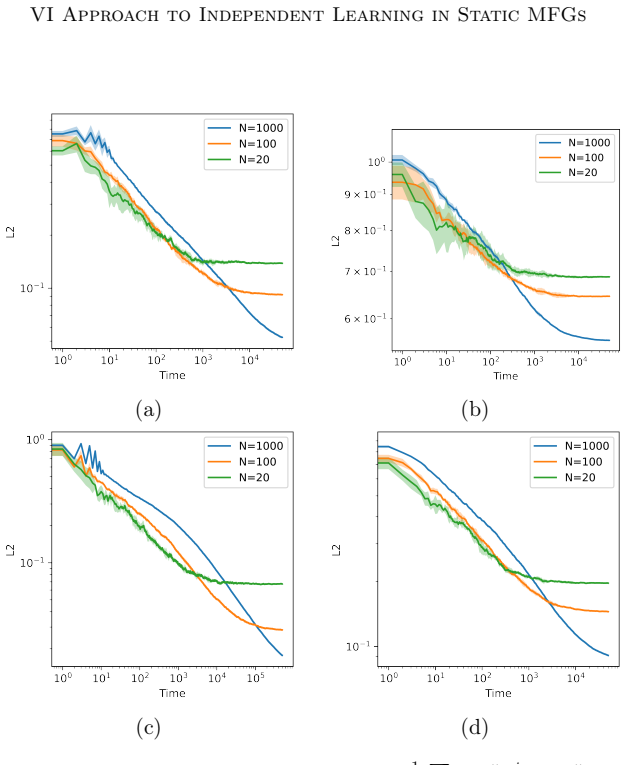
- [Section 6 and Appendix F.1] Two of the four synthetic benchmarks do not satisfy Assumption 2, so the corresponding experiments cannot validate the theoretical results. For the 'Linear' problem, F_lin(µ) = (S+X)µ + b with S positive definite gives (F_lin(µ1)-F_lin(µ2))^T(µ1-µ2) = (µ1-µ2)^T S (µ1-µ2) > 0 for µ1 ≠ µ2, which is the opposite of the inequality ≤ -λ||µ1-µ2||^2 required by Assumption 2. For the 'kl' problem, F_KL = ∇Φ_KL with Φ_KL convex implies (F_KL(µ1)-F_KL(µ2))^T(µ1-µ2) ≥ 0, again violating Assumption 2. Consequently, Figures 1, 3, 5, and 6 for the linear and KL payoffs do not test the monotone-decreasing regime required by Theorems 3 and 4; only the beach bar and exponentially decreasing payoffs appear to satisfy Assumption 2. Please correct the generators, for example by using (-S+X)µ+b for the linear payoff and a concave potential for the KL payoff, and rerun the experiments, or explicitly present the current linear/KL experiments as outside the assumptions.
- [Appendices F.5 and F.6] The monotonicity of the real-world payoff operators is only checked qualitatively, and the Tor experiment uses hand-set parameters (τ = 0.01, ε = 0.3) that differ from the theoretically optimal values in Corollary 2. Since the abstract claims numerical validation through real-world applications, the paper should either quantify monotonicity on the actual operators used during learning (for example, by evaluating the bilinear form in Assumption 2 on sampled pairs of occupancy measures) or temper the claim that the traffic and Tor experiments validate the monotone theory. The Tor experiment in particular should be described as a heuristic demonstration in the presence of external users, not as a quantitative test of Corollary 2.
minor comments (5)
- [Section 2.2 and Remark 1] The monotonicity sign convention in Assumption 2 is nonstandard: the paper defines 'monotone' as (F(µ1)-F(µ2))^T(µ1-µ2) ≤ 0, whereas the standard VI literature uses ≥ 0. This convention appears to have contributed to the sign error in Appendix F.1; consider defining F as monotone when -F is monotone in the standard sense, or explicitly stating that all VI results are applied to -F.
- [Lemma 4] In the monotone case of Lemma 4, the displayed constant in front of the 1/N term is 4τ^{-1}η_t L^2 δ^{-1}, but the proof derives 2τ^{-1}η_t L^2 δ^{-1} for the term involving E[||F(^µ_t)-F(¯µ_t)||^2]. This discrepancy does not affect the stated rates but should be corrected.
- [Appendix E.4] In the law of total expectation in the proof of Lemma 6, the second conditional expectation should be conditioned on the complement event, not on E_i^h; the preceding line writes both terms with E_i^h. The subsequent bound is correct, but the notation is confusing.
- [Section 1.5] In the notation paragraph, 'For N-tuple v ∈ X^N and u, v ∈ X, (v, v^{-i})...' uses v for both the tuple and an element; please use a different symbol, such as w, for the scalar element.
- [Appendix E.7] The proof of Theorem 4 states that the recurrences are solved by Lemma 10 and then jumps to the final asymptotic statement; it would be helpful to display the explicit bound on u_H or E[E_exp] before taking the eO notation.
Circularity Check
No circularity: theorem chain is assumption-driven; self-citations are contextual.
full rationale
The central derivation chain is self-contained and assumption-driven. The SMFG and MF-NE are defined first, and the MF-VI formulation in Section 2 is an exact reformulation of the MF-NE optimality condition rather than a fitted or imported result. Theorem 1 bounds the finite-N approximation directly from Lipschitz continuity and concentration of empirical measures. Theorems 3 and 4 derive exploitability bounds from explicit recurrences (Lemmas 4/5 and 6/8) under the stated Lipschitz, monotonicity/strong-monotonicity, and noise assumptions; no parameter used in these bounds is fitted to data. The optimal regularization and exploration parameters in Corollaries 1 and 2 are obtained by balancing terms in the proven upper bounds, not by matching experimental outputs. The only self-citations (Yardim et al., 2023, 2024) appear in related-work and motivation statements, e.g. "This difficulty persists even in the mean-field regime (Yardim et al., 2024)" and the discussion of stationary MFG IL with "poor sample complexity"; they are not used to justify any theorem, algorithm, or uniqueness statement. The contractivity of TRPA is explicitly attributed to the external classical reference Facchinei and Pang (2003). For completeness, I note that the experimental generators in Appendix F.1 (linear and KL potential) appear to satisfy the opposite inequality sign to Assumption 2, but this is a numerical-validation concern and does not affect the circularity assessment of the theoretical derivation.
Assumptions & free parameters
free parameters (3)
- tau (Tikhonov regularization) =
N^(-1/4) (monotone) or N^(-1/3) (strongly monotone); 0.01 in Tor experiment
- epsilon (exploration probability) =
N^(-1/2) in Corollary 2; 0.3 in Tor experiment
- delta (Young's inequality splitting constant) =
1/4
assumptions (6)
- domain assumption Payoff operator F is L-Lipschitz (Assumption 1).
- domain assumption F is monotone or lambda-strongly monotone (Assumption 2).
- domain assumption Noise is zero mean, entrywise variance at most sigma^2, and independent across agents, actions, and rounds (Assumption 3).
- standard math Existence and uniqueness results for monotone variational inequalities (Facchinei and Pang 2003).
- standard math Nash equilibrium existence in finite normal-form games (Nash 1950).
- domain assumption All agents know K, the horizon and epoch schedule, and shared hyperparameters tau, epsilon, and learning rates, and initialize at uniform policy.
Cite this review
Pith. "Pith review of A Variational Inequality Approach to Independent Learning in Static Mean-Field Games." pith.science (2026). https://pith.science/paper/PL5GTIBC
@misc{pith2026250200915,
  author       = {Pith},
  title        = {Pith review of: A Variational Inequality Approach to Independent Learning in Static Mean-Field Games},
  year         = {2026},
  howpublished = {\url{https://pith.science/paper/PL5GTIBC}},
  note         = {Machine review of arXiv:2502.00915}
}
read the original abstract
Competitive games involving thousands or even millions of players are prevalent in real-world contexts, such as transportation, communications, and computer networks. However, learning in these large-scale multi-agent environments presents a grand challenge, often referred to as the "curse of many agents". In this paper, we formalize and analyze the Static Mean-Field Game (SMFG) under both full and bandit feedback, offering a generic framework for modeling large population interactions while enabling independent learning. We first establish close connections between SMFG and variational inequality (VI), showing that SMFG can be framed as a VI problem in the infinite agent limit. Building on the VI perspective, we propose independent learning and exploration algorithms that efficiently converge to approximate Nash equilibria, when dealing with a finite number of agents. Theoretically, we provide explicit finite sample complexity guarantees for independent learning across various feedback models in repeated play scenarios, assuming (strongly-)monotone payoffs. Numerically, we validate our results through both simulations and real-world applications in city traffic and network access management.
Figures


Figures from the paper (5 more)


Reference graph
Works this paper leans on
-
[4]
Laëtitia Matignon, Guillaume J Laurent, and Nadine Le Fort-Piat. Hysteretic q-learning: an algorithm for decentralized reinforcement learning in cooperative multi-agent teams. In 2007 IEEE/RSJ International Conference on Intelligent Robots and Systems, pages 64–69. IEEE,
work page 2007
-
[6]
Independent learning in stochastic games
Asuman Ozdaglar, Muhammed O Sayin, and Kaiqing Zhang. Independent learning in stochastic games. arXiv preprint arXiv:2111.11743,
- [9]
-
[10]
In the monotone case, we pickδ = 1/4 as before. Theboundinthestatementofthetheoreminthemainbodyofthepaperfollowsfromthe fact that the lengths of the exploration epochs scale withTh = O(ε−1 log(h + 2)) = eO(ε−1). 46 VI Approach to Independent Learning in Static MFGs Appendix F. Details of Experiments Setup. All experiments were run on single core of an AMD...
work page 2008
-
[11]
Mean-Field Games With Finitely Many Players: Independent Learning and Subjectivity
Bora Yongacoglu, Gürdal Arslan, and Serdar Yüksel. Independent learning in mean- field games: Satisficing paths and convergence to subjective equilibria. arXiv preprint arXiv:2209.05703,
-
[12]
Learning regularized monotonegraphonmean-fieldgames
Fengzhuo Zhang, Vincent Tan, Zhaoran Wang, and Zhuoran Yang. Learning regularized monotonegraphonmean-fieldgames. Advances in Neural Information Processing Systems, 36, 2024a. 33 VI Approach to Independent Learning in Static MFGs Liang Zhang, Junchi Yang, Amin Karbasi, and Niao He. Optimal guarantees for algorith- mic reproducibility and gradient complexi...
work page 2013
-
[14]
in terms of number of samples. In the work of Gummadi et al. (2013), the main aim is convergence to a steady state rather than learning. Population regeneration.Finally, to be able to obtain a contractive mapping yielding a population stationary distribution/steady state, Gummadi et al. (2013) assume that the population regenerates at a constant rateβ, im...
work page 2013
-
[1000]
F.4 Comparison with Multiplicative Weight Updates The SMFG problem of interactive learning without communications and bandit feedback has not been studied in the literature previously, and there is no alternative algorithm with theoretical guarantees to the best of our knowledge in this setting. However, in Figure 7 we provide comparison with a heuristic ...
work page 2022
Show all 16 references
-
[1976]
Simple and optimal methods for stochas- tic variational inequalities, i: Operator extrapolation.SIAM Journal on Optimization, 32 (3):2041–2073,
Georgios Kotsalis, Guanghui Lan, and Tianjiao Li. Simple and optimal methods for stochas- tic variational inequalities, i: Operator extrapolation.SIAM Journal on Optimization, 32 (3):2041–2073,
-
[2007]
Shining light in dark places: Understanding the tor network
DamonMcCoy, KevinBauer, DirkGrunwald, TadayoshiKohno, andDouglasSicker. Shining light in dark places: Understanding the tor network. InPrivacy Enhancing Technologies: 8th International Symposium, PETS 2008 Leuven, Belgium, July 23-25, 2008 Proceedings 8, pages 63–76. Springer,
2008
-
[2013]
do not analyze or aim to characterize optimality. In their analysis, a fixed map σ : Z2n ≥0 → ∆A is assumed to be the policy/strategy of a continuum of (i.e., infinitely many) agents, which maps observed loss/win counts (from Bernoulli distributed arm rewards) to arm probabili...
2013
-
[2017]
Making gradient descent optimal for strongly convex stochastic optimization.arXiv preprint arXiv:1109.5647,
Alexander Rakhlin, Ohad Shamir, and Karthik Sridharan. Making gradient descent optimal for strongly convex stochastic optimization.arXiv preprint arXiv:1109.5647,
-
[2021]
Mastering chess and shogi by self-play with a general reinforcement learning algorithm
David Silver, Thomas Hubert, Julian Schrittwieser, Ioannis Antonoglou, Matthew Lai, Arthur Guez, Marc Lanctot, Laurent Sifre, Dharshan Kumaran, Thore Graepel, et al. Mastering chess and shogi by self-play with a general reinforcement learning algorithm. arXiv preprint arXiv:17...
-
[2022]
Concurrent bandits and cognitive radio networks
Orly Avner and Shie Mannor. Concurrent bandits and cognitive radio networks. InMachine Learning and Knowledge Discovery in Databases: European Conference, ECML PKDD 2014, Nancy, France, September 15-19,
2014
-
[2023]
Batuhan Yardim, Artur Goldman, and Niao He. When is mean-field reinforcement learning tractable and relevant? In Proceedings of the 23rd International Conference on Au- tonomous Agents and Multiagent Systems, pages 2038–2046,
-
[2024]
Stefanos Leonardos, Will Overman, Ioannis Panageas, and Georgios Piliouras
URL https://arxiv.org/abs/2205.12944. Stefanos Leonardos, Will Overman, Ioannis Panageas, and Georgios Piliouras. Global con- vergence of multi-agent policy gradient in markov potential games. InInternational Con- ference on Learning Representations,
Reviewed August 9, 2026 · model on record in the stance chip above.
Discussion (0). Continue with ORCID to comment.