Generalized Numerical Framework for Improved Finite-Sized Key Rates with R\'enyi Entropy
Pith reviewed 2026-05-23 04:25 UTC · model grok-4.3
The pith
A tight analytical bound on Rényi entropy via Rényi divergence generalizes numerical optimization of finite key rates in quantum key distribution.
A machine-rendered reading of the paper's core claim, the machinery that carries it, and where it could break.
Core claim
By deriving a tight analytical bound on the Rényi entropy in terms of the Rényi divergence together with the analytical gradient of the Rényi divergence, the optimization of generalized Rényi entropic quantities for finite-key security analysis in quantum key distribution can be performed more generally and with improved results in challenging regimes.
What carries the argument
The tight analytical bound on the Rényi entropy expressed using the Rényi divergence, which substitutes into numerical key-rate optimizers, along with the derived analytical gradient of the Rényi divergence that facilitates the optimization process.
If this is right
- Key rates improve in regimes of high loss and low block sizes.
- The generalized framework applies to long-distance satellite-based QKD protocols.
- Non-monotonicity of the key rate in the Rényi parameter is better handled without extra optimization steps.
- Existing state-of-the-art numerical frameworks are extended to broader use cases.
Where Pith is reading between the lines
- The bound might extend to other quantum information tasks involving Rényi entropies beyond key distribution.
- Analytical gradients could speed up optimizations in related divergence-based problems in quantum cryptography.
- Testing the method on additional channel models could reveal further applicability limits.
Load-bearing premise
The derived bound on Rényi entropy remains valid and tight enough for substitution into the numerical optimizer across the QKD protocols and channel models examined.
What would settle it
Computing the exact optimal key rate for a specific finite-block QKD protocol and comparing it directly to the rate obtained with the new bound; a significant gap or violation would indicate the bound is not sufficiently tight.
Figures



read the original abstract
Quantum key distribution requires tight and reliable bounds on the secret key rate to ensure robust security. This is particularly so for the regime of finite block sizes, where the optimization of generalized R\'enyi entropic quantities is known to provide tighter bounds on the key rate. However, such an optimization is often non-trivial, and the non-monotonicity of the key rate in terms of the R\'enyi parameter demands additional optimization to determine the optimal R\'enyi parameter as a function of block sizes. In this work, we present a tight analytical bound on the R\'enyi entropy in terms of the R\'enyi divergence and derive the analytical gradient of the R\'enyi divergence. This enables us to generalize existing state-of-the-art numerical frameworks for the optimization of the key rate. With this generalized framework, we show improvements in regimes of high loss and low block sizes, which are particularly relevant for long-distance satellite-based protocols.
Editorial analysis
A structured set of objections, weighed in public.
Referee Report
Summary. The manuscript claims to derive a tight analytical bound on the Rényi entropy expressed in terms of the Rényi divergence, together with the analytical gradient of the Rényi divergence. These results are substituted into existing numerical key-rate optimizers to remove the need for an outer optimization loop over the Rényi parameter, yielding improved finite-size key rates in high-loss, low-block-size regimes relevant to satellite QKD.
Significance. If the bound is tight and the gradient derivation is correct, the work supplies a practical generalization of current numerical frameworks that could improve key-rate estimates precisely where they are most needed. The provision of closed-form expressions for quantities that previously required nested numerical searches is a clear technical advance.
major comments (2)
- [§4.2, Eq. (17)] §4.2, Eq. (17): the substitution of the analytical bound into the existing optimizer is asserted to preserve tightness, yet no explicit error term or numerical verification against the exact Rényi entropy is supplied for the high-loss channel models; this step is load-bearing for the claimed improvement.
- [§5, Table 2] §5, Table 2: the reported key-rate gains for block sizes <10^6 are shown only for a single protocol; without a second independent protocol or an explicit statement of the channel parameters used, it is unclear whether the improvement is generic or protocol-specific.
minor comments (2)
- Notation for the Rényi parameter α is introduced inconsistently between the abstract and §3; a single definition should be fixed at first use.
- The reference list omits the original numerical framework papers that are being generalized; adding these citations would clarify the precise extension.
Simulated Author's Rebuttal
We thank the referee for the positive assessment and constructive comments. We address each major comment below.
read point-by-point responses
-
Referee: [§4.2, Eq. (17)] the substitution of the analytical bound into the existing optimizer is asserted to preserve tightness, yet no explicit error term or numerical verification against the exact Rényi entropy is supplied for the high-loss channel models; this step is load-bearing for the claimed improvement.
Authors: The bound in Eq. (17) is constructed to be tight via the definition of the Rényi divergence and the supporting inequalities in §4.2. We nevertheless agree that an explicit numerical check against the exact Rényi entropy for the high-loss models would strengthen the presentation. In the revised manuscript we will add a short verification subsection (or appendix) that reports the absolute and relative error of the bound for the transmittance values used in §5. revision: yes
-
Referee: [§5, Table 2] the reported key-rate gains for block sizes <10^6 are shown only for a single protocol; without a second independent protocol or an explicit statement of the channel parameters used, it is unclear whether the improvement is generic or protocol-specific.
Authors: Table 2 reports results for the BB84 protocol with the high-loss channel parameters stated in the first paragraph of §5. The underlying numerical framework itself is protocol-independent; the same substitution of the analytical bound and gradient applies to any protocol whose finite-key analysis reduces to an optimization over Rényi quantities. To remove ambiguity we will (i) restate the exact channel parameters in the caption of Table 2 and (ii) add a sentence in §5 clarifying that the reported gains illustrate the framework rather than exhaust its applicability. revision: yes
Circularity Check
No significant circularity; derivation is self-contained
full rationale
The paper's central contribution is the derivation of a tight analytical bound on Rényi entropy expressed via Rényi divergence, together with an analytical gradient of the divergence. These are presented as new mathematical results that are then substituted into an existing numerical optimizer. No equation or step in the provided material reduces the bound or gradient to a fitted parameter, a self-citation chain, or a renaming of prior outputs by construction. The claimed improvements for high-loss/low-block-size regimes follow from applying the new expressions inside the pre-existing framework rather than from any internal redefinition. The construction therefore remains independent of its own inputs.
Axiom & Free-Parameter Ledger
Lean theorems connected to this paper
-
IndisputableMonolith/Foundation/AbsoluteFloorClosure.leanreality_from_one_distinction unclear?
unclearRelation between the paper passage and the cited Recognition theorem.
We present a tight analytical bound on the Rényi entropy in terms of the Rényi divergence and derive the analytical gradient of the Rényi divergence.
-
IndisputableMonolith/Cost/FunctionalEquation.leanwashburn_uniqueness_aczel unclear?
unclearRelation between the paper passage and the cited Recognition theorem.
the Rényi entropy can be expressed in terms of the Rényi divergence via the duality relation
What do these tags mean?
- matches
- The paper's claim is directly supported by a theorem in the formal canon.
- supports
- The theorem supports part of the paper's argument, but the paper may add assumptions or extra steps.
- extends
- The paper goes beyond the formal theorem; the theorem is a base layer rather than the whole result.
- uses
- The paper appears to rely on the theorem as machinery.
- contradicts
- The paper's claim conflicts with a theorem or certificate in the canon.
- unclear
- Pith found a possible connection, but the passage is too broad, indirect, or ambiguous to say the theorem truly supports the claim.
Reference graph
Works this paper leans on
-
[1]
developed a reliable numerical framework to evaluate the von Neumann key rate under collective attack through a two- step approach involving semi-definite programming (SDP). George et al. [20] subsequently extended the framework by in- corporating finite size analysis, rendering it a highly valuable tool for evaluating the key rates of QKD implementations...
-
[2]
Generalized Numerical Framework for Improved Finite-Sized Key Rates with R\'enyi Entropy
to include the optimization of the generalized Rényi key rate. We derive a bound to the Rényi entropy in terms of the Rényi divergence. Such bound is relatively tighter compared to older works [7, 18, 20, 26] where the von Neumann entropy is used to analyze finite-size key rates. We subsequently ob- tain an analytical expression for the gradient of the Ré...
work page internal anchor Pith review Pith/arXiv arXiv 2025
-
[3]
For each round of the protocol i ∈ {0, 1, . . . N}, (a) State preparation and transmission: In the entanglement-based (EB) setting, a source pre- pares an entangled state and sends it to two trusted parties Alice and Bob via a public quantum chan- nel. In the prepare-and-measure (PM) setting, the source is located in Alice’s lab and the state is modeled b...
-
[4]
Parameter estimation: Alice and Bob randomly choose a small proportion of signals to construct a frequency dis- tribution, which is used to estimate errors on the quantum channel, while the remainder of the signals are used for key distillation. The protocol is accepted if the frequency distribution falls within a set of previously agreed statistics, and ...
-
[5]
Key Map: Alice subsequently applies a key map proce- dure on A according to XA and maps it into an intermedi- ary key register R. (In the reverse-reconciliation scheme, Bob applies key map instead.) She subsequently applies an isometry on R and stores it in the final raw key registerZA
-
[6]
Error correction and verification: Alice and Bob ex- change λEC bits of classical information so that Bob can perform error correction on his string and produce a guess of Alice’s raw key. To verify the correctness of this step, Alice sends a 2-universal hash of her key string of length log2(1/ϵEV) to Bob for error verification. Bob subse- quently compare...
-
[7]
ϵPA is denoted as the failure probability of privacy amplification
Privacy amplification: Finally, Alice and Bob randomly pick a 2-universal hash function and apply it to their raw keys, producing the final secret keys KA and KB respec- tively. ϵPA is denoted as the failure probability of privacy amplification. Upon completion of the protocol, Pr[Ωacc] = Pr[ΩEV ∧ ΩAT] is the probability where the protocol is accepted (Pr...
-
[8]
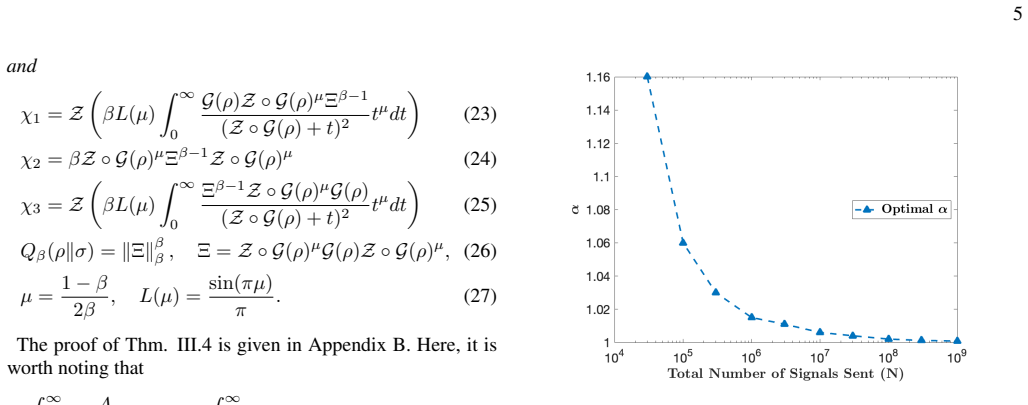
From Figure 4, it can be seen that the Rényi key rate yields a higher bound as compared to the von Neumann key rate in the low block size regime ( N < 107). This is especially evi- dent for signal block size N = 105, where the Rényi key rate doubles that of the von Neumann key rate. For N ≥ 107, there is no significant difference between the two bounds. W...
-
[9]
C. H. Bennett and G. Brassard, Quantum cryptography: Public key distribution and coin tossing, Theoretical Computer Sci- ence 560, 7 (2014), theoretical Aspects of Quantum Cryptogra- phy – celebrating 30 years of BB84
work page 2014
-
[10]
A. K. Ekert, Quantum cryptography based on bell’s theorem, Physical review letters 67, 661 (1991)
work page 1991
-
[11]
Wolf, Quantum key distribution, Lecture notes in physics 988 (2021)
R. Wolf, Quantum key distribution, Lecture notes in physics 988 (2021)
work page 2021
-
[12]
E. Diamanti, H.-K. Lo, B. Qi, and Z. Yuan, Practical chal- lenges in quantum key distribution, npj Quantum Information 2, 1 (2016)
work page 2016
-
[13]
F. Xu, X. Ma, Q. Zhang, H.-K. Lo, and J.-W. Pan, Secure quan- tum key distribution with realistic devices, Reviews of modern physics 92, 025002 (2020)
work page 2020
-
[14]
S. Pirandola, U. L. Andersen, L. Banchi, M. Berta, D. Bunan- dar, R. Colbeck, D. Englund, T. Gehring, C. Lupo, C. Ottaviani, et al., Advances in quantum cryptography, Advances in optics and photonics 12, 1012 (2020)
work page 2020
-
[15]
R. Renner, Security of quantum key distribution, International Journal of Quantum Information 6, 1 (2008)
work page 2008
-
[16]
M. Tomamichel, C. Schaffner, A. Smith, and R. Renner, Left- over hashing against quantum side information, IEEE Transac- tions on Information Theory 57, 5524 (2011)
work page 2011
-
[17]
A Framework for Non-Asymptotic Quantum Information Theory
M. Tomamichel, A framework for non-asymptotic quantum in- formation theory, arXiv preprint arXiv:1203.2142 (2012)
work page internal anchor Pith review Pith/arXiv arXiv 2012
-
[18]
I. Devetak and A. Winter, Distillation of secret key and entan- glement from quantum states, Proceedings of the Royal Society A: Mathematical, Physical and engineering sciences 461, 207 (2005)
work page 2005
- [19]
- [20]
- [21]
-
[22]
T. Metger and R. Renner, Security of quantum key distribu- tion from generalised entropy accumulation, Nature Commu- nications 14, 5272 (2023)
work page 2023
- [23]
-
[24]
M. Christandl, R. König, and R. Renner, Postselection tech- nique for quantum channels with applications to quantum cryp- tography, Physical review letters102, 020504 (2009)
work page 2009
-
[25]
D. Gottesman, H.-K. Lo, N. Lutkenhaus, and J. Preskill, Se- curity of quantum key distribution with imperfect devices, in International Symposium on Information Theory, 2004. ISIT
work page 2004
- [26]
-
[27]
V . Scarani, H. Bechmann-Pasquinucci, N. J. Cerf, M. Dušek, N. Lütkenhaus, and M. Peev, The security of practical quantum key distribution, Reviews of modern physics 81, 1301 (2009)
work page 2009
- [28]
- [29]
-
[30]
F. Dupuis, Privacy amplification and decoupling without smoothing, IEEE Transactions on Information Theory (2023)
work page 2023
-
[31]
D. Tupkary, E. Y .-Z. Tan, and N. Lütkenhaus, Security proof for variable-length quantum key distribution, Physical Review Research 6, 023002 (2024)
work page 2024
- [32]
- [33]
- [34]
-
[35]
V . Scarani and R. Renner, Security bounds for quantum cryp- tography with finite resources, in Workshop on Quantum Com- putation, Communication, and Cryptography (Springer, 2008) pp. 83–95
work page 2008
- [36]
-
[37]
J. Burniston, W. Wang, L. Kamin, et al. , Open QKD Security: Version 2.0.2, https://github.com/ Optical-Quantum-Communication-Theory/ openQKDsecurity (2024)
work page 2024
-
[38]
C. H. Bennett, G. Brassard, and N. D. Mermin, Quantum cryp- tography without bell’s theorem, Physical review letters68, 557 (1992)
work page 1992
- [39]
-
[40]
A. Ferenczi and N. Lütkenhaus, Symmetries in quantum key distribution and the connection between optimal attacks and optimal cloning, Physical Review A—Atomic, Molecular, and Optical Physics 85, 052310 (2012)
work page 2012
-
[41]
Tomamichel, Quantum information processing with finite resources: mathematical foundations, V ol
M. Tomamichel, Quantum information processing with finite resources: mathematical foundations, V ol. 5 (Springer, 2015)
work page 2015
-
[42]
S. Beigi, Sandwiched Rényi divergence satisfies data process- ing inequality, Journal of Mathematical Physics 54 (2013)
work page 2013
-
[43]
J. Lin, T. Upadhyaya, and N. Lütkenhaus, Asymptotic secu- rity analysis of discrete-modulated continuous-variable quan- tum key distribution, Physical Review X 9, 041064 (2019)
work page 2019
-
[44]
H. Hu, J. Im, J. Lin, N. Lütkenhaus, and H. Wolkowicz, Robust interior point method for quantum key distribution rate compu- tation, Quantum 6, 792 (2022)
work page 2022
- [45]
- [46]
- [47]
-
[48]
W. K. Wootters and W. H. Zurek, A single quantum cannot be cloned, Nature 299, 802 (1982)
work page 1982
-
[49]
W. Wang and N. Lütkenhaus, Numerical security proof for the decoy-state bb84 protocol and measurement-device- independent quantum key distribution resistant against large ba- sis misalignment, Physical Review Research 4, 043097 (2022)
work page 2022
- [50]
-
[51]
R. Arnon-Friedman and R. Renner, de finetti reductions for cor- relations, Journal of Mathematical Physics 56 (2015)
work page 2015
-
[52]
O. Fawzi and R. Renner, Quantum conditional mutual informa- tion and approximate markov chains, Communications in Math- ematical Physics 340, 575 (2015)
work page 2015
-
[53]
L. Kamin and N. Lütkenhaus, Improved decoy-state and flag- state squashing methods, Physical Review Research 6, 043223 (2024)
work page 2024
-
[54]
M. Müller-Lennert, F. Dupuis, O. Szehr, S. Fehr, and M. Tomamichel, On quantum Rényi entropies: A new gener- alization and some properties, Journal of Mathematical Physics 54 (2013)
work page 2013
-
[55]
R. Bhatia, Matrix analysis, V ol. 169 (Springer Science & Busi- ness Media, 2013)
work page 2013
-
[56]
R. Rubboli and M. Tomamichel, New additivity properties of the relative entropy of entanglement and its generalizations, Communications in Mathematical Physics 405, 162 (2024)
work page 2024
-
[57]
P. J. Coles, Unification of different views of decoherence and discord, Physical Review A—Atomic, Molecular, and Optical Physics 85, 042103 (2012)
work page 2012
-
[58]
A GENERALIZED NUMERICAL FRAMEWORK FOR IMPROVED FINITE-SIZED KEY RATES WITH RÉNYI ENTROPY
H. Zhu, M. Hayashi, and L. Chen, Coherence and entanglement measures based on Rényi relative entropies, Journal of Physics A: Mathematical and Theoretical 50, 475303 (2017). 1 SUPPLEMENTARY MATERIALS FOR “A GENERALIZED NUMERICAL FRAMEWORK FOR IMPROVED FINITE-SIZED KEY RATES WITH RÉNYI ENTROPY” Appendix A: Proof of Theorem III.3 Here we prove that the Rény...
work page 2017
discussion (0)
Sign in with ORCID, Apple, or X to comment. Anyone can read and Pith papers without signing in.