REVIEW 3 major objections 4 minor 300 references
Developing techniques for Simulation of SU(3) Quantum Field Theories on State-of-the-Art Quantum Devices
T0 review · 3 major / 4 minor · reviewed 2026-08-09 · deepseek-v4-flash
Pith's one-line read Dense three-flavor neutrino systems that start in all three flavors develop the highest, most persistent non-stabilizer 'magic', making initial flavor composition a control knob for quantum advantage.
desk verdict Solid SU(3) simulation toolbox; headline neutrino-magic claim needs qualification on basis-dependence and scan scope. read the letter →
The pith
A machine-rendered reading of the paper's core claim, the machinery that carries it, and where it could break.
The reading
What carries the argument
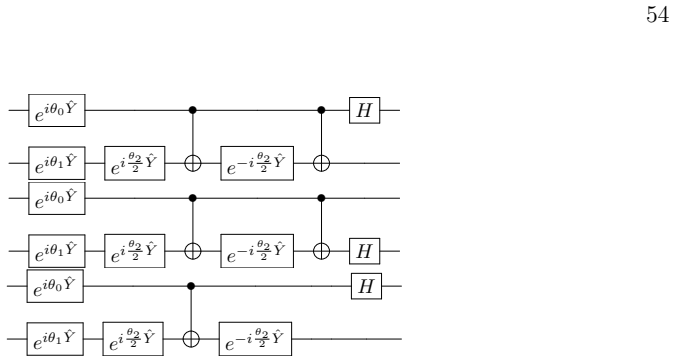
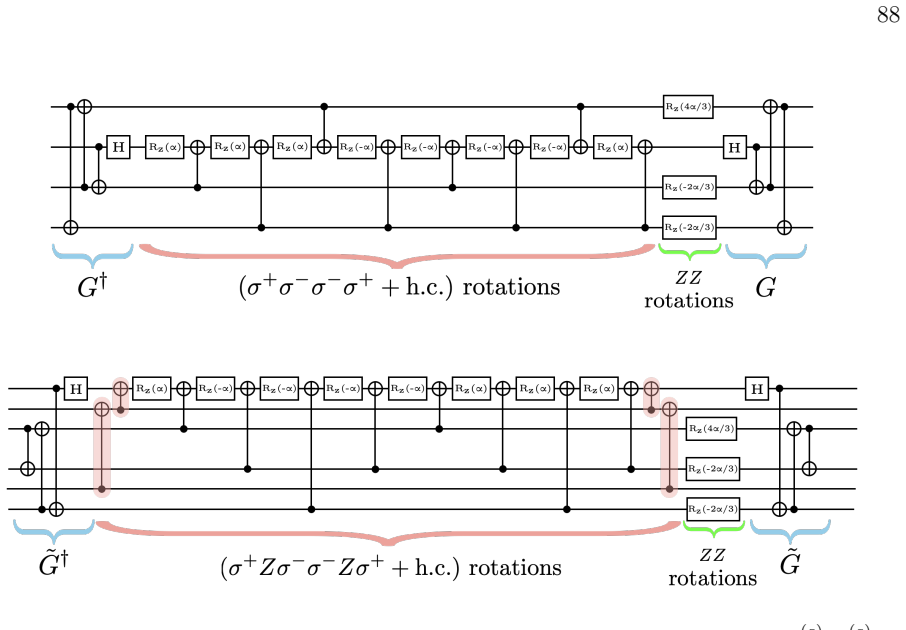
The load-bearing object for the neutrino result is the collective-oscillation Hamiltonian $H_{\nu\nu} = \sum_{i<j} J_{ij}\,\boldsymbol{\lambda}^{(i)}\cdot\boldsymbol{\lambda}^{(j)}$, written in terms of SU(3) Gell-Mann matrices, together with the M2 magic measure, a stabilizer Rényi entropy that quantifies deviation from the classically simulable stabilizer states. Trotterized time evolution is implemented either on qutrits through the natural $\boldsymbol{\lambda}\cdot\boldsymbol{\lambda}$ interaction or on qubits via a swap network; the swap network converts the all-to-all interaction into nearest-neighbor form at no extra circuit cost. For the lattice-gauge-theory half of the thesis, the analogous machinery is the axial-gauge Kogut-Susskind Hamiltonian, in which Gauss's law eliminates the gauge links and turns the chromo-electric energy into a non-local sum over color charges, plus VQE circuits that prepare the vacuum and hadronic states.
What would settle it
Prepare $N_\nu=8$ systems in single-flavor and all-three-flavor tensor-product states, evolve them under the collective Hamiltonian, and tomographically measure M2 per neutrino over time; if any state with fewer than three flavors has higher or more persistent asymptotic magic, the paper's ordering claim is refuted. Adding a matter potential to the Hamiltonian and repeating the scan is a second decisive test.
Extended reading notes
Core claim
On the paper's own terms, the central discovery is that the asymptotic magic per neutrino—quantified by the M2 stabilizer Rényi entropy—is larger, and stays larger over time, for collective-neutrino-oscillation systems whose initial tensor-product state contains all three flavors than for systems starting in one flavor alone. This ordering is established numerically for systems of up to eight neutrinos under the all-to-all two-body SU(3) flavor Hamiltonian, using neutrino mixing parameters taken from experiment. The thesis presents this as a result with implications for the Standard Model: dense three-flavor neutrino environments, such as the interiors of core-collapse supernovae or compact-object mergers, are natural places to look for quantum advantage in simulation. The same work develops the circuit toolbox that makes the claim testable, including swap-network Trotterizations for nearest-neighbor hardware and a two-neutrino qutrit circuit with only four two-qutrit entangling gates.
Load-bearing premise
The magic-ordering result is computed for tensor-product initial states with up to eight neutrinos under the collective-oscillation Hamiltonian; if a wider class of initial states, a different magic measure, or extra physical terms such as matter or collisions changes which initial flavor composition wins, the headline claim fails.
Editorial extensions
If this is right
- Preparing initial neutrino states that contain all three flavors should be prioritized in quantum simulations of dense neutrino systems, since the numerics show these states carry the most magic.
- The M2 measure can serve as a state-selection benchmark: experiments aiming at quantum advantage should evolve until magic is high and persistent rather than stopping at early times.
- The qutrit encoding reduces the two-neutrino circuit to four two-qutrit entangling gates, and the qubit swap network makes the all-to-all neutrino interaction implementable on nearest-neighbor superconducting devices with no extra SWAP overhead.
- The VQE and domain-decomposition results indicate that gradient-descent optimization with Lanczos-preconditioned starts, rather than Bayesian optimization, is the more scalable route for SU(3) lattice-gauge-theory state preparation.
- The Trotterized circuits for beta decay and neutrinoless double beta decay provide a reusable starting point for simulating weak-interaction processes in 1+1D lattice QCD on near-term hardware.
Reading between the lines
- If the magic ordering holds for larger $N_\nu$, initial flavor composition is not just a physics detail but a resource-allocation decision: the hardest circuits should be spent on all-three-flavor initial states.
- The same SU(3) all-to-all structure appears in other many-body settings, such as color systems in quark matter; it is a natural extension to test whether maximally symmetric initial states generically maximize non-stabilizerness there, though the thesis does not make that claim.
- Persistence may matter more than peak magic under hardware noise; an implied, testable extension is to compare the magic decay time against device decoherence time to see whether all-three-flavor states are also the most noise-resilient.
- A scaling study beyond $N_\nu=8$, using tensor networks or sampling, could reveal whether the per-neutrino magic gap between flavor compositions saturates or grows, sharpening the experimental target.
Editorial analysis
A structured set of objections, weighed in public.
Referee Report
Summary. This dissertation develops circuit-level techniques for simulating SU(3) lattice gauge theories and three-flavor neutrino oscillations on NISQ hardware, and it studies "magic" (non-stabilizerness) in collective neutrino oscillations. Chapters 2–5 cover VQE preparation of the SU(3) Yang–Mills vacuum, an axial-gauge Hamiltonian for 1+1D QCD, beta-decay and neutrinoless double-beta decay circuits, and optimizations for nearest-neighbor connectivity. Chapter 6 presents qutrit and qubit Trotter circuits for three-flavor collective neutrino oscillations and reports hardware results on Quantinuum H1-1 and IBM ibm torino. Chapter 7 defines the M2 magic measure and reports numerical integrations showing that, among the tensor-product initial states scanned up to Nnu=8, states containing all three flavors achieve higher asymptotic magic per neutrino than all-electron-type initial states (Figs. 7.4–7.6, Tables 7.1–7.2). The abstract generalizes this to "the 3 flavor ultradense neutrino systems with the highest, most-persistent magic" and to "implications for the Standard Model in general." The manuscript is a mixed compilation of prior collaborative work, but it is self-contained enough for review.
Significance. The thesis has concrete strengths: Trotter circuit counts are tabulated (Table 6.2 and Tables 3.4, 4.3), ODE solver tolerances are stated in Tables 7.1–7.2, device parameters are collected in Tables 6.6–6.7, and several chapters report genuine hardware runs. Section 5.4 includes a proof of the color-singlet space construction, and Appendix 7.D gives analytic expressions for the one-body magic power. The central magic claim, if it survives scrutiny, is interesting: initial flavor composition would be a control knob for non-stabilizerness, one candidate resource for quantum advantage in neutrino simulations. However, the claim is currently an empirical result over a finite scan, and the M2 measure is stabilizer-basis dependent. The physical significance is therefore real but narrower than the abstract states.
major comments (3)
- [§7, Eq. (7.4) and App. 7.C] The M2 measure is defined with respect to a fixed Weyl–Heisenberg group and computational basis, yet the abstract presents the ordering as a property of the neutrino system. A unitary change of basis (e.g., flavor basis vs. mass basis) or a change of encoding (qutrit basis in App. 7.C vs. the qubit mappings used in Chapter 6) can change M2 values. The thesis does not show that the ordering "all three flavors > other tensor products" is invariant under such choices. I request a numerical check of the ordering under at least one alternative basis/encoding, or an explicit argument for stability, before the claim is stated without qualification.
- [§7, Figs. 7.4–7.6 and Tables 7.1–7.2] The supporting evidence covers tensor-product initial states with Nnu up to 8. The abstract generalizes to "the 3 flavor ultradense neutrino systems with the highest, most-persistent magic" without restricting to this scanned class. No proof or scaling argument is given for arbitrary Nnu or for non-product or entangled initial states. The abstract and the Chapter 7 conclusions should either be restricted to the scanned class or supplemented with an argument that the ordering persists for larger systems and more general initial states.
- [§7, Fig. 7.1 and Tables 7.1–7.2] Fig. 7.1 shows that the one-body magic power M2(U1) varies appreciably when Δm²32 and δm²21 are sampled over their 68% confidence intervals, but Tables 7.1–7.2 report asymptotic per-neutrino magic as point values. Since the abstract makes a universal claim, the multi-neutrino ordering should be checked against parameter variation as well; otherwise the conclusion is tied to a single point in the neutrino parameter space and may not be robust to updated measurements.
minor comments (4)
- [Abstract and §§1.1, 1.2.1, 2.5] There are several typographical errors, including "out-of-equilbrium" in the abstract, "aformentioned" in §1.2.1, "of-nonperturbative QCD" in §1.1, and "vaccum" in §2.5; these should be corrected.
- [App. 7.E, Tables 7.1–7.2] The table captions refer to "Fig. 4 of the main text," but the corresponding figures in the thesis are numbered 7.4–7.6; the cross-references should be updated.
- [§7] The term "persistent" is used informally. The authors should define whether it refers to the late-time asymptotic value of M2 per neutrino and, if a different time horizon is intended, specify the window over which persistence is evaluated.
- [§6 and §7] The connection between the qutrit-based magic calculation and the qubit encodings used for hardware in Chapter 6 is not discussed; a short remark in Chapter 7 explaining how the encoding choice affects the reported magic values would help the reader.
Circularity Check
No significant circularity: the thesis's results are computed from external Hamiltonian parameters, exact diagonalization benchmarks, and standard magic measures, with no target result built into the inputs.
full rationale
The derivation chain is self-contained and non-circular. The central claim—that three-flavor ultradense neutrino systems starting with all three flavors have the highest, most-persistent magic—is obtained by numerically evolving the collective-neutrino-oscillation Hamiltonian with externally fixed parameters from Refs. [230, 5] and evaluating the standard M2 stabilizer-Rényi measure against tensor-product initial states. No fitted parameter, ansatz, or cited result is used to define the magic ordering; the ordering is the output of the computation. The hardware and circuit chapters are similarly benchmarked against exact diagonalization or exact classical simulation (e.g., β-decay probabilities in Chapter 4 compared with exact results, and collective neutrino flavor evolution in Chapter 6 compared with exact evolution). The thesis does cite prior work from the same research group for circuit building blocks (e.g., Ref. [238] for e^{iθ/2(XY±YX)} building blocks), but these citations are implementation details, not load-bearing justifications of the paper's physical conclusions. The basis-dependence of the magic measure is a legitimate correctness or interpretation concern, but it is not circular: the paper does not define the measure in terms of the claimed ordering, nor does it input the ordering into the calculation. No step in the paper reduces by construction to its own inputs, and no self-citation chain is invoked to forbid alternatives or to force the stated result. Therefore the appropriate circularity score is 0.
Assumptions & free parameters
free parameters (6)
- h (color edge-state penalty coefficient) =
h -> infinity (large limit)
- lepton state-preparation angles (theta, phi, chi, omega, psi) =
theta=-0.83015, phi=-0.83015, chi=0.24090, omega=-1.02630, psi=-1.28030 (Fig. 5.5)
- single-plaquette VQE ansatz angles =
optimized on IBM Manila; not tabulated as constants
- domain-decomposition stitching angles (R1-R7) =
optimized via simulated VQE; values in Ch. 2/C
- Bayesian optimization regularization lambda =
lambda = 0.0036, 0.0009, 1e-6, 1e-9, 1e-12 (Fig. 2.4)
- field truncation cutoff (p,q max) =
3, 6, 8, 31 depending on coupling and accuracy
assumptions (8)
- standard math Jordan-Wigner transformation maps fermionic operators to Pauli operators while preserving anticommutation relations.
- standard math Suzuki-Trotter decomposition approximates time evolution by products of exponentials of individual Hamiltonian terms.
- domain assumption Deviation from stabilizer states is necessary for quantum advantage, motivated by the Gottesman-Knill theorem.
- domain assumption Axial gauge A_x=0 with Gauss's law determines chromo-electric fields non-locally and allows removing gauge links.
- domain assumption Collective neutrino oscillations are described by all-to-all two-body SU(3) flavor interactions with parameters from Refs. [230,5].
- domain assumption ODR error mitigation assumes all errors are depolarizing.
- domain assumption The vacuum state of the SU(3) plaquette system respects CP symmetry under link reversal.
- ad hoc to paper Color edge-state penalty term H1 with large h projects onto the color-singlet sector.
Cite this review
Pith. "Pith review of Developing techniques for Simulation of SU(3) Quantum Field Theories on State-of-the-Art Quantum Devices." pith.science (2026). https://pith.science/paper/ALUD3LYI
@misc{pith2026250202502,
  author       = {Pith},
  title        = {Pith review of: Developing techniques for Simulation of SU(3) Quantum Field Theories on State-of-the-Art Quantum Devices},
  year         = {2026},
  howpublished = {\url{https://pith.science/paper/ALUD3LYI}},
  note         = {Machine review of arXiv:2502.02502}
}
read the original abstract
Quantum computing has long been an experimental technology with the potential to simulate, at scale, phenomena which on classical devices would be too expensive to simulate at any but the smallest scales. Over the last several years, however, it has entered the NISQ era, where the number of qubits are sufficient for quantum advantage but substantial noise on hardware stands in the way of this achievement. This thesis details NISQ device-centered improvements to techniques of quantum simulation of the out-of-equilbrium real-time dynamics of lattice quantum chromodynamics (LQCD) and of dense 3-flavor neutrino systems on digital quantum devices. The first project concerning LQCD is a comparison of methods for implementing the variational quantum eigensolver (VQE) that initializes the ground state of an SU(3) plaquette-chain. The thesis then pivots to a 1+1D lattice of quarks interacting with an SU(3) gauge-field. A VQE-based state-preparation for the vacua and a Trotterized time-evolution circuit is designed and applied to the problems of simulating beta and neutrinoless double beta decay. Finally, these circuits are adapted to a version useable on quantum devices with nearest-neighbor connectivity with minimal overhead, with an eye towards utilizing the higher qubit count of such devices for hadron dynamics and scattering. This thesis covers two projects that concern dense 3-flavor neutrino systems. The first details design and testing of Trotterized time-evolution circuits on state-of-the-art quantum devices. The second, motivated by the Gottesman-Knill theorem's result that deviation from stabilizer states ("magic") is necessary for a problem to exhibit quantum advantage, details results with implications for the Standard Model in general that the 3 flavor ultradense neutrino systems with the highest, most-persistent magic are those that start with neutrinos in all 3 flavors.
Figures


Figures from the paper (103 more)















Reference graph
Works this paper leans on
-
[1]
https://quantum-computing.ibm.com/, 2022
IBM Quantum. https://quantum-computing.ibm.com/, 2022
2022
-
[2]
Tikhonov Regularization and ERM
-
[3]
Reaching for the Horizon: The 2015 Long Range Plan for Nuclear Science, 2015
2015
-
[4]
Nature, 614(7949):676–681, 2023
Suppressing quantum errors by scaling a surface code logical qubit. Nature, 614(7949):676–681, 2023
2023
-
[5]
Nufit 5.3, www.nu-fit.org, 2024
2024
-
[7]
SU(2) lattice gauge theory on a quantum annealer
Sarmed A Rahman, Randy Lewis, Emanuele Mendicelli, and Sarah Powell. SU(2) lattice gauge theory on a quantum annealer. Phys. Rev. D , 104(3):034501, 2021
2021
-
[8]
Self- mitigating Trotter circuits for SU(2) lattice gauge theory on a quantum computer
Sarmed A Rahman, Randy Lewis, Emanuele Mendicelli, and Sarah Powell. Self- mitigating Trotter circuits for SU(2) lattice gauge theory on a quantum computer. Phys. Rev. D , 106(7):074502, 2022
2022
-
[9]
Improved simulation of stabilizer circuits
Scott Aaronson and Daniel Gottesman. Improved simulation of stabilizer circuits. Physical Review A , 70(5), Nov 2004
2004
Show all 300 references
-
[10]
Accardi et al
A. Accardi et al. Electron Ion Collider: The Next QCD Frontier: Understanding the glue that binds us all. Eur. Phys. J. A , 52(9):268, 2016
2016
-
[11]
Sengupta
Atithi Acharya, Siddhartha Saha, and Anirvan M. Sengupta. Shadow tomography based on informationally complete positive operator-valued measure. Phys. Rev. A , 104:052418, Nov 2021
2021
-
[12]
Theoretical foundation for the index theorem on the lattice with staggered fermions
David H Adams. Theoretical foundation for the index theorem on the lattice with staggered fermions. Physical review letters , 104(14):141602, 2010
2010
-
[13]
Pairs of chiral quarks on the lattice from staggered fermions
David H Adams. Pairs of chiral quarks on the lattice from staggered fermions. Physics Letters B, 699(5):394–397, 2011. 272
2011
-
[14]
Adolph et al
C. Adolph et al. The spin structure function gp 1 of the proton and a test of the Bjorken sum rule. Phys. Lett. B , 753:18–28, 2016
2016
-
[15]
Agadjanov, V
A. Agadjanov, V. Bernard, U. G. Meißner, and A. Rusetsky. A framework for the calculation of the ∆N γ∗ transition form factors on the lattice. Nucl. Phys. B, 886:1199– 1222, 2014
2014
-
[16]
Monika Aidelsburger, Luca Barbiero, Alejandro Bermudez, Titas Chanda, Alexandre Dauphin, Daniel Gonz´ alez-Cuadra, Przemys law R. Grzybowski, Simon Hands, Fred Jendrzejewski, Johannes J¨ unemann, Gediminas Juzeliunas, Valentin Kasper, Angelo Piga, Shi-Ju Ran, Matteo Rizzi, G´ ...
2021
-
[17]
Tameem Albash and Daniel A. Lidar. Adiabatic quantum computation. Rev. Mod. Phys., 90:015002, Jan 2018
2018
-
[18]
Chow, Antonio D
Gadi Aleksandrowicz, Thomas Alexander, Panagiotis Barkoutsos, Luciano Bello, Yael Ben-Haim, David Bucher, Francisco Jose Cabrera-Hern´ andez, Jorge Carballo-Franquis, Adrian Chen, Chun-Fu Chen, Jerry M. Chow, Antonio D. C´ orcoles-Gonzales, Abi- gail J. Cross, Andrew Cross, Ju...
2019
-
[19]
Alexandrou, S
C. Alexandrou, S. Bacchio, M. Constantinou, J. Finkenrath, K. Hadjiyiannakou, K. Jansen, G. Koutsou, H. Panagopoulos, and G. Spanoudes. Complete flavor de- 273 composition of the spin and momentum fraction of the proton using lattice QCD simulations at physical pion mass. Phys...
2020
-
[20]
Nucleon axial and pseudoscalar form factors using twisted-mass fermion ensembles at the physical point
Constantia Alexandrou, Simone Bacchio, Martha Constantinou, Jacob Finkenrath, Roberto Frezzotti, Bartosz Kostrzewa, Giannis Koutsou, Gregoris Spanoudes, and Carsten Urbach. Nucleon axial and pseudoscalar form factors using twisted-mass fermion ensembles at the physical point. ...
2024
-
[21]
Complex paths around the sign problem
Andrei Alexandru, G¨ ok¸ ce Ba¸ sar, Paulo F Bedaque, and Neill C Warrington. Complex paths around the sign problem. Reviews of Modern Physics , 94(1):015006, 2022
2022
-
[22]
Bedaque, Siddhartha Harmalkar, Henry Lamm, Scott Lawrence, and Neill C
Andrei Alexandru, Paulo F. Bedaque, Siddhartha Harmalkar, Henry Lamm, Scott Lawrence, and Neill C. Warrington. Gluon Field Digitization for Quantum Computers. Phys. Rev. D , 100(11):114501, 2019
2019
-
[23]
Bedaque, Henry Lamm, and Scott Lawrence
Andrei Alexandru, Paulo F. Bedaque, Henry Lamm, and Scott Lawrence. Sigma models on quantum computers. Physical Review Letters, 123(9), Aug 2019
2019
-
[24]
Algora, J
A. Algora, J. L. Tain, B. Rubio, M. Fallot, and W. Gelletly. Beta-decay studies for applied and basic nuclear physics. Eur. Phys. J. A , 57(3):85, 2021
2021
-
[25]
C. R. Allton, S. Ejiri, S. J. Hands, O. Kaczmarek, F. Karsch, E. Laermann, Ch. Schmidt, and L. Scorzato. Qcd thermal phase transition in the presence of a small chemical potential. Phys. Rev. D , 66:074507, Oct 2002
2002
-
[26]
Trapped-ion quantum simulation of collective neu- trino oscillations
Valentina Amitrano, Alessandro Roggero, Piero Luchi, Francesco Turro, Luca Vespucci, and Francesco Pederiva. Trapped-ion quantum simulation of collective neu- trino oscillations. Phys. Rev. D , 107(2):023007, 2023
2023
-
[27]
Classical benchmarking of zero noise extrapolation beyond the exactly-verifiable regime, 2023
Sajant Anand, Kristan Temme, Abhinav Kandala, and Michael Zaletel. Classical benchmarking of zero noise extrapolation beyond the exactly-verifiable regime, 2023
2023
-
[28]
Anastasiou, Yanzhu Chen, Nicholas J
Panagiotis G. Anastasiou, Yanzhu Chen, Nicholas J. Mayhall, Edwin Barnes, and Sophia E. Economou. Tetris-adapt-vqe: An adaptive algorithm that yields shallower, denser circuit ans¨ atze.Phys. Rev. Res. , 6:013254, Mar 2024
2024
-
[29]
Engineering an effective three-spin Hamiltonian in trapped-ion sys- tems for applications in quantum simulation
B´ arbara Andrade, Zohreh Davoudi, Tobias Graß, Mohammad Hafezi, Guido Pagano, and Alireza Seif. Engineering an effective three-spin Hamiltonian in trapped-ion sys- tems for applications in quantum simulation. Quantum Sci. Technol. , 7(3):034001, 2022. 274
2022
-
[30]
S. Aoki, Y. Aoki, D. Beˇ cirevi´ c, T. Blum, G. Colangelo, S. Collins, M. Della Morte, P. Dimopoulos, S. D¨ urr, H. Fukaya, and et al. Flag review 2019.The European Physical Journal C , 80(2), Feb 2020
2019
-
[31]
bßD ∗ ℓνℓ semileptonic form factors from lattice qcd with m¨ obius domain-wall quarks.Physical Review D , 109(7):074503, 2024
Y Aoki, B Colquhoun, H Fukaya, S Hashimoto, T Kaneko, R Kellermann, J Koponen, E Kou, and (JLQCD Collaboration). bßD ∗ ℓνℓ semileptonic form factors from lattice qcd with m¨ obius domain-wall quarks.Physical Review D , 109(7):074503, 2024
2024
-
[32]
Aoki et al
Y. Aoki et al. FLAG Review 2021. 11 2021
2021
-
[33]
Machado, and Man-Kuan Tam
Rafael Aoude, Ming-Zhi Chung, Yu-tin Huang, Camila S. Machado, and Man-Kuan Tam. Silence of Binary Kerr Black Holes. Phys. Rev. Lett. , 125(18):181602, 2020
2020
-
[34]
C. A. Arg¨ uelles and B. J. P. Jones. Neutrino Oscillations in a Quantum Processor. Phys. Rev. Research., 1:033176, 2019
2019
-
[35]
Photon-mediated stroboscopic quantum simulation of a Z2 lattice gauge theory, 2021
Tsafrir Armon, Shachar Ashkenazi, Gerardo Garc ´ ıa-Moreno, Alejandro Gonz´ alez- Tudela, and Erez Zohar. Photon-mediated stroboscopic quantum simulation of a Z2 lattice gauge theory, 2021
2021
-
[36]
R. L. Arnowitt and S. I. Fickler. Quantization of the yang-mills field. Phys. Rev. , 127:1821–1829, Sep 1962
1962
-
[37]
Bardin, Rami Barends, Sergio Boixo, Michael Broughton, Bob B
Frank Arute, Kunal Arya, Ryan Babbush, Dave Bacon, Joseph C. Bardin, Rami Barends, Sergio Boixo, Michael Broughton, Bob B. Buckley, and et al. Hartree-fock on a superconducting qubit quantum computer. Science, 369(6507):1084–1089, Aug 2020
2020
-
[38]
Ashman and et al
J. Ashman and et al . A measurement of the spin asymmetry and determination of the structure function g1 in deep inelastic muon-proton scattering. Physics Letters B , 206(2):364–370, 1988
1988
-
[39]
Ashman and et al
J. Ashman and et al. An investigation of the spin structure of the proton in deep inelas- tic scattering of polarised muons on polarised protons. Nuclear Physics B, 328(1):1–35, 1989
1989
-
[40]
Atas, Jan F
Yasar Y. Atas, Jan F. Haase, Jinglei Zhang, Victor Wei, Sieglinde M. L. Pfaendler, Randy Lewis, and Christine A. Muschik. Real-time evolution of SU(3) hadrons on a quantum computer, 7 2022
2022
-
[41]
Atas, Jinglei Zhang, Randy Lewis, Amin Jahanpour, Jan F
Yasar Y. Atas, Jinglei Zhang, Randy Lewis, Amin Jahanpour, Jan F. Haase, and Chris- tine A. Muschik. SU(2) hadrons on a quantum computer via a variational approach. Nat Commun , 12(1):6499, 2021. 275
2021
-
[42]
Avkhadiev, P
A. Avkhadiev, P. E. Shanahan, and R. D. Young. Accelerating Lattice Quantum Field Theory Calculations via Interpolator Optimization Using Noisy Intermediate- Scale Quantum Computing. Phys. Rev. Lett. , 124(8):080501, 2020
2020
-
[43]
Avkhadiev, P
A. Avkhadiev, P. E. Shanahan, and R. D. Young. Strategies for quantum-optimized construction of interpolating operators in classical simulations of lattice quantum field theories, 9 2022
2022
-
[44]
M. C. Ba˜ nuls, K. Cichy, K. Jansen, and J. I. Cirac. The mass spectrum of the Schwinger model with Matrix Product States. JHEP, 11:158, 2013
2013
-
[45]
M. C. Ba˜ nuls et al. Simulating Lattice Gauge Theories within Quantum Technologies. Eur. Phys. J. D , 74(8):165, 2020
2020
-
[46]
Ignacio Cirac, Karl Jansen, and Stefan K¨ uhn
Mari Carmen Ba˜ nuls, Krzysztof Cichy, J. Ignacio Cirac, Karl Jansen, and Stefan K¨ uhn. Efficient basis formulation for 1+1 dimensional SU(2) lattice gauge theory: Spectral calculations with matrix product states. Phys. Rev. X , 7(4):041046, 2017
2017
-
[47]
Further applications of metrix notation to integration prob- lems
Henry Frederick Baker. Further applications of metrix notation to integration prob- lems. Proceedings of the London Mathematical Society , 1(1):347–360, 1901
1901
-
[48]
Baker, Casey Duckering, and Frederic T
Jonathan M. Baker, Casey Duckering, and Frederic T. Chong. Efficient quantum circuit decompositions via intermediate qudits. In 2020 IEEE 50th International Symposium on Multiple-Valued Logic (ISMVL), pages 303–308, 2020
2020
-
[49]
A. B. Balantekin, Michael J. Cervia, Amol V. Patwardhan, Ermal Rrapaj, and Pooja Siwach. Quantum information and quantum simulation of neutrino physics.Eur. Phys. J. A , 59(8):186, 2023
2023
-
[50]
A. B. Balantekin and Y. Pehlivan. Neutrino-Neutrino Interactions and Flavor Mixing in Dense Matter. J. Phys. G , 34:47–66, 2007
2007
-
[51]
A. B. Balantekin and H. Yuksel. Neutrino mixing and nucleosynthesis in core-collapse supernovae. New J. Phys. , 7:51, 2005
2005
-
[52]
Baha Balantekin, Michael J
A. Baha Balantekin, Michael J. Cervia, Amol V. Patwardhan, Rebecca Surman, and Xilu Wang. Collective Neutrino Oscillations and Heavy-element Nucleosynthesis in Su- pernovae: Exploring Potential Effects of Many-body Neutrino Correlations. Astrophys. J., 967(2):146, 2024
2024
-
[53]
Banerjee, M
D. Banerjee, M. B¨ ogli, M. Dalmonte, E. Rico, P. Stebler, U.-J. Wiese, and P. Zoller. Atomic Quantum Simulation of U(N ) and SU( N ) Non-Abelian Lattice Gauge Theo- ries. Phys. Rev. Lett. , 110:125303, Mar 2013. 276
2013
-
[54]
Banerjee, M
D. Banerjee, M. Dalmonte, M. Muller, E. Rico, P. Stebler, U. J. Wiese, and P. Zoller. Atomic quantum simulation of dynamical gauge fields coupled to fermionic matter: From string breaking to evolution after a quench. Phys. Rev. Lett. , 109:175302, 2012
2012
-
[55]
Strong-coupling calculations of the hadron spectrum of quantum chro- modynamics
Tom Banks, S Raby, Leonard Susskind, J Kogut, DRT Jones, PN Scharbach, and DK Sinclair. Strong-coupling calculations of the hadron spectrum of quantum chro- modynamics. Physical Review D , 15(4):1111, 1977
1977
-
[56]
Tom Banks, Leonard Susskind, and John B. Kogut. Strong Coupling Calculations of Lattice Gauge Theories: (1+1)-Dimensional Exercises. Phys. Rev. D , 13:1043, 1976
1976
-
[57]
Single-particle digitization strategy for quantum computation of a ϕ4 scalar field theory
Jo˜ ao Barata, Niklas Mueller, Andrey Tarasov, and Raju Venugopalan. Single-particle digitization strategy for quantum computation of a ϕ4 scalar field theory. Phys. Rev. A, 103:042410, Apr 2021
2021
-
[58]
Results on finite density qcd
Ian M Barbour, Susan E Morrison, Elyakum G Klepfish, John B Kogut, Maria-Paola Lombardo, Ukqcd Collaboration, et al. Results on finite density qcd. Nuclear Physics B-Proceedings Supplements, 60(1-2):220–233, 1998
1998
-
[59]
Toward n to n π matrix elements from lattice qcd
Lorenzo Barca, Gunnar Bali, and Sara Collins. Toward n to n π matrix elements from lattice qcd. Physical Review D , 107(5):L051505, 2023
2023
-
[60]
Baroni et al
A. Baroni et al. Local chiral interactions, the tritium Gamow-Teller matrix element, and the three-nucleon contact term. Phys. Rev. C , 98(4):044003, 2018
2018
-
[61]
Baroni, L
A. Baroni, L. Girlanda, A. Kievsky, L. E. Marcucci, R. Schiavilla, and M. Viviani. Tritium β-decay in chiral effective field theory. Phys. Rev. C , 94(2):024003, 2016. [Erratum: Phys.Rev.C 95, 059902 (2017)]
2017
-
[62]
Baroni, L
A. Baroni, L. Girlanda, S. Pastore, R. Schiavilla, and M. Viviani. Nuclear Axial Currents in Chiral Effective Field Theory. Phys. Rev. C, 93(1):015501, 2016. [Erratum: Phys.Rev.C 93, 049902 (2016), Erratum: Phys.Rev.C 95, 059901 (2017)]
2016
-
[63]
King, and Saori Pastore
Alessandro Baroni, Garrett B. King, and Saori Pastore. Electroweak Currents from Chiral Effective Field Theory. Few-Body Syst., 62(4):114, 2021
2021
-
[64]
Bauer, Zohreh Davoudi, A
Christian W. Bauer, Zohreh Davoudi, A. Baha Balantekin, Tanmoy Bhattacharya, Marcela Carena, Wibe A. de Jong, Patrick Draper, Aida El-Khadra, Nate Gemelke, Masanori Hanada, Dmitri Kharzeev, Henry Lamm, Ying-Ying Li, Junyu Liu, Mikhail Lukin, Yannick Meurice, Christopher Monroe...
2022
-
[65]
Quantum simulation of fundamental particles and forces
Christian W Bauer, Zohreh Davoudi, Natalie Klco, and Martin J Savage. Quantum simulation of fundamental particles and forces. Nature Reviews Physics, 5(7):420–432, 2023
2023
-
[66]
Bauer and Dorota M
Christian W. Bauer and Dorota M. Grabowska. Efficient representation for simulating U(1) gauge theories on digital quantum computers at all values of the coupling. Phys. Rev. D, 107(3):L031503, 2023
2023
-
[67]
Bazavov, C
A. Bazavov, C. Bernard, C. M. Bouchard, C. DeTar, Daping Du, A. X. El-Khadra, J. Foley, E. D. Freeland, E. G´ amiz, Steven Gottlieb, U. M. Heller, Jongjeong Kim, A. S. Kronfeld, J. Laiho, L. Levkova, P. B. Mackenzie, E. T. Neil, M. B. Oktay, Si- Wei Qiu, J. N. Simone, R. Sugar...
2014
-
[68]
Bazavov, C
A. Bazavov, C. Bernard, N. Brown, C. DeTar, A. X. El-Khadra, E. G´ amiz, Steven Gottlieb, U. M. Heller, J. Komijani, A. S. Kronfeld, J. Laiho, P. B. Mackenzie, E. T. Neil, J. N. Simone, R. L. Sugar, D. Toussaint, and R. S. Van de Water. b- and d-meson leptonic decay constants ...
2018
-
[69]
Bazavov, C
A. Bazavov, C. Bernard, C. DeTar, Daping Du, A. X. El-Khadra, E. D. Freeland, E. G´ amiz, Steven Gottlieb, U. M. Heller, J. Komijani, A. S. Kronfeld, J. Laiho, P. B. Mackenzie, E. T. Neil, T. Primer, J. N. Simone, R. Sugar, D. Toussaint, and R. S. Van de Water.|vus| from Kℓ3 d...
2019
-
[70]
Bazavov, C
A. Bazavov, C. Bernard, J. Komijani, C. M. Bouchard, C. DeTar, J. Foley, L. Levkova, D. Du, J. Laiho, A. X. El-Khadra, E. D. Freeland, E. G´ amiz, Steven Gottlieb, U. M. Heller, J. Kim, D. Toussaint, A. S. Kronfeld, P. B. Mackenzie, J. N. Simone, R. S. Van de Water, R. Zhou, E...
2014
-
[71]
Gauge-invariant implementation of the Abelian Higgs model on optical lattices
Alexei Bazavov, Yannick Meurice, Shan-Wen Tsai, Judah Unmuth-Yockey, and Jin Zhang. Gauge-invariant implementation of the Abelian Higgs model on optical lattices. Phys. Rev. D , 92(7):076003, 2015. 278
2015
-
[72]
Simulating lattice gauge theories within quantum technologies
Mari Carmen Ba˜ nuls, Rainer Blatt, Jacopo Catani, Alessio Celi, Juan Ignacio Cirac, Marcello Dalmonte, Leonardo Fallani, Karl Jansen, Maciej Lewenstein, Simone Mon- tangero, and et al. Simulating lattice gauge theories within quantum technologies. The European Physical Journa...
2020
-
[73]
S. R. Beane, P. F. Bedaque, A. Parre˜ no, and M. J. Savage. Two nucleons on a lattice. Phys. Lett. B , 585:106–114, 2004
2004
-
[74]
Beane, Paulo F
Silas R. Beane, Paulo F. Bedaque, Thomas C. Luu, Kostas Orginos, Elisabetta Pal- lante, Assumpta Parre˜ no, and Martin J. Savage. Hyperon–nucleon scattering from fully-dynamical lattice qcd. Nuclear Physics A , 794(1):62–72, 2007
2007
-
[75]
Beane, Emmanuel Chang, William Detmold, Kostas Orginos, Assumpta Parre˜ no, Martin J
Silas R. Beane, Emmanuel Chang, William Detmold, Kostas Orginos, Assumpta Parre˜ no, Martin J. Savage, and Brian C. Tiburzi. Ab initio calculation of thenp → dγ radiative capture process. Phys. Rev. Lett. , 115:132001, Sep 2015
2015
-
[76]
Beane, William Detmold, Thomas C
Silas R. Beane, William Detmold, Thomas C. Luu, Kostas Orginos, Martin J. Savage, and Aaron Torok. Multi-Pion Systems in Lattice QCD and the Three-Pion Interaction. Phys. Rev. Lett. , 100:082004, 2008
2008
-
[77]
Beane, William Detmold, and Martin J
Silas R. Beane, William Detmold, and Martin J. Savage. n-Boson Energies at Finite Volume and Three-Boson Interactions. Phys. Rev. D , 76:074507, 2007
2007
-
[78]
Beane and Roland C
Silas R. Beane and Roland C. Farrell. Geometry and entanglement in the scattering matrix. Annals Phys., 433:168581, 2021
2021
-
[79]
Beane, Roland C
Silas R. Beane, Roland C. Farrell, and Mira Varma. Entanglement minimization in hadronic scattering with pions. Int. J. Mod. Phys. A , 36(30):2150205, 2021
2021
-
[80]
Beane, David B
Silas R. Beane, David B. Kaplan, Natalie Klco, and Martin J. Savage. Entangle- ment Suppression and Emergent Symmetries of Strong Interactions. Phys. Rev. Lett., 122(10):102001, 2019
2019
-
[81]
Beane, Thomas C
Silas R. Beane, Thomas C. Luu, Kostas Orginos, Assumpta Parre˜ no, Martin J. Savage, Aaron Torok, and Andr´ e Walker-Loud.K +K + scattering length from lattice qcd. Phys. Rev. D, 77:094507, May 2008
2008
-
[82]
Beane and Martin J
Silas R. Beane and Martin J. Savage. The Quark mass dependence of two nucleon systems. Nucl. Phys. A , 717:91–103, 2003. 279
2003
-
[83]
Quantum information science and technology for nuclear physics
Douglas Beck, Joseph Carlson, Zohreh Davoudi, Joseph Formaggio, Sofia Quaglioni, Martin Savage, Joao Barata, Tanmoy Bhattacharya, Michael Bishof, Ian Cloet, et al. Quantum information science and technology for nuclear physics. input into us long- range planning, 2023. arXiv p...
2023 arXiv
-
[84]
Fast and converged classi- cal simulations of evidence for the utility of quantum computing before fault tolerance
Tomislav Beguˇ si´ c, Johnnie Gray, and Garnet Kin-Lic Chan. Fast and converged classi- cal simulations of evidence for the utility of quantum computing before fault tolerance. Science Advances, 10(3):eadk4321, 2024
2024
-
[85]
Fast classical simulation of evidence for the utility of quantum computing before fault tolerance, 2023
Tomislav Beguˇ si´ c and Garnet Kin-Lic Chan. Fast classical simulation of evidence for the utility of quantum computing before fault tolerance, 2023
2023
-
[86]
Dynamical Magic Transi- tions in Monitored Clifford+T Circuits
Mircea Bejan, Campbell McLauchlan, and Benjamin B´ eri. Dynamical Magic Transi- tions in Monitored Clifford+T Circuits. 11 2023
2023
-
[87]
Digital quantum simulation of lattice gauge theories in three spatial dimensions.New Journal of Physics, 20(9):093001, Sep 2018
Julian Bender, Erez Zohar, Alessandro Farace, and J Ignacio Cirac. Digital quantum simulation of lattice gauge theories in three spatial dimensions.New Journal of Physics, 20(9):093001, Sep 2018
2018
-
[88]
The computer as a physical system: A microscopic quantum mechan- ical hamiltonian model of computers as represented by turing machines
Paul Benioff. The computer as a physical system: A microscopic quantum mechan- ical hamiltonian model of computers as represented by turing machines. Journal of Statistical Physics, 22(5):563–591, May 1980
1980
-
[89]
J. C. Berengut, E. Epelbaum, V. V. Flambaum, C. Hanhart, U. G. Meissner, J. Ne- breda, and J. R. Pelaez. Varying the light quark mass: impact on the nuclear force and Big Bang nucleosynthesis. Phys. Rev. D , 87(8):085018, 2013
2013
-
[90]
Complex langevin and other approaches to the sign problem in quantum many-body physics
Casey E Berger, Lukas Rammelm¨ uller, Andrew C Loheac, Florian Ehmann, Jens Braun, and Joaquın E Drut. Complex langevin and other approaches to the sign problem in quantum many-body physics. Physics Reports, 892:1–54, 2021
2021
-
[91]
Vartiainen, Mikko M¨ ott¨ onen, and Martti M
Ville Bergholm, Juha J. Vartiainen, Mikko M¨ ott¨ onen, and Martti M. Salomaa. Quan- tum circuits with uniformly controlled one-qubit gates. Phys. Rev. A , 71:052330, May 2005
2005
-
[92]
Bermudez, L
A. Bermudez, L. Mazza, M. Rizzi, N. Goldman, M. Lewenstein, and M. A. Martin- Delgado. Wilson fermions and axion electrodynamics in optical lattices. Phys. Rev. Lett., 105:190404, Nov 2010
2010
-
[93]
Bernard, D
V. Bernard, D. Hoja, U. G. Meißner, and A. Rusetsky. Matrix elements of unstable states. JHEP, 09:023, 2012. 280
2012
-
[94]
Lower bounds on the non-Clifford resources for quantum computations
Michael Beverland, Earl Campbell, Mark Howard, and Vadym Kliuchnikov. Lower bounds on the non-Clifford resources for quantum computations. Quantum Sci. Tech- nol., 5(3):035009, 2020
2020
-
[95]
Julia: A fresh approach to numerical computing
Jeff Bezanson, Alan Edelman, Stefan Karpinski, and Viral B Shah. Julia: A fresh approach to numerical computing. SIAM Review , 59(1):65–98, 2017
2017
-
[96]
Ramya Bhaskar, Alessandro Roggero, and Martin J. Savage. Time Scales in Many- Body Fast Neutrino Flavor Conversion, 12 2023
2023
-
[97]
Buser, Shailesh Chandrasekharan, Rajan Gupta, and Hersh Singh
Tanmoy Bhattacharya, Alexander J. Buser, Shailesh Chandrasekharan, Rajan Gupta, and Hersh Singh. Qubit regularization of asymptotic freedom. Phys. Rev. Lett. , 126:172001, Apr 2021
2021
-
[98]
Cohen, Rajan Gupta, Huey-Wen Lin, and Boram Yoon
Tanmoy Bhattacharya, Vincenzo Cirigliano, Saul D. Cohen, Rajan Gupta, Huey-Wen Lin, and Boram Yoon. Axial, scalar, and tensor charges of the nucleon from 2 + 1 + 1- flavor lattice qcd. Phys. Rev. D , 94:054508, Sep 2016
2016
-
[99]
Blanton, Fernando Romero-L´ opez, and Stephen R
Tyler D. Blanton, Fernando Romero-L´ opez, and Stephen R. Sharpe. i = 3 three-pion scattering amplitude from lattice qcd. Phys. Rev. Lett. , 124:032001, Jan 2020
2020
-
[100]
M. S. Blok, V. V. Ramasesh, T. Schuster, K. O’Brien, J. M. Kreikebaum, D. Dahlen, A. Morvan, B. Yoshida, N. Y. Yao, and I. Siddiqi. Quantum information scrambling on a superconducting qutrit processor. Phys. Rev. X , 11(2):021010, 2021
2021
-
[101]
Logical quantum processor based on reconfigurable atom arrays
Dolev Bluvstein et al. Logical quantum processor based on reconfigurable atom arrays. Nature, 626(7997):58–65, 2024
2024
-
[102]
Gluons and the quark sea at high energies: Distributions, polariza- tion, tomography
Daniel Boer et al. Gluons and the quark sea at high energies: Distributions, polariza- tion, tomography. 8 2011
2011
-
[103]
Borsanyi, S
Sz. Borsanyi, S. Durr, Z. Fodor, C. Hoelbling, S. D. Katz, S. Krieg, L. Lellouch, T. Lippert, A. Portelli, K. K. Szabo, and B. C. Toth. Ab initio calculation of the neutron-proton mass difference. Science, 347(6229):1452–1455, 2015
2015
-
[104]
Applications of machine learning to lattice quantum field theory
Denis Boyda, Salvatore Cal ` ı, Sam Foreman, Lena Funcke, Daniel C Hackett, Yin Lin, Gert Aarts, Andrei Alexandru, Xiao-Yong Jin, Biagio Lucini, et al. Applications of machine learning to lattice quantum field theory. arXiv preprint arXiv:2202.05838 , 2022
2022 arXiv
-
[105]
Simulation of quantum circuits by low-rank stabilizer decompositions
Sergey Bravyi, Dan Browne, Padraic Calpin, Earl Campbell, David Gosset, and Mark Howard. Simulation of quantum circuits by low-rank stabilizer decompositions. Quan- tum, 3:181, September 2019. 281
2019
-
[106]
High-threshold and low-overhead fault-tolerant quantum memory
Sergey Bravyi, Andrew W Cross, Jay M Gambetta, Dmitri Maslov, Patrick Rall, and Theodore J Yoder. High-threshold and low-overhead fault-tolerant quantum memory. Nature, 627(8005):778–782, 2024
2024
-
[107]
Bravyi and Alexei Yu
Sergey B. Bravyi and Alexei Yu. Kitaev. Fermionic quantum computation. Annals of Physics, 298(1):210–226, 2002
2002
-
[108]
G. K. Brennen, G. Pupillo, E. Rico, T. M. Stace, and D. Vodola. Loops and Strings in a Superconducting Lattice Gauge Simulator. Phys. Rev. Lett. , 117(24):240504, 2016
2016
-
[109]
Brice˜ no
Ra´ ul A. Brice˜ no. Two-particle multichannel systems in a finite volume with arbitrary spin. Phys. Rev. D , 89(7):074507, 2014
2014
-
[110]
Brice˜ no and Zohreh Davoudi
Ra´ ul A. Brice˜ no and Zohreh Davoudi. Moving multichannel systems in a finite volume with application to proton-proton fusion. Phys. Rev. D , 88(9):094507, 2013
2013
-
[111]
Brice˜ no and Zohreh Davoudi
Ra´ ul A. Brice˜ no and Zohreh Davoudi. Three-particle scattering amplitudes from a finite volume formalism. Phys. Rev. D , 87(9):094507, 2013
2013
-
[112]
Brice˜ no, Zohreh Davoudi, Maxwell T
Ra´ ul A. Brice˜ no, Zohreh Davoudi, Maxwell T. Hansen, Matthias R. Schindler, and Alessandro Baroni. Long-range electroweak amplitudes of single hadrons from Eu- clidean finite-volume correlation functions. Phys. Rev. D , 101(1):014509, 2020
2020
-
[113]
Brice˜ no, Zohreh Davoudi, Thomas Luu, and Martin J
Ra´ ul A. Brice˜ no, Zohreh Davoudi, Thomas Luu, and Martin J. Savage. Two-nucleon systems in a finite volume. II. 3S1 −3 D1 coupled channels and the deuteron. Phys. Rev. D, 88(11):114507, 2013
2013
-
[114]
Brice˜ no, Zohreh Davoudi, and Thomas C
Ra´ ul A. Brice˜ no, Zohreh Davoudi, and Thomas C. Luu. Two-Nucleon Systems in a Finite Volume: (I) Quantization Conditions. Phys. Rev. D , 88(3):034502, 2013
2013
-
[115]
Brice˜ no, Zohreh Davoudi, Thomas C
Ra´ ul A. Brice˜ no, Zohreh Davoudi, Thomas C. Luu, and Martin J. Savage. Two-Baryon Systems with Twisted Boundary Conditions. Phys. Rev. D , 89(7):074509, 2014
2014
-
[116]
Brice˜ no, Juan V
Ra´ ul A. Brice˜ no, Juan V. Guerrero, Maxwell T. Hansen, and Alexandru M. Sturzu. Role of boundary conditions in quantum computations of scattering observables. Phys. Rev. D, 103:014506, Jan 2021
2021
-
[117]
Brice˜ no and Maxwell T
Ra´ ul A. Brice˜ no and Maxwell T. Hansen. Multichannel 0→ 2 and 1 → 2 transition amplitudes for arbitrary spin particles in a finite volume. Phys. Rev. D , 92(7):074509, 2015. 282
2015
-
[118]
Brice˜ no and Maxwell T
Ra´ ul A. Brice˜ no and Maxwell T. Hansen. Relativistic, model-independent, multichan- nel 2 → 2 transition amplitudes in a finite volume. Phys. Rev. D , 94(1):013008, 2016
2016
-
[119]
Brice˜ no, Maxwell T
Ra´ ul A. Brice˜ no, Maxwell T. Hansen, and Andr´ e Walker-Loud. Multichannel 1→ 2 transition amplitudes in a finite volume. Phys. Rev. D , 91(3):034501, 2015
2015
-
[120]
Brice˜ no, Andrew W
Ra´ ul A. Brice˜ no, Andrew W. Jackura, Felipe G. Ortega-Gama, and Keegan H. Sher- man. On-shell representations of two-body transition amplitudes: Single external cur- rent. Phys. Rev. D , 103(11):114512, 2021
2021
-
[121]
Momme Hengstenberg, James W
Florian Brokemeier, S. Momme Hengstenberg, James W. T. Keeble, Caroline E. P. Robin, Federico Rocco, and Martin J. Savage. Quantum Magic and Multi-Partite Entanglement in the Structure of Nuclei. 9 2024
2024
-
[122]
John B. Bronzan. Explicit Hamiltonian for SU(2) lattice gauge theory. Phys. Rev. D , 31:2020–2028, Apr 1985
2020
-
[123]
Brower, S
R. Brower, S. Chandrasekharan, S. Riederer, and U.J. Wiese. D theory: Field quan- tization by dimensional reduction of discrete variables. Nucl. Phys. B , 693:149–175, 2004
2004
-
[124]
Smith, Tom Conte, Austin Adams, Aniket Dalvi, Christopher Kang, and Josh Viszlai
Kenneth Brown, Fred Chong, Kaitlin N. Smith, Tom Conte, Austin Adams, Aniket Dalvi, Christopher Kang, and Josh Viszlai. 5 year update to the next steps in quantum computing, 2024
2024
-
[125]
S. W. Bruenn, C. J. Dirk, A. Mezzacappa, J. C. Hayes, J. M. Blondin, W. R. Hix, and O. E. B. Messer. Modeling core collapse supernovae in 2 and 3 dimensions with spectral neutrino transport. J. Phys. Conf. Ser. , 46:393–402, 2006
2006
-
[126]
S. W. Bruenn, A. Mezzacappa, W. R. Hix, J. M. Blondin, P. Marronetti, O. E. B. Messer, C. J. Dirk, and S. Yoshida. 2D and 3D Core-Collapse Supernovae Simulation Results Obtained with the CHIMERA Code. J. Phys. Conf. Ser. , 180:012018, 2009
2009
-
[127]
Bruzewicz, John Chiaverini, Robert McConnell, and Jeremy M
Colin D. Bruzewicz, John Chiaverini, Robert McConnell, and Jeremy M. Sage. Trapped-ion quantum computing: Progress and challenges. Applied Physics Reviews , 6(2):021314, Jun 2019
2019
-
[128]
Burrows and D
A. Burrows and D. Vartanyan. Core-collapse supernova explosion theory. Nature, 589(7840):29–39, January 2021
2021
-
[129]
Buser, Hrant Gharibyan, Masanori Hanada, Masazumi Honda, and Junyu Liu
Alexander J. Buser, Hrant Gharibyan, Masanori Hanada, Masazumi Honda, and Junyu Liu. Quantum simulation of gauge theory via orbifold lattice. JHEP, 09:034, 2021. 283
2021
-
[130]
Elastic and inelastic neutrino deuteron scattering in effective field theory
Malcolm Butler and Jiunn-Wei Chen. Elastic and inelastic neutrino deuteron scattering in effective field theory. Nucl. Phys. A , 675:575–600, 2000
2000
-
[131]
Constraints on two-body axial currents from reactor anti-neutrino deuteron breakup reactions
Malcolm Butler, Jiunn-Wei Chen, and Petr Vogel. Constraints on two-body axial currents from reactor anti-neutrino deuteron breakup reactions. Phys. Lett. B, 549:26– 31, 2002
2002
-
[132]
Matrix product states for gauge field theories
Boye Buyens, Jutho Haegeman, Karel Van Acoleyen, Henri Verschelde, and Frank Verstraete. Matrix product states for gauge field theories. Phys. Rev. Lett., 113:091601, Aug 2014
2014
-
[133]
Matrix product states for hamiltonian lattice gauge theories
Boye Buyens, Karel Van Acoleyen, Jutho Haegeman, and Frank Verstraete. Matrix product states for hamiltonian lattice gauge theories. arXiv preprint arXiv:1411.0020 , 2014
2014 arXiv
-
[134]
Simulating lattice gauge theories on a quantum computer
Tim Byrnes and Yoshihisa Yamamoto. Simulating lattice gauge theories on a quantum computer. Phys. Rev. A , 73:022328, Feb 2006
2006
-
[135]
Unitary Symmetry and Leptonic Decays
Nicola Cabibbo. Unitary Symmetry and Leptonic Decays. Phys. Rev. Lett., 10:531–533, 1963
1963
-
[136]
Digital quantum simulation of a (1+1)D SU(2) lattice gauge theory with ion qudits, 2 2024
Giuseppe Calaj` o, Giuseppe Magnifico, Claire Edmunds, Martin Ringbauer, Simone Montangero, and Pietro Silvi. Digital quantum simulation of a (1+1)D SU(2) lattice gauge theory with ion qudits, 2 2024
2024
-
[137]
Entanglement and U(D)- spin squeezing in symmetric multi-quDit systems and applications to quantum phase transitions in Lipkin–Meshkov–Glick D-level atom models
Manuel Calixto, Alberto Mayorgas, and Julio Guerrero. Entanglement and U(D)- spin squeezing in symmetric multi-quDit systems and applications to quantum phase transitions in Lipkin–Meshkov–Glick D-level atom models. Quantum Inf. Process. , 20:304, 2021
2021
-
[138]
Callan, R.F
C.G. Callan, R.F. Dashen, and D.J. Gross. The structure of the gauge theory vacuum. Physics Letters B , 63(3):334–340, 1976
1976
-
[139]
Campbell
Earl T. Campbell. Catalysis and activation of magic states in fault-tolerant architec- tures. Phys. Rev. A , 83:032317, Mar 2011
2011
-
[140]
On a law of combination of operators bearing on the theory of continuous transformation groups
JE Campbell. On a law of combination of operators bearing on the theory of continuous transformation groups. Proceedings of the London Mathematical Society, 1(1):381–390, 1896
-
[141]
Fast flavor conversions in supernovae: the rise of mu-tau neutrinos
Francesco Capozzi, Madhurima Chakraborty, Sovan Chakraborty, and Manibrata Sen. Fast flavor conversions in supernovae: the rise of mu-tau neutrinos. Phys. Rev. Lett. , 125:251801, 2020. 284
2020
-
[142]
Unfinished fabric of the three neutrino paradigm
Francesco Capozzi, Eleonora Di Valentino, Eligio Lisi, Antonio Marrone, Alessandro Melchiorri, and Antonio Palazzo. Unfinished fabric of the three neutrino paradigm. Phys. Rev. D , 104(8):083031, 2021
2021
-
[143]
Neutrino Flavor Conversions in High-Density Astrophysical and Cosmological Environments
Francesco Capozzi and Ninetta Saviano. Neutrino Flavor Conversions in High-Density Astrophysical and Cosmological Environments. Universe, 8(2):94, 2022
2022
-
[144]
Gustafson, Henry Lamm, Ying-Ying Li, and Wanqiang Liu
Marcela Carena, Erik J. Gustafson, Henry Lamm, Ying-Ying Li, and Wanqiang Liu. Gauge theory couplings on anisotropic lattices. Phys. Rev. D , 106(11):114504, 2022
2022
-
[145]
Quantum error thresholds for gauge-redundant digitizations of lattice field theories, 2 2024
Marcela Carena, Henry Lamm, Ying-Ying Li, and Wanqiang Liu. Quantum error thresholds for gauge-redundant digitizations of lattice field theories, 2 2024
2024
-
[146]
Savage, Richard Gerber, Katie Antypas, Deborah Bard, Richard Coffey, Eli Dart, Sudip Dosanjh, James Hack, Inder Monga, Michael E
Joseph Carlson, Martin J. Savage, Richard Gerber, Katie Antypas, Deborah Bard, Richard Coffey, Eli Dart, Sudip Dosanjh, James Hack, Inder Monga, Michael E. Papka, Katherine Riley, Lauren Rotman, Tjerk Straatsma, Jack Wells, Harut Avakian, Yassid Ayyad, Steffen A. Bass, Daniel ...
2016
-
[147]
A. G. Catalano, J. Odavi´ c, G. Torre, A. Hamma, F. Franchini, and S. M. Giampaolo. Magic phase transition and non-local complexity in generalized W State. 6 2024
2024
-
[148]
Sim- ulating (2+ 1) d su (2) yang-mills lattice gauge theory at finite density with tensor networks
Giovanni Cataldi, Giuseppe Magnifico, Pietro Silvi, and Simone Montangero. Sim- ulating (2+ 1) d su (2) yang-mills lattice gauge theory at finite density with tensor networks. Physical Review Research, 6(3):033057, 2024. 285
2024
-
[149]
Stabilizer entropy of quantum tetrahedra
Simone Cepollaro, Goffredo Chirco, Gianluca Cuffaro, Gianluca Esposito, and Alioscia Hamma. Stabilizer entropy of quantum tetrahedra. 2 2024
2024
-
[150]
Cerf, Mohamed Bourennane, Anders Karlsson, and Nicolas Gisin
Nicolas J. Cerf, Mohamed Bourennane, Anders Karlsson, and Nicolas Gisin. Security of Quantum Key Distribution Using d-Level Systems. Phys. Rev. Lett., 88(12):127902, March 2002
2002
-
[151]
Exact ising model simulation on a quantum computer
Alba Cervera-Lierta. Exact ising model simulation on a quantum computer. Quantum, 2:114, 2018
2018
-
[152]
Experimen- tal high-dimensional Greenberger-Horne-Zeilinger entanglement with superconducting transmon qutrits
Alba Cervera-Lierta, Mario Krenn, Al´ an Aspuru-Guzik, and Alexey Galda. Experimen- tal high-dimensional Greenberger-Horne-Zeilinger entanglement with superconducting transmon qutrits. Phys. Rev. Applied , 17:024062, 2022
2022
-
[153]
Latorre, Juan Rojo, and Luca Rottoli
Alba Cervera-Lierta, Jos´ e I. Latorre, Juan Rojo, and Luca Rottoli. Maximal Entan- glement in High Energy Physics. SciPost Phys. , 3(5):036, 2017
2017
-
[154]
Cervia, Pooja Siwach, Amol V
Michael J. Cervia, Pooja Siwach, Amol V. Patwardhan, A. B. Balantekin, S. N. Cop- persmith, and Calvin W. Johnson. Collective neutrino oscillations with tensor networks using a time-dependent variational principle. Phys. Rev. D , 105(12):123025, 2022
2022
-
[155]
Digital quantum simulation of the schwinger model with topological term via adiabatic state preparation, 2020
Bipasha Chakraborty, Masazumi Honda, Taku Izubuchi, Yuta Kikuchi, and Akio Tomiya. Digital quantum simulation of the schwinger model with topological term via adiabatic state preparation, 2020
2020
-
[156]
Collective neutrino flavor conversion: Recent developments
Sovan Chakraborty, Rasmus Hansen, Ignacio Izaguirre, and Georg Raffelt. Collective neutrino flavor conversion: Recent developments. Nucl. Phys. B , 908:366–381, 2016
2016
-
[157]
Multi-frequency control and measurement of a spin-7/2 system encoded in a transmon qudit, 5 2024
Elizabeth Champion, Zihao Wang, Rayleigh Parker, and Machiel Blok. Multi-frequency control and measurement of a spin-7/2 system encoded in a transmon qudit, 5 2024
2024
-
[158]
Chandrasekharan and U
S. Chandrasekharan and U. J. Wiese. Quantum link models: A Discrete approach to gauge theories. Nucl. Phys. B , 492:455–474, 1997
1997
-
[159]
C. C. Chang, A. N. Nicholson, E. Rinaldi, E. Berkowitz, N. Garron, D. A. Brantley, H. Monge-Camacho, C. J. Monahan, C. Bouchard, M. A. Clark, and et al. A per- cent-level determination of the nucleon axial coupling from quantum chromodynamics. Nature, 558(7708):91–94, May 2018
2018
-
[160]
Humble, and Shigetoshi Sota
Chia Cheng Chang, Arjun Gambhir, Travis S. Humble, and Shigetoshi Sota. Quantum annealing for systems of polynomial equations. Sci. Rep., 9(1):10258, Jul 2019. 286
2019
-
[161]
Helicity coherence in binary neutron star mergers and non-linear feedback
Am´ elie Chatelain and Cristina Volpe. Helicity coherence in binary neutron star mergers and non-linear feedback. Phys. Rev. D , 95(4):043005, 2017
2017
-
[162]
Jiunn-Wei Chen, Gautam Rupak, and Martin J. Savage. Nucleon-nucleon effective field theory without pions. Nucl. Phys. A , 653:386–412, 1999
1999
-
[163]
Estimating entan- glement monotones with a generalization of the wootters formula
Zhi-Hua Chen, Zhi-Hao Ma, Otfried G¨ uhne, and Simone Severini. Estimating entan- glement monotones with a generalization of the wootters formula. Physical Review Letters, 109(20), November 2012
2012
-
[164]
Quantum magic and computational complexity in the neutrino sector
Ivan Chernyshev, Caroline EP Robin, and Martin J Savage. Quantum magic and computational complexity in the neutrino sector. arXiv preprint arXiv:2411.04203 , 2024
2024 arXiv
-
[165]
Chernyshev
Ivan A. Chernyshev. Three-flavor Collective Neutrino Oscillations on D-Wave’s Ad- vantage Quantum Annealer, 2024
2024
-
[166]
A programmable qudit-based quantum processor
Yulin Chi et al. A programmable qudit-based quantum processor. Nat. Commun. , 13:1166, March 2022
2022
-
[167]
Childs, Yuan Su, Minh C
Andrew M. Childs, Yuan Su, Minh C. Tran, Nathan Wiebe, and Shuchen Zhu. Theory of trotter error with commutator scaling. Physical Review X , 11(1), feb 2021
2021
-
[168]
Rodeo Algorithm for Quantum Computing
Kenneth Choi, Dean Lee, Joey Bonitati, Zhengrong Qian, and Jacob Watkins. Rodeo Algorithm for Quantum Computing. Phys. Rev. Lett. , 127(4):040505, 2021
2021
-
[169]
Enhancing quantum utility: simulating large-scale quantum spin chains on superconducting quantum computers
Talal Ahmed Chowdhury, Kwangmin Yu, Mahmud Ashraf Shamim, ML Kabir, and Raza Sabbir Sufian. Enhancing quantum utility: simulating large-scale quantum spin chains on superconducting quantum computers. Physical Review Research , 6(3):033107, 2024
2024
-
[170]
Christ, Changhoan Kim, and Takeshi Yamazaki
Norman H. Christ, Changhoan Kim, and Takeshi Yamazaki. Finite volume corrections to the two-particle decay of states with non-zero momentum. Phys. Rev. D, 72:114506, 2005
2005
-
[171]
Anthony Ciavarella, Natalie Klco, and Martin J. Savage. Trailhead for quantum simu- lation of SU(3) Yang-Mills lattice gauge theory in the local multiplet basis. Phys. Rev. D, 103:094501, May 2021
2021
-
[172]
Ciavarella
Anthony N. Ciavarella. Quantum simulation of lattice QCD with improved Hamilto- nians. Phys. Rev. D , 108(9):094513, 2023. 287
2023
-
[173]
String breaking in the heavy quark limit with scalable circuits
Anthony N Ciavarella. String breaking in the heavy quark limit with scalable circuits. arXiv preprint arXiv:2411.05915 , 2024
2024 arXiv
-
[174]
Quantum simulation of su (3) lattice yang-mills theory at leading order in large- Nc expansion
Anthony N Ciavarella and Christian W Bauer. Quantum simulation of su (3) lattice yang-mills theory at leading order in large- Nc expansion. Physical Review Letters , 133(11):111901, 2024
2024
-
[175]
Ciavarella, Stephan Caspar, Hersh Singh, and Martin J
Anthony N. Ciavarella, Stephan Caspar, Hersh Singh, and Martin J. Savage. Prepara- tion for quantum simulation of the (1 + 1)-dimensional o(3) nonlinear σ model using cold atoms. Phys. Rev. A , 107:042404, Apr 2023
2023
-
[176]
Ciavarella and Ivan A
Anthony N. Ciavarella and Ivan A. Chernyshev. Preparation of the SU(3) lattice Yang-Mills vacuum with variational quantum methods. Phys. Rev. D , 105(7):074504, 2022
2022
-
[177]
Cirigliano, W
V. Cirigliano, W. Dekens, J. De Vries, M. L. Graesser, E. Mereghetti, S. Pastore, M. Piarulli, U. Van Kolck, and R. B. Wiringa. Renormalized approach to neutrinoless double- β decay. Phys. Rev. C , 100(5):055504, 2019
2019
-
[178]
Cirigliano et al
V. Cirigliano et al. Towards Precise and Accurate Calculations of Neutrinoless Double- Beta Decay: Project Scoping Workshop Report. J. Phys. G , 49(12):120502, 2022
2022
-
[179]
Graesser, Emanuele Mereghetti, Saori Pastore, and Ubirajara Van Kolck
Vincenzo Cirigliano, Wouter Dekens, Jordy De Vries, Michael L. Graesser, Emanuele Mereghetti, Saori Pastore, and Ubirajara Van Kolck. New Leading Contribution to Neutrinoless Double-β Decay. Phys. Rev. Lett. , 120(20):202001, 2018
2018
-
[180]
Neutrino many-body flavor evolution: the full Hamiltonian, 4 2024
Vincenzo Cirigliano, Srimoyee Sen, and Yukari Yamauchi. Neutrino many-body flavor evolution: the full Hamiltonian, 4 2024
2024
-
[181]
Universal quantum cir- cuit for two-qubit transformations with three controlled-NOT gates
Mark W. Coffey, Ron Deiotte, and Torey Semi. Comment on “Universal quantum cir- cuit for two-qubit transformations with three controlled-NOT gates” and “Recognizing small-circuit structure in two-qubit operators”. Phys. Rev. A , 77:066301, Jun 2008
2008
-
[182]
Hot-dense lattice qcd
USQCD Collaboration, Alexei Bazavov, Frithjof Karsch, Swagato Mukherjee, and Pe- ter Petreczky. Hot-dense lattice qcd. The European Physical Journal A, 55:1–11, 2019
2019
-
[183]
J. I. Colless, V. V. Ramasesh, D. Dahlen, M. S. Blok, M. E. Kimchi-Schwartz, J. R. McClean, J. Carter, W. A. de Jong, and I. Siddiqi. Computation of molecular spectra on a quantum processor with an error-resilient algorithm. Phys. Rev. X, 8:011021, Feb 2018. 288
2018
-
[184]
Neutrino quantum kinetics in two spatial dimensions
Marie Cornelius, Shashank Shalgar, and Irene Tamborra. Neutrino quantum kinetics in two spatial dimensions. 7 2024
2024
-
[185]
The origins of kriging
Noel Cressie. The origins of kriging. Math. Geol., 22(3), Apr 1990
1990
-
[186]
Monte carlo study of quantized su(2) gauge theory
Michael Creutz. Monte carlo study of quantized su(2) gauge theory. Phys. Rev. D , 21:2308–2315, Apr 1980
1980
-
[187]
New approach to the sign problem in quantum field theories: High density qcd on a lefschetz thimble
Marco Cristoforetti, Francesco Di Renzo, Luigi Scorzato, and (AuroraScience Collab- oration). New approach to the sign problem in quantum field theories: High density qcd on a lefschetz thimble. Physical Review D—Particles, Fields, Gravitation, and Cosmology, 86(7):074506, 2012
2012
-
[188]
Cui and Zhenghan Wang
Shawn X. Cui and Zhenghan Wang. Universal quantum computation with metaplectic anyons. Journal of Mathematical Physics , 56(3), March 2015
2015
-
[189]
Neutrino emission from binary neutron star mergers: characterising light curves and mean energies
Marco Cusinato, Federico Maria Guercilena, Albino Perego, Domenico Logoteta, David Radice, Sebastiano Bernuzzi, and Stefano Ansoldi. Neutrino emission from binary neutron star mergers: characterising light curves and mean energies. The European Physical Journal A , 58(5), May 2022
2022
-
[190]
D-Wave Leap, 2022
D-Wave Systems Inc. D-Wave Leap, 2022
2022
-
[191]
Dalmonte and S
M. Dalmonte and S. Montangero. Lattice gauge theory simulations in the quantum information era. Contemp. Phys. , 57(3):388–412, 2016
2016
-
[192]
Fast Neutrino Flavor Conversion as Oscillations in a Quartic Potential
Basudeb Dasgupta and Manibrata Sen. Fast Neutrino Flavor Conversion as Oscillations in a Quartic Potential. Phys. Rev. D , 97(2):023017, 2018
2018
-
[193]
Long-distance nuclear matrix elements for neutrinoless double-beta decay from lattice qcd
Zohreh Davoudi, William Detmold, Zhenghao Fu, Anthony V Grebe, William Jay, David Murphy, Patrick Oare, Phiala E Shanahan, Michael L Wagman, and (NPLQCD Collaboration). Long-distance nuclear matrix elements for neutrinoless double-beta decay from lattice qcd. Physical Review D...
2024
-
[194]
Savage, and Michael L
Zohreh Davoudi, William Detmold, Phiala Shanahan, Kostas Orginos, Assumpta Parre˜ no, Martin J. Savage, and Michael L. Wagman. Nuclear matrix elements from lattice qcd for electroweak and beyond-standard-model processes. Physics Reports , 900:1–74, 2021. Nuclear matrix element...
2021
-
[195]
Towards analog quantum simulations of lattice gauge theories with trapped ions
Zohreh Davoudi, Mohammad Hafezi, Christopher Monroe, Guido Pagano, Alireza Seif, and Andrew Shaw. Towards analog quantum simulations of lattice gauge theories with trapped ions. Phys. Rev. Res. , 2(2):023015, 2020. 289
2020
-
[196]
Zohreh Davoudi and Saurabh V. Kadam. Extraction of low-energy constants of single- and double- β decays from lattice QCD: A sensitivity analysis. Phys. Rev. D , 105(9):094502, 2022
2022
-
[197]
Linke, and Guido Pagano
Zohreh Davoudi, Norbert M. Linke, and Guido Pagano. Toward simulating quantum field theories with controlled phonon-ion dynamics: A hybrid analog-digital approach. Phys. Rev. Research, 3:043072, 2021
2021
-
[198]
Towards Quantum Computing Phase Diagrams of Gauge Theories with Thermal Pure Quantum States
Zohreh Davoudi, Niklas Mueller, and Connor Powers. Towards Quantum Computing Phase Diagrams of Gauge Theories with Thermal Pure Quantum States. Phys. Rev. Lett., 131(8):081901, 2023
2023
-
[199]
Search for efficient formulations for hamiltonian simulation of non-abelian lattice gauge theories
Zohreh Davoudi, Indrakshi Raychowdhury, and Andrew Shaw. Search for efficient formulations for hamiltonian simulation of non-abelian lattice gauge theories. Phys. Rev. D, 104(7), 10 2021
2021
-
[200]
Zohreh Davoudi and Martin J. Savage. Improving the Volume Dependence of Two- Body Binding Energies Calculated with Lattice QCD. Phys. Rev. D , 84:114502, 2011
2011
-
[201]
Ex- traction of Spin-Dependent Parton Densities and Their Uncertainties
Daniel de Florian, Rodolfo Sassot, Marco Stratmann, and Werner Vogelsang. Ex- traction of Spin-Dependent Parton Densities and Their Uncertainties. Phys. Rev. D , 80:034030, 2009
2009
-
[202]
Numerical properties of staggered overlap fermions
Philippe de Forcrand, Aleksi Kurkela, and Marco Panero. Numerical properties of staggered overlap fermions. arXiv preprint arXiv:1102.1000 , 2011
2011 arXiv
-
[203]
Numerical properties of staggered quarks with a taste-dependent mass term
Philippe De Forcrand, Aleksi Kurkela, and Marco Panero. Numerical properties of staggered quarks with a taste-dependent mass term. Journal of High Energy Physics , 2012(4):1–17, 2012
2012
-
[204]
The qcd phase diagram for small densities from imaginary chemical potential
Philippe de Forcrand and Owe Philipsen. The qcd phase diagram for small densities from imaginary chemical potential. Nuclear Physics B , 642(1):290–306, 2002
2002
-
[205]
de Jong, Kyle Lee, James Mulligan, Mateusz P losko´ n, Felix Ringer, and Xiaojun Yao
Wibe A. de Jong, Kyle Lee, James Mulligan, Mateusz P losko´ n, Felix Ringer, and Xiaojun Yao. Quantum simulation of non-equilibrium dynamics and thermalization in the schwinger model, 2021
2021
-
[206]
P. F. de Salas, D. V. Forero, S. Gariazzo, P. Mart ´ ınez-Mirav´ e, O. Mena, C. A. Ternes, M. T´ ortola, and J. W. F. Valle. 2020 global reassessment of the neutrino oscillation picture. JHEP, 02:071, 2021
2020
-
[207]
Low-cost noise reduction for clifford circuits, 2024
Nicolas Delfosse and Edwin Tham. Low-cost noise reduction for clifford circuits, 2024. 290
2024
-
[208]
Jay, David J
William Detmold, William I. Jay, David J. Murphy, Patrick R. Oare, and Phiala E. Shanahan. Neutrinoless Double Beta Decay from Lattice QCD: The Short-Distance π− → π+e−e− Amplitude, 8 2022
2022
-
[209]
William Detmold and Martin J. Savage. Electroweak matrix elements in the two nucleon sector from lattice QCD. Nucl. Phys. A , 743:170–193, 2004
2004
-
[210]
DiVincenzo
David P. DiVincenzo. The Physical Implementation of Quantum Computation. Fortschritte der Physik: Progress of Physics , 48:771–783, 2000
2000
-
[211]
Precision calculation of the electromagnetic radii of the proton and neutron from lattice qcd
Dalibor Djukanovic, Georg von Hippel, Harvey B Meyer, Konstantin Ottnad, Miguel Salg, and Hartmut Wittig. Precision calculation of the electromagnetic radii of the proton and neutron from lattice qcd. Physical Review Letters, 132(21):211901, 2024
2024
-
[212]
Do and Honglak Lee
Chuong B. Do and Honglak Lee. Gaussian processes, 2008
2008
-
[213]
Dolinski, Alan W.P
Michelle J. Dolinski, Alan W.P. Poon, and Werner Rodejohann. Neutrinoless double- beta decay: Status and prospects. Ann. Rev. Nucl. Part. Sci. , 69(1):219–251, oct 2019
2019
-
[214]
J. C. D’Olivo and Jose F. Nieves. Field theoretic treatment of mixed neutrinos in a neutrino and matter background. 1 1995
1995
-
[215]
Ground-state preparation and energy estimation on early fault-tolerant quantum computers via quantum eigenvalue transformation of unitary matrices
Yulong Dong, Lin Lin, and Yu Tong. Ground-state preparation and energy estimation on early fault-tolerant quantum computers via quantum eigenvalue transformation of unitary matrices. PRX Quantum , 3:040305, Oct 2022
2022
-
[216]
Dowling and Michael A
Mark R. Dowling and Michael A. Nielsen. The geometry of quantum computation, 2007
2007
-
[217]
McLaughlin, and Rebecca Surman
Huaiyu Duan, Alexander Friedland, GailC. McLaughlin, and Rebecca Surman. The influence of collective neutrino oscillations on a supernova r-process. J. Phys. G , 38:035201, 2011
2011
-
[218]
Fuller, J
Huaiyu Duan, George M. Fuller, J. Carlson, and Yong-Zhong Qian. Coherent Develop- ment of Neutrino Flavor in the Supernova Environment. Phys. Rev. Lett. , 97:241101, 2006
2006
-
[219]
Fuller, J Carlson, and Yong-Zhong Qian
Huaiyu Duan, George M. Fuller, J Carlson, and Yong-Zhong Qian. Simulation of Coherent Non-Linear Neutrino Flavor Transformation in the Supernova Environment
-
[220]
Correlated Neutrino Trajectories. Phys. Rev. D , 74:105014, 2006. 291
2006
-
[221]
Fuller, and Yong-Zhong Qian
Huaiyu Duan, George M. Fuller, and Yong-Zhong Qian. Collective Neutrino Oscilla- tions. Ann. Rev. Nucl. Part. Sci. , 60:569–594, 2010
2010
-
[222]
Neutrino flavour transformation in supernovae
Huaiyu Duan and James P Kneller. Neutrino flavour transformation in supernovae. J. Phys. G , 36:113201, 2009
2009
-
[223]
Suppressing environmental noise in quantum computation through pulse control
Lu-Ming Duan and Guang-Can Guo. Suppressing environmental noise in quantum computation through pulse control. Phys. Lett. A , 261(3):139–144, 1999
1999
-
[224]
Topological properties of minimally doubled fermions in two spacetime dimensions
Stephan D¨ urr and Johannes H Weber. Topological properties of minimally doubled fermions in two spacetime dimensions. Physical Review D , 105(11):114511, 2022
2022
-
[225]
Sepehr Ebadi, Tout T. Wang, Harry Levine, Alexander Keesling, Giulia Semeghini, Ahmed Omran, Dolev Bluvstein, Rhine Samajdar, Hannes Pichler, Wen Wei Ho, Soon- won Choi, Subir Sachdev, Markus Greiner, Vladan Vuleti´ c, and Mikhail D. Lukin. Quantum phases of matter on a 256-at...
2021
-
[226]
Fault- tolerant control of an error-corrected qubit
Laird Egan, Dripto M Debroy, Crystal Noel, Andrew Risinger, Daiwei Zhu, Debopriyo Biswas, Michael Newman, Muyuan Li, Kenneth R Brown, Marko Cetina, et al. Fault- tolerant control of an error-corrected qubit. Nature, 598(7880):281–286, 2021
2021
-
[227]
The resource theory of stabilizer quantum computation
Joseph Emerson, Daniel Gottesman, Seyed Ali Hamed Mousavian, and Victor Veitch. The resource theory of stabilizer quantum computation. New J. Phys. , 16(1):013009, 2014
2014
-
[228]
L¨ ahde, Dean Lee, and Ulf-G
Evgeny Epelbaum, Hermann Krebs, Timo A. L¨ ahde, Dean Lee, and Ulf-G. Meißner. Viability of Carbon-Based Life as a Function of the Light Quark Mass. Phys. Rev. Lett., 110(11):112502, 2013
2013
-
[229]
Espino, David Radice, Francesco Zappa, Rossella Gamba, and Sebastiano Bernuzzi
Pedro L. Espino, David Radice, Francesco Zappa, Rossella Gamba, and Sebastiano Bernuzzi. Impact of moment-based, energy integrated neutrino transport on micro- physics and ejecta in binary neutron star mergers. Phys. Rev. D , 109:103027, May 2024
2024
-
[230]
Neutrino trapping and out-of-equilibrium effects in binary neutron-star merger remnants
Pedro Luis Espino, Peter Hammond, David Radice, Sebastiano Bernuzzi, Rossella Gamba, Francesco Zappa, Lu ´ ıs Felipe Longo Micchi, and Albino Perego. Neutrino trapping and out-of-equilibrium effects in binary neutron-star merger remnants. Phys. Rev. Lett., 132:211001, May 2024
2024
-
[231]
The fate of hints: updated global analysis of three-flavor neutrino oscillations
Ivan Esteban, Maria Concepti´ on Gonz´ alez-Garc ´ ıa, Michele Maltoni, Thomas Schwetz, and Albert Zhou. The fate of hints: updated global analysis of three-flavor neutrino oscillations. JHEP, 09:178, 2020. 292
2020
-
[232]
ibmq measurement error
IBM Quantum Experience. ibmq measurement error. https://qiskit.org/ documentation/tutorials/noise/3_measurement_error_mitigation.html, 2020
2020
-
[233]
Nic Ezzell, Bibek Pokharel, Lina Tewala, Gregory Quiroz, and Daniel A. Lidar. Dy- namical decoupling for superconducting qubits: A performance survey. Phys. Rev. Applied, 20(6):064027, 2023
2023
-
[234]
Quantum Com- putation by Adiabatic Evolution
Edward Farhi, Jeffrey Goldstone, Sam Gutmann, and Michael Sipser. Quantum Com- putation by Adiabatic Evolution. arXiv e-prints , pages quant–ph/0001106, January 2000
2000
-
[235]
Farrell, Ivan Chernyshev, Marc Illa, and Martin J
Roland C. Farrell, Ivan Chernyshev, Marc Illa, and Martin J. Savage. Preparations for quantum simulations of quantum chromodynamics in 1+1 dimensions: (iii) neutrinoless ββ -decay in real time. Unpublished notes, 2024
2024
-
[236]
Farrell, Ivan A
Roland C. Farrell, Ivan A. Chernyshev, Sarah J. M. Powell, Nikita A. Zemlevskiy, Marc Illa, and Martin J. Savage. Preparations for quantum simulations of quantum chromodynamics in 1 + 1 dimensions. ii. single-baryonβ-decay in real time. Phys. Rev. D, 107:054513, Mar 2023
2023
-
[237]
Preparations for quantum simulations of quantum chro- modynamics in 1+ 1 dimensions
Roland C Farrell, Ivan A Chernyshev, Sarah JM Powell, Nikita A Zemlevskiy, Marc Illa, and Martin J Savage. Preparations for quantum simulations of quantum chro- modynamics in 1+ 1 dimensions. i. axial gauge. Physical Review D , 107(5):054512, 2023
2023
-
[238]
Farrell, Marc Illa, Anthony N
Roland C. Farrell, Marc Illa, Anthony N. Ciavarella, and Martin J. Savage. Quantum simulations of hadron dynamics in the Schwinger model using 112 qubits. Phys. Rev. D, 109(11):114510, 2024
2024
-
[239]
Farrell, Marc Illa, Anthony N
Roland C. Farrell, Marc Illa, Anthony N. Ciavarella, and Martin J. Savage. Scalable Circuits for Preparing Ground States on Digital Quantum Computers: The Schwinger Model Vacuum on 100 Qubits. PRX Quantum , 5(2):020315, 2024
2024
-
[240]
Timelike pion form factor in lattice QCD
Xu Feng, Sinya Aoki, Shoji Hashimoto, and Takashi Kaneko. Timelike pion form factor in lattice QCD. Phys. Rev. D , 91(5):054504, 2015
2015
-
[241]
R. R. Ferguson, L. Dellantonio, A. Al Balushi, K. Jansen, W. D¨ ur, and C. A. Muschik. Measurement-based variational quantum eigensolver. Phys. Rev. Lett. , 126:220501, Jun 2021
2021
-
[242]
R. P. Feynman and Murray Gell-Mann. Theory of Fermi interaction. Phys. Rev. , 109:193–198, 1958. 293
1958
-
[243]
Richard P. Feynman. Simulating physics with computers. Int. J. Theor. Phys., 21:467– 488, 1982
1982
-
[244]
Richard P. Feynman. Quantum mechanical computers.Foundations of Physics, 16:507– 531, 1986
1986
-
[245]
Space-time approach to non-relativistic quantum mechan- ics
Richard Phillips Feynman. Space-time approach to non-relativistic quantum mechan- ics. Reviews of modern physics , 20(2):367, 1948
1948
-
[246]
Damiano F. G. Fiorillo and Georg G. Raffelt. Flavor solitons in dense neutrino gases. Phys. Rev. D , 107(12):123024, 2023
2023
-
[247]
Damiano F. G. Fiorillo and Georg G. Raffelt. Slow and fast collective neutrino oscil- lations: Invariants and reciprocity. Phys. Rev. D , 107(4):043024, 2023
2023
-
[248]
Damiano F. G. Fiorillo, Georg G. Raffelt, and G¨ unter Sigl. Collective neutrino- antineutrino oscillations in dense neutrino environments? Phys. Rev. D, 109(4):043031, 2024
2024
-
[249]
Damiano F. G. Fiorillo, Georg G. Raffelt, and G¨ unter Sigl. Inhomogeneous Ki- netic Equation for Mixed Neutrinos: Tracing the Missing Energy. Phys. Rev. Lett. , 133(2):021002, 2024
2024
-
[250]
Light hadron masses from lattice qcd
Zoltan Fodor and Christian Hoelbling. Light hadron masses from lattice qcd. Reviews of Modern Physics , 84(2):449–495, 2012
2012
-
[251]
Neutrino transport in general relativistic neutron star merger simu- lations
Francois Foucart. Neutrino transport in general relativistic neutron star merger simu- lations. Living Reviews in Computational Astrophysics , 9(1), February 2023
2023
-
[252]
M. Frau, P. S. Tarabunga, M. Collura, M. Dalmonte, and E. Tirrito. Non-stabilizerness versus entanglement in matrix product states, 2024
2024
-
[253]
A tutorial on bayesian optimization
Peter I Frazier. A tutorial on bayesian optimization. arXiv preprint arXiv:1807.02811, 2018
2018 arXiv
-
[254]
Neutrino Flavor Evolution in Binary Neutron Star Merger Remnants
Maik Frensel, Meng-Ru Wu, Cristina Volpe, and Albino Perego. Neutrino Flavor Evolution in Binary Neutron Star Merger Remnants. Phys. Rev. D , 95(2):023011, 2017
2017
-
[255]
Non-Perturbative Field Theory – From Two Dimensional Conformal field Theory to QCD in Four Dimensions
Yitzhak Frishman and Jacob Sonnenschein. Non-Perturbative Field Theory – From Two Dimensional Conformal field Theory to QCD in Four Dimensions. 4 2010. 294
2010
-
[256]
Non-Perturbative Field Theory: From Two Dimensional Conformal Field Theory to QCD in Four Dimensions
Yitzhak Frishman and Jacob Sonnenschein. Non-Perturbative Field Theory: From Two Dimensional Conformal Field Theory to QCD in Four Dimensions . Cambridge University Press; 1st edition (July 1, 2014), 2014
2014
-
[257]
Adaptive aggregation based domain decomposition multigrid for the lattice wilson dirac operator, 2014
Andreas Frommer, Karsten Kahl, Stefan Krieg, Bj¨ orn Leder, and Matthias Rottmann. Adaptive aggregation based domain decomposition multigrid for the lattice wilson dirac operator, 2014
2014
-
[258]
Bounds on the equation of state from qcd inequalities and lattice qcd
Yuki Fujimoto and Sanjay Reddy. Bounds on the equation of state from qcd inequalities and lattice qcd. Physical Review D , 109(1):014020, 2024
2024
-
[259]
G. M. Fuller, R. W. Mayle, J. R. Wilson, and D. N. Schramm. Resonant Neutrino Oscillations and Stellar Collapse. Astrophys. J., 322:795, November 1987
1987
-
[260]
G. M. Fuller and B. S. Meyer. Neutrino capture and supernova nucleosynthesis. As- trophys. J., 453:792–809, 1995
1995
-
[261]
Fuller and Yong-Zhong Qian
George M. Fuller and Yong-Zhong Qian. Simultaneous flavor transformation of neutri- nos and antineutrinos with dominant potentials from neutrino-neutrino forward scat- tering. Phys. Rev. D , 73:023004, 2006
2006
-
[262]
Review on quantum computing for lattice field theory
Lena Funcke, Tobias Hartung, Karl Jansen, and Stefan K¨ uhn. Review on quantum computing for lattice field theory. arXiv preprint arXiv:2302.00467 , 2023
2023 arXiv
-
[263]
Towards quantum simulations in particle physics and beyond on noisy intermediate-scale quantum devices
Lena Funcke, Tobias Hartung, Karl Jansen, Stefan K¨ uhn, Manuel Schneider, Paolo Stornati, and Xiaoyang Wang. Towards quantum simulations in particle physics and beyond on noisy intermediate-scale quantum devices. Phil. Trans. A. Math. Phys. Eng. Sci., 380(2216):20210062, 2021
2021
-
[264]
Fux, Emanuele Tirrito, Marcello Dalmonte, and Rosario Fazio
Gerald E. Fux, Emanuele Tirrito, Marcello Dalmonte, and Rosario Fazio. Entanglement-magic separation in hybrid quantum circuits. 12 2023
2023
-
[265]
Practical guide for building superconducting quantum devices
Yvonne Y Gao, M Adriaan Rol, Steven Touzard, and Chen Wang. Practical guide for building superconducting quantum devices. PRX Quantum , 2(4):040202, 2021
2021
-
[266]
Garc ´ ıa, Igor L
H´ ector J. Garc ´ ıa, Igor L. Markov, and Andrew W. Cross. On the geometry of stabilizer states. Quantum Info. Comput. , 14(7 & 8):683–720, may 2014
2014
-
[267]
Faster ground state preparation and high-precision ground energy estimation with fewer qubits
Yimin Ge, Jordi Tura, and J Ignacio Cirac. Faster ground state preparation and high-precision ground energy estimation with fewer qubits. Journal of Mathematical Physics, 60(2), 2019. 295
2019
-
[268]
Gedik, I
Z. Gedik, I. A. Silva, B. C ¸ akmak, G. Karpat, E. L. G. Vidoto, D. O. Soares-Pinto, E. R. Deazevedo, and F. F. Fanchini. Computational speed-up with a single qudit. Sci. Rep., 5:14671, October 2015
2015
-
[269]
Fast neutrino flavor conversion, ejecta properties, and nucleosynthe- sis in newly-formed hypermassive remnants of neutron-star mergers
Manu George, Meng-Ru Wu, Irene Tamborra, Ricard Ardevol-Pulpillo, and Hans- Thomas Janka. Fast neutrino flavor conversion, ejecta properties, and nucleosynthe- sis in newly-formed hypermassive remnants of neutron-star mergers. Phys. Rev. D , 102(10):103015, 2020
2020
-
[270]
Lie algebras in particle physics: from isospin to unified theories
Howard Georgi. Lie algebras in particle physics: from isospin to unified theories. Taylor & Francis, 2000
2000
-
[271]
Toward simu- lating superstring/m-theory on a quantum computer
Hrant Gharibyan, Masanori Hanada, Masazumi Honda, and Junyu Liu. Toward simu- lating superstring/m-theory on a quantum computer. Journal of High Energy Physics , 2021(7), Jul 2021
2021
-
[272]
Sudip Ghosh, Ronak M Soni, and Sandip P. Trivedi. On The Entanglement Entropy For Gauge Theories. JHEP, 09:069, 2015
2015
-
[273]
Time evolution of an unstable quantum system
Francesco Giacosa. Time evolution of an unstable quantum system. Acta Phys. Polon. B, 48:1831, 2017
2017
-
[274]
Ginsparg and Kenneth G
Paul H. Ginsparg and Kenneth G. Wilson. A remnant of chiral symmetry on the lattice. Phys. Rev. D , 25:2649–2657, May 1982
1982
-
[275]
Katz, Daniel Nogradi, and Attila Pasztor
Matteo Giordano, Kornel Kapas, Sandor D. Katz, Daniel Nogradi, and Attila Pasztor. New approach to lattice qcd at finite density; results for the critical end point on coarse lattices. Journal of High Energy Physics , 2020(5), May 2020
2020
-
[276]
Tudor Giurgica-Tiron, Yousef Hindy, Ryan LaRose, Andrea Mari, and William J. Zeng. Digital zero noise extrapolation for quantum error mitigation. In 2020 IEEE International Conference on Quantum Computing and Engineering (QCE) , pages 306– 316, 2020
2020
-
[277]
S.L. Glashow. Partial Symmetries of Weak Interactions. Nucl. Phys., 22:579–588, 1961
1961
-
[278]
Baker, Casey Duckering, Natalie C
Pranav Gokhale, Jonathan M. Baker, Casey Duckering, Natalie C. Brown, Kenneth R. Brown, and Frederic T. Chong. Asymptotic improvements to quantum circuits via qutrits. In Proceedings of the 46th International Symposium on Computer Architec- ture, ISCA ’19, page 554–566, New Yo...
2019
-
[279]
Golterman and Jan Smit
Maarten F.L. Golterman and Jan Smit. Self-energy and flavor interpretation of stag- gered fermions. Nuclear Physics B , 245:61–88, 1984
1984
-
[280]
Gonz´ alez-Alonso, O
M. Gonz´ alez-Alonso, O. Naviliat-Cuncic, and N. Severijns. New physics searches in nuclear and neutron beta-decay. Prog. Part. Nucl. Phys. , 104:165–223, jan 2019
2019
-
[281]
Zache, Jose Carrasco, Barbara Kraus, and Peter Zoller
Daniel Gonz´ alez-Cuadra, Torsten V. Zache, Jose Carrasco, Barbara Kraus, and Peter Zoller. Hardware Efficient Quantum Simulation of Non-Abelian Gauge Theories with Qudits on Rydberg Platforms. Phys. Rev. Lett. , 129(16):160501, 2022
2022
-
[282]
Ignacio Cirac
Daniel Gonz´ alez-Cuadra, Erez Zohar, and J. Ignacio Cirac. Quantum Simulation of the Abelian-Higgs Lattice Gauge Theory with Ultracold Atoms. New J. Phys. , 19(6):063038, 2017
2017
-
[283]
Google Quantum AI: Advancing Quantum Computing
Google Quantum AI. Google Quantum AI: Advancing Quantum Computing. https: //quantumai.google/. Accessed: 2024-11-27
2024
-
[284]
High-fidelity qutrit entangling gates for superconducting circuits
Noah Goss et al. High-fidelity qutrit entangling gates for superconducting circuits. Nature Commun., 13(1):7481, 2022. [Erratum: Nature Commun. 14, 4256 (2023)]
2023
-
[285]
Stabilizer codes and quantum error correction
Daniel Gottesman. Stabilizer codes and quantum error correction. 1997
1997
-
[286]
The Heisenberg representation of quantum computers
Daniel Gottesman. The Heisenberg representation of quantum computers. In 22nd International Colloquium on Group Theoretical Methods in Physics , 7 1998
1998
-
[287]
Fault tolerant quantum computation with higher dimensional sys- tems
Daniel Gottesman. Fault tolerant quantum computation with higher dimensional sys- tems. Chaos Solitons Fractals, 10:1749–1758, 1999
1999
-
[288]
Grabowska, Christopher Kane, Benjamin Nachman, and Christian W
Dorota M. Grabowska, Christopher Kane, Benjamin Nachman, and Christian W. Bauer. Overcoming exponential scaling with system size in Trotter-Suzuki implemen- tations of constrained Hamiltonians: 2+1 U(1) lattice gauge theories, 8 2022
2022
-
[289]
Dorota Maria Grabowska and Maxwell T. Hansen. Analytic Expansions of Two- and Three-Particle Excited-State Energies. PoS, LATTICE2021:203, 2022
2022
-
[290]
Grimsley, Sophia E
Harper R. Grimsley, Sophia E. Economou, Edwin Barnes, and Nicholas J. Mayhall. An adaptive variational algorithm for exact molecular simulations on a quantum computer. Nature Communications, 10(1), Jul 2019
2019
-
[291]
Rothstein
Benjamin Grinstein and Ira Z. Rothstein. Effective field theory and matching in non- relativistic gauge theories. Phys. Rev. D , 57:78–82, 1998. 297
1998
-
[292]
D. Gross. Hudson’s theorem for finite-dimensional quantum systems. Journal of Math- ematical Physics, 47(12), December 2006
2006
-
[293]
Gross and Frank Wilczek
David J. Gross and Frank Wilczek. Ultraviolet Behavior of Nonabelian Gauge Theories. Phys. Rev. Lett. , 30:1343–1346, 1973
1973
-
[294]
50 years of quantum chromodynamics
Franz Gross, Eberhard Klempt, Stanley J Brodsky, Andrzej J Buras, Volker D Burkert, Gudrun Heinrich, Karl Jakobs, Curtis A Meyer, Kostas Orginos, Michael Strickland, et al. 50 years of quantum chromodynamics. The European Physical Journal C, 83(12), 2023
2023
-
[295]
Isovector axial charge and form factors of nucleons from lattice qcd
Rajan Gupta. Isovector axial charge and form factors of nucleons from lattice qcd. Universe, 10(3), 2024
2024
-
[296]
Noise Improvements in Quantum Simulations of sQED using Qutrits, 1 2022
Erik Gustafson. Noise Improvements in Quantum Simulations of sQED using Qutrits, 1 2022
2022
-
[297]
Surrogate constructed scalable circuits adapt-vqe in the schwinger model
Erik Gustafson, Kyle Sherbert, Adrien Florio, Karunya Shirali, Yanzhu Chen, Henry Lamm, Semeon Valgushev, Andreas Weichselbaum, Sophia E Economou, Robert D Pisarski, et al. Surrogate constructed scalable circuits adapt-vqe in the schwinger model. arXiv preprint arXiv:2408.12641 , 2024
2024 arXiv
-
[298]
Gustafson
Erik J. Gustafson. Prospects for simulating a qudit-based model of (1 + 1)D scalar qed. Phys. Rev. D , 103:114505, Jun 2021
2021
-
[299]
Gustafson, Yao Ji, Henry Lamm, Edison M
Erik J. Gustafson, Yao Ji, Henry Lamm, Edison M. Murairi, and Shuchen Zhu. Prim- itive Quantum Gates for an SU(3) Discrete Subgroup: Σ(36 × 3), 4 2024
2024
-
[300]
Gustafson and Henry Lamm
Erik J. Gustafson and Henry Lamm. Robustness of Gauge Digitization to Quantum Noise, 1 2023
2023
-
[301]
Gustafson, Henry Lamm, Felicity Lovelace, and Damian Musk
Erik J. Gustafson, Henry Lamm, Felicity Lovelace, and Damian Musk. Primitive quantum gates for an SU(2) discrete subgroup: Binary tetrahedral. Phys. Rev. D , 106(11):114501, 2022
2022
Reviewed August 9, 2026 · model on record in the stance chip above.
Discussion (0). Continue with ORCID to comment.