REVIEW 3 major objections 5 minor 36 references
Adaptive Budget Optimization for Multichannel Advertising Using Combinatorial Bandits
T0 review · 3 major / 5 minor · reviewed 2026-08-09 · deepseek-v4-flash
Pith's one-line read TUCB-MAE, a combinatorial bandit for ad-budget allocation, claims sublinear regret and beats UCB, Thompson, sliding-window, and discounting baselines on real campaigns.
desk verdict Useful simulator and sensible algorithm, but the regret bound is not proven and the paper overstates its theoretical contribution. read the letter →
The pith
A machine-rendered reading of the paper's core claim, the machinery that carries it, and where it could break.
The reading
What carries the argument
The two main mechanisms are the saturating mean and the targeted exploration indicator. For a sub-campaign $j$ with discrete budget levels $B$, the GP mean is modified so that $\hat n_j(b) = \hat n_{j,\max}$ for every $b > b_{j,\max}$, where $b_{j,\max}$ is the budget level with the highest predicted reward so far; this encodes the domain knowledge that more spend yields more reward but with diminishing returns. The exploration bonus $\beta(1-\theta_j)\sigma_j$ is multiplied by the indicator $\mathbb{I}[b_{j,i} > b_{j,\max}]$, so uncertainty is resolved only where a better optimum might appear, with more efficient arms (lower cost per click) explored more aggressively. Around these, the algorithm wraps a Gaussian process regressor over each arm, a multi-choice knapsack dynamic program to solve the daily allocation under the total budget cap, and a mean-average-error test between the long-term model and a short sliding-window model to detect breakpoints. The information gain $\gamma_T(\hat n_j)$ is the quantity that carries the regret bound, and the design shrinks it by shrinking the explored arm space to $X_j^+$.
What would settle it
Fit GP reward curves from the released simulator and look for any sub-campaign whose estimated mean reward is not monotone over the allowed budget range; if one exists, run TUCB-MAE with and without the targeted-exploration restriction. The claim fails if the restricted version's cumulative regret exceeds the unrestricted version or if a higher-budget allocation is chosen while a lower budget would have earned more clicks.
Extended reading notes
Core claim
The paper's central claim is that the combination of a saturating mean function, a target-region exploration utility, and MAE-based change-point detection (the TUCB-MAE algorithm) improves both the theory and the practice of multichannel budget allocation. The saturating mean replaces a zero-mean GP prior with one that clamps predictions at the highest reward observed so far for each sub-campaign, removing the pessimistic low predictions at high budgets. The exploration utility adds $\beta(1-\theta_j)\sigma_j$ to the GP upper confidence bound only for budget levels above the current best level $b_{j,\max}$, where $\theta_j$ is a normalized efficiency measure such as cost per click; this is justified by Assumption 3 that reward functions are monotone increasing and concave. In the GP-UCB regret framework, restricting exploration to the space $X_j^+$ of higher budgets gives $\gamma_T(\hat n_j, X_j^+) \le \gamma_T(\hat n_j)$, so the regret bound $R_T(U^+) = \tilde O(\sqrt{T N \sum_j \gamma_T(\hat n_j, X_j^+)})$ is no larger than the standard bound and the paper reports better empirical performance than all five baselines across four campaign groups from two platforms.
Load-bearing premise
Everything rests on the assumption that every sub-campaign's reward function is monotone increasing and concave in spend; if a lower budget can ever beat the current best, skipping exploration there can miss the optimum and the claimed regret reduction stops being valid.
Editorial extensions
If this is right
- Under the monotone-concavity assumption, exploration below the current best budget is provably wasted, so the targeted indicator makes the algorithm safe as well as efficient.
- The $O(\sqrt{T})$ regret bound means the cost of learning the allocation policy grows sublinearly, so longer campaigns amortize the exploration cost.
- The empirical results indicate the method can be used in place of standard UCB, Thompson sampling, sliding-window, and discounted-reward policies in deployed campaigns.
- The released simulation environment lets subsequent work compare allocation policies on the same non-stationary logged data rather than on synthetic curves.
Reading between the lines
- An extension the authors leave implicit: the targeted-exploration indicator could be applied symmetrically when a reward curve has an interior peak, which would let the algorithm detect violations of monotonicity instead of assuming them away.
- The efficiency weight $\theta_j$ is normalized cost per click; using conversion value instead would likely sharpen the pseudo-conversion results reported in Section 7.1.
- The change-point detector assumes abrupt shifts separated by at least $T_p$ days; gradual drift or seasonal cycles would need a different detector, and the paper's theory does not cover those cases.
Editorial analysis
A structured set of objections, weighed in public.
Referee Report
Summary. The paper proposes TUCB-MAE, a combinatorial bandit algorithm for multichannel advertising budget allocation under a total daily budget cap. The algorithm combines a Gaussian-process reward model with a saturating mean, a target-UCB exploration rule that only explores budget levels above the current best level, and change-point detection for non-stationary rewards. The authors also build a simulation environment calibrated to logged ad-campaign data and report experiments on several campaign groups. The paper claims a sublinear regret bound of O(√T) and lower regret than standard exploration techniques, plus empirical improvements over UCB, Thompson sampling, sliding-window, and discounted-reward baselines.
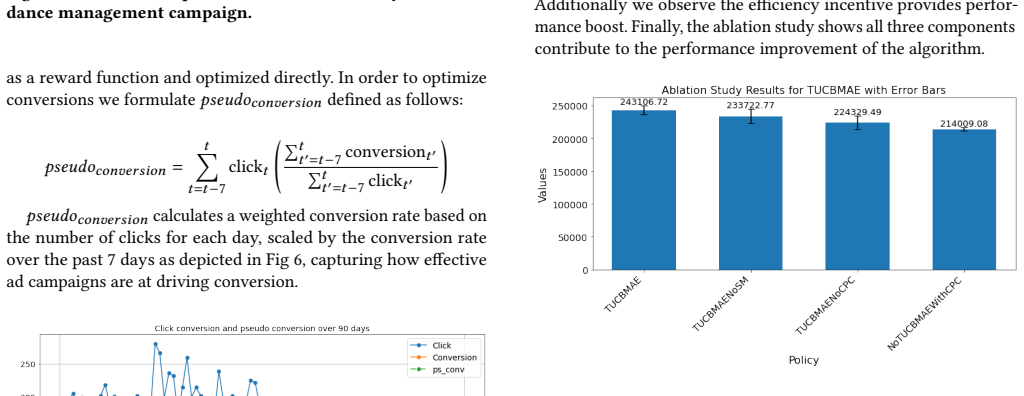
Significance. The practical contribution is real: the paper ships a publicly available simulator driven by logged campaign data, evaluates on multiple campaign types, and includes an ablation study showing the contribution of each algorithmic component. The empirical comparisons are internally consistent and the design of a non-stationary, combinatorial-bandit budget allocator with change-point detection is a useful engineering contribution. If the theoretical guarantees were valid, the method would also be of theoretical interest. However, the paper's headline theoretical claim — sublinear regret with a reduced bound from targeted exploration — is not established. The proof contains a concrete mathematical error in the union bound, and the regret-reduction argument is not a derivation. These flaws undermine the central theoretical contribution, which the paper explicitly touts as one of its three main contributions.
major comments (3)
- [§8.2 (Appendix), union-bound step] The union bound used to construct the high-probability event is invalid. With β_{j,t} = 2k_j log(π²NMt²/(3δ)) and k_j = (1-θ_j) ∈ (0,1], the bound becomes Σ_{t=1}^T Σ_{j=1}^N M e^{-β_{j,t}/2} = Σ_{j=1}^N M (3δ/(π²NM))^{k_j} Σ_{t=1}^T t^{-2k_j}. The series Σ t^{-2k_j} diverges for k_j ≤ 1/2 (in particular for campaigns with normalized CPC θ_j ≥ 1/2), and even for 1/2 < k_j < 1 it is not bounded by the claimed (6/π²)Σ 1/t² with the same constants. Since k_j is not restricted to values ≥ 1/2, the series cannot be uniformly bounded by δ/2, and the event that all GP upper-confidence bounds hold does not hold with probability 1−δ. The subsequent inequality R_T(U) ≤ ... therefore does not follow.
- [§6, Proposition 6.2 and §8.2] The claimed reduction R_T(U+) ≤ R_T(U) from restricting exploration to X+_j is not derived. The inequality γ_T(n_j, X+_j) ≤ γ_T(n_j) is a trivial property of information gain on a subset; it holds for any subset and does not by itself bound regret. A regret bound for the restricted algorithm requires that the optimal super-arm lie in the restricted action set, or a quantified cost for excluding it. Under the total budget constraint (1b), the optimal allocation can assign a sub-campaign a budget below its current b_{j,max}; Assumption 3 (monotone, concave per-campaign rewards) does not prevent such lower budgets from being part of the optimal super-arm. Excluding them from exploration can therefore cause linear regret, so the claimed reduction is unsupported and potentially false.
- [§6, Eq. (6)-(7) and §8.2] The proof conflates the true reward function n_j with the GP estimate ˆn_j. Assumption 3 imposes monotonicity and concavity on n_j, but the regret analysis in Lemma 6.1 applies to the GP posterior on ˆn_j; the GP estimate with a saturating mean is not shown to be monotone. Moreover, b_{j,max} is defined in the algorithm as the budget level with highest predicted reward, but the proof does not define how this quantity is updated over time nor why it is a valid surrogate for the minimizer of the information-gain regret bound. A rigorous proof would need to couple the evolution of b_{j,max} with the exploration decisions; none is given.
minor comments (5)
- [§5, Simulation Environment] The simulator models the reward as a power law n_j(x) = α_c x^{ω_c} + ε with parameters fitted to logged data, and the cost is drawn from a truncated normal. The paper's phrase "multiple real-world campaigns" should be clarified: the campaign data are logged, but the rewards are synthesized through this fitted power-law model rather than observed from real platform feedback.
- [§8.2, reference numbering] The proof refers to "Lemma 5.6 of [35]" in the main text (Section 6) but to "Lemma 5.3 in [35]" in the Appendix; the reference number should be made consistent.
- [§8.2 and Table 3, notation M] The symbol M is used both as the number of possible budget combinations (Table 3) and as the per-campaign action-set size in the union-bound sum ("for each action a∈D"). This ambiguity affects the readability of the proof; the authors should distinguish the cardinality of the per-campaign action set from the number of super-arms.
- [§7, Figure 5 discussion] The text notes that the algorithm is unable to adapt to a very short non-stationary change around day 250. This is a real limitation and should be discussed in the conclusion rather than as a one-line remark, since it bears on the method's practical robustness.
- [§7.3, Table 2] In the Criteo experiment the proposed method is compared only to UCBGP and TSGP without change-point detection; the absence of non-stationarity in this dataset means the comparison tests only the targeted-UCB and saturating-mean components. The caption should state this scope explicitly.
Circularity Check
No significant circularity: the regret bound and empirical claims are not baked into the inputs; the main issues are proof gaps, not circular dependencies.
full rationale
The paper's central theoretical claim follows the standard GP-UCB template of Srinivas et al. [35], with the exploration parameter β_{j,t} chosen via a union bound and the regret bound expressed in terms of total information gain γ_T. The targeted exploration argument then tries to show that restricting exploration to budgets above b_{j,max} reduces γ_T and hence regret. None of these steps defines the conclusion in terms of itself: the high-probability event, the information-gain bound, and the monotonicity argument are all separate mathematical assertions rather than restatements of the theorem being proved. The serious problem identified by the skeptic — that the union bound ∑_t e^{-β_{j,t}/2} = ∑_t (3δ/(π^2 N M t^2))^{k_j} diverges for k_j < 1 — is a correctness gap in the proof, not a circularity: the theorem's conclusion is not assumed in the inputs; rather, the derivation fails at a technical step. Similarly, the claim γ_T(𝑈, X^+_j) ≤ γ_T(𝑈) may be unjustified or false, but it is not an instance of fitting a parameter to the target result and then announcing it as a prediction. The simulation environment uses power-law reward functions fitted to logged real-world business data, which is external to the algorithm, and the empirical comparison against an oracle and multiple baselines is not constructed from the proposed method's own outputs. The paper does cite prior work for standard assumptions (e.g., monotone concave rewards from [17, 19]), but those citations are external publications, not self-citations, and they do not smuggle in the paper's central claim. Overall, the weaknesses are mathematical rigor and empirical scope, not circular derivation.
Assumptions & free parameters
free parameters (8)
- beta (exploration factor) =
100, 2, 100, 2, 50 per campaign group (Table 5)
- tau (change detection threshold) =
10, 4, 4, 10, 10 per campaign group (Table 5)
- alpha_c, omega_c (simulator power-law reward parameters) =
Estimated per sub-campaign from logged data via curve fitting (Eq 5)
- epsilon noise standard deviation =
0.1
- window length for change detection =
7 days
- T_p (minimum stationary phase length) =
20 days
- B (budget discretization granularity) =
500
- RBF kernel lengthscale l =
1.0
assumptions (7)
- domain assumption Assumption 1: known minimum change magnitude tau for each sub-campaign reward shift
- domain assumption Assumption 2: minimum phase length T_p between breakpoints
- domain assumption Assumption 3: reward function n_j(x) is smooth, monotone increasing, and concave (n'>0, n''<0)
- domain assumption Rewards are a realization of a Gaussian process with RBF kernel
- ad hoc to paper Simulator reward model follows a power law n_j(x)=alpha_c * x^{omega_c} + epsilon
- ad hoc to paper Daily cost is drawn from a truncated normal with mean b_{j,t} and upper bound 2*b_{j,t}
- standard math GP-UCB confidence lemma from Srinivas et al. 2010 (Lemma 6.1)
Cite this review
Pith. "Pith review of Adaptive Budget Optimization for Multichannel Advertising Using Combinatorial Bandits." pith.science (2026). https://pith.science/paper/ATRA3WL7
@misc{pith2026250202920,
  author       = {Pith},
  title        = {Pith review of: Adaptive Budget Optimization for Multichannel Advertising Using Combinatorial Bandits},
  year         = {2026},
  howpublished = {\url{https://pith.science/paper/ATRA3WL7}},
  note         = {Machine review of arXiv:2502.02920}
}
read the original abstract
Effective budget allocation is crucial for optimizing the performance of digital advertising campaigns. However, the development of practical budget allocation algorithms remain limited, primarily due to the lack of public datasets and comprehensive simulation environments capable of verifying the intricacies of real-world advertising. While multi-armed bandit (MAB) algorithms have been extensively studied, their efficacy diminishes in non-stationary environments where quick adaptation to changing market dynamics is essential. In this paper, we advance the field of budget allocation in digital advertising by introducing three key contributions. First, we develop a simulation environment designed to mimic multichannel advertising campaigns over extended time horizons, incorporating logged real-world data. Second, we propose an enhanced combinatorial bandit budget allocation strategy that leverages a saturating mean function and a targeted exploration mechanism with change-point detection. This approach dynamically adapts to changing market conditions, improving allocation efficiency by filtering target regions based on domain knowledge. Finally, we present both theoretical analysis and empirical results, demonstrating that our method consistently outperforms baseline strategies, achieving higher rewards and lower regret across multiple real-world campaigns.
Figures


Figures from the paper (4 more)



Reference graph
Works this paper leans on
-
[1]
About average daily budgets - Google Ads Help — support.google.com
[n.d.]. About average daily budgets - Google Ads Help — support.google.com. https://support.google.com/google-ads/answer/6385083?hl=en. [Accessed 11- 09-2024]
-
[2]
Vashist Avadhanula, Riccardo Colini Baldeschi, Stefano Leonardi, Karthik Abinav Sankararaman, and Okke Schrijvers. 2021. Stochastic bandits for multi-platform budget optimization in online advertising. In Proceedings of the Web Conference
work page 2021
-
[3]
Abraham Bagherjeiran, Nemanja Djuric, Kuang-Chih Lee, Linsey Pang, Vladan Radosavljevic, and Suju Rajan. 2024. AdKDD 2024. In Proceedings of the 30th ACM SIGKDD Conference on Knowledge Discovery and Data Mining (Barcelona, Spain) (KDD ’24). Association for Computing Machinery, New York, NY, USA, 6706–6707. https://doi.org/10.1145/3637528.3671476
arXiv 2024
-
[4]
Omar Besbes, Yonatan Gur, and Assaf Zeevi. 2014. Stochastic multi-armed-bandit problem with non-stationary rewards. Advances in neural information processing systems 27 (2014)
work page 2014
-
[5]
Yang Cao, Zheng Wen, Branislav Kveton, and Yao Xie. 2019. Nearly optimal adaptive procedure with change detection for piecewise-stationary bandit. In The 22nd International Conference on Artificial Intelligence and Statistics . PMLR, 418–427
work page 2019
-
[6]
Emanuele Cavenaghi, Gabriele Sottocornola, Fabio Stella, and Markus Zanker
-
[7]
Wei Chen, Yajun Wang, and Yang Yuan. 2013. Combinatorial Multi-Armed Bandit: General Framework and Applications. In Proceedings of the 30th Interna- tional Conference on Machine Learning (Proceedings of Machine Learning Research, Vol. 28), Sanjoy Dasgupta and David McAllester (Eds.). PMLR, Atlanta, Georgia, USA, 151–159. https://proceedings.mlr.press/v28/...
work page 2013
-
[8]
Vincenzo D’Elia. 2019. On the causality of advertising. http://papers.adkdd. org/2019/invited-talks/slides-adkdd19-delia-causality.pdf. [Online; accessed September-2024]
work page 2019
Show all 36 references
-
[9]
Qiyuan Deng, Kejia Hu, and Yun Fong Lim. 2023. Cross-Channel Marketing on E-commerce Marketplaces: Impact and Strategic Budget Allocation. A vailable at SSRN 4332631 (2023)
2023
-
[10]
Yuan Deng, Negin Golrezaei, Patrick Jaillet, Jason Cheuk Nam Liang, and Vahab Mirrokni. 2023. Multi-channel autobidding with budget and ROI constraints. In Proceedings of the 40th International Conference on Machine Learning (Honolulu, Hawaii, USA) (ICML’23). JMLR.org, Article...
2023
-
[11]
Eustache Diemert, Julien Meynet, Pierre Galland, and Damien Lefortier. 2017. Attribution modeling increases efficiency of bidding in display advertising. In Proceedings of the ADKDD’17 . 1–6
2017
-
[12]
Diemert Eustache, Meynet Julien, Pierre Galland, and Damien Lefortier. 2017. Attribution Modeling Increases Efficiency of Bidding in Display Advertising. In Proceedings of the AdKDD and TargetAd Workshop, KDD, Halifax, NS, Canada, August, 14, 2017. ACM, To appear
2017
-
[13]
Paul W Farris, Dominique M Hanssens, James D Lenskold, and David J Reib- stein. 2015. Marketing return on investment: Seeking clarity for concept and measurement. Applied Marketing Analytics 1, 3 (2015), 267–282
2015
-
[14]
Marco Fiandri, Alberto Maria Metelli, and Francesco Trovò. 2024. Sliding- Window Thompson Sampling for Non-Stationary Settings. arXiv preprint arXiv:2409.05181 (2024)
2024 arXiv
-
[15]
Aurélien Garivier and Eric Moulines. 2011. On upper-confidence bound policies for switching bandit problems. In International conference on algorithmic learning theory. Springer, 174–188
2011
-
[17]
Marco Gigli and Fabio Stella. 2024. Multi-armed bandits for performance mar- keting. International Journal of Data Science and Analytics (2024), 1–15
2024
-
[18]
Benjamin Han and Carl Arndt. 2021. Budget allocation as a multi-agent system of contextual & continuous bandits. In Proceedings of the 27th ACM SIGKDD Conference on Knowledge Discovery & Data Mining . 2937–2945
2021
-
[20]
Benjamin Han and Jared Gabor. 2020. Contextual bandits for advertising budget allocation. Proceedings of the ADKDD 17 (2020)
2020
-
[21]
EM Italia, A Nuara, Francesco Trovò, Marcello Restelli, N Gatti, E Dellavalle, et al. 2017. Internet advertising for non-stationary environments. In Proceedings of the International Workshop on Agent-Mediated Electronic Commerce . 1–15
2017
-
[22]
Hans Kellerer, Ulrich Pferschy, David Pisinger, Hans Kellerer, Ulrich Pferschy, and David Pisinger. 2004. The multiple-choice knapsack problem. Knapsack problems (2004), 317–347
2004
-
[23]
Randall Lewis and Jeffrey Wong. 2022. Incrementality bidding and attribution. arXiv preprint arXiv:2208.12809 (2022)
2022 arXiv
-
[24]
Fang Liu, Joohyun Lee, and Ness Shroff. 2018. A change-detection based frame- work for piecewise-stationary multi-armed bandit problem. In Proceedings of the AAAI Conference on Artificial Intelligence , Vol. 32
2018
-
[26]
Phuong Ha Nguyen, Djordje Gligorijevic, Arnab Borah, Gajanan Adalinge, and Abraham Bagherjeiran. 2023. Practical Budget Pacing Algorithms and Simulation Test Bed for eBay Marketplace Sponsored Search.. In AdKDD@ KDD
2023
-
[27]
Alessandro Nuara, Francesco Trovò, Nicola Gatti, and Marcello Restelli. 2018. A Combinatorial-Bandit Algorithm for the Online Joint Bid/Budget Optimiza- tion of Pay-per-Click Advertising Campaigns. In AAAI Conference on Artificial Intelligence. https://api.semanticscholar.org/...
2018
-
[28]
Alessandro Nuara, Francesco Trovò, Nicola Gatti, and Marcello Restelli. 2022. Online joint bid/daily budget optimization of internet advertising campaigns. Artificial Intelligence 305 (2022), 103663
2022
-
[29]
PwC. 2021. IAB_PwC_Internet_Ad_Revenue_Report_2021. https: //www.iab.com/wp-content/uploads/2022/04/IAB_Internet_Advertising_ Revenue_Report_Full_Year_2021.pdf. [Accessed 26-08-2024]
2021
-
[30]
PwC. 2024. IAB_PwC_Internet_Ad_Revenue_Report_2024. https: //www.iab.com/wp-content/uploads/2024/04/IAB_PwC_Internet_Ad_ Revenue_Report_2024.pdf. [Accessed 26-08-2024]
2024
-
[31]
Arvind Rangaswamy and Gerrit H Van Bruggen. 2005. Opportunities and chal- lenges in multichannel marketing: An introduction to the special issue. Journal of interactive marketing 19, 2 (2005), 5–11
2005
-
[32]
Gerlando Re, Fabio Chiusano, Francesco Trovò, Diego Carrera, Giacomo Bo- racchi, and Marcello Restelli. 2021. Exploiting history data for nonstationary multi-armed bandit. In Machine Learning and Knowledge Discovery in Databases. Research Track: European Conference, ECML PKDD ...
2021
-
[33]
Gerlando Re, Fabio Chiusano, Francesco Trovò, Diego Carrera, Giacomo Boracchi, and Marcello Restelli. 2021. Exploiting History Data for Nonstationary Multi- armed Bandit. Springer-Verlag, Berlin, Heidelberg, 51–66. https://doi.org/10. 1007/978-3-030-86486-6_4
2021
-
[34]
Eric Schulz, Maarten Speekenbrink, and Andreas Krause. 2018. A tutorial on Gaussian process regression: Modelling, exploring, and exploiting functions. Journal of mathematical psychology 85 (2018), 1–16
2018
-
[35]
Niranjan Srinivas, Andreas Krause, Sham Kakade, and Matthias Seeger. 2010. Gaussian process optimization in the bandit setting: no regret and experimental design. In Proceedings of the 27th International Conference on International Con- ference on Machine Learning (Haifa, Isra...
2010
-
[36]
Francesco Trovo, Stefano Paladino, Marcello Restelli, and Nicola Gatti. 2020. Sliding-window thompson sampling for non-stationary settings. Journal of Artificial Intelligence Research 68 (2020), 311–364
2020
-
[37]
Xingfu wang, Pengcheng Li, and Ammar Hawbani. 2018. An Efficient Budget Allocation Algorithm for Multi-Channel Advertising. In 2018 24th International Conference on Pattern Recognition (ICPR) . 886–891. https://doi.org/10.1109/ICPR. 2018.8545777
2018
-
[38]
Haifeng Zhang and Yevgeniy Vorobeychik. 2017. Multi-channel marketing with budget complementarities. In International Conference on Autonomous Agents and Multiagent Systems. APPENDIX 8.1 Summary of Notations Notation Description 𝛽𝑗,𝑡 Exploration parameter for campaign 𝑗 at tim...
2017
-
[2021]
Entropy 23, 3 (2021), 380
Non stationary multi-armed bandit: Empirical evaluation of a new concept drift-aware algorithm. Entropy 23, 3 (2021), 380
2021
Reviewed August 9, 2026 · model on record in the stance chip above.
Discussion (0). Continue with ORCID to comment.