REVIEW 3 major objections 3 minor 71 references
Observation of slow relaxation due to Hilbert space fragmentation in strongly interacting Bose-Hubbard chains
T0 review · 3 major / 3 minor · reviewed 2026-08-09 · deepseek-v4-flash
Pith's one-line read A 1D Bose-Hubbard chain with strong interactions and no disorder or tilt exhibits slow relaxation because the numbers of doublons and singlons are emergent conserved quantities that fragment the Hilbert space.
desk verdict A careful experiment with solid controls, but the claim that the slow relaxation indicates Hilbert space fragmentation is not uniquely supported; ordinary large-U dynamics with singlon-assisted transport explains the data just as well. read the letter →
The pith
A machine-rendered reading of the paper's core claim, the machinery that carries it, and where it could break.
The reading
What carries the argument
The load-bearing object is the one-dimensional Bose-Hubbard Hamiltonian $$\hat H = -J \sum_{\langle i,j\rangle} \hat a_i^\dagger \hat a_j + \frac{U}{2} \sum_i \hat n_i(\hat n_i-1) + \sum_i V_i \hat n_i$$ with a weak parabolic trap $V_i = \Omega[i-(M+1)/2]^2$ and no tilt. Around this Hamiltonian the paper organizes a state-preparation sequence that produces the doublon CDW, a singlon/doublon-resolved measurement based on photoassociation and band mapping, and an effective description in which doublons hop with amplitude $J_{\mathrm{eff}} = 2J^2/U$. In the large-$U$ limit the doublon-holon system is mapped to spin-1/2 particles with a nearest-neighbor interaction, which is used to explain why doublons relax even more slowly than non-interacting hard-core bosons; time-evolving block decimation with matrix-product states supplies the numerical reference curves.
What would settle it
A decisive check is to measure $n_D$ and $I_D$ at holding times beyond about 20 tunneling times while suppressing transverse hopping with a deeper lattice along the perpendicular directions; if $n_D$ decays measurably or $I_D$ crosses zero within that window, the conserved quantities are only transient and the slowdown is a prethermal effect rather than Hilbert space fragmentation. Alternatively, a numerical count of Krylov sectors for the Hamiltonian in Eq. (2) at $U/J \simeq 67$ would settle the mechanism: if the number of sectors does not grow exponentially with chain length, the parabolic trap, not fragmentation, is responsible for the slow relaxation.
Extended reading notes
Core claim
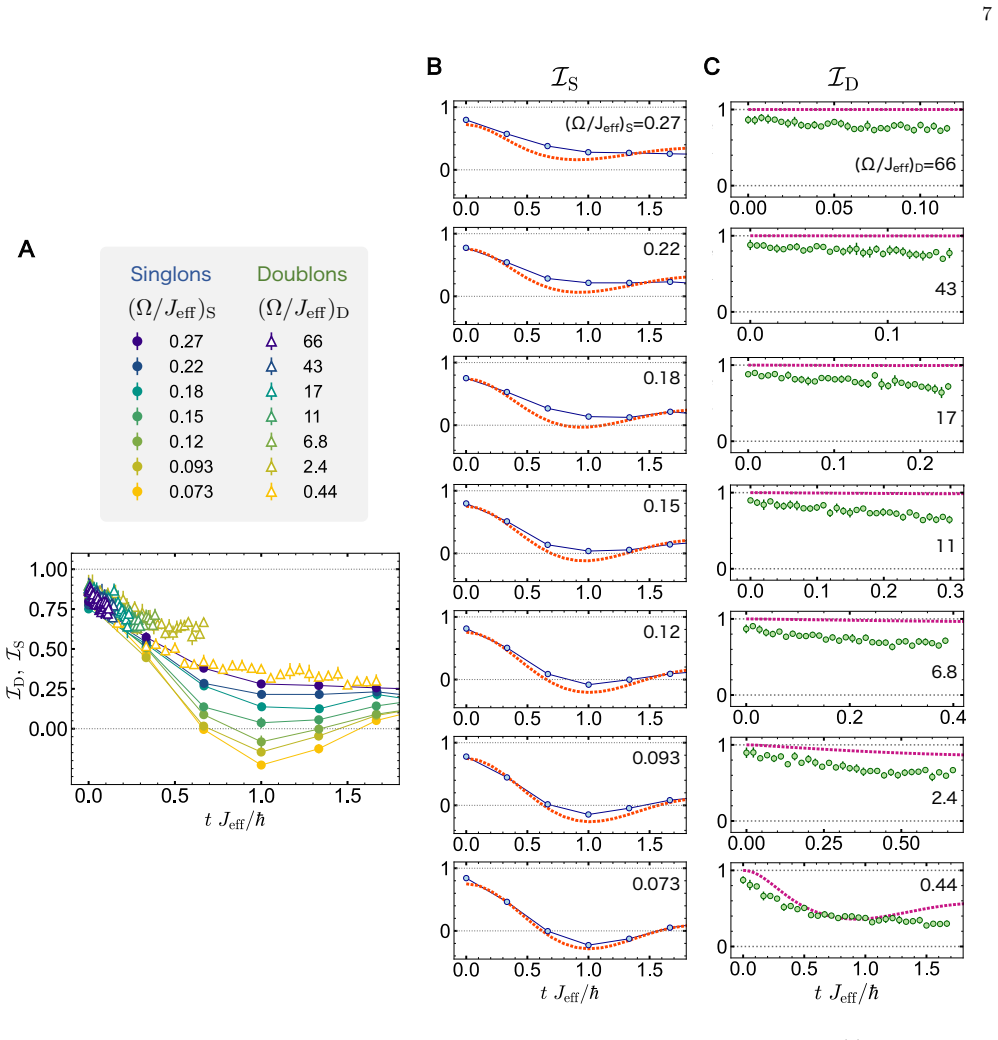
The central claim is that in the one-dimensional Bose-Hubbard model at $U/J \gg 1$, the total numbers of doublons and singlons are emergent conserved quantities, and these conserved quantities fragment the Hilbert space into an exponentially large number of Krylov subsectors (the disjoint state spaces generated by repeatedly applying the Hamiltonian). Starting from a period-two doublon charge-density wave $|\cdots2020\cdots\rangle$ (with a 25--30% singlon admixture), the dynamics should therefore be restricted to a tiny fragment of the Hilbert space: doublons cannot dissociate into singlons because the process $|2,0\rangle \leftrightarrow |1,1\rangle$ costs energy $U$, while singlons can still tunnel freely. The experiment reports that the doublon imbalance relaxes slowly and remains nonzero for hold times up to roughly ten tunneling times, whereas the singlon imbalance relaxes rapidly; concurrently $n_D$ and $n_S$ stay almost constant. Removing part of the initial singlon population slows the doublon relaxation further, confirming that singlons act as the main agent of equilibration. The paper takes this as experimental confirmation that the conserved quantities responsible for Hilbert space fragmentation exist in a disorder-free, untilted bosonic system.
Load-bearing premise
The experiment assumes that the superlattice merging procedure actually creates a period-two doublon charge-density wave and that photoassociation-based detection cleanly separates singlons from doublons; if either fails, the apparent conservation of n_D and n_S would not be evidence for Hilbert space fragmentation.
Editorial extensions
If this is right
- In a clean, untilted bosonic chain, strong interactions alone are enough to keep the system out of thermal equilibrium for tens of tunneling times, so Hilbert space fragmentation is a real physical mechanism rather than a tilt- or disorder-induced artifact.
- The conserved doublon and singlon numbers protect the doublon CDW: dissociation $|2,0\rangle \to |1,1\rangle$ is kinematically forbidden at large $U/J$.
- The relaxation of the doublon imbalance is controlled by the singlon population, so reducing singlon contamination makes the nonergodic behavior sharper and lengthens the relaxation time.
- The singlon/doublon-resolved imbalance protocol can be applied to other composite-particle dynamics in optical lattices, including pair superfluids, $\eta$-pairing states, and bosonic many-body scars.
- Because the kinetic constraint comes from the interaction rather than the trap, the fragmentation picture is not tied to a particular system size or to the specific parabolic potential used in the experiment.
Reading between the lines
- If the fragmentation is genuine, the asymptotic doublon imbalance in the pure-doublon limit ($n_S \to 0$, $U/J \to \infty$) should saturate at a nonzero value controlled by the parabolic trap; measuring the imbalance at much longer hold times under stronger transverse confinement would test this directly.
- The singlon-assisted relaxation suggests a defect-controlled picture in which the equilibration time scales with the inverse singlon density; plotting the doublon relaxation time against $n_S$ across the accessible range could expose a power law and distinguish fragmentation from a simple prethermal plateau.
- The same PA-based species-resolved imbalance technique could be carried over to tilted Fermi-Hubbard chains to separate the conserved dipole-moment sector (tilt-induced) from interaction-induced doublon-number sectors, since both give slow relaxation but with different selection rules.
- A cleaner test of Hilbert space fragmentation would be to analyse the level statistics or sector decomposition of the Hamiltonian in Eq. (2) numerically: if the number of Krylov sectors grows only polynomially with chain length, the slow relaxation is more naturally attributed to the trap than to fragmentation.
Editorial analysis
A structured set of objections, weighed in public.
Referee Report
Summary. The manuscript reports ultracold-atom experiments on strongly interacting 174Yb bosons in 1D optical lattices. Starting from an approximate period-two charge-density wave of doublons (with 25-30% singlon contamination), the authors suddenly quench the lattice depth and measure, using photoassociation-based removal, the time-resolved imbalances of doublons and singlons separately. They observe that the doublon imbalance relaxes slowly and the singlon imbalance rapidly, that the fractions of atoms in doublons and singlons stay nearly constant, that doublon relaxation slows with increasing U/J, and that partial removal of singlons slows the doublon relaxation. TEBD calculations of the Bose-Hubbard model with a parabolic trap reproduce the main trends. The authors interpret the near-conservation of doublon and singlon numbers as evidence for Hilbert-space fragmentation and conclude that this mechanism causes the observed slow relaxation.
Significance. If the attribution to Hilbert-space fragmentation were established, this would be a noteworthy experimental demonstration of an emergent conserved quantity in a disorder-free and untilted 1D Bose-Hubbard system. The paper has concrete strengths: the observables are direct and species-resolved, with error bars based on multiple scans; the comparison between doublon-CDW and singlon-CDW initial states is a useful control; the U/J scan and partial-singlon-removal experiment provide parameter dependence in the expected direction; and the TEBD comparisons give an honest account of quantitative disagreement. However, the specific signatures that would distinguish Hilbert-space fragmentation from generic large-U dynamics are not isolated, and the main interpretive claim is therefore underdetermined by the presented data.
major comments (3)
- [Results: Typical quench dynamics, Fig. 1F and Fig. 2E] The near-conservation of nD and nS is presented as the key evidence for HSF ('strongly supports the occurrence of HSF'). This inference is not valid: for the Hamiltonian in Eq. (2), every process that changes nD or nS, such as |20> <-> |11>, is off-resonant by an energy U. The probability of such a process during one tunneling attempt is of order (J/U)^2, so after tJ/hbar = 10 at U/J = 67 the expected change in nD and nS is about 10(J/U)^2, i.e., 2x10^-3, far below the experimental resolution. A large-U Bose-Hubbard model with no fragmentation whatsoever would show exactly the same flat nD and nS curves. The measurement of nD and nS conservation is therefore necessary but not sufficient for the HSF claim.
- [Results: Competition among doublon-doublon interactions, doublon-singlon interactions, and a parabolic trap, Figs.] The relaxation of the doublon imbalance that the authors attribute to fragmentation is, on their own analysis, driven by the resonant doublon-singlon swap |2,1> <-> |1,2> (Fig. 4A), a process that conserves nD and nS exactly and has amplitude J rather than J^2/U. Since the initial state contains 25-30% singlons, this process allows doublons to be transported and ID to decay on a few-hbar/J time scale, as the authors use it to explain why the observed doublon dynamics is faster than the noninteracting hardcore-boson prediction in Fig. 3C. Thus the simultaneous observations that nD and nS are flat while ID decays slowly are fully consistent with ordinary large-U dynamics with singlon-assisted transport; they do not single out fragmentation. A fragmentation-specific observable, such as the conservation of the number of doublons in each interval between holes, or a plateau of ID at times long compared with all second-order processes, would be required.
- [Discussion and observation window] The observation window ends at tJ/hbar = 10, which is comparable to or shorter than the transport time of a singlon across the roughly 25-site chains and much shorter than the second-order doublon-hopping time hbar/(2J^2/U) at the largest U/J. The data show a slow decay of ID but no clear separation of time scales and no long-time plateau that would indicate restriction to a Krylov sector. Without a longer-time measurement or an order-sensitive probe, the observed slow relaxation can be accounted for by the small effective doublon mobility and the doublon-doublon interaction in Eq. (8), both of which are generic strong-coupling effects rather than fragmentation signatures. The claim in the Discussion that the inter-tube hopping is the limiting time scale should be supported by an explicit estimate of the expected fragmentation plateau value and relaxation time, and why the present window suffices.
minor comments (3)
- [Fig. 1D caption and main text] The caption of Fig. 1D states U/J = 52, while the main text description of the same panel states U/J = 67; please correct this inconsistency.
- [Eqs. (5) and (6)] The definitions nS = Nw/PA / Nw/oPA and nD = (Nw/oPA - Nw/PA) / Nw/oPA are fractions of the total atom number, not absolute numbers; the text sometimes refers to them as the 'numbers' of singlons and doublons, which is imprecise.
- [Supplementary Sec. S5] The initial-state simulation protocol determines beta and mu by matching Ntot and Ndoublon for the CDW(d) case, but for the CDW(s) case beta is simply assumed to be betaER = 20 rather than determined from data; the sensitivity of the TEBD comparisons to this assumption should be stated.
Circularity Check
No significant circularity: the conserved fractions and slow relaxation are directly measured; the coauthored prediction of Ref. [54] is independently tested rather than used to force the result.
full rationale
Walking the derivation chain, the central claims are experimental measurements, not outputs of a fitted or self-referential model. The singlon/doublon fractions are defined by direct photoassociation-resolved atom counts, Eqs. (5)-(6), and the imbalances are defined by site- and band-mapped atom numbers, Eqs. (3)-(4); the near-conservation of nD and nS and the slow doublon relaxation reported in Figs. 1E-F and 2 are raw data. The TEBD calculations (Sec. 'Comparison between experiments and numerical calculations' and Sec. S.5) evolve the first-principles Bose-Hubbard Hamiltonian Eq. (2) with parameters obtained from Wannier functions and the measured scattering length (Sec. S.3). The only calibrated inputs are the temperature and central chemical potential of the initial Mott state, fixed by the measured total atom number and initial doublon number via Eqs. (S13)-(S14); these do not encode the predicted imbalance curves or the conserved-fraction result. The theoretical expectation of nonergodic doublon-CDW dynamics is cited to Ref. [54], whose authors (Kunimi and Danshita) are coauthors of this work; however, that reference is a prior prediction being tested by an independent experiment, and the HSF concept itself is anchored in external references (Refs. [43-50]). The skeptical objection that flat nD/nS over about 10 hbar/J is also compatible with ordinary large-U dynamics is a legitimate concern about discriminative power, but it is not a circular reduction: the paper does not fit the conserved fractions and then present the fit as a prediction. No equation or parameter in the paper makes the claimed conclusion equivalent to its input by construction.
Assumptions & free parameters
free parameters (2)
- Inverse temperature beta/E_R =
20.1 (for rho_CDW(d,s) case)
- Chemical potential mu_ctr/E_R =
0.326 (for rho_CDW(d,s) case)
assumptions (4)
- domain assumption The system is described by the 1D Bose-Hubbard model of Eq. (2) with a parabolic trap and negligible coupling to other chains during the observation window.
- domain assumption In the U >> J regime the numbers of doublons and singlons are emergent conserved quantities that fragment the Hilbert space, as predicted in Ref. [54].
- domain assumption The photoassociation (PA) resonance selectively removes doublons without affecting singlons, and the band-mapping and site-mapping procedure faithfully converts site occupancies to momentum bands.
- domain assumption The initial state preparation via the superlattice produces the period-two CDW of doublons with single-site occupancy defects, and the temperature and chemical potential of the intermediate Mott state are inferred from a thermal model.
Cite this review
Pith. "Pith review of Observation of slow relaxation due to Hilbert space fragmentation in strongly interacting Bose-Hubbard chains." pith.science (2026). https://pith.science/paper/2A4SL34P
@misc{pith2026250202959,
  author       = {Pith},
  title        = {Pith review of: Observation of slow relaxation due to Hilbert space fragmentation in strongly interacting Bose-Hubbard chains},
  year         = {2026},
  howpublished = {\url{https://pith.science/paper/2A4SL34P}},
  note         = {Machine review of arXiv:2502.02959}
}
read the original abstract
While isolated quantum systems generally thermalize after long-time evolution, there are several exceptions defying thermalization. A notable mechanism of such nonergodicity is the Hilbert space fragmentation (HSF), where the Hamiltonian matrix splits into an exponentially large number of sectors due to the presence of nontrivial conserved quantities. Using ultracold gases, here we experimentally investigate the one-dimensional Bose-Hubbard system with neither disorder nor tilt potential, which has been predicted to exhibit HSF caused by a strong interatomic interaction. Specifically, we analyze far-from-equilibrium dynamics starting from a charge-density wave of doublons (atoms in doubly occupied sites) in a singlon and doublon-resolved manner to reveal a slowing-down of the relaxation in a strongly interacting regime. We find that the numbers of singlons and doublons are conserved during the dynamics, indicating HSF as a mechanism of the observed slow relaxation. Our results provide an experimental confirmation of the conserved quantities responsible for HSF.
Figures


Figures from the paper (1 more)

Reference graph
Works this paper leans on
-
[1]
J. M. Deutsch, Quantum statistical mechanics in a closed system, Phys. Rev. A 43, 2046 (1991)
1991
-
[2]
Srednicki, Chaos and quantum thermalization, Phys
M. Srednicki, Chaos and quantum thermalization, Phys. Rev. E 50, 888 (1994)
1994
-
[3]
Rigol, V
M. Rigol, V. Dunjko, and M. Olshanii, Thermalization and its mechanism for generic isolated quantum systems, Nature 452, 854 (2008)
2008
-
[4]
J. M. Deutsch, Eigenstate thermalization hypothesis, Re- ports on Progress in Physics 81, 082001 (2018)
2018
-
[5]
D’Alessio, Y
L. D’Alessio, Y. Kafri, A. Polkovnikov, and M. Rigol, From quantum chaos and eigenstate thermalization to statistical mechanics and thermodynamics, Advances in Physics 65, 239 (2016)
2016
-
[6]
T. Mori, T. N. Ikeda, E. Kaminishi, and M. Ueda, Thermalization and prethermalization in isolated quan- tum systems: a theoretical overview, Journal of Physics B: Atomic, Molecular and Optical Physics 51, 112001 (2018)
2018
-
[7]
Kinoshita, T
T. Kinoshita, T. Wenger, and D. S. Weiss, A quantum newton’s cradle, Nature 440, 900 (2006)
2006
-
[8]
Rigol, V
M. Rigol, V. Dunjko, V. Yurovsky, and M. Olshanii, Re- laxation in a completely integrable many-body quantum system: An ab initio study of the dynamics of the highly excited states of 1d lattice hard-core bosons, Phys. Rev. Lett. 98, 050405 (2007)
2007
Show all 71 references
-
[9]
Rigol, Breakdown of thermalization in finite one- dimensional systems, Phys
M. Rigol, Breakdown of thermalization in finite one- dimensional systems, Phys. Rev. Lett. 103, 100403 (2009)
2009
-
[10]
Rigol, Quantum quenches and thermalization in one- dimensional fermionic systems, Phys
M. Rigol, Quantum quenches and thermalization in one- dimensional fermionic systems, Phys. Rev. A 80, 053607 (2009)
2009
-
[11]
A. C. Cassidy, C. W. Clark, and M. Rigol, Generalized thermalization in an integrable lattice system, Phys. Rev. Lett. 106, 140405 (2011)
2011
-
[12]
Vidmar and M
L. Vidmar and M. Rigol, Generalized gibbs ensemble in integrable lattice models, Journal of Statistical Mechan- ics: Theory and Experiment 2016, 064007 (2016)
2016
-
[13]
I. V. Gornyi, A. D. Mirlin, and D. G. Polyakov, Interact- ing electrons in disordered wires: Anderson localization and low-t transport, Phys. Rev. Lett. 95, 206603 (2005)
2005
-
[14]
D. M. Basko, I. L. Aleiner, and B. L. Altshuler, Metal– insulator transition in a weakly interacting many-electron system with localized single-particle states, Annals of physics 321, 1126 (2006)
2006
-
[15]
D. A. Huse, R. Nandkishore, and V. Oganesyan, Phe- nomenology of fully many-body-localized systems, Phys. Rev. B 90, 174202 (2014)
2014
-
[16]
Altman and R
E. Altman and R. Vosk, Universal dynamics and renor- malization in many-body-localized systems, Annu. Rev. Condens. Matter Phys. 6, 383 (2015)
2015
-
[17]
Nandkishore and D
R. Nandkishore and D. A. Huse, Many-body localiza- tion and thermalization in quantum statistical mechan- ics, Annu. Rev. Condens. Matter Phys. 6, 15 (2015)
2015
-
[18]
Schreiber, S
M. Schreiber, S. S. Hodgman, P. Bordia, H. P. L¨ uschen, M. H. Fischer, R. Vosk, E. Altman, U. Schneider, and I. Bloch, Observation of many-body localization of inter- acting fermions in a quasirandom optical lattice, Science 349, 842 (2015)
2015
-
[19]
J.-y. Choi, S. Hild, J. Zeiher, P. Schauß, A. Rubio- Abadal, T. Yefsah, V. Khemani, D. A. Huse, I. Bloch, and C. Gross, Exploring the many-body localization transition in two dimensions, Science 352, 1547 (2016)
2016
-
[20]
Sierant, D
P. Sierant, D. Delande, and J. Zakrzewski, Many-body localization due to random interactions, Phys. Rev. A 11 95, 021601 (2017)
2017
-
[21]
Sierant, D
P. Sierant, D. Delande, and J. Zakrzewski, Many-body localization for randomly interacting bosons, Acta Phys. Polon. A 132, 1707 (2017)
2017
-
[22]
H. P. L¨ uschen, P. Bordia, S. Scherg, F. Alet, E. Alt- man, U. Schneider, and I. Bloch, Observation of slow dynamics near the many-body localization transition in one-dimensional quasiperiodic systems, Phys. Rev. Lett. 119, 260401 (2017)
2017
-
[23]
Sierant and J
P. Sierant and J. Zakrzewski, Many-body localization of bosons in optical lattices, New Journal of Physics 20, 043032 (2018)
2018
-
[24]
Alet and N
F. Alet and N. Laflorencie, Many-body localization: An introduction and selected topics, Comptes Rendus Physique 19, 498 (2018)
2018
-
[25]
D. A. Abanin, E. Altman, I. Bloch, and M. Serbyn, Col- loquium: Many-body localization, thermalization, and entanglement, Rev. Mod. Phys. 91, 021001 (2019)
2019
-
[26]
Kohlert, S
T. Kohlert, S. Scherg, X. Li, H. P. L¨ uschen, S. Das Sarma, I. Bloch, and M. Aidelsburger, Obser- vation of many-body localization in a one-dimensional system with a single-particle mobility edge, Phys. Rev. Lett. 122, 170403 (2019)
2019
-
[27]
Sierant, M
P. Sierant, M. Lewenstein, A. Scardicchio, L. Vidmar, and J. Zakrzewski, Many-body localization in the age of classical computing, Reports on Progress in Physics 88, 026502 (2025)
2025
-
[28]
Bernien, S
H. Bernien, S. Schwartz, A. Keesling, H. Levine, A. Om- ran, H. Pichler, S. Choi, A. S. Zibrov, M. Endres, M. Greiner, V. Vuleti´ c, and M. D. Lukin, Probing many- body dynamics on a 51-atom quantum simulator, Nature 551, 579 (2017)
2017
-
[29]
H. Zhao, J. Vovrosh, F. Mintert, and J. Knolle, Quantum many-body scars in optical lattices, Phys. Rev. Lett.124, 160604 (2020)
2020
-
[30]
Serbyn, D
M. Serbyn, D. A. Abanin, and Z. Papi´ c, Quantum many- body scars and weak breaking of ergodicity, Nature Physics 17, 675 (2021)
2021
-
[31]
Bluvstein, A
D. Bluvstein, A. Omran, H. Levine, A. Keesling, G. Se- meghini, S. Ebadi, T. T. Wang, A. A. Michailidis, N. Maskara, W. W. Ho, S. Choi, M. Serbyn, M. Greiner, V. Vuleti´ c, and M. D. Lukin, Controlling quantum many- body dynamics in driven rydberg atom arrays, Science 371, 1355 (2021)
2021
-
[32]
Z. Papi´ c, Weak ergodicity breaking through the lens of quantum entanglement, in Entanglement in Spin Chains: From Theory to Quantum Technology Applica- tions (Springer International Publishing, Cham, 2022) pp. 341–395
2022
-
[33]
Moudgalya, B
S. Moudgalya, B. A. Bernevig, and N. Regnault, Quan- tum many-body scars and hilbert space fragmentation: a review of exact results, Reports on Progress in Physics 85, 086501 (2022)
2022
-
[34]
Chandran, T
A. Chandran, T. Iadecola, V. Khemani, and R. Moess- ner, Quantum many-body scars: A quasiparticle perspec- tive, Annual Review of Condensed Matter Physics 14, 443 (2023)
2023
-
[35]
G.-X. Su, H. Sun, A. Hudomal, J.-Y. Desaules, Z.-Y. Zhou, B. Yang, J. C. Halimeh, Z.-S. Yuan, Z. Papi´ c, and J.-W. Pan, Observation of many-body scarring in a bose- hubbard quantum simulator, Physical Review Research 5, 023010 (2023)
2023
-
[36]
Kaneko, M
R. Kaneko, M. Kunimi, and I. Danshita, Quantum many- body scars in the bose-hubbard model with a three-body constraint, Physical Review A 109, L011301 (2024)
2024
-
[37]
component fermions, and quantum many-body scar states of bosons with a three-body constraint [36]. More specifically, these states are expected to be prepared by adiabatically increasing the hopping from zero and con- trolling the energy offset of the double wells when one sta...
2020
-
[38]
Schulz, C
M. Schulz, C. A. Hooley, R. Moessner, and F. Poll- mann, Stark many-body localization, Phys. Rev. Lett. 122, 040606 (2019)
2019
-
[39]
Nakagawa, H
M. Nakagawa, H. Katsura, and M. Ueda, Exact eigen- states of multicomponent hubbard models: Su( n) mag- netic η pairing, weak ergodicity breaking, and partial in- tegrability, Phys. Rev. Res. 6, 043259 (2024)
2024
-
[40]
R. Yao, T. Chanda, and J. Zakrzewski, Nonergodic dy- namics in disorder-free potentials, Annals of Physics435, 168540 (2021)
2021
-
[41]
van Nieuwenburg, Y
E. van Nieuwenburg, Y. Baum, and G. Refael, From bloch oscillations to many-body localization in clean in- teracting systems, Proceedings of the National Academy of Sciences 116, 9269 (2019)
2019
-
[42]
Q. Guo, C. Cheng, H. Li, S. Xu, P. Zhang, Z. Wang, C. Song, W. Liu, W. Ren, H. Dong, R. Mondaini, and H. Wang, Stark many-body localization on a supercon- ducting quantum processor, Phys. Rev. Lett.127, 240502 (2021)
2021
-
[43]
Morong, F
W. Morong, F. Liu, P. Becker, K. Collins, L. Feng, A. Kyprianidis, G. Pagano, T. You, A. Gorshkov, and C. Monroe, Observation of stark many-body localization without disorder, Nature 599, 393 (2021)
2021
-
[44]
Khemani, M
V. Khemani, M. Hermele, and R. Nandkishore, Local- ization from hilbert space shattering: From theory to physical realizations, Phys. Rev. B 101, 174204 (2020)
2020
-
[45]
P. Sala, T. Rakovszky, R. Verresen, M. Knap, and F. Poll- mann, Ergodicity breaking arising from hilbert space fragmentation in dipole-conserving hamiltonians, Phys. Rev. X 10, 011047 (2020)
2020
-
[46]
Kohlert, S
T. Kohlert, S. Scherg, P. Sala, F. Pollmann, B. Hebbe Madhusudhana, I. Bloch, and M. Aidelsburger, Exploring the regime of fragmentation in strongly tilted fermi-hubbard chains, Phys. Rev. Lett. 130, 010201 (2023)
2023
-
[47]
Scherg, T
S. Scherg, T. Kohlert, P. Sala, F. Pollmann, B. Hebbe Madhusudhana, I. Bloch, and M. Aidelsburger, Observing non-ergodicity due to kinetic constraints in tilted fermi-hubbard chains, Nature Communications 12, 4490 (2021)
2021
-
[48]
Wang, Y.-H
Y.-Y. Wang, Y.-H. Shi, Z.-H. Sun, C.-T. Chen, Z.-A. Wang, K. Zhao, H.-T. Liu, W.-G. Ma, Z. Wang, H. Li, J.-C. Zhang, Y. Liu, C.-L. Deng, T.-M. Li, Y. He, Z.-H. Liu, Z.-Y. Peng, X. Song, G. Xue, H. Yu, K. Huang, Z. Xiang, D. Zheng, K. Xu, and H. Fan, Exploring hilbert-space fra...
2024
-
[49]
Y. Li, P. Sala, and F. Pollmann, Hilbert space fragmenta- tion in open quantum systems, Phys. Rev. Res. 5, 043239 (2023)
2023
-
[50]
Adler, D
D. Adler, D. Wei, M. Will, K. Srakaew, S. Agrawal, P. Weckesser, R. Moessner, F. Pollmann, I. Bloch, and J. Zeiher, Observation of hilbert space fragmentation and fractonic excitations in 2d, Nature 636, 80 (2024)
2024
-
[51]
L. Zhao, P. R. Datla, W. Tian, M. M. Aliyu, and H. Loh, Observation of quantum thermalization restricted to hilbert space fragments and Z2k scars, Phys. Rev. X 15, 011035 (2025)
2025
-
[52]
Russomanno, M
A. Russomanno, M. Fava, and R. Fazio, Nonergodic be- havior of the clean bose-hubbard chain, Phys. Rev. B 12 102, 144302 (2020)
2020
-
[53]
Carleo, F
G. Carleo, F. Becca, M. Schir´ o, and M. Fabrizio, Lo- calization and glassy dynamics of many-body quantum systems, Scientific reports 2, 243 (2012)
2012
-
[54]
Kunimi and I
M. Kunimi and I. Danshita, Nonergodic dynamics of the one-dimensional bose-hubbard model with a trapping po- tential, Phys. Rev. A 104, 043322 (2021)
2021
-
[55]
Yao and J
R. Yao and J. Zakrzewski, Many-body localization of bosons in an optical lattice: Dynamics in disorder-free potentials, Physical Review B 102, 104203 (2020)
2020
-
[56]
Sebby-Strabley, M
J. Sebby-Strabley, M. Anderlini, P. S. Jessen, and J. V. Porto, Lattice of double wells for manipulating pairs of cold atoms, Phys. Rev. A 73, 033605 (2006)
2006
-
[57]
(see Fig. 1C). Then, the band-mapping is performed in 0.6 ms, and derive the imbalance I from the obtained band-mapping image. Note that in our analysis, we count the atom numbers in the ”1st Brillouin zone (BZ) + half of the 2nd BZ on the closer side to the 1st BZ” and ”3rd B...
-
[58]
Winkler, G
K. Winkler, G. Thalhammer, F. Lang, R. Grimm, J. Hecker Denschlag, A. Daley, A. Kantian, H. B¨ uchler, and P. Zoller, Repulsively bound atom pairs in an optical lattice, Nature 441, 853 (2006)
2006
-
[59]
F¨ olling, S
S. F¨ olling, S. Trotzky, P. Cheinet, M. Feld, R. Saers, A. Widera, T. M¨ uller, and I. Bloch, Direct observation of second-order atom tunnelling, Nature 448, 1029 (2007)
2007
-
[60]
Trotzky, Y.-A
S. Trotzky, Y.-A. Chen, A. Flesch, I. P. McCulloch, U. Schollw¨ ock, J. Eisert, and I. Bloch, Probing the re- laxation towards equilibrium in an isolated strongly cor- related one-dimensional bose gas, Nature physics 8, 325 (2012)
2012
-
[61]
Vidal, Efficient simulation of one-dimensional quan- tum many-body systems, Phys
G. Vidal, Efficient simulation of one-dimensional quan- tum many-body systems, Phys. Rev. Lett. 93, 040502 (2004)
2004
-
[62]
Schollw¨ ock, The density-matrix renormalization group in the age of matrix product states, Annals of Physics 326, 96 (2011), january 2011 Special Issue
U. Schollw¨ ock, The density-matrix renormalization group in the age of matrix product states, Annals of Physics 326, 96 (2011), january 2011 Special Issue
2011
-
[63]
A. J. Daley, J. M. Taylor, S. Diehl, M. Baranov, and P. Zoller, Atomic three-body loss as a dynamical three- body interaction, Phys. Rev. Lett. 102, 040402 (2009)
2009
-
[64]
Kantian, A
A. Kantian, A. J. Daley, and P. Zoller, η condensate of fermionic atom pairs via adiabatic state preparation, Phys. Rev. Lett. 104, 240406 (2010)
2010
-
[65]
Fishman, S
M. Fishman, S. R. White, and E. M. Stoudenmire, The ITensor Software Library for Tensor Network Calcula- tions, SciPost Phys. Codebases , 4 (2022)
2022
-
[66]
J. H. Denschlag, J. E. Simsarian, H. H¨ affner, C. McKen- zie, A. Browaeys, D. Cho, K. Helmerson, S. L. Rolston, and W. D. Phillips, A bose-einstein condensate in an op- tical lattice, Journal of Physics B: Atomic, Molecular and Optical Physics 35, 3095 (2002)
2002
-
[67]
Tomita, S
T. Tomita, S. Nakajima, I. Danshita, Y. Takasu, and Y. Takahashi, Observation of the mott insulator to su- perfluid crossover of a driven-dissipative bose-hubbard system, Science advances 3, e1701513 (2017)
2017
-
[68]
S. Kato, S. Sugawa, K. Shibata, R. Yamamoto, and Y. Takahashi, Control of resonant interaction between electronic ground and excited states, Phys. Rev. Lett. 110, 173201 (2013)
2013
-
[69]
S. Kato, K. Inaba, S. Sugawa, K. Shibata, R. Yamamoto, M. Yamashita, and Y. Takahashi, Laser spectroscopic probing of coexisting superfluid and insulating states of an atomic bose–hubbard system, Nature communications 7, 11341 (2016)
2016
-
[70]
Nakamura, Y
Y. Nakamura, Y. Takasu, J. Kobayashi, H. Asaka, Y. Fukushima, K. Inaba, M. Yamashita, and Y. Taka- hashi, Experimental determination of bose-hubbard en- ergies, Phys. Rev. A 99, 033609 (2019)
2019
-
[71]
Observation of slow relaxation due to Hilbert space fragmentation in strongly interacting Bose-Hubbard chains
O. Dutta, M. Gajda, P. Hauke, M. Lewenstein, D.- S. L¨ uhmann, B. A. Malomed, T. Sowi´ nski, and J. Za- krzewski, Non-standard hubbard models in optical lat- tices: a review, Reports on Progress in Physics 78, 066001 (2015). 1 Supplementary Materials for “Observation of slow r...
2015
Reviewed August 9, 2026 · model on record in the stance chip above.
Discussion (0). Continue with ORCID to comment.