REVIEW 3 major objections 6 minor 51 references
Extraordinary nature of the nucleon scalar charge and its densities as a signal of nontrivial vacuum structure of QCD
T0 review · 3 major / 6 minor · reviewed 2026-08-09 · deepseek-v4-flash
Pith's one-line read The nucleon's scalar quark density does not vanish at large distances but settles at the vacuum condensate, forcing a delta-function singularity at $x=0$ in the twist-3 PDF $e(x)$ with coefficient about 9.92.
desk verdict A clear review of the author's CQSM case for a delta-function term in e(x), honest about its indirect extraction of the coefficient, but the central numerical claim is a sum-rule remainder rather than a direct prediction. read the letter →
The pith
A machine-rendered reading of the paper's core claim, the machinery that carries it, and where it could break.
The reading
What carries the argument
The load-bearing object is the light-cone scalar correlator $E(z_0)$ and its Fourier transform, the twist-3 PDF $e(x)$. The mechanism is one line: a correlator that tends to a nonzero constant as $z_0 \to \infty$ Fourier-transforms into a $\delta(x)$ singularity at $x=0$. The model's Dirac-sea (vacuum-polarization) contribution supplies the constant tail, and the first-moment sum rule $\int_{-1}^{1} e(x)\,dx = \bar\sigma$ supplies the missing normalization of the delta function once the regular part of the sea contribution is subtracted.
What would settle it
A lattice QCD computation of the equal-time scalar correlator $E_{qs}(z_3)$ at large $z_3$ would settle the question: if the correlator decays to zero instead of approaching a nonzero constant, the claimed delta function is absent.
Extended reading notes
Core claim
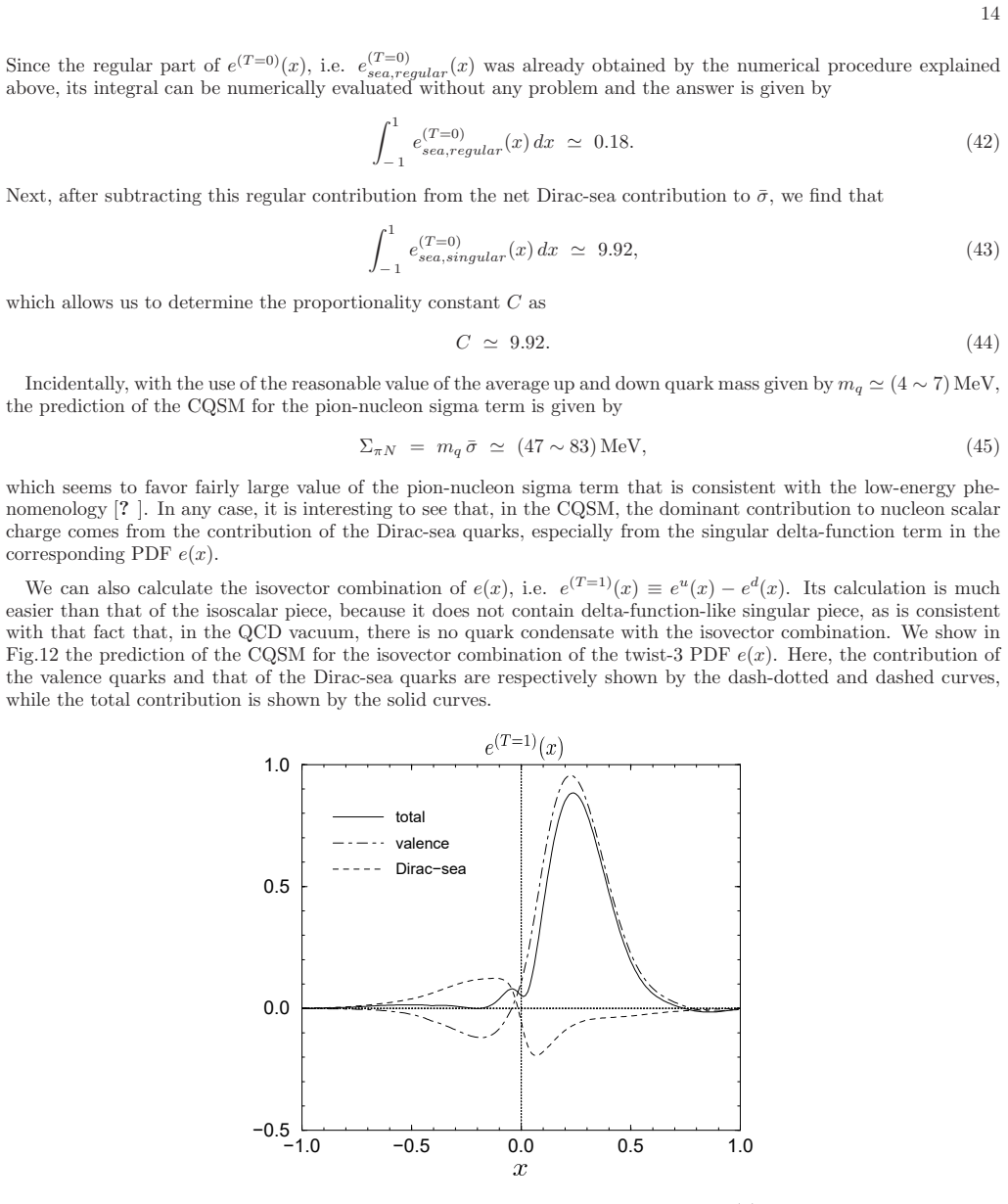
The central claim is that the light-cone scalar quark correlation $E(z_0)$, the nucleon matrix element of the operator $\bar\psi\psi$ between points separated along the light cone, does not decay at large separation. It approaches a nonzero constant set by the vacuum quark condensate, so its Fourier conjugate—the chiral-odd twist-3 PDF $e(x)$—contains a Dirac delta-function piece at $x=0$. In the chiral quark soliton model the calculation separates into valence-quark and Dirac-sea contributions, and the sea contribution is the one that produces the constant tail. Direct numerical evaluation cannot resolve the delta function on a discretized basis, so the author fixes its coefficient by the first-moment sum rule: the sea part of the nucleon scalar charge is about 10.0, the regular part of the sea $e(x)$ integrates to about 0.18, and the remainder $C \simeq 9.92$ is assigned to the delta-function term. The isovector combination, having no vacuum condensate counterpart, is predicted to contain no such singularity.
Load-bearing premise
The whole case rests on the assumption that the flat tail seen in the model's smoothed calculation is the true QCD behavior at large separation, not a numerical artifact of the finite basis used in the calculation—the peak vanishes at small smearing and the coefficient is recovered only by imposing the first-moment sum rule.
Editorial extensions
If this is right
- Most of the nucleon scalar charge would come from the vacuum: the singular piece alone contributes about 9.92 of the total $\bar\sigma \simeq 11.8$, so the pion-nucleon sigma term is dominated by the Dirac-sea quarks rather than the valence quarks.
- Any measurement of $e(x)$ over a finite $x$ range would miss the spike at $x=0$, producing an integral that falls short of the scalar-charge sum rule by roughly $C$—a deficit that can be looked for in semi-inclusive data.
- The equal-time counterpart of $E(z_0)$ would also tend to a nonzero constant at large separation, giving lattice QCD a concrete signature to confirm or rule out.
- The isovector combination $e^{T=1}(x)$ would have no delta-function singularity, tying the effect specifically to the isoscalar vacuum condensate.
Reading between the lines
- This suggests a practical test that does not require resolving the spike: comparing the truncated $x$-integral of $e(x)$ from semi-inclusive data with the lattice value of the pion-nucleon sigma term should show a gap of order 9.92 if the claim is right.
- The same constant-tail logic could apply to other operators with vacuum quantum numbers, such as scalar gluon densities, whose quasi-PDF counterparts would then also be expected to show long-distance constants.
- One could sharpen the model's estimate by computing the normalization of the constant tail in lattice QCD; the coefficient $C$ sets the size of the tail and would provide a direct quantitative check beyond the mere presence of a constant.
Signed reviews
Editorial analysis
A structured set of objections, weighed in public.
Referee Report
Summary. The paper argues that the nucleon scalar charge density in the chiral quark soliton model (CQSM) does not vanish at spatial infinity but approaches the nonzero vacuum quark condensate, and that this behavior manifests in momentum space as a delta-function-type singularity at x=0 in the chiral-odd twist-3 PDF e(x). After reviewing the model and previous CQSM results, the paper studies the light-cone scalar correlator E(z0), shows that its Dirac-sea contribution tends to a nonzero constant (Eqs. (28)-(29)), and then attempts to extract the coefficient C of the putative delta term from the first-moment sum rule, obtaining C ≈ 9.92 (Eqs. (40)-(44)). The paper also presents the isovector combination e^{T=1}(x), a preliminary comparison with CLAS data, and a discussion of lattice quasi-PDF expectations.
Significance. If the central claim is correct, the paper provides a concrete nonperturbative connection between the QCD vacuum condensate and a parton-level observable, and it offers a quantitative CQSM prediction for the strength of the delta-function term in e(x). The paper is commendably transparent about several limitations: it acknowledges that the Gaussian peak in the smeared distribution disappears below a critical smearing width, that the CLAS comparison deliberately omits the singular piece, and that the existence of the singularity is contested in the literature through the light-front zero-mode discussion. It also makes a falsifiable suggestion concerning lattice quasi-PDF calculations. However, the quantitative coefficient C is not obtained by a direct computation of a delta singularity, but as the remainder of a sum-rule subtraction; this weakens the advertised numerical prediction and needs to be addressed explicitly.
major comments (3)
- [Section VI, Eqs. (40)-(44)] The central numerical claim C ≈ 9.92 is not a direct measurement of a delta-function coefficient. The paper states that the Gaussian-like peak in e_gamma(x) disappears when gamma is smaller than a critical value, because the delta function cannot be reproduced with the truncated discretized basis. Instead, C is obtained as the remainder after subtracting a fitted regular integral (0.18) from the Dirac-sea first moment (≈10.0). Since the regular part is fit to a fluctuating truncated-basis result and the sea moment is largely controlled by the Pauli-Villars parameters fitted to the vacuum condensate, the large remainder 9.92 is a sum-rule construction rather than an observed singularity. Please provide evidence that C is stable under variations of gamma, basis truncation, and the fitting procedure, or clearly state that C is a derived residual rather than a directly computed coefficient.
- [Section V, Eqs. (24), (29); Section VI] The existence of a nonzero constant E(z0) is inferred from a smeared version of a discretized-basis CQSM correlator. The paper itself emphasizes that E(z0) is a rapidly fluctuating function of z0 and that the Gaussian peak in e_gamma(x) disappears at small gamma. Because the singularity sits exactly at x=0, this is precisely the region where light-front zero-mode contributions are decisive; the dispute between Ma-Zhang [41] and Bhattacharya et al. [42]/Hatta-Zhao [43] is acknowledged but not resolved. The physical interpretation as a signal of nontrivial vacuum structure requires that the constant term be a genuine light-front zero mode rather than an artifact of the model truncation. Please state explicitly which treatment of zero modes the CQSM calculation implements and how the result would change under the alternative treatment.
- [Sections II-III and Section VI] The model input includes the very quantity that is claimed to be predicted: the Pauli-Villars subtraction parameters in Eq. (20) are fixed to reproduce the empirical vacuum condensate, and the asymptotic value of the scalar density is then found to equal that same condensate. The paper should separate what is put in from what comes out: the delta-function coefficient inherits the fitted condensate, so the statement that the singularity is a 'signal of nontrivial vacuum structure' is partly circular. A non-circular test would be to show that the ratio C/<qbar q> is stable when the condensate input is varied, or that C can be obtained from an independent relation not involving the fitted condensate.
minor comments (6)
- [Keywords] The keyword list ('Time-dependent Aharonov-Bohm effect, 4-dimensional Stokes theorem, quantum mechanics, gauge transformation') is unrelated to the paper's content and should be corrected.
- [Section II, Eq. (8) and Section VI, Eq. (45)] The text contains unresolved reference placeholders '[?]' in the discussion of the pion-nucleon sigma term; these citations should be supplied.
- [Section VII, first bullet] There is a typo: 'nonezero constant' should be 'nonzero constant'.
- [Figure 10 caption] The caption refers to 'Fig.6' when discussing the sample result, but the figure is numbered Fig.10 and should be cited accordingly.
- [Fig. 13] The comparison with CLAS data is described as preliminary, but the figure shows no uncertainty bands for either the theory curve or the empirical extraction; adding them would help the reader judge the agreement.
- [Eq. (35)] The normalization convention for the smeared distribution e_gamma(x) is not stated. As written, the Gaussian kernel has unit integral, so e_gamma(x) is not a probability density; a brief note on the normalization would prevent confusion.
Circularity Check
No load-bearing circularity: the e(x) delta-function claim is a model inference, and the C coefficient is an honestly reported sum-rule remainder.
full rationale
The paper's derivation is model-based rather than circular. The CQSM's Pauli-Villars parameters are fixed by reproducing the empirical vacuum condensate, but this input defines the vacuum background; it does not directly insert the nucleon e(x) singularity. The nucleon scalar density approaching the condensate at infinity and the light-cone correlator E(z0) tending to a constant are computed consequences (Eqs. 21, 24, 29; Fig. 9). The singular coefficient C is not obtained by fitting e(x) to the target; it is recovered from the exact first-moment sum rule as the difference between the Dirac-sea scalar charge and the regular sea integral (Eqs. 40-44). This is an indirect and admittedly qualitative extraction: the paper states that the Gaussian peak disappears below a critical smearing and that the demonstration is to 'qualitatively convince' the reader. The self-citations [18, 40, 46] refer to prior model developments and computations that are separately benchmarked against spin and sea-quark data, so they are not an unverified self-citation chain. No equation used to support the central claim is identical to its input by construction; the C coefficient is reported as a sum-rule remainder, not as a directly predicted observable. Therefore no load-bearing circular step is identified; the minor self-citation and indirect C extraction warrant only a low score.
Assumptions & free parameters
free parameters (3)
- Effective quark mass M =
~400 MeV
- Pauli-Villars parameters c1, c2, Lambda1, Lambda2 =
Not specified numerically; chosen to remove divergences, reproduce the vacuum condensate and pion kinetic term
- Smearing width gamma =
0.05 and 0.06, plus a critical value where the peak disappears
assumptions (5)
- domain assumption Spontaneous chiral symmetry breaking creates a nonzero vacuum quark condensate in QCD
- domain assumption The CQSM with Pauli-Villars regularization is a reliable effective theory for nucleon scalar densities and twist-3 PDFs, including the Dirac-sea contribution
- ad hoc to paper The asymptotic value of the light-cone scalar correlator E(z0) equals the vacuum quark condensate and survives as a delta-function singularity in e(x), not canceled by zero-mode contributions
- standard math The Fourier transform of a constant is a Dirac delta function
- domain assumption The hedgehog mean-field and large-Nc picture of the nucleon
Cite this review
Pith. "Pith review of Extraordinary nature of the nucleon scalar charge and its densities as a signal of nontrivial vacuum structure of QCD." pith.science (2026). https://pith.science/paper/EOTMDZ4R
@misc{pith2026250202961,
  author       = {Pith},
  title        = {Pith review of: Extraordinary nature of the nucleon scalar charge and its densities as a signal of nontrivial vacuum structure of QCD},
  year         = {2026},
  howpublished = {\url{https://pith.science/paper/EOTMDZ4R}},
  note         = {Machine review of arXiv:2502.02961}
}
abstract
It is widely known that the nucleon scalar charge is proportional to the pion-nucleon sigma term as one of the important low energy observables of QCD. Especially interesting to us is the physics of the nucleon scalar charge densities. This comes from the fact that the corresponding operator has the same quantum number as the physical vacuum. It indicates unusual behavior of the the nucleon scalar density as a function of the distance $r$ from the nucleon center. Namely, it would not be reduced down to zero at the spatial infinity but rather approaches some nonzero constant corresponding to the vacuum quark condensate. Naturally, this unique nature of the nucleon scalar density in the position space also affects the corresponding density in the momentum space, i.e. the corresponding parton distribution function (PDF) as a function of the Bjorken variable $x$. This PDF is known as the chiral-odd twist-3 PDF $e (x)$. We argue that $e(x)$ is likely to have a delta-function type singularity at $x=0$, and that the appearance of this singularity can be interpreted as a signal of the nontrivial vacuum structure of the QCD.
Figures


Figures from the paper (10 more)



Reference graph
Works this paper leans on
-
[39]
and that by ourselves [40]. In these papers, it was shown that t he nonperturbative origin of the delta-function singularity in e(x) can be traced back to infinite-range quark-quark correlation of scalar type in the nucleon and that the existence of this infinite-range correlation is inseparably c onnected with the nontrivial vacuum structure of QCD, i.e. t...
-
[40]
Burkardt, M.; Koike, Y., Violation of sum rules for twis t-3 parton distributions in QCD, Nucl. Phys. B 2002, 632, 311-329
work page 2002
-
[46]
Ji, X., Parton Physics on a Euclidean Lattice, Phys. Rev. Lett. 2013, 110, 262002/1-4
work page 2013
-
[41]
Schweitzer, P., The chirally-odd twist-3 distributio n function e(x) in the chiral quark-soliton model, Phys. Rev. D 2003, 67, 114010/1-13
work page 2003
-
[42]
Wakamatsu, M.; Ohnishi, Y., Nonperturbative origin of the delta-function singularity in the chirally odd twist-3 distributio function e(x), Phys. Rev. D 2003, 67, 114011/1-5
work page 2003
-
[43]
Ma, J. P.,; Zhang, G. P., On the singular behavior of the c hirally-odd twist-3 parton distribution e(x), Physics Letters. B 2020, em 811, 135947
work page 2020
-
[1]
W.; Chanfray, G., The pion-nucle on sigma term, J
Jameson, I.; Thomas, A. W.; Chanfray, G., The pion-nucle on sigma term, J. Phys. G: Nucl. Part. Phys. 1992, L159-L165
work page 1992
-
[2]
E., Pion-nucleon sigma-term - a review, arXiv:0110413 [hep-ph] 2001
Sainio, M. E., Pion-nucleon sigma-term - a review, arXiv:0110413 [hep-ph] 2001
work page 2001
Show all 51 references
-
[3]
N.; Greenwood, D
Cottingham, W. N.; Greenwood, D. A., An Introduction to the Standard Model of Particle Physics, 2n d ed.; Cambridge University Press, USA, 2007
2007
-
[4]
Schwartz, M., Quantum Field Theory and the Standard Model, Cambridge Unive rsity Press, USA, 2014
2014
-
[5]
Courtoy, A.; Baeßler, S.; Gonz´ alez-Alonso, M.; Liuti, S., Beyond-Standard-Model Tensor Interaction and Hadron P he- nomenology, Phys. Rev. Lett. 2015, 115, 162001
2015
-
[6]
Courtoy, A., The Tensor and the Scalar Charges of the Nucl eon from Hadron Phenomenology, EPJ Web of Conferences 2018, 172, 03007
2018
-
[7]
Yamanaka, N.; Hashimoto, S.; Kaneko, T.; Ohki, H., Nucle on charges with dynamical overlap fermion, Phys. Rev. D 2018, 98, 054516/1-18
2018
-
[8]
Hasan, N.; Green, J.; Meinel, S.; Engelhardt, M.; Krieg, S.; Negele, J.; Pochinski, A.; Syritsyn, S., Nucleon axial, scalar, and tensor charges using lattice QCD at the physical pion mas s, Phys. Rev. D 2019, 99, 114505/1-22
2019
-
[9]
Alexandrou, C.; Bacchio, S.; Constantinou, M.; Finkenr ath, J.; Hadjiyiannakou, K.; Jansen, K., Nucleon axial, ten sor, and scalar charges and σ -term in lattice QCD, Phys. Rev. D 2020, 102, 054517/1-20
2020
-
[10]
Leutwyler, H; Sainio, M.E; Sigma-term upd ate, Phys
Gasser, J; H. Leutwyler, H; Sainio, M.E; Sigma-term upd ate, Phys. Lett. B 1991, 253, 252-259
1991
-
[11]
Hoferichter, M; de Elvira, J.R.; Kubis, B; Meißner, Ulf -G., High-Precision Determination of the Pion-Nucleon σ Term from Roy-Steiner Equations, Phys. Rev. Lett. 2015, 115, 092301/1-5
2015
-
[12]
Hoferichter, M; de Elvira, J.R.; Kubis, B; Meißner, Ulf -G., On the role of isospin violation in the pion-nucleon σ -term, Phys. Lett. B 2023, 843, 1-6
2023
-
[13]
bag model, ACTA PHYSICA POLONICA 1975, B6, 865-892
Johnson, K., The M.I.T. bag model, ACTA PHYSICA POLONICA 1975, B6, 865-892
1975
-
[14]
J.; Roberts, C
Brodsky, S. J.; Roberts, C. D.; Shrock, R.; Tandy, P. C., New perspective on the quark condensate, Phys. Rev. C 2010, 82, 022201(R)/1-5
2010
-
[15]
I.; Petrov, V
Diakonov, D. I.; Petrov, V. Yu.; Pobylitsa, P. V., A chir al theory of nucleons, Nucl. Phys. B 1988, 306, 809
1988
-
[16]
A 1984, 429, 462
Kahana, S.; Ripka, G., Baryon density of quarks coupled to a chiral field, Nucl Phys. A 1984, 429, 462
1984
-
[17]
A 1991, 524, 561-600
Wakamatsu, M.; Yoshiki, A Chiral Quark Model of the Nucl eon Nucl Phys. A 1991, 524, 561-600
1991
-
[18]
Kubota, T.; Wakamatsu, M.; Watabe, T., Chiral quark sol iton model with Pauli-Villars regularization, Phys. Rev. D 1999, 60, 014018/1-12
1999
-
[19]
B 1996, 480, 341-378
Diakonov, D.; Petrov, V.; Pobylitsa, P.; Polyakov, M.; Weiss, C, Nucleon parton distributions at low normalizatio n point in the large Nc limit, Nucl Phys. B 1996, 480, 341-378
1996
-
[20]
Diakonov, D.; Petrov, V.; Pobylitsa, P.; Polyakov, M.; Weiss, C, Unpolarized and polarized quark distributions in the large Nc limit, Phys. Rev. D 1997, 56, 4069-4083
1997
-
[21]
Weigel, H.; Gamberg, L.; Reinhardt, H., Nucleon struct ure functions from a chiral soliton, Phys. Lett. B 1997, 399, 287-296
1997
-
[22]
Weigel, H.; Gamberg, L.; Reinhardt, H., Polarized nucl eon structure functions withoin a chiral soliton model, Phys. Rev. D 1997, 55, 6910-6923
1997
-
[23]
Wakamatsu, M.; Kubota, T., Chiral symmetry and the nucl eon spin structure functions, Phys. Rev. D 1999, 60,034020/1- 32
1999
-
[24]
Wakamatsu, M., Light-flavor sea-quark distributions i n the nucleon in the SU(3) chiral quark soliton model. I. Phen omeno- logical predictions, Phys. Rev. D 2003, 67,034005/1-15. 17
2003
-
[25]
Wakamatsu, M., Light-flavor sea-quark distributions i n the nucleon in the SU(3) chiral quark soliton model. II. The oretical formalism, Phys. Rev. D 2003, 67,034006/1-25
2003
-
[26]
Wakamatsu, M., On the new COMPASS measurement of the deu teron spin-dependent structure function gd 1 , Phys. Lett. B 2007, 646, 24-28
2007
-
[27]
We can s ay that the agreement with the empirical information is encouraging especially in view of the fact that the pred ictions of the CQSM are almost parameter free
and the Compass group [28, 29] and HERMES group [30]. We can s ay that the agreement with the empirical information is encouraging especially in view of the fact that the pred ictions of the CQSM are almost parameter free. Still another prominent feature of the CQSM is that it...
-
[28]
et al.), Measureme nt of the spin structure of the deuteron in the DIS region, Phys
COMPASS Collaboration (Ageev, E.S. et al.), Measureme nt of the spin structure of the deuteron in the DIS region, Phys. Lett. B 2005, 612, 154-164
2005
-
[29]
et al.), Spin asymm etries A1 and structure functions g1 of the proton and the deuteron from polarized high energy muon scattering, Phys
Spin Muon Collabollation (Adeva, B. et al.), Spin asymm etries A1 and structure functions g1 of the proton and the deuteron from polarized high energy muon scattering, Phys. Rev. D 1998, 58, 112001/1-17
1998
-
[30]
et al.), Precise determination of the spin structure function g1 of the proton, deuteron, and neutron, Phys
HERMES Collaboration (Airapetian, A. et al.), Precise determination of the spin structure function g1 of the proton, deuteron, and neutron, Phys. Rev. D 2007, 75, 012007/1-48
2007
-
[31]
et al.), The d euteron spin-dependent structure function gd 1 and its first moment, Phys
COMPASS Collaboration (Alexakhin, V.Yu. et al.), The d euteron spin-dependent structure function gd 1 and its first moment, Phys. Lett. B 2007, 647, 8-17
2007
-
[32]
et al.), I mproved measurement of the ¯u / ¯u asymmetry in the nucleon sea, Phys
FNAL E866/NuSea Collaboration (Towell, R.S. et al.), I mproved measurement of the ¯u / ¯u asymmetry in the nucleon sea, Phys. Rev. D 2001, 64, 052002/1-16
2001
-
[33]
et al.), Flavor As ymmetry of the Light Quark Sea from Semi-inclusive Deep- Inelastic Scattering, Phys
HERMES Collaboration (Ackerstaff, K. et al.), Flavor As ymmetry of the Light Quark Sea from Semi-inclusive Deep- Inelastic Scattering, Phys. Rev. Lett. 1998, 81, 5519-5523
1998
-
[34]
de Florian, D.; Sassot, R.; Strattmann, M.; Vogelsang, W., Extraction of spin-dependent parton densities and thei r uncertaintities, Phys. Rev. D 2009, 80, 034030/1-26 (2009)
2009
-
[35]
et al.), Study of the iso spin symmetry breaking in the light quark sea of the nucleon f rom the Drell-Yan process, Phys
NA51 Collaboration (Baldit, A. et al.), Study of the iso spin symmetry breaking in the light quark sea of the nucleon f rom the Drell-Yan process, Phys. Lett. B 1994, 332, 244-250
1994
-
[36]
Kodaira, J.; Tanaka, K., Polarized Structure Function s in QCD, Prog. Theor. Phys. 1999, 101, 191-242
1999
-
[37]
Reinhardt, H.; Weigel, H., Vacuum nature of the QCD cond ensates, Phys. Rev. D 2012, 85,074029/1-5
2012
-
[38]
V.; Schweitzer, P., The chirally-odd twist -3 distribution ea(x), JHEP 2003, 08, 006
Efremov, A. V.; Schweitzer, P., The chirally-odd twist -3 distribution ea(x), JHEP 2003, 08, 006
2003
-
[44]
Bhattacharya, S.; Cichy, K.; Constantinou, M.; Metz, A .; Scapellato, A.; Stefenns, F., The role of zero-mode contr ibutions in the matching for the twist-3 PDFs e(x) and hL(x), Phys. Rev. D 2020, 102, 114025
2020
-
[45]
Hatta, Y.; Zhao, Y., Parton distribution function for t he gluon condensate, Phys. Rev. D 2020, 102, 034004
2020
-
[47]
Ji, X.; Zhang, J.-H.; Zhao, Y., Physics of the Gluon-Hel icity Contribution to Proton Spin, Phys. Rev. Lett. 2013, 111, 112002/1-4
2013
-
[48]
Ohnishi, Y.; Wakamatsu, M., πN sigma term and chiral-odd twist-3 distribution function e(x) of the nucleon in the chiral quark soliton model, Phys. Rev. D 2004, 69, 114002/1-15
2004
-
[49]
V.; Goeke, K.; Schweitzer, P., Azimuthal as ymmetries in SIDIS and Collins analysing power, Nucl
Efremov, A. V.; Goeke, K.; Schweitzer, P., Azimuthal as ymmetries in SIDIS and Collins analysing power, Nucl. Phys. A 2002, 711, 84-88
2002
-
[50]
Courtoy, A., Insight into the higher-twist distributi on e(x) at CLASS, arXiv:1405.7659 [hep-ph] 2022
2022 arXiv
-
[51]
Miramontes, A.; Avakian, A
Courtoy, A. ; Miramontes, A.; Avakian, A. H.; Mirazita, M. ; Pisano, S., Extraction of the higher-twist parton distr ibution e(x) from CLAS data, Phys. Rev. D 2022, 106, 014027
2022
Reviewed August 9, 2026 · model on record in the stance chip above.
Discussion (0). Continue with ORCID to comment.