REVIEW 3 major objections 5 minor 2 cited by
SACRA-2D: New axisymmetric general relativistic hydrodynamics code with fixed mesh refinement
T0 review · 3 major / 5 minor · reviewed 2026-08-09 · deepseek-v4-flash
Pith's one-line read SACRA-2D, a new axisymmetric general-relativistic hydrodynamics code, claims sixth-order-accurate spacetime evolution and near-machine-precision conservation of mass and angular momentum, with the HLLC solver beating TVDLF on contact…
desk verdict A serious new axisymmetric GRHD code with a strong benchmark suite; the main gap is the lack of a direct 3D cross-validation of the cartoon off-plane closure, but the work deserves peer review. read the letter →
The pith
A machine-rendered reading of the paper's core claim, the machinery that carries it, and where it could break.
The reading
What carries the argument
The central mechanism is the cartoon method, which imposes axial symmetry on a Cartesian grid by solving Einstein's equations only on the x-z plane and filling three extra layers in the off-plane y-direction using interpolation plus a rotation law for the geometric variables. Around this sit the BSSN formalism with Z4c constraint propagation for the spacetime sector, the finite-volume high-resolution shock-capturing scheme with the HLLC Riemann solver (using a local tetrad transformation) for the matter sector, and a two-to-one fixed mesh refinement with Berger-Oliger adaptive time stepping and flux correction across refinement boundaries. The HLLC solver restores the contact discontinuity in the approximate Riemann fan, and the flux correction across mesh-refinement boundaries is what keeps mass and angular momentum conserved to near machine precision.
What would settle it
Compare the same axisymmetric system, say the unstable rotating neutron-star migration or the head-on black-hole collision, between SACRA-2D and a full three-dimensional GRHD code at matched resolution; if the 2D-3D difference in the $\Psi_4$ waveform or in Hamiltonian constraint violation exceeds the 3D code's own convergence error, the cartoon method's off-plane y-derivative treatment in the refinement-boundary region is the likely cause.
Extended reading notes
Core claim
The paper's central claim is that a fully general-relativistic hydrodynamics code confined to two spatial dimensions can reproduce the dynamics of axisymmetric neutron stars, black holes, and their collapse with a combination of sixth-order-accurate metric evolution, second-order hydrodynamics, and near-machine-precision conservation of baryon mass and angular momentum. The authors demonstrate the claim through benchmark tests covering vacuum spacetimes, fixed-spacetime hydrodynamics, stable and unstable neutron stars, black-hole formation, and supermassive-star collapse, with gravitational waveforms matching analytical quasinormal-mode frequencies. A key quantitative claim is that the HLLC solver resolves the stellar surface contact discontinuity about five orders of magnitude better than TVDLF, reducing artificial atmosphere density and long-term error.
Load-bearing premise
The code's accuracy rests on the assumption that the cartoon method's interpolated off-plane layers and the algebraic y-derivative formulas at the refinement-boundary region correctly represent a three-dimensional axisymmetric spacetime; if that representation is wrong, errors in the y-derivatives contaminate the Einstein equations and the whole evolution.
Editorial extensions
If this is right
- Long-term axisymmetric simulations of neutron-star migration and collapse become practical at a fraction of the 3D computational cost.
- The HLLC solver's sharper contact resolution reduces artificial atmosphere densities around neutron stars by about five orders of magnitude relative to TVDLF, improving long-term fidelity.
- Black-hole formation, apparent-horizon properties, and ringdown waveforms can be computed in axisymmetry, with final black-hole mass and spin matching the initial system to about 0.03%.
- The supermassive-star-collapse test shows the FMR structure can span radii from about 2M to 1100M and follow a black-hole-plus-disk remnant of a $\sim 1.5\times10^5\,M_\odot$ star.
- Strong scaling of about 70% efficiency up to thousands of cores makes parameter surveys feasible for axisymmetric relativistic astrophysics.
Reading between the lines
- Inference: the HLLC advantage should be at least as important in magnetohydrodynamics, where contact discontinuities and current sheets are even more sharply degraded by diffusive solvers; the authors list MHD with HLLD as planned future work.
- Inference: a direct head-to-head with a full 3D GRHD code on the same axisymmetric initial data would provide the cleanest test of the cartoon method's off-plane approximation, especially in the outer refinement levels.
- Inference: because the code is axisymmetric and comparatively cheap, it could serve as a quick survey tool for alternative theories of gravity before investing in 3D runs, an application the paper mentions as future work.
- Inference: the near-machine-precision conservation of angular momentum suggests the code may be useful for studying disk evolution and collapsar scenarios over dynamical timescales inaccessible to 3D codes.
Editorial analysis
A structured set of objections, weighed in public.
Referee Report
Summary. The paper presents SACRA-2D, a new MPI+OpenMP parallelized axisymmetric general-relativistic hydrodynamics code. The spacetime is evolved with the BSSN formalism augmented by Z4c constraint propagation in Cartesian coordinates on the y=0 plane, using the cartoon method for off-plane closure and a two-to-one fixed mesh refinement hierarchy. The hydrodynamic sector uses finite-volume shock capturing with both TVDLF and HLLC Riemann solvers, a hybrid piecewise-polytropic EOS, and an artificial atmosphere. The authors validate the metric sector with trumpet and spinning black hole evolutions and a head-on black hole collision, validate the hydrodynamics sector with a shock tube and Bondi accretion, and then present full dynamical-spacetime tests: a stable rotating neutron star, unstable neutron star migration, collapse of an unstable rotating neutron star to a black hole, and collapse of a supermassive star. They report sixth-order convergence for metric variables and gravitational waveforms, second-order convergence for hydrodynamics, excellent baryon-mass and angular-momentum conservation, and better performance of HLLC over TVDLF, especially in resolving contact discontinuities and reducing artificial surface heating.
Significance. If validated, SACRA-2D is a valuable tool for long-term axisymmetric GRHD simulations, including neutron-star stability, stellar collapse, black-hole-torus systems, and modified-gravity studies, where 3D simulations are prohibitively expensive. The benchmark suite is unusually broad and includes several external analytic anchors: the trumpet solution, Bondi accretion, the 1D shock-tube analytic solution, quasinormal-mode frequencies for black hole ringdown, and prior published results for neutron star migration and supermassive star collapse. The reported conservation of baryon mass and angular momentum to the 1e-10 level or better in HLLC runs is a strong quantitative result, as is the sixth-order convergence observed in the metric sector. The explicit comparison of HLLC versus TVDLF, showing reduced artificial surface heating and sharper instability fingers, is a concrete and useful contribution. The main gap, discussed below, is the absence of a direct 3D cross-validation of the cartoon method's off-plane closure in a coupled matter+spacetime evolution.
major comments (3)
- [II.B.2 (Cartoon method), Eq. (14)] The spinning-black-hole test in Section III.A.2 provides some metric-sector validation of the cartoon method for a rotating spacetime, but it is a stationary vacuum configuration and does not exercise the off-plane closure in the presence of dynamical matter and strong hydrodynamics.
- [III.A.1 and Fig. 1; Abstract and Summary] The waveform convergence statement in Section III.A.3 is also only demonstrated for t_ret ≲ 40M; the loss of convergence at later times due to reflection at coarse refinement boundaries should be mentioned in the same qualified way.
- [III.C.2 and Fig. 9] The SMS collapse comparison with Ref. [45] is similarly qualitative ('the ejecta mass is ~1% of the total mass, and this result agrees with that of [45]').
minor comments (5)
- [III.C.1] The text states the neutron star has angular frequency Ω = 6.28 rad/s, but with this value the rotational period is 1 s, which is inconsistent with the statement that the 250 ms evolution covers roughly 250 rotational periods. The unit should presumably be rad/ms or the value should be corrected.
- [III.C.1 and Fig. 8] The sentence 'the structure of the neutron star remains intact across the refinement boundary as shown by the green solid line in Fig. 10' appears to reference the wrong figure: the stable-neutron-star snapshots are in Fig. 8, while Fig. 10 shows the migration test. Please correct the cross-reference.
- [Fig. 2 caption] The caption lists 'blue, green, red, and cyan lines' but the figure text describes only three resolutions, N = 200, 300, and 400. The color list and the number of curves should be made consistent.
- [IV. Summary] The summary refers to 'Z4c constraint transport' but the formulation in Section II.B is constraint propagation via the Z4c damping terms; the wording should be aligned with the body of the paper.
- [I. Introduction] The phrase 'providing shreds of evidence' is understandable but informal for a journal article; consider replacing it with 'evidence' or 'clues'.
Circularity Check
No significant circularity: SACRA-2D's validation is anchored to external analytic solutions and independently published benchmark results.
full rationale
The paper's central claim is that SACRA-2D correctly solves axisymmetric GRHD. The evidence is self-contained in the verification sense: the metric solver is tested against the analytic maximal-trumpet solution (Eqs. 65-66) and the spinning-black-hole initial data of Liu et al.; the hydrodynamics solver is tested against the analytic shock-tube solution and the Bondi accretion solution; the waveform extraction is checked against QNM frequencies from Berti et al. (Ref. [138]). The HLLC-vs-TVDLF improvement is demonstrated by resolving the Richtmyer-Meshkov instability and by reduced artificial atmosphere heating, neither of which involves fitting a parameter to a target result. Conservation of baryon mass and angular momentum to machine precision is a consistency check of the conservative finite-volume scheme (s_D = 0 = s_Sphi and flux matching), not a prediction forced by construction. The cartoon-method closure (Eq. 12 and Eq. 14) is an exact continuum implementation of axisymmetry; no free parameter is tuned to make benchmarks agree. Self-citations occur when comparing the SMS collapse to earlier work by Shibata and collaborators (Refs. [42,45]), but those are prior independent simulations, not outputs of SACRA-2D, and they are corroborative rather than load-bearing: the primary benchmarks are external analytic results. The absence of a direct 3D cross-validation of the off-plane closure is a validation gap, not a circularity, because nothing in the derivation assumes the conclusion it is used to support. No circular step could be identified by the paper's own equations or by a self-citation chain.
Assumptions & free parameters
free parameters (8)
- constraint damping parameter κ =
5e-3 / M
- shift damping parameter ηB =
1 / M
- Kreiss-Oliger dissipation coefficient ε =
0.5
- atmosphere factor f_atm =
1e-15 to 1e-20
- CFL factor c_CFL =
0.5
- lfix =
4
- Lorentz factor cap w_max =
100
- pressure reduction in SMS test =
20%
assumptions (6)
- domain assumption BSSN formulation with Z4c constraint propagation correctly evolves the spacetime.
- domain assumption The cartoon method accurately represents axisymmetric spacetimes using Cartesian coordinates on the y=0 plane plus three off-plane layers.
- standard math The reference-metric formalism in cylindrical coordinates conserves rest mass and angular momentum when s_D=0 and s_{Sϕ}=0.
- standard math The tetrad-based HLLC solver is a valid approximate Riemann solver for relativistic hydrodynamics.
- ad hoc to paper The outer boundary condition (Eq. 15) together with the exponential suppression of Z4c terms outside r_Z4 prevents spurious constraint violations.
- ad hoc to paper The artificial atmosphere with density floor does not significantly affect the dynamics.
Cite this review
Pith. "Pith review of SACRA-2D: New axisymmetric general relativistic hydrodynamics code with fixed mesh refinement." pith.science (2026). https://pith.science/paper/BEWXAE7Y
@misc{pith2026250203223,
  author       = {Pith},
  title        = {Pith review of: SACRA-2D: New axisymmetric general relativistic hydrodynamics code with fixed mesh refinement},
  year         = {2026},
  howpublished = {\url{https://pith.science/paper/BEWXAE7Y}},
  note         = {Machine review of arXiv:2502.03223}
}
read the original abstract
We present \texttt{SACRA-2D}, a new MPI and OpenMP parallelized, fully relativistic hydrodynamics (GRHD) code in dynamical spacetime under axial symmetry with the cartoon method using the finite-volume shock-capturing schemes for hydrodynamics. Specifically, we implemented the state-of-the-art HLLC Riemann solver and found better accuracy than the standard Total Variation Diminishing Lax-Friedrich Riemann solver. The spacetime evolves under the Baumgarte-Shapiro-Shibata-Nakamura formalism with Z4c constraint propagation. We demonstrate the accuracy of the code with some benchmark tests and excellent agreement with other codes in the literature. A wide variety of test simulations, including the head-on collision of black holes, the migration and collapse of neutron stars, and the collapse of a rotating supermassive star to a massive black hole and a disk, is also performed to show the robustness of our new code.
Figures


Figures from the paper (14 more)



Forward citations
Cited by 2 Pith papers
-
Spinning down neutron-star merger remnants with the Tayler-Spruit dynamo: Global simulations reveal the formation of massive disks and neutron-rich ejecta
A subgrid Tayler–Spruit dynamo in axisymmetric GR neutrino-MHD runs flattens merger-core rotation on ~100 ms scales, builds massive neutron-rich disks, and boosts neutron-rich ejecta.
-
Axisymmetric stability of neutron stars as extreme rotators in massive scalar-tensor theory
Differentially rotating scalarized neutron stars with enormous angular momentum are axisymmetrically stable up to the turning point of their mass sequence, beyond which they collapse to black holes, confirming the tur...
Reference graph
Works this paper leans on
-
[45]
M. D. Duez, Y. T. Liu, S. L. Shapiro, and B. C. Stephens, Phys. Rev. D 69, 104030 (2004), arXiv:astro- ph/0402502 [astro-ph]
arXiv 2004
-
[1]
Evaluate the rescaled quantities that are fixed in the iterations r := √ SiSi D , q := E D − 1, k := r 1 + q , (46)
-
[2]
Both Total Variation Di- minishing Lax-Friedrich (TVDLF) [108–110] and HLLC [12, 13, 111] approximate Riemann solvers are imple- mented in SACRA-2D
Riemann Solver We adopt the HSRC scheme to handle the flux term in hydrodynamics equations. Both Total Variation Di- minishing Lax-Friedrich (TVDLF) [108–110] and HLLC [12, 13, 111] approximate Riemann solvers are imple- mented in SACRA-2D. To obtain the numerical flux, we first reconstruct the left and right states of the primi- tive variables p = ( ρ, u...
-
[3]
Equation of state We implement a hybrid equation of state (EOS) in the current version of SACRA-2D where the pressure P and the specific internal energy ϵ are split into the cold part Pcold/ϵcold and thermal part Pth/ϵth as P = Pcold + Pth, ϵ = ϵcold + ϵth. (43) The cold part is described by a phenomenological piece- wise polytropic (PWP) EOS [115] where ...
-
[4]
We implement the primitive recovery proce- dure for GRHD mentioned in Appendix C of [116]
Recovery of primitive variables The recovery of primitive variables ( ρ, ui, P, ϵ) from conserved variables q is non-trivial and can only be done numerically. We implement the primitive recovery proce- dure for GRHD mentioned in Appendix C of [116]. Here, we briefly outline the implementation of the recovery pro- cedure:
-
[5]
Set the bounds [ z−, z+] for the root defined as z− := k/2p 1 − k2/4 , z + := k√ 1 − k2 (47)
-
[6]
(49) In SACRA 2D, we numerically solve Eq
Within the interval [ z−, z+], we find the root of f (z) = 0 with the master function f (z) defined as f (z) := z − r ˆh(z) , (48) where ˆh(z) := (1 + ˆϵ)(1 + ˆa(z)), ˆP (z) := P (ˆρ(z), ˆϵ(z)), ˆa(z) := ˆP (z) ˆρ(z)(1 + ˆϵ(z)) , ˆρ(z) := D ˆw(z) , ˆϵ(z) := ˆw(z)q − zr + z2 1 + ˆw(z) , ˆw(z) := p 1 + z2. (49) In SACRA 2D, we numerically solve Eq. (48) usi...
-
[7]
Set the bounds [ z−, z+] for the root defined as z− := 0, z + := r (50)
Show all 172 references
-
[8]
Within the interval [ z−, z+], we find the root of ˜f (z) = 0 with the master function ˜f (z) defined as ˜f (z) := z − r hcold(ˆρ(z)) , (51) where ˆρ(z) := D ˆw(z) ˆw(z) := p 1 + z2 (52)
-
[9]
Reset the conversed energy E from primitive vari- ables. In addition, we impose an artificial atmosphere by defining a lower bound ρatm and reset the rest-mass density ρ after the primitive recovery whenever it falls below the bound ρ = max( ρ, ρatm) to maintain stable evoluti...
-
[10]
Under axisymmetry, the mo- mentum constraints Mx and My evaluated are effec- tively Mϖ and Mϕ in cylindrical coordinates, respec- tively
Constraints, mass, and angular momentum We monitor the overall constraint violations by com- puting the corresponding L2-norm every timestep as ||H||2 = Z R + K 2 − KijK ij − 16πE dV, (57a) ||Mi||2 = Z DjK j i − DiK − 8πJi dV, (57b) where H and Mi are the Hamiltonian and momen...
-
[11]
Here, ka and la 9 are outgoing and ingoing null vectors, respectively, where ma is a complex null vector satisfying −kala = 1 = ma ¯ma
Extraction of gravitational wave We extract gravitational waves from the numerical data using the outgoing component of Newman-Penrose quantity Ψ 4 [122], which can be expressed by the elec- tric part Eac := Cabcdnbnd and magnetic part Bac := 1 2 Cabef ϵef cdnbnd of Weyl tenso...
-
[12]
Assuming that the apparent horizon contains the coordinate center (x, z) = (0, 0), the horizon radius H can be represented as a function of polar angle θ as r = H(θ)
Apparent horizon finder To identify the presence of a black hole and to diag- nose its properties, we implement an apparent horizon finder in SACRA-2D. Assuming that the apparent horizon contains the coordinate center (x, z) = (0, 0), the horizon radius H can be represented as...
-
[13]
Specifically, we consider a non-rotating black hole in the so-called maximal trumpet coordinate, which is time-independent under BSSN formalism with the puncture gauge
Trumpet Black hole We first test our metric solver on a stationary space- time. Specifically, we consider a non-rotating black hole in the so-called maximal trumpet coordinate, which is time-independent under BSSN formalism with the puncture gauge. The analytic solution of the...
-
[14]
Spinning Black hole To further test our metric solver in a system with non- zero angular momentum, we evolve a near-extreme-spin black hole with the dimensionless spin parameter χ = 0.95. We adopt the spinning black hole in quasi-isotropic coordinates under a new radial coordi...
-
[15]
Black hole head-on collision To explore the convergence of gravitational waves nu- merically extracted, we perform a test simulation of the head-on collision of two non-spinning black holes. Under axial symmetry, we can set up the Brill-Lindquist initial data [135] which consi...
-
[16]
For this test, the cylindrical coordinates in SACRA-2D are converted to the Cartesian coordinates
one-dimensional shock-tube test We carry out a one-dimensional shock-tube test prob- lem following [139], which is commonly used to test the performance of the Riemann solver and reconstruction scheme. For this test, the cylindrical coordinates in SACRA-2D are converted to the...
-
[17]
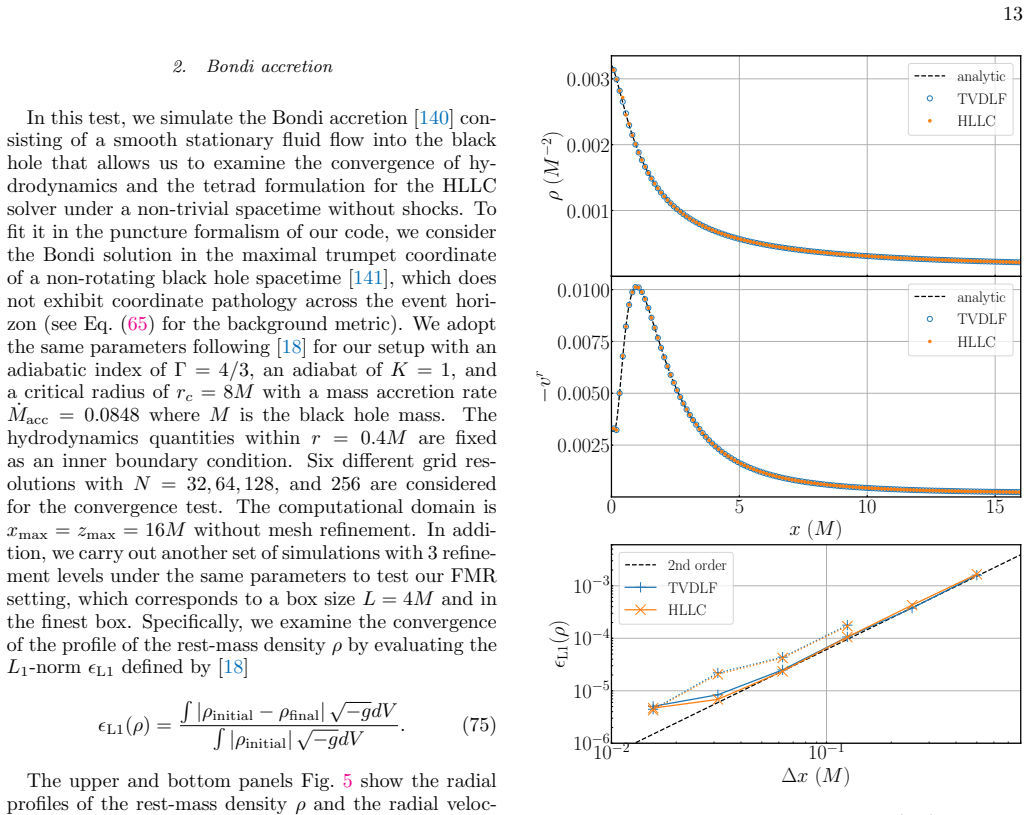
Bondi accretion In this test, we simulate the Bondi accretion [140] con- sisting of a smooth stationary fluid flow into the black hole that allows us to examine the convergence of hy- drodynamics and the tetrad formulation for the HLLC solver under a non-trivial spacetime with...
-
[18]
Rayleigh-Taylor instability from the modified Bondi flow To further validate our HLLC solver and demonstrate its improvement over the TVDLF solver, we modify the configuration of the Bondi flow to induce Rayleigh-Taylor instability. Following [114], we change the initial setup...
-
[19]
Stable rotating neutron star We first evolve a stable rotating neutron star in equi- librium configuration with initial data constructed by the open-source code RNS [142] using the MPA1 EOS [143]. Specifically, a uniformly rotating neutron star with baryon mass Mb = 1 .80M⊙ an...
-
[20]
Migration of an unstable neutron star To further test the nonlinear dynamics of matter and spacetime, we perform one standard test prob- lem that simulates the migration of an unstable neu- tron star [86, 106, 145–148]. We construct a Tol- man–Oppenheimer–Volkoff (TOV) neutron...
-
[21]
We consider uniformly rotating neutron stars in both the stable and unstable branches indicated as the red crosses in Fig
Migration of an unstable rotating neutron star In this test, we simulate the rotating neutron stars that are very close to the turning point of the mass ver- sus energy density (MADM-ec) curve to examine the per- formance of SACRA-2D. We consider uniformly rotating neutron sta...
-
[22]
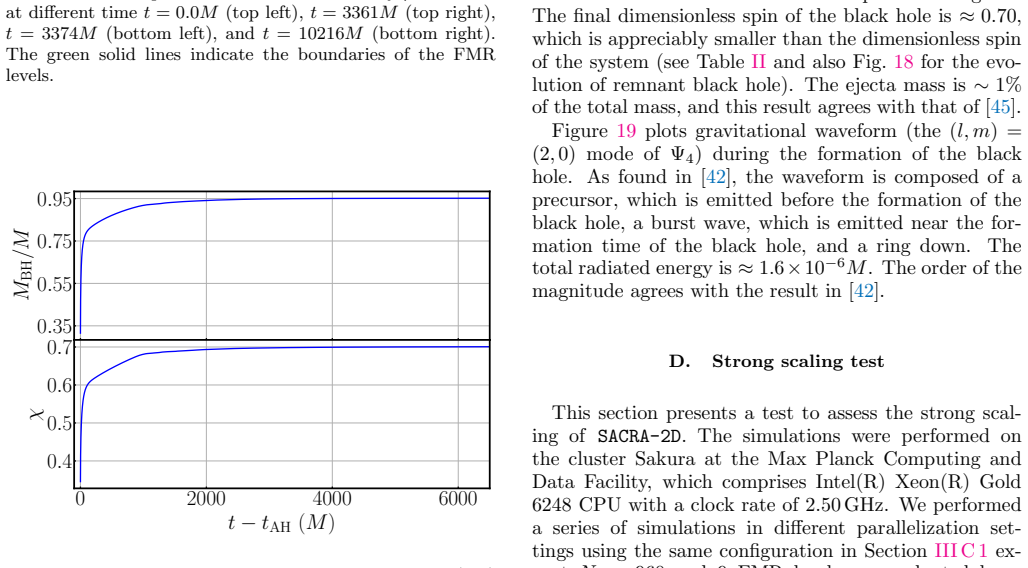
Gravitational collapse of a supermassive star For the final test, we simulate the gravitational col- lapse of a rotating supermassive star (SMS) to a black hole. In this problem, the SMS with a radius of ≈ 450M collapses to a black hole and a disk, and hence, we have to follow...
2000
-
[23]
Harten, P
A. Harten, P. D. Lax, and B. v. Leer, SIAM Review 25, 35 (1983), https://doi.org/10.1137/1025002
1983 doi
-
[24]
M¨ osta, B
P. M¨ osta, B. C. Mundim, J. A. Faber, R. Haas, S. C. Noble, T. Bode, F. L¨ offler, C. D. Ott, C. Reisswig, and E. Schnetter, Classical and Quantum Gravity 31, 015005 (2013)
2013
-
[25]
Z. B. Etienne, V. Paschalidis, R. Haas, P. M¨ osta, and S. L. Shapiro, Classical and Quantum Gravity 32, 175009 (2015), arXiv:1501.07276 [astro-ph.HE]
2015 arXiv
-
[26]
Bernuzzi and T
S. Bernuzzi and T. Dietrich, Phys. Rev. D 94, 064062 (2016)
2016
-
[27]
E. R. Most, L. J. Papenfort, and L. Rezzolla, MNRAS 490, 3588 (2019), arXiv:1907.10328 [astro-ph.HE]. 22
2019 arXiv
-
[28]
Vigan` o, R
D. Vigan` o, R. Aguilera-Miret, F. Carrasco, B. Mi˜ nano, and C. Palenzuela, Phys. Rev. D 101, 123019 (2020), arXiv:2004.00870 [gr-qc]
2020 arXiv
-
[29]
Cipolletta, J
F. Cipolletta, J. V. Kalinani, E. Giangrandi, B. Giaco- mazzo, R. Ciolfi, L. Sala, and B. Giudici, Classical and Quantum Gravity 38, 085021 (2021), arXiv:2012.10174 [astro-ph.HE]
2021 arXiv
-
[30]
Foucart, A
F. Foucart, A. Chernoglazov, M. Boyle, T. Hinderer, M. Miller, J. Moxon, M. A. Scheel, N. Deppe, M. D. Duez, F. H´ ebert, L. E. Kidder, W. Throwe, and H. P. Pfeiffer, Phys. Rev. D 103, 064007 (2021), arXiv:2010.14518 [gr-qc]
2021 arXiv
-
[31]
Hayashi, S
K. Hayashi, S. Fujibayashi, K. Kiuchi, K. Kyutoku, Y. Sekiguchi, and M. Shibata, Phys. Rev. D106, 023008 (2022), arXiv:2111.04621 [astro-ph.HE]
2022 arXiv
-
[32]
Radice, S
D. Radice, S. Bernuzzi, A. Perego, and R. Haas, MN- RAS 512, 1499 (2022), arXiv:2111.14858 [astro-ph.HE]
2022 arXiv
-
[33]
Kurganov and E
A. Kurganov and E. Tadmor, Journal of Computational Physics 160, 241 (2000)
2000
-
[34]
E. F. Toro, M. Spruce, and W. Speares, Shock Waves 4, 25 (1994)
1994
-
[35]
Mignone and G
A. Mignone and G. Bodo, MNRAS 364, 126 (2005), arXiv:astro-ph/0506414 [astro-ph]
2005 arXiv
-
[36]
Mignone, M
A. Mignone, M. Ugliano, and G. Bodo, MNRAS 393, 1141 (2009), arXiv:0811.1483 [astro-ph]
2009 arXiv
-
[37]
L. E. Held and H. N. Latter, MNRAS 480, 4797 (2018), arXiv:1808.00267 [astro-ph.SR]
2018 arXiv
-
[38]
Y. Gao, K. Hayashi, K. Kiuchi, A. Tsz-Lok Lam, H.-J. Kuan, and M. Shibata, arXiv e-prints , arXiv:2501.19053 (2025), arXiv:2501.19053 [astro- ph.HE]
2025
-
[39]
Kiuchi, L
K. Kiuchi, L. E. Held, Y. Sekiguchi, and M. Shibata, Phys. Rev. D 106, 124041 (2022), arXiv:2205.04487 [astro-ph.HE]
2022 arXiv
-
[40]
C. J. White, J. M. Stone, and C. F. Gammie, ApJS 225, 22 (2016), arXiv:1511.00943 [astro-ph.HE]
2016 arXiv
-
[41]
H.-J. Kuan, K. Kiuchi, and M. Shibata, arXiv e-prints , arXiv:2411.16850 (2024), arXiv:2411.16850 [hep-ph]
2024
-
[42]
Kiuchi, M
K. Kiuchi, M. Shibata, and S. Yoshida, Phys. Rev. D 78, 024029 (2008), arXiv:0805.2712 [astro-ph]
2008 arXiv
-
[43]
Shibata, ApJ 595, 992 (2003), arXiv:astro- ph/0310020 [astro-ph]
M. Shibata, ApJ 595, 992 (2003), arXiv:astro- ph/0310020 [astro-ph]
2003
-
[44]
Shibata and Y.-I
M. Shibata and Y.-I. Sekiguchi, Phys. Rev. D 68, 104020 (2003), arXiv:astro-ph/0402184 [astro-ph]
2003 arXiv
-
[46]
M. D. Duez, Y. T. Liu, S. L. Shapiro, and B. C. Stephens, Phys. Rev. D 72, 024028 (2005), arXiv:astro- ph/0503420
2005
-
[47]
M. D. Duez, Y. T. Liu, S. L. Shapiro, M. Shibata, and B. C. Stephens, Phys. Rev. Lett. 96, 031101 (2006), arXiv:astro-ph/0510653
2006 arXiv
-
[48]
Shibata, M
M. Shibata, M. D. Duez, Y. T. Liu, S. L. Shapiro, and B. C. Stephens, Phys. Rev. Lett. 96, 031102 (2006), arXiv:astro-ph/0511142
2006 arXiv
-
[49]
M. D. Duez, Y. T. Liu, S. L. Shapiro, and M. Shi- bata, Phys. Rev. D 73, 104015 (2006), arXiv:astro- ph/0605331
2006
-
[50]
Shibata, K
M. Shibata, K. Kiuchi, and Y.-i. Sekiguchi, Phys. Rev. D 95, 083005 (2017), arXiv:1703.10303 [astro-ph.HE]
2017 arXiv
-
[51]
Sekiguchi and M
Y.-I. Sekiguchi and M. Shibata, Phys. Rev. D 70, 084005 (2004), arXiv:gr-qc/0403036 [gr-qc]
2004 arXiv
-
[52]
Sekiguchi and M
Y.-I. Sekiguchi and M. Shibata, Phys. Rev. D 71, 084013 (2005), arXiv:astro-ph/0504567 [astro-ph]
2005 arXiv
-
[53]
Shibata and Y.-I
M. Shibata and Y.-I. Sekiguchi, Phys. Rev. D 69, 084024 (2004), arXiv:gr-qc/0402040 [gr-qc]
2004 arXiv
-
[54]
Shibata, Y
M. Shibata, Y. T. Liu, S. L. Shapiro, and B. C. Stephens, Phys. Rev. D 74, 104026 (2006), arXiv:astro- ph/0610840 [astro-ph]
2006
-
[55]
Kuroda, K
T. Kuroda, K. Kotake, and T. Takiwaki, ApJ 755, 11 (2012), arXiv:1202.2487 [astro-ph.HE]
2012 arXiv
-
[56]
Fujibayashi, K
S. Fujibayashi, K. Takahashi, Y. Sekiguchi, and M. Shi- bata, ApJ 919, 80 (2021), arXiv:2102.04467 [astro- ph.HE]
2021 arXiv
-
[57]
Fujibayashi, Y
S. Fujibayashi, Y. Sekiguchi, M. Shibata, and S. Wanajo, ApJ 956, 100 (2023), arXiv:2212.03958 [astro-ph.HE]
2023 arXiv
-
[58]
Fujibayashi, A
S. Fujibayashi, A. T.-L. Lam, M. Shibata, and Y. Sekiguchi, Phys. Rev. D 109, 023031 (2024), arXiv:2309.02161 [astro-ph.HE]
2024 arXiv
-
[59]
Shibata, S
M. Shibata, S. Fujibayashi, A. T.-L. Lam, K. Ioka, and Y. Sekiguchi, Phys. Rev. D 109, 043051 (2024), arXiv:2309.12086 [astro-ph.HE]
2024 arXiv
-
[60]
Shibata, S
M. Shibata, S. Fujibayashi, S. Wanajo, K. Ioka, A. Tsz-Lok Lam, and Y. Sekiguchi, arXiv e-prints , arXiv:2502.02077 (2025), arXiv:2502.02077 [astro- ph.HE]
2025 arXiv
-
[61]
Shibata and S
M. Shibata and S. L. Shapiro, Astrophys. J. Lett. 572, L39 (2002), arXiv:astro-ph/0205091
2002 arXiv
-
[62]
Y. T. Liu, S. L. Shapiro, and B. C. Stephens, Phys. Rev. D 76, 084017 (2007), arXiv:0706.2360 [astro- ph]
2007 arXiv
-
[63]
P. J. Montero, H.-T. Janka, and E. M¨ uller, ApJ749, 37 (2012), arXiv:1108.3090 [astro-ph.CO]
2012 arXiv
-
[64]
Shibata, Y
M. Shibata, Y. Sekiguchi, H. Uchida, and H. Umeda, Phys. Rev. D 94, 021501 (2016), arXiv:1606.07147 [astro-ph.HE]
2016 arXiv
-
[65]
Uchida, M
H. Uchida, M. Shibata, T. Yoshida, Y. Sekiguchi, and H. Umeda, Phys. Rev. D 96, 083016 (2017), arXiv:1704.00433 [astro-ph.HE]
2017 arXiv
-
[66]
Uchida, M
H. Uchida, M. Shibata, K. Takahashi, and T. Yoshida, ApJ 870, 98 (2019), arXiv:1809.10502 [astro-ph.HE]
2019 arXiv
-
[67]
Fujibayashi, C
S. Fujibayashi, C. Jockel, K. Kawaguchi, Y. Sekiguchi, and M. Shibata, arXiv e-prints , arXiv:2408.11572 (2024), arXiv:2408.11572 [astro-ph.HE]
2024 arXiv
-
[68]
P. J. Montero, J. A. Font, and M. Shibata, Phys. Rev. D 78, 064037 (2008), arXiv:0805.3099 [gr-qc]
2008 arXiv
-
[69]
P. J. Montero, J. A. Font, and M. Shibata, Phys. Rev. Lett. 104, 191101 (2010), arXiv:1004.3102 [gr-qc]
2010 arXiv
-
[70]
Shibata and Y
M. Shibata and Y. Sekiguchi, Progress of Theoretical Physics 127, 535 (2012), arXiv:1206.5911 [astro-ph.HE]
2012 arXiv
-
[71]
Yoshino and M
H. Yoshino and M. Shibata, Phys. Rev. D 80, 084025 (2009), arXiv:0907.2760 [gr-qc]
2009 arXiv
-
[72]
Fujibayashi, Y
S. Fujibayashi, Y. Sekiguchi, K. Kiuchi, and M. Shibata, ApJ 846, 114 (2017), arXiv:1703.10191 [astro-ph.HE]
2017 arXiv
-
[73]
Fujibayashi, M
S. Fujibayashi, M. Shibata, S. Wanajo, K. Kiuchi, K. Kyutoku, and Y. Sekiguchi, Phys. Rev. D 101, 083029 (2020), arXiv:2001.04467 [astro-ph.HE]
2020 arXiv
-
[74]
Fujibayashi, M
S. Fujibayashi, M. Shibata, S. Wanajo, K. Kiuchi, K. Kyutoku, and Y. Sekiguchi, Phys. Rev. D 102, 123014 (2020), arXiv:2009.03895 [astro-ph.HE]
2020 arXiv
-
[75]
Shibata, S
M. Shibata, S. Fujibayashi, and Y. Sekiguchi, Phys. Rev. D 103, 043022 (2021), arXiv:2102.01346 [astro-ph.HE]. 23
2021 arXiv
-
[76]
Shibata, S
M. Shibata, S. Fujibayashi, and Y. Sekiguchi, Phys. Rev. D 104, 063026 (2021), arXiv:2109.08732 [astro-ph.HE]
2021 arXiv
-
[77]
Fujibayashi, K
S. Fujibayashi, K. Kiuchi, S. Wanajo, K. Kyutoku, Y. Sekiguchi, and M. Shibata, ApJ 942, 39 (2023), arXiv:2205.05557 [astro-ph.HE]
2023 arXiv
-
[78]
Shibata, K
M. Shibata, K. Taniguchi, H. Okawa, and A. Buonanno, Phys. Rev. D 89, 084005 (2014), arXiv:1310.0627 [gr- qc]
2014 arXiv
-
[79]
Taniguchi, M
K. Taniguchi, M. Shibata, and A. Buonanno, Phys. Rev. D 91, 024033 (2015), arXiv:1410.0738 [gr- qc]
2015 arXiv
-
[80]
H.-J. Kuan, K. Van Aelst, A. T.-L. Lam, and M. Shibata, Phys. Rev. D 108, 064057 (2023), arXiv:2309.01709 [gr-qc]
2023 arXiv
-
[81]
A. T.-L. Lam, H.-J. Kuan, M. Shibata, K. Van Aelst, and K. Kiuchi, Phys. Rev. D 110, 104018 (2024), arXiv:2406.05211 [gr-qc]
2024 arXiv
-
[82]
A. T.-L. Lam, Y. Gao, H.-J. Kuan, M. Shibata, K. Van Aelst, and K. Kiuchi, arXiv e-prints , arXiv:2410.00137 (2024), arXiv:2410.00137 [astro-ph.HE]
2024 arXiv
-
[83]
Witek, L
H. Witek, L. Gualtieri, P. Pani, and T. P. Sotiriou, Phys. Rev. D 99, 064035 (2019), arXiv:1810.05177 [gr- qc]
2019 arXiv
-
[84]
J. L. Ripley and F. Pretorius, Classical and Quantum Gravity 36, 134001 (2019), arXiv:1903.07543 [gr-qc]
2019 arXiv
-
[85]
J. L. Ripley and F. Pretorius, Phys. Rev. D 101, 044015 (2020), arXiv:1911.11027 [gr-qc]
2020 arXiv
-
[86]
H. O. Silva, H. Witek, M. Elley, and N. Yunes, Phys. Rev. Lett. 127, 031101 (2021), arXiv:2012.10436 [gr-qc]
2021 arXiv
-
[87]
W. E. East and F. Pretorius, Phys. Rev. D 106, 104055 (2022), arXiv:2208.09488 [gr-qc]
2022 arXiv
-
[88]
H.-J. Kuan, A. T.-L. Lam, D. D. Doneva, S. S. Yazad- jiev, M. Shibata, and K. Kiuchi, Phys. Rev. D 108, 063033 (2023), arXiv:2302.11596 [gr-qc]
2023 arXiv
-
[89]
Delsate, D
T. Delsate, D. Hilditch, and H. Witek, Phys. Rev. D 91, 024027 (2015), arXiv:1407.6727 [gr-qc]
2015 arXiv
-
[90]
Okounkova, L
M. Okounkova, L. C. Stein, M. A. Scheel, and S. A. Teukolsky, Phys. Rev. D 100, 104026 (2019), arXiv:1906.08789 [gr-qc]
2019 arXiv
-
[91]
Okounkova, L
M. Okounkova, L. C. Stein, J. Moxon, M. A. Scheel, and S. A. Teukolsky, Phys. Rev. D 101, 104016 (2020), arXiv:1911.02588 [gr-qc]
2020 arXiv
-
[92]
Richards, A
C. Richards, A. Dima, and H. Witek, Phys. Rev. D 108, 044078 (2023), arXiv:2305.07704 [gr-qc]
2023 arXiv
-
[93]
Bezares, R
M. Bezares, R. Aguilera-Miret, L. ter Haar, M. Crisos- tomi, C. Palenzuela, and E. Barausse, Phys. Rev. Lett. 128, 091103 (2022), arXiv:2107.05648 [gr-qc]
2022 arXiv
-
[94]
Shibata and D
M. Shibata and D. Traykova, Phys. Rev. D 107, 044068 (2023), arXiv:2210.12139 [gr-qc]
2023 arXiv
-
[95]
R. F. P. Mendes and N. Ortiz, Phys. Rev. D 93, 124035 (2016), arXiv:1604.04175 [gr-qc]
2016 arXiv
-
[96]
Sperhake, C
U. Sperhake, C. J. Moore, R. Rosca, M. Agathos, D. Gerosa, and C. D. Ott, Phys. Rev. Lett. 119, 201103 (2017), arXiv:1708.03651 [gr-qc]
2017 arXiv
-
[97]
P. C.-K. Cheong and T. G. F. Li, Phys. Rev. D 100, 024027 (2019), arXiv:1812.04835 [gr-qc]
2019 arXiv
-
[98]
H.-J. Kuan, D. D. Doneva, and S. S. Yazadjiev, Phys. Rev. Lett. 127, 161103 (2021), arXiv:2103.11999 [gr-qc]
2021 arXiv
-
[99]
H.-J. Kuan, J. Singh, D. D. Doneva, S. S. Yazadjiev, and K. D. Kokkotas, Phys. Rev. D 104, 124013 (2021), arXiv:2105.08543 [gr-qc]
2021 arXiv
-
[100]
H.-J. Kuan, A. G. Suvorov, D. D. Doneva, and S. S. Yazadjiev, Phys. Rev. Lett. 129, 121104 (2022), arXiv:2203.03672 [gr-qc]
2022 arXiv
-
[101]
Kuroda and M
T. Kuroda and M. Shibata, Phys. Rev. D 107, 103025 (2023), arXiv:2302.09853 [astro-ph.HE]
2023 arXiv
-
[102]
W. E. East and F. Pretorius, Phys. Rev. Lett. 119, 041101 (2017), arXiv:1704.04791 [gr-qc]
2017 arXiv
-
[103]
W. E. East, Phys. Rev. D 96, 024004 (2017), arXiv:1705.01544 [gr-qc]
2017 arXiv
-
[104]
Yamamoto, M
T. Yamamoto, M. Shibata, and K. Taniguchi, Phys. Rev. D 78, 064054 (2008), arXiv:0806.4007 [gr- qc]
2008 arXiv
-
[105]
Kiuchi, K
K. Kiuchi, K. Kawaguchi, K. Kyutoku, Y. Sekiguchi, M. Shibata, and K. Taniguchi, Phys. Rev. D 96, 084060 (2017), arXiv:1708.08926 [astro-ph.HE]
2017 arXiv
-
[106]
Shibata and T
M. Shibata and T. Nakamura, Phys. Rev. D 52, 5428 (1995)
1995
-
[107]
T. W. Baumgarte and S. L. Shapiro, Phys. Rev. D 59, 024007 (1998), arXiv:gr-qc/9810065 [gr-qc]
1998 arXiv
-
[108]
Bernuzzi and D
S. Bernuzzi and D. Hilditch, Phys. Rev. D 81, 084003 (2010), arXiv:0912.2920 [gr-qc]
2010 arXiv
-
[109]
Hilditch, S
D. Hilditch, S. Bernuzzi, M. Thierfelder, Z. Cao, W. Tichy, and B. Br¨ ugmann, Phys. Rev. D88, 084057 (2013), arXiv:1212.2901 [gr-qc]
2013 arXiv
-
[110]
Br¨ ugmann, J
B. Br¨ ugmann, J. A. Gonz´ alez, M. Hannam, S. Husa, U. Sperhake, and W. Tichy, Phys. Rev. D 77, 024027 (2008), arXiv:gr-qc/0610128 [gr-qc]
2008 arXiv
-
[111]
Arnowitt, S
R. Arnowitt, S. Deser, and C. W. Misner, in in Gravi- tation: An Introduction to Current Research (Chap. 7). Edited by Louis Witten. John Wiley & Sons Inc (New York Plenum, 1962) p. 227
1962
-
[112]
J. York, J. W., in Sources of Gravitational Radiation , edited by L. L. Smarr (1979) pp. 83–126
1979
-
[113]
C. Bona, T. Ledvinka, C. Palenzuela, and M. ˇZ´ aˇ cek, Phys. Rev. D 67, 104005 (2003), arXiv:gr-qc/0302083 [gr-qc]
2003 arXiv
-
[114]
Bona and C
C. Bona and C. Palenzuela, Phys. Rev. D 69, 104003 (2004), arXiv:gr-qc/0401019 [gr-qc]
2004 arXiv
-
[115]
Gundlach, G
C. Gundlach, G. Calabrese, I. Hinder, and J. M. Mart ´ ın- Garc ´ ıa, Classical and Quantum Gravity22, 3767-3773 (2005), arXiv:gr-qc/0504114 [gr-qc]
2005 arXiv
-
[116]
Alcubierre, B
M. Alcubierre, B. Br¨ ugmann, P. Diener, M. Koppitz, D. Pollney, E. Seidel, and R. Takahashi, Phys. Rev. D 67, 084023 (2003), arXiv:gr-qc/0206072 [gr-qc]
2003 arXiv
-
[117]
J. G. Baker, J. Centrella, D.-I. Choi, M. Koppitz, and J. van Meter, Phys. Rev. Lett. 96, 111102 (2006), arXiv:gr-qc/0511103 [gr-qc]
2006 arXiv
-
[118]
Campanelli, C
M. Campanelli, C. O. Lousto, P. Marronetti, and Y. Zlo- chower, Phys. Rev. Lett. 96, 111101 (2006), arXiv:gr- qc/0511048 [gr-qc]
2006
-
[119]
Shibata, Progress of Theoretical Physics 104, 325 (2000), arXiv:gr-qc/0007049 [gr-qc]
M. Shibata, Progress of Theoretical Physics 104, 325 (2000), arXiv:gr-qc/0007049 [gr-qc]
2000 arXiv
-
[120]
Alcubierre, B
M. Alcubierre, B. Br¨ ugmann, D. Holz, R. Takahashi, S. Brandt, E. Seidel, J. Thornburg, and A. Ashtekar, In- ternational Journal of Modern Physics D10, 273 (2001), arXiv:gr-qc/9908012 [gr-qc]
2001 arXiv
-
[121]
Shibata, Phys
M. Shibata, Phys. Rev. D 67, 024033 (2003), arXiv:gr- qc/0301103 [gr-qc]
2003
-
[122]
M. Ruiz, D. Hilditch, and S. Bernuzzi, Phys. Rev. D 83, 024025 (2011), arXiv:1010.0523 [gr-qc]
2011 arXiv
-
[123]
Kyutoku, M
K. Kyutoku, M. Shibata, and K. Taniguchi, Phys. Rev. D 90, 064006 (2014), arXiv:1405.6207 [gr-qc]. 24
2014 arXiv
-
[124]
Rezzolla and O
L. Rezzolla and O. Zanotti, Relativistic Hydrodynamics (Oxford University Press, USA, 2013)
2013
-
[125]
Shibata, Numerical Relativity (World Scientific, 2016)
M. Shibata, Numerical Relativity (World Scientific, 2016)
2016
-
[126]
Banyuls, J
F. Banyuls, J. A. Font, J. M. Ib´ a˜ nez, J. M. Mart ´ ı, and J. A. Miralles, ApJ 476, 221 (1997)
1997
-
[127]
P. J. Montero, T. W. Baumgarte, and E. M¨ uller, Phys. Rev. D 89, 084043 (2014), arXiv:1309.7808 [gr- qc]
2014 arXiv
-
[128]
P. C.-K. Cheong, A. T.-L. Lam, H. H.-Y. Ng, and T. G. F. Li, MNRAS 508, 2279 (2021), arXiv:2012.07322 [astro-ph.IM]
2021 arXiv
-
[129]
T. W. Baumgarte, P. J. Montero, I. Cordero-Carri´ on, and E. M¨ uller, Phys. Rev. D 87, 044026 (2013), arXiv:1211.6632 [gr-qc]
2013 arXiv
-
[130]
YEE, NASA TM-101088 (1989)
H. YEE, NASA TM-101088 (1989)
1989
-
[131]
T´ oth and D
G. T´ oth and D. Odstrˇ cil, Journal of Computational Physics 128, 82 (1996)
1996
-
[132]
Keppens, Z
R. Keppens, Z. Meliani, A. J. van Marle, P. Delmont, A. Vlasis, and B. van der Holst, Journal of Computa- tional Physics 231, 718 (2012)
2012
-
[133]
Batten, N
P. Batten, N. Clarke, C. Lambert, and D. M. Causon, SIAM Journal on Scientific Computing 18, 1553 (1997)
1997
-
[134]
Colella and P
P. Colella and P. R. Woodward, Journal of Computa- tional Physics 54, 174 (1984)
1984
-
[135]
Shibata and Y.-I
M. Shibata and Y.-I. Sekiguchi, Phys. Rev. D 72, 044014 (2005), arXiv:astro-ph/0507383 [astro-ph]
2005 arXiv
-
[136]
Xie and A
X. Xie and A. T.-L. Lam, Phys. Rev. D 109, 084070 (2024), arXiv:2401.01889 [astro-ph.HE]
2024 arXiv
-
[137]
J. S. Read, B. D. Lackey, B. J. Owen, and J. L. Fried- man, Phys. Rev. D 79, 124032 (2009), arXiv:0812.2163 [astro-ph]
2009 arXiv
-
[138]
Galeazzi, W
F. Galeazzi, W. Kastaun, L. Rezzolla, and J. A. Font, Phys. Rev. D 88, 064009 (2013), arXiv:1306.4953 [gr- qc]
2013 arXiv
-
[139]
M. J. Berger and J. Oliger, Journal of Computational Physics 53, 484 (1984)
1984
-
[140]
J. M. Stone, K. Tomida, C. J. White, and K. G. Felker, ApJS 249, 4 (2020), arXiv:2005.06651 [astro-ph.IM]
2020 arXiv
-
[141]
M. J. Berger and P. Colella, Journal of Computational Physics 82, 64 (1989)
1989
-
[142]
W. E. East, F. Pretorius, and B. C. Stephens, Phys. Rev. D 85, 124010 (2012), arXiv:1112.3094 [gr- qc]
2012 arXiv
-
[143]
Reisswig, R
C. Reisswig, R. Haas, C. D. Ott, E. Abdikamalov, P. M¨ osta, D. Pollney, and E. Schnetter, Phys. Rev. D 87, 064023 (2013), arXiv:1212.1191 [astro-ph.HE]
2013 arXiv
-
[144]
Newman and R
E. Newman and R. Penrose, Journal of Mathematical Physics 3, 566 (1962)
1962
-
[145]
Pollney, C
D. Pollney, C. Reisswig, E. Schnetter, N. Dorband, and P. Diener, Phys. Rev. D 83, 044045 (2011), arXiv:0910.3803 [gr-qc]
2011 arXiv
-
[146]
Estabrook, H
F. Estabrook, H. Wahlquist, S. Christensen, B. Dewitt, L. Smarr, and E. Tsiang, Phys. Rev. D 7, 2814 (1973)
1973
-
[147]
T. W. Baumgarte and S. G. Naculich, Phys. Rev. D 75, 067502 (2007), arXiv:gr-qc/0701037 [gr-qc]
2007 arXiv
-
[148]
Ruchlin, Z
I. Ruchlin, Z. B. Etienne, and T. W. Baumgarte, Phys. Rev. D 97, 064036 (2018), arXiv:1712.07658 [gr- qc]
2018 arXiv
-
[149]
Z. B. Etienne, J. G. Baker, V. Paschalidis, B. J. Kelly, and S. L. Shapiro, Phys. Rev. D 90, 064032 (2014), arXiv:1404.6523 [astro-ph.HE]
2014 arXiv
-
[150]
Y. T. Liu, Z. B. Etienne, and S. L. Shapiro, Phys. Rev. D 80, 121503 (2009), arXiv:1001.4077 [gr-qc]
2009 arXiv
-
[151]
Krivan and R
W. Krivan and R. H. Price, Phys. Rev. D 58, 104003 (1998), arXiv:gr-qc/9806017 [gr-qc]
1998 arXiv
-
[152]
Hannam, S
M. Hannam, S. Husa, D. Pollney, B. Br¨ ugmann, and N. ´O. Murchadha, Phys. Rev. Lett. 99, 241102 (2007), arXiv:gr-qc/0606099 [gr-qc]
2007 arXiv
-
[153]
J. D. Brown, Phys. Rev. D 77, 044018 (2008), arXiv:0705.1359 [gr-qc]
2008 arXiv
-
[154]
Hannam, S
M. Hannam, S. Husa, F. Ohme, B. Br¨ ugmann, and N. ´O Murchadha, Phys. Rev. D 78, 064020 (2008), arXiv:0804.0628 [gr-qc]
2008 arXiv
-
[155]
Br¨ ugmann, General Relativity and Gravitation 41, 2131 (2009), arXiv:0904.4418 [gr-qc]
B. Br¨ ugmann, General Relativity and Gravitation 41, 2131 (2009), arXiv:0904.4418 [gr-qc]
2009 arXiv
-
[156]
Dietrich and B
T. Dietrich and B. Br¨ ugmann, in Journal of Physics Conference Series, Journal of Physics Conference Series, Vol. 490 (IOP, 2014) p. 012155, arXiv:1403.5746 [gr-qc]
2014 arXiv
-
[157]
D. R. Brill and R. W. Lindquist, Physical Review 131, 471 (1963)
1963
-
[158]
Shibata, Phys
M. Shibata, Phys. Rev. D 55, 2002 (1997)
1997
-
[159]
Kiuchi, K
K. Kiuchi, K. Kawaguchi, K. Kyutoku, Y. Sekiguchi, and M. Shibata, Phys. Rev. D 101, 084006 (2020), arXiv:1907.03790 [astro-ph.HE]
2020 arXiv
-
[160]
Berti, V
E. Berti, V. Cardoso, and A. O. Starinets, Classical and Quantum Gravity 26, 163001 (2009), arXiv:0905.2975 [gr-qc]
2009 arXiv
-
[161]
J. M. Mart ´ ı and E. M¨ uller, Living Reviews in Relativity 2, 3 (1999), arXiv:astro-ph/9906333 [astro-ph]
1999 arXiv
-
[162]
J. F. Hawley, L. L. Smarr, and J. R. Wilson, ApJ 277, 296 (1984)
1984
-
[163]
A. J. Miller and T. W. Baumgarte, Classical and Quan- tum Gravity 34, 035007 (2017), arXiv:1607.03047 [gr- qc]
2017 arXiv
-
[164]
Stergioulas and J
N. Stergioulas and J. L. Friedman, ApJ 444, 306 (1995), arXiv:astro-ph/9411032 [astro-ph]
1995 arXiv
-
[165]
M¨ uther, M
H. M¨ uther, M. Prakash, and T. L. Ainsworth, Physics Letters B 199, 469 (1987)
1987
-
[166]
Stergioulas and J
N. Stergioulas and J. L. Friedman, ApJ 492, 301 (1998), arXiv:gr-qc/9705056 [gr-qc]
1998 arXiv
-
[167]
J. A. Font, T. Goodale, S. Iyer, M. Miller, L. Rezzolla, E. Seidel, N. Stergioulas, W.-M. Suen, and M. Tobias, Phys. Rev. D 65, 084024 (2002), arXiv:gr-qc/0110047 [gr-qc]
2002 arXiv
-
[168]
Cordero-Carri´ on, P
I. Cordero-Carri´ on, P. Cerd´ a-Dur´ an, H. Dimmelmeier, J. L. Jaramillo, J. Novak, and E. Gourgoulhon, Phys. Rev. D 79, 024017 (2009), arXiv:0809.2325 [gr- qc]
2009 arXiv
-
[169]
Bucciantini and L
N. Bucciantini and L. Del Zanna, A&A 528, A101 (2011), arXiv:1010.3532 [astro-ph.IM]
2011 arXiv
-
[170]
H. H.-Y. Ng, J.-L. Jiang, C. Musolino, C. Ecker, S. D. Tootle, and L. Rezzolla, Phys. Rev. D 109, 064061 (2024), arXiv:2312.11358 [gr-qc]
2024 arXiv
-
[171]
J. L. Friedman, J. R. Ipser, and R. D. Sorkin, ApJ 325, 722 (1988)
1988
-
[172]
Shibata, S
M. Shibata, S. Fujibayashi, C. Jockel, and K. Kawaguchi, Astrophys. J. 978, 58 (2025), arXiv:2408.11577 [astro-ph.HE]
2025 arXiv
Reviewed August 9, 2026 · model on record in the stance chip above.
Discussion (0). Continue with ORCID to comment.