REVIEW 5 major objections 4 minor 77 references
The Other Side of the Coin: Unveiling the Downsides of Model Aggregation in Federated Learning from a Layer-peeled Perspective
T0 review · 5 major / 4 minor · reviewed 2026-08-09 · deepseek-v4-flash
Pith's one-line read In federated learning, averaging client models degrades learned feature representations and their coupling to later layers; the damage accumulates with depth (Cumulative Feature Degradation) and explains the recurring post-aggregation…
desk verdict The CFD phenomenon is a real and useful diagnostic observation; the causal story overreaches, and part of the depth trend in CFD-V may be a normalization artifact. read the letter →
The pith
A machine-rendered reading of the paper's core claim, the machinery that carries it, and where it could break.
The reading
What carries the argument
The core object is a layer-peeled diagnostic framework that evaluates, for every layer $\ell$, two quantities: the normalized within-class variance $\bar\sigma^\ell_W = \operatorname{Tr}(\Sigma^\ell_W)/\operatorname{Tr}(\Sigma^\ell_T)$ and normalized between-class variance $\bar\sigma^\ell_B = \operatorname{Tr}(\Sigma^\ell_B)/\operatorname{Tr}(\Sigma^\ell_T)$, together with the alignment between the range space of class-wise feature means $\bar Z^\ell$ and the top-$C$ subspace of the next layer's parameter matrix $W^{\ell+1}$, measured by the mean singular value of $(V^{\ell+1}_W)^\top U^\ell_{\bar Z}$ (principal angles between subspaces). The relative change $\Delta^\ell(V) = |V^\ell_{\mathrm{post}} - V^\ell_{\mathrm{pre}}| / (|V^\ell_{\mathrm{pre}}| + |V^\ell_{\mathrm{post}}|) \times 100\%$ before versus after aggregation is the quantity that reveals Cumulative Feature Degradation, and the same machinery is then applied to FedPer, FedBN, progressive personalization, pretrained initialization, and classifier fine-tuning to locate which part of the degradation each method repairs.
What would settle it
In a fixed federated round, record the pre-aggregation penultimate features and classifier, aggregate normally, then surgically restore only the pre-aggregation alignment (or feature variance) in the post-aggregation model—for instance by locally re-fitting the classifier or projecting features—while leaving the other metric untouched. If local accuracy does not recover, the claimed causal role of Cumulative Feature Degradation is not supported.
Extended reading notes
Core claim
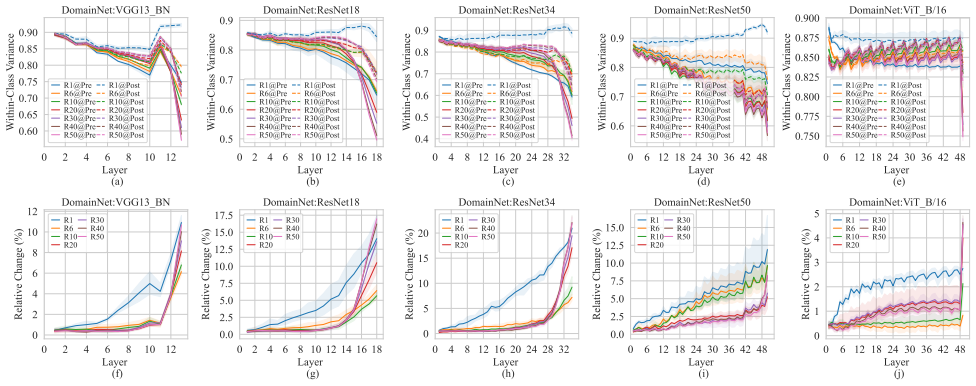
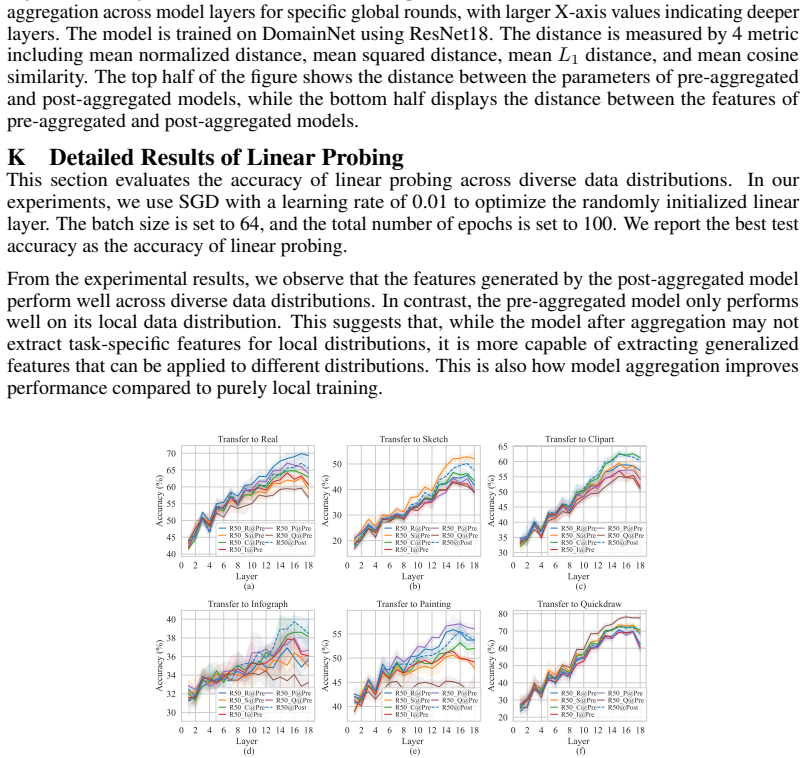
The paper's central claim is that the post-aggregation accuracy drop in federated learning is caused mainly by damage to the feature extraction process itself, not just by parameter divergence or client drift. Using metrics computed directly on a single model—normalized within-class and between-class feature variance, and the alignment between the subspace of class-mean features and the input subspace of subsequent parameters (computed via principal angles)—the authors observe that aggregation raises within-class variance, lowers between-class variance, and weakens feature-parameter alignment. These disruptions grow with network depth: degraded features from early layers propagate into later ones, so the relative change of the metrics increases layer by layer. The paper names this accumulation Cumulative Feature Degradation (CFD) and identifies two concrete manifestations, CFD-V in feature variance and CFD-A in alignment, with the sharpest alignment spike at the penultimate-layer/classifier interface. It further argues that personalizing parameters, pretrained initialization, and classifier fine-tuning all work because they mitigate CFD, while the same aggregation that hurts local discrimination improves generalization to other clients' distributions.
Load-bearing premise
The load-bearing premise is that the two measured quantities—feature variance and feature-parameter alignment—capture what actually determines downstream performance, and that the post-aggregation changes in them cause the accuracy drop rather than merely accompany it.
Editorial extensions
If this is right
- If CFD is the true cause of the post-aggregation drop, then treating the drop as an unavoidable cost of knowledge sharing is no longer necessary; convergence could be accelerated by protecting feature structure across the aggregation step.
- Deeper layers—especially the penultimate layer and its classifier—are the fragile point, so aggregation-aware methods should pay special attention to re-aligning the final classifier with locally produced features after each round.
- The three studied solution families (parameter personalization, pretrained initialization, classifier fine-tuning) succeed by the same mechanism of mitigating feature degradation, which gives a principled design criterion rather than separate empirical stories.
- Because aggregation simultaneously hurts local feature discrimination and improves cross-client generalization, methods that simply reduce aggregation strength may trade away the generalization benefit; the paper implies the goal is to repair local degradation while keeping the fusion advantage.
Reading between the lines
- Editorial extension: the metrics are observational, so a direct intervention test—such as re-projecting post-aggregation penultimate features back to the pre-aggregation variance and alignment values and checking whether local accuracy recovers—would convert the correlation into causation.
- Editorial extension: if CFD accumulates with depth, then architectures with more stages (deeper ResNets, long ViTs) should show larger relative changes in late-layer metrics, a prediction that could be tested by sweeping depth while holding data and aggregation fixed.
- Editorial extension: the framework suggests a tunable design—keep shallow layers global (they carry transferable, generalizable features) and personalize or locally fine-tune deeper layers (where task-specific compression happens)—which would sit between FedAvg and full personalization on the generalization-localization trade-off.
Signed reviews
Editorial analysis
A structured set of objections, weighed in public.
Referee Report
Summary. This paper proposes a layer-peeled feature analysis framework to study how model aggregation affects feature representations in federated learning (FL). The framework measures normalized within-class/between-class feature variance, linear probing accuracy, and alignment between features and subsequent parameters. Across three cross-domain datasets and several architectures (ConvNet, ResNet variants, VGG, ViT), the authors report that aggregation degrades feature discrimination and feature-parameter alignment, that this degradation accumulates with network depth (termed Cumulative Feature Degradation, CFD), and that it most severely affects penultimate-layer features and their coupling with the classifier. They then reinterpret three common FL remedies—parameter personalization, pretrained initialization, and classifier fine-tuning—as mitigating CFD. The paper also shows that the post-aggregated model achieves better out-of-distribution generalization.
Significance. If the main claims hold, this is a useful diagnostic perspective: it provides single-model, layer-wise metrics for understanding why FedAvg exhibits temporary performance drops under heterogeneity, and it offers an interpretable explanation for why several existing FL solutions work. The empirical coverage is broad (three datasets, six architectures), and the proposed metrics are defined externally with no fitted parameters, so the framework itself is not circular. The paper's value is primarily observational and explanatory rather than prescriptive; it does not introduce a new FL algorithm but may inspire mechanism-aware designs.
major comments (5)
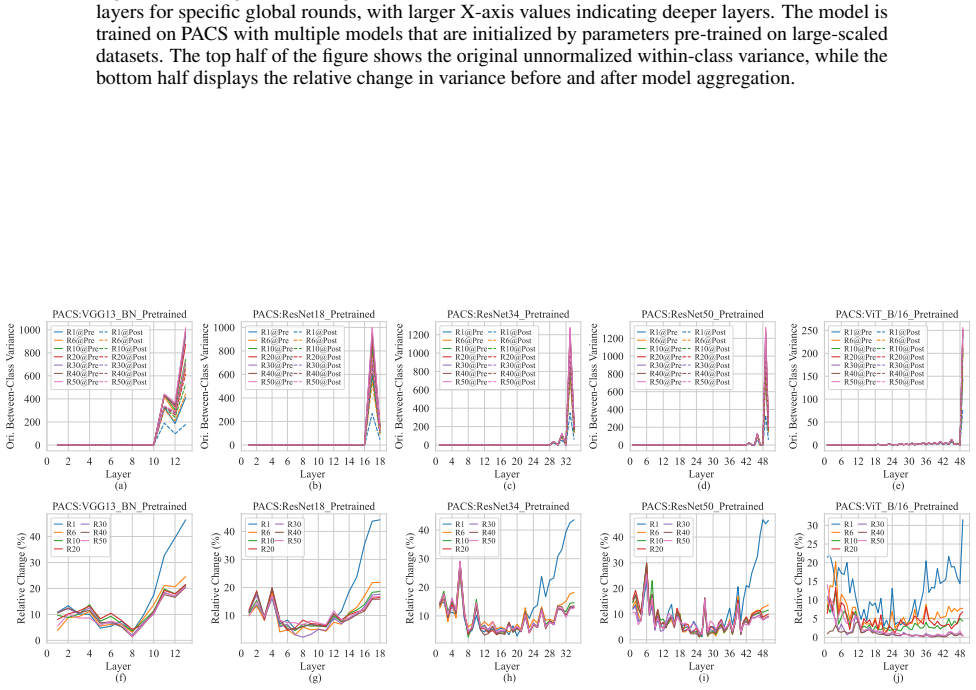
- [§4.2] The depth-increasing relative change in normalized variance (CFD-V) is confounded by the normalization in Eqs. (8)-(9). Since normalized within-class variance systematically decreases with depth (Figs. 2a and 3a), and the relative change in Eq. (14) divides by |V_pre| + |V_post|, a constant absolute perturbation produces a larger relative change at deeper layers even with no true accumulation. The authors should analyze the absolute changes of the unnormalized variances (which they report in Appendix G) or directly regress the relative change against depth while controlling for the denominator magnitude. Without this, the central 'cumulative' claim for CFD-V is not established.
- [§3.1] The paper states that all experiments are repeated three times with different random seeds, but no figure or table reports error bars, standard deviations, or confidence intervals. This matters because many claims are about monotonic trends (e.g., relative change increasing with depth in Figs. 2-3, the penultimate-layer spike in Fig. 6). I ask the authors to add error bars or shaded regions to at least the main figures, and to report seed-level variance for the key quantitative claims.
- [§4.2] The paper repeatedly states that CFD 'impairs', 'degrades', and 'ultimately degrades model performance', but the evidence is correlational. No experiment manipulates the CFD metrics while holding all other model properties fixed. The solution analyses in Section 5 alter multiple components simultaneously: personalizing shallow layers changes local training trajectories, pretraining changes the initialization distribution, and classifier fine-tuning directly changes the classifier that defines accuracy. These interventions therefore do not isolate the hypothesized mechanism. At minimum, the authors should either (a) soften the causal language to 'is associated with' and 'is consistent with', or (b) add a controlled experiment (e.g., perturbing penultimate features in a trained model and measuring accuracy) that directly links the metric to performance.
- [Appendix B] All experiments use cross-domain heterogeneity, where each client has a different input domain. Label-skew heterogeneity (different class distributions across clients) is the most common FL heterogeneity in the literature and is absent from this study. The claim that CFD is a fundamental cause of the aggregation-induced accuracy drop cannot be generalized without at least one label-skew setting (e.g., Dirichlet-partitioned CIFAR-10 or FEMNIST). Without this, the scope of the paper's main conclusion is limited to cross-domain FL.
- [§4.4] The generalization result in Section 4.4 appears to conflict with the paper's overall 'degradation' framing: the post-aggregated model has worse ID accuracy but better OOD accuracy. The paper does not quantify this trade-off or reconcile it with the claim that CFD 'degrades' feature quality. If aggregation improves generalization, then the observed variance and alignment changes are not uniformly negative. I recommend adding a quantitative comparison of the ID accuracy drop versus OOD accuracy gain, and discussing how the benefit of aggregation interacts with the CFD phenomenon.
minor comments (4)
- [Throughout] The manuscript contains numerous typos and inconsistent notation. Examples include 'intermidiate' (Eq. 4), 'featre' (Section 4.1), 'Reset50' (Section 4.3), 'VGG1_BN' (Appendix C, should be VGG13_BN), 'presenst' (Section 5.2), 'aligment' (Figure 9 caption), and inconsistent use of 'pre-aggregated' vs 'pre-aggregated' (hyphenation). A thorough language and proofreading pass is needed.
- [Figures 2-4] The axis labels in Figures 2, 3, and 4 are difficult to read, and the figure captions do not explain the color scheme or what 'L1', 'L2', etc. refer to. I recommend larger fonts and a legend that maps layer indices to the architecture.
- [§3.2] The alignment metric is described as using principal angles between the range space of class-wise feature means and the top-C subspace of the subsequent layer parameters. The description of the SVD-based computation for convolutional layers is dense and should include an explicit dimension check or a small example, especially given that the metric is central to CFD-A.
- [Appendix Q] The 'Discussion and Limitations' section is only in the appendix. Given the strong causal language used in the main text, I recommend moving a condensed limitations discussion into the main body (or at least explicitly referencing it in Section 4.2 where the causal claims are made).
Circularity Check
No significant circularity; the framework is observational and self-contained, with no fitted parameters, no load-bearing self-citation, and no prediction that reduces by construction to its inputs.
full rationale
The paper's central claims are empirical measurements: it defines feature-variance and feature-parameter alignment metrics (Appendix E, Eqs. 5-14), observes that aggregation perturbs them, and reports that the relative perturbations grow with depth (CFD). No parameter is fitted to accuracy data and then renamed a prediction; the metrics are externally defined from covariance traces and principal angles. The reinterpretation of existing FL solutions (FedPer, FedBN, pretrained initialization, classifier fine-tuning) is post hoc but not circular, because those methods were designed independently and their success is not used to define CFD. Self-citations (e.g., [50,51] for dataset partition) are confined to setup and related work and do not carry the load-bearing claim. The main validity threat, that the relative-change metric in Eq. (14) applied to normalized variances that shrink with depth may inflate apparent CFD, and that Section 5 interventions alter multiple components without isolating the mechanism, is a correctness or confounding concern rather than circularity: the observations would still be nontrivial empirical facts even if their causal interpretation is underdetermined. No step in the derivation is equivalent by construction to its own input, so the appropriate circularity score is low.
Assumptions & free parameters
assumptions (3)
- domain assumption Model performance fundamentally depends on feature quality and feature-parameter alignment.
- domain assumption Cross-domain datasets with one domain per client represent the general data-heterogeneous FL setting.
- domain assumption Normalized variance (Tr(Sigma_W)/Tr(Sigma_T)) and PABS-based alignment are valid quantitative proxies for feature quality and coupling.
Cite this review
Pith. "Pith review of The Other Side of the Coin: Unveiling the Downsides of Model Aggregation in Federated Learning from a Layer-peeled Perspective." pith.science (2026). https://pith.science/paper/K5CPIDCG
@misc{pith2026250203231,
  author       = {Pith},
  title        = {Pith review of: The Other Side of the Coin: Unveiling the Downsides of Model Aggregation in Federated Learning from a Layer-peeled Perspective},
  year         = {2026},
  howpublished = {\url{https://pith.science/paper/K5CPIDCG}},
  note         = {Machine review of arXiv:2502.03231}
}
read the original abstract
It is often observed that the aggregated model in FL underperforms on local data until after several rounds of local training. This temporary performance drop can potentially slow down the convergence of the FL model. Prior work regards this performance drop as an inherent cost of knowledge sharing among clients and does not give it special attention. While some studies directly focus on designing techniques to alleviate the issue, its root causes remain poorly understood. To bridge this gap, we construct a framework that enables layer-peeled analysis of how feature representations evolve during model aggregation in FL. It focuses on two key aspects: (1) the intrinsic quality of extracted features, and (2) the alignment between features and their subsequent parameters -- both of which are critical to downstream performance. Using this framework, we first investigate how model aggregation affects internal feature extraction process. Our analysis reveals that aggregation degrades feature quality and weakens the coupling between intermediate features and subsequent layers, both of which are well shaped during local training. More importantly, this degradation is not confined to specific layers but progressively accumulates with network depth -- a phenomenon we term Cumulative Feature Degradation (CFD). CFD significantly impairs the quality of penultimate-layer features and weakens their coupling with the classifier, ultimately degrading model performance. We further revisit several widely adopted solutions through the lens of layer-peeled feature extraction to understand why they are effective in addressing aggregation-induced performance drop. Our results show that their effectiveness lies in mitigating the feature degradation described above, which is well aligned with our observations.
Figures


Figures from the paper (85 more)








Reference graph
Works this paper leans on
-
[1]
Peter Kairouz, H Brendan McMahan, Brendan Avent, Aurélien Bellet, Mehdi Bennis, Ar- jun Nitin Bhagoji, Kallista Bonawitz, Zachary Charles, Graham Cormode, Rachel Cummings, et al. Advances and open problems in federated learning.Foundations and Trends® in Machine Learning, 14(1–2):1–210, 2021
work page 2021
-
[2]
Communication-efficient learning of deep networks from decentralized data
Brendan McMahan, Eider Moore, Daniel Ramage, Seth Hampson, and Blaise Aguera y Arcas. Communication-efficient learning of deep networks from decentralized data. InArtificial intelligence and statistics, pages 1273–1282. PMLR, 2017
2017
-
[3]
Federated learning based on dynamic regularization
Durmus Alp Emre Acar, Yue Zhao, Ramon Matas, Matthew Mattina, Paul Whatmough, and Venkatesh Saligrama. Federated learning based on dynamic regularization. InInternational Conference on Learning Representations, 2021. URL https://openreview.net/forum? id=B7v4QMR6Z9w
2021
-
[4]
Federated optimization in heterogeneous networks.Proceedings of Machine learning and systems, 2:429–450, 2020
Tian Li, Anit Kumar Sahu, Manzil Zaheer, Maziar Sanjabi, Ameet Talwalkar, and Virginia Smith. Federated optimization in heterogeneous networks.Proceedings of Machine learning and systems, 2:429–450, 2020
2020
-
[5]
Scaffold: Stochastic controlled averaging for federated learning
Sai Praneeth Karimireddy, Satyen Kale, Mehryar Mohri, Sashank Reddi, Sebastian Stich, and Ananda Theertha Suresh. Scaffold: Stochastic controlled averaging for federated learning. In International conference on machine learning, pages 5132–5143. PMLR, 2020
2020
-
[6]
Hai Jin, Dongshan Bai, Dezhong Yao, Yutong Dai, Lin Gu, Chen Yu, and Lichao Sun. Personal- ized edge intelligence via federated self-knowledge distillation.IEEE Transactions on Parallel and Distributed Systems, 34(2):567–580, 2022
work page 2022
-
[7]
Gihun Lee, Minchan Jeong, Yongjin Shin, Sangmin Bae, and Se-Young Yun. Preservation of the global knowledge by not-true distillation in federated learning.Advances in Neural Information Processing Systems, 35:38461–38474, 2022
work page 2022
-
[8]
Rethinking personalized federated learning from knowledge perspective
Dezhong Yao, Ziquan Zhu, Tongtong Liu, Zhiqiang Xu, and Hai Jin. Rethinking personalized federated learning from knowledge perspective. InProceedings of the 53rd International Conference on Parallel Processing, pages 991–1000, 2024
work page 2024
Show all 77 references
-
[9]
Federated learning on non-iid data: A survey.Neurocomputing, 465:371–390, 2021
Hangyu Zhu, Jinjin Xu, Shiqing Liu, and Yaochu Jin. Federated learning on non-iid data: A survey.Neurocomputing, 465:371–390, 2021
2021
-
[10]
Fedbn: Federated learning on non-iid features via local batch normalization
Xiaoxiao Li, Meirui JIANG, Xiaofei Zhang, Michael Kamp, and Qi Dou. Fedbn: Federated learning on non-iid features via local batch normalization. InInternational Conference on Learning Representations, 2021
2021
-
[11]
Bold but cautious: Unlocking the potential of personalized federated learning through cautiously aggressive collab- oration
Xinghao Wu, Xuefeng Liu, Jianwei Niu, Guogang Zhu, and Shaojie Tang. Bold but cautious: Unlocking the potential of personalized federated learning through cautiously aggressive collab- oration. InProceedings of the IEEE/CVF International Conference on Computer Vision, pages 19...
2023
-
[12]
Model-contrastive federated learning
Qinbin Li, Bingsheng He, and Dawn Song. Model-contrastive federated learning. InProceedings of the IEEE/CVF conference on computer vision and pattern recognition, pages 10713–10722, 2021
2021
-
[13]
Federated learning with personalization layers.arXiv preprint arXiv:1912.00818, 2019
Manoj Ghuhan Arivazhagan, Vinay Aggarwal, Aaditya Kumar Singh, and Sunav Choudhary. Federated learning with personalization layers.arXiv preprint arXiv:1912.00818, 2019. 10
1912 arXiv
-
[14]
Think locally, act globally: Federated learning with local and global representations.arXiv preprint arXiv:2001.01523, 2020
Paul Pu Liang, Terrance Liu, Liu Ziyin, Nicholas B Allen, Randy P Auerbach, David Brent, Ruslan Salakhutdinov, and Louis-Philippe Morency. Think locally, act globally: Federated learning with local and global representations.arXiv preprint arXiv:2001.01523, 2020
2001 arXiv
-
[15]
Partialfed: Cross-domain personalized federated learning via partial initialization.Advances in Neural Information Processing Systems, 34:23309–23320, 2021
Benyuan Sun, Hongxing Huo, Yi Yang, and Bo Bai. Partialfed: Cross-domain personalized federated learning via partial initialization.Advances in Neural Information Processing Systems, 34:23309–23320, 2021
2021
-
[16]
Where to begin? on the impact of pre-training and initialization in federated learning
John Nguyen, Jianyu Wang, Kshitiz Malik, Maziar Sanjabi, and Michael Rabbat. Where to begin? on the impact of pre-training and initialization in federated learning. InThe Eleventh International Conference on Learning Representations, 2023. URL https://openreview. net/forum?id=...
2023
-
[17]
On the importance and applicability of pre-training for federated learning
Hong-You Chen, Cheng-Hao Tu, Ziwei Li, Han Wei Shen, and Wei-Lun Chao. On the importance and applicability of pre-training for federated learning. InThe Eleventh International Conference on Learning Representations, 2023. URL https://openreview.net/forum? id=fWWFv--P0xP
2023
-
[18]
Fedbabu: Toward enhanced representation for federated image classification
Jaehoon Oh, SangMook Kim, and Se-Young Yun. Fedbabu: Toward enhanced representation for federated image classification. InInternational Conference on Learning Representations, 2022
2022
-
[19]
No fear of classifier biases: Neural collapse inspired federated learning with synthetic and fixed classifier
Zexi Li, Xinyi Shang, Rui He, Tao Lin, and Chao Wu. No fear of classifier biases: Neural collapse inspired federated learning with synthetic and fixed classifier. InProceedings of the IEEE/CVF International Conference on Computer Vision (ICCV), pages 5319–5329, October 2023
2023
-
[20]
Methods for interpreting and understanding deep neural networks.Digital signal processing, 73:1–15, 2018
Grégoire Montavon, Wojciech Samek, and Klaus-Robert Müller. Methods for interpreting and understanding deep neural networks.Digital signal processing, 73:1–15, 2018
2018
-
[21]
Explaining deep neural networks and beyond: A review of methods and applications.Proceedings of the IEEE, 109(3):247–278, 2021
Wojciech Samek, Grégoire Montavon, Sebastian Lapuschkin, Christopher J Anders, and Klaus- Robert Müller. Explaining deep neural networks and beyond: A review of methods and applications.Proceedings of the IEEE, 109(3):247–278, 2021
2021
-
[22]
How transferable are features in deep neural networks?Advances in neural information processing systems, 27, 2014
Jason Yosinski, Jeff Clune, Yoshua Bengio, and Hod Lipson. How transferable are features in deep neural networks?Advances in neural information processing systems, 27, 2014
2014
-
[23]
Feature visualization.Distill, 2(11): e7, 2017
Chris Olah, Alexander Mordvintsev, and Ludwig Schubert. Feature visualization.Distill, 2(11): e7, 2017
2017
-
[24]
The tunnel effect: Building data representations in deep neural networks
Wojciech Masarczyk, Mateusz Ostaszewski, Ehsan Imani, Razvan Pascanu, Piotr Miło´s, and Tomasz Trzcinski. The tunnel effect: Building data representations in deep neural networks. Advances in Neural Information Processing Systems, 36, 2024
2024
-
[25]
Under- standing deep representation learning via layerwise feature compression and discrimination
Peng Wang, Xiao Li, Can Yaras, Zhihui Zhu, Laura Balzano, Wei Hu, and Qing Qu. Under- standing deep representation learning via layerwise feature compression and discrimination. arXiv preprint arXiv:2311.02960, 2023
2023 arXiv
-
[26]
Visualizing and understanding convolutional networks
Matthew D Zeiler and Rob Fergus. Visualizing and understanding convolutional networks. In Computer Vision–ECCV 2014: 13th European Conference, Zurich, Switzerland, September 6-12, 2014, Proceedings, Part I 13, pages 818–833. Springer, 2014
2014
-
[27]
Feature learning in deep classifiers through intermediate neural collapse
Akshay Rangamani, Marius Lindegaard, Tomer Galanti, and Tomaso A Poggio. Feature learning in deep classifiers through intermediate neural collapse. InInternational Conference on Machine Learning, pages 28729–28745. PMLR, 2023
2023
-
[28]
No fear of hetero- geneity: Classifier calibration for federated learning with non-iid data.Advances in Neural Information Processing Systems, 34:5972–5984, 2021
Mi Luo, Fei Chen, Dapeng Hu, Yifan Zhang, Jian Liang, and Jiashi Feng. No fear of hetero- geneity: Classifier calibration for federated learning with non-iid data.Advances in Neural Information Processing Systems, 34:5972–5984, 2021
2021
-
[29]
Yun-Hin Chan, Rui Zhou, Running Zhao, Zhihan JIANG, and Edith C. H. Ngai. Internal cross-layer gradients for extending homogeneity to heterogeneity in federated learning. In The Twelfth International Conference on Learning Representations, 2024. URL https:// openreview.net/for...
2024
-
[30]
Layer-wise linear mode connectivity
Linara Adilova, Maksym Andriushchenko, Michael Kamp, Asja Fischer, and Martin Jaggi. Layer-wise linear mode connectivity. InThe Twelfth International Conference on Learning Representations, 2024. URLhttps://openreview.net/forum?id=LfmZh91tDI
2024
-
[31]
Deeper, broader and artier domain generalization
Da Li, Yongxin Yang, Yi-Zhe Song, and Timothy M Hospedales. Deeper, broader and artier domain generalization. InProceedings of the IEEE international conference on computer vision, pages 5542–5550, 2017
2017
-
[32]
Moment matching for multi-source domain adaptation
Xingchao Peng, Qinxun Bai, Xide Xia, Zijun Huang, Kate Saenko, and Bo Wang. Moment matching for multi-source domain adaptation. InProceedings of the IEEE/CVF international conference on computer vision, pages 1406–1415, 2019
2019
-
[33]
Very deep convolutional networks for large-scale image recognition.arXiv preprint arXiv:1409.1556, 2014
Karen Simonyan and Andrew Zisserman. Very deep convolutional networks for large-scale image recognition.arXiv preprint arXiv:1409.1556, 2014
2014 arXiv
-
[34]
Deep residual learning for image recognition
Kaiming He, Xiangyu Zhang, Shaoqing Ren, and Jian Sun. Deep residual learning for image recognition. InProceedings of the IEEE conference on computer vision and pattern recognition, pages 770–778, 2016
2016
-
[35]
An image is worth 16x16 words: Transformers for image recognition at scale
Alexey Dosovitskiy, Lucas Beyer, Alexander Kolesnikov, Dirk Weissenborn, Xiaohua Zhai, Thomas Unterthiner, Mostafa Dehghani, Matthias Minderer, Georg Heigold, Sylvain Gelly, Jakob Uszkoreit, and Neil Houlsby. An image is worth 16x16 words: Transformers for image recognition at...
2021
-
[36]
A simple framework for contrastive learning of visual representations
Ting Chen, Simon Kornblith, Mohammad Norouzi, and Geoffrey Hinton. A simple framework for contrastive learning of visual representations. InInternational conference on machine learning, pages 1597–1607. PMLR, 2020
2020
-
[37]
Masked autoencoders are scalable vision learners
Kaiming He, Xinlei Chen, Saining Xie, Yanghao Li, Piotr Dollár, and Ross Girshick. Masked autoencoders are scalable vision learners. InProceedings of the IEEE/CVF Conference on Computer Vision and Pattern Recognition, pages 16000–16009, 2022
2022
-
[38]
Does learning from decentralized non-iid unlabeled data benefit from self supervision? InThe Eleventh International Conference on Learning Representations, 2023
Lirui Wang, Kaiqing Zhang, Yunzhu Li, Yonglong Tian, and Russ Tedrake. Does learning from decentralized non-iid unlabeled data benefit from self supervision? InThe Eleventh International Conference on Learning Representations, 2023
2023
-
[39]
Essai sur la géométrie à n dimensions.Bulletin de la Société mathématique de France, 3:103–174, 1875
Camille Jordan. Essai sur la géométrie à n dimensions.Bulletin de la Société mathématique de France, 3:103–174, 1875
-
[40]
Numerical methods for computing angles between linear subspaces.Mathematics of computation, 27(123):579–594, 1973
¯Ake Björck and Gene H Golub. Numerical methods for computing angles between linear subspaces.Mathematics of computation, 27(123):579–594, 1973
1973
-
[41]
Visualizing data using t-sne.Journal of machine learning research, 9(11), 2008
Laurens Van der Maaten and Geoffrey Hinton. Visualizing data using t-sne.Journal of machine learning research, 9(11), 2008
2008
-
[42]
Local sgd converges fast and communicates little
Sebastian U Stich. Local sgd converges fast and communicates little. InInternational Conference on Learning Representations, 2018
2018
-
[43]
Is local sgd better than minibatch sgd? In International Conference on Machine Learning, pages 10334–10343
Blake Woodworth, Kumar Kshitij Patel, Sebastian Stich, Zhen Dai, Brian Bullins, Brendan Mcmahan, Ohad Shamir, and Nathan Srebro. Is local sgd better than minibatch sgd? In International Conference on Machine Learning, pages 10334–10343. PMLR, 2020
2020
-
[44]
Federated learning with non-iid data.arXiv preprint arXiv:1806.00582, 2018
Yue Zhao, Meng Li, Liangzhen Lai, Naveen Suda, Damon Civin, and Vikas Chandra. Federated learning with non-iid data.arXiv preprint arXiv:1806.00582, 2018
2018 arXiv
-
[45]
pfedgf: Enabling personalized federated learning via gradient fusion
Xinghao Wu, Jianwei Niu, Xuefeng Liu, Tao Ren, Zhangmin Huang, and Zhetao Li. pfedgf: Enabling personalized federated learning via gradient fusion. In2022 IEEE International Parallel and Distributed Processing Symposium (IPDPS), pages 639–649. IEEE, 2022
2022
-
[46]
Exploiting shared representations for personalized federated learning
Liam Collins, Hamed Hassani, Aryan Mokhtari, and Sanjay Shakkottai. Exploiting shared representations for personalized federated learning. InInternational Conference on Machine Learning, pages 2089–2099. PMLR, 2021. 12
2021
-
[47]
Channelfed: Enabling personalized federated learning via localized channel attention
Kaiyu Zheng, Xuefeng Liu, Guogang Zhu, Xinghao Wu, and Jianwei Niu. Channelfed: Enabling personalized federated learning via localized channel attention. InGLOBECOM 2022-2022 IEEE Global Communications Conference, pages 2987–2992. IEEE, 2022
2022
-
[48]
Decoupling general and personalized knowledge in federated learning via additive and low-rank decomposition.arXiv preprint arXiv:2406.19931, 2024
Xinghao Wu, Xuefeng Liu, Jianwei Niu, Haolin Wang, Shaojie Tang, Guogang Zhu, and Hao Su. Decoupling general and personalized knowledge in federated learning via additive and low-rank decomposition.arXiv preprint arXiv:2406.19931, 2024
2024 arXiv
-
[49]
Fedproto: Federated prototype learning across heterogeneous clients
Yue Tan, Guodong Long, Lu Liu, Tianyi Zhou, Qinghua Lu, Jing Jiang, and Chengqi Zhang. Fedproto: Federated prototype learning across heterogeneous clients. InProceedings of the AAAI Conference on Artificial Intelligence, volume 36, pages 8432–8440, 2022
2022
-
[50]
Aligning before aggregating: Enabling cross-domain federated learning via consistent feature extraction
Guogang Zhu, Xuefeng Liu, Shaojie Tang, and Jianwei Niu. Aligning before aggregating: Enabling cross-domain federated learning via consistent feature extraction. In2022 IEEE 42nd International Conference on Distributed Computing Systems (ICDCS), pages 809–819. IEEE, 2022
2022
-
[51]
Aligning before aggregating: En- abling communication efficient cross-domain federated learning via consistent feature extraction
Guogang Zhu, Xuefeng Liu, Shaojie Tang, and Jianwei Niu. Aligning before aggregating: En- abling communication efficient cross-domain federated learning via consistent feature extraction. IEEE Transactions on Mobile Computing, 2023
2023
-
[52]
Fedfa: Federated learning with feature anchors to align features and classifiers for heterogeneous data.IEEE Transactions on Mobile Computing, 2023
Tailin Zhou, Jun Zhang, and Danny HK Tsang. Fedfa: Federated learning with feature anchors to align features and classifiers for heterogeneous data.IEEE Transactions on Mobile Computing, 2023
2023
-
[53]
Rethinking federated learning with domain shift: A prototype view
Wenke Huang, Mang Ye, Zekun Shi, He Li, and Bo Du. Rethinking federated learning with domain shift: A prototype view. In2023 IEEE/CVF Conference on Computer Vision and Pattern Recognition (CVPR), pages 16312–16322. IEEE, 2023
2023
-
[54]
Spherefed: Hyperspherical federated learning
Xin Dong, Sai Qian Zhang, Ang Li, and HT Kung. Spherefed: Hyperspherical federated learning. InEuropean Conference on Computer Vision, pages 165–184. Springer, 2022
2022
-
[55]
Towards understanding and mitigating dimensional collapse in heterogeneous federated learning
Yujun Shi, Jian Liang, Wenqing Zhang, Vincent Tan, and Song Bai. Towards understanding and mitigating dimensional collapse in heterogeneous federated learning. InThe Eleventh International Conference on Learning Representations, 2023. URL https://openreview. net/forum?id=EXnIyMVTL8s
2023
-
[56]
Under- standing and mitigating dimensional collapse in federated learning.IEEE Transactions on Pattern Analysis and Machine Intelligence, 2023
Yujun Shi, Jian Liang, Wenqing Zhang, Chuhui Xue, Vincent YF Tan, and Song Bai. Under- standing and mitigating dimensional collapse in federated learning.IEEE Transactions on Pattern Analysis and Machine Intelligence, 2023
2023
-
[57]
Taming cross-domain rep- resentation variance in federated prototype learning with heterogeneous data domains
Lei Wang, Jieming Bian, Letian Zhang, Chen Chen, and Jie Xu. Taming cross-domain rep- resentation variance in federated prototype learning with heterogeneous data domains. In The Thirty-eighth Annual Conference on Neural Information Processing Systems, 2024. URL https://openre...
2024
-
[58]
Imagenet classification with deep convolutional neural networks.Advances in neural information processing systems, 25, 2012
Alex Krizhevsky, Ilya Sutskever, and Geoffrey E Hinton. Imagenet classification with deep convolutional neural networks.Advances in neural information processing systems, 25, 2012
2012
-
[59]
Backward feature correction: How deep learning performs deep (hierarchical) learning
Zeyuan Allen-Zhu and Yuanzhi Li. Backward feature correction: How deep learning performs deep (hierarchical) learning. InThe Thirty Sixth Annual Conference on Learning Theory, pages 4598–4598. PMLR, 2023
2023
-
[60]
Dualfed: enjoying both generalization and personalization in federated learning via hierachical representations
Guogang Zhu, Xuefeng Liu, Jianwei Niu, Shaojie Tang, Xinghao Wu, and Jiayuan Zhang. Dualfed: enjoying both generalization and personalization in federated learning via hierachical representations. InProceedings of the 32nd ACM International Conference on Multimedia, pages 1106...
2024
-
[61]
Head2toe: Utilizing intermediate representations for better transfer learning
Utku Evci, Vincent Dumoulin, Hugo Larochelle, and Michael C Mozer. Head2toe: Utilizing intermediate representations for better transfer learning. InInternational Conference on Machine Learning, pages 6009–6033. PMLR, 2022. 13
2022
-
[62]
Fine- tuning can distort pretrained features and underperform out-of-distribution
Ananya Kumar, Aditi Raghunathan, Robbie Matthew Jones, Tengyu Ma, and Percy Liang. Fine- tuning can distort pretrained features and underperform out-of-distribution. InInternational Conference on Learning Representations, 2022. URL https://openreview.net/forum? id=UYneFzXSJWh
2022
-
[63]
Understanding intermediate layers using linear classifier probes, 2017
Guillaume Alain and Yoshua Bengio. Understanding intermediate layers using linear classifier probes, 2017. URLhttps://openreview.net/forum?id=ryF7rTqgl
2017
-
[64]
Prevalence of neural collapse during the terminal phase of deep learning training.Proceedings of the National Academy of Sciences, 117 (40):24652–24663, 2020
Vardan Papyan, XY Han, and David L Donoho. Prevalence of neural collapse during the terminal phase of deep learning training.Proceedings of the National Academy of Sciences, 117 (40):24652–24663, 2020
2020
-
[65]
Intrinsic dimension of data representations in deep neural networks.Advances in Neural Information Processing Systems, 32, 2019
Alessio Ansuini, Alessandro Laio, Jakob H Macke, and Davide Zoccolan. Intrinsic dimension of data representations in deep neural networks.Advances in Neural Information Processing Systems, 32, 2019
2019
-
[66]
Understanding and improving transfer learning of deep models via neural collapse.Transactions on Machine Learning Research, 2024
Xiao Li, Sheng Liu, Jinxin Zhou, Xinyu Lu, Carlos Fernandez-Granda, Zhihui Zhu, and Qing Qu. Understanding and improving transfer learning of deep models via neural collapse.Transactions on Machine Learning Research, 2024. ISSN 2835-8856. URL https://openreview.net/ forum?id=o...
2024
-
[67]
Lempitsky
Yaroslav Ganin and Victor S. Lempitsky. Unsupervised domain adaptation by backpropagation. InInt. Conf. Machin. Learn., pages 1180–1189, 2015
2015
-
[68]
Gradient-based learning applied to document recognition.Proc
Yann LeCun, Léon Bottou, Yoshua Bengio, and Patrick Haffner. Gradient-based learning applied to document recognition.Proc. IEEE (USA), pages 2278–2324, 1998
1998
-
[69]
Jonathan J. Hull. A database for handwritten text recognition research.IEEE Trans. Pattern Anal. Mach. Intell., 16(5):550–554, 1994
1994
-
[70]
Reading digits in natural images with unsupervised feature learning
Yuval Netzer, Tao Wang, Adam Coates, Alessandro Bissacco, Bo Wu, and Andrew Y Ng. Reading digits in natural images with unsupervised feature learning. 2011
2011
-
[71]
Pytorch: An imperative style, high-performance deep learning library.Advances in neural information processing systems, 32, 2019
Adam Paszke, Sam Gross, Francisco Massa, Adam Lerer, James Bradbury, Gregory Chanan, Trevor Killeen, Zeming Lin, Natalia Gimelshein, Luca Antiga, et al. Pytorch: An imperative style, high-performance deep learning library.Advances in neural information processing systems, 32, 2019
2019
-
[72]
Simulated annealing in early layers leads to better generalization
Amir M Sarfi, Zahra Karimpour, Muawiz Chaudhary, Nasir M Khalid, Mirco Ravanelli, Sudhir Mudur, and Eugene Belilovsky. Simulated annealing in early layers leads to better generalization. InProceedings of the IEEE/CVF Conference on Computer Vision and Pattern Recognition, pages...
2023
-
[73]
What variables affect out-of-distribution generalization in pretrained models? InThe Thirty- eighth Annual Conference on Neural Information Processing Systems, 2024
Md Yousuf Harun, Kyungbok Lee, Jhair Gallardo, Giri Prashanth, and Christopher Kanan. What variables affect out-of-distribution generalization in pretrained models? InThe Thirty- eighth Annual Conference on Neural Information Processing Systems, 2024. URL https: //openreview.n...
2024
-
[74]
Do vision transformers see like convolutional neural networks?Advances in neural information processing systems, 34:12116–12128, 2021
Maithra Raghu, Thomas Unterthiner, Simon Kornblith, Chiyuan Zhang, and Alexey Dosovitskiy. Do vision transformers see like convolutional neural networks?Advances in neural information processing systems, 34:12116–12128, 2021. 14 Appendix Contents 1 Introduction 1 2 Problem For...
2021
-
[75]
Let the features of the pre-aggregated and post-aggregated models be denoted as Z ℓ pre and Z ℓ post, respectively
Thus, the distance computation is applied to these features can be directly transferred to models. Let the features of the pre-aggregated and post-aggregated models be denoted as Z ℓ pre and Z ℓ post, respectively. The corresponding distance can then be computed as follows. 21...
-
[76]
Discussions and Limitations
and FedPer[13], applying the framework to a broader range of state-of-the-art algorithms could further validate its generality and reveal new insights into their effectiveness. 62 NeurIPS Paper Checklist 1.Claims Question: Do the main claims made in the abstract and introducti...
-
[77]
Guidelines: • The answer NA means that the paper does not involve crowdsourcing nor research with human subjects
Institutional review board (IRB) approvals or equivalent for research with human subjects Question: Does the paper describe potential risks incurred by study participants, whether such risks were disclosed to the subjects, and whether Institutional Review Board (IRB) approvals...
2025
Reviewed August 9, 2026 · model on record in the stance chip above.
Discussion (0). Continue with ORCID to comment.