REVIEW 4 major objections 4 minor 15 references
Cosmology on the Generalized Proca Theory
T0 review · 4 major / 4 minor · reviewed 2026-08-09 · deepseek-v4-flash
Pith's one-line read Generalized SU(2) Proca theory fails to provide a complete cosmological history because the Hubble parameter becomes indeterminate at each crossing of the pseudo-stationary points and complex after escape.
desk verdict GSU2P chapter has a load-bearing coordinate-singularity problem; the central 'nonphysical H' claim is likely an artifact, though the paper is careful and worth a serious referee. read the letter →
The pith
A machine-rendered reading of the paper's core claim, the machinery that carries it, and where it could break.
The reading
What carries the argument
The load-bearing construction is the autonomous system in the dimensionless variables $x\equiv \dot{\psi}/(\sqrt{2}m_P H)$, $y\equiv \psi/(\sqrt{2}m_P)$, and $z\equiv \sqrt{\hat{g}/(2m_P H)}\,\psi$, with the constraint $1=(x+y)^2(1-12c_2y^2)+8(c_1-c_2)xy^3+2z^4$ and the inversion $H^2/m_P^2=\hat{g}^2(y/z)^4$. The argument turns on two pseudo-stationary structures: the large-field straight line $y=\beta_0 x$, along which the field obeys constant-roll dynamics $\ddot{\psi}=H\dot{\psi}/\beta_0$ and behaves like de Sitter, and the small-field central zone generated by the nullcline points $U_\pm=\{\pm1,0\}$, where $x'=0$ while the denominator $D_{x'}$ of the evolution equation vanishes. The mechanism that kills viability is the ratio $y/z$ in the Hubble inversion: $z\to0$ at $U_\pm$ makes $H$ indeterminate, and the sign flip of $z^4$ after the trajectory escapes makes $H$ complex. The absence of a limit cycle in the central zone is what turns these local pathologies into a terminal failure.
What would settle it
Rederive the same dynamics in the original variables $(\psi,H)$ or on a compactified phase space and integrate a trajectory through the point where $y=0$ (equivalently $\psi=0$) with a high-precision integrator. If the Hubble parameter stays finite and real both at the crossing and after the trajectory leaves the central zone, the claimed nonphysical expansion rate is an artifact of the normalized variables and the ruling-out conclusion collapses.
Extended reading notes
Core claim
The central claim is that the GSU2P theory, within the parameter sector that avoids ghost and Laplacian instabilities and keeps gravitational waves luminal, cannot generate a complete cosmic history. The de Sitter fixed points $A_\pm$ are formally accelerated solutions with $w_B=-1$, but in their attraction regions the rescaled density $\hat\rho_B$ is negative (equivalently $z^4<0$), while the other fixed points $B_\pm$ and $C_\pm$ make the field density, and hence $H$, diverge. Away from fixed points, the phase space is organized by pseudo-stationary structures: a constant-roll attractor line $y=\beta_0 x$ at large field values, and a small-field 'central zone' bounded by the two saddle-like points $U_\pm=\{\pm1,0\}$ where the nullcline $x'=0$ meets $y=0$. Trajectories that follow the attractor line toward smaller fields enter this central zone and oscillate between $U_+$ and $U_-$ with the field behaving as radiation, but at every crossing $z\to0$ makes $H^2=\hat{g}^2(y/z)^4$ indeterminate; because no limit cycle exists, the trajectory escapes after a few e-folds, $z^4$ flips sign, and $H$ becomes complex. Regularization of the autonomous equations also reveals singular points $S_\pm$ where the numerator and denominator of $x'$ vanish simultaneously, making the system non-integrable. The paper concludes that the theory cannot provide a graceful exit from inflation or a transition from matter domination to dark-energy domination, and is therefore not a viable complete model of cosmic acceleration.
Load-bearing premise
The argument assumes the singularities at the pseudo-stationary points are physical properties of the GSU2P theory and not artifacts of the dimensionless variables chosen to write the equations; if a different choice of variables makes the Hubble parameter smooth and real through the central zone, the central conclusion collapses.
Editorial extensions
If this is right
- Within the stable sector of GSU2P, no trajectory can connect a radiation- or matter-dominated era to an accelerated phase while keeping the Hubble parameter real: the crossing of the central zone always produces an undefined or complex $H$.
- The constant-roll phase that begins on the line $y=\beta_0 x$ can produce about 65 e-folds of inflation for the reference initial conditions, but it cannot end gracefully; the exit is replaced by oscillations and then divergence.
- The absence of a limit cycle means the small-field radiation-like behavior is transient, not periodic, so the central zone cannot act as a long-lived dark-energy precursor or reheating stage.
- If trajectories start inside the central zone with late-time dark energy in mind, the field grows and dominates the cosmic budget within a few e-folds, preventing a matter-dominated epoch.
- The only apparently viable route is to begin near the $A_\pm$ de Sitter attractors or tune $\hat{g}$ so the field locks onto the attractor almost immediately, in which case the model is observationally indistinguishable from $\Lambda$CDM.
Reading between the lines
- A consequence the paper leaves implicit is that the same $U_\pm$ obstruction should appear in any SU(2) vector-field theory whose isotropic configuration is a cosmic triad, because the singularity is tied to $\psi\to0$ and $z\to0$ rather than to the specific GSU2P couplings.
- If the $H$ divergence is a physical singularity rather than a coordinate artifact, then GSU2P is excluded not just as a complete history but as a model for any transition between non-accelerated and accelerated eras; a measured real Hubble rate across such a transition would be a direct contradiction.
- A testable extension would be to compactify the phase space, for example by adding a projective coordinate that removes the $y\to0$ divergence, and repeat the analysis; if the central zone becomes regular in the compactified variables, the paper's central objection would be weakened, whereas if it persists, the theory would be robustly ruled out on dynamical grounds.
Editorial analysis
A structured set of objections, weighed in public.
Referee Report
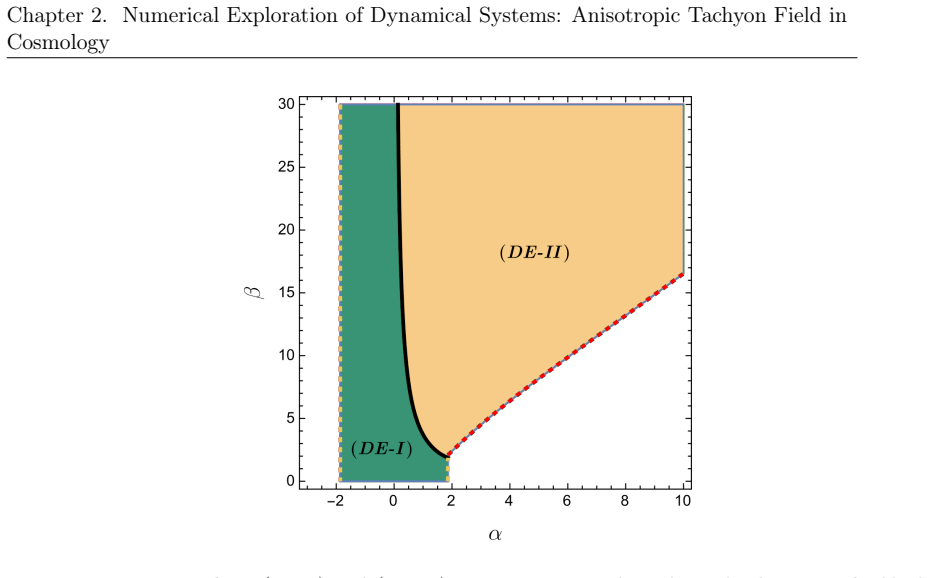
Summary. This manuscript, presented as a Master's thesis, applies dynamical-systems methods to two cosmological models. Chapter 2 develops a stochastic numerical procedure to locate and classify fixed points of an anisotropic tachyon-vector dark-energy model in a Bianchi-I background, identifying parameter regions with an anisotropic accelerated attractor (DE-II). Chapter 3 analyzes the Generalized SU(2) Proca (GSU2P) theory in a flat FLRW universe with a cosmic-triad configuration, deriving fixed points, pseudo-stationary states, and a 'central zone' whose crossings allegedly make the Hubble parameter indeterminate or complex. The paper's headline conclusion is that GSU2P fails as a complete cosmological model because of recurrent nonphysical expansion rates and unstable trajectories.
Significance. The numerical framework of Chapter 2 is a useful contribution: it is clearly described, reproducible (code on GitHub), and its ability to identify attractor regions without analytical fixed points is demonstrated. Chapter 3 contains substantive analytical work: the reduction of GSU2P to a two-dimensional autonomous system, the stability conditions (3.1)–(3.3), the fixed-point catalogue (3.20)–(3.22), and the parameter-space maps are valuable. If the conclusion that GSU2P cannot provide a viable cosmic history were rigorously established, it would be an important exclusion result for modified-gravity cosmology. However, the manuscript does not yet establish this conclusion, because the apparent singularities of the Hubble parameter appear to be artifacts of the singular change of variables (3.14).
major comments (4)
- [Sec. 3.3.3 and Eq. (3.30)] The recurrent 'nonphysical expansion rates' at the pseudo-stationary points U± are not established, because the variables (3.14) are singular at y=0. When ψ=0, any finite H maps to z=0, so Eq. (3.30) is an indeterminate 0/0 identity rather than a prediction about H. The original equations are regular at this locus: with ψ=0, Eq. (3.9) gives ρ_B=(3/2)ψdot² and hence H²=ψdot²/(2m_P²), while Eq. (3.18) gives ϵ=2, so H'/H=−2 and H remains finite through the crossing. The eigenvalues in Eqs. (3.49)–(3.50) diverge as 1/y, indicating that the linearization is performed outside the regular domain of the vector field. The conclusion in Section 3.4 that U± are physical singularities is therefore unsupported; the analysis should be repeated in a regular chart (for example, the original variables) before the viability claim is made.
- [Sec. 3.2.4, fixed points B± and C±] The statement that ρ_B diverges and H becomes infinite at B± and C± follows from Eq. (3.30) with z=0. But z=0 with y≠0 is a degeneracy of the Hubble-normalized coordinates, not necessarily a physical divergence. In that case the Friedmann constraint (3.15) becomes a condition that cancels the leading H² terms, leaving H undetermined rather than forcing it to infinity. A finite-H solution may exist at these points. The nonviability of B± and C± should be demonstrated in the original variables or by a regular limiting procedure, rather than inferred directly from the 0/0 form of Eq. (3.30).
- [Sec. 3.3.3, Figs. 3.2–3.5] The claim that H becomes complex after the trajectory escapes the central zone is based on the sign flip of z⁴ in the reconstructed identity H²/m_P²=ĝ²(y/z)^4. This identity is only meaningful while the map (3.14) is invertible; at the crossing z=0 it gives H²→∞, so the numerical trajectory in (x,y) leaves the domain of the chart before H² can change sign. Continuing the reduced autonomous system through this surface does not by itself describe a solution of the original field equations (3.8)–(3.13). The paper should either integrate the original equations directly or justify that the continuation through z=0 is physically meaningful.
- [Abstract and Sec. 3.4] The abstract states that GSU2P is 'ultimately rul[ed] out' as a complete description of the Universe's expansion, but Section 3.4 concedes that the analysis applies only to the parameter choice that makes the theory perturbatively GR-like and that other 'trivial' parameter choices are largely unexplored. Given the coordinate-singularity issues described above, this strong conclusion is not supported by the presented analysis. The conclusion should be explicitly restricted to the parameter sector examined, or the additional sectors must be analyzed before a global ruling-out claim is made.
minor comments (4)
- [Sec. 3.2.1, Eq. (3.17)] The definition p≡\ddotψ/(m_P H) appears dimensionally inconsistent with the evolution equation x'=p/√2+xϵ; the correct dimensionless combination is likely p≡\ddotψ/(m_P H²). Please check this definition and its use throughout Section 3.2.1.
- [Table 2.1] The caption states a mean error of 20% in Σ, but several entries, e.g., the row with β=800, show uncertainties exceeding 60% of the central value. The definition of the quoted error and the convergence criterion for the numerical integration should be clarified.
- [Sec. 1.5.1, step 4] The criterion 'the stability of the point in the parameter space is determined by the most stable point' is ambiguous; it should specify whether 'most stable' means the largest number of negative eigenvalues or the smallest spectral abscissa.
- [Figure 3.3 caption] The caption contains a typo: 'the precise moments at which y crosses cero' should read 'crosses zero'.
Circularity Check
Central no-go claim is built into the Hubble-normalized variables z ∝ ψ/H; the rest of the dynamical analysis is self-contained.
-
self definitional
[Section 3.2.1, Eq. (3.14); Section 3.2.4, Eq. (3.30); Section 3.3.3]
"z≡ sqrt(ĝ/(2m_P H)) ψ [Eq. (3.14)]; 'The Hubble parameter, H, can be expressed in terms of the dynamical variables as: H²/m_P² = ĝ²(y/z)^4' [Eq. (3.30)]; 'At each crossing through U ±, the expansion rate becomes undefined' [Sec. 3.3.3]."
By definition y=ψ/(√2 m_P) and z=√(ĝ/(2 m_P H)) ψ, so y/z=√(H/(m_P ĝ)) and Eq. (3.30) is simply the identity H²/m_P²=H²/m_P², not an independent equation that determines H. At U±={±1,0} (Sec. 3.3.2), y=0 and the Friedmann constraint (3.15) forces z=0, so Eq. (3.30) becomes 0/0. The singularity is in the coordinate chart, not in the theory: at ψ=0 the original Friedmann equation, Eqs. (3.8)-(3.9), gives 3 m_P² H² = (3/2) ψdot², which is finite, and the ψ evolution equation reduces to a regular equation. Thus the reported 'undefined/nonphysical H' at U± is manufactured by the Hubble-normalized variable z, which contains H in its denominator; the central no-go result is self-definitional.
-
self definitional
[Section 3.3.3, caption of Figure 3.2]
"'When exiting from the central zone, z^4 flips sign causing the Hubble parameter to become complex (light blue region).'"
With z defined as √(ĝ/(2 m_P H)) ψ, one has z⁴ = [ĝ/(2 m_P H)]² ψ⁴, which is non-negative for real H and ψ. A 'flip of sign' of z⁴ is therefore impossible in the defining variables. The claim that H becomes complex is read off the algebraic identity H²/m_P²=ĝ²(y/z)^4 by treating z⁴ as a signed input, rather than being obtained by solving the original field equations. This is the same self-definitional artifact as the U± indeterminacy: the 'complex expansion rate' is a consequence of the chosen Hubble-normalized coordinates, not an independent dynamical result of the GSU2P theory.
full rationale
Most of the thesis is a standard dynamical-systems application to the published GSU2P action. Fixed-point locations, stability eigenvalues, and the straight-line slopes β0, β± are computed from the paper's own equations; the self-citations [25], [38], and [88] are used as tools or prior context and are not the load-bearing step. The genuinely circular element is the reconstruction of the Hubble parameter. Equation (3.14) defines z with H in the denominator and ψ in the numerator, and Eq. (3.30) is then the identity H²/m_P²=ĝ²(y/z)^4. When the trajectory reaches U± (ψ=0), the constraint (3.15) forces z=0, so Eq. (3.30) gives 0/0; the paper interprets this as H becoming undefined or infinite and builds the no-go conclusion on it. But the original Friedmann equation at ψ=0 gives 3 m_P² H² = (3/2) ψdot², which is finite. The companion claim that z⁴ flips sign and makes H complex is likewise impossible for a real fourth power of the defining variable. These are internal reductions of the central 'recurrent nonphysical expansion rates' claim to the choice of variables. Because the thesis also contains independent dynamical results—the oscillatory central zone, saddle-escape, and the regularization points S±—the circularity is partial rather than total.
Assumptions & free parameters
free parameters (4)
- α (tachyon model parameter) =
0.5 (example), scan range [-30,30], acceleration bound |α| < 1.861
- β (tachyon-vector coupling parameter) =
0.1 and 80 in examples; scan [0,30]
- c1, c2 (GSU2P action constants) =
c1=0.0206, c2=0.0366; c1=-1, c2=0.1; c1=-0.784, c2=-2.99; c1=0.2, c2=2.2
- ĝ (effective SU(2) coupling) =
not fixed; sign inferred from region
assumptions (5)
- domain assumption FLRW metric and cosmic triad configuration for the GSU2P vector field
- domain assumption Stability conditions (3.1)-(3.3) from Garnica et al. ensure no ghosts, no Laplacian instabilities, and c_T=1
- domain assumption Matter and radiation are neglected in the GSU2P autonomous system
- ad hoc to paper α and β are constant, restricting V(ϕ) and f(ϕ) to inverse-square and power-law forms
- domain assumption The Bianchi-I metric with axial symmetry and the field ansatz Eq. (2.3)
Cite this review
Pith. "Pith review of Cosmology on the Generalized Proca Theory." pith.science (2026). https://pith.science/paper/3SSVI463
@misc{pith2026250203483,
  author       = {Pith},
  title        = {Pith review of: Cosmology on the Generalized Proca Theory},
  year         = {2026},
  howpublished = {\url{https://pith.science/paper/3SSVI463}},
  note         = {Machine review of arXiv:2502.03483}
}
read the original abstract
This thesis employs the dynamical systems approach to explore two cosmological models: an anisotropic dark energy scenario in a Bianchi-I background and the Generalized SU(2) Proca (GSU2P) theory in a flat FLRW background. In the first case, a numerical framework is developed to analyze the interaction between a scalar tachyon field and a vector field, identifying parameter regions that allow anisotropic accelerated attractors. The second case examines the viability of GSU2P as a driver of inflation and late-time acceleration. Our analysis reveals fundamental limitations, including the absence of stable attractors and smooth cosmological transitions, ultimately ruling out the model as a complete description of the Universe's expansion. This work highlights the effectiveness of dynamical systems techniques in assessing alternative cosmological scenarios and underscores the need for refined theoretical frameworks aligned with observational constraints.
Figures


Figures from the paper (21 more)




Reference graph
Works this paper leans on
-
[125]
Testing gravitational wave propagation with multiband detections,
T. Bakeret al., “Testing gravitational wave propagation with multiband detections,”JCAP, vol. 03, p. 044, 2023
work page 2023
-
[126]
Dark Energy After GW170817: Dead Ends and the Road Ahead,
J. M. Ezquiaga and M. Zumalacárregui, “Dark Energy After GW170817: Dead Ends and the Road Ahead,”Phys. Rev. Lett., vol. 119, no. 25, p. 251304, 2017
work page 2017
-
[127]
Implications of the Neutron Star Merger GW170817 for Cosmo- logical Scalar-Tensor Theories,
J. Sakstein and B. Jain, “Implications of the Neutron Star Merger GW170817 for Cosmo- logical Scalar-Tensor Theories,”Phys. Rev. Lett., vol. 119, no. 25, p. 251303, 2017
work page 2017
-
[128]
Dark Energy after GW170817 and GRB170817A,
P. Creminelli and F. Vernizzi, “Dark Energy after GW170817 and GRB170817A,”Phys. Rev. Lett., vol. 119, no. 25, p. 251302, 2017
work page 2017
-
[129]
Strong constraints on cosmological gravity from GW170817 and GRB 170817A,
T. Bakeret al., “Strong constraints on cosmological gravity from GW170817 and GRB 170817A,”Phys. Rev. Lett., vol. 119, no. 25, p. 251301, 2017
work page 2017
-
[130]
Constraints onf(R)theories of gravity from GW170817,
S. Jana and S. Mohanty, “Constraints onf(R)theories of gravity from GW170817,”Phys. Rev. D, vol. 99, no. 4, p. 044056, 2019
work page 2019
-
[131]
Is the observable Universe consistent with the cosmological principle?
P. K. Aluriet al., “Is the observable Universe consistent with the cosmological principle?” Class. Quant. Grav., vol. 40, no. 9, p. 094001, 2023
work page 2023
-
[132]
Stable solutions of inflation driven by vector fields,
R. Emami, S. Mukohyama, R. Namba, and Y.-l. Zhang, “Stable solutions of inflation driven by vector fields,”JCAP, vol. 03, p. 058, 2017
work page 2017
Show all 15 references
-
[133]
Some Exact Multi - Instanton Solutions of Classical Yang-Mills Theory,
E. Witten, “Some Exact Multi - Instanton Solutions of Classical Yang-Mills Theory,”Phys. Rev. Lett., vol. 38, pp. 121–124, 1977
1977
-
[134]
Space-Time Symmetries in Gauge Theories,
P. Forgacs and N. S. Manton, “Space-Time Symmetries in Gauge Theories,”Commun. Math. Phys., vol. 72, p. 15, 1980
1980
-
[135]
Variational Approach to Classical SU(2) Gauge Theory With Spherical Sym- metry,
D. W. Sivers, “Variational Approach to Classical SU(2) Gauge Theory With Spherical Sym- metry,”Phys. Rev. D, vol. 34, p. 1141, 1986
1986
-
[136]
Theory of stability of motion,
I. G. Malkin, “Theory of stability of motion,”Gos. Izdat. tekh.-teoret. Lit., Moskow, (1952). English transl., AEC tr-3352 (1958)
1952
-
[137]
Phantom crossing dark energy in Horndeski’s theory,
J. Matsumoto, “Phantom crossing dark energy in Horndeski’s theory,”Phys. Rev. D, vol. 97, no. 12, p. 123538, 2018
2018
-
[138]
A. A. Coley,Dynamical systems and cosmology. Kluwer, 2003
2003
-
[139]
Einstein Yang–Mills Higgs dark energy revisited,
M. Álvarez, J. B. Orjuela-Quintana, Y. Rodríguez, and C. A. Valenzuela-Toledo, “Einstein Yang–Mills Higgs dark energy revisited,”Class. Quant. Grav., vol. 36, no. 19, p. 195004, 2019. 78
2019
Reviewed August 9, 2026 · model on record in the stance chip above.
Discussion (0). Continue with ORCID to comment.