Physically consistent predictive reduced-order modeling by enhancing Operator Inference with state constraints
Pith reviewed 2026-05-23 03:32 UTC · model grok-4.3
The pith
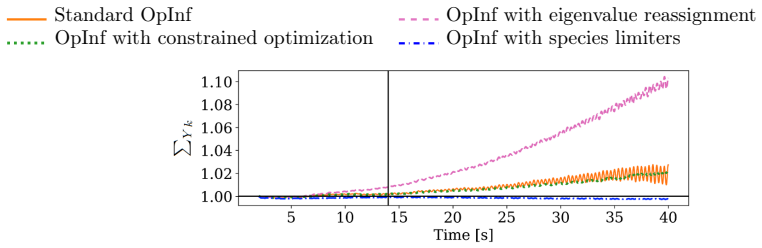
Embedding state constraints into Operator Inference yields stable reduced-order models that extrapolate over 200 percent past training data for char combustion.
A machine-rendered reading of the paper's core claim, the machinery that carries it, and where it could break.
Core claim
The paper claims that embedding state constraints in the Operator Inference reduced-order model predictions, together with performance-indicator-based hyperparameter selection, produces models superior to standard Operator Inference and other stability-enhancing approaches in stability and accuracy; for char combustion this enables extrapolation over 200 percent past the training regime while preserving computational efficiency and physical consistency.
What carries the argument
State constraints-embedded Operator Inference, which incorporates physical constraints on state variables directly into the learning of the low-dimensional representation from data.
If this is right
- State predictions remain more stable and accurate than those from standard Operator Inference or other stability methods.
- The models extrapolate over 200 percent past the training regime for the char combustion case.
- Predictions stay physically consistent with the underlying system constraints.
- The overall procedure remains computationally efficient compared with full-order simulation.
Where Pith is reading between the lines
- The same constraint-embedding step could be tested on other multiphysics problems whose state variables obey known bounds to check whether stability gains transfer.
- The key-performance-indicator approach to regularization might reduce trial-and-error tuning when Operator Inference is applied to new systems.
- If the physical constraints are only approximately known, the method could still improve consistency but would require separate checks on bias introduced by inexact constraints.
Load-bearing premise
Embedding the state constraints during learning does not introduce new bias or instability that offsets the reported extrapolation gains, and the key performance indicator selects hyperparameters that generalize beyond the specific combustion dataset.
What would settle it
A direct comparison on a second multiphysics dataset or a longer extrapolation interval showing whether the state-constrained models lose physical consistency or accuracy relative to the unconstrained baselines.
Figures




read the original abstract
Numerical simulations of complex multiphysics systems, such as char combustion considered herein, yield numerous state variables that inherently exhibit physical constraints. This paper presents a new approach to augment Operator Inference -- a methodology within scientific machine learning that enables learning from data a low-dimensional representation of a high-dimensional system governed by nonlinear partial differential equations -- by embedding such state constraints in the reduced-order model predictions. In the model learning process, we propose a new way to choose regularization hyperparameters based on a key performance indicator. Since embedding state constraints improves the stability of the Operator Inference reduced-order model, we compare the proposed state constraints-embedded Operator Inference with the standard Operator Inference and other stability-enhancing approaches. For an application to char combustion, we demonstrate that the proposed approach yields state predictions superior to the other methods regarding stability and accuracy. It extrapolates over 200\% past the training regime while being computationally efficient and physically consistent.
Editorial analysis
A structured set of objections, weighed in public.
Referee Report
Summary. The paper augments Operator Inference (OpInf) for reduced-order modeling of nonlinear PDE-governed systems by embedding physical state constraints during the learning stage and selecting regularization hyperparameters via a key performance indicator (KPI). On a char-combustion application, the resulting constrained OpInf model is reported to outperform standard OpInf and other stability-enhancing variants in stability and accuracy, to extrapolate stably more than 200% beyond the training regime, and to remain physically consistent while remaining computationally efficient.
Significance. If the central claims are substantiated, the work would supply a practical route to enforce physical consistency inside data-driven reduced-order models without sacrificing the non-intrusive character of OpInf. The reported 200% extrapolation on a multiphysics combustion problem would constitute a concrete, falsifiable demonstration of improved predictive capability for systems whose states obey hard constraints.
major comments (3)
- [Abstract] Abstract and results section: the claim that constraint embedding 'improves the stability of the Operator Inference reduced-order model' is presented without a derivation or numerical verification that the added constraints preserve the underlying least-squares learning guarantees of OpInf; no error bars, cross-validation statistics, or sensitivity analysis on the constraint embedding are supplied.
- [Abstract] Abstract and hyperparameter-selection paragraph: the KPI used to choose regularization hyperparameters is not shown to be independent of the test trajectories; without an ablation that compares KPI selection against, e.g., cross-validation on held-out training windows, the reported 200% extrapolation gain cannot be distinguished from dataset-specific tuning.
- [Abstract] Comparison paragraph: the statement that the proposed method 'yields state predictions superior to the other methods regarding stability and accuracy' is not accompanied by quantitative tables or figures that report the precise metrics, the number of independent runs, or the precise definition of the 200% extrapolation horizon.
Simulated Author's Rebuttal
We thank the referee for the constructive comments. We agree that the abstract and results require additional substantiation and will revise the manuscript to include a theoretical note on the least-squares properties, an ablation study for the KPI, and quantitative tables with precise metrics and definitions. Point-by-point responses are below.
read point-by-point responses
-
Referee: [Abstract] Abstract and results section: the claim that constraint embedding 'improves the stability of the Operator Inference reduced-order model' is presented without a derivation or numerical verification that the added constraints preserve the underlying least-squares learning guarantees of OpInf; no error bars, cross-validation statistics, or sensitivity analysis on the constraint embedding are supplied.
Authors: Stability improvement is demonstrated numerically on the char combustion problem, where constrained models remain bounded while others diverge. We acknowledge that a formal derivation preserving least-squares guarantees is absent; the constraints are added as linear equalities to the OpInf regression, preserving convexity. We will add a methods discussion on this point plus error bars from repeated runs, cross-validation statistics, and sensitivity analysis on constraint weights. revision: yes
-
Referee: [Abstract] Abstract and hyperparameter-selection paragraph: the KPI used to choose regularization hyperparameters is not shown to be independent of the test trajectories; without an ablation that compares KPI selection against, e.g., cross-validation on held-out training windows, the reported 200% extrapolation gain cannot be distinguished from dataset-specific tuning.
Authors: The KPI is evaluated exclusively on training trajectories using physical consistency indicators, ensuring independence from test data. To strengthen the claim, we will add an ablation comparing KPI selection against cross-validation on held-out training windows in the revised manuscript. revision: yes
-
Referee: [Abstract] Comparison paragraph: the statement that the proposed method 'yields state predictions superior to the other methods regarding stability and accuracy' is not accompanied by quantitative tables or figures that report the precise metrics, the number of independent runs, or the precise definition of the 200% extrapolation horizon.
Authors: Figures illustrate the trajectories, but we agree precise metrics are needed. The revision will add a results table with stability/accuracy metrics (e.g., L2 errors), the number of independent runs, and an explicit definition of the 200% horizon as simulation times reaching three times the training duration. revision: yes
Circularity Check
No significant circularity in derivation or claims
full rationale
The paper augments Operator Inference by embedding state constraints during learning and selects regularization hyperparameters via a proposed key performance indicator. These steps are presented as methodological choices whose outputs (reduced-order model predictions) are then evaluated empirically on char combustion data for stability, accuracy, and extrapolation. No equation or step is shown to reduce the reported performance metrics to the inputs by construction, nor does any load-bearing claim rely on a self-citation chain, uniqueness theorem imported from the authors, or an ansatz smuggled via prior work. The extrapolation results are treated as independent validation rather than a fitted quantity renamed as prediction. The derivation chain therefore remains self-contained against external benchmarks.
Axiom & Free-Parameter Ledger
Reference graph
Works this paper leans on
-
[1]
I. Adibnazari, H. Sharma, J. C. Torralba, B. Kramer, and M. T. Tolley. Full-body optimal control of a swimming soft robot enabled by data-driven model reduction.2023 Southern California Robotics (SCR) Symposium, 2023
work page 2023
-
[2]
A. Agrawal, R. Verschueren, S. Diamond, and S. Boyd. A rewriting system for convex optimiza- tion problems.Journal of Control and Decision, 5(1):42–60, 2018
work page 2018
-
[3]
S. E. Ahmed, S. Pawar, O. San, A. Rasheed, T. Iliescu, and B. R. Noack. On closures for reduced order models—a spectrum of first-principle to machine-learned avenues.Physics of Fluids, 33(9), 2021
work page 2021
-
[4]
Basu.Combustion and Gasification in Fluidized Beds
P. Basu.Combustion and Gasification in Fluidized Beds. CRC press, 2006
work page 2006
-
[5]
A. Baumgart and G. Blanquart. Ensuring P s ys = 1in transport of species mass fractions. Journal of Computational Physics, 513:113199, 2024
work page 2024
- [6]
- [7]
- [8]
-
[9]
M. Benosman, J. Borggaard, and B. Kramer. Robust POD model stabilization for the 3D Boussi- nesq equations based on Lyapunov theory and extremum seeking. InAmerican Control Confer- ence (ACC), pages 1827–1832. IEEE, 2017
work page 2017
-
[10]
M. Benosman, J. Borggaard, O. San, and B. Kramer. Learning-based robust stabilization for reduced-order models of 2D and 3D Boussinesq equations.Applied Mathematical Modelling, 49:162–181, 2017
work page 2017
-
[11]
M. A. Clarke and J. M. Musser. The MFiX particle-in-cell method (MFiX-PIC) theory guide. Technical report, National Energy Technology Laboratory (NETL), 2020
work page 2020
-
[12]
S. Diamond and S. Boyd. CVXPY: A python-embedded modeling language for convex optimiza- tion.The Journal of Machine Learning Research, 17(1):2909–2913, 2016
work page 2016
-
[13]
F. Dryer and I. Glassman. High-temperature oxidation of CO and CH4.Symposium (Interna- tional) on Combustion, 14(1):987–1003, 1973
work page 1973
- [14]
-
[15]
Y. Filanova, I. P. Duff, P. Goyal, and P. Benner. An operator inference oriented approach for linear mechanical systems.Mechanical Systems and Signal Processing, 200:110620, 2023
work page 2023
-
[16]
Y. Geng and D. Che. An extended DEM–CFD model for char combustion in a bubbling fluidized bed combustor of inert sand.Chemical Engineering Science, 66(2):207–219, 2011. 30
work page 2011
-
[17]
Y. Geng, J. Singh, L. Ju, B. Kramer, and Z. Wang. Gradient preserving operator inference: Data-driven reduced-order models for equations with gradient structure.Computer Methods in Applied Mechanics and Engineering, 427:117033, 2024
work page 2024
-
[18]
O. Ghattas and K. Willcox. Learning physics-based models from data: perspectives from inverse problems and model reduction.Acta Numerica, 30:445–554, 2021
work page 2021
-
[19]
A. Gruber and I. Tezaur. Canonical and noncanonical Hamiltonian operator inference.Computer Methods in Applied Mechanics and Engineering, 416:116334, 2023
work page 2023
-
[20]
N. Halko, P.-G. Martinsson, and J. A. Tropp. Finding structure with randomness: Probabilistic algorithms for constructing approximate matrix decompositions.SIAM Review, 53(2):217–288, 2011
work page 2011
-
[21]
J. S. Hesthaven, G. Rozza, B. Stamm, et al.Certified Reduced Basis Methods for Parametrized Partial Differential Equations, volume 590. Springer, 2016
work page 2016
- [22]
-
[23]
O. Issan and B. Kramer. Predicting solar wind streams from the inner-heliosphere to earth via shifted operator inference.Journal of Computational Physics, 473:111689, 2023
work page 2023
-
[24]
P. Jain, S. McQuarrie, and B. Kramer. Performance comparison of data-driven reduced models for a single-injector combustion process. InAIAA Propulsion and Energy 2021 Forum, page 3633, 2021
work page 2021
-
[25]
I. Kalashnikova, B. van Bloemen Waanders, S. Arunajatesan, and M. Barone. Stabilization of projection-based reduced order models for linear time-invariant systems via optimization-based eigenvalue reassignment.Computer Methods in Applied Mechanics and Engineering, 272:251–270, 2014
work page 2014
-
[26]
V.L.KalbandA.E.Deane. Anintrinsicstabilizationschemeforproperorthogonaldecomposition based low-dimensional models.Physics of Fluids, 19(5), 2007
work page 2007
-
[27]
A. A. Kaptanoglu, J. L. Callaham, A. Aravkin, C. J. Hansen, and S. L. Brunton. Promoting global stability in data-driven models of quadratic nonlinear dynamics.Physical Review Fluids, 6(9):094401, 2021
work page 2021
-
[28]
T. Koike and E. Qian. Energy-preserving reduced operator inference for efficient design and control. InAIAA SciTech 2024 Forum, page 1012, 2024
work page 2024
-
[29]
B. Kramer. Stability domains for quadratic-bilinear reduced-order models.SIAM Journal on Applied Dynamical Systems, 20(2):981–996, 2021
work page 2021
- [30]
-
[31]
X. Ku, T. Li, and T. Løvås. CFD–DEM simulation of biomass gasification with steam in a fluidized bed reactor.Chemical Engineering Science, 122:270–283, 2015
work page 2015
-
[32]
R. La Nauze, K. Jung, and J. Kastl. Mass transfer to large particles in fluidised beds of smaller particles.Chemical Engineering Science, 39(11):1623–1633, 1984
work page 1984
-
[33]
D. Lee, E. Lavichant, and B. Kramer. Global sensitivity analysis with limited data via sparsity- promoting D-MORPH regression: Application to char combustion.Journal of Computational Physics, 511:113116, 2024. 31
work page 2024
-
[34]
S. A. McQuarrie, C. Huang, and K. E. Willcox. Data-driven reduced-order models via regularised operator inference for a single-injector combustion process.Journal of the Royal Society of New Zealand, 51(2):194–211, 2021
work page 2021
-
[35]
S. A. McQuarrie, P. Khodabakhshi, and K. E. Willcox. Nonintrusive reduced-order models for parametric partial differential equations via data-driven operator inference.SIAM Journal on Scientific Computing, 45(4):A1917–A1946, 2023
work page 2023
-
[36]
J. M. Musser and J. E. Carney. Theoretical review of the MFiX fluid and two-fluid models. Technical report, National Energy Technology Laboratory (NETL), 2020
work page 2020
-
[37]
F. Pedregosa, G. Varoquaux, A. Gramfort, V. Michel, B. Thirion, O. Grisel, M. Blondel, A. Müller, J. Nothman, G. Louppe, P. Prettenhofer, R. Weiss, V. Dubourg, J. Vanderplas, A. Passos, D. Cournapeau, M. Brucher, M. Perrot, and Édouard Duchesnay. Scikit-learn: Ma- chine learning in python, 2018
work page 2018
-
[38]
B. Peherstorfer and K. Willcox. Data-driven operator inference for nonintrusive projection-based model reduction.Computer Methods in Applied Mechanics and Engineering, 306:196–215, 2016
work page 2016
-
[39]
E. Qian, I.-G. Farcas, and K. Willcox. Reduced operator inference for nonlinear partial differential equations.SIAM Journal on Scientific Computing, 44(4):A1934–A1959, 2022
work page 2022
-
[40]
A. Quarteroni, G. Rozza, et al.Reduced Order Methods for Modeling and Computational Reduc- tion, volume 9. Springer, 2014
work page 2014
-
[41]
P. R. B. Rocha, J. L. de Sousa Almeida, M. S. de Paula Gomes, and A. C. N. Junior. Reduced- order modeling of the two-dimensional Rayleigh–Bénard convection flow through a non-intrusive operator inference.Engineering Applications of Artificial Intelligence, 126:106923, 2023
work page 2023
- [42]
-
[43]
F. Scala. Mass transfer around freely moving active particles in the dense phase of a gas fluidized bed of inert particles.Chemical Engineering Science, 62(16):4159–4176, 2007
work page 2007
-
[44]
M. Schlegel and B. R. Noack. On long-term boundedness of Galerkin models.Journal of Fluid Mechanics, 765:325–352, 2015
work page 2015
-
[45]
H. Sharma and B. Kramer. Preserving Lagrangian structure in data-driven reduced-order mod- eling of large-scale dynamical systems.Physica D: Nonlinear Phenomena, 462:134128, 2024
work page 2024
- [46]
- [47]
-
[48]
R. Swischuk, B. Kramer, C. Huang, and K. Willcox. Learning physics-based reduced-order models for a single-injector combustion process.AIAA Journal, 58(6):2658–2672, June 2020
work page 2020
-
[49]
Z. Wang, I. Akhtar, J. Borggaard, and T. Iliescu. Proper orthogonal decomposition closure models for turbulent flows: A numerical comparison.Computer Methods in Applied Mechanics and Engineering, 237:10–26, 2012. 32
work page 2012
- [50]
-
[51]
J. Xie, W. Zhong, and Y. Shao. Study on the char combustion in a fluidized bed by CFD-DEM simulations: Influences of fuel properties.Powder Technology, 394:20–34, 2021
work page 2021
-
[52]
S. Yang, H. Wang, Y. Wei, J. Hu, and J. W. Chew. Particle-scale modeling of biomass gasification in the three-dimensional bubbling fluidized bed.Energy Conversion and Management, 196:1–17, 2019
work page 2019
- [53]
-
[54]
B. G. Zastrow, A. Chaudhuri, K. Willcox, A. S. Ashley, and M. C. Henson. Data-driven model reduction via operator inference for coupled aeroelastic flutter. InAIAA SciTech 2023 Forum, page 0330, 2023. 33
work page 2023
discussion (0)
Sign in with ORCID, Apple, or X to comment. Anyone can read and Pith papers without signing in.