REVIEW 3 major objections 6 minor 17 references
Retro-Rank-In: A Ranking-Based Approach for Inorganic Materials Synthesis Planning
T0 review · 3 major / 6 minor · reviewed 2026-08-08 · deepseek-v4-flash
Pith's one-line read Retro-Rank-In proposes that inorganic retrosynthesis should be treated as pairwise ranking of precursors in a shared embedding space, allowing the model to recommend synthesis routes whose precursors were never seen during training.
desk verdict A genuine pairwise-ranking reformulation with better splits, but the 'unseen precursor' headline is supported by anecdote, not an aggregate measurement. read the letter →
The pith
A machine-rendered reading of the paper's core claim, the machinery that carries it, and where it could break.
The reading
What carries the argument
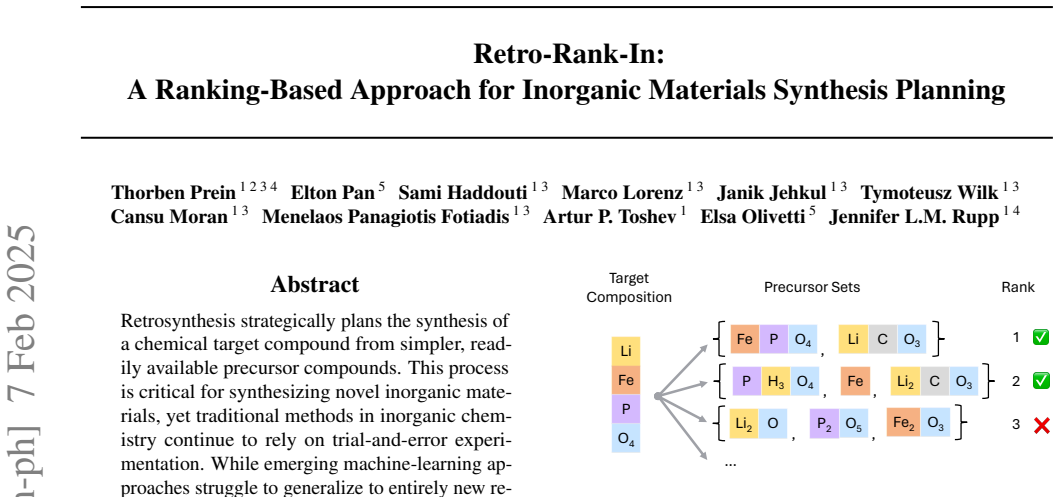
The load-bearing machinery is the pairwise ranker operating on a shared latent space. A multi-task pretrained transformer encoder maps each composition to an embedding; the ranker takes the concatenation of target and precursor embeddings and outputs a compatibility probability. Candidate precursor sets are assembled from the top-scoring individual precursors under element-completeness and cardinality constraints, and each set is scored by the product of its members' individual probabilities. The shared embedding space is what allows an unseen precursor to be scored, and the product rule is what turns pairwise scores into set rankings.
What would settle it
Take a test set of reactions in which precursor interactions are known to matter, such as routes where an intermediate phase forms and one precursor becomes infeasible once another is present. If the product-of-individual-scores ranking mis-orders these sets markedly more than a ranker that scores the entire set at once, the independence assumption is the culprit; that comparison is directly measurable with the paper's own Top-K evaluation.
Extended reading notes
Core claim
The central claim is that the multi-label classification framing used by earlier retrosynthesis models is the bottleneck, and replacing it with pairwise ranking in a shared embedding space removes that bottleneck. The authors train a binary classifier on target–precursor pairs drawn from a bipartite graph of known reactions, then at inference score every candidate precursor against the target, multiply the individual scores of a candidate set, and rank sets by that product. This formulation lets the model extrapolate to new precursors and new material systems, and the paper reports that it outperforms prior methods at Top-3, Top-5, and Top-10 exact match on deduplicated and novel-system splits. The Cr2AlB2 example is given as evidence that the model can recover a verified unfamiliar route.
Load-bearing premise
The ranking of a whole precursor set assumes each precursor contributes independently, so a set's score is simply the product of its members' individual scores.
Editorial extensions
If this is right
- Synthesis planners built on this approach can propose routes whose precursor compounds were absent from the training corpus, opening search to unexplored chemical space.
- Because the method keeps improving as K grows, it delivers many plausible candidate routes per target, which helps experimentalists choose based on availability, cost, or safety.
- The drop in accuracy from the complete archive to the deduplicated splits shows that duplicate-heavy benchmarks overstate generalization, so future evaluations should include distinct-reaction and novel-system splits.
- The same pairwise score can be applied to any composition vector at inference time, so newly discovered or newly considered precursors can be added to the candidate pool without retraining.
Reading between the lines
- Editorial extension: the paper does not directly test the independence assumption; a straightforward experiment would compare the product rule against a set-level ranker on reactions with known intermediate phases, holding everything else fixed.
- The open-vocabulary property suggests a transferable recipe for other set-prediction problems in chemistry, such as solvent, additive, or atmosphere selection, whenever a composition encoder is available.
- The reported diversity at high K implies a practical workflow: generate many candidate sets with Retro-Rank-In and filter by thermodynamic stability or precursor cost, rather than trusting only the top-ranked route.
Editorial analysis
A structured set of objections, weighed in public.
Referee Report
Summary. The paper proposes Retro-Rank-In, a method for inorganic materials retrosynthesis that scores target–precursor pairs with a pairwise ranker built on top of a pretrained composition transformer (MTEncoder). At inference, candidate precursors are ranked by pairwise probability, composed into sets satisfying elemental completeness, and the sets are ranked by the product of their component probabilities (Eq. 5). The method is evaluated by Top-K exact-match accuracy on three splits of the Kononova et al. (2019) dataset: the complete reaction archive (CRA), a deduplicated distinct-reactions split (DR), and a novel-material-systems split (NMS) in which the element sets of target materials do not overlap between train and test. The central claims are that the pairwise reformulation enables recommendation of precursors not seen in the ranker's training pairs and that this yields state-of-the-art Top-3/5/10 performance on DR and NMS.
Significance. The paper addresses a real limitation of prior methods: multi-label classifiers are closed-vocabulary and cannot propose new precursor compounds. The pairwise ranking formulation is a clean and sensible reformulation, and the ablations (Tables 4 and 12) provide credible evidence that pairwise ranking and pretrained embeddings both contribute to performance. The DR and NMS splits are a useful contribution toward less inflated evaluation. If the generalization claim is substantiated at the aggregate level, the method would be a practically valuable tool for inorganic synthesis planning. However, the headline capability—recommending previously unseen precursors—is currently supported only by selected examples without a denominator, and the set-level scoring rests on an unexamined independence assumption. These gaps are fixable with additional experiments and reporting.
major comments (3)
- [Section 4.1, Section 4.2, Table 3] The NMS split only prevents overlap of target element sets between training and test; it does not prevent a test target's ground-truth precursor compositions from appearing in training reactions. Consequently, the Top-K numbers in Table 2 for NMS mostly measure the ability to rank precursors that the ranker has seen for unfamiliar targets, not the ability to propose wholly unseen precursors. The four examples in Table 3 and the Cr2AlB2 case study are selected successes with no denominator; the reader is not told how many NMS (or DR) test targets have ground-truth precursor sets fully absent from the ranker training pairs, nor what Top-K accuracy is achieved on that subset. This is load-bearing because the abstract and Section 3 claim 'never seeing them in training' as the key capability. Please add an aggregate evaluation: define 'unseen precursor set' relative to the ranker training pairs, report the number of such test targets and the Top-K exact-match accuracy over that subset, and compare with baselines restricted to seen precursors (e.g., Retrieval-Retro's closed vocabulary). Also describe exactly how the Cr2AlB2 training set was constructed (which compounds or reactions were removed).
- [Section 3.2, Eq. (5); Section 5] The set-level score p_S = ∏ p_i assumes conditional independence of precursors given the target. The paper itself acknowledges in Section 5 that precursor interactions and intermediate phase formation are not accounted for, but it does not analyze how sensitive the reported Top-K accuracies are to this assumption. Since all Top-K metrics are computed from the product-rule ranking, a failure of the independence assumption could change the ranking even if pairwise scores are well calibrated. Please report an ablation of the set aggregation rule (e.g., product versus min, mean, or a learned combination) and/or an analysis of whether errors concentrate on targets whose ground-truth precursors show high pairwise correlation, as characterized in Figure 7.
- [Section 3.1 and Section 4.2, 'Generalization to new precursors'] The claim that the model recommends Cr2AlB2 precursors 'despite never seeing them in training' is only true with respect to the ranker's training pairs. The MTEncoder is pretrained on the Alexandria database of over two million compositions, and the pretraining objectives include property regression and masked element prediction over those compositions; the model therefore has indirect exposure to the chemical identities of many candidate precursors before ranker training. This does not invalidate the open-vocabulary design, but it substantially weakens the 'never seen' formulation. Please clarify the precise sense of 'unseen' (unseen as a target–precursor pair versus unseen as a composition in any training stage) and, if the intended capability is compositional novelty, provide an experiment in which the encoder is not pretrained on the test precursors' compositions or at least discuss the implications of the encoder's pretraining exposure.
minor comments (6)
- [Section 4.2, 'Diversity at no cost of performance'] The text says 'MTEnocer' where it should say 'MTEncoder'.
- [Section 4.2, 'Generalization to new precursors'] The sentence 'Section 4.2 shows four more examples' should refer to Table 3, not Section 4.2.
- [Table 3] The entry '∅' for Retrieval-Retro needs explanation; it is unclear whether this means the model produced no valid set or whether its top-ranked set was incorrect.
- [Section 4.1, preprocessing] The description of excluding entries with variables 'b and c' should clarify that these are lowercase variable placeholders, not the elemental symbols B and C, to avoid confusion.
- [Appendix E, Table 11] The column label 'N' is used both for the total number of unique precursors in the dataset (Table 6) and for the number of evaluated precursor combinations; please rename one of the two quantities.
- [Appendix C.1, Table 8] The text says 'data is used from alexandria'; capitalize Alexandria and provide the specific dataset version or DOI.
Circularity Check
No significant circularity: the ranking model is trained on held-out pairs and its central claims are empirically evaluated rather than derived from its own assumptions.
full rationale
The derivation chain is self-contained. The pairwise ranker (Eq. 6) is trained with binary cross-entropy on target–precursor pairs and evaluated on held-out splits (CRA, DR, NMS) using Top-K exact match against ground-truth precursor sets; no target result is encoded in the loss or in the split construction. The set-level joint probability (Eq. 5) is a compositional rule from the model's own pairwise scores, not a fitted parameter, and it cannot force agreement with an unseen ground-truth set. The MTEncoder self-citation (Prein et al., 2023) is not load-bearing in a circular way: the encoder is pretrained on the external Alexandria database with property-prediction tasks unrelated to retrosynthesis, it is evaluated independently as a baseline in Table 2, and the paper's ablation (Table 4) shows the pairwise-ranking benefit also holds with composition-only embeddings. The 'novel precursor' claim is supported by a controlled case study (Cr2AlB2) and Table 3 examples, though the aggregate NMS split does not quantify the subset with fully unseen ground-truth precursors; that is an evaluation limitation, not a circular derivation. No equation or fitted parameter reduces to the prediction target by construction.
Assumptions & free parameters
free parameters (2)
- Retro-Rank-In hyperparameters =
batch=128, heads=1, FFWD layers=3, lr=6.81e-5, MT lr=6.37e-5
- Candidate precursor cutoff n =
30
assumptions (5)
- domain assumption Precursor independence in set scoring (Eq. 5: pS = prod pi)
- domain assumption Literature-reported synthesis routes are correct ground truth
- domain assumption No new elements can form during solid-state reactions
- domain assumption Composition alone determines retrosynthetic feasibility
- domain assumption Pretrained MTEncoder embeddings transfer to the retrosynthesis task
Cite this review
Pith. "Pith review of Retro-Rank-In: A Ranking-Based Approach for Inorganic Materials Synthesis Planning." pith.science (2026). https://pith.science/paper/N5NVSJ7W
@misc{pith2026250204289,
  author       = {Pith},
  title        = {Pith review of: Retro-Rank-In: A Ranking-Based Approach for Inorganic Materials Synthesis Planning},
  year         = {2026},
  howpublished = {\url{https://pith.science/paper/N5NVSJ7W}},
  note         = {Machine review of arXiv:2502.04289}
}
read the original abstract
Retrosynthesis strategically plans the synthesis of a chemical target compound from simpler, readily available precursor compounds. This process is critical for synthesizing novel inorganic materials, yet traditional methods in inorganic chemistry continue to rely on trial-and-error experimentation. Emerging machine-learning approaches struggle to generalize to entirely new reactions due to their reliance on known precursors, as they frame retrosynthesis as a multi-label classification task. To address these limitations, we propose Retro-Rank-In, a novel framework that reformulates the retrosynthesis problem by embedding target and precursor materials into a shared latent space and learning a pairwise ranker on a bipartite graph of inorganic compounds. We evaluate Retro-Rank-In's generalizability on challenging retrosynthesis dataset splits designed to mitigate data duplicates and overlaps. For instance, for Cr2AlB2, it correctly predicts the verified precursor pair CrB + Al despite never seeing them in training, a capability absent in prior work. Extensive experiments show that Retro-Rank-In sets a new state-of-the-art, particularly in out-of-distribution generalization and candidate set ranking, offering a powerful tool for accelerating inorganic material synthesis.
Figures


Figures from the paper (7 more)


Reference graph
Works this paper leans on
-
[1]
M., Dzamba, M., Gao, M., Rizvi, A., Zitnick, C
Barroso-Luque, L., Shuaibi, M., Fu, X., Wood, B. M., Dzamba, M., Gao, M., Rizvi, A., Zitnick, C. L., and Ulissi, Z. W. Open materials 2024 (omat24) inor- ganic materials dataset and models. arXiv preprint arXiv:2410.12771,
arXiv 2024
-
[7]
McDermott, M. J., McBride, B. C., Regier, C. E., Tran, G. T., Chen, Y ., Corrao, A. A., Gallant, M. C., Kamm, G. E., Bartel, C. J., Chapman, K. W., et al. Assessing thermodynamic selectivity of solid-state reactions for the predictive synthesis of inorganic materials. ACS Central Science, 9(10):1957–1975,
work page 1957
-
[8]
Moreira, G. d. S. P., Osmulski, R., Xu, M., Ak, R., Schif- ferer, B., and Oldridge, E. Nv-retriever: Improving text embedding models with effective hard-negative mining. arXiv preprint arXiv:2407.15831,
-
[9]
Orb: A fast, scalable neural network potential
Neumann, M., Gin, J., Rhodes, B., Bennett, S., Li, Z., Choubisa, H., Hussey, A., and Godwin, J. Orb: A fast, scalable neural network potential. arXiv preprint arXiv:2410.22570,
-
[10]
Distribution of predicted probabilities. A comparison of the top 60 highest predicted precursor probabilities across the test set of the Distinct Reactions dataset. Our approach demonstrates improved probability calibration compared to the previous state-of-the-art (Noh et al., 2024). We attribute this improvement to the class-balanced learning of a pairw...
work page 2024
-
[11]
Prein, T., Pan, E., Doerr, T., Olivetti, E., and Rupp, J. L. Mtencoder: A multi-task pretrained transformer encoder for materials representation learning. In AI for Acceler- ated Materials Design-NeurIPS 2023 Workshop,
work page 2023
-
[12]
Investigating the impact of pretraining for the encoder with the Top-K accuracy
Ablation pretraining. Investigating the impact of pretraining for the encoder with the Top-K accuracy. Pretrained Encoder Top-K Accuracy↑ Top-1 Top-3 Top-5 Top-10 ✗ 33.24 53.13 62.70 71.22 (8.20) (5.52) (5.45) (2.98) ✓ 47.04 62.64 70.05 76.61 (1.76) (1.73) (2.13) (1.66) F.3. Performance across different chemistries In Figure 6, we illustrate the correlati...
work page 2023
-
[13]
Mattergen: a generative model for inorganic materials design
Zeni, C., Pinsler, R., Z ¨ugner, D., Fowler, A., Horton, M., Fu, X., Shysheya, S., Crabb´e, J., Sun, L., Smith, J., et al. Mattergen: a generative model for inorganic materials design. arXiv preprint arXiv:2312.03687,
Show all 17 references
-
[14]
proposes a two-stage approach to inorganic retrosynthesis that implicitly extracts the precursor information of reference materials. First, for each target material, reference materials from the knowledge base of previously synthesized materials are elaborately retrieved by tw...
2023
-
[1999]
doi: 10.1023/a: 1009868929893
ISSN 1384-5810. doi: 10.1023/a: 1009868929893. Gao, C., Wang, X., He, X., and Li, Y . Graph neural networks for recommender system. In Proceedings of the fifteenth ACM international conference on web search and data mining, pp. 1623–1625,
-
[2013]
M., Das, A., Ulissi, Z., Uyttendaele, M., Medford, A
Sriram, A., Choi, S., Yu, X., Brabson, L. M., Das, A., Ulissi, Z., Uyttendaele, M., Medford, A. J., and Sholl, D. S. The open dac 2023 dataset and challenges for sorbent discovery in direct air capture,
2023
-
[2019]
and Smidt, T
Liao, Y .-L. and Smidt, T. Equiformer: Equivariant graph attention transformer for 3d atomistic graphs. arXiv preprint arXiv:2206.11990,
-
[2020]
E., Segler, M
Bradshaw, J., Zhang, A., Mahjour, B., Graff, D. E., Segler, M. H., and Coley, C. W. Challenging reaction prediction models to generalize to novel chemistry. arXiv preprint arXiv:2501.06669,
-
[2021]
H., Chen, S., and Jung, Y
Kim, S., Noh, J., Gu, G. H., Chen, S., and Jung, Y . Element- wise formulation of inorganic retrosynthesis. In AI for Accelerated Materials Design NeurIPS 2022 Workshop,
2022
-
[2022]
proposes a template-based approach to inorganic retrosynthesis that represents target materials as fully connected composition graphs. To guide the retrosynthesis process, the researchers distinguish between two types of elements: ”source elements,” provided as precursors, and...
2023
-
[2023]
Trans- fer learning on large datasets for the accurate prediction of material properties
Hoffmann, N., Schmidt, J., Botti, S., and Marques, M. Trans- fer learning on large datasets for the accurate prediction of material properties. 2023,
2023
-
[2024]
S., and Park, C
Noh, H., Lee, N., Na, G. S., and Park, C. Retrieval- retro: Retrieval-based inorganic retrosynthesis with ex- pert knowledge. arXiv preprint arXiv:2410.21341,
Reviewed August 8, 2026 · model on record in the stance chip above.
Discussion (0). Continue with ORCID to comment.