REVIEW 2 major objections 5 minor 55 references
Fundamental Factors Governing Stabilization of Janus 2D-Bulk Heterostructures with Machine Learning
T0 review · 2 major / 5 minor · reviewed 2026-08-08 · deepseek-v4-flash
Pith's one-line read Bulk properties, not the 2D layer, set heterostructure stability.
desk verdict A genuinely useful dataset and model, but the bulk-dominance conclusion is oversold beyond the sampled chemical space. read the letter →
The pith
A machine-rendered reading of the paper's core claim, the machinery that carries it, and where it could break.
The reading
What carries the argument
The machinery is a pair of random-forest regression models trained on the lowest-energy DFT configuration for each 2D-bulk pair, using 155 candidate features from the 2D material, the bulk slab, and the relaxed interface. Feature reduction (low-variance, high-correlation, recursive elimination) leaves 15 features for the binding-energy model and 10 for the z-separation model. A deliberately restricted z-separation model uses only features available from databases and elemental properties—bulk surface energy, atomic number, packing efficiency, molar volume—and still predicts separation with R2 of 0.838. The physical argument that bulk properties should dominate is that the bulk surface is created by breaking strong metallic bonds while the 2D material's exfoliation breaks weak van der Waals bonds, so the bulk side sets the interaction energy scale.
What would settle it
Extend the study to non-Janus 2D materials with electronegativities below 1.5 or above 3.0 on the same 19 substrates, recompute binding energies, and retrain the random forest; if 2D electronegativity or the 2D–bulk difference enters the top features, the bulk-dominance claim fails for the broader class.
Extended reading notes
Core claim
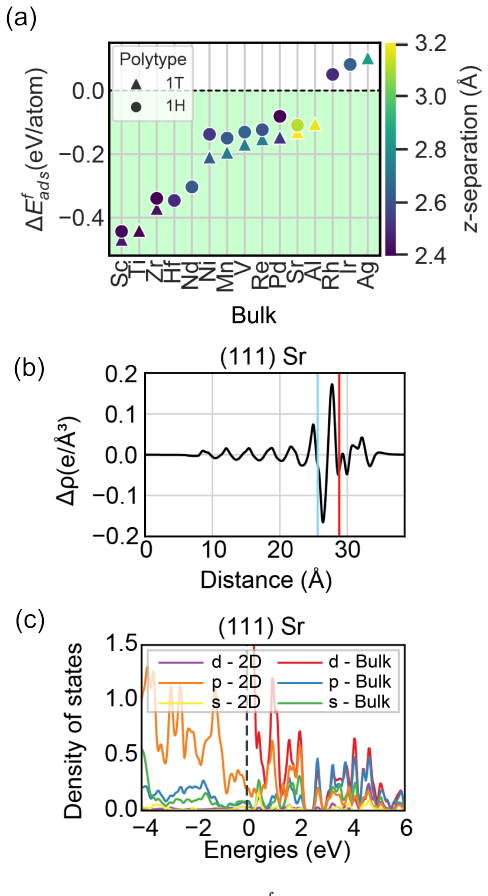
The central claim is that in Janus 2D-bulk heterostructures, the bulk material's intrinsic properties dominate the interface energetics and geometry. For binding energy, bulk electronegativity has the highest feature importance (29%), ahead of the 2D–bulk electronegativity difference (13%), and removing the difference from the model slightly improves accuracy. For z-separation, bulk surface energy is the top feature, and higher surface energy correlates with smaller separation, consistent with more dangling bonds at the surface. The random-forest models, trained on the most stable configuration of each of 438 2D-bulk pairs, achieve R2 of 0.940 for binding energy and 0.838 for z-separation when the z-model is restricted to features that require no DFT calculation. The authors interpret the bulk dominance physically: creating the bulk surface breaks strong metallic bonds, whereas exfoliating the 2D layer breaks weak van der Waals bonds, so the bulk side carries the energy scale.
Load-bearing premise
The claim that bulk properties dominate stability rests on a dataset in which the 2D materials vary little (electronegativity 1.98–2.59) while the bulk set varies widely (0.95–2.54), so the bulk features have more variance to explain; a wider range of 2D materials could change the ranking.
Editorial extensions
If this is right
- Substrate choice, not the 2D layer, becomes the primary design knob for stabilizing metastable Janus monolayers on metals.
- The random-forest models can screen 2D-bulk pairs at negligible cost, with the z-separation model needing only database-available properties.
- The published database of over 1200 heterostructures gives other researchers a benchmark and training set for interface models.
- The computed stability ordering rationalizes experimental reports that some metal substrates (for example, Cu) grow many TMDCs while others (for example, Ni) grow few.
- Because binding energy and z-separation correlate, a single bulk descriptor such as surface energy can guide targeted tuning of interface geometry.
Reading between the lines
- The bulk-dominated feature ranking may partly reflect the narrow electronegativity range of the 2D set (1.98–2.59) compared with the bulk set (0.95–2.54); including 2D materials with more extreme electronegativities could shift importance toward the 2D side.
- The 19 elemental cubic (111) substrates are all metals, so the conclusion that bulk properties dominate may not transfer to polar, compound, or differently oriented surfaces without retesting.
- Stability here is thermodynamic (negative adsorption formation energy); kinetic barriers to nucleation and growth are not addressed, so a predicted stable pair might still fail in synthesis.
- The no-DFT z-separation model's modest accuracy drop (R2 0.886 to 0.838) suggests it is best used for coarse screening, with DFT reserved for finalists.
Signed reviews
Editorial analysis
A structured set of objections, weighed in public.
Referee Report
Summary. The manuscript presents a high-throughput DFT study of 1147 Janus 2D-bulk heterostructures formed from 51 Janus 2D materials and 19 metallic cubic (111) substrates, together with random-forest regression models that predict the binding energy and interfacial z-separation of the most stable configuration for each of 438 2D-bulk pairs. The reported models achieve RMSEs of 0.047 eV/atom and 0.139 Å, respectively. The central physical claim is that bulk-material properties, specifically bulk electronegativity for binding energy and bulk surface energy for z-separation, are the leading fundamental factors governing heterostructure stabilization, implying that substrate choice is the primary design lever. The computed data are released in the aiHD database.
Significance. If the central claim holds, the work is significant: it provides a large, openly available database of ab initio 2D-bulk interface data, demonstrates that random-forest models can capture trends in binding energy and interfacial separation across this chemical space, and offers a physically plausible case study of charge redistribution and hybridization at the SbTeI/Sr interface. Strengths include the consistent vdW-corrected DFT workflow, the large dataset relative to prior 2D-bulk studies, the explicit cross-validation of the ML models, and the authors' own acknowledgment of the narrow 2D electronegativity range in the feature-importance discussion. However, the generalization of the feature-importance conclusion is not yet fully supported because the dataset is deliberately narrow on the 2D side and the feature-importance rankings are sensitive to that sampling.
major comments (2)
- [Machine Learning Insights into the Fundamental Factors Governing Janus 2D Heterostructure Stability and Figure 7(b)] The headline claim that bulk electronegativity and bulk surface energy are the 'leading fundamental factor' is not established by the reported feature-importance analysis. Random-forest feature importance depends on the range and variance of features in the training set. Here the Janus 2D electronegativities lie between 1.98 and 2.59, while the bulk values span 0.95 to 2.54, and all 19 substrates are metallic cubic (111) surfaces. Under this sampling, the bulk electronegativity has far more variance to explain ΔEb, so its high importance is partly a sampling artifact. The authors acknowledge this limitation for electronegativity ('Thus, for this subset of materials, the bulk electronegativity plays a much larger role than the difference'), yet the abstract and conclusion state the dominance as a general finding without that caveat. A concrete control is needed: for example, retrain the models on a set with a broader 2D electronegativity range (e.g., oxides, fluorides, or alkali-based 2D compounds) or use permutation importance on variance-balanced resamples. If bulk dominance persists under such controls, the claim is strengthened; otherwise, it should be restricted to the studied chemical subspace.
- [Table 1 and Section 'Energetic Stability of Janus 2D Materials'] The term 'thermodynamically stable' overstates what is computed. The criterion ΔEf_ads < 0 compares the heterostructure with the freestanding 2D material and its 3D bulk counterpart; it does not establish stability against all competing phases and includes no temperature or pressure dependence. The 828 'stable' configurations are better described as 'bulk-stabilized relative to the freestanding 2D material.' Because the number 828 is cited in the abstract as a central result, the wording should be corrected to match the actual definition.
minor comments (5)
- [Table 1 and Figure 7] The reported RMSE and MAE values are cross-validated on the same dataset, but no uncertainty intervals are given. Reporting standard deviations across cross-validation folds would help assess whether the differences between model variants (e.g., RFRz−sep and RFRz−sep*) are meaningful.
- [Machine Learning Methodology] The feature-reduction process is described only at a high level, and the final lists of 15 and 10 features are not given in the main text. Since the feature set is central to the interpretation, the full feature lists and their importances should be included or more completely summarized in the main text.
- [Abstract] The abstract says 'nearly 1000 heterostructures' but the paper reports 1147 heterostructure configurations; please make the count consistent.
- [DFT Methods] There is a typo in 'V ASP' (should be VASP) and in 'M atminer's database' (should be Matminer) in the text near Figure 3.
- [Energetic Stability of Janus 2D Materials] The phrase 'the lower the ΔEb the lower the stability' is confusing: since ΔEb is defined as (E2D + ES − E2D+S)/N2D, a lower (more negative) ΔEb means stronger binding and thus higher stability. Please clarify the sign convention.
Circularity Check
No significant circularity: the ML models are cross-validated fits, the feature-importance claims are explicitly confined to the sampled chemical space, and the self-citations are methodological rather than load-bearing.
full rationale
The paper's derivation chain is: DFT-computed dataset → random forest regression → feature importances → conclusion that bulk electronegativity and bulk surface energy dominate. None of these steps is circular by the standards of the review. The reported RMSE values (0.047 eV/atom and 0.139 Å) are cross-validated performance metrics on the same dataset; this is standard supervised machine learning and does not constitute 'a fitted parameter renamed as prediction.' The models are empirical fits, not first-principles derivations, and the paper does not claim otherwise. The central feature-importance conclusion is also presented with an explicit sampling caveat: 'The Janus 2D materials in our study all had electronegativities falling between 1.98-2.59, which is a much narrower range than that of the study's bulk materials (0.95-2.54). Thus, for this subset of materials, the bulk electronegativity plays a much larger role than the difference in determining heterostructure stability (i.e. ∆ Eb ).' This admission locates the bulk-dominance finding within the studied chemical subspace rather than deriving it from the definition of any feature or target. The concern that a wider 2D electronegativity range or different substrate classes could change the ranking is an external-validity or sampling-risk criticism, not a circularity. Self-citations to Ref. 27 are used as methodological references for the Hetero2d package, DFT parameters, and the set of 19 bulk materials; they are not invoked as an unverified theorem to force a conclusion. No equation is recycled as its own output, and no known result is merely renamed. Therefore the paper is self-contained against external benchmarks in the sense relevant to circularity, and the honest finding is no significant circularity.
Assumptions & free parameters
free parameters (2)
- Machine learning hyperparameters =
150 or 500 trees; K=8 or 5; correlation threshold 65%; RFECV feature counts 15 and 10
- Lattice-matching screening thresholds =
maximum surface area 80 A^2; maximum 2D strain 3%
assumptions (5)
- domain assumption vdW-DF/optB88 accurately captures 2D-bulk van der Waals interactions and binding energies.
- domain assumption Random forest feature importance reflects the physical factors governing stabilization.
- domain assumption The 51 Janus 2D and 19 bulk materials sampled are representative of 2D-bulk heterostructures generally.
- domain assumption Negative adsorption formation energy identifies thermodynamic stability.
- domain assumption Lattice-matched low-strain configurations are representative of synthesizable interfaces.
Cite this review
Pith. "Pith review of Fundamental Factors Governing Stabilization of Janus 2D-Bulk Heterostructures with Machine Learning." pith.science (2026). https://pith.science/paper/PDSWWCCM
@misc{pith2026250204603,
  author       = {Pith},
  title        = {Pith review of: Fundamental Factors Governing Stabilization of Janus 2D-Bulk Heterostructures with Machine Learning},
  year         = {2026},
  howpublished = {\url{https://pith.science/paper/PDSWWCCM}},
  note         = {Machine review of arXiv:2502.04603}
}
abstract
The more-than-6000 2D materials predicted thus far provide a huge combinatorial space for forming functional heterostructures with bulk materials, with potential applications in nanoelectronics, sensing, and energy conversion. In this work, we investigate nearly 1000 heterostructures, the largest number of heterostructures thus far, of 2D Janus and bulk materials' surfaces using ab initio simulations and machine learning (ML) to deduce the structure-property relationships of the complex interfaces in such heterostructures. We first perform van der Waals-corrected density functional theory simulations using a high-throughput computational framework on 51 Janus 2D materials and 19 metallic, cubic phase, elemental bulk materials that exhibit low lattice mismatches and low coincident site lattices. The formation energy of the resultant 1147 Janus 2D-bulk heterostructures were analyzed and 828 were found to be thermodynamically stable. ML models were trained on the computed data, and we found that they could predict the binding energy and $z$-separation of 2D-bulk heterostructures with root mean squared errors (RMSE) of 0.05 eV/atom and 0.14 angstroms, respectively. The feature importance of the models reveals that the properties of the bulk materials dominate the heterostructures' energies and interfacial structures heavily. These findings are in-line with experimentally observed behavior of several well-known 2D materials-bulk systems. The data used within this paper is freely available in the Ab Initio 2D-Bulk Heterostructure Database (aiHD). The fundamental insights on 2D-bulk heterostructures and the predictive ML models developed in this work could accelerate the application of thousands of 2D-bulk heterostructures, thus stimulating research within a wide range of electronic, quantum computing, sensing, and energy applications.
Figures


Figures from the paper (5 more)


Reference graph
Works this paper leans on
-
[1]
Novoselov, K. S.; Geim, A. K.; Morozov, S. V.; Jiang, D.; Zhang, Y.; Dubonos, S. V.; Grigorieva, I. V.; Firsov, A. A. Electric Field Effect in Atomically Thin Carbon Films. Science 2004, 306, 666--669
work page 2004
-
[2]
Singh, A. K.; Hennig, R. G.; Davydov, A. V.; Tavazza, F. Al _2 O _3 as a suitable substrate and a dielectric layer for n-layer MoS _2 . Applied Physics Letters 2015, 107, 053106
work page 2015
-
[3]
Singh, A. K.; Zhuang, H. L.; Hennig, R. G. Ab initio synthesis of single-layer III-V materials . Physical Review B - Condensed Matter and Materials Physics 2014, 89, 1--10
work page 2014
- [4]
-
[5]
Smirman, M.; Taha, D.; Singh, A. K.; Huang, Z.-F.; Elder, K. R. Influence of misorientation on graphene Moir \' e patterns . Physical Review B 2017, 95, 1--7
work page 2017
-
[6]
Paul, J. T.; Singh, A. K.; Dong, Z.; Zhuang, H.; Revard, B. C.; Rijal, B.; Ashton, M.; Linscheid, A.; Blonsky, M.; Gluhovic, D.; Guo, J. Computational methods for 2D materials: discovery, property characterization, and application design . Journal of Physics: Condensed Matter 2017, 29, 473001
work page 2017
-
[7]
Singh, A. K.; Hennig, R. G. Computational prediction of two-dimensional group-IV mono-chalcogenides . Applied Physics Letters 2014, 105, 042103
work page 2014
-
[8]
Singh, A. K.; Mathew, K.; Zhuang, H. L.; Hennig, R. G. Computational screening of 2D materials for photocatalysis. Journal of Physical Chemistry Letters 2015, 6, 1087--1098
work page 2015
Show all 55 references
-
[9]
K.; Mathew, K.; Davydov, A
Singh, A. K.; Mathew, K.; Davydov, A. V.; Hennig, R. G.; Tavazza, F. High throughput screening of substrates for synthesis and functionalization of 2D materials. SPIE 2015, 9553
2015
-
[10]
Pakdel, S.; Rasmussen, A.; Taghizadeh, A.; Kruse, M.; Olsen, T.; Thygesen, K. S. High-throughput computational stacking reveals emergent properties in natural van der Waals bilayers. Nature Communications 2024, 15, 932
2024
-
[11]
K.; Zhao, W
Zhang, Q. K.; Zhao, W. H.; Zhou, Z. P.; Cao, L. M.; Yin, W. J.; Wei, X. L.; Tang, Z. K.; Zhang, H. 2D Janus MoSSe/MoGeSiN4 vdW heterostructures for photovoltaic and photocatalysis applications. Journal of Alloys and Compounds 2023, 938, 168708
2023
-
[12]
H.; Ribeiro-Palau, R.; Hone, J
Rhodes, D.; Chae, S. H.; Ribeiro-Palau, R.; Hone, J. Disorder in van der Waals heterostructures of 2D materials . Nature materials 2019, 18, 541--549
2019
-
[13]
Computational discovery of stable phases of graphene and h-BN van der Waals heterostructures composed of group III-V binary compounds
Akiyama, T.; Kawamura, T.; Ito, T. Computational discovery of stable phases of graphene and h-BN van der Waals heterostructures composed of group III-V binary compounds . Applied Physics Letters 2021, 118
2021
-
[14]
O.; Azadani, J
\"Oz c c elik, V. O.; Azadani, J. G.; Yang, C.; Koester, S. J.; Low, T. Band alignment of two-dimensional semiconductors for designing heterostructures with momentum space matching. Phys. Rev. B 2016, 94, 035125
2016
-
[15]
K.; Grigorieva, I
Geim, A. K.; Grigorieva, I. V. Van der Waals heterostructures . Nature 2013, 499, 419--425
2013
-
[16]
Predicting Van der Waals Heterostructures by a Combined Machine Learning and Density Functional Theory Approach
Willhelm, D.; Wilson, N.; Arroyave, R.; Qian, X.; Cagin, T.; Pachter, R.; Qian, X. Predicting Van der Waals Heterostructures by a Combined Machine Learning and Density Functional Theory Approach . ACS Applied Materials & Interfaces 2022, 14, 25907--25919
2022
-
[17]
Novel optoelectronic devices: transition-metal-dichalcogenide-based 2D heterostructures
Zeng, Q.; Liu, Z. Novel optoelectronic devices: transition-metal-dichalcogenide-based 2D heterostructures. Advanced Electronic Materials 2018, 4, 1700335
2018
-
[18]
S.; Hinsche, N
Haastrup, S.; Strange, M.; Pandey, M.; Deilmann, T.; Schmidt, P. S.; Hinsche, N. F.; Gjerding, M. N.; Torelli, D.; Larsen, P. M.; Riis-Jensen, A. C.; Gath, J.; Jacobsen, K. W.; Mortensen, J. J.; Olsen, T.; Thygesen, K. S. The Computational 2D Materials Database: High-Throughpu...
2018
-
[19]
B.; Hennig, R
Ashton, M.; Paul, J.; Sinnott, S. B.; Hennig, R. G. Topology-scaling identification of layered solids and stable exfoliated 2D materials . Physical Review Letters 2017, 118, 106101
2017
-
[20]
High-throughput Identification and Characterization of Two-dimensional Materials using Density functional theory
Choudhary, K.; Kalish, I.; Beams, R.; Tavazza, F. High-throughput Identification and Characterization of Two-dimensional Materials using Density functional theory. Scientific Reports 2017 7:1 2017, 7, 1--16
2017
-
[21]
High-throughput computational screening of layered and two-dimensional materials
Zhang, X.; Chen, A.; Zhou, Z. High-throughput computational screening of layered and two-dimensional materials. Wiley Interdisciplinary Reviews: Computational Molecular Science 2019, 9, e1385
2019
-
[22]
The Materials Cloud 2D database (MC2D
Campi, D.; Mounet, N.; Gibertini, M.; Pizzi, G.; Marzari, N. The Materials Cloud 2D database (MC2D. Materials Cloud Archive 2022,
2022
-
[23]
L.; Jahnatek, M.; Chepulskii, R
Curtarolo, S.; Setyawan, W.; Hart, G. L.; Jahnatek, M.; Chepulskii, R. V.; Taylor, R. H.; Wang, S.; Xue, J.; Yang, K.; Levy, O.; Mehl, M. J.; Stokes, H. T.; Demchenko, D. O.; Morgan, D. AFLOW: An automatic framework for high-throughput materials discovery. Computational Materi...
2012
-
[24]
P.; Hautier, G.; Chen, W.; Richards, W
Jain, A.; Ong, S. P.; Hautier, G.; Chen, W.; Richards, W. D.; Dacek, S.; Cholia, S.; Gunter, D.; Skinner, D.; Ceder, G.; Persson, K. A. The Materials Project: A materials genome approach to accelerating materials innovation . APL Materials 2013, 1, 011002
2013
-
[25]
E.; Meredig, B.; Thompson, A.; Doak, J
Kirklin, S.; Saal, J. E.; Meredig, B.; Thompson, A.; Doak, J. W.; Aykol, M.; R\" u hl, S.; Wolverton, C. The Open Quantum Materials Database (OQMD): assessing the accuracy of DFT formation energies. npj Computational Materials 2015, 1, 15010
2015
-
[26]
I.; Technology NIST Inorganic Crystal Structure Database
of Standards, N. I.; Technology NIST Inorganic Crystal Structure Database. NIST Standard Reference Database Number 3
-
[27]
M.; Singh, A
Boland, T. M.; Singh, A. K. Computational synthesis of 2D materials: A high-throughput approach to materials design. Computational Materials Science 2022, 207, 111238
2022
-
[28]
C.; Deilmann, T.; Olsen, T.; Thygesen, K
Riis-Jensen, A. C.; Deilmann, T.; Olsen, T.; Thygesen, K. S. Classifying the Electronic and Optical Properties of Janus Monolayers . ACS Nano 2019, 13, 13354--13364
2019
-
[29]
Recent advances in emerging Janus two-dimensional materials: From fundamental physics to device applications
Zhang, L.; Yang, Z.; Gong, T.; Pan, R.; Wang, H.; Guo, Z.; Zhang, H.; Fu, X. Recent advances in emerging Janus two-dimensional materials: From fundamental physics to device applications . Journal of Materials Chemistry A 2020, 8, 8813--8830
2020
-
[30]
Multifunctional two-dimensional van der Waals Janus magnet Cr-based dichalcogenide halides
Hou, Y.; Xue, F.; Qiu, L.; Wang, Z.; Wu, R. Multifunctional two-dimensional van der Waals Janus magnet Cr-based dichalcogenide halides . npj Computational Materials 2022, 8, 1--6
2022
-
[31]
P.; Richards, W
Ong, S. P.; Richards, W. D.; Jain, A.; Hautier, G.; Kocher, M.; Cholia, S.; Gunter, D.; Chevrier, V. L.; Persson, K. A.; Ceder, G. Python Materials Genomics (pymatgen): A robust, open-source python library for materials analysis . Computational Materials Science 2013, 68, 314--319
2013
-
[32]
Zur, A.; McGill, T. C. Lattice match: An application to heteroepitaxy . Journal of Applied Physics 1984, 55, 378--386
1984
-
[33]
K.; Gabriel, J
Mathew, K.; Singh, A. K.; Gabriel, J. J.; Choudhary, K.; Sinnott, S. B.; Davydov, A. V.; Tavazza, F.; Hennig, R. G. MPInterfaces: A Materials Project based Python tool for high-throughput computational screening of interfacial systems . Computational Materials Science 2016, 12...
2016
-
[34]
Ab initio molecular dynamics for liquid metals
Kresse, G.; Hafner, J. Ab initio molecular dynamics for liquid metals . Phys. Rev. B 1993, 47, 558
1993
-
[35]
Ab initio molecular-dynamics simulation of the liquid-metal-amorphous-semiconductor transition germanium
Kresse, G.; Hafner, J. Ab initio molecular-dynamics simulation of the liquid-metal-amorphous-semiconductor transition germanium . Phys. Rev. B 1994, 49, 14251
1994
-
[36]
Efficiency of ab-initio total energy calculations for metals and semiconductors using a plane-wave set
Kresse, G.; Furthm\" u ller, J. Efficiency of ab-initio total energy calculations for metals and semiconductors using a plane-wave set . Comput. Mat. Sci. 1996, 6, 15
1996
-
[37]
Efficient iterative schemes for ab initio total-energy calculations using a plane-wave basis set
Kresse, G.; Furthm \" u ller, J. Efficient iterative schemes for ab initio total-energy calculations using a plane-wave basis set . Physical Review B 1996, 54, 11169--11186
1996
-
[38]
From ultrasoft pseudopotentials to the projector augmented-wave method
Kresse, G.; Joubert, D. From ultrasoft pseudopotentials to the projector augmented-wave method . Physical Review B 1999, 59, 1758
1999
-
[39]
I.; Langreth, D
Rydberg, H.; Dion, M.; Jacobson, N.; Schr\" o der, E.; Hyldgaard, P.; Simak, S. I.; Langreth, D. C.; Lundqvist, B. I. Phys. Rev. Lett. 2003, 91
2003
-
[40]
Bowler, J. K. D. R.; Michaelides, A. Van der Waals density functionals applied to solids . Physical Review B 2011, 83, 195131
2011
-
[41]
A grid-based Bader analysis algorithm without lattice bias
Tang, W.; Sanville, E.; Henkelman, G. A grid-based Bader analysis algorithm without lattice bias . Journal of Physics Condensed Matter 2009, 21
2009
-
[42]
A fast and robust algorithm for Bader decomposition of charge density
Henkelman, G.; Arnaldsson, A.; J nsson, H. A fast and robust algorithm for Bader decomposition of charge density. Computational Materials Science 2006, 36
2006
-
[43]
Scikit-learn: Machine Learning in Python
Pedregosa, F.; Varoquaux, G.; Gramfort, A.; Thirion, B.; Grisel, O.; Prettenhofer, P.; Weiss, R.; Dubourg, V.; Vanderplas, J.; Passos, A.; Cournapeau, D.; Brucher, M.; Perrot, M. Scikit-learn: Machine Learning in Python. Journal of Machine Learning Research 2011, 12, 2825--2830
2011
-
[44]
API design for machine learning software: experiences from the scikit-learn project
Buitinck, L.; Louppe, G.; Blondel, M.; Pedregosa, F.; Mueller, A.; Grisel, O.; Niculae, V.; Prettenhofer, P.; Gramfort, A.; Grobler, J.; Layton, R.; VanderPlas, J.; Joly, A.; Holt, B.; Varoquaux, G. API design for machine learning software: experiences from the scikit-learn pr...
2013
-
[45]
Machine learning in materials research: developments over the last decade and challenges for the future
Jain, A. Machine learning in materials research: developments over the last decade and challenges for the future. 2024,
2024
-
[46]
Machine learning in materials science: From explainable predictions to autonomous design
Pilania, G. Machine learning in materials science: From explainable predictions to autonomous design. Computational Materials Science 2021, 193, 110360
2021
-
[47]
Biswas, T.; Singh, A. K. Incorporating quasiparticle and excitonic properties into material discovery. arXiv preprint arXiv:2401.17831 2024,
2024 arXiv
-
[48]
Ward, L. et al. Matminer: An open source toolkit for materials data mining. Computational Materials Science 2018, 152, 60--69
2018
-
[49]
K.; Hennig, R
Singh, A. K.; Hennig, R. G. Computational synthesis of single-layer GaN on refractory materials . Applied Physics Letters 2014, 105
2014
-
[50]
Adhesion Energy of MoS _2 Thin Films on Silicon-Based Substrates Determined via the Attributes of a Single MoS _2 Wrinkle
Deng, S.; Gao, E.; Xu, Z.; Berry, V. Adhesion Energy of MoS _2 Thin Films on Silicon-Based Substrates Determined via the Attributes of a Single MoS _2 Wrinkle . ACS Publications 2017, 9, 7812--7818
2017
-
[51]
Geng, D.; Yang, H. Y. Recent advances in growth of novel 2D materials: beyond graphene and transition metal dichalcogenides. Advanced Materials 2018, 30, 1800865
2018
-
[52]
Growth of multi-layer hBN on Ni (111) substrates via MOCVD
Siegel, G.; Gryzbowcki, G.; Hilton, A.; Muratore, C.; Snure, M. Growth of multi-layer hBN on Ni (111) substrates via MOCVD. Crystals 2019, 9, 339
2019
-
[53]
A.; Chua, D
Loh, T. A.; Chua, D. H. Growth mechanism of pulsed laser fabricated few-layer MoS2 on metal substrates. ACS applied materials & interfaces 2014, 6, 15966--15971
2014
-
[54]
T.-W.; Chang, C.-S.; Li, L.-J.; others Synthesis of large-area MoS2 atomic layers with chemical vapor deposition
Lee, Y.-H.; Zhang, X.-Q.; Zhang, W.; Chang, M.-T.; Lin, C.-T.; Chang, K.-D.; Yu, Y.-C.; Wang, J. T.-W.; Chang, C.-S.; Li, L.-J.; others Synthesis of large-area MoS2 atomic layers with chemical vapor deposition. arXiv preprint arXiv:1202.5458 2012,
2012 arXiv
-
[55]
IDATxq G7魽U Pr # LG : XT � V V
Novoselov, K. S.; Colombo, L.; Gellert, P.; Schwab, M.; Kim, K.; others A roadmap for graphene. nature 2012, 490, 192--200 mcitethebibliography Main-Figs/0000775000000000000000000000000014751257573011350 5ustar rootrootMain-Figs/Fig2_iface_criteria.png0000664000000000000000000...
1972
Reviewed August 8, 2026 · model on record in the stance chip above.
Discussion (0). Continue with ORCID to comment.