REVIEW 4 major objections 5 minor 20 references
Graph Federated Learning Based Proactive Content Caching in Edge Computing
T0 review · 4 major / 5 minor · reviewed 2026-08-08 · deepseek-v4-flash
Pith's one-line read Federated graph learning on user devices can pick edge-cache contents almost as well as an oracle that already knows future requests.
desk verdict A workmanlike LightGCN+q-FedAvg caching paper whose reported gains are small and whose 'proactive' evaluation is in-sample; fine as a workshop draft but not a validated result. read the letter →
The pith
A machine-rendered reading of the paper's core claim, the machinery that carries it, and where it could break.
The reading
What carries the argument
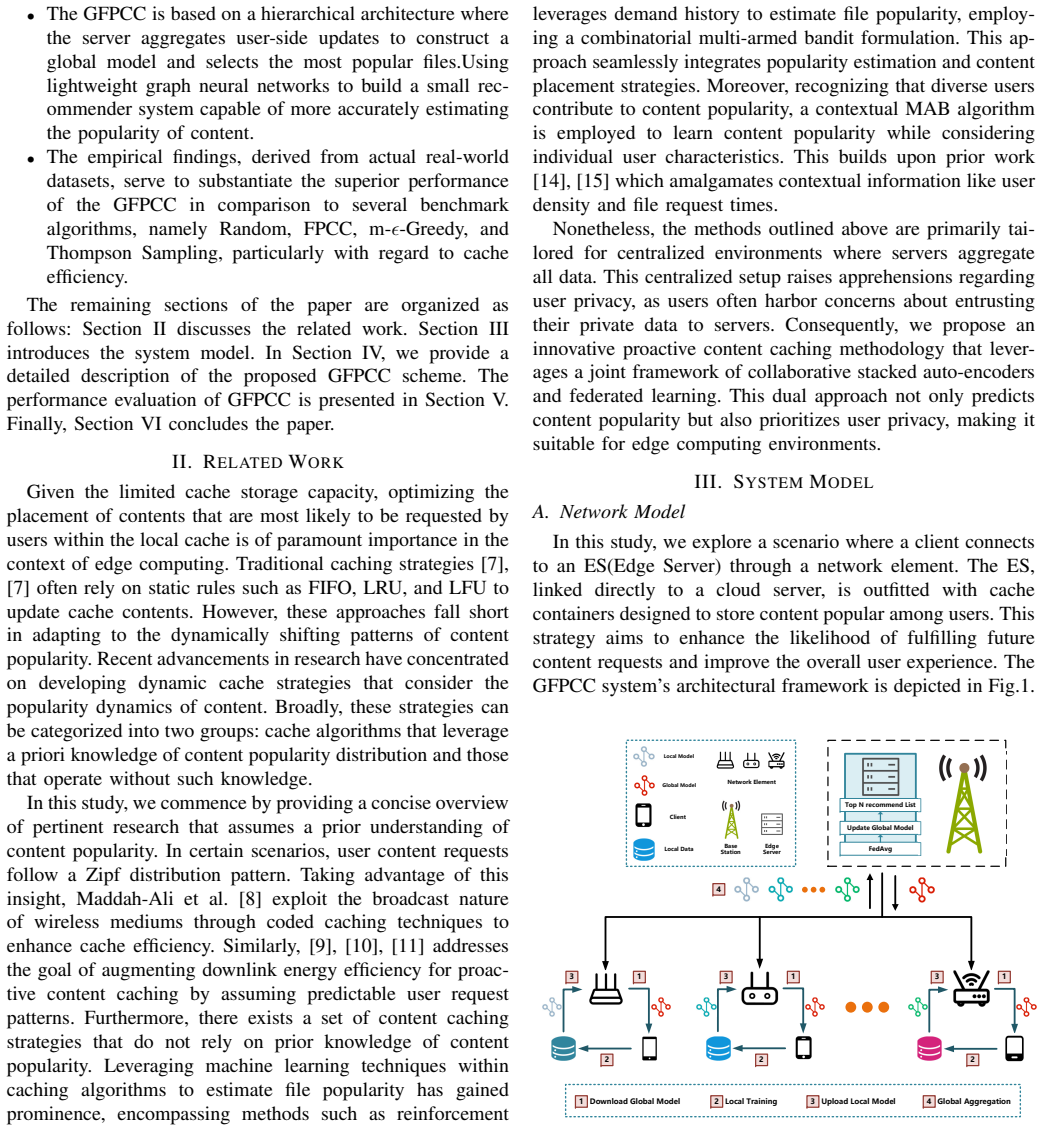
The machinery is a user-item bipartite graph propagated through LightGCN layers: each node embedding is updated by a symmetric normalized sum of its neighbors' embeddings, with no self-connections or nonlinearities, and the layer embeddings are pooled with weights $\beta$. User preference for an item is the dot product of the final user and item embedding vectors, and training uses Bayesian Personalized Ranking loss so that observed interactions rank above unobserved ones. On the server side, q-FedAvg aggregates local parameter updates with a fairness weighting derived from each device's loss, so raw interactions never leave the device; the server then caches the $N$ files that appear most often in users' local top-N lists.
What would settle it
Run a temporal split of MovieLens: train GFPCC and FPCC on ratings dated before a cutoff, count cache hits only on ratings dated after the cutoff, and compare hit rates; if the GFPCC-over-FPCC gap narrows toward zero, the claimed predictive advantage is an artifact of in-sample evaluation.
Extended reading notes
Core claim
The central claim is that a graph neural network trained under federated learning can capture user-item correlations well enough to drive proactive caching decisions, and that doing so beats both a federated autoencoder baseline and non-learning baselines. Concretely, the proposed GFPCC scheme trains LightGCN locally on each user's ratings, aggregates model updates with q-FedAvg, and has the edge server cache the files most frequently ranked at the top of users' local recommendation lists. On MovieLens 100K, GFPCC reports cache efficiency from 13.57% at a 50-file cache to 46.71% at 400 files, exceeding FPCC by 0.45 to 2.63 percentage points. On MovieLens 1M, it reaches 55.84% at a 400-file cache and stays within about 0.30 percentage points of the Oracle upper bound.
Load-bearing premise
The paper assumes that each movie rating in MovieLens is a content request and evaluates cache efficiency on the same ratings the model was trained on, with no temporal train/test split described, so the reported hit rates may measure how well the model fits the past rather than predicts future popularity.
Editorial extensions
If this is right
- On MovieLens 100K, reported cache efficiency for GFPCC rises from 13.57% at 50 cached files to 46.71% at 400, beating FPCC by 0.45 to 2.63 percentage points.
- On MovieLens 1M, GFPCC reaches 15.06% at 50 files and 55.84% at 400 files, staying within about 0.30 percentage points of the Oracle upper bound.
- Keeping raw ratings on user devices means the caching model can be trained without a central repository of individual histories, reducing the privacy exposure of centralized popularity learning.
- The same learned embeddings rank items for each user, so the mechanism functions as a recommender as well as a popularity estimator, with the server caching the items ranked most often across users.
- Because the graph convolution uses only normalized neighbor sums and no nonlinearities, the local training load is light enough for edge devices with limited compute.
Reading between the lines
- A deployment-oriented test on future requests is the missing check: if cache hits are counted only on ratings dated after the training window, the reported advantage over FPCC could narrow, because the paper's numbers come from the same ratings used for training.
- The same user-item embedding machinery could be reused for other edge decisions, such as preloading content on user devices or assigning users to edge servers, since it produces a per-user affinity score rather than a single popularity count.
- In a network where popular content shifts quickly, the fairness weighting of q-FedAvg may slow adaptation to new trends; the paper acknowledges scalability with dynamic preferences but does not measure concept drift.
- The MovieLens evaluation assumes a rating equals a streaming or download request; a real request trace could change both the absolute hit rates and the relative ranking of the algorithms.
Editorial analysis
A structured set of objections, weighed in public.
Referee Report
Summary. The paper proposes GFPCC, a federated-learning-based proactive content caching scheme in which clients locally train a LightGCN-style graph collaborative filtering model, upload model updates to an edge server, and the server aggregates updates via q-FedAvg. The server then selects the most frequently recommended items for caching. The authors evaluate cache efficiency on MovieLens 100K and 1M datasets against Oracle, FPCC, m-epsilon-Greedy, Thompson Sampling, and Random baselines, reporting that GFPCC consistently outperforms all baselines except Oracle and approaches the Oracle upper bound. The abstract and conclusion claim that GFPCC predicts future content popularity while preserving privacy.
Significance. If the reported results were obtained under a proper temporal evaluation protocol, the paper would provide a moderately useful demonstration that a federated LightGCN recommender can be repurposed for cache placement, with a small but consistent gain over an autoencoder-based federated baseline. The privacy-preserving distributed training setup is a relevant contribution to edge-caching research. However, the central 'proactive prediction' claim is currently unsupported because the evaluation appears to measure cache hits on the same ratings used to train the model, which reduces the reported numbers to in-sample reconstruction performance rather than predictive performance. No code, error bars, or hyperparameter settings are provided, so reproducibility is limited. The manuscript also contains several internal inconsistencies (e.g., promised reinforcement learning and adaptive beta schemes that are never implemented) that need to be resolved.
major comments (4)
- [V-A, V-B, Tables I-II] There is no temporal train/test split. Section V-A states that 'the rated movies are the files requested by users. Each movie rating corresponds to a downloading or streaming request,' and Section IV-A trains the model with BPR loss on the user-item interaction matrix. Cache efficiency in Section V-B is then computed as the ratio of cache hits to user requests. If the same ratings are used for training and for generating the request stream, the hit rates in Tables I and II measure the model's ability to reconstruct the training interaction matrix, not its ability to predict future content popularity. The abstract's and conclusion's 'proactive' claim is therefore unsupported. The authors must introduce an explicit temporal split (e.g., train on early ratings, test on later ratings) and re-run all experiments, or clearly state if such a split was used and how it was constructed.
- [IV-A, Eq. (1)] Equation (1) includes a trainable weight matrix W(i) in the propagation rule, which is not part of the standard LightGCN formulation. The paper claims to use LightGCN, whose defining property is the absence of feature transformation matrices and nonlinear activations, relying only on normalized adjacency aggregation. If W(i) is learned, then the architecture is not LightGCN and the parameter count and 'light' claim change; if W(i) is fixed, its role should be specified. The same inconsistency appears in Algorithm 1's ExtractUserVector and ExtractItemVector. This needs to be clarified because the method's identity and complexity depend on it.
- [III-A, IV-A] The system model in Section III-A states that 'we introduce a methodology employing reinforcement learning algorithms' to personalize local models, and Section IV-A promises 'an adaptive parameter adjustment strategy' for the layer combination weights beta. Neither component appears in Algorithms 1-2, in Section V, or anywhere else in the paper. These are load-bearing descriptions of the proposed method's novelty; if they are not implemented, the text must be revised to remove them, or the experiments must include them.
- [V-B, Tables I-II] The reported experimental evaluation is missing essential statistical and configuration details. No error bars, confidence intervals, or multiple-seed runs are reported, so the 0.4-1.0 percentage point advantage of GFPCC over FPCC cannot be judged as statistically meaningful. The paper does not list the embedding dimension d, number of propagation layers K, regularization coefficient lambda, q-FedAvg parameter q, learning rate, local/global epochs, batch size, or the number of clients and client subset size used in the experiments. Without these details, the results are not reproducible, and the claim of superiority over FPCC is not adequately supported.
minor comments (5)
- [Throughout] The acronym is inconsistently used: the title and abstract introduce 'GFPCC,' but Table I, Table II, and the result analysis refer to 'GFPC.' Please standardize the terminology.
- [II, References] Reference [7] is cited twice for the same traditional caching strategies, and the citation list contains mismatches: 'MovieLens [16]' points to Kipf and Welling's GCN paper rather than a MovieLens data source, and the FPCC baseline is attributed to 'Zhengxin Yu[12]' while reference [12] is Bastug et al. These citation errors should be corrected.
- [V-B] The text says 'As illustrated in Fig.4 and Fig.5,' but the actual cache-efficiency figures are Fig.5 (MovieLens 100K) and Fig.6 (MovieLens 1M); Fig.4 is the model architecture. The figure references should be updated.
- [IV-A, Eq. (4)] Equation (4) uses K both as the number of users in the outer sum and as the number of LGC layers in Eqs. (1)-(2). This overloaded notation makes the loss function ambiguous; a different symbol (e.g., |U|) should be used for the user count.
- [IV-A] There is a typo in the phrase 'TThis improved process' near the embedding description. Additionally, the paper does not cite LightGCN (He et al., SIGIR 2020), despite the method being essentially that architecture; a proper citation would be appropriate.
Circularity Check
Cache efficiency is scored on the same MovieLens ratings used for BPR training, so the reported "proactive" gains are in-sample fits rather than predictions of future popularity.
-
fitted input called prediction
[Section V-A and V-B; Section IV-A, Eq. (4)]
"To simulate the content requests, we assume that the rated movies are the files requested by users. Each movie rating corresponds to a downloading or streaming request. ... We use cache efficiency [2] as the performance metric to evaluate our algorithm, which is the ratio of cache hits to the number of user requests on the cache."
The BPR loss in Eq. (4) fits user/item embeddings to observed interactions Nu (the ratings). Section V-A then defines the evaluation requests as those same ratings, and Section V-B scores cache hits against these requests. No train/test split is described anywhere in Section V, so a cache hit means a training rating was placed in the fitted model's top-N list. The claimed prediction of future content popularity is therefore an in-sample reconstruction of the training interaction matrix; the Oracle is likewise computed on the training ratings. Tables I-II support only in-sample ranking quality, not proactive prediction.
full rationale
The central derivation chain is not circular in the narrow sense: no result is imported from a self-citation, no uniqueness theorem is invoked, and LightGCN-style embeddings plus q-FedAvg are externally describable. The circularity is in the evaluation protocol. Section V-A equates user requests with the MovieLens ratings, while Section IV-A trains on those same ratings via BPR loss; Section V-B then defines cache efficiency as hits among those requests. Without a temporal or random split, the "proactive" popularity prediction reduces to ranking the training interaction matrix, which is the fitted-input-called-prediction pattern. Because this affects the headline numbers in Tables I-II and the abstract's central claim, the partial-circularity score is 6. Separately flagged as non-circular provenance defects: Section IV-A contains an explicit "[reference pending]" for the GCN comparison, and Section V-A attributes FPCC to "Zhengxin Yu[12]" while reference [12] is Bastug et al.; these do not affect the score. No self-citation load-bearing chain was found.
Assumptions & free parameters
free parameters (6)
- Embedding dimension d =
not reported
- Number of propagation layers K =
not reported
- Layer combination weights beta^(k) =
not reported
- BPR regularization lambda =
not reported
- q-FedAvg fairness parameter q =
not reported
- Training hyperparameters (learning rate, local/global epochs, batch size, client subset size) =
not reported
assumptions (5)
- domain assumption MovieLens ratings are treated as content requests, with each rating corresponding to a download or streaming request.
- domain assumption Cache efficiency can be evaluated without an explicitly described temporal train/test split.
- ad hoc to paper The system model invokes reinforcement learning personalization and adaptive beta adjustment, but the implemented method uses standard LightGCN training with BPR loss and q-FedAvg.
- standard math Graph normalization by 1/sqrt(|N_u||N_i|) prevents embedding scale escalation.
- standard math BPR pairwise loss and the Adam optimizer are appropriate for implicit-feedback popularity ranking.
Cite this review
Pith. "Pith review of Graph Federated Learning Based Proactive Content Caching in Edge Computing." pith.science (2026). https://pith.science/paper/QALBML3O
@misc{pith2026250204760,
  author       = {Pith},
  title        = {Pith review of: Graph Federated Learning Based Proactive Content Caching in Edge Computing},
  year         = {2026},
  howpublished = {\url{https://pith.science/paper/QALBML3O}},
  note         = {Machine review of arXiv:2502.04760}
}
read the original abstract
With the rapid growth of mobile data traffic and the increasing prevalence of video streaming, proactive content caching in edge computing has become crucial for reducing latency and alleviating network congestion. However, traditional caching strategies such as FIFO, LRU, and LFU fail to effectively predict future content popularity, while existing proactive caching approaches often require users to upload data to a central server, raising concerns regarding privacy and scalability. To address these challenges, this paper proposes a Graph Federated Learning-based Proactive Content Caching (GFPCC) scheme that enhances caching efficiency while preserving user privacy. The proposed approach integrates federated learning and graph neural networks, enabling users to locally train Light Graph Convolutional Networks (LightGCN) to capture user-item relationships and predict content popularity. Instead of sharing raw data, only the trained model parameters are transmitted to the central server, where a federated averaging algorithm aggregates updates, refines the global model, and selects the most popular files for proactive caching. Experimental evaluations on real-world datasets, such as MovieLens, demonstrate that GFPCC outperforms baseline caching algorithms by achieving higher cache efficiency through more accurate content popularity predictions. Moreover, the federated learning framework strengthens privacy protection while maintaining efficient model training; however, scalability remains a challenge in large-scale networks with dynamic user preferences.
Figures


Figures from the paper (3 more)


Reference graph
Works this paper leans on
-
[7]
Bi Yu Chen, William HK Lam, Qingquan Li, Agachai Sumalee, and Ke Yan. Shortest path finding problem in stochastic time-dependent road networks with stochastic first-in-first-out property. IEEE Transactions on Intelligent Transportation Systems , 14(4):1907–1917, 2013
work page 1907
-
[12]
Living on the edge: The role of proactive caching in 5g wireless networks
Ejder Bastug, Mehdi Bennis, and M ´erouane Debbah. Living on the edge: The role of proactive caching in 5g wireless networks. IEEE Communications Magazine , 52(8):82–89, 2014
work page 2014
-
[1]
Cisco Annual Internet Report (2018–2023)
Cisco Systems. Cisco Annual Internet Report (2018–2023). Technical report, 2020
work page 2018
-
[2]
Context-aware proactive content caching with service differentiation in wireless networks
Sabrina M ¨uller, Onur Atan, Mihaela Van Der Schaar, and Anja Klein. Context-aware proactive content caching with service differentiation in wireless networks. IEEE Transactions on Wireless Communications , 16(2):1024–1036, 2016
work page 2016
-
[3]
An adaptive popularity tracking algorithm for dynamic content caching for radio access networks
Youkang Shi and Qiang Ling. An adaptive popularity tracking algorithm for dynamic content caching for radio access networks. In 2017 36th Chinese Control Conference (CCC) , pages 5690–5694. IEEE, 2017
work page 2017
-
[4]
Jiajun Wu, Chenyang Yang, and Binqiang Chen. Proactive caching and bandwidth allocation in heterogenous networks by learning from historical numbers of requests. IEEE Transactions on Communications , 68(7):4394–4410, 2020
work page 2020
-
[5]
A reinforcement-learning approach to proactive caching in wireless net- works
Samuel O Somuyiwa, Andr ´as Gy ¨orgy, and Deniz G ¨und¨uz. A reinforcement-learning approach to proactive caching in wireless net- works. IEEE Journal on Selected Areas in Communications , 36(6):1331– 1344, 2018
work page 2018
-
[6]
Towards personalized federated learning
Alysa Ziying Tan, Han Yu, Lizhen Cui, and Qiang Yang. Towards personalized federated learning. IEEE transactions on neural networks and learning systems , 34(12):9587–9603, 2022
2022
Show all 20 references
-
[8]
Fundamental limits of caching
Mohammad Ali Maddah-Ali and Urs Niesen. Fundamental limits of caching. IEEE Transactions on information theory , 60(5):2856–2867, 2014
2014
-
[9]
Proactive wireless caching at mobile user devices for energy efficiency
Arif Can G ¨ung¨or and Deniz G ¨und¨uz. Proactive wireless caching at mobile user devices for energy efficiency. In 2015 International Symposium on Wireless Communication Systems (ISWCS) , pages 186–
2015
-
[10]
Proactive caching for energy-efficiency in wireless networks: A markov decision process approach
Zhijie Chen, Hoshyar Mohammed, and Wei Chen. Proactive caching for energy-efficiency in wireless networks: A markov decision process approach. In 2018 IEEE International Conference on Communications (ICC), pages 1–6. IEEE, 2018
2018
-
[11]
Energy-efficient proactive caching with multipath routing
Yantong Wang and Vasilis Friderikos. Energy-efficient proactive caching with multipath routing. Computer Networks , 216:109272, 2022
2022
-
[13]
Learning distributed caching strategies in small cell networks
Avik Sengupta, SaiDhiraj Amuru, Ravi Tandon, R Michael Buehrer, and T Charles Clancy. Learning distributed caching strategies in small cell networks. In 2014 11th International Symposium on Wireless Communications Systems (ISWCS) , pages 917–921. IEEE, 2014
2014
-
[14]
Collaborative multi-agent multi-armed bandit learning for small-cell caching
Xianzhe Xu, Meixia Tao, and Cong Shen. Collaborative multi-agent multi-armed bandit learning for small-cell caching. IEEE Transactions on Wireless Communications , 19(4):2570–2585, 2020
2020
-
[15]
A non-stationary bandit-learning approach to energy-efficient femto-caching with rateless- coded transmission
Setareh Maghsudi and Mihaela van der Schaar. A non-stationary bandit-learning approach to energy-efficient femto-caching with rateless- coded transmission. IEEE Transactions on Wireless Communications , 19(7):5040–5056, 2020
2020
-
[16]
Semi-supervised classification with graph convolutional networks
Thomas N Kipf and Max Welling. Semi-supervised classification with graph convolutional networks. arXiv preprint arXiv:1609.02907 , 2016
2016 arXiv
-
[17]
Inductive representation learning on large graphs
Will Hamilton, Zhitao Ying, and Jure Leskovec. Inductive representation learning on large graphs. Advances in neural information processing systems, 30, 2017
2017
-
[18]
Neural graph collaborative filtering
Xiang Wang, Xiangnan He, Meng Wang, Fuli Feng, and Tat-Seng Chua. Neural graph collaborative filtering. In Proceedings of the 42nd international ACM SIGIR conference on Research and development in Information Retrieval , pages 165–174, 2019
2019
-
[19]
Bpr: Bayesian personalized ranking from implicit feedback
Steffen Rendle, Christoph Freudenthaler, Zeno Gantner, and Lars Schmidt-Thieme. Bpr: Bayesian personalized ranking from implicit feedback. arXiv preprint arXiv:1205.2618 , 2012
2012 arXiv
-
[20]
Fair resource allocation in federated learning
Tian Li, Maziar Sanjabi, Ahmad Beirami, and Virginia Smith. Fair resource allocation in federated learning. arXiv preprint arXiv:1905.10497, 2019
1905 arXiv
Reviewed August 8, 2026 · model on record in the stance chip above.
Discussion (0). Continue with ORCID to comment.