REVIEW 5 major objections 6 minor 48 references
MedMimic: Physician-Inspired Multimodal Fusion for Early Diagnosis of Fever of Unknown Origin
T0 review · 5 major / 6 minor · reviewed 2026-08-08 · deepseek-v4-flash
Pith's one-line read On 416 FUO cases, a tri-modal self-attention network reaches macro-AUROC up to 0.9291, beating all single-modality baselines.
desk verdict A useful new FUO dataset and a broad benchmark, but the headline AUROC range is a per-task best over four feature extractors, not a fixed, reproducible model. read the letter →
The pith
A machine-rendered reading of the paper's core claim, the machinery that carries it, and where it could break.
The reading
What carries the argument
The load-bearing object is the MFCN (multimodal fusion classification network), built from two modules. The first is a learnable self-attention recalibration layer: CT and PET slice features extracted by pretrained encoders are zero-padded to a common slice count, concatenated with expanded clinical features, and passed through three 1×1 convolutions to form query, key, and value tensors; the resulting attention map weights which spatial and modal information matters for each patient before global average pooling. The second is ResFusion, a six-block residual classifier with batch normalization, dropout, and skip connections that maps the pooled fusion vector to a softmax distribution over etiologic classes. The self-attention is the mechanism that lets imaging and clinical modalities interact dynamically, and the pretrained encoders are what make the high-dimensional volumes tractable on a 416-patient dataset.
What would settle it
Re-run the same MFCN on an external cohort that includes patients who remained undiagnosed after workup, and compare performance separately for diagnosed and undiagnosed patients; if accuracy on diagnosed patients drops when undiagnosed cases are added to the test set, or if the model confidently assigns undiagnosed cases to specific etiologies, the claim that it captures early FUO diagnosis is falsified. A simpler check: have two physicians independently re-adjudicate the 416 final diagnoses and measure label agreement; if agreement is low, the AUROC ceiling itself is questionable.
Extended reading notes
Core claim
The paper's central claim is that the bottleneck in computer-assisted FUO diagnosis is not the scarcity of deep networks but the mismatch between high-dimensional imaging data and low-dimensional clinical data. MedMimic resolves this by extracting per-slice features with pretrained DINOv2, ViT, and ResNet-18 encoders, stacking them into patient-level tensors with zero-padding, and feeding a fused tensor—imaging plus clinical features—through a learnable self-attention recalibration layer followed by a residual classification network. Across seven tasks (benign vs malignant, immune vs non-immune, infectious vs non-infectious, and finer etiologic splits), this multimodal fusion classification network achieved macro-AUROC scores of 0.8654 to 0.9291, and the tri-modality input consistently outperformed both dual-modality and single-modality configurations. The paper also demonstrates through ablations that the attention layer, dropout, residual connections, and larger hidden dimensions each contribute to the result, and that DINOv2 is the strongest feature extractor.
Load-bearing premise
The load-bearing premise is that the seven diagnostic labels, regrouped from final clinical diagnoses at a single center, are true and complete enough that predicting them measures early diagnostic skill; patients without a definitive diagnosis were excluded, so if those labels are noisy or the excluded cases differ systematically, the reported accuracy overstates real-world performance.
Editorial extensions
If this is right
- On every one of the seven tasks, the Clinical + CT + PET configuration beat the two-modality and single-modality configurations, so dropping a modality costs diagnostic accuracy.
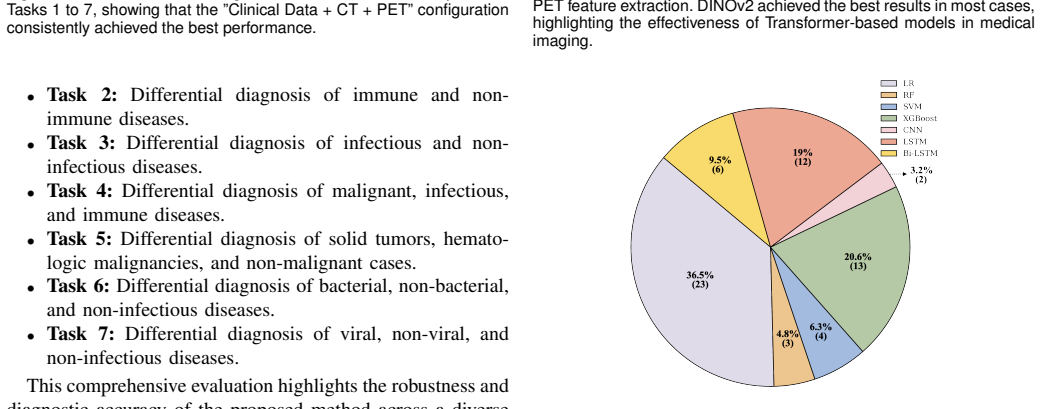
- DINOv2 features produced the best result in 59.5% of the evaluated cases, indicating that self-supervised pretraining is the most useful encoder choice for this small medical cohort.
- The same encoder-plus-attention pipeline can be lifted to other diagnostic domains with small datasets, since it avoids training deep image encoders from scratch.
- The model's output is a probability distribution over etiologic categories, which could be used to prioritize expensive or invasive follow-up tests rather than to replace the physician.
Reading between the lines
- Because the seven tasks are re-groupings of the same final diagnoses, their high AUROC scores may partly reflect shared label structure; a task built on independently adjudicated labels would be a stricter test.
- Excluding undiagnosed patients removes exactly the cases that make FUO clinically difficult, so real deployment would face a distribution shift toward harder, less certain patients.
- Comparing MedMimic against a nuclear medicine physician reading the same scans would show whether the fusion adds information beyond what trained eyes already extract.
- The zero-padding of slices to a common maximum length lets the attention layer see masked positions; a slice-count-aware pooling mechanism would test whether this padding biases the learned weights.
Signed reviews
Editorial analysis
A structured set of objections, weighed in public.
Referee Report
Summary. The paper proposes MedMimic, a multimodal fusion framework for classifying causes of fever of unknown origin (FUO). Imaging features are extracted from 18F-FDG PET/CT slices with four encoders (PCA, ResNet-18, ViT, DINOv2), and a learnable self-attention network (MFCN) fuses these features with clinical data. The method is evaluated on 416 patients from a single center across seven diagnostic tasks defined by regrouping final clinical diagnoses. Using five-fold cross-validation and macro-AUROC, the authors report a range of 0.8654 to 0.9291 for the Clinical Data + CT + PET configuration and conclude that multimodal fusion consistently outperforms single-modality ML and DL baselines. Ablation studies examine hidden dimensions and network components.
Significance. The manuscript addresses a clinically meaningful problem, uses a real hospital cohort, and systematically compares several input configurations and feature extractors. The five-fold protocol and the use of out-of-sample test folds are appropriate, and the ablation study is a useful sanity check. If the reported performance corresponded to a fixed, pre-specified model with reported uncertainty, the result would be of interest to the medical-imaging community. At present, however, the central claim is weakened by selection over multiple feature extractors and hyperparameter settings, by the absence of confidence intervals or significance tests, and by the gap between the reported AUROC range and the actual values of any single model configuration.
major comments (5)
- [Abstract and Section V-C, Tables IV-X] The headline macro-AUROC range 0.8654–0.9291 is a per-task maximum over four feature extractors, not the performance of one fixed MFCN model. For example, in Table VI (Task 3) the best Clinical Data + CT + PET result is ViT at 0.8654 while DINOv2 gives 0.8556; in Table VIII (Task 5) the best is DINOv2 at 0.9291; in Table IX (Task 6) the best is DINOv2 at 0.8899 while ViT gives 0.8342. The abstract and Section V-C should state which extractor and architecture produce each number, or should report results for a single pre-specified model, otherwise the central claim is not reproducible as stated.
- [Section V (Experimental Setup) and Tables IV-X] No confidence intervals, standard deviations, or significance tests are reported for any macro-AUROC value. With 416 patients and rare classes such as hematologic malignancies (n=18 in Table II), per-fold macro-AUROC will have substantial variability. In addition, the paper states that 'the hyperparameter configuration that yielded the best performance on the training sets was selected as optimal' and the ablation varies hidden dimension from 16 to 256 and ResNet depth from 3 to 6; selecting the best configuration on the same study data and then reporting the best result can inflate apparent performance. The authors should report per-fold results, confidence intervals, and use nested cross-validation or a held-out validation set for model selection, or clearly separate model-selection performance from final test performance.
- [Section IV-A, Fig. 2, and Task Definitions] The seven classification tasks are constructed by regrouping final clinical diagnoses, and patients without a definitive diagnosis were excluded. This makes the reported AUROC values a measure of classifying already-resolved diagnoses, not necessarily of early FUO diagnosis as claimed. The number of excluded undiagnosed patients and their characteristics are not reported. The authors should quantify the exclusions, discuss how label noise or ambiguous final diagnoses could affect the tasks, and temper the 'early diagnosis' claim accordingly.
- [Section IV-C.2 and Algorithm 2] The zero-padding mask tensor Z introduced in Section IV-C.2 is never applied as an attention mask in Algorithm 2; zero-padded slice positions appear to participate in the self-attention computation on the same footing as real slices. The paper should clarify whether padded positions are masked out, and if they are not, justify this design choice and provide an ablation comparing masked versus unmasked attention. Without this, the contribution of the learnable self-attention mechanism is not precisely established.
- [Section V-A and Table III] The comparison is not symmetric: the MFCN is evaluated with four imaging feature extractors, while the baseline ML and single-modality DL methods are not given the same fusion architecture. The statement that 'Clinical Data + CT + PET consistently achieved the best performance' is therefore a claim about MFCN with per-task best extractor selection, not about the fusion strategy in general. A fairer comparison would couple the same fusion module to all extractors or report MFCN results for each extractor separately as the primary result.
minor comments (6)
- [Section V-C] The text says 'accuracy ranging from 0.8654 to 0.9291,' but the tables report macro-AUROC, not accuracy; please use the correct metric name consistently.
- [Algorithm 1] Line 20 of Algorithm 1 says 'FPET ← Pad(FCT)' but should almost certainly be 'FPET ← Pad(FPET)'; this pseudocode error should be corrected.
- [Section III-B and Eq. (1)] The notation for y is inconsistent: Eq. (1) calls y 'a scalar' while the problem formulation defines y as a one-hot encoded label vector. Please unify the notation.
- [Section IV-C.1 and Figure 5] The number of PCA components b1 is never specified in the experimental setup, making the PCA baseline difficult to reproduce.
- [References] Reference [18] cites a survey on large language model datasets, but the text discusses a multicenter FUO study in Japan; the citation appears incorrect.
- [Index Terms] The index term 'Self-Attenton' contains a typo and should read 'Self-Attention'.
Circularity Check
No significant circularity: the reported AUROC values are genuine out-of-sample test-fold results, and the framework is not derived from its own outputs or from load-bearing self-citations.
full rationale
This is an empirical machine-learning paper rather than a derivation, so the main circularity patterns do not apply. The central claim is that the MFCN with Clinical Data + CT + PET achieves macro-AUROC 0.8654 to 0.9291 across seven tasks (Section V-C, Tables IV-X). These are test-fold macro-AUROC values obtained under five-fold cross-validation, with the test fold held out during training; no fitted constant is relabeled as a prediction. The hyperparameter configuration was selected on training folds ('The hyperparameter configuration that yielded the best performance on the training sets was selected as optimal'), which is standard model selection, and the test-fold numbers remain out-of-sample. The abstract's range takes the best feature extractor per task, but the paper reports per-extractor results in Tables IV-X, so each reported value is a real evaluation rather than an identity. The physician-inspired Eq. (1) is motivating formalism, not a derivation that presupposes the result. References are external prior work; there is no author self-citation chain and no imported uniqueness theorem. Concerns about label noise, arbitrary task boundaries, or selection over many configurations are validity and robustness risks, not circularity. Accordingly, no circular step is identified.
Assumptions & free parameters
free parameters (3)
- Hidden layer dimension =
256
- Number of ResNet layers in ResFusion =
6
- PCA component count b1 =
not reported
assumptions (4)
- domain assumption Final clinical diagnosis is an accurate ground-truth label for FUO etiology.
- domain assumption Pretrained natural-image features transfer to FDG-PET/CT slices.
- ad hoc to paper Zero-padding slices to the cohort maximum and omitting attention masking preserves meaningful representations.
- domain assumption The seven hand-defined classification tasks capture clinically meaningful FUO distinctions.
Cite this review
Pith. "Pith review of MedMimic: Physician-Inspired Multimodal Fusion for Early Diagnosis of Fever of Unknown Origin." pith.science (2026). https://pith.science/paper/OFSRIDM2
@misc{pith2026250204794,
  author       = {Pith},
  title        = {Pith review of: MedMimic: Physician-Inspired Multimodal Fusion for Early Diagnosis of Fever of Unknown Origin},
  year         = {2026},
  howpublished = {\url{https://pith.science/paper/OFSRIDM2}},
  note         = {Machine review of arXiv:2502.04794}
}
read the original abstract
Fever of unknown origin FUO remains a diagnostic challenge. MedMimic is introduced as a multimodal framework inspired by real-world diagnostic processes. It uses pretrained models such as DINOv2, Vision Transformer, and ResNet-18 to convert high-dimensional 18F-FDG PET/CT imaging into low-dimensional, semantically meaningful features. A learnable self-attention-based fusion network then integrates these imaging features with clinical data for classification. Using 416 FUO patient cases from Sichuan University West China Hospital from 2017 to 2023, the multimodal fusion classification network MFCN achieved macro-AUROC scores ranging from 0.8654 to 0.9291 across seven tasks, outperforming conventional machine learning and single-modality deep learning methods. Ablation studies and five-fold cross-validation further validated its effectiveness. By combining the strengths of pretrained large models and deep learning, MedMimic offers a promising solution for disease classification.
Figures


Figures from the paper (12 more)




Reference graph
Works this paper leans on
-
[1]
The three long-continued fevers of new england,
R. C. Cabot, “The three long-continued fevers of new england,” The Boston Medical and Surgical Journal , vol. 157, no. 9, pp. 281–285, 1907
work page 1907
-
[2]
W. F. Wright, J. Wang, and P. G. Auwaerter, “Fever of unknown origin (fuo) criteria influences diagnostic outcomes: A systematic review and meta-analysis,” The American Journal of Medicine , vol. 137, no. 12, pp. 1246–1254.e6, 2024
work page 2024
-
[3]
Fever of unknown origin-reexamined and redefined,
D. Durack, “Fever of unknown origin-reexamined and redefined,” Curr Clin Top Infect Dis , vol. 111, pp. 35–51, 1991
work page 1991
-
[4]
Fever of unknown origin: is there a role for empiric therapy?,
C. S. Bryan and D. Ahuja, “Fever of unknown origin: is there a role for empiric therapy?,” Infectious disease clinics of North America , vol. 21, no. 4, pp. 1213–1220, 2007
work page 2007
-
[5]
Fever of unknown origin: a clinical approach,
B. A. Cunha, O. Lortholary, and C. B. Cunha, “Fever of unknown origin: a clinical approach,” The American journal of medicine, vol. 128, no. 10, pp. 1138–e1, 2015
work page 2015
-
[6]
T. Xu, S. Wu, J. Li, L. Wang, and H. Huang, “Development of a risk prediction model for bloodstream infection in patients with fever of unknown origin,” Journal of Translational Medicine , vol. 20, no. 1, p. 575, 2022
work page 2022
-
[7]
Y . Yan, C. Chen, Y . Liu, Z. Zhang, L. Xu, and K. Pu, “Application of machine learning for the prediction of etiological types of classic fever of unknown origin,” Frontiers in Public Health, vol. 9, p. 800549, 2021
work page 2021
-
[8]
Z. Wang, J. Liu, Y . Tian, T. Zhou, Q. Liu, Y . Qiu, and J. Li, “Integrating medical domain knowledge for early diagnosis of fever of unknown ori- gin: An interpretable hierarchical multimodal neural network approach,” IEEE Journal of Biomedical and Health Informatics , 2023
work page 2023
Show all 48 references
-
[10]
Differential diagnosis of lymphoma with 18f-fdg pet/ct in pa- tients with fever of unknown origin accompanied by lymphadenopathy,
J. Chen, D. Xu, W.-J. Sun, W.-X. Wang, N.-N. Xie, Q.-R. Ruan, and J.- X. Song, “Differential diagnosis of lymphoma with 18f-fdg pet/ct in pa- tients with fever of unknown origin accompanied by lymphadenopathy,” Journal of Cancer Research and Clinical Oncology , vol. 149, no. 1...
2023
-
[11]
Diagnos- tic value of 18f-fdg-pet/ct in patients with fuo,
S. Georga, P. Exadaktylou, I. Petrou, D. Katsampoukas, V . Mpalaris, E.-I. Moralidis, K. Arvaniti, C. Papastergiou, and G. Arsos, “Diagnos- tic value of 18f-fdg-pet/ct in patients with fuo,” Journal of Clinical Medicine, vol. 9, no. 7, 2020
2020
-
[12]
Fdg pet in evaluation of patients with fever of unknown origin: Ajr expert panel narrative review,
C. J. Palestro, D. C. Brandon, E. H. Dibble, Z. Keidar, and J. J. Kwak, “Fdg pet in evaluation of patients with fever of unknown origin: Ajr expert panel narrative review,” American Journal of Roentgenology , vol. 221, no. 2, pp. 151–162, 2023. PMID: 36722759
2023
-
[13]
Fever of unknown origin,
G. Haidar and N. Singh, “Fever of unknown origin,” New England Journal of Medicine , vol. 386, no. 5, pp. 463–477, 2022
2022
-
[14]
Fusion of medical imaging and electronic health records using deep learning: a systematic review and implementation guidelines,
S.-C. Huang, A. Pareek, S. Seyyedi, I. Banerjee, and M. P. Lungren, “Fusion of medical imaging and electronic health records using deep learning: a systematic review and implementation guidelines,” npj Dig- ital Medicine, vol. 3, no. 1, p. 136, 2020
2020
-
[15]
Comparison of 18f-fdg pet/ct and 67ga-spect for the diagnosis of fever of unknown origin: a multicenter prospective study in japan,
K. Kubota, N. Tanaka, Y . Miyata, H. Ohtsu, T. Nakahara, S. Sakamoto, T. Kudo, Y . Nishiyama, U. Tateishi, K. Murakami, Y . Nakamoto, Y . Taki, T. Kaneta, J. Kawabe, S. Nagamachi, T. Kawano, J. Hatazawa, Y . Mizutani, S. Baba, K. Kirii, K. Yokoyama, T. Okamura, M. Kameyama, R....
2021
-
[16]
Etiology and clinical characteristics of fever of unknown origin in children: a 15-year experience in a single center,
Y . S. Kim, K. R. Kim, J. M. Kang, J. M. Kim, and Y . J. Kim, “Etiology and clinical characteristics of fever of unknown origin in children: a 15-year experience in a single center,” Korean Journal of Pediatrics , vol. 60, pp. 77–85, March 2017
2017
-
[17]
Fever of unknown origin caused by infectious diseases in the era of migrant and refugee crisis,
N. Spernovasilis, C. Tsioutis, L. Markaki, M. Zafeiri, S. Soundoulounaki, and A. Gikas, “Fever of unknown origin caused by infectious diseases in the era of migrant and refugee crisis,” Travel Medicine and Infectious Disease , vol. 33, p. 101425, Jan–Feb 2020
2020
-
[18]
Datasets for large language models: A comprehensive survey,
Y . Liu, J. Cao, C. Liu, K. Ding, and L. Jin, “Datasets for large language models: A comprehensive survey,” 2024. 16 IEEE TRANSACTIONS AND JOURNALS TEMPLATE
2024
-
[19]
Medical workforce in the united states,
E. I. Bluth, D. P. Frush, M. E. Oates, J. LaBerge, H. Y . Pan, W. D. Newhauser, and S. A. Rosenthal, “Medical workforce in the united states,” Journal of Applied Clinical Medical Physics , vol. 23, p. e13799, 2022
2022
-
[20]
Trends in nuclear medicine and the radiopharmaceutical sciences in oncology: workforce challenges and training in the age of theranostics,
A. M. Scott, B. M. Zeglis, S. E. Lapi, P. J. H. Scott, A. D. Wind- horst, M. Abdel-Wahab, F. Giammarile, D. Paez, A. Jalilian, P. Knoll, A. Korde, S. Vichare, N. Ayati, S. T. Lee, S. K. Lyashchenko, J. Zhang, J. L. Urbain, and J. S. Lewis, “Trends in nuclear medicine and the r...
2024 doi
-
[21]
Medical imaging and nuclear medicine: a Lancet Oncology commission,
H. Hricak, M. Abdel-Wahab, R. Atun, M. M. Lette, D. Paez, J. A. Brink, L. Donoso-Bach, G. Frija, M. Hierath, O. Holmberg, P.-L. Khong, J. S. Lewis, G. McGinty, W. J. G. Oyen, L. N. Shulman, Z. J. Ward, and A. M. Scott, “Medical imaging and nuclear medicine: a Lancet Oncology c...
2021 doi
-
[22]
Deep convolutional neural networks for computer-aided detection: Cnn architectures, dataset characteristics and transfer learning,
H.-C. Shin, H. R. Roth, M. Gao, L. Lu, Z. Xu, I. Nogues, J. Yao, D. Mollura, and R. M. Summers, “Deep convolutional neural networks for computer-aided detection: Cnn architectures, dataset characteristics and transfer learning,” IEEE Transactions on Medical Imaging , vol. 35, ...
2016
-
[23]
Attention is all you need,
A. Vaswani, “Attention is all you need,” Advances in Neural Information Processing Systems, 2017
2017
-
[24]
Image transformer,
N. Parmar, A. Vaswani, J. Uszkoreit, L. Kaiser, N. Shazeer, A. Ku, and D. Tran, “Image transformer,” in International conference on machine learning, pp. 4055–4064, PMLR, 2018
2018
-
[25]
An image is worth 16x16 words: Transformers for image recognition at scale,
A. Dosovitskiy, “An image is worth 16x16 words: Transformers for image recognition at scale,” arXiv preprint arXiv:2010.11929 , 2020
2010 arXiv
-
[26]
Dinov2: Learning robust visual features without supervision,
M. Oquab, T. Darcet, T. Moutakanni, H. V o, M. Szafraniec, V . Khalidov, P. Fernandez, D. Haziza, F. Massa, A. El-Nouby, et al. , “Dinov2: Learning robust visual features without supervision,” arXiv preprint arXiv:2304.07193, 2023
2023 arXiv
-
[27]
Exploring scalable medicalperezgarcia2025raddino image encoders beyond text supervision,
F. P ´erez-Garc´ıa, H. Sharma, S. Bond-Taylor, K. Bouzid, V . Salvatelli, M. Ilse, S. Bannur, D. C. Castro, A. Schwaighofer, M. P. Lungren, M. T. Wetscherek, N. Codella, S. L. Hyland, J. Alvarez-Valle, and O. Oktay, “Exploring scalable medicalperezgarcia2025raddino image encod...
2025
-
[28]
Multimodal machine learning: A survey and taxonomy,
T. Baltru ˇsaitis, C. Ahuja, and L.-P. Morency, “Multimodal machine learning: A survey and taxonomy,” IEEE transactions on pattern anal- ysis and machine intelligence , vol. 41, no. 2, pp. 423–443, 2018
2018
-
[29]
Attentional feature fusion,
Y . Dai, F. Gieseke, S. Oehmcke, Y . Wu, and K. Barnard, “Attentional feature fusion,” in Proceedings of the IEEE/CVF winter conference on applications of computer vision , pp. 3560–3569, 2021
2021
-
[30]
Diagnostic yield of fdg-pet/ct in fever of unknown origin: a systematic review, meta-analysis, and delphi exercise,
T. Bharucha, A. Rutherford, S. Skeoch, A. Alavi, M. Brown, J. Galloway, R. Miller, M. Llewelyn, N. Jenkins, J. Lambourne, et al. , “Diagnostic yield of fdg-pet/ct in fever of unknown origin: a systematic review, meta-analysis, and delphi exercise,” Clinical radiology, vol. 72,...
2017
-
[31]
Optimal use of the fdg-pet/ct in the diagnostic process of fever of unknown origin (fuo): a comprehensive review,
R. Minamimoto, “Optimal use of the fdg-pet/ct in the diagnostic process of fever of unknown origin (fuo): a comprehensive review,” Japanese Journal of Radiology , vol. 40, no. 11, pp. 1121–1137, 2022
2022
-
[32]
The declaration of helsinki,
M. D. Goodyear, K. Krleza-Jeric, and T. Lemmens, “The declaration of helsinki,” 2007
2007
-
[33]
Fever of unknown origin,
C. Mulders-Manders, A. Simon, and C. Bleeker-Rovers, “Fever of unknown origin,” Clinical Medicine (London) , vol. 15, pp. 280–284, June 2015
2015
-
[34]
Deep residual learning for image recognition,
K. He, X. Zhang, S. Ren, and J. Sun, “Deep residual learning for image recognition,” in Proceedings of the IEEE conference on computer vision and pattern recognition , pp. 770–778, 2016
2016
-
[35]
Principal component analysis,
H. Abdi and L. J. Williams, “Principal component analysis,” Wiley interdisciplinary reviews: computational statistics, vol. 2, no. 4, pp. 433– 459, 2010
2010
-
[36]
Learning represen- tations by back-propagating errors,
D. E. Rumelhart, G. E. Hinton, and R. J. Williams, “Learning represen- tations by back-propagating errors,” nature, vol. 323, no. 6088, pp. 533– 536, 1986
1986
-
[37]
Pytorch: An imperative style, high-performance deep learning library,
A. Paszke, S. Gross, F. Massa, A. Lerer, J. Bradbury, G. Chanan, T. Killeen, Z. Lin, N. Gimelshein, L. Antiga, et al. , “Pytorch: An imperative style, high-performance deep learning library,” Advances in neural information processing systems , vol. 32, 2019
2019
-
[38]
A study of cross-validation and bootstrap for accuracy estimation and model selection,
R. Kohavi et al., “A study of cross-validation and bootstrap for accuracy estimation and model selection,” in Ijcai, vol. 14, pp. 1137–1145, Montreal, Canada, 1995
1995
-
[39]
Sgdr: Stochastic gradient descent with warm restarts,
I. Loshchilov and F. Hutter, “Sgdr: Stochastic gradient descent with warm restarts,” arXiv preprint arXiv:1608.03983 , 2016
2016 arXiv
-
[40]
Adam: A method for stochastic optimization,
D. P. Kingma, “Adam: A method for stochastic optimization,” arXiv preprint arXiv:1412.6980, 2014
2014 arXiv
-
[41]
The regression analysis of binary sequences,
D. R. Cox, “The regression analysis of binary sequences,” Journal of the Royal Statistical Society Series B: Statistical Methodology , vol. 20, no. 2, pp. 215–232, 1958
1958
-
[42]
Random forests,
L. Breiman, “Random forests,” Machine learning , vol. 45, pp. 5–32, 2001
2001
-
[43]
Vapnik, The nature of statistical learning theory
V . Vapnik, The nature of statistical learning theory . Springer science & business media, 2013
2013
-
[44]
Xgboost: A scalable tree boosting system,
T. Chen and C. Guestrin, “Xgboost: A scalable tree boosting system,” in Proceedings of the 22nd acm sigkdd international conference on knowledge discovery and data mining , pp. 785–794, 2016
2016
-
[45]
Backpropagation applied to handwritten zip code recognition,
Y . LeCun, B. Boser, J. S. Denker, D. Henderson, R. E. Howard, W. Hubbard, and L. D. Jackel, “Backpropagation applied to handwritten zip code recognition,” Neural computation, vol. 1, no. 4, pp. 541–551, 1989
1989
-
[46]
Convolutional neural networks for medical image analysis: Full training or fine tuning?,
N. Tajbakhsh, J. Y . Shin, S. R. Gurudu, R. T. Hurst, C. B. Kendall, M. B. Gotway, and J. Liang, “Convolutional neural networks for medical image analysis: Full training or fine tuning?,” IEEE transactions on medical imaging, vol. 35, no. 5, pp. 1299–1312, 2016
2016
-
[47]
Long short-term memory,
S. Hochreiter, “Long short-term memory,” Neural Computation MIT- Press, 1997
1997
-
[48]
Framewise phoneme classification with bidirectional lstm and other neural network architectures,
A. Graves and J. Schmidhuber, “Framewise phoneme classification with bidirectional lstm and other neural network architectures,” Neural networks, vol. 18, no. 5-6, pp. 602–610, 2005
2005
-
[49]
A review on multi-label learning al- gorithms,
M.-L. Zhang and Z.-H. Zhou, “A review on multi-label learning al- gorithms,” IEEE Transactions on Knowledge and Data Engineering , vol. 26, no. 8, pp. 1819–1837, 2014
2014
Reviewed August 8, 2026 · model on record in the stance chip above.
Discussion (0). Continue with ORCID to comment.