REVIEW 3 major objections 6 minor 121 references
Applying the Liouville-Lanczos Method of Time-Dependent Density-Functional Theory to Warm Dense Matter
T0 review · 3 major / 6 minor · reviewed 2026-08-08 · deepseek-v4-flash
Pith's one-line read The Liouville–Lanczos method of time-dependent DFT computes warm dense matter spectra without empty bands and passes benchmarks against standard theory and quantum Monte Carlo.
desk verdict A careful, useful benchmark of an existing method for a new regime, with a central claim slightly broader than the independent evidence. read the letter →
The pith
A machine-rendered reading of the paper's core claim, the machinery that carries it, and where it could break.
The reading
What carries the argument
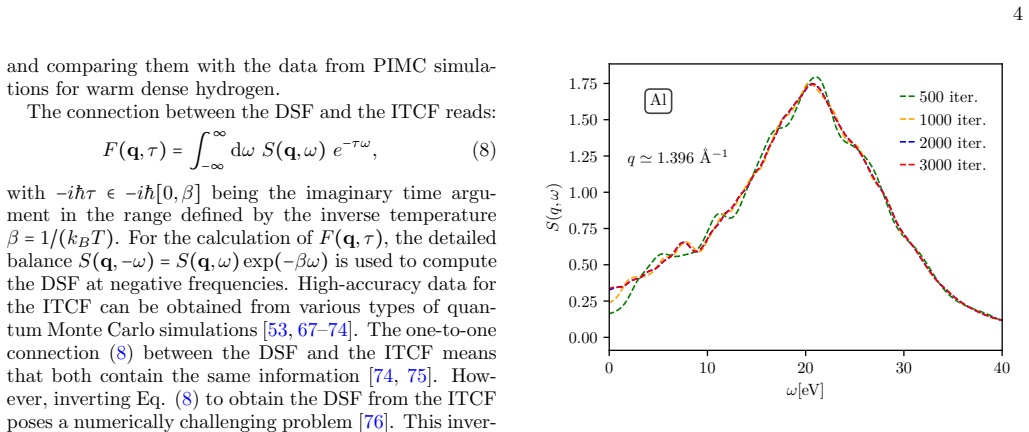
The machinery is the Liouville–Lanczos representation of the density response. One linearizes the quantum Liouville equation for the one-electron Kohn–Sham density matrix, writes the response as $(\omega-\hat{L})^{-1}$ acting on the perturbation commutator, and iteratively builds a tridiagonal Lanczos form of the Liouvillian superoperator $\hat{L}$. This gives $\chi(q,\omega)$ and hence the dynamic structure factor through the fluctuation-dissipation theorem, and the imaginary-time correlation function through the Laplace transform $F(q,\tau)=\int d\omega\, S(q,\omega)e^{-\tau\omega}$, using only the occupied density matrix; the number of Lanczos steps controls convergence.
What would settle it
Repeat the aluminum comparison with a projector augmented-wave or all-electron treatment that includes semicore states as valence at the same $q$ and $T=6$ eV; if the DSF maximum moves by more than the LDA-versus-PBE spread shown in the paper, the LL method's frozen-core pseudopotential is the limiting error and its core-loss claim fails. A high-$q$ X-ray Thomson scattering measurement of warm dense hydrogen at $q\simeq 4.584\,\mathrm{\AA}^{-1}$ with a characterized source-and-instrument function would settle whether the LL large-$q$ spectrum is physical.
Extended reading notes
Core claim
The central discovery is that the Liouville–Lanczos (LL) method reproduces the dynamic structure factor of standard orbital-based LR-TDDFT under warm dense matter conditions while avoiding the empty-band bottleneck: no unoccupied states are needed, so the accessible frequency range is no longer capped by the highest occupied-to-empty eigenvalue difference. For warm dense hydrogen at metallic and solid densities, the shifted imaginary-time correlation function $\tilde{F}(q,\tau)$ computed from the LL dynamic structure factor agrees with exact PIMC benchmarks. For isochorically heated aluminum, overall agreement with projector augmented-wave LR-TDDFT is good, though small differences near the DSF maximum are traced to how pseudopotentials treat core electrons.
Load-bearing premise
The entire high-frequency and high-wavenumber capability rests on the frozen-core pseudopotential's description of the electron–ion interaction; if the pseudopotential misses core-electron excitations, the claimed access to the core-loss region and large-$q$ DSF is not truly ab initio.
Editorial extensions
If this is right
- At large wavenumbers, where the number of empty bands in standard LR-TDDFT grows roughly as $q^3$, the LL method keeps computing the DSF, making backward-scattering XRTS geometries tractable.
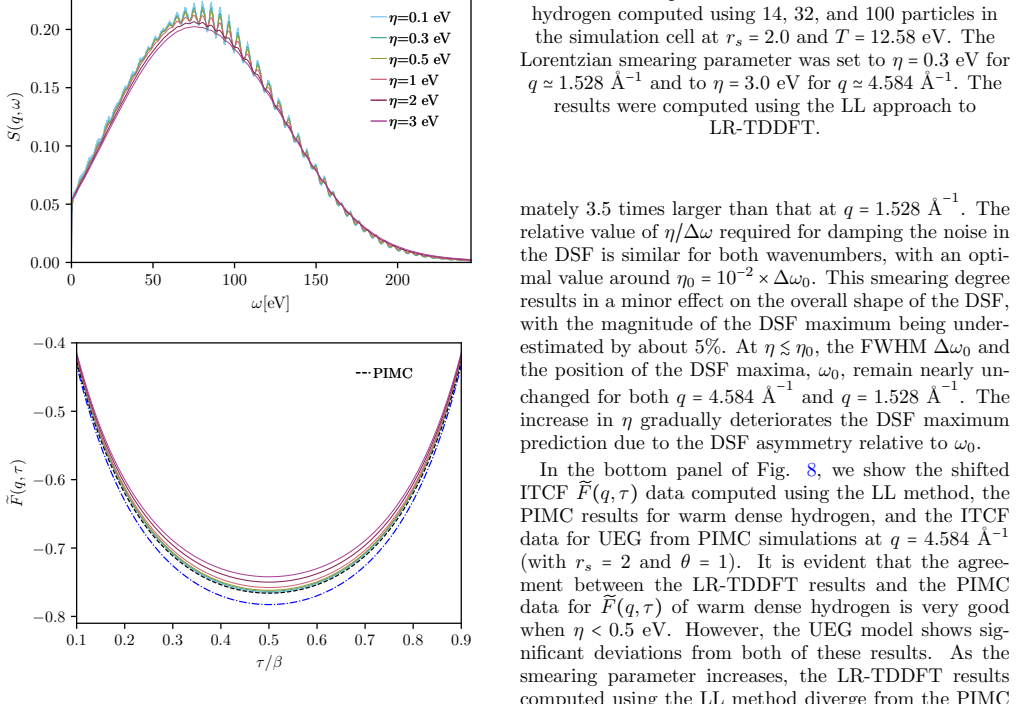
- Snapshot-averaged LL results for warm dense hydrogen match exact PIMC data for the imaginary-time correlation function, providing an ab initio benchmark for XRTS analysis in the Laplace domain.
- The Lorentzian smearing parameter has little effect on the ITCF after Laplace transform, so smaller $\eta$ can be used to converge the ITCF without needing a fully smooth DSF.
- The LL method's freedom in choosing $q$ values beyond the k-point grid helps model the wavenumber blurring that real X-ray detectors introduce.
Reading between the lines
- A natural next test is all-electron or high-valence PAW computation at high energy loss; if they match the LL pseudopotential results, the method could be trusted for core-edge spectroscopy of compressed matter, a regime the paper does not itself claim.
- The computational advantage of LL over standard LR-TDDFT is not universal: at small $q$ and small systems the standard method can be far cheaper, so large campaigns should benchmark the crossover before choosing.
- Since the Laplace transform suppresses Lanczos noise, ITCF-based temperature diagnostics could be applied to LL spectra where standard LR-TDDFT cannot reach, an extension the authors suggest but do not demonstrate.
- The remaining discrepancy between LDA and PBE kernels in the aluminum DSF peak suggests that exchange-correlation kernel errors, not just algorithmic ones, will matter when LL is pushed to quantitative XRTS fitting.
Editorial analysis
A structured set of objections, weighed in public.
Referee Report
Summary. This manuscript benchmarks the Liouville-Lanczos (LL) implementation of linear-response TDDFT (turboEELS in Quantum ESPRESSO) for warm dense matter. The authors compute the electronic dynamic structure factor S(q,ω) for isochorically heated aluminum and for warm dense hydrogen at two densities, comparing against standard LR-TDDFT in the PAW formalism (GPAW) and against exact PIMC data for the imaginary-time correlation function F(q,τ). The LL results are shown to agree with PAW LR-TDDFT at low frequencies, to reproduce the PIMC ITCF after averaging over ionic snapshots, and to extend to higher frequencies and wavenumbers than the standard approach with a manageable number of empty bands. The paper also analyzes the effect of Lorentzian smearing and pseudopotential choice.
Significance. If valid, the paper provides a practically useful validation of the LL method for WDM applications, where standard LR-TDDFT is limited by the need for large numbers of empty bands and large memory footprints. The use of an exact PIMC benchmark for the ITCF, the cross-code comparison between QE/turboEELS and GPAW, and the explicit treatment of Lorentzian smearing and pseudopotential effects are strengths. The authors are appropriately cautious about the pseudopotential dependence of the Al DSF, and they demonstrate convergence with Lanczos iterations. However, the validation of the high-frequency and high-wavenumber capability—the central claimed advantage—is incomplete, and the statistics of the snapshot averaging are not quantified. These issues are fixable and do not invalidate the core methodological message, but they need to be addressed before the claim of 'successful validation' can be accepted.
major comments (3)
- [Sec. III B, Eq. (8), Figs. 6-8] The PIMC benchmark is performed on the shifted ITCF F̃(q,τ), which is a Laplace transform of S(q,ω) with kernel e^{-τω}. At the hydrogen condition T=12.58 eV (β≈0.0795 eV^{-1}), the weight at τ/β=0.5 is below 0.02 for ω=100 eV and below 0.003 for ω=150 eV, so features above roughly 100 eV contribute to F̃(q,τ) essentially as a τ-independent constant that cancels in the shifted definition (9). The excellent agreement with PIMC therefore validates only the low-frequency content of the DSF. The direct comparison with standard LR-TDDFT covers only ω up to about 50 eV for Al (Figs. 2-3) and up to about 80 eV for hydrogen (Fig. 4); for ω>150 eV, where the authors claim a key advantage of the LL method, there is no independent reference, and the comparison in Fig. 5 is only against standard LR-TDDFT, which is incomplete there because of the empty-state cutoff. Thus the abstract's statement that the LL method is 'successfully validated ... under WDM conditions' for a broad frequency range is stronger than the evidence presented. I recommend adding a high-frequency benchmark (e.g., a sum-rule check, comparison with RT-TDDFT, or an all-electron calculation at selected q) or explicitly restricting the validation claim to the frequency range actually tested.
- [Figs. 6-8, 10-11] The averaged DSF and shifted ITCF curves are presented without statistical uncertainties, although they are computed from a finite number of snapshots (5-20) with visible snapshot-to-snapshot scatter. Without error bars or a statement of the standard error of the mean, the claims of 'excellent' agreement with PIMC and of convergence with respect to η cannot be quantitatively assessed. This is particularly important because the snapshot scatter varies strongly with q and η (compare the top panels of Fig. 6 and Fig. 8). Please include error bars on the averaged quantities and, ideally, show the PIMC error bars from Ref. [44].
- [Sec. I, Sec. III A, Fig. 3] The paper claims access to the 'core-loss region' and to a 'broad frequency range' via the LL method, but all QE calculations use frozen-core norm-conserving or ultrasoft pseudopotentials (Al 3s^2 3p^1; H 1s^1). With frozen cores, true inner-shell excitations are absent by construction; the high-frequency DSF is therefore only as reliable as the pseudopotential's description of the valence response. The authors themselves show in Fig. 3 that the DSF maximum in Al changes with the pseudopotential/PAW treatment, and Sec. III A attributes the LL-versus-PAW difference to core-electron handling. This indicates that the high-frequency part is subject to similar or larger pseudopotential uncertainties. The text notes this in passing ('defined by the utilized pseudopotential'), but the abstract and conclusions state the broad-frequency capability without this caveat. Please either demonstrate the pseudopotential convergence of the high-ω DSF (e.g., by comparing different pseudopotentials with more valence electrons, as in Ref. [116], or all-electron calculations) or clearly state that the claimed broad-frequency access is limited to the valence response.
minor comments (6)
- [Introduction] In the sentence "When the shape of the probing X-ray beam are known," the verb should agree with the singular subject "shape": "is known."
- [Sec. III B] The text contains a typo: "the standard LT-TDDFT method" should read "the standard LR-TDDFT method."
- [Sec. III B and Fig. 7] The text says the Lorentzian smearing parameter is varied in the range 0.1 eV ≤ η ≤ 0.9 eV, while the caption of Fig. 7 states 0.1 eV ≤ η ≤ 0.8 eV; please make the two consistent.
- [Fig. 2 caption] The caption appears to contain duplicated legend entries ('LL app. stand. LR-TDDFT' repeated); please clean up the caption so that it clearly identifies the curves for each wavenumber and method.
- [Sec. II B] The bi-constant extrapolation used to obtain 10^4 Lanczos coefficients from Niter iterations is referenced only to Ref. [39]; a brief description of the extrapolation and its main parameters would improve self-containedness.
- [Sec. II A, Eqs. (5)-(7)] The superoperator notation for the Liouvillian is not consistently distinguished from ordinary operators (e.g., in (ω−L̂) the bold or calligraphic style is not maintained); a short notational note would help the reader.
Circularity Check
No circularity: LL method is benchmarked against independent PAW-LR-TDDFT and exact PIMC references.
full rationale
No circular step found. The paper validates the Liouville–Lanczos implementation by comparing it against (i) standard LR-TDDFT in the PAW formalism as implemented in the independent GPAW code, and (ii) exact PIMC results for the imaginary-time density–density correlation function. Neither benchmark is derived from, fitted to, or defined in terms of the LL calculation. The LL DSF enters the comparison only through the exact Laplace relation F(q,τ)=∫dω S(q,ω)e^{-τω} and the shifted ITCF (Eq. 9); no parameter is fitted to PIMC, and the Lorentzian smearing η is scanned over a range rather than optimized. The PIMC reference [44] shares authors with the present work, but it is a separate first-principles method (parameter-free PIMC) and thus constitutes real evidence rather than a self-referential chain. The limitation that the Laplace transform suppresses high-frequency spectral weight — so the PIMC agreement mainly constrains frequencies below about 100 eV — is an evidential gap for the paper's broad-frequency claim, but it is not a form of circularity. Similarly, the Al comparison to standard LR-TDDFT is limited to about 50 eV and shows a pseudopotential-dependent shift, which again affects the strength of the validation, not its circularity. The central derivation chain is therefore self-contained.
Assumptions & free parameters
free parameters (3)
- Lorentzian smearing eta =
0.1-3.0 eV; 0.2-0.5 eV in main comparisons
- Lanczos iteration count Niter =
3000 (Al), 12000 (H)
- Number of snapshots for averaging =
5-20
assumptions (9)
- standard math Fluctuation-dissipation theorem, Eq. (1), relates the DSF to the imaginary part of the density response.
- standard math Dyson equation, Eq. (2), for the density response in LR-TDDFT.
- standard math Quantum Liouville equation, Eq. (4), for the reduced one-electron KS density matrix.
- standard math Laplace transform relation, Eq. (8), between DSF and ITCF.
- domain assumption Adiabatic LDA/PBE exchange-correlation kernel K_xc(q, omega=0).
- domain assumption PIMC ITCF data for warm dense hydrogen from Ref. [44] is exact for the non-relativistic model.
- domain assumption Separability of quasi-elastic and inelastic contributions; only the inelastic part is computed.
- ad hoc to paper Frozen-core pseudopotential approximation is sufficient for high-frequency DSF up to the defined core-loss region.
- domain assumption Snapshot averaging over KSDFT-MD trajectories represents the equilibrium proton configuration.
Cite this review
Pith. "Pith review of Applying the Liouville-Lanczos Method of Time-Dependent Density-Functional Theory to Warm Dense Matter." pith.science (2026). https://pith.science/paper/6TGTHOO3
@misc{pith2026250204921,
  author       = {Pith},
  title        = {Pith review of: Applying the Liouville-Lanczos Method of Time-Dependent Density-Functional Theory to Warm Dense Matter},
  year         = {2026},
  howpublished = {\url{https://pith.science/paper/6TGTHOO3}},
  note         = {Machine review of arXiv:2502.04921}
}
read the original abstract
Ab initio modeling of dynamic structure factors (DSF) and related density response properties in the warm dense matter (WDM) regime is a challenging computational task. The DSF, convolved with a probing X-ray beam and instrument function, is measured in X-ray Thomson scattering (XRTS) experiments, which allows for the study of electronic structure properties at the microscopic level. Among the various ab initio methods, linear response time-dependent density functional theory (LR-TDDFT) is a key framework for simulating the DSF. The standard approach in LR-TDDFT for computing the DSF relies on the orbital representation. A significant drawback of this method is the unfavorable scaling of the number of required empty bands as the wavenumber increases, making LR-TDDFT impractical for modeling XRTS measurements over large energy scales, such as in backward scattering geometry. We consider and test an alternative approach that employs the Liouville-Lanczos (LL) method for simulating the DSF. This approach does not require empty states and allows the DSF at large momentum transfer values and over a broad frequency range to be accessed. We compare the results obtained from the LL method with those from the standard LR-TDDFT within the projector augmented-wave formalism for isochorically heated aluminum and warm dense hydrogen. Additionally, we utilize exact path integral Monte Carlo (PIMC) results for the imaginary-time density-density correlation function (ITCF) of warm dense hydrogen to rigorously benchmark the LL approach. We discuss the application of the LL method for calculating DSFs and ITCFs at different wavenumbers, the effects of pseudopotentials, and the role of Lorentzian smearing. The successful validation of the LL method under WDM conditions makes it a valuable addition to the ab initio simulation landscape, supporting experimental efforts and advancing WDM theory.
Figures


Figures from the paper (7 more)




Reference graph
Works this paper leans on
-
[44]
Ab initio density response and local field factor of warm dense hy- drogen,
Tobias Dornheim, Sebastian Schwalbe, Panagiotis Tolias, Maximilian P. B¨ ohme, Zhandos A. Mold- abekov, and Jan Vorberger, “Ab initio density response and local field factor of warm dense hy- drogen,” Matter and Radiation at Extremes 9, 057401 (2024), https://pubs.aip.org/aip/mre/article- pdf/doi/10.1063/5.0211407/20079329/057401 1 5.0211407.pdf
-
[116]
Hans-Christian Weissker, Jorge Serrano, Simo Huotari, Eleonora Luppi, Marco Cazzaniga, Fabien Bruneval, Francesco Sottile, Giulio Monaco, Valerio Olevano, and Lucia Reining, “Dynamic structure factor and dielectric function of silicon for finite momentum transfer: Inelas- tic x-ray scattering experiments and ab initio calcula- tions,” Phys. Rev. B 81, 085...
work page 2010
-
[1]
Extreme states of matter on earth and in space,
V. E. Fortov, “Extreme states of matter on earth and in space,” Phys.-Usp 52, 615–647 (2009)
2009
-
[2]
Nanosecond formation of diamond and lonsdaleite by shock com- pression of graphite,
D. Kraus, A. Ravasio, M. Gauthier, D. O. Gericke, J. Vorberger, S. Frydrych, J. Helfrich, L. B. Fletcher, G. Schaumann, B. Nagler, B. Barbrel, B. Bachmann, E. J. Gamboa, S. G¨ ode, E. Granados, G. Gregori, H. J. Lee, P. Neumayer, W. Schumaker, T. D¨ oppner, R. W. Falcone, S. H. Glenzer, and M. Roth, “Nanosecond formation of diamond and lonsdaleite by shoc...
2016
-
[3]
Recent progress in matter in extreme states created by laser,
K. Batani, D. Batani, X. T. He, and K. Shige- mori, “Recent progress in matter in extreme states created by laser,” Matter and Radiation at Extremes 7, 013001 (2021), https://pubs.aip.org/aip/mre/article- pdf/doi/10.1063/5.0078895/16615560/013001 1 online.pdf
-
[4]
A milestone in fusion research is reached,
R. Betti, “A milestone in fusion research is reached,” Nature Reviews Physics 5, 6–8 (2023)
2023
-
[5]
Drake, High-Energy-Density Physics: Founda- tion of Inertial Fusion and Experimental Astrophysics, Graduate Texts in Physics (Springer International Pub- lishing, 2018)
R.P. Drake, High-Energy-Density Physics: Founda- tion of Inertial Fusion and Experimental Astrophysics, Graduate Texts in Physics (Springer International Pub- lishing, 2018)
2018
-
[6]
Graziani, M
F. Graziani, M. P. Desjarlais, R. Redmer, and S. B. Trickey, eds., Frontiers and Challenges in Warm Dense Matter (Springer, International Publishing, 2014)
2014
Show all 121 references
-
[7]
Toward first principles-based simulations of dense hydrogen,
Michael Bonitz, Jan Vorberger, Mandy Bethkenhagen, Maximilian P. B¨ ohme, David M. Ceperley, Alexey Fili- nov, Thomas Gawne, Frank Graziani, Gianluca Gregori, Paul Hamann, Stephanie B. Hansen, Markus Holz- mann, S. X. Hu, Hanno K¨ ahlert, Valentin V. Karasiev, Uwe Kleinschmidt...
2024
-
[8]
From density response to energy functionals and back: An ab initio perspective on matter under extreme conditions,
Zhandos Moldabekov, Jan Vorberger, and Tobias Dorn- heim, “From density response to energy functionals and back: An ab initio perspective on matter under extreme conditions,” Progress in Particle and Nuclear Physics 140, 104144 (2025)
2025
-
[9]
The High Energy Density Sci- entific Instrument at the European XFEL,
Ulf Zastrau, Karen Appel, Carsten Baehtz, Oliver Baehr, Lewis Batchelor, Andreas Bergh¨ auser, Moham- madreza Banjafar, Erik Brambrink, Valerio Cerantola, Thomas E. Cowan, Horst Damker, Steffen Dietrich, Samuele Di Dio Cafiso, J¨ orn Dreyer, Hans-Olaf En- gel, Thomas Feldmann,...
2021
-
[10]
Toward using collective x-ray thomson scattering to study c–h demixing and hydrogen metallization in warm dense matter conditions,
D. Ranjan, K. Ramakrishna, K. Voigt, O. S. Humphries, B. Heuser, M. G. Stevenson, J. L¨ utgert, Z. He, C. Qu, S. Schumacher, P. T. May, A. Amouretti, K. Appel, E. Brambrink, V. Cerantola, D. Chekrygina, L. B. Fletcher, S. G¨ ode, M. Harmand, N. J. Hartley, S. P. Hau-Riege, M. ...
2023
-
[11]
Ultrabright x-ray laser scattering for dy- namic warm dense matter physics,
L. B. Fletcher, H. J. Lee, T. D¨ oppner, E. Galtier, B. Na- gler, P. Heimann, C. Fortmann, S. LePape, T. Ma, M. Millot, A. Pak, D. Turnbull, D. A. Chapman, D. O. Gericke, J. Vorberger, T. White, G. Gregori, M. Wei, B. Barbrel, R. W. Falcone, C.-C. Kao, H. Nuhn, J. Welch, U. Za...
2015
-
[12]
Two-colour hard x-ray free-electron laser with wide tunability,
Toru Hara, Yuichi Inubushi, Tetsuo Katayama, Takahiro Sato, Hitoshi Tanaka, Takashi Tanaka, Tadashi Togashi, Kazuaki Togawa, Kensuke Tono, Mak- ina Yabashi, et al., “Two-colour hard x-ray free-electron laser with wide tunability,” Nature communications 4, 2919 (2013)
2013
-
[13]
Experimen- tally inferred fusion yield dependencies of omega inertial confinement fusion implosions,
A. Lees, R. Betti, J. P. Knauer, V. Gopalaswamy, D. Pa- tel, K. M. Woo, K. S. Anderson, E. M. Campbell, D. Cao, J. Carroll-Nellenback, R. Epstein, C. Forrest, V. N. Goncharov, D. R. Harding, S. X. Hu, I. V. Igu- menshchev, R. T. Janezic, O. M. Mannion, P. B. Radha, S. P. Regan...
2021
-
[14]
Direct observation of an abrupt insulator-to-metal transition in dense liquid deuterium,
M. D. Knudson, M. P. Desjarlais, A. Becker, R. W. Lemke, K. R. Cochrane, M. E. Savage, D. E. Bliss, T. R. Mattsson, and R. Redmer, “Direct observation of an abrupt insulator-to-metal transition in dense liquid deuterium,” Science 348, 1455–1460 (2015), https://www.science.org/...
2015 doi
-
[15]
Observing the onset of pressure-driven k-shell delocal- ization,
T. D¨ oppner, M. Bethkenhagen, D. Kraus, P. Neu- mayer, D. A. Chapman, B. Bachmann, R. A. Baggott, M. P. B¨ ohme, L. Divol, R. W. Falcone, L. B. Fletcher, O. L. Landen, M. J. MacDonald, A. M. Saunders, M. Sch¨ orner, P. A. Sterne, J. Vorberger, B. B. L. Witte, A. Yi, R. Redmer...
2023 doi
-
[16]
Electronic density response of warm dense mat- ter,
Tobias Dornheim, Zhandos A. Moldabekov, Kushal Ra- makrishna, Panagiotis Tolias, Andrew D. Baczewski, Dominik Kraus, Thomas R. Preston, David A. Chap- man, Maximilian P. B¨ ohme, Tilo D¨ oppner, Frank Graziani, Michael Bonitz, Attila Cangi, and Jan Vor- berger, “Electronic den...
2023
-
[17]
Observations of plasmons in warm dense matter,
S. H. Glenzer, O. L. Landen, P. Neumayer, R. W. Lee, K. Widmann, S. W. Pollaine, R. J. Wallace, G. Gre- gori, A. H¨ oll, T. Bornath, R. Thiele, V. Schwarz, W.- D. Kraeft, and R. Redmer, “Observations of plasmons in warm dense matter,” Phys. Rev. Lett. 98, 065002 (2007)
2007
-
[18]
Probing warm dense lithium by inelastic x-ray scatter- ing,
E. Garc ´ ıa Saiz, G. Gregori, D. O. Gericke, J. Vor- berger, B. Barbrel, R. J. Clarke, R. R. Freeman, S. H. Glenzer, F. Y. Khattak, M. Koenig, O. L. Lan- den, D. Neely, P. Neumayer, M. M. Notley, A. Pelka, D. Price, M. Roth, M. Schollmeier, C. Spindloe, R. L. Weber, L. van Wo...
2008
-
[19]
Towards model-free temperature diagnostics of warm dense matter from multiple scattering angles,
Hannah M. Bellenbaum, Benjamin Bachmann, Dominik Kraus, Thomas Gawne, Maximilian P. B¨ ohme, Tilo D¨ oppner, Luke B. Fletcher, Michael J. MacDonald, Zhandos A. Moldabekov, Thomas R. Preston, Jan Vor- berger, and Tobias Dornheim, “Towards model-free temperature diagnostics of w...
2024 arXiv
-
[20]
Effects of mosaic crystal instrument functions on x-ray thomson scat- tering diagnostics,
Thomas Gawne, Hannah Bellenbaum, Luke B. Fletcher, Karen Appel, Carsten Baehtz, Victorien Bouffetier, Erik Brambrink, Danielle Brown, Attila Cangi, Adrien Descamps, Sebastian Goede, Nicholas J. Hartley, Marie-Luise Herbert, Philipp Hesselbach, Hauke H¨ oppner, Oliver S. Humphr...
2024
-
[21]
Accurate temperature di- agnostics for matter under extreme conditions,
Tobias Dornheim, Maximilian B¨ ohme, Dominik Kraus, Tilo D¨ oppner, Thomas R. Preston, Zhandos A. Mold- abekov, and Jan Vorberger, “Accurate temperature di- agnostics for matter under extreme conditions,” Nature Communications 13, 7911 (2022)
2022
-
[22]
Temperature measurement through detailed balance in x-ray thomson scattering,
T. D¨ oppner, O.L. Landen, H.J. Lee, P. Neumayer, S.P. Regan, and S.H. Glenzer, “Temperature measurement through detailed balance in x-ray thomson scattering,” High Energy Density Physics 5, 182–186 (2009)
2009
-
[23]
Model-free rayleigh weight from x-ray thomson scattering measurements,
Tobias Dornheim, Hannah M. Bellenbaum, Mandy Bethkenhagen, Stephanie B. Hansen, Maximilian P. B¨ ohme, Tilo D¨ oppner, Luke B. Fletcher, Thomas Gawne, Dirk O. Gericke, Sebastien Hamel, Dominik Kraus, Michael J. MacDonald, Zhandos A. Mold- abekov, Thomas R. Preston, Ronald Redm...
2024 arXiv
-
[24]
Unraveling electronic cor- relations in warm dense quantum plasmas,
Tobias Dornheim, Tilo D¨ oppner, Panagiotis Tolias, Maximilian B¨ ohme, Luke Fletcher, Thomas Gawne, Frank Graziani, Dominik Kraus, Michael MacDonald, Zhandos Moldabekov, Sebastian Schwalbe, Dirk Ger- icke, and Jan Vorberger, “Unraveling electronic cor- relations in warm dense...
2024 arXiv
-
[25]
Theoretical model of x-ray scattering as a dense matter probe,
G. Gregori, S. H. Glenzer, W. Rozmus, R. W. Lee, and O. L. Landen, “Theoretical model of x-ray scattering as a dense matter probe,” Phys. Rev. E 67, 026412 (2003)
2003
-
[26]
Evidence of free-bound transitions in warm dense matter and their impact on equation-of-state mea- surements,
Maximilian P. B¨ ohme, Luke B. Fletcher, Tilo D¨ oppner, Dominik Kraus, Andrew D. Baczewski, Thomas R. Preston, Michael J. MacDonald, Frank R. Graziani, Zhandos A. Moldabekov, Jan Vorberger, and Tobias Dornheim, “Evidence of free-bound transitions in warm dense matter and thei...
2023 arXiv
-
[27]
Inverse problem in- stabilities in large-scale modeling of matter in ex- treme conditions,
M. F. Kasim, T. P. Galligan, J. Topp-Mugglestone, G. Gregori, and S. M. Vinko, “Inverse problem in- stabilities in large-scale modeling of matter in ex- treme conditions,” Physics of Plasmas 26 (2019), 10.1063/1.5125979, 112706
2019 doi
-
[28]
Marques, N.T
M.A.L. Marques, N.T. Maitra, F.M.S. Nogueira, E.K.U. Gross, and A. Rubio, Fundamentals of Time-Dependent Density Functional Theory, Lecture Notes in Physics (Springer Berlin Heidelberg, 2012)
2012
-
[29]
X-ray thomson scat- tering in warm dense matter without the chihara de- composition,
A. D. Baczewski, L. Shulenburger, M. P. Desjarlais, S. B. Hansen, and R. J. Magyar, “X-ray thomson scat- tering in warm dense matter without the chihara de- composition,” Phys. Rev. Lett. 116, 115004 (2016)
2016
-
[31]
First-principles estimation of electronic tem- perature from x-ray thomson scattering spectrum of iso- chorically heated warm dense matter,
Chongjie Mo, Zhenguo Fu, Wei Kang, Ping Zhang, and X. T. He, “First-principles estimation of electronic tem- perature from x-ray thomson scattering spectrum of iso- chorically heated warm dense matter,” Phys. Rev. Lett. 120, 205002 (2018)
2018
-
[32]
First-principles method for x-ray thomson scattering including both elastic and inelastic features in warm dense matter,
Chongjie Mo, Zhen-Guo Fu, Ping Zhang, Wei Kang, Weiyan Zhang, and X. T. He, “First-principles method for x-ray thomson scattering including both elastic and inelastic features in warm dense matter,” Phys. Rev. B 102, 195127 (2020)
2020
-
[33]
Linear-response time-dependent density func- tional theory approach to warm dense matter with adi- abatic exchange-correlation kernels,
Zhandos A. Moldabekov, Michele Pavanello, Maxim- ilian P. B¨ ohme, Jan Vorberger, and Tobias Dorn- heim, “Linear-response time-dependent density func- tional theory approach to warm dense matter with adi- abatic exchange-correlation kernels,” Phys. Rev. Res. 5, 023089 (2023)
2023
-
[34]
X-ray thomson scat- tering spectra from density functional theory molecular dynamics simulations based on a modified chihara for- mula,
Maximilian Sch¨ orner, Mandy Bethkenhagen, Tilo D¨ oppner, Dominik Kraus, Luke B. Fletcher, Siegfried H. Glenzer, and Ronald Redmer, “X-ray thomson scat- tering spectra from density functional theory molecular dynamics simulations based on a modified chihara for- mula,” Phys. ...
2023
-
[35]
Linear density response function in the projector augmented wave method: Applications to solids, surfaces, and interfaces,
Jun Yan, Jens. J. Mortensen, Karsten W. Jacobsen, and Kristian S. Thygesen, “Linear density response function in the projector augmented wave method: Applications to solids, surfaces, and interfaces,” Phys. Rev. B 83, 245122 (2011)
2011
-
[36]
Efficient approach to time-dependent density-functional perturbation theory for optical spec- troscopy,
Brent Walker, A. Marco Saitta, Ralph Gebauer, and Stefano Baroni, “Efficient approach to time-dependent density-functional perturbation theory for optical spec- troscopy,” Phys. Rev. Lett. 96, 113001 (2006)
2006
-
[37]
Turbo charging time-dependent density-functional theory with lanczos chains,
Dario Rocca, Ralph Gebauer, Yousef Saad, and Stefano Baroni, “Turbo charging time-dependent density-functional theory with lanczos chains,” The Journal of Chemical Physics 128, 154105 (2008), https://pubs.aip.org/aip/jcp/article- pdf/doi/10.1063/1.2899649/15411522/154105 1 online.pdf
2008 doi
-
[38]
turboTDDFT – A code for the simulation of molecular spectra using the Li- ouville–Lanczos approach to time-dependent density- functional perturbation theory,
Osman Barı¸ s Malcıo˘ glu, Ralph Gebauer, Dario Rocca, and Stefano Baroni, “turboTDDFT – A code for the simulation of molecular spectra using the Li- ouville–Lanczos approach to time-dependent density- functional perturbation theory,” Computer Physics Communications 182, 1744–...
2011
-
[39]
Iurii Timrov, Nathalie Vast, Ralph Gebauer, and Ste- fano Baroni, “turboEELS—A code for the simulation of the electron energy loss and inelastic X-ray scat- tering spectra using the Liouville–Lanczos approach to time-dependent density-functional perturbation the- ory,” Compute...
2015
-
[40]
Quantum espresso: One further step toward the exascale,
Ivan Carnimeo, Fabio Affinito, Stefano Baroni, Os- car Baseggio, Laura Bellentani, Riccardo Bertossa, Pietro Davide Delugas, Fabrizio Ferrari Ruffino, Ser- gio Orlandini, Filippo Spiga, and Paolo Giannozzi, “Quantum espresso: One further step toward the exascale,” Journal of C...
2023 doi
-
[41]
Electron energy loss spectroscopy of bulk gold with ultrasoft pseudopotentials and the liouville-lanczos method,
Oleksandr Motornyi, Nathalie Vast, Iurii Timrov, Os- car Baseggio, Stefano Baroni, and Andrea Dal Corso, “Electron energy loss spectroscopy of bulk gold with ultrasoft pseudopotentials and the liouville-lanczos method,” Phys. Rev. B 102, 035156 (2020)
2020
-
[42]
Ab initio study of electron energy loss spectra of bulk bismuth up to 100 ev,
Iurii Timrov, Maxime Markov, Tommaso Gorni, Mich` ele Raynaud, Oleksandr Motornyi, Ralph Gebauer, Stefano Baroni, and Nathalie Vast, “Ab initio study of electron energy loss spectra of bulk bismuth up to 100 ev,” Phys. Rev. B 95, 094301 (2017)
2017
-
[43]
Electron energy loss and inelastic x-ray scattering cross sections from time-dependent density- functional perturbation theory,
Iurii Timrov, Nathalie Vast, Ralph Gebauer, and Ste- fano Baroni, “Electron energy loss and inelastic x-ray scattering cross sections from time-dependent density- functional perturbation theory,” Phys. Rev. B 88, 064301 (2013). 15
2013
-
[45]
Electron- ion equilibration in a strongly coupled plasma,
A. Ng, P. Celliers, G. Xu, and A. Forsman, “Electron- ion equilibration in a strongly coupled plasma,” Phys. Rev. E 52, 4299–4310 (1995)
1995
-
[46]
Picosecond acoustic response of a laser-heated gold-film studied with time-resolved x-ray diffraction,
Matthieu Nicoul, Uladzimir Shymanovich, Alexander Tarasevitch, Dietrich von der Linde, and Klaus Sokolowski-Tinten, “Picosecond acoustic response of a laser-heated gold-film studied with time-resolved x-ray diffraction,” Applied Physics Letters 98, 191902 (2011), https://doi.o...
2011 doi
-
[47]
Electron-phonon equili- bration in laser-heated gold films,
T. G. White, P. Mabey, D. O. Gericke, N. J. Hartley, H. W. Doyle, D. McGonegle, D. S. Rackstraw, A. Hig- ginbotham, and G. Gregori, “Electron-phonon equili- bration in laser-heated gold films,” Phys. Rev. B 90, 014305 (2014)
2014
-
[48]
Excitation signatures of isochorically heated electrons in solids at finite wave number explored from first principles,
Zhandos A. Moldabekov, Thomas D. Gawne, Sebastian Schwalbe, Thomas R. Preston, Jan Vorberger, and To- bias Dornheim, “Excitation signatures of isochorically heated electrons in solids at finite wave number explored from first principles,” Phys. Rev. Res. 6, 023219 (2024)
2024
-
[49]
Projector augmented-wave method,
P. E. Bl¨ ochl, “Projector augmented-wave method,” Phys. Rev. B 50, 17953–17979 (1994)
1994
-
[50]
Electron-ion temperature relaxation in warm dense hydrogen observed with pi- cosecond resolved x-ray scattering,
L. B. Fletcher, J. Vorberger, W. Schumaker, C. Ruyer, S. Goede, E. Galtier, U. Zastrau, E. P. Alves, S. D. Baal- rud, R. A. Baggott, B. Barbrel, Z. Chen, T. D¨ oppner, M. Gauthier, E. Granados, J. B. Kim, D. Kraus, H. J. Lee, M. J. MacDonald, R. Mishra, A. Pelka, A. Rava- sio,...
2022
-
[51]
Resolving ultrafast heating of dense cryogenic hydrogen,
U. Zastrau, P. Sperling, M. Harmand, A. Becker, T. Bornath, R. Bredow, S. Dziarzhytski, T. Fen- nel, L. B. Fletcher, E. F¨ orster, S. G¨ ode, G. Gre- gori, V. Hilbert, D. Hochhaus, B. Holst, T. Laarmann, H. J. Lee, T. Ma, J. P. Mithen, R. Mitzner, C. D. Murphy, M. Nakatsutsumi...
2014
-
[52]
Bayesian inference and the analytic continuation of imaginary-time quan- tum monte carlo data,
Mark Jarrell and J.E. Gubernatis, “Bayesian inference and the analytic continuation of imaginary-time quan- tum monte carlo data,” Physics Reports 269, 133–195 (1996)
1996
-
[53]
Ab initio path integral Monte Carlo results for the dy- namic structure factor of correlated electrons: From the electron liquid to warm dense matter,
T. Dornheim, S. Groth, J. Vorberger, and M. Bonitz, “Ab initio path integral Monte Carlo results for the dy- namic structure factor of correlated electrons: From the electron liquid to warm dense matter,” Phys. Rev. Lett. 121, 255001 (2018)
2018
-
[54]
X-ray thomson scatter- ing in high energy density plasmas,
S. H. Glenzer and R. Redmer, “X-ray thomson scatter- ing in high energy density plasmas,” Rev. Mod. Phys 81, 1625 (2009)
2009
-
[55]
Characterizing the ionization potential depression in dense carbon plasmas with high-precision spectrally re- solved x-ray scattering,
D. Kraus, B. Bachmann, B. Barbrel, R. W. Falcone, L. B. Fletcher, S. Frydrych, E. J. Gamboa, M. Gauthier, D. O. Gericke, S. H. Glenzer, S. G¨ ode, E. Granados, N. J. Hartley, J. Helfrich, H. J. Lee, B. Nagler, A. Rava- sio, W. Schumaker, J. Vorberger, and T. D¨ oppner, “Charac...
2019
-
[56]
Ab initio approach to model x-ray diffraction in warm dense matter,
J. Vorberger and D. O. Gericke, “Ab initio approach to model x-ray diffraction in warm dense matter,” Phys. Rev. E 91, 033112 (2015)
2015
-
[57]
Difference in x-ray scattering between metallic and non-metallic liquids due to conduction elec- trons,
J Chihara, “Difference in x-ray scattering between metallic and non-metallic liquids due to conduction elec- trons,” Journal of Physics F: Metal Physics 17, 295–304 (1987)
1987
-
[58]
Interaction of photons with plasmas and liquid metals – photoabsorption and scattering,
Junzo Chihara, “Interaction of photons with plasmas and liquid metals – photoabsorption and scattering,” Journal of Physics: Condensed Matter 12, 231 (2000)
2000
-
[59]
Giuliani and G
G. Giuliani and G. Vignale, Quantum Theory of the Electron Liquid (Cambridge University Press, Cam- bridge, 2008)
2008
-
[60]
Electron-hole and plasmon excitations in 3d transition metals: Ab initio calculations and inelas- tic x-ray scattering measurements,
I. G. Gurtubay, J. M. Pitarke, Wei Ku, A. G. Eguiluz, B. C. Larson, J. Tischler, P. Zschack, and K. D. Finkelstein, “Electron-hole and plasmon excitations in 3d transition metals: Ab initio calculations and inelas- tic x-ray scattering measurements,” Phys. Rev. B 72, 125117 (2005)
2005
-
[61]
Martin, Lucia Reining, and David M
Richard M. Martin, Lucia Reining, and David M. Ceperley, Interacting Electrons: Theory and Computa- tional Approaches (Cambridge University Press, 2016)
2016
-
[62]
Time-dependent density-functional theory for periodic solids: assessment of excitonic exchange–correlation ker- nels,
Young-Moo Byun, Jiuyu Sun, and Carsten A Ullrich, “Time-dependent density-functional theory for periodic solids: assessment of excitonic exchange–correlation ker- nels,” Electronic Structure 2, 023002 (2020)
2020
-
[63]
Ab initio static dielectric matrices from the density-functional approach. i. formulation and application to semicon- ductors and insulators,
Mark S. Hybertsen and Steven G. Louie, “Ab initio static dielectric matrices from the density-functional approach. i. formulation and application to semicon- ductors and insulators,” Phys. Rev. B 35, 5585–5601 (1987)
1987
-
[64]
Local density- functional theory of frequency-dependent linear re- sponse,
E. K. U. Gross and Walter Kohn, “Local density- functional theory of frequency-dependent linear re- sponse,” Phys. Rev. Lett. 55, 2850–2852 (1985)
1985
-
[65]
turbotddft 2.0—hy- brid functionals and new algorithms within time- dependent density-functional perturbation theory,
Xiaochuan Ge, Simon J. Binnie, Dario Rocca, Ralph Gebauer, and Stefano Baroni, “turbotddft 2.0—hy- brid functionals and new algorithms within time- dependent density-functional perturbation theory,” Computer Physics Communications 185, 2080–2089 (2014)
2014
-
[66]
(Society for In- dustrial and Applied Mathematics, 2003) https://epubs.siam.org/doi/pdf/10.1137/1.9780898718003
Yousef Saad, Iterative Methods for Sparse Linear Systems , 2nd ed. (Society for In- dustrial and Applied Mathematics, 2003) https://epubs.siam.org/doi/pdf/10.1137/1.9780898718003
2003 doi
-
[67]
Ab initio low-energy dynamics of superfluid and solid 4He,
E. Vitali, M. Rossi, L. Reatto, and D. E. Galli, “Ab initio low-energy dynamics of superfluid and solid 4He,” Phys. Rev. B 82, 174510 (2010)
2010
-
[68]
Collective and single-particle excitations in two-dimensional dipolar bose gases,
A. Filinov and M. Bonitz, “Collective and single-particle excitations in two-dimensional dipolar bose gases,” Phys. Rev. A 86, 043628 (2012)
2012
-
[69]
Dynamic structure factor of superfluid 4He from quantum monte carlo: Maximum entropy revisited,
Youssef Kora and Massimo Boninsegni, “Dynamic structure factor of superfluid 4He from quantum monte carlo: Maximum entropy revisited,” Phys. Rev. B 98, 134509 (2018)
2018
-
[70]
Dynamic structure factor of liquid 4He across the normal-superfluid transition,
G. Ferr´ e and J. Boronat, “Dynamic structure factor of liquid 4He across the normal-superfluid transition,” Phys. Rev. B 93, 104510 (2016). 16
2016
-
[71]
Imaginary time density-density correlations for two- dimensional electron gases at high density,
M. Motta, D. E. Galli, S. Moroni, and E. Vitali, “Imaginary time density-density correlations for two- dimensional electron gases at high density,” The Journal of Chemical Physics 143, 164108 (2015)
2015
-
[72]
Correlation effects and collective excita- tions in bosonic bilayers: Role of quantum statistics, su- perfluidity, and the dimerization transition,
A. Filinov, “Correlation effects and collective excita- tions in bosonic bilayers: Role of quantum statistics, su- perfluidity, and the dimerization transition,” Phys. Rev. A 94, 013603 (2016)
2016
-
[73]
Path integral monte carlo approach to the structural properties and collec- tive excitations of liquid 3he without fixed nodes,
Tobias Dornheim, Zhandos A. Moldabekov, Jan Vor- berger, and Burkhard Militzer, “Path integral monte carlo approach to the structural properties and collec- tive excitations of liquid 3he without fixed nodes,” Sci- entific Reports 12, 708 (2022)
2022
-
[74]
Physi- cal insights from imaginary-time density–density corre- lation functions,
Tobias Dornheim, Zhandos Moldabekov, Panagiotis To- lias, Maximilian B¨ ohme, and Jan Vorberger, “Physi- cal insights from imaginary-time density–density corre- lation functions,” Matter and Radiation at Extremes 8, 056601 (2023)
2023
-
[75]
Extraction of the frequency moments of spectral densities from imaginary-time correlation func- tion data,
Tobias Dornheim, Damar C. Wicaksono, Juan E. Suarez-Cardona, Panagiotis Tolias, Maximilian P. B¨ ohme, Zhandos A. Moldabekov, Michael Hecht, and Jan Vorberger, “Extraction of the frequency moments of spectral densities from imaginary-time correlation func- tion data,” Phys. Re...
2023
-
[76]
Dual for- mulation of the maximum entropy method applied to analytic continuation of quantum monte carlo data,
Thomas Chuna, Nicholas Barnfield, Tobias Dornheim, Michael P. Friedlander, and Tim Hoheisel, “Dual for- mulation of the maximum entropy method applied to analytic continuation of quantum monte carlo data,” (2025), arXiv:2501.01869 [physics.comp-ph]
2025
-
[77]
Numerical an- alytic continuation: Answers to well-posed questions,
Olga Goulko, Andrey S. Mishchenko, Lode Pollet, Niko- lay Prokof’ev, and Boris Svistunov, “Numerical an- alytic continuation: Answers to well-posed questions,” Phys. Rev. B 95, 014102 (2017)
2017
-
[78]
Analysing the dynamic struc- ture of warm dense matter in the imaginary-time do- main: theoretical models and simulations,
Tobias Dornheim, Jan Vorberger, Zhandos Moldabekov, and Maximilian B¨ ohme, “Analysing the dynamic struc- ture of warm dense matter in the imaginary-time do- main: theoretical models and simulations,” Phil. Trans. R. Soc. A 381, 20220217 (2023)
2023
-
[79]
Imaginary-time cor- relation function thermometry: A new, high-accuracy and model-free temperature analysis technique for x- ray Thomson scattering data,
Tobias Dornheim, Maximilian P. B¨ ohme, David A. Chapman, Dominik Kraus, Thomas R. Preston, Zhan- dos A. Moldabekov, Niclas Schl¨ unzen, Attila Cangi, Tilo D¨ oppner, and Jan Vorberger, “Imaginary-time cor- relation function thermometry: A new, high-accuracy and model-free tem...
2023
-
[80]
Real-space grid implementation of the projector aug- mented wave method,
J. J. Mortensen, L. B. Hansen, and K. W. Jacobsen, “Real-space grid implementation of the projector aug- mented wave method,” Physical Review B 71, 035109 (2005)
2005
-
[81]
Electronic structure calculations with GPA W: a real-space implementation of the projector augmented- wave method,
J Enkovaara, C Rostgaard, J J Mortensen, J Chen, M Du lak, L Ferrighi, J Gavnholt, C Glinsvad, V Haikola, H A Hansen, H H Kristoffersen, M Kuisma, A H Larsen, L Lehtovaara, M Ljungberg, O Lopez- Acevedo, P G Moses, J Ojanen, T Olsen, V Petzold, N A Romero, J Stausholm-Møller, ...
2010
-
[82]
Time-dependent density- functional theory in the projector augmented-wave method,
Michael Walter, Hannu H¨ akkinen, Lauri Lehtovaara, Martti Puska, Jussi Enkovaara, Carsten Rostgaard, and Jens Jørgen Mortensen, “Time-dependent density- functional theory in the projector augmented-wave method,” The Journal of Chemical Physics 128, 244101 (2008), https://doi....
2008 doi
-
[83]
The atomic simulation environ- ment—a Python library for working with atoms,
Ask Hjorth Larsen, Jens Jørgen Mortensen, Jakob Blomqvist, Ivano E Castelli, Rune Christensen, Marcin Du lak, Jesper Friis, Michael N Groves, Bjørk Hammer, Cory Hargus, Eric D Hermes, Paul C Jennings, Pe- ter Bjerre Jensen, James Kermode, John R Kitchin, Es- ben Leonhard Kolsb...
2017
-
[84]
An object-oriented scripting interface to a legacy electronic structure code,
S. R. Bahn and K. W. Jacobsen, “An object-oriented scripting interface to a legacy electronic structure code,” Computing in Science & Engineering 4, 56–66 (2002)
2002
-
[85]
Quantum espresso: a modular and open-source software project for quantum simulations of materi- als,
Paolo Giannozzi, Stefano Baroni, Nicola Bonini, Mat- teo Calandra, Roberto Car, Carlo Cavazzoni, Davide Ceresoli, Guido L Chiarotti, Matteo Cococcioni, Ismaila Dabo, Andrea Dal Corso, Stefano de Gironcoli, Ste- fano Fabris, Guido Fratesi, Ralph Gebauer, Uwe Ger- stmann, Christ...
2009
-
[86]
Advanced capabilities for materials modelling with quantum espresso,
P Giannozzi, O Andreussi, T Brumme, O Bunau, M Buongiorno Nardelli, M Calandra, R Car, C Cavaz- zoni, D Ceresoli, M Cococcioni, N Colonna, I Carnimeo, A Dal Corso, S de Gironcoli, P Delugas, R A DiStasio, A Ferretti, A Floris, G Fratesi, G Fugallo, R Gebauer, U Gerstmann, F Gi...
2017
-
[87]
Quantum espresso toward the exascale,
Paolo Giannozzi, Oscar Baseggio, Pietro Bonf` a, Davide Brunato, Roberto Car, Ivan Carnimeo, Carlo Cavazzoni, Stefano de Gironcoli, Pietro Del- ugas, Fabrizio Ferrari Ruffino, Andrea Ferretti, Nicola Marzari, Iurii Timrov, Andrea Urru, and Stefano Baroni, “Quantum espresso tow...
2020 doi
-
[88]
G Wyckoff, Crystal Structures (Interscience Publishers, New York, 1948)
Ralph W. G Wyckoff, Crystal Structures (Interscience Publishers, New York, 1948). 17
1948
-
[89]
Accurate and simple analytic representation of the electron-gas correlation energy,
John P. Perdew and Yue Wang, “Accurate and simple analytic representation of the electron-gas correlation energy,” Phys. Rev. B 45, 13244–13249 (1992)
1992
-
[90]
Generalized gradient approximation made sim- ple,
John P. Perdew, Kieron Burke, and Matthias Ernz- erhof, “Generalized gradient approximation made sim- ple,” Phys. Rev. Lett. 77, 3865–3868 (1996)
1996
-
[91]
Self-interaction cor- rection to density-functional approximations for many- electron systems,
J. P. Perdew and Alex Zunger, “Self-interaction cor- rection to density-functional approximations for many- electron systems,” Phys. Rev. B 23, 5048–5079 (1981)
1981
-
[92]
In ad- dition, the PA W method was used with the PBE setup for hydrogen from GPA W
and ultrasoft h pbe v1.4.uspp.F.UPF [93]. In ad- dition, the PA W method was used with the PBE setup for hydrogen from GPA W. We considered 14, 32, and 100 5 protons in the simulation cell. As a part of the analysis of the behavior of the ITCF computed from the DSF values, we ...
2000
-
[93]
We used pseudopotentials from the quantum espresso pseudopotential data base: http://www.quantum- espresso.org/pseudopotentials,
“We used pseudopotentials from the quantum espresso pseudopotential data base: http://www.quantum- espresso.org/pseudopotentials,”
-
[94]
Pseudopotentials for high- throughput dft calculations,
Kevin F. Garrity, Joseph W. Bennett, Karin M. Rabe, and David Vanderbilt, “Pseudopotentials for high- throughput dft calculations,” Computational Materials Science 81, 446–452 (2014)
2014
-
[95]
Re- cent progress in the theory and simulation of strongly correlated plasmas: phase transitions, transport, quan- tum, and magnetic field effects,
Torben Ott, Hauke Thomsen, Jan Willem Abra- ham, Tobias Dornheim, and Michael Bonitz, “Re- cent progress in the theory and simulation of strongly correlated plasmas: phase transitions, transport, quan- tum, and magnetic field effects,” The European Physical Journal D 72, 84 (2018)
2018
-
[96]
Evidence for phonon hardening in laser-excited gold using x-ray diffraction at a hard x-ray free elec- tron laser,
Adrien Descamps, Benjamin K. Ofori-Okai, Oliviero Bistoni, Zhijiang Chen, Eric Cunningham, Luke B. Fletcher, Nicholas J. Hartley, Jerome B. Hastings, Dimitri Khaghani, Mianzhen Mo, Bob Nagler, Vanina Recoules, Ronald Redmer, Maximilian Sch¨ orner, Deb- bie G. Senesky, Peihao S...
2024
-
[97]
An approach for the measurement of the bulk tem- perature of single crystal diamond using an x-ray free electron laser,
A. Descamps, B. K. Ofori-Okai, K. Appel, V. Ceran- tola, A. Comley, J. H. Eggert, L. B. Fletcher, D. O. Gericke, S. G¨ ode, O. Humphries, O. Karnbach, A. Laz- icki, R. Loetzsch, D. McGonegle, C. A. J. Palmer, C. Plueckthun, T. R. Preston, R. Redmer, D. G. Senesky, C. Strohm, I...
2020
-
[98]
Ultrahigh resolution x- ray thomson scattering measurements at the european x-ray free electron laser,
Thomas Gawne, Zhandos A. Moldabekov, Oliver S. Humphries, Karen Appel, Carsten Baehtz, Victorien Bouffetier, Erik Brambrink, Attila Cangi, Sebastian G¨ ode, Zuzana Konˆ opkov´ a, Mikako Makita, Mikhail Mishchenko, Motoaki Nakatsutsumi, Kushal Ramakr- ishna, Lisa Randolph, Seba...
2024
-
[99]
On the vibrations of the electronic plasma,
L. D. Landau, “On the vibrations of the electronic plasma,” Acad. Sci. USSR. J. Phys. 10, 25–34 (1946)
1946
-
[100]
Ab ini- tio results for the plasmon dispersion and damping of the warm dense electron gas,
Paul Hamann, Jan Vorberger, Tobias Dornheim, Zhan- dos A. Moldabekov, and Michael Bonitz, “Ab ini- tio results for the plasmon dispersion and damping of the warm dense electron gas,” Contributions to Plasma Physics 60, e202000147 (2020)
2020
-
[101]
Correlation and band structure effects in the electronic energy loss spectra of al: an experimental per- spective,
B.C. Larson, J.Z. Tischler, A. Fleszar, and A.G. Eguiluz, “Correlation and band structure effects in the electronic energy loss spectra of al: an experimental per- spective,” Journal of Physics and Chemistry of Solids 61, 391–396 (2000)
2000
-
[102]
Bound-state breaking and the im- portance of thermal exchange–correlation effects in warm dense hydrogen,
Zhandos Moldabekov, Sebastian Schwalbe, Maxim- ilian P. B¨ ohme, Jan Vorberger, Xuecheng Shao, Michele Pavanello, Frank R. Graziani, and To- bias Dornheim, “Bound-state breaking and the im- portance of thermal exchange–correlation effects in warm dense hydrogen,” Journal of Ch...
2024 doi
-
[103]
Reevaluation of x- ray atomic energy levels,
J. A. BEARDEN and A. F. BURR, “Reevaluation of x- ray atomic energy levels,” Rev. Mod. Phys. 39, 125–142 (1967)
1967
-
[104]
Cardona and L
M. Cardona and L. Ley, eds., Photoemission in Solids I: General Principles(Springer Berlin, Heidelberg, Berlin, Heidelberg, 1978)
1978
-
[105]
Dielectric re- sponse of quantum plasmas in thermal equilibrium,
N´ estor R. Arista and Werner Brandt, “Dielectric re- sponse of quantum plasmas in thermal equilibrium,” Phys. Rev. A 29, 1471–1480 (1984)
1984
-
[106]
Theoretical foundations of quantum hydrodynamics for plasmas,
Zh. A. Moldabekov, M. Bonitz, and T. S. Ramazanov, “Theoretical foundations of quantum hydrodynamics for plasmas,” Physics of Plasmas 25, 031903 (2018)
2018
-
[107]
Electronic pair alignment and roton feature in the warm dense electron gas,
Tobias Dornheim, Zhandos Moldabekov, Jan Vorberger, Hanno K¨ ahlert, and Michael Bonitz, “Electronic pair alignment and roton feature in the warm dense electron gas,” Communications Physics 5, 304 (2022)
2022
-
[108]
Effective static approximation: A fast and re- liable tool for warm-dense matter theory,
Tobias Dornheim, Attila Cangi, Kushal Ramakrishna, Maximilian B¨ ohme, Shigenori Tanaka, and Jan Vor- berger, “Effective static approximation: A fast and re- liable tool for warm-dense matter theory,” Phys. Rev. Lett. 125, 235001 (2020)
2020
-
[109]
Analytical representation of the local field correction of the uniform electron gas within the effec- tive static approximation,
Tobias Dornheim, Zhandos A. Moldabekov, and Pana- giotis Tolias, “Analytical representation of the local field correction of the uniform electron gas within the effec- tive static approximation,” Phys. Rev. B 103, 165102 (2021)
2021
-
[110]
Imaginary-time cor- relation function thermometry: A new, high-accuracy and model-free temperature analysis technique for x-ray thomson scattering data,
Tobias Dornheim, Maximilian P. B¨ ohme, David A. Chapman, Dominik Kraus, Thomas R. Preston, Zhan- dos A. Moldabekov, Niclas Schl¨ unzen, Attila Cangi, Tilo D¨ oppner, and Jan Vorberger, “Imaginary-time cor- relation function thermometry: A new, high-accuracy and model-free tem...
2023 doi
-
[111]
Ab initio path integral monte carlo simulations of warm dense two- component systems without fixed nodes: Structural properties,
Tobias Dornheim, Sebastian Schwalbe, Maximil- ian P. B¨ ohme, Zhandos A. Moldabekov, Jan Vor- berger, and Panagiotis Tolias, “Ab initio path integral monte carlo simulations of warm dense two- component systems without fixed nodes: Structural properties,” The Journal of Chemic...
2024 doi
-
[112]
Electronic density response of warm dense hydrogen on the nanoscale,
Tobias Dornheim, Maximilian P. B¨ ohme, Zhandos A. Moldabekov, and Jan Vorberger, “Electronic density response of warm dense hydrogen on the nanoscale,” Phys. Rev. E 108, 035204 (2023)
2023
-
[113]
Intraband and interband processes in the infrared spectrum of metallic alu- minum,
D. Y. Smith and B. Segall, “Intraband and interband processes in the infrared spectrum of metallic alu- minum,” Phys. Rev. B 34, 5191–5198 (1986)
1986
-
[114]
Dynamic and static structure factor of electrons in si: Inelastic x-ray scattering results,
W. Sch¨ ulke, J. R. Schmitz, H. Schulte-Schrepping, and A. Kaprolat, “Dynamic and static structure factor of electrons in si: Inelastic x-ray scattering results,” Phys. 18 Rev. B 52, 11721–11732 (1995)
1995
-
[115]
Dynamic structure of electrons in al metal studied by inelastic x-ray scattering,
W. Sch¨ ulke, H. Schulte-Schrepping, and J. R. Schmitz, “Dynamic structure of electrons in al metal studied by inelastic x-ray scattering,” Phys. Rev. B 47, 12426– 12436 (1993)
1993
-
[117]
Statistical inference of collision frequencies from x-ray thom- son scattering spectra,
Thomas W. Hentschel, Alina Kononov, Andrew D. Baczewski, and Stephanie B. Hansen, “Statistical inference of collision frequencies from x-ray thom- son scattering spectra,” Physics of Plasmas 32, 013906 (2025), https://pubs.aip.org/aip/pop/article- pdf/doi/10.1063/5.0235628/203...
2025 doi
-
[118]
Optimizing gpaw,
Jussi Enkovaara, “Optimizing gpaw,” (2012)
2012
-
[119]
A case study of using x-ray thomson scatter- ing to diagnose the in-flight plasma conditions of dt cryogenic implosions,
H. Poole, D. Cao, R. Epstein, I. Golovkin, T. Wal- ton, S. X. Hu, M. Kasim, S. M. Vinko, J. R. Rygg, V. N. Goncharov, G. Gregori, and S. P. Regan, “A case study of using x-ray thomson scatter- ing to diagnose the in-flight plasma conditions of dt cryogenic implosions,” Physics...
2022 doi
-
[120]
Dynamical structure factors of warm dense matter from time-dependent orbital-free and mixed-stochastic-deterministic density functional theory,
Alexander J. White, “Dynamical structure factors of warm dense matter from time-dependent orbital-free and mixed-stochastic-deterministic density functional theory,” (2024), arXiv:2410.23599 [physics.plasm-ph]
2024 arXiv
-
[121]
Time-dependent orbital-free density functional theory: Background and pauli kernel approximations,
Kaili Jiang and Michele Pavanello, “Time-dependent orbital-free density functional theory: Background and pauli kernel approximations,” Phys. Rev. B103, 245102 (2021)
2021
-
[122]
Efficient time-dependent orbital-free density functional theory: Semilocal adiabatic response,
Kaili Jiang, Xuecheng Shao, and Michele Pavanello, “Efficient time-dependent orbital-free density functional theory: Semilocal adiabatic response,” Phys. Rev. B 106, 115153 (2022)
2022
Reviewed August 8, 2026 · model on record in the stance chip above.
Discussion (0). Continue with ORCID to comment.