REVIEW 2 major objections 6 minor 1 cited by
3DMolFormer: A Dual-channel Framework for Structure-based Drug Discovery
T0 review · 2 major / 6 minor · reviewed 2026-08-08 · deepseek-v4-flash
Pith's one-line read 3DMolFormer claims to be the first single framework that both predicts protein-ligand binding poses and designs 3D drug candidates, beating prior baselines on each task.
desk verdict Genuinely new dual-channel representation, but the docking numbers rest on an unstated normalization choice and the design metric is partly circular. read the letter →
The pith
A machine-rendered reading of the paper's core claim, the machinery that carries it, and where it could break.
The reading
What carries the argument
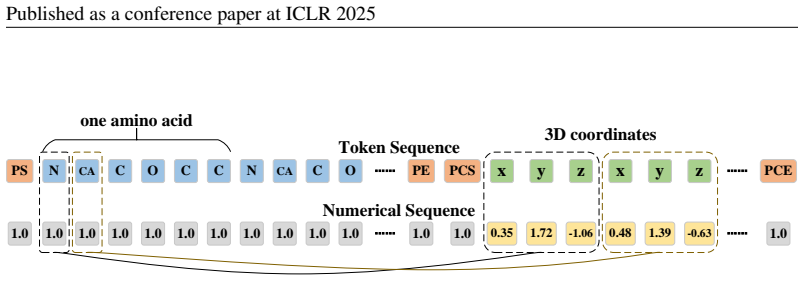
The central object is the parallel sequence format for pocket-ligand complexes, together with the dual-channel transformer that consumes it. A complex is encoded as a token sequence (pocket atoms in PDB order, SMILES tokens, and special start/end markers) running in parallel with a numerical sequence holding the normalized 3D coordinates of the corresponding atoms, padded with 1.0 wherever no coordinate exists. The transformer extends the GPT-2 autoregressive architecture with a number head beside the token head: each token embedding is multiplied by its paired numerical value at the input, and the number head predicts the next floating-point coordinate, so the same next-value mechanism handles SMILES tokens in token mode and coordinates in numerical mode. Training proceeds in three stages: self-supervised pre-training on about 228M samples (3.2M pockets, 209M ligand conformations, 167K docked complexes) with a composite cross-entropy-plus-MSE loss, supervised fine-tuning for docking on PDBBind with an MSE loss over ligand coordinates, and reinforcement-learning fine-tuning for drug design with a regularized maximum-likelihood loss whose reward combines Vina Dock, QED, and SA scores.
What would settle it
Re-run docking fine-tuning and the CASF-2016 evaluation while computing the Eq. (1) coordinate shift from the pocket center of mass only, with no knowledge of the ligand's atoms, and compare the average RMSD to the reported 1.29 Å; material degradation would indicate the published number depended on the ground-truth pose during input preparation. A supporting check is to compare success rates on the drug-design benchmark when the Vina reward oracle is replaced by a different docking scorer.
Extended reading notes
Core claim
The paper claims that writing a protein pocket and a ligand as two parallel, element-aligned streams — a discrete token sequence (atom types, SMILES tokens, special markers) and a continuous numerical sequence of x/y/z coordinates — turns both docking and drug design into one autoregressive next-value prediction problem. On this basis 3DMolFormer outperforms all evaluated search-based and deep-learning docking baselines on CASF-2016 without requiring an initialized ligand conformation, and outperforms all evaluated generative baselines on the CrossDocked2020 design benchmark on binding affinity, synthesizability, and multi-objective success rate. As a first, it exploits the duality of the two tasks by using the docking-fine-tuned weights to generate the 3D coordinates of molecules sampled by the reinforcement-learning design agent. The paper's stated conclusion is that 3DMolFormer is the first machine learning framework that simultaneously addresses protein-ligand docking and pocket-aware 3D drug design and beats previous baselines in both.
Load-bearing premise
The load-bearing premise is that no ground-truth ligand information reaches the model's input at inference time: the paper does not specify whether the center-of-mass shift that recenters coordinates before the model sees them is computed from the pocket alone or from the whole pocket-ligand complex, and if it is the whole complex, the true pose is baked into the input during both training and testing.
Editorial extensions
If this is right
- A single pretrained backbone, fine-tuned twice, reaches the best reported binding-pose accuracy on CASF-2016 and the best reported affinity optimization on the CrossDocked2020 design benchmark.
- Docking no longer needs an initialized 3D conformation of the ligand, removing a preprocessing step that search-based and most deep-learning dockers require.
- Because the design agent generates 3D coordinates with the docking-fine-tuned weights, any improvement in captured docking physics flows directly into the quality of designed molecules.
- Ranked by the multi-objective thresholds (Vina Dock below −8.18, QED above 0.25, SA above 0.59), 85.3% of generated molecules qualify, a rate that exceeds every baseline and the dataset's own reference ligands.
- Pose prediction takes about 0.8 seconds per complex with GPU inference, which the paper argues suits it for large-scale virtual screening.
Reading between the lines
- The parallel token-plus-number representation is a general device: the same dual-channel scheme could be redirected to binding-affinity scoring, protein-ligand co-folding, or pocket design, which also pair discrete structure with continuous geometry.
- Because the RL reward is built from exactly the same Vina Dock, QED, and SA criteria used in the success-rate metric, part of the 85.3% figure may reflect reward-metric alignment; a test that replaced the Vina oracle with another scorer would separate genuine binding improvement from fitting the oracle.
- The architecture separates pocket atoms from ligand tokens inside one autoregressive sequence, so adding a pocket-detection head could extend the same backbone from targeted docking to blind docking, where the binding site must be located rather than given.
- The claimed SE(3) robustness is learned rather than enforced, so it deserves a targeted probe: evaluating poses on complexes whose reference frame differs sharply from the training distribution would reveal whether the normalization-plus-augmentation strategy generalizes as well as an explicitly equivariant architecture.
Editorial analysis
A structured set of objections, weighed in public.
Referee Report
Summary. The paper proposes 3DMolFormer, a dual-channel autoregressive transformer that represents protein-ligand complexes as parallel discrete token and continuous coordinate sequences. It pre-trains on a large corpus of pockets, ligand conformations, and docked complexes, then fine-tunes with supervised learning for targeted protein-ligand docking and with reinforcement learning for pocket-aware 3D drug design. On CASF-2016 the model reports an average RMSD of 1.29 Å and 96.4% of poses below 3 Å, and on CrossDocked2020 it reports a Vina Dock score of -9.48 and an 85.3% success rate on a multi-objective criterion. The main claims are that the architecture unifies both tasks in one framework and outperforms existing baselines on both.
Significance. If the results hold, this is a strong contribution: it is the first framework of which I am aware that addresses both targeted docking and 3D drug design in a single model, and it introduces a practical representation for continuous 3D coordinates in a language-model framework. The paper provides useful ablations (w/o PT, w/o DA, w/o RL), standard errors over five runs, and additional evaluations on PoseBusters, Delta Score, and PoseCheck, which are genuine strengths. The central concern is that the coordinate normalization in Eq. (1) is ambiguous as written, and the docking claims depend on resolving that ambiguity. A second, less severe concern is that the reported drug-design success rate is constructed from the same reward components used in RL fine-tuning, so it is not a fully independent validation.
major comments (2)
- [Section 3.1, Eq. (1); Section 4.1, Table 1] The normalization step is not specified precisely enough to support the docking results in Table 1. The text says "we normalize the coordinates of all pocket-ligand complexes by translating their center of mass to the origin" but does not state whether the center of mass is computed from the pocket atoms only, the ligand atoms only, or the whole complex. If the whole complex is used, then the pocket coordinates fed to the model depend on the ground-truth ligand pose. At inference, the model would either need the ligand pose to compute the normalization (contradicting the Section 4.1 claim that "3DMolFormer does not require an initialized 3D conformation of the ligand"), or the normalization would differ between training and inference, in which case the reported RMSD values would not reflect genuine pose prediction. If the pocket-only center is intended, the wording "pocket-ligand complexes" is misleading and the exact inference-time recipe (including handling of random rotations) must be stated. Please clarify the normalization, explain how it is computed at inference time for CASF-2016, and confirm that no ligand-derived information enters the pocket coordinates.
- [Section 4.2, Eqs. (5)-(7), Success Rate definition] The RL reward R(m) is assembled from the same Vina Dock value, QED threshold, and SA threshold that define the reported Success Rate (Vina Dock < -8.18, QED > 0.25, SA > 0.59). Consequently, the 85.3% Success Rate is largely a self-optimized objective rather than an independent confirmation that the generated molecules are drug-like or that the binding poses are physically valid. The comparison against baselines that do not optimize this reward is still informative, but the main text should clearly state this circularity and should present the independent metrics (Delta Score and PoseCheck results from Appendix D) in the main empirical table, or at least explicitly cite them as the primary evidence for the drug-design claim.
minor comments (6)
- [Appendix C] The first sentence of "Additional Experiments on PoseBusters" reads "PoseBusters (Buttenschoen et al., 2024) s a widely-used benchmark"; it should read "is a widely-used benchmark".
- [Appendix D, Table 7] The table title reads "Experimental results of Delta Score on pocket-aware 3D drug design" but the table reports Clash Score and Strain Energy; the title should be corrected.
- [Section 4.2, Table 2] The caption states that the best result in each column is bolded, but in the Vina Score column the Reference row has a lower (better) value than 3DMolFormer; please clarify whether the Reference ligands are excluded from the "best" comparison or adjust the caption.
- [Section 3.4.2, Eq. (4)] The notation pi_pre-trained and pi_agent is used without an explicit definition (e.g., as likelihoods of the token sequence under the respective models); please define the terms.
- [Appendix D, Generation Setup] The text says "exactly 100 unique molecules are generated and seleted for each protein pocket"; "seleted" should be "selected".
- [Appendix B, Model Scaling] The model scaling table shows two configurations (12 layers/12 heads/768 embedding and 16 layers/12 heads/768 embedding) with the same pre-training loss of 0.178, so the statement that "The standard model size achieves the best performance" should acknowledge the tie.
Circularity Check
Drug-design Success Rate is built from the RL reward's own QED/SA thresholds and Vina-Dock transform, so the 85.3% headline is partly self-optimized; docking half is not circular.
-
self definitional
[Section 4.2, Eqs. (5)-(7) and the 'Evaluation'/'Reward Function' paragraphs]
"we also report the percentage of designed drug molecules meeting specific criteria: Vina Dock< −8.18, QED > 0.25, and SA> 0.59. This percentage, referred to as the Success Rate... RDock(m) = 1/(1 + 100.625·(VinaDock(m)+10)), RQED(m) =I(QED(m) > 0.25), R SA(m) =I(SA(m) > 0.59), R(m) = 1/3(RDock(m) +RQED(m) +RSA(m)). This composite reward is also used as the multi-objective criteria for selecting drug candidates from all generated molecules."
The paper's own Eq. (6) puts I(QED>0.25) and I(SA>0.59) directly into the RL reward R(m) in Eq. (7), and Eq. (5) makes RDock a monotonically increasing function of Vina Dock. The Success Rate metric is then defined as the percentage of molecules with Vina Dock < -8.18, QED > 0.25, SA > 0.59. Two of the three success criteria are literally reward terms, and the third is monotonically optimized by RDock; the same composite reward is also used to select candidates. Thus the headline 85.3% Success Rate is a self-optimized objective, not an independent evaluation. This is a partial circularity: the drug-design claim is partly forced by construction, while Table 1 docking and external Vina Score / Delta Score / PoseCheck metrics are not.
full rationale
The docking half of the paper is self-contained against external benchmarks: supervised fine-tuning minimizes MSE on ligand coordinates (Eq. 3) and evaluation uses RMSD on the same coordinates, which is a standard supervised protocol rather than a circular reduction. The potential ambiguity in Eq. (1) about whether the normalization center is pocket-only or whole-complex is a correctness concern, but the paper text does not establish that the docking input leaks the ligand pose, so under the hard-evidence rule it is not counted as demonstrated circularity. The drug-design half contains one clear self-definitional loop: the Success Rate reported in Table 2 is composed of the same QED and SA thresholds that appear as indicator-function reward terms, plus a Vina-Dock threshold that is monotonically optimized by the RDock reward term, and the paper states the composite reward is also used for candidate selection. Consequently the 85.3% Success Rate is partly the agent's own training/selection objective rather than an independent outcome. This is mitigated by auxiliary external handles (Vina Score, Delta Score, PoseCheck Clash and Strain) where 3DMolFormer also leads, so the circularity is partial rather than total. Self-citations in the paper (e.g., the reverse sigmoid from Hu et al. 2023) are not load-bearing; the central docking result and the auxiliary drug-design metrics do not reduce to those citations. Overall score 6 reflects one central claim being partly forced by construction, while substantial independent content remains.
Assumptions & free parameters
free parameters (6)
- q (coordinate scaling factor) =
5.0
- alpha (loss balance coefficient) =
1.0
- sigma (RL reward coefficient) =
100
- R_Dock sigmoid parameters =
0.625 and +10
- Data replication factors =
pocket x5, complex x20
- Model scale =
12 layers, 12 heads, 768 dims
assumptions (5)
- domain assumption A causal autoregressive model over the parallel token/number sequence can represent 3D structure without explicit SE(3)-equivariant architecture; equivariance is approximated by data augmentation and normalization.
- ad hoc to paper The center-of-mass normalization in Eq. (1) is computable during docking inference without the true ligand pose.
- domain assumption QuickVina2's Vina Dock score is a valid proxy for binding affinity and can serve both as RL reward and as evaluation metric.
- domain assumption PDBbind v2020 training split filtered as in Uni-Mol does not overlap with the CASF-2016 test set.
- domain assumption Pre-training data from Uni-Mol and CrossDocked2020 are representative and the coordinate-range screening (max diff >40 removed) does not bias the tasks.
Cite this review
Pith. "Pith review of 3DMolFormer: A Dual-channel Framework for Structure-based Drug Discovery." pith.science (2026). https://pith.science/paper/QA7DS2YO
@misc{pith2026250205107,
  author       = {Pith},
  title        = {Pith review of: 3DMolFormer: A Dual-channel Framework for Structure-based Drug Discovery},
  year         = {2026},
  howpublished = {\url{https://pith.science/paper/QA7DS2YO}},
  note         = {Machine review of arXiv:2502.05107}
}
read the original abstract
Structure-based drug discovery, encompassing the tasks of protein-ligand docking and pocket-aware 3D drug design, represents a core challenge in drug discovery. However, no existing work can deal with both tasks to effectively leverage the duality between them, and current methods for each task are hindered by challenges in modeling 3D information and the limitations of available data. To address these issues, we propose 3DMolFormer, a unified dual-channel transformer-based framework applicable to both docking and 3D drug design tasks, which exploits their duality by utilizing docking functionalities within the drug design process. Specifically, we represent 3D pocket-ligand complexes using parallel sequences of discrete tokens and continuous numbers, and we design a corresponding dual-channel transformer model to handle this format, thereby overcoming the challenges of 3D information modeling. Additionally, we alleviate data limitations through large-scale pre-training on a mixed dataset, followed by supervised and reinforcement learning fine-tuning techniques respectively tailored for the two tasks. Experimental results demonstrate that 3DMolFormer outperforms previous approaches in both protein-ligand docking and pocket-aware 3D drug design, highlighting its promising application in structure-based drug discovery. The code is available at: https://github.com/HXYfighter/3DMolFormer .
Figures


Figures from the paper (1 more)

Forward citations
Cited by 1 Pith paper
-
Teaching LLMs to Speak Spectroscopy
A LLaMA-3.1-8B model fine-tuned with LoRA on digit-serialized SDSS spectra predicts redshifts with MAE 0.043 and retains 85% of its astronomy QA performance.
Reference graph
Works this paper leans on
-
[1]
write newline
" write newline "" before.all 'output.state := FUNCTION n.dashify 't := "" t empty not t #1 #1 substring "-" = t #1 #2 substring "--" = not "--" * t #2 global.max substring 't := t #1 #1 substring "-" = "-" * t #2 global.max substring 't := while if t #1 #1 substring * t #2 global.max substring 't := if while FUNCTION format.date year duplicate empty "emp...
-
[2]
Accurate structure prediction of biomolecular interactions with alphafold 3
Josh Abramson, Jonas Adler, Jack Dunger, Richard Evans, Tim Green, Alexander Pritzel, Olaf Ronneberger, Lindsay Willmore, Andrew J Ballard, Joshua Bambrick, et al. Accurate structure prediction of biomolecular interactions with alphafold 3. Nature, pp.\ 1--3, 2024
2024
-
[3]
Guiding deep molecular optimization with genetic exploration
Sungsoo Ahn, Junsu Kim, Hankook Lee, and Jinwoo Shin. Guiding deep molecular optimization with genetic exploration. In H. Larochelle, M. Ranzato, R. Hadsell, M.F. Balcan, and H. Lin (eds.), Advances in Neural Information Processing Systems, volume 33, pp.\ 12008--12021. Curran Associates, Inc., 2020
2020
-
[4]
Uni-mol docking v2: Towards realistic and accurate binding pose prediction
Eric Alcaide, Zhifeng Gao, Guolin Ke, Yaqi Li, Linfeng Zhang, Hang Zheng, and Gengmo Zhou. Uni-mol docking v2: Towards realistic and accurate binding pose prediction. arXiv preprint arXiv:2405.11769, 2024
arXiv 2024
-
[5]
Fast, accurate, and reliable molecular docking with quickvina 2
Amr Alhossary, Stephanus Daniel Handoko, Yuguang Mu, and Chee-Keong Kwoh. Fast, accurate, and reliable molecular docking with quickvina 2. Bioinformatics, 31 0 (13): 0 2214--2216, 2015
2015
-
[6]
Randomized smiles strings improve the quality of molecular generative models
Josep Ar \'u s-Pous, Simon Viet Johansson, Oleksii Prykhodko, Esben Jannik Bjerrum, Christian Tyrchan, Jean-Louis Reymond, Hongming Chen, and Ola Engkvist. Randomized smiles strings improve the quality of molecular generative models. Journal of cheminformatics, 11 0 (1): 0 1--13, 2019
2019
-
[7]
Geometric deep learning on molecular representations
Kenneth Atz, Francesca Grisoni, and Gisbert Schneider. Geometric deep learning on molecular representations. Nature Machine Intelligence, 3 0 (12): 0 1023--1032, 2021
2021
-
[8]
Accurate prediction of protein structures and interactions using a three-track neural network
Minkyung Baek, Frank DiMaio, Ivan Anishchenko, Justas Dauparas, Sergey Ovchinnikov, Gyu Rie Lee, Jue Wang, Qian Cong, Lisa N Kinch, R Dustin Schaeffer, et al. Accurate prediction of protein structures and interactions using a three-track neural network. Science, 373 0 (6557): 0 871--876, 2021
2021
Show all 98 references
-
[9]
Molgpt: molecular generation using a transformer-decoder model
Viraj Bagal, Rishal Aggarwal, PK Vinod, and U Deva Priyakumar. Molgpt: molecular generation using a transformer-decoder model. Journal of Chemical Information and Modeling, 62 0 (9): 0 2064--2076, 2021
2021
-
[10]
Can ai reproduce observed chemical diversity? bioRxiv, pp.\ 292177, 2018
Mostapha Benhenda. Can ai reproduce observed chemical diversity? bioRxiv, pp.\ 292177, 2018
2018
-
[11]
Quantifying the chemical beauty of drugs
G Richard Bickerton, Gaia V Paolini, J \'e r \'e my Besnard, Sorel Muresan, and Andrew L Hopkins. Quantifying the chemical beauty of drugs. Nature chemistry, 4 0 (2): 0 90--98, 2012
2012
-
[12]
The role of ai in drug discovery: challenges, opportunities, and strategies
Alexandre Blanco-Gonzalez, Alfonso Cabezon, Alejandro Seco-Gonzalez, Daniel Conde-Torres, Paula Antelo-Riveiro, Angel Pineiro, and Rebeca Garcia-Fandino. The role of ai in drug discovery: challenges, opportunities, and strategies. Pharmaceuticals, 16 0 (6): 0 891, 2023
2023
-
[13]
Language models are few-shot learners
Tom Brown, Benjamin Mann, Nick Ryder, Melanie Subbiah, Jared D Kaplan, Prafulla Dhariwal, Arvind Neelakantan, Pranav Shyam, Girish Sastry, Amanda Askell, Sandhini Agarwal, Ariel Herbert-Voss, Gretchen Krueger, Tom Henighan, Rewon Child, Aditya Ramesh, Daniel Ziegler, Jeffrey W...
1901
-
[14]
Posebusters: Ai-based docking methods fail to generate physically valid poses or generalise to novel sequences
Martin Buttenschoen, Garrett M Morris, and Charlotte M Deane. Posebusters: Ai-based docking methods fail to generate physically valid poses or generalise to novel sequences. Chemical Science, 15 0 (9): 0 3130--3139, 2024
2024
-
[15]
Structure-aware protein self-supervised learning
Can Chen, Jingbo Zhou, Fan Wang, Xue Liu, and Dejing Dou. Structure-aware protein self-supervised learning. Bioinformatics, 2023
2023
-
[16]
Diffdock: Diffusion steps, twists, and turns for molecular docking
Gabriele Corso, Hannes Stärk, Bowen Jing, Regina Barzilay, and Tommi Jaakkola. Diffdock: Diffusion steps, twists, and turns for molecular docking. In International Conference on Learning Representations (ICLR), 2023
2023
-
[17]
Deep confident steps to new pockets: Strategies for docking generalization
Gabriele Corso, Arthur Deng, Nicholas Polizzi, Regina Barzilay, and Tommi Jaakkola. Deep confident steps to new pockets: Strategies for docking generalization. In International Conference on Learning Representations (ICLR), 2024
2024
-
[18]
BERT : Pre-training of deep bidirectional transformers for language understanding
Jacob Devlin, Ming-Wei Chang, Kenton Lee, and Kristina Toutanova. BERT : Pre-training of deep bidirectional transformers for language understanding. In North A merican Chapter of the Association for Computational Linguistics: Human Language Technologies , pp.\ 4171--4186, 2019
2019
-
[19]
Chai-1: Decoding the molecular interactions of life
Chai Discovery, Jacques Boitreaud, Jack Dent, Matthew McPartlon, Joshua Meier, Vinicius Reis, Alex Rogozhnikov, and Kevin Wu. Chai-1: Decoding the molecular interactions of life. bioRxiv, pp.\ 2024--10, 2024
2024
-
[20]
Molgensurvey: A systematic survey in machine learning models for molecule design
Yuanqi Du, Tianfan Fu, Jimeng Sun, and Shengchao Liu. Molgensurvey: A systematic survey in machine learning models for molecule design. arXiv preprint arXiv:2203.14500, 2022
2022 arXiv
-
[21]
Machine learning-aided generative molecular design
Yuanqi Du, Arian R Jamasb, Jeff Guo, Tianfan Fu, Charles Harris, Yingheng Wang, Chenru Duan, Pietro Li \`o , Philippe Schwaller, and Tom L Blundell. Machine learning-aided generative molecular design. Nature Machine Intelligence, pp.\ 1--16, 2024
2024
-
[22]
Autodock vina 1.2
Jerome Eberhardt, Diogo Santos-Martins, Andreas F Tillack, and Stefano Forli. Autodock vina 1.2. 0: New docking methods, expanded force field, and python bindings. Journal of chemical information and modeling, 61 0 (8): 0 3891--3898, 2021
2021
-
[23]
Limo: Latent inceptionism for targeted molecule generation
Peter Eckmann, Kunyang Sun, Bo Zhao, Mudong Feng, Michael K Gilson, and Rose Yu. Limo: Latent inceptionism for targeted molecule generation. In International Conference on Machine Learning. PMLR, 2022
2022
-
[24]
Estimation of synthetic accessibility score of drug-like molecules based on molecular complexity and fragment contributions
Peter Ertl and Ansgar Schuffenhauer. Estimation of synthetic accessibility score of drug-like molecules based on molecular complexity and fragment contributions. Journal of cheminformatics, 1 0 (1): 0 1--11, 2009
2009
-
[25]
Geometry-enhanced molecular representation learning for property prediction
Xiaomin Fang, Lihang Liu, Jieqiong Lei, Donglong He, Shanzhuo Zhang, Jingbo Zhou, Fan Wang, Hua Wu, and Haifeng Wang. Geometry-enhanced molecular representation learning for property prediction. Nature Machine Intelligence, 4 0 (2): 0 127--134, 2022
2022
-
[26]
Protein-ligand binding representation learning from fine-grained interactions
Shikun Feng, Minghao Li, Yinjun Jia, Weiying Ma, and Yanyan Lan. Protein-ligand binding representation learning from fine-grained interactions. In International Conference on Learning Representations, 2024 a
2024
-
[27]
Generation of 3d molecules in pockets via a language model
Wei Feng, Lvwei Wang, Zaiyun Lin, Yanhao Zhu, Han Wang, Jianqiang Dong, Rong Bai, Huting Wang, Jielong Zhou, Wei Peng, et al. Generation of 3d molecules in pockets via a language model. Nature Machine Intelligence, 6 0 (1): 0 62--73, 2024 b
2024
-
[28]
Language models can generate molecules, materials, and protein binding sites directly in three dimensions as xyz, cif, and pdb files
Daniel Flam-Shepherd and Al \'a n Aspuru-Guzik. Language models can generate molecules, materials, and protein binding sites directly in three dimensions as xyz, cif, and pdb files. arXiv preprint arXiv:2305.05708, 2023
2023 arXiv
-
[29]
Three-dimensional convolutional neural networks and a cross-docked data set for structure-based drug design
Paul G Francoeur, Tomohide Masuda, Jocelyn Sunseri, Andrew Jia, Richard B Iovanisci, Ian Snyder, and David R Koes. Three-dimensional convolutional neural networks and a cross-docked data set for structure-based drug design. Journal of chemical information and modeling, 60 0 (9...
2020
-
[30]
Reinforced genetic algorithm for structure-based drug design
Tianfan Fu, Wenhao Gao, Connor Coley, and Jimeng Sun. Reinforced genetic algorithm for structure-based drug design. Advances in Neural Information Processing Systems, 35: 0 12325--12338, 2022
2022
-
[31]
Drugclip: Contrasive protein-molecule representation learning for virtual screening
Bowen Gao, Bo Qiang, Haichuan Tan, Yinjun Jia, Minsi Ren, Minsi Lu, Jingjing Liu, Wei-Ying Ma, and Yanyan Lan. Drugclip: Contrasive protein-molecule representation learning for virtual screening. Advances in Neural Information Processing Systems, 36, 2024 a
2024
-
[32]
Rethinking specificity in sbdd: Leveraging delta score and energy-guided diffusion
Bowen Gao, Minsi Ren, Yuyan Ni, Yanwen Huang, Bo Qiang, Zhi-Ming Ma, Wei-Ying Ma, and Yanyan Lan. Rethinking specificity in sbdd: Leveraging delta score and energy-guided diffusion. arXiv preprint arXiv:2403.12987, 2024 b
2024 arXiv
-
[33]
xval: A continuous number encoding for large language models
Siavash Golkar, Mariel Pettee, Michael Eickenberg, Alberto Bietti, Miles Cranmer, Geraud Krawezik, Francois Lanusse, Michael McCabe, Ruben Ohana, Liam Parker, et al. xval: A continuous number encoding for large language models. arXiv preprint arXiv:2310.02989, 2023
-
[34]
3d equivariant diffusion for target-aware molecule generation and affinity prediction
Jiaqi Guan, Wesley Wei Qian, Xingang Peng, Yufeng Su, Jian Peng, and Jianzhu Ma. 3d equivariant diffusion for target-aware molecule generation and affinity prediction. In International Conference on Learning Representations, 2023 a
2023
-
[35]
Decompdiff: diffusion models with decomposed priors for structure-based drug design
Jiaqi Guan, Xiangxin Zhou, Yuwei Yang, Yu Bao, Jian Peng, Jianzhu Ma, Qiang Liu, Liang Wang, and Quanquan Gu. Decompdiff: diffusion models with decomposed priors for structure-based drug design. In International Conference on Machine Learning, 2023 b
2023
-
[36]
Benchmarking generated poses: How rational is structure-based drug design with generative models? arXiv preprint arXiv:2308.07413, 2023
Charles Harris, Kieran Didi, Arian R Jamasb, Chaitanya K Joshi, Simon V Mathis, Pietro Lio, and Tom Blundell. Benchmarking generated poses: How rational is structure-based drug design with generative models? arXiv preprint arXiv:2308.07413, 2023
2023 arXiv
-
[37]
De novo drug design using reinforcement learning with multiple gpt agents
Xiuyuan Hu, Guoqing Liu, Yang Zhao, and Hao Zhang. De novo drug design using reinforcement learning with multiple gpt agents. In Thirty-seventh Conference on Neural Information Processing Systems, 2023
2023
-
[38]
Hamiltonian diversity: effectively measuring molecular diversity by shortest hamiltonian circuits
Xiuyuan Hu, Guoqing Liu, Quanming Yao, Yang Zhao, and Hao Zhang. Hamiltonian diversity: effectively measuring molecular diversity by shortest hamiltonian circuits. Journal of Cheminformatics, 16 0 (1): 0 94, 2024
2024
-
[39]
Chemformer: a pre-trained transformer for computational chemistry
Ross Irwin, Spyridon Dimitriadis, Jiazhen He, and Esben Jannik Bjerrum. Chemformer: a pre-trained transformer for computational chemistry. Machine Learning: Science and Technology, 3 0 (1): 0 015022, 2022
2022
-
[40]
Structure-based drug design with geometric deep learning
Clemens Isert, Kenneth Atz, and Gisbert Schneider. Structure-based drug design with geometric deep learning. Current Opinion in Structural Biology, 79: 0 102548, 2023 a
2023
-
[41]
Structure-based drug design with geometric deep learning
Clemens Isert, Kenneth Atz, and Gisbert Schneider. Structure-based drug design with geometric deep learning. Current Opinion in Structural Biology, 79: 0 102548, 2023 b
2023
-
[42]
Interactiongraphnet: A novel and efficient deep graph representation learning framework for accurate protein--ligand interaction predictions
Dejun Jiang, Chang-Yu Hsieh, Zhenxing Wu, Yu Kang, Jike Wang, Ercheng Wang, Ben Liao, Chao Shen, Lei Xu, Jian Wu, et al. Interactiongraphnet: A novel and efficient deep graph representation learning framework for accurate protein--ligand interaction predictions. Journal of med...
2021
-
[43]
Jaakkola
Wengong Jin, Regina Barzilay, and T. Jaakkola. Multi-objective molecule generation using interpretable substructures. In International Conference on Machine Learning, pp.\ 4849–4859. PMLR, 2020
2020
-
[44]
Drugpose: benchmarking 3d generative methods for early stage drug discovery
Zygimantas Jocys, Joanna Grundy, and Katayoun Farrahi. Drugpose: benchmarking 3d generative methods for early stage drug discovery. Digital Discovery, 2024
2024
-
[45]
Highly accurate protein structure prediction with alphafold
John Jumper, Richard Evans, Alexander Pritzel, Tim Green, Michael Figurnov, Olaf Ronneberger, Kathryn Tunyasuvunakool, Russ Bates, Augustin Z \' dek, Anna Potapenko, et al. Highly accurate protein structure prediction with alphafold. nature, 596 0 (7873): 0 583--589, 2021
2021
-
[46]
On large-batch training for deep learning: Generalization gap and sharp minima
Nitish Shirish Keskar, Dheevatsa Mudigere, Jorge Nocedal, Mikhail Smelyanskiy, and Ping Tak Peter Tang. On large-batch training for deep learning: Generalization gap and sharp minima. In International Conference on Learning Representations, 2017
2017
-
[47]
Lessons learned in empirical scoring with smina from the csar 2011 benchmarking exercise
David Ryan Koes, Matthew P Baumgartner, and Carlos J Camacho. Lessons learned in empirical scoring with smina from the csar 2011 benchmarking exercise. Journal of chemical information and modeling, 53 0 (8): 0 1893--1904, 2013
2011
-
[48]
Drug discovery with dynamic goal-aware fragments
Seul Lee, Seanie Lee, Kenji Kawaguchi, and Sung Ju Hwang. Drug discovery with dynamic goal-aware fragments. Proceedings of the 41th International Conference on Machine Learning, 2024
2024
-
[49]
Evolutionary-scale prediction of atomic-level protein structure with a language model
Zeming Lin, Halil Akin, Roshan Rao, Brian Hie, Zhongkai Zhu, Wenting Lu, Nikita Smetanin, Robert Verkuil, Ori Kabeli, Yaniv Shmueli, et al. Evolutionary-scale prediction of atomic-level protein structure with a language model. Science, 379 0 (6637): 0 1123--1130, 2023
2023
-
[50]
Multi-objective reinforcement learning: A comprehensive overview
Chunming Liu, Xin Xu, and Dewen Hu. Multi-objective reinforcement learning: A comprehensive overview. IEEE Transactions on Systems, Man, and Cybernetics: Systems, 45 0 (3): 0 385--398, 2014
2014
-
[51]
Generating 3d molecules for target protein binding
Meng Liu, Youzhi Luo, Kanji Uchino, Koji Maruhashi, and Shuiwang Ji. Generating 3d molecules for target protein binding. In International Conference on Machine Learning, 2022
2022
-
[52]
Forging the basis for developing protein--ligand interaction scoring functions
Zhihai Liu, Minyi Su, Li Han, Jie Liu, Qifan Yang, Yan Li, and Renxiao Wang. Forging the basis for developing protein--ligand interaction scoring functions. Accounts of chemical research, 50 0 (2): 0 302--309, 2017
2017
-
[53]
Zero-shot 3d drug design by sketching and generating
Siyu Long, Yi Zhou, Xinyu Dai, and Hao Zhou. Zero-shot 3d drug design by sketching and generating. Advances in Neural Information Processing Systems, 35: 0 23894--23907, 2022
2022
-
[54]
Decoupled weight decay regularization
Ilya Loshchilov and Frank Hutter. Decoupled weight decay regularization. In International Conference on Learning Representations, 2019
2019
-
[55]
Tankbind: Trigonometry-aware neural networks for drug-protein binding structure prediction
Wei Lu, Qifeng Wu, Jixian Zhang, Jiahua Rao, Chengtao Li, and Shuangjia Zheng. Tankbind: Trigonometry-aware neural networks for drug-protein binding structure prediction. Advances in neural information processing systems, 35: 0 7236--7249, 2022
2022
-
[56]
A 3d generative model for structure-based drug design
Shitong Luo, Jiaqi Guan, Jianzhu Ma, and Jian Peng. A 3d generative model for structure-based drug design. Advances in Neural Information Processing Systems, 34: 0 6229--6239, 2021
2021
-
[57]
Artificial intelligence in drug discovery and development
Kit-Kay Mak, Yi-Hang Wong, and Mallikarjuna Rao Pichika. Artificial intelligence in drug discovery and development. Drug Discovery and Evaluation: Safety and Pharmacokinetic Assays, pp.\ 1--38, 2023
2023
-
[58]
A geometric deep learning approach to predict binding conformations of bioactive molecules
Oscar M \'e ndez-Lucio, Mazen Ahmad, Ehecatl Antonio del Rio-Chanona, and J \"o rg Kurt Wegner. A geometric deep learning approach to predict binding conformations of bioactive molecules. Nature Machine Intelligence, 3 0 (12): 0 1033--1039, 2021
2021
-
[59]
Deep learning for protein-ligand docking: Are we there yet? arXiv preprint arXiv:2405.14108, 2024
Alex Morehead, Nabin Giri, Jian Liu, and Jianlin Cheng. Deep learning for protein-ligand docking: Are we there yet? arXiv preprint arXiv:2405.14108, 2024
2024
-
[60]
Autodock4 and autodocktools4: Automated docking with selective receptor flexibility
Garrett M Morris, Ruth Huey, William Lindstrom, Michel F Sanner, Richard K Belew, David S Goodsell, and Arthur J Olson. Autodock4 and autodocktools4: Automated docking with selective receptor flexibility. Journal of computational chemistry, 30 0 (16): 0 2785--2791, 2009
2009
-
[61]
Molecular de-novo design through deep reinforcement learning
Marcus Olivecrona, Thomas Blaschke, Ola Engkvist, and Hongming Chen. Molecular de-novo design through deep reinforcement learning. Journal of cheminformatics, 9 0 (1): 0 1--14, 2017
2017
-
[62]
Caught between a rock and a hard place: current challenges in structure-based drug design
Daniele Pala and David E Clark. Caught between a rock and a hard place: current challenges in structure-based drug design. Drug Discovery Today, pp.\ 104106, 2024
2024
-
[63]
Fabind: Fast and accurate protein-ligand binding
Qizhi Pei, Kaiyuan Gao, Lijun Wu, Jinhua Zhu, Yingce Xia, Shufang Xie, Tao Qin, Kun He, Tie-Yan Liu, and Rui Yan. Fabind: Fast and accurate protein-ligand binding. Advances in Neural Information Processing Systems, 36, 2024
2024
-
[64]
Pocket2mol: Efficient molecular sampling based on 3d protein pockets
Xingang Peng, Shitong Luo, Jiaqi Guan, Qi Xie, Jian Peng, and Jianzhu Ma. Pocket2mol: Efficient molecular sampling based on 3d protein pockets. In International Conference on Machine Learning, 2022
2022
-
[65]
Dive into deep learning: Tools for engagement
Joanne Quinn, Joanne McEachen, Michael Fullan, Mag Gardner, and Max Drummy. Dive into deep learning: Tools for engagement. Corwin Press, 2019
2019
-
[66]
Vinardo: A scoring function based on autodock vina improves scoring, docking, and virtual screening
Rodrigo Quiroga and Marcos A Villarreal. Vinardo: A scoring function based on autodock vina improves scoring, docking, and virtual screening. PloS one, 11 0 (5): 0 e0155183, 2016
2016
-
[67]
Language models are unsupervised multitask learners
Alec Radford, Jeffrey Wu, Rewon Child, David Luan, Dario Amodei, Ilya Sutskever, et al. Language models are unsupervised multitask learners. OpenAI blog, 1 0 (8): 0 9, 2019
2019
-
[68]
Generating 3d molecules conditional on receptor binding sites with deep generative models
Matthew Ragoza, Tomohide Masuda, and David Ryan Koes. Generating 3d molecules conditional on receptor binding sites with deep generative models. Chemical science, 13 0 (9): 0 2701--2713, 2022
2022
-
[69]
Structure-based drug design with equivariant diffusion models
Arne Schneuing, Yuanqi Du, Charles Harris, Arian Jamasb, Ilia Igashov, Weitao Du, Tom Blundell, Pietro Li \'o , Carla Gomes, Max Welling, et al. Structure-based drug design with equivariant diffusion models. arXiv preprint arXiv:2210.13695, 2022
-
[70]
Molecular transformer: a model for uncertainty-calibrated chemical reaction prediction
Philippe Schwaller, Teodoro Laino, Th \'e ophile Gaudin, Peter Bolgar, Christopher A Hunter, Costas Bekas, and Alpha A Lee. Molecular transformer: a model for uncertainty-calibrated chemical reaction prediction. ACS central science, 5 0 (9): 0 1572--1583, 2019
2019
-
[71]
Generating focused molecule libraries for drug discovery with recurrent neural networks
Marwin HS Segler, Thierry Kogej, Christian Tyrchan, and Mark P Waller. Generating focused molecule libraries for drug discovery with recurrent neural networks. ACS central science, 4 0 (1): 0 120--131, 2018
2018
-
[72]
Reinforcement learning for molecular design guided by quantum mechanics
Gregor Simm, Robert Pinsler, and Jos \'e Miguel Hern \'a ndez-Lobato. Reinforcement learning for molecular design guided by quantum mechanics. In International Conference on Machine Learning, pp.\ 8959--8969. PMLR, 2020
2020
-
[73]
Autogrow4: an open-source genetic algorithm for de novo drug design and lead optimization
Jacob O Spiegel and Jacob D Durrant. Autogrow4: an open-source genetic algorithm for de novo drug design and lead optimization. Journal of cheminformatics, 12: 0 1--16, 2020
2020
-
[74]
Equibind: Geometric deep learning for drug binding structure prediction
Hannes St \"a rk, Octavian Ganea, Lagnajit Pattanaik, Regina Barzilay, and Tommi Jaakkola. Equibind: Geometric deep learning for drug binding structure prediction. In International conference on machine learning, pp.\ 20503--20521. PMLR, 2022
2022
-
[75]
Comparative assessment of scoring functions: the casf-2016 update
Minyi Su, Qifan Yang, Yu Du, Guoqin Feng, Zhihai Liu, Yan Li, and Renxiao Wang. Comparative assessment of scoring functions: the casf-2016 update. Journal of chemical information and modeling, 59 0 (2): 0 895--913, 2018
2016
-
[76]
Utilizing reinforcement learning for de novo drug design
Hampus Gummesson Svensson, Christian Tyrchan, Ola Engkvist, and Morteza Haghir Chehreghani. Utilizing reinforcement learning for de novo drug design. arXiv preprint arXiv:2303.17615, 2023
2023 arXiv
-
[77]
Autodock vina: improving the speed and accuracy of docking with a new scoring function, efficient optimization, and multithreading
Oleg Trott and Arthur J Olson. Autodock vina: improving the speed and accuracy of docking with a new scoring function, efficient optimization, and multithreading. Journal of computational chemistry, 31 0 (2): 0 455--461, 2010
2010
-
[78]
Structure-based drug design: aiming for a perfect fit
Rob LM Van Montfort and Paul Workman. Structure-based drug design: aiming for a perfect fit. Essays in biochemistry, 61 0 (5): 0 431--437, 2017
2017
-
[79]
Structure-based, deep-learning models for protein-ligand binding affinity prediction
Debby D Wang, Wenhui Wu, and Ran Wang. Structure-based, deep-learning models for protein-ligand binding affinity prediction. Journal of Cheminformatics, 16 0 (1): 0 2, 2024 a
2024
-
[80]
Token-mol 1.0: Tokenized drug design with large language model
Jike Wang, Rui Qin, Mingyang Wang, Meijing Fang, Yangyang Zhang, Yuchen Zhu, Qun Su, Qiaolin Gou, Chao Shen, Odin Zhang, et al. Token-mol 1.0: Tokenized drug design with large language model. arXiv preprint arXiv:2407.07930, 2024 b
2024 arXiv
-
[81]
Property-aware relation networks for few-shot molecular property prediction
Yaqing Wang, Abulikemu Abuduweili, Quanming Yao, and Dejing Dou. Property-aware relation networks for few-shot molecular property prediction. Advances in Neural Information Processing Systems, 34: 0 17441--17454, 2021
2021
-
[82]
A compact review of molecular property prediction with graph neural networks
Oliver Wieder, Stefan Kohlbacher, M \'e laine Kuenemann, Arthur Garon, Pierre Ducrot, Thomas Seidel, and Thierry Langer. A compact review of molecular property prediction with graph neural networks. Drug Discovery Today: Technologies, 37: 0 1--12, 2020
2020
-
[83]
A systematic survey of chemical pre-trained models
Jun Xia, Yanqiao Zhu, Yuanqi Du, Yue Liu, and Stan Z Li. A systematic survey of chemical pre-trained models. International Joint Conference on Artificial Intelligence, 2023
2023
-
[84]
Protein--ligand docking in the machine-learning era
Chao Yang, Eric Anthony Chen, and Yingkai Zhang. Protein--ligand docking in the machine-learning era. Molecules, 27 0 (14): 0 4568, 2022
2022
-
[85]
Deep molecular representation learning via fusing physical and chemical information
Shuwen Yang, Ziyao Li, Guojie Song, and Lingsheng Cai. Deep molecular representation learning via fusing physical and chemical information. Advances in Neural Information Processing Systems, 34: 0 16346--16357, 2021 a
2021
-
[86]
Hit and lead discovery with explorative rl and fragment-based molecule generation
Soojung Yang, Doyeong Hwang, Seul Lee, Seongok Ryu, and Sung Ju Hwang. Hit and lead discovery with explorative rl and fragment-based molecule generation. Advances in Neural Information Processing Systems, 34: 0 7924--7936, 2021 b
2021
-
[87]
Graph convolutional policy network for goal-directed molecular graph generation
Jiaxuan You, Bowen Liu, Zhitao Ying, Vijay Pande, and Jure Leskovec. Graph convolutional policy network for goal-directed molecular graph generation. Advances in neural information processing systems, 31, 2018
2018
-
[88]
E3bind: An end-to-end equivariant network for protein-ligand docking
Yangtian Zhang, Huiyu Cai, Chence Shi, Bozitao Zhong, and Jian Tang. E3bind: An end-to-end equivariant network for protein-ligand docking. In International Conference on Learning Representations (ICLR), 2023 a
2023
-
[89]
Motif-based graph self-supervised learning for molecular property prediction
Zaixi Zhang, Qi Liu, Hao Wang, Chengqiang Lu, and Chee-Kong Lee. Motif-based graph self-supervised learning for molecular property prediction. Advances in Neural Information Processing Systems, 34: 0 15870--15882, 2021
2021
-
[90]
A systematic survey in geometric deep learning for structure-based drug design
Zaixi Zhang, Jiaxian Yan, Qi Liu, Enhong Chen, and Marinka Zitnik. A systematic survey in geometric deep learning for structure-based drug design. arXiv preprint arXiv:2306.11768, 2023 b
2023 arXiv
-
[91]
A brief review of protein--ligand interaction prediction
Lingling Zhao, Yan Zhu, Junjie Wang, Naifeng Wen, Chunyu Wang, and Liang Cheng. A brief review of protein--ligand interaction prediction. Computational and Structural Biotechnology Journal, 20: 0 2831--2838, 2022
2022
-
[92]
Structure-based drug design benchmark: Do 3d methods really dominate? arXiv preprint arXiv:2406.03403, 2024
Kangyu Zheng, Yingzhou Lu, Zaixi Zhang, Zhongwei Wan, Yao Ma, Marinka Zitnik, and Tianfan Fu. Structure-based drug design benchmark: Do 3d methods really dominate? arXiv preprint arXiv:2406.03403, 2024
2024 arXiv
-
[94]
Uni-mol: A universal 3d molecular representation learning framework
Gengmo Zhou, Zhifeng Gao, Qiankun Ding, Hang Zheng, Hongteng Xu, Zhewei Wei, Linfeng Zhang, and Guolin Ke. Uni-mol: A universal 3d molecular representation learning framework. In International Conference on Learning Representations, 2023 a
2023
-
[95]
Do deep learning methods really perform better in molecular conformation generation? arXiv preprint arXiv:2302.07061, 2023 b
Gengmo Zhou, Zhifeng Gao, Zhewei Wei, Hang Zheng, and Guolin Ke. Do deep learning methods really perform better in molecular conformation generation? arXiv preprint arXiv:2302.07061, 2023 b
2023 arXiv
-
[96]
Unified 2d and 3d pre-training of molecular representations
Jinhua Zhu, Yingce Xia, Lijun Wu, Shufang Xie, Tao Qin, Wengang Zhou, Houqiang Li, and Tie-Yan Liu. Unified 2d and 3d pre-training of molecular representations. In Proceedings of the 28th ACM SIGKDD conference on knowledge discovery and data mining, pp.\ 2626--2636, 2022
2022
-
[97]
@esa (Ref
\@ifxundefined[1] #1\@undefined \@firstoftwo \@secondoftwo \@ifnum[1] #1 \@firstoftwo \@secondoftwo \@ifx[1] #1 \@firstoftwo \@secondoftwo [2] @ #1 \@temptokena #2 #1 @ \@temptokena \@ifclassloaded agu2001 natbib The agu2001 class already includes natbib coding, so you should ...
-
[98]
\@lbibitem[] @bibitem@first@sw\@secondoftwo \@lbibitem[#1]#2 \@extra@b@citeb \@ifundefined br@#2\@extra@b@citeb \@namedef br@#2 \@nameuse br@#2\@extra@b@citeb \@ifundefined b@#2\@extra@b@citeb @num @parse #2 @tmp #1 NAT@b@open@#2 NAT@b@shut@#2 \@ifnum @merge>\@ne @bibitem@firs...
-
[99]
BERT : Pre-training of Deep Bidirectional Transformers for Language Understanding
@open @close @open @close and [1] URL: #1 \@ifundefined chapter * \@mkboth \@ifxundefined @sectionbib * \@mkboth * \@mkboth\@gobbletwo \@ifclassloaded amsart * \@ifclassloaded amsbook * \@ifxundefined @heading @heading NAT@ctr thebibliography [1] @ \@biblabel @NAT@ctr \@bibset...
2024 arXiv
Reviewed August 8, 2026 · model on record in the stance chip above.
Discussion (0). Continue with ORCID to comment.