REVIEW 4 major objections 4 minor 56 references
Latent Swap Joint Diffusion for 2D Long-Form Latent Generation
T0 review · 4 major / 4 minor · reviewed 2026-08-08 · deepseek-v4-flash
Pith's one-line read This paper argues that the averaging step used to stitch overlapping diffusion outputs destroys high-frequency detail in long-form audio, and that a binary frame-level latent swap preserves that detail while keeping distant views…
desk verdict Solid, well-motivated methods paper: the binary swap trick is simple and seems to work, but the key assumption about trajectory distance is never measured, and the evaluation has a few uncontrolled choices. read the letter →
The pith
A machine-rendered reading of the paper's core claim, the machinery that carries it, and where it could break.
The reading
What carries the argument
The load-bearing object is the binary latent swap operator $W_{\mathrm{swap}} = \mathbf{1}_n \otimes v_m$, where $v_m$ alternates between 0 and 1 with period $w$, applied as a Hadamard selection between adjacent subview latents in the overlap (Eq. 9), together with its unidirectional counterpart $W_{\mathrm{refer}}$ for reference-guided consistency (Eq. 11). It does the work that averaging did in prior joint diffusion, but instead of blending the two denoising trajectories it selects whole frames from one or the other, preserving each trajectory’s independent high-frequency content. The paper also introduces Connectivity Inheritance: a channel-wise linear map relating a VAE latent to a downsampled original feature explains why spectrum latents, inheriting the sparse high-frequency structure of mel-spectrograms, are particularly damaged by averaging.
What would settle it
Compute the step-wise distance $d(\mathrm{Right}(\Phi(x_t^i \cup I_{i,i+1}(J_{t+1}), y_i)), \mathrm{Left}(\Phi(x_t^{i+1} \cup I_{i,i+1}(J_{t+1}), y_{i+1})))$ in Eq. (7) during DDIM sampling of a spectrally rich prompt. If for some prompt the median distance falls outside the assumed interval and SaFa’s output nevertheless shows no seam or artifact, the claimed mechanism is not doing the work; conversely, if the distance exceeds the upper bound and the output develops a narrow-band discontinuity in the overlap, the hard swap is the cause.
Extended reading notes
Core claim
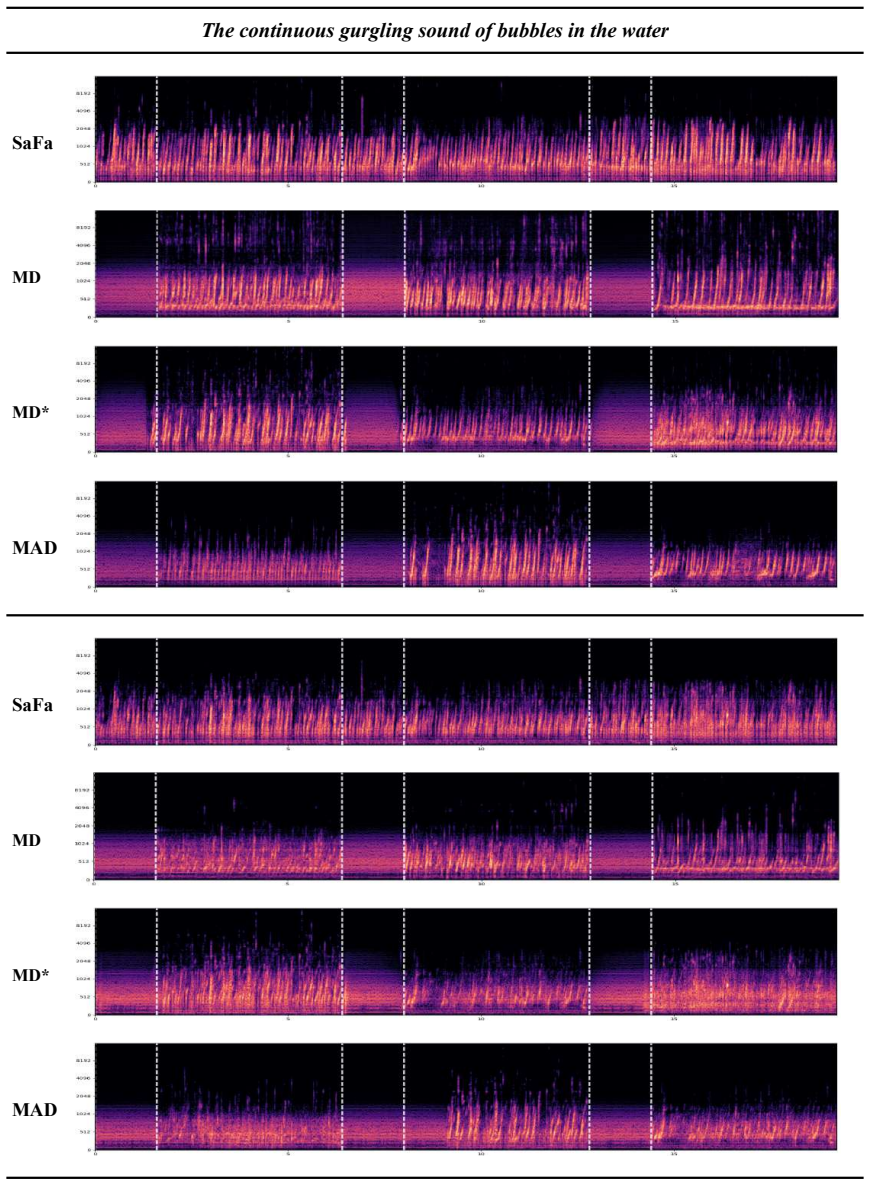
At the center of the paper is the claim that the averaging operator used to merge overlapping subview latents is the cause of spectrum aliasing in long-form audio. Because a mel-spectrogram’s VAE latent inherits the high-frequency, low-connectivity structure of the spectrogram through a channel-wise linear map, step-wise averaging progressively attenuates high-frequency components in overlap regions. SaFa replaces this averaging with a binary swap operator, so the merged overlap is $I_{i,i+1}(J_t) = W_{\mathrm{swap}} \odot \mathrm{Right}(X_t^i) + (1-W_{\mathrm{swap}}) \odot \mathrm{Left}(X_t^{i+1})$, alternating frame-by-frame between the two subview trajectories. A second unidirectional operator $M_i(J_t) = W_{\mathrm{refer}} \odot \mathrm{Mid}(X_t^0) + (1-W_{\mathrm{refer}}) \odot \mathrm{Mid}(X_t^i)$ borrows from one reference trajectory in early steps to synchronize non-overlap regions. The authors support this with Fourier analysis of overlap latents and with quantitative gains in FD, FAD, KL, and CLAP for audio and FID, KID, and CLIP for panoramas.
Load-bearing premise
Swap works only if, at each denoising step, the two subviews’ denoised versions of the overlap region are neither too similar nor too different, so that swapping frames between them blends two coherent views instead of splicing two incompatible ones.
Editorial extensions
If this is right
- A fixed-length text-to-audio diffusion model can be extended to 24–96 second audio by joint denoising with overlapping subviews, with stable quality metrics as the target length grows from 24s to 72s.
- The same two swap operators transfer across modalities: they improve panorama generation with both U-Net and DiT backbones, at overlap rates as low as 0.2 and with 2 to 20 times faster inference than gradient-based joint diffusion.
- Existing joint diffusion pipelines can replace their averaging operator with this binary swap without additional computation, since the operator is feed-forward and requires no training or backpropagation.
- Reference-Guided Swap provides a single dial, the guidance rate, that trades cross-view similarity against local diversity, with 20–40% guidance reported as a good balance.
Reading between the lines
- One extension the authors leave implicit is that the binary swap acts like an adaptive filter whose pass-band is set by the difference between adjacent trajectories; this predicts the same operator should help other over-smoothing failure modes, such as long video or tiled high-resolution generation, wherever overlap averaging blurs fine structure.
- Because the swap interval controls the spatial granularity of selection, the method suggests a general recipe: choose the swap unit to match the correlation length of the modality’s VAE tokens (frames for spectra, rows for images), which could be estimated from the latent’s autocorrelation before applying the method.
- The paper’s Fourier diagnosis is testable without running full generation: measure the high-frequency energy of overlap versus non-overlap latents after averaging; audio latents should show a monotone gap that grows with denoising step, and if a dataset does not show that gap, SaFa’s advantage should shrink.
Editorial analysis
A structured set of objections, weighed in public.
Referee Report
Summary. The paper introduces Swap Forward (SaFa), a training-free joint diffusion framework for generating long-form 2D latents (mel-spectrograms and panoramic images). The core idea is to replace the averaging operator used in overlap regions by MultiDiffusion-style methods with two binary latent swap operators: Self-Loop Latent Swap (Eq. 9), which performs frame-level bidirectional swaps in overlapping regions to preserve high-frequency details, and Reference-Guided Latent Swap (Eq. 11), which aligns non-overlapping regions to a reference trajectory in early denoising steps. The authors motivate the approach through a Fourier analysis of spectrum aliasing and validate it on text-to-audio generation with U-Net and DiT models and on panorama generation with SD 2.0 and SD 3.5, reporting improved fidelity metrics, user-study preference, and 2-20x runtime speedups over baselines.
Significance. If the reported results hold, SaFa is a simple, architecture-agnostic, and computationally efficient alternative to existing joint diffusion methods for length extrapolation in audio and image generation. Its main strengths are the breadth of evaluation (two modalities, two architectures, multiple baselines, user studies), the concrete diagnostic of spectrum aliasing via Fourier analysis, the clear formulation of the swap operators, and the substantial efficiency gains. The paper also includes an appendix with additional experiments and a theoretical analysis of the reference-guided swap, though the theory is best viewed as a supporting explanation rather than a derivation of the method. The method is empirical and incremental relative to prior joint diffusion work, but the application to long-form audio and the swap mechanism are novel enough to be of interest to the community.
major comments (4)
- [§5, Eq. (7)] The robustness claim for the hard binary swap rests on the assumed bound εl ≤ d(Right(Φ(...)), Left(Φ(...))) ≤ εu in Eq. (7), but this bound is never measured or estimated anywhere in the paper. The authors do not report d(·) across denoising steps, prompts, models, or modalities, nor do they provide evidence that εl/εu hold. If trajectories diverge beyond εu, the binary swap in Eq. (9) can inject hard discontinuities; if they are too similar, the anti-aliasing argument loses its basis. Please either measure d(·) and exhibit the bounds, or explicitly re-frame Eq. (7) as a heuristic and add an ablation or failure analysis that characterizes when the hard swap breaks down.
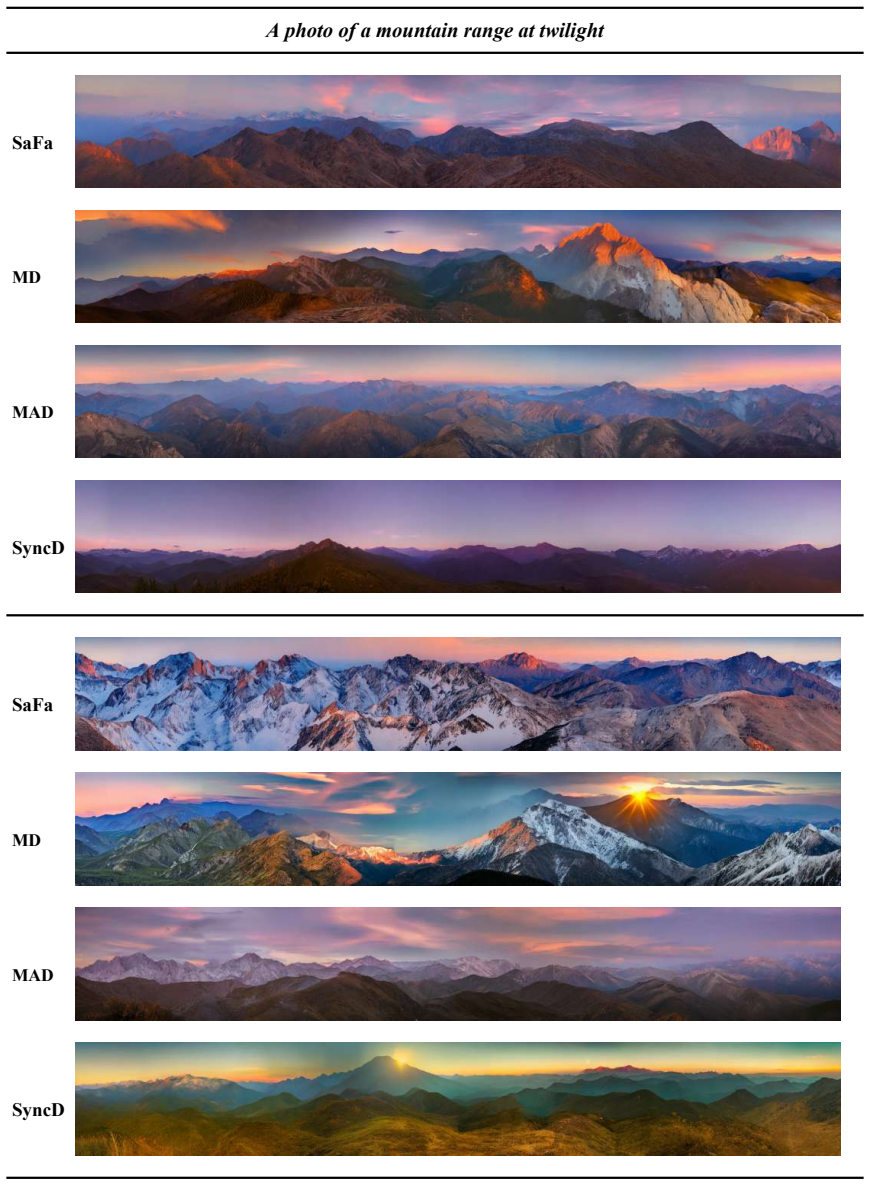
- [§6.2, Table 4] The panorama comparison is confounded by different overlap rates: the baselines (MD, SyncD, MAD) are run at an overlap rate of 0.8, while SaFa uses 0.2. This makes the reported FID/KID and runtime differences difficult to attribute to the method itself rather than to the operating point. Please report baseline results at 0.2 overlap (or SaFa at 0.8), or otherwise justify why the overlap rate is a method-specific optimization choice and show that the qualitative conclusions are unchanged under matched overlap settings.
- [§6.1 and Appendix §8.3] The two key hyperparameters w=1 (self-loop swap interval) and rguide=0.3 (reference guidance rate) are selected after qualitative inspection of a few examples; no quantitative sensitivity analysis is provided. Since these parameters directly control the claimed similarity-diversity trade-off and the method's robustness, please include a quantitative sweep over w and rguide in both audio and panorama tasks, and specify the validation procedure used to select the final values.
- [§6.1, §6.2, Tables 2-5, 8-9] All quantitative metrics are reported as single point estimates without error bars, confidence intervals, or statistical significance tests. The phrase "significantly outperforms" is therefore not supported statistically. Please report standard errors or confidence intervals across seeds/prompts, or perform paired significance tests (e.g., bootstrap or permutation tests) on the main comparisons.
minor comments (4)
- [Appendix §8.2, Table 6] The text introduces SaFa+ as an improved variant for Make-An-Audio2 that resolves latent sensitivity via a five-token forward shift and mel-spectrogram concatenation, but Table 6 reports results only for SaFa. Define SaFa+ explicitly and include its quantitative results so the reader can verify the improvement.
- [Eq. (10)] The definition of the swap mask v_m uses floor((i−1)/w) but does not specify the index range of i or the relationship between m and the spatial dimensions; please clarify the indexing so the mask construction is unambiguous.
- [Fig. 2(c)] The Fourier analysis in Fig. 2(c) is shown for selected latents only; please state how many samples were averaged or whether the curves are representative, and consider reporting a quantitative high-frequency energy ratio over a larger set.
- [Throughout] There are several typos and inconsistencies: "Meanwile" in Section 1, "aroverlap" in Section 6.2, "SynD" for SyncDiffusion in the text near Table 4, and "specta" in Section 4. Also, the notation SaFa* and SaFa+ is introduced without a consistent explanation; please define both terms at first use.
Circularity Check
No significant circularity; SaFa's swap operators are newly proposed mechanisms and the Appendix analysis is a post-hoc bound, not a fitted prediction.
full rationale
The paper's central contribution is the latent swap operator defined in Eq. 9 and the reference-guided variant in Eq. 11. These are new combination rules proposed and then empirically compared against external baselines, not quantities fitted to data and then renamed as predictions. Eq. 7 posits a bounded distance between adjacent step-wise trajectories as motivation for the swap, but the paper does not estimate epsilon_l or epsilon_u; this is an unmeasured premise and a robustness concern, not a circular step, because the swap operator is not derived from Eq. 7 by algebraic construction. The Fourier analysis in Fig. 2(c) is an illustration of the operator's effect, not a hidden target used to define the operator. The Appendix theoretical analysis in Sec. 10 proves a contraction bound for reference-guided swap; the corollary's tighter bound follows directly from the swap definition, which replaces part of each subview with the same reference slice. That is a valid theorem about the designed operator, not an independent 'prediction' secretly equivalent to its input. Evaluation metrics use reference sets generated by the same reference model, which is standard distributional evaluation for generative models; no metric is optimized during training, and the reported gains come from comparing fixed methods. The hyperparameters w=1 and rguide=0.3 are selected through ablations in the appendix, and while they are tuned on the same benchmark, this does not make the central derivation circular. No load-bearing self-citation chain appears: internal citations such as [35] are related-work mentions, and the external baseline MD* [42] is not authored by the present paper's authors. Overall, the derivation chain is self-contained, and no step reduces by construction to its own inputs.
Assumptions & free parameters
free parameters (2)
- Swap interval w =
1
- Reference guidance rate rguide =
0.3
assumptions (3)
- domain assumption Downsample(X) ≈ Wc·Z for a learnable channel-wise linear map Wc (Eq. 5)
- domain assumption Adjacent subview trajectories satisfy εl ≤ d(...) ≤ εu (Eq. 7)
- standard math Score network is bounded: ‖sθ(x,t,y)‖≤C (Appendix Sec. 10)
Cite this review
Pith. "Pith review of Latent Swap Joint Diffusion for 2D Long-Form Latent Generation." pith.science (2026). https://pith.science/paper/CW5K4MBK
@misc{pith2026250205130,
  author       = {Pith},
  title        = {Pith review of: Latent Swap Joint Diffusion for 2D Long-Form Latent Generation},
  year         = {2026},
  howpublished = {\url{https://pith.science/paper/CW5K4MBK}},
  note         = {Machine review of arXiv:2502.05130}
}
abstract
This paper introduces Swap Forward (SaFa), a modality-agnostic and efficient method to generate seamless and coherence long spectrum and panorama through latent swap joint diffusion across multi-views. We first investigate the spectrum aliasing problem in spectrum-based audio generation caused by existing joint diffusion methods. Through a comparative analysis of the VAE latent representation of Mel-spectra and RGB images, we identify that the failure arises from excessive suppression of high-frequency components during the spectrum denoising process due to the averaging operator. To address this issue, we propose Self-Loop Latent Swap, a frame-level bidirectional swap applied to the overlapping region of adjacent views. Leveraging stepwise differentiated trajectories of adjacent subviews, this swap operator adaptively enhances high-frequency components and avoid spectrum distortion. Furthermore, to improve global cross-view consistency in non-overlapping regions, we introduce Reference-Guided Latent Swap, a unidirectional latent swap operator that provides a centralized reference trajectory to synchronize subview diffusions. By refining swap timing and intervals, we can achieve a cross-view similarity-diversity balance in a forward-only manner. Quantitative and qualitative experiments demonstrate that SaFa significantly outperforms existing joint diffusion methods and even training-based methods in audio generation using both U-Net and DiT models, along with effective longer length adaptation. It also adapts well to panorama generation, achieving comparable performance with 2 $\sim$ 20 $\times$ faster speed and greater model generalizability. More generation demos are available at https://swapforward.github.io/
Figures


Figures from the paper (26 more)






Reference graph
Works this paper leans on
-
[1]
Musiclm: Generating music from text
Andrea Agostinelli, Timo I Denk, Zal ´an Borsos, Jesse En- gel, Mauro Verzetti, Antoine Caillon, Qingqing Huang, Aren Jansen, Adam Roberts, Marco Tagliasacchi, et al. Musiclm: Generating music from text. arXiv:2301.11325, 2023. 3
arXiv 2023
-
[2]
Blended diffusion for text-driven editing of natural images
Omri Avrahami, Dani Lischinski, and Ohad Fried. Blended diffusion for text-driven editing of natural images. 2022 IEEE/CVF Conference on Computer Vision and Pattern Recognition (CVPR), pages 18187–18197, 2021. 3
work page 2022
-
[3]
Omri Avrahami, Ohad Fried, and Dani Lischinski. Blended latent diffusion. ACM Transactions on Graphics (TOG), 42:1 – 11, 2022. 2, 3
work page 2022
-
[4]
Blended diffusion for text-driven editing of natural images
Omri Avrahami, Dani Lischinski, and Ohad Fried. Blended diffusion for text-driven editing of natural images. In Pro- ceedings of the IEEE/CVF conference on computer vision and pattern recognition, pages 18208–18218, 2022. 6
work page 2022
-
[5]
Multidiffusion: Fusing diffusion paths for controlled image generation
Omer Bar-Tal, Lior Yariv, Yaron Lipman, and Tali Dekel. Multidiffusion: Fusing diffusion paths for controlled image generation. In International Conference on Machine Learn- ing, 2023. 2, 3, 5, 6, 7, 8
work page 2023
-
[6]
Mikołaj Bi´nkowski, Danica J Sutherland, Michael Arbel, and Arthur Gretton. Demystifying mmd gans. arXiv:1801.01401,
-
[7]
Audiolm: a language modeling approach to audio genera- tion
Zal´an Borsos, Rapha ¨el Marinier, Damien Vincent, Eugene Kharitonov, Olivier Pietquin, Matt Sharifi, Dominik Roblek, Olivier Teboul, David Grangier, Marco Tagliasacchi, et al. Audiolm: a language modeling approach to audio genera- tion. IEEE/ACM transactions on audio, speech, and language processing, 31:2523–2533, 2023. 3
work page 2023
-
[8]
Scaling instruction- finetuned language models
Hyung Won Chung, Le Hou, Shayne Longpre, Barret Zoph, Yi Tay, William Fedus, Yunxuan Li, Xuezhi Wang, Mostafa Dehghani, Siddhartha Brahma, et al. Scaling instruction- finetuned language models. Journal of Machine Learning Research, 25(70):1–53, 2024. 6
work page 2024
Show all 56 references
-
[9]
Sim- ple and controllable music generation
Jade Copet, Felix Kreuk, Itai Gat, Tal Remez, David Kant, Gabriel Synnaeve, Yossi Adi, and Alexandre D´efossez. Sim- ple and controllable music generation. In Thirty-seventh Conference on Neural Information Processing Systems, 2023. 3
2023
-
[10]
Demofusion: Democratising high- resolution image generation with no $
Ruoyi Du, Dongliang Chang, Timothy Hospedales, Yi-Zhe Song, and Zhanyu Ma. Demofusion: Democratising high- resolution image generation with no $. In Proceedings of the IEEE/CVF Conference on Computer Vision and Pattern Recognition, pages 6159–6168, 2024. 3
2024
-
[11]
Taming transformers for high-resolution image synthesis
Patrick Esser, Robin Rombach, and Bjorn Ommer. Taming transformers for high-resolution image synthesis. In Proceed- ings of the IEEE/CVF conference on computer vision and pattern recognition, pages 12873–12883, 2021. 3
2021
-
[12]
Scaling rectified flow trans- formers for high-resolution image synthesis
Patrick Esser, Sumith Kulal, Andreas Blattmann, Rahim En- tezari, Jonas M¨uller, Harry Saini, Yam Levi, Dominik Lorenz, Axel Sauer, Frederic Boesel, et al. Scaling rectified flow trans- formers for high-resolution image synthesis. In Forty-first international conference on mac...
2024
-
[13]
Hawley, and Jordi Pons
Zach Evans, CJ Carr, Josiah Taylor, Scott H. Hawley, and Jordi Pons. Fast timing-conditioned latent audio diffusion. In ICML 2024, 2024. 1, 3, 7, 11, 12
2024
-
[14]
Long-form music generation with latent diffusion
Zach Evans, Julian D Parker, CJ Carr, Zack Zukowski, Josiah Taylor, and Jordi Pons. Long-form music generation with latent diffusion. arXiv:2404.10301, 2024. 2, 3
2024 arXiv
-
[15]
Masked diffusion transformer is a strong image synthe- sizer
Shanghua Gao, Pan Zhou, Ming-Ming Cheng, and Shuicheng Yan. Masked diffusion transformer is a strong image synthe- sizer. In Proceedings of the IEEE/CVF International Confer- ence on Computer Vision, pages 23164–23173, 2023. 6
2023
-
[16]
Image style transfer using convolutional neural networks
Leon A Gatys, Alexander S Ecker, and Matthias Bethge. Image style transfer using convolutional neural networks. In Proceedings of the IEEE conference on computer vision and pattern recognition, pages 2414–2423, 2016. 8
2016
-
[18]
Text-to-audio generation using instruction- tuned llm and latent diffusion model
Deepanway Ghosal, Navonil Majumder, Ambuj Mehrish, and Soujanya Poria. Text-to-audio generation using instruction- tuned llm and latent diffusion model. arXiv:2304.13731,
-
[19]
Latent video diffusion models for high-fidelity long video generation
Yingqing He, Tianyu Yang, Yong Zhang, Ying Shan, and Qifeng Chen. Latent video diffusion models for high-fidelity long video generation. arXiv:2211.13221, 2022. 1
2022 arXiv
-
[20]
Scalecrafter: Tuning-free higher- resolution visual generation with diffusion models
Yingqing He, Shaoshu Yang, Haoxin Chen, Xiaodong Cun, Menghan Xia, Yong Zhang, Xintao Wang, Ran He, Qifeng Chen, and Ying Shan. Scalecrafter: Tuning-free higher- resolution visual generation with diffusion models. In The Twelfth International Conference on Learning Representa-...
2023
-
[21]
Clipscore: A reference-free evaluation metric for image captioning
Jack Hessel, Ari Holtzman, Maxwell Forbes, Ronan Le Bras, and Yejin Choi. Clipscore: A reference-free evaluation metric for image captioning. arXiv:2104.08718, 2021. 8
2021 arXiv
-
[22]
Gans trained by a two time-scale update rule converge to a local nash equilibrium
Martin Heusel, Hubert Ramsauer, Thomas Unterthiner, Bern- hard Nessler, and Sepp Hochreiter. Gans trained by a two time-scale update rule converge to a local nash equilibrium. Advances in neural information processing systems, 30, 2017. 8
2017
-
[23]
Denoising diffu- sion probabilistic models
Jonathan Ho, Ajay Jain, and Pieter Abbeel. Denoising diffu- sion probabilistic models. Advances in neural information processing systems, 33:6840–6851, 2020. 1, 3
2020
-
[24]
Make-an-audio 2: Temporal-enhanced text- to-audio generation
Jia-Bin Huang, Yi Ren, Rongjie Huang, Dongchao Yang, Zhenhui Ye, Chen Zhang, Jinglin Liu, Xiang Yin, Zejun Ma, and Zhou Zhao. Make-an-audio 2: Temporal-enhanced text- to-audio generation. ArXiv, 2023. 1, 3, 4, 6, 8, 11, 12
2023
-
[25]
Park, Tao Wang, Timo I
Qingqing Huang, Daniel S. Park, Tao Wang, Timo I. Denk, Andy Ly, Nanxin Chen, Zhengdong Zhang, Zhishuai Zhang, Jiahui Yu, Christian Havnø Frank, Jesse Engel, Quoc V . Le, William Chan, and Wei Han. Noise2music: Text- conditioned music generation with diffusion models. ArXiv, a...
2023 arXiv
-
[26]
Mixture of diffusers for scene composition and high resolution image generation
´Alvaro Barbero Jim ´enez. Mixture of diffusers for scene composition and high resolution image generation. arXiv:2302.02412, 2023. 2, 3
2023 arXiv
-
[27]
Audiocaps: Generating captions for audios in the wild
Chris Dongjoo Kim, Byeongchang Kim, Hyunmin Lee, and Gunhee Kim. Audiocaps: Generating captions for audios in the wild. In Proceedings of the 2019 Conference of the North American Chapter of the Association for Computational Lin- guistics: Human Language Technologies, Volume 1...
2019
-
[29]
Fifo-diffusion: Generating infinite videos from text without training
Jihwan Kim, Junoh Kang, Jinyoung Choi, and Bohyung Han. Fifo-diffusion: Generating infinite videos from text without training. arXiv:2405.11473, 2024. 1
2024 arXiv
-
[30]
Synctweedies: A general generative framework based on synchronized diffusions
Jaihoon Kim, Juil Koo, Kyeongmin Yeo, and Minhyuk Sung. Synctweedies: A general generative framework based on synchronized diffusions. arXiv:2403.14370, 2024. 3
2024 arXiv
-
[31]
Leveraging early-stage robustness in diffusion models for efficient and high-quality image synthesis
Yulhwa Kim, Dongwon Jo, Hyesung Jeon, Taesu Kim, Dae- hyun Ahn, Hyungjun Kim, et al. Leveraging early-stage robustness in diffusion models for efficient and high-quality image synthesis. Advances in Neural Information Processing Systems, 36, 2024. 7
2024
-
[32]
Hifi-gan: Generative adversarial networks for efficient and high fidelity speech synthesis
Jungil Kong, Jaehyeon Kim, and Jaekyoung Bae. Hifi-gan: Generative adversarial networks for efficient and high fidelity speech synthesis. Advances in neural information processing systems, 33:17022–17033, 2020. 6
2020
-
[33]
Audiogen: Textually guided audio generation
Felix Kreuk, Gabriel Synnaeve, Adam Polyak, Uriel Singer, Alexandre D´efossez, Jade Copet, Devi Parikh, Yaniv Taigman, and Yossi Adi. Audiogen: Textually guided audio generation. arXiv:2209.15352, 2022. 2, 3, 7, 11
2022 arXiv
-
[34]
Syncdiffusion: Coherent montage via synchronized joint dif- fusions
Yuseung Lee, Kunho Kim, Hyunjin Kim, and Minhyuk Sung. Syncdiffusion: Coherent montage via synchronized joint dif- fusions. Advances in Neural Information Processing Systems, 36:50648–50660, 2023. 2, 3, 5, 6, 7, 8
2023
-
[35]
Quality-aware masked diffusion transformer for enhanced music generation
Chang Li, Ruoyu Wang, Lijuan Liu, Jun Du, Yixuan Sun, Zilu Guo, Zhenrong Zhang, and Yuan Jiang. Quality-aware masked diffusion transformer for enhanced music generation. arXiv:2405.15863, 2024. 1
2024 arXiv
-
[36]
Panofree: Tuning-free holistic multi-view image generation with cross-view self-guidance
Aoming Liu, Zhong Li, Zhang Chen, Nannan Li, Yi Xu, and Bryan A Plummer. Panofree: Tuning-free holistic multi-view image generation with cross-view self-guidance. In European Conference on Computer Vision, pages 146–164. Springer,
-
[37]
Audi- oldm: Text-to-audio generation with latent diffusion models
Haohe Liu, Zehua Chen, Yi Yuan, Xinhao Mei, Xubo Liu, Danilo Mandic, Wenwu Wang, and Mark D Plumbley. Audi- oldm: Text-to-audio generation with latent diffusion models. arXiv:2301.12503, 2023. 3, 4, 6, 7, 11, 12
2023 arXiv
-
[38]
Mandic, Wenwu Wang, and MarkD
Haohe Liu, Zehua Chen, Yiitan Yuan, Xinhao Mei, Xubo Liu, Danilo P. Mandic, Wenwu Wang, and MarkD . Plumbley. Audioldm: Text-to-audio generation with latent diffusion models. In International Conference on Machine Learning,
-
[39]
Audioldm 2: Learning holistic audio gen- eration with self-supervised pretraining
Haohe Liu, Yi Yuan, Xubo Liu, Xinhao Mei, Qiuqiang Kong, Qiao Tian, Yuping Wang, Wenwu Wang, Yuxuan Wang, and Mark D Plumbley. Audioldm 2: Learning holistic audio gen- eration with self-supervised pretraining. IEEE/ACM Trans- actions on Audio, Speech, and Language Processing, 2024. 1
2024
-
[40]
Autoregressive omni-aware outpainting for open- vocabulary 360-degree image generation
Zhuqiang Lu, Kun Hu, Chaoyue Wang, Lei Bai, and Zhiy- ong Wang. Autoregressive omni-aware outpainting for open- vocabulary 360-degree image generation. In Proceedings of the AAAI Conference on Artificial Intelligence, pages 14211– 14219, 2024. 2
2024
-
[41]
Tango 2: Aligning diffusion-based text-to-audio generations through direct preference optimization
Navonil Majumder, Chia-Yu Hung, Deepanway Ghosal, Wei- Ning Hsu, Rada Mihalcea, and Soujanya Poria. Tango 2: Aligning diffusion-based text-to-audio generations through direct preference optimization. In Proceedings of the 32nd ACM International Conference on Multimedia, pages ...
2024
-
[42]
Movie gen: A cast of media foundation models
Adam Polyak, Amit Zohar, Andrew Brown, Andros Tjandra, Animesh Sinha, Ann Lee, Apoorv Vyas, Bowen Shi, Chih- Yao Ma, Ching-Yao Chuang, et al. Movie gen: A cast of media foundation models. arXiv:2410.13720, 2024. 2, 3, 6, 7
2024 arXiv
-
[43]
Freenoise: Tuning-free longer video diffusion via noise rescheduling
Haonan Qiu, Menghan Xia, Yong Zhang, Yingqing He, Xintao Wang, Ying Shan, and Ziwei Liu. Freenoise: Tuning-free longer video diffusion via noise rescheduling. arXiv:2310.15169, 2023. 1
2023 arXiv
-
[44]
Merging and splitting diffusion paths for semanti- cally coherent panoramas
Fabio Quattrini, Vittorio Pippi, Silvia Cascianelli, and Rita Cucchiara. Merging and splitting diffusion paths for semanti- cally coherent panoramas. In ECCV, 2024. 2, 3, 6, 7, 8
2024
-
[45]
High-resolution image synthesis with latent diffusion models
Robin Rombach, Andreas Blattmann, Dominik Lorenz, Patrick Esser, and Bj ¨orn Ommer. High-resolution image synthesis with latent diffusion models. In Proceedings of the IEEE/CVF conference on computer vision and pattern recognition, pages 10684–10695, 2022. 3, 4, 8, 14
2022
-
[46]
Freeu: Free lunch in diffusion u-net
Chenyang Si, Ziqi Huang, Yuming Jiang, and Ziwei Liu. Freeu: Free lunch in diffusion u-net. In Proceedings of the IEEE/CVF Conference on Computer Vision and Pattern Recognition, pages 4733–4743, 2024. 4
2024
-
[47]
Denoising diffusion implicit models
Jiaming Song, Chenlin Meng, and Stefano Ermon. Denoising diffusion implicit models. arXiv:2010.02502, 2020. 1, 6
2010 arXiv
-
[48]
Score-based generative modeling through stochastic differential equations
Yang Song, Jascha Sohl-Dickstein, Diederik P Kingma, Ab- hishek Kumar, Stefano Ermon, and Ben Poole. Score-based generative modeling through stochastic differential equations. arXiv:2011.13456, 2020. 1, 14
2011 arXiv
-
[49]
Litefocus: Accelerated diffusion inference for long audio synthesis
Zhenxiong Tan, Xinyin Ma, Gongfan Fang, and Xinchao Wang. Litefocus: Accelerated diffusion inference for long audio synthesis. arXiv:2407.10468, 2024. 3
2024 arXiv
-
[50]
Gen-l-video: Multi-text to long video generation via temporal co-denoising
Fu-Yun Wang, Wenshuo Chen, Guanglu Song, Han-Jia Ye, Yu Liu, and Hongsheng Li. Gen-l-video: Multi-text to long video generation via temporal co-denoising. arXiv:2305.18264,
-
[51]
Large-scale con- trastive language-audio pretraining with feature fusion and keyword-to-caption augmentation
Yusong Wu, Ke Chen, Tianyu Zhang, Yuchen Hui, Taylor Berg-Kirkpatrick, and Shlomo Dubnov. Large-scale con- trastive language-audio pretraining with feature fusion and keyword-to-caption augmentation. In ICASSP 2023-2023 IEEE International Conference on Acoustics, Speech and Si...
2023
-
[52]
Stochsync: Stochastic diffusion synchronization for image generation in arbitrary spaces
Kyeongmin Yeo, Jaihoon Kim, and Minhyuk Sung. Stochsync: Stochastic diffusion synchronization for image generation in arbitrary spaces. arXiv:2501.15445, 2025. 3
2025 arXiv
-
[53]
Diffcollage: Parallel generation of large content with diffusion models
Qinsheng Zhang, Jiaming Song, Xun Huang, Yongxin Chen, and Ming-Yu Liu. Diffcollage: Parallel generation of large content with diffusion models. In2023 IEEE/CVF Conference on Computer Vision and Pattern Recognition (CVPR), pages 10188–10198. IEEE, 2023. 2
2023
-
[54]
The unreasonable effectiveness of deep features as a perceptual metric
Richard Zhang, Phillip Isola, Alexei A Efros, Eli Shechtman, and Oliver Wang. The unreasonable effectiveness of deep features as a perceptual metric. In Proceedings of the IEEE conference on computer vision and pattern recognition, pages 586–595, 2018. 2, 8
2018
-
[55]
Comparison with Training-Based Methods We further compare our method with more training-based long audio generation models, including both diffusion mod- els and language models
More Quantitive Experiments 8.1. Comparison with Training-Based Methods We further compare our method with more training-based long audio generation models, including both diffusion mod- els and language models. Although strictly speaking, the absolute performance between mode...
-
[56]
We use the same notation as in Section 6.1
User Study For subjective evaluation, we randomly select samples from the qualitative results of the top four methods in audio and panorama generation for user studies. We use the same notation as in Section 6.1. Specifically, SaFa is compared with MD, MD*, and MAD for audio g...
-
[57]
Theoretical Analysis of Refer-Guided Swap for Cross-View Similarity-Diversity Balance Reference-Guided Latent Swap improves cross-view consistency comparing with independent denoising process with reference model directly. When SD-2.0 [45] is employed as the reference model Φ,...
-
[58]
11 to 19 and panorama generation are in Fig
Further Qualitative Comparison More qualitative results on the audio generation are in Fig. 11 to 19 and panorama generation are in Fig. 20 to 30. Casino Ambience, electronic slot machines SaFa MD MD* MAD SaFa MD MD* MAD Figure 11. Qualitative comparison on soundscape generati...
Reviewed August 8, 2026 · model on record in the stance chip above.
Discussion (0). Continue with ORCID to comment.