REVIEW 4 major objections 4 minor 1 cited by
DobLIX: A Dual-Objective Learned Index for Log-Structured Merge Trees
T0 review · 4 major / 4 minor · reviewed 2026-08-08 · deepseek-v4-flash
Pith's one-line read This paper claims that in LSM-tree key-value stores, a learned index trained on both index-lookup cost and storage data-access cost can improve read throughput by 1.19x to 2.21x over state-of-the-art methods while preserving write…
desk verdict Genuine dual-objective contribution for learned LSM indexes, but the single-block access guarantee is unproven and the RL tuning partly fits the benchmark. read the letter →
The pith
A machine-rendered reading of the paper's core claim, the machinery that carries it, and where it could break.
The reading
What carries the argument
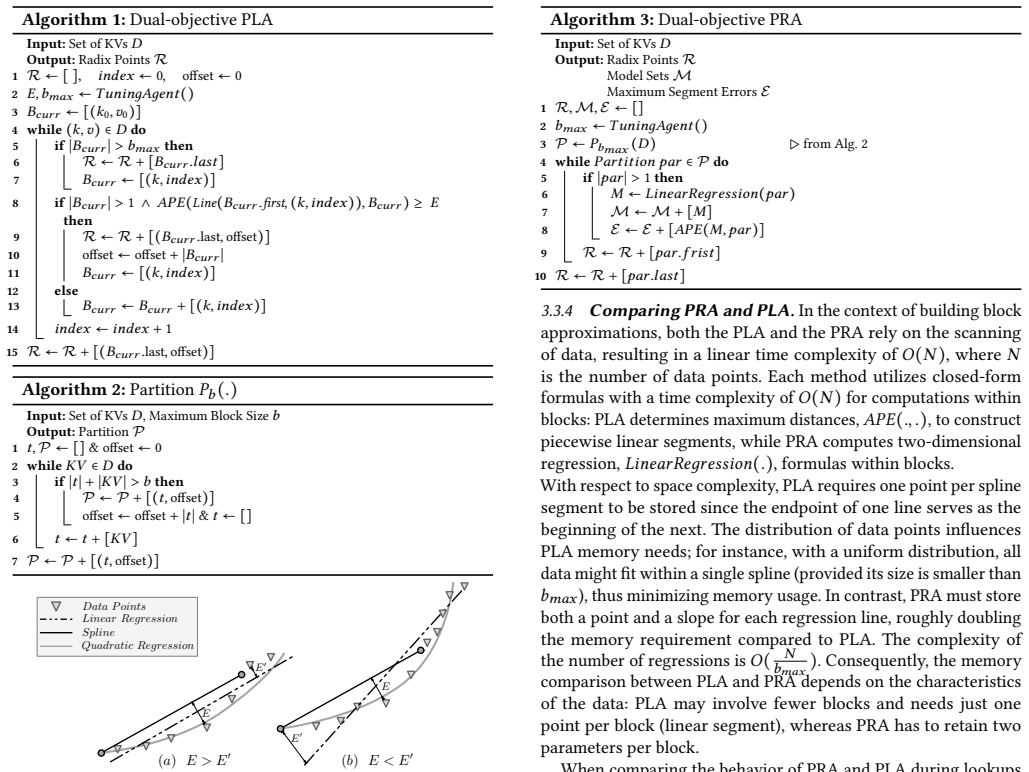
The load-bearing machinery is a dual-objective training procedure that enforces two constraints on every segment: block size $|B_i| \le b_{\max}$ and model error $\le E$. During lookups, the model output is adjusted by subtracting the block's offset, $M_{\text{adj}}(k) = M(k) - \text{offset}$, and the stored per-segment error bound confines binary search to one block. The paper offers two model families: PLA, a piecewise linear spline with radix points, and PRA, which partitions by $b_{\max}$ and fits linear regression per segment. An RL agent selects between them and tunes $E$, $b_{\max}$, and the model type.
What would settle it
Instrument a build of DobLIX to count how many data blocks are loaded per point lookup, and run it on a dataset where keys are dense near the boundary between two blocks, such as many small KVs followed by one large KV that forces a block boundary; if any lookup whose model interval $[M_{\text{adj}}(k)-E, M_{\text{adj}}(k)+E]$ straddles that boundary loads two blocks, then the single-block-access guarantee is violated.
Extended reading notes
Core claim
The central claim is that the bottleneck in LSM lookups is not the learned index itself but the coordination between index prediction and storage block layout. By training the index to minimize both the index-lookup error and the number and size of loaded blocks, DobLIX achieves single-block read amplification with block sizes capped at $b_{\max}$. The paper introduces two approximation methods, PLA and PRA, and uses an offset-adjusted prediction $M_{\text{adj}}(k) = M(k) - \text{offset}$ to locate keys within the loaded block, with stored per-segment errors limiting the final search. It further optimizes the last-mile search by skipping common key prefixes and comparing only a fixed number of bytes decoded as integers. The paper reports that this design improves throughput by 1.19x to 2.21x and reduces tail latency by up to 2.13x in read-only workloads compared with existing learned-index and native-index baselines.
Load-bearing premise
The entire speedup rests on the assumption that the model's prediction interval always stays inside the single block it names, so no lookup ever needs to load a second block.
Editorial extensions
If this is right
- Point lookups in LSM stores should see 1.19x to 2.21x higher throughput and lower tail latency than the tested baselines, with the largest gains in read-only workloads.
- Block loading and last-mile KV search cease to be the dominant lookup costs because each query reads at most one block and searches only the model's error interval.
- Index size and write amplification stay at or below native RocksDB: for 64-byte keys the DobLIX index is about 25.9% smaller, and compaction time is comparable or slightly lower.
- Variable-length keys and values, which prior learned LSM indexes could not handle, work under the same model because common prefixes are stripped and only fixed-size integer suffixes are compared.
- The RL tuning agent can adapt $E$, $b_{\max}$, and the PLA/PRA choice online, so the method tracks workload shifts without manual reconfiguration.
Reading between the lines
- Beyond the paper: if the single-block guarantee holds in general, the real design lever is the Pareto trade-off between model error and block size, and the tuning agent could be extended to allow a small number of block reads per lookup instead of strictly one.
- This design implies that the same dual-objective training should transfer to other LSM engines with immutable, sorted files, such as LevelDB or Cassandra's storage engine; the paper does not test those systems.
- Readers could test the core guarantee directly by checking whether the adjusted prediction interval ever crosses a block boundary on adversarial key distributions; if it does, a per-block error bound rather than a per-segment bound would be needed.
Editorial analysis
A structured set of objections, weighed in public.
Referee Report
Summary. DobLIX is a learned index for LSM-tree key-value stores, implemented in RocksDB. Per SST, it trains either a piecewise linear approximation (PLA) or a piecewise regression approximation (PRA) model that aims to jointly optimize index lookup and data-block access, with a maximum model error E and a maximum block size b_max. A Q-learning agent periodically chooses the model type, E, and b_max, and the lookup path uses an offset-adjusted model output to narrow the last-mile search and compares only a prefix-limited portion of string keys. The paper reports throughput improvements of 1.19x to 2.21x versus RocksDB, Bourbon, and TridentKV on several datasets and workloads, lower tail latency, smaller index size, and comparable compaction overhead.
Significance. If the single-block guarantee and the evaluation held, DobLIX would be a useful contribution: it directly targets the interaction between learned index predictions and storage block layout in a widely used LSM engine, handles variable-size keys and values, and ships a public artifact plus a fairly broad benchmark suite. The paper also gives a latency breakdown and ablation-style analysis, which is valuable. However, the central claim that every lookup requires exactly one block read is not proven, and the empirical gains are entangled with per-dataset RL tuning and lack of statistical confidence, so the significance is currently conditional on additional justification and cleaner experiments.
major comments (4)
- [§3.2, §3.5, Algs. 1-3] The central single-block access claim is not established. Block selection is described as a binary search over the offset array using the model output M(k) (§3.2 and step 7 of Fig. 6), but Algs. 1-3 only enforce |M(k)-I(k)| <= E (or per-segment E') for the global index I(k). For the last key of block B_i, whose true global index is end_i, the model may legally output end_i + epsilon with 0 < epsilon <= E; when end_i + epsilon >= offset_{i+1}, the offset-array lookup selects B_{i+1} even though the key is in B_i. The offset adjustment M_adj(k) = M(k) - B_i.offset described in §3.5 is applied to the search range after block selection and cannot repair the wrong block choice. No boundary-key verification or fallback read is specified. Because the paper attributes its read-amplification reduction to 'single block access' (§3.2, takeaway in §4.2.1), this is a load-bearing gap that must be closed with a proof, an additional per-block containment condition, or an algorithmic guard.
- [§4.1.6, §4.7] The RL-based tuning is trained on a 1% sample drawn from the same datasets used in the throughput experiments, and the RL hyperparameters alpha and gamma are selected by sensitivity tests on these same workloads (§4.1.6). The agent then chooses model type, E, and b_max per dataset. Consequently, the reported gains in Fig. 11 are partly the result of per-dataset tuning rather than a demonstration that the agent adapts to unseen distributions, which is the claim of the abstract and §3.6. A clean evaluation should train the agent on a held-out dataset or workload and evaluate on different ones, or compare against an untuned/random configuration to isolate the contribution of the RL component.
- [§4.1.5, Fig. 11] No repeated runs, error bars, or confidence intervals are reported for any throughput, latency, or index-size measurement. The headline numbers in Fig. 11 are single measurements, and the text reports average improvements without dispersion. Given the known variability of NVMe benchmarks, the claimed 1.19x-2.21x gains cannot be distinguished from noise. Please report means and standard deviations over multiple runs, or bootstrap confidence intervals, for at least the main comparisons.
- [§3.5] The last-mile optimization that compares only K bytes after the common prefix also lacks a correctness argument. If two distinct keys in the search range share the same next K bytes after the trie-level prefix, a comparison limited to those bytes cannot identify the target key. The text says this 'ensuring that the key can be identified' (§3.5), but no uniqueness assumption is stated for the K-byte suffix within the error range, and no fallback to a full comparison is described. This needs either a proof that collisions cannot occur or an explicit fallback in the search procedure.
minor comments (4)
- [Abstract and §4.2.1] The abstract states throughput improvements of 1.19x to 2.21x, but §4.2.1 reports a WH speedup versus RocksDB of 1.04x; the reported range should be reconciled or qualified.
- [§4.2.4 and Fig. 12] The spelling 'TridenKV' appears in Fig. 12 and §4.2.4; the system name should be consistent with 'TridentKV'.
- [Fig. 8] Panel labels use 'E > E0' and 'E < E0', while the text compares E and E'; these error quantities should be defined consistently in the caption and body.
- [§4.4] The claim that DobLIX 'even decreases storage and write amplification compared to RocksDB native indexing' is stronger than what Fig. 15(a) supports; for 8-byte keys the index sizes are nearly equal, and the 25.9% improvement is shown for 64-byte keys.
Circularity Check
No significant circularity: DobLIX's algorithmic contributions are constructive and its measured gains are not derived from fitted parameters.
full rationale
DobLIX's derivation chain is not circular. The PLA and PRA algorithms (Algorithms 1-3) construct models and block partitions directly from the KV set, with explicit error bounds and maximum block sizes, and the last-mile search (Section 3.5) uses the stored model output and error range to narrow the search within an already loaded block. These are constructive steps, not definitions that presuppose the claimed result. The dual-objective optimization is a stated design criterion, and the measured throughput improvements are empirical results, not predictions derived from the model equations. The RL agent (Section 3.6) does tune parameters such as E, b_max, and model choice, and Section 4.1.6 states that a 1% sample of each dataset is used to train the agent before evaluation. This is a legitimate empirical configuration step: the paper reports measured throughput of the tuned system, not a parameter-free prediction, so it does not reduce the reported gains to the fitted inputs by construction. There is no reliance on a self-citation chain or an imported uniqueness theorem; the cited external techniques (e.g., RSS, RMI) are used as building blocks with independent support. The concern that the single-block access guarantee is not proven from the stated error bounds is a soundness or correctness issue, not circularity: the error bound would need an additional guard or proof, but the claim is not equivalent to its input by definition. Overall, the paper is self-contained in its algorithmic derivation, and no circular step can be exhibited.
Assumptions & free parameters
free parameters (5)
- E (maximum model error for PLA) =
32 to 256, tuned by RL agent
- b_max (maximum block size) =
4KB to 32KB, tuned by RL agent
- nu (reward weight in RL reward) =
1 for main experiments, varied 0-1 in Section 4.7
- alpha, gamma (RL learning rate, discount) =
0.2, 0.8
- epsilon (exploration rate) =
initial 0.99, min 0.02
assumptions (4)
- domain assumption SSTs are immutable and sorted, so a trained LI model remains valid for the SST lifetime.
- ad hoc to paper The model error bound E (or per-block E') after offset adjustment confines the last-mile search to a single block.
- domain assumption The RL agent's Q-learning over the 32-state space converges and generalizes from a 1% sample to the full workload.
- domain assumption Latency and index-size measurements are stationary within an experiment.
Cite this review
Pith. "Pith review of DobLIX: A Dual-Objective Learned Index for Log-Structured Merge Trees." pith.science (2026). https://pith.science/paper/2IEJMUC5
@misc{pith2026250205369,
  author       = {Pith},
  title        = {Pith review of: DobLIX: A Dual-Objective Learned Index for Log-Structured Merge Trees},
  year         = {2026},
  howpublished = {\url{https://pith.science/paper/2IEJMUC5}},
  note         = {Machine review of arXiv:2502.05369}
}
read the original abstract
In this paper, we introduce DobLIX, a dual-objective learned index specifically designed for Log-Structured Merge(LSM) tree-based key-value stores. Although traditional learned indexes focus exclusively on optimizing index lookups, they often overlook the impact of data access from storage, resulting in performance bottlenecks. DobLIX addresses this by incorporating a second objective, data access optimization, into the learned index training process. This dual-objective approach ensures that both index lookup efficiency and data access costs are minimized, leading to significant improvements in read performance while maintaining write efficiency in real-world LSM-tree systems. Additionally, DobLIX features a reinforcement learning agent that dynamically tunes the system parameters, allowing it to adapt to varying workloads in real-time. Experimental results using real-world datasets demonstrate that DobLIX reduces indexing overhead and improves throughput by 1.19 to 2.21 times compared to state-of-the-art methods within RocksDB, a widely used LSM-tree-based storage engine.
Figures



Figures from the paper (10 more)




Forward citations
Cited by 1 Pith paper
-
Filter-Centric Vector Indexing: Geometric Transformation for Efficient Filtered Vector Search
FCVI subtracts a scaled filter vector from each segment of an embedding, turning filtered vector search into plain ANN search in a re-coordinated space.
Reference graph
Works this paper leans on
-
[1]
2011. LevelDB. https://opensource.googleblog.com/2011/07/leveldb-fast- persistent-key-value-store.html. Last accessed 2025-07-11
work page 2011
-
[2]
2019. FB Dataset. https://doi.org/10.7910/DVN/JGVF9A/Y54SI9. Last accessed 2025-07-11
-
[3]
2019. OSM Dataset. https://console.cloud.google.com/marketplace/product/ openstreetmap/geo-openstreetmap. Last accessed 2025-07-11
work page 2019
-
[4]
2019. WikiTS Dataset. https://doi.org/10.7910/DVN/JGVF9A/SVN8PI. Last accessed 2025-07-11
-
[5]
2020. Bourbon Code. https://github.com/edydfang/Bourbon. Last accessed 2025-07-11
work page 2020
-
[6]
2021. TridentKV Code. https://github.com/emperorlu/Learned-RocksDB. Last accessed 2025-07-11
work page 2021
-
[7]
Jacob D Abernethy, Robert Schapire, and Umar Syed. 2024. Lexicographic op- timization: Algorithms and stability. In International Conference on Artificial Intelligence and Statistics. PMLR, 2503–2511
work page 2024
-
[8]
Stephen Boyd and Lieven Vandenberghe. 2004. Convex optimization. Cambridge university press
2004
Show all 74 references
-
[9]
Zhichao Cao, Siying Dong, Sagar Vemuri, and David H. C. Du. 2020. Character- izing, modeling, and benchmarking RocksDB key-value workloads at facebook. In Proceedings of the 18th USENIX Conference on File and Storage Technologies (Santa Clara, CA, USA) (FAST’20). USENIX Associ...
2020
-
[10]
Fay Chang, Jeffrey Dean, Sanjay Ghemawat, Wilson C Hsieh, Deborah A Wal- lach, Mike Burrows, Tushar Chandra, Andrew Fikes, and Robert E Gruber. 2008. Bigtable: A distributed storage system for structured data. ACM Transactions on Computer Systems (TOCS) 26, 2 (2008), 1–26
2008
-
[11]
Subarna Chatterjee, Mark F Pekala, Lev Kruglyak, and Stratos Idreos. 2024. Limousine: Blending Learned and Classical Indexes to Self-Design Larger-than- Memory Cloud Storage Engines. Proceedings of the ACM on Management of Data 2, 1 (2024), 1–28
2024
-
[12]
Altannar Chinchuluun and Panos M Pardalos. 2007. A survey of recent devel- opments in multiobjective optimization. Annals of Operations Research 154, 1 (2007), 29–50
2007
-
[13]
Cooper, Adam Silberstein, Erwin Tam, Raghu Ramakrishnan, and Russell Sears
Brian F. Cooper, Adam Silberstein, Erwin Tam, Raghu Ramakrishnan, and Russell Sears. 2010. Benchmarking Cloud Serving Systems with YCSB. In Proceedings of the 1st ACM Symposium on Cloud Computing (Indianapolis, Indiana, USA) (SoCC ’10). ACM, New York, NY, USA, 143–154. https:/...
2010 doi
-
[14]
Graham Cormode and Marios Hadjieleftheriou. 2008. Finding frequent items in data streams. Proceedings of the VLDB Endowment 1, 2 (2008), 1530–1541
2008
-
[15]
Arpaci-Dusseau, and Remzi H
Yifan Dai, Yien Xu, Aishwarya Ganesan, Ramnatthan Alagappan, Brian Kroth, Andrea C. Arpaci-Dusseau, and Remzi H. Arpaci-Dusseau. 2020. From WiscKey to Bourbon: a learned index for log-structured merge trees. In Proceedings of the 14th USENIX Conference on Operating Systems Des...
2020
-
[16]
Niv Dayan, Manos Athanassoulis, and Stratos Idreos. 2018. Optimal bloom filters and adaptive merging for LSM-trees. ACM Transactions on Database Systems (TODS) 43, 4 (2018), 1–48
2018
-
[17]
Niv Dayan and Stratos Idreos. 2018. Dostoevsky: Better space-time trade-offs for LSM-tree based key-value stores via adaptive removal of superfluous merging. In Proceedings of the 2018 International Conference on Management of Data. 505–520
2018
-
[18]
Jialin Ding, Umar Farooq Minhas, Jia Yu, Chi Wang, Jaeyoung Do, Yinan Li, Hantian Zhang, Badrish Chandramouli, Johannes Gehrke, Donald Kossmann, et al. 2020. ALEX: an updatable adaptive learned index. SIGMOD
2020
-
[19]
Nan Ding and Radu Soricut. 2017. Cold-start reinforcement learning with softmax policy gradient. In Proceedings of the 31st International Conference on Neural Information Processing Systems (Long Beach, California, USA) (NIPS’17). Curran Associates Inc., Red Hook, NY, USA, 2814–2823
2017
-
[20]
Siying Dong, Andrew Kryczka, Yanqin Jin, and Michael Stumm. 2021. Evolution of Development Priorities in Key-value Stores Serving Large-scale Applications: The RocksDB Experience. In19th USENIX Conference on File and Storage Technolo- gies (FAST 21). USENIX Association, 33–49....
2021
-
[21]
Alexandra Fedorova, Craig Mustard, Ivan Beschastnikh, Julia Rubin, Augustine Wong, Svetozar Miucin, and Louis Ye. 2018. Performance comprehension at WiredTiger. In Proceedings of the 2018 26th ACM Joint Meeting on European Soft- ware Engineering Conference and Symposium on the...
2018
-
[22]
Paolo Ferragina and Giorgio Vinciguerra. 2020. The PGM-index: a fully-dynamic compressed learned index with provable worst-case bounds. Proc. VLDB Endow. 13, 8 (April 2020), 1162–1175. https://doi.org/10.14778/3389133.3389135
2020
-
[23]
Alex Galakatos, Michael Markovitch, Carsten Binnig, Rodrigo Fonseca, and Tim Kraska. 2019. Fiting-tree: A data-aware index structure. In SIGMOD
2019
-
[24]
Alireza Heidari, Amirhossein Ahmadi, and Wei Zhang. 2025. UpLIF: An Up- datable Self-tuning Learned Index Framework. In Database Engineered Applica- tions, Richard Chbeir, Sergio Ilarri, Yannis Manolopoulos, Peter Z. Revesz, Jorge Bernardino, and Carson K. Leung (Eds.). Spring...
2025
-
[25]
Alireza Heidari, Amirhossein Ahmadi, Zefeng Zhi, and Wei Zhang. 2024. Metahive: A cache-optimized metadata management for heterogeneous key- value stores. arXiv preprint arXiv:2407.19090 (2024)
2024 arXiv
-
[26]
Alireza Heidari, Ihab F Ilyas, and Theodoros Rekatsinas. 2020. Approximate infer- ence in structured instances with noisy categorical observations. In Uncertainty in Artificial Intelligence. PMLR, 412–421
2020
-
[27]
Alireza Heidari, Shrinu Kushagra, and Ihab F Ilyas. 2020. On sampling from data with duplicate records. arXiv preprint arXiv:2008.10549 (2020)
2020 arXiv
-
[28]
Alireza Heidari, Joshua McGrath, Ihab F Ilyas, and Theodoros Rekatsinas. 2019. Holodetect: Few-shot learning for error detection. In Proceedings of the 2019 International Conference on Management of Data . 829–846
2019
-
[29]
Alireza Heidarikhazaei. 2021. Structured Prediction on Dirty Datasets. (2021)
2021
-
[30]
Chaudhari, Evimaria Terzi, and Manos Athanas- soulis
Andy Huynh, Harshal A. Chaudhari, Evimaria Terzi, and Manos Athanas- soulis. 2022. Endure: a robust tuning paradigm for LSM trees under work- load uncertainty. Proc. VLDB Endow. 15, 8 (April 2022), 1605–1618. https: //doi.org/10.14778/3529337.3529345
2022
-
[31]
Andy Huynh, Harshal A Chaudhari, Evimaria Terzi, and Manos Athanassoulis
-
[32]
Olzhas Kaiyrakhmet, Songyi Lee, Beomseok Nam, Sam H Noh, and Young-ri Choi
-
[33]
Andreas Kipf, Ryan Marcus, Alexander van Renen, Mihail Stoian, Alfons Kemper, Tim Kraska, and Thomas Neumann. 2020. RadixSpline: a single-pass learned index. In Proceedings of the third international workshop on exploiting artificial intelligence techniques for data management . 1–5
2020
-
[34]
Kornilios Kourtis, Nikolas Ioannou, and Ioannis Koltsidas. 2019. Reaping the performance of fast NVM storage with uDepot. In 17th USENIX Conference on File and Storage Technologies (FAST 19) . USENIX Association, Boston, MA, 1–15. https://www.usenix.org/conference/fast19/prese...
2019
-
[35]
Tim Kraska, Alex Beutel, Ed H Chi, Jeffrey Dean, and Neoklis Polyzotis. 2018. The case for learned index structures. In SIGMOD
2018
-
[36]
Avinash Lakshman and Prashant Malik. 2010. Cassandra: a decentralized struc- tured storage system. ACM SIGOPS operating systems review 44, 2 (2010), 35–40
2010
-
[37]
Shane Culpepper, and Renata Borovica-Gajic
Hai Lan, Zhifeng Bao, J. Shane Culpepper, and Renata Borovica-Gajic. 2023. Updatable Learned Indexes Meet Disk-Resident DBMS - From Evaluations to Design Choices. Proc. ACM Manag. Data 1, 2, Article 139 (jun 2023), 22 pages. https://doi.org/10.1145/3589284
2023 doi
-
[38]
Baptiste Lepers, Oana Balmau, Karan Gupta, and Willy Zwaenepoel. 2019. Kvell: the design and implementation of a fast persistent key-value store. InProceedings of the 27th ACM Symposium on Operating Systems Principles . 447–461
2019
-
[39]
Pengfei Li, Yu Hua, Pengfei Zuo, Zhangyu Chen, and Jiajie Sheng. 2023. ROLEX : A Scalable RDMA-oriented Learned Key-Value Store for Dis- aggregated Memory Systems. In 21st USENIX Conference on File and Storage Technologies (FAST 23). 99–114
2023
-
[40]
Pengfei Li, Hua Lu, Qian Zheng, Long Yang, and Gang Pan. 2020. LISA: A learned index structure for spatial data. In Proceedings of the 2020 ACM SIGMOD international conference on management of data . 2119–2133
2020
-
[41]
Pengfei Li, Hua Lu, Rong Zhu, Bolin Ding, Long Yang, and Gang Pan. 2023. DILI: A Distribution-Driven Learned Index. VLDB (2023). https://doi.org/10.14778/ 3598581.3598593
2023
-
[42]
Yongkun Li, Chengjin Tian, Fan Guo, Cheng Li, and Yinlong Xu. 2019. ElasticBF : Elastic Bloom Filter with Hotness Awareness for Boosting Read Performance in Large Key-Value Stores. In 2019 USENIX Annual Technical Conference (USENIX ATC 19). 739–752
2019
-
[43]
Ester Livshits, Alireza Heidari, Ihab F Ilyas, and Benny Kimelfeld. 2020. Approx- imate denial constraints. arXiv preprint arXiv:2005.08540 (2020)
2020 arXiv
-
[44]
Baotong Lu, Jialin Ding, Eric Lo, Umar Farooq Minhas, and Tianzheng Wang
-
[45]
Kai Lu, Nannan Zhao, Jiguang Wan, Changhong Fei, Wei Zhao, and Tongliang Deng. 2022. TridentKV: A Read-Optimized LSM-Tree Based KV Store via Adap- tive Indexing and Space-Efficient Partitioning. IEEE Transactions on Parallel and Distributed Systems 33, 8 (2022), 1953–1966. htt...
2022 doi
-
[46]
Lanyue Lu, Thanumalayan Sankaranarayana Pillai, Hariharan Gopalakrishnan, Andrea C Arpaci-Dusseau, and Remzi H Arpaci-Dusseau. 2017. Wisckey: Sepa- rating keys from values in ssd-conscious storage. ACM Transactions On Storage (TOS) 13, 1 (2017), 1–28
2017
-
[47]
Ryan Marcus, Andreas Kipf, Alexander van Renen, Mihail Stoian, Sanchit Misra, Alfons Kemper, Thomas Neumann, and Tim Kraska. 2020. Benchmarking learned indexes. Proc. VLDB Endow. 14, 1 (Sept. 2020), 1–13. https://doi.org/10.14778/ 3421424.3421425
2020
-
[48]
Dingheng Mo, Fanchao Chen, Siqiang Luo, and Caihua Shan. 2023. Learning to Optimize LSM-trees: Towards A Reinforcement Learning based Key-Value Store for Dynamic Workloads. Proceedings of the ACM on Management of Data 1, 3 (2023), 1–25
2023
-
[49]
Dingheng Mo, Siqiang Luo, and Stratos Idreos. 2025. How to Grow an LSM- tree? Towards Bridging the Gap Between Theory and Practice. arXiv preprint arXiv:2504.17178 (2025)
2025 arXiv
-
[50]
Barzan Mozafari, Eugene Zhen Ye Goh, and Dong Young Yoon. 2015. Cliffguard: A principled framework for finding robust database designs. InProceedings of the 2015 ACM SIGMOD international conference on management of data . 1167–1182
2015
-
[51]
Ibrahim Sabek and Tim Kraska. 2023. The Case for Learned In-Memory Joins. (2023). https://doi.org/10.14778/3587136.3587148
2023
-
[52]
Subhadeep Sarkar and Manos Athanassoulis. 2022. Dissecting, designing, and optimizing LSM-based data stores. In Proceedings of the 2022 International Con- ference on Management of Data . 2489–2497
2022
-
[53]
Subhadeep Sarkar, Niv Dayan, and Manos Athanassoulis. 2023. The LSM design space and its read optimizations. In 2023 IEEE 39th International Conference on Data Engineering (ICDE). IEEE, 3578–3584
2023
-
[54]
Benjamin Spector, Andreas Kipf, Kapil Vaidya, Chi Wang, Umar Farooq Minhas, and Tim Kraska. 2021. Bounding the Last Mile: Efficient Learned String Indexing. CoRR abs/2111.14905 (2021). arXiv:2111.14905 https://arxiv.org/abs/2111.14905
2021 arXiv
-
[55]
Zhaoyan Sun, Xuanhe Zhou, and Guoliang Li. 2023. Learned index: A com- prehensive experimental evaluation. Proceedings of the VLDB Endowment 16, 8 (2023), 1992–2004
2023
-
[56]
Dejun Teng, Lei Guo, Rubao Lee, Feng Chen, Siyuan Ma, Yanfeng Zhang, and Xiaodong Zhang. 2017. LSbM-tree: Re-enabling buffer caching in data manage- ment for mixed reads and writes. In 2017 IEEE 37th International Conference on Distributed Computing Systems (ICDCS) . IEEE, 68–79
2017
-
[57]
Hengrui Wang, Te Guo, Junzhao Yang, and Huanchen Zhang. 2024. GRF: A Global Range Filter for LSM-Trees with Shape Encoding. Proceedings of the ACM on Management of Data 2, 3 (2024), 1–27
2024
-
[58]
Wenlong Wang and David Hung-Chang Du. 2024. LearnedKV: Integrating LSM and Learned Index for Superior Performance on SSD. arXiv preprint arXiv:2406.18892 (2024)
2024 arXiv
-
[59]
Youyun Wang, Chuzhe Tang, Zhaoguo Wang, and Haibo Chen. 2020. SIndex: a scalable learned index for string keys. In Proceedings of the 11th ACM SIGOPS Asia-Pacific Workshop on Systems. 17–24
2020
-
[60]
Yi Wang, Jianan Yuan, Shangyu Wu, Huan Liu, Jiaxian Chen, Chenlin Ma, and Jianbin Qin. 2024. LeaderKV: Improving Read Performance of KV Stores via Learned Index and Decoupled KV Table. In 40th IEEE International Conference on Data Engineering, ICDE 2024, Utrecht, The Netherlan...
2024
-
[61]
Zhonghua Wang, Chen Ding, Fengguang Song, Kai Lu, Jiguang Wan, Zhihu Tan, Changsheng Xie, and Guokuan Li. 2024. WIPE: A Write-Optimized Learned Index for Persistent Memory. ACM Trans. Archit. Code Optim. 21, 2, Article 22 (feb 2024), 25 pages. https://doi.org/10.1145/3634915
2024 doi
-
[62]
Christopher JCH Watkins and Peter Dayan. 1992. Q-learning. Machine learning 8 (1992), 279–292
1992
-
[64]
Fenggang Wu, Ming-Hong Yang, Baoquan Zhang, and David HC Du. 2020. AC- Key : Adaptive caching for LSM-based Key-Value stores. In 2020 USENIX Annual Technical Conference (USENIX ATC 20). 603–615
2020
-
[65]
Giorgos Xanthakis, Antonios Katsarakis, Giorgos Saloustros, and Angelos Bilas
-
[66]
Yifan Yang and Shimin Chen. 2024. LITS: An Optimized Learned Index for Strings. Proceedings of the VLDB Endowment 17, 11 (2024), 3415–3427
2024
-
[67]
Qiaolin Yu, Chang Guo, Jay Zhuang, Viraj Thakkar, Jianguo Wang, and Zhichao Cao. 2024. CaaS-LSM: compaction-as-a-service for LSM-based key-value stores in storage disaggregated infrastructure. Proceedings of the ACM on Management of Data 2, 3 (2024), 1–28
2024
-
[68]
Jiaoyi Zhang and Yihan Gao. 2022. CARMI: A Cache-Aware Learned Index with a Cost-Based Construction Algorithm. VLDB (2022). https://doi.org/10.14778/ 3551793.3551823
2022
-
[69]
arXiv preprint arXiv:2407.15581 (2024)
vLSM: Low tail latency and I/O amplification in LSM-based KV stores. arXiv preprint arXiv:2407.15581 (2024)
2024 arXiv
-
[70]
Zhou Zhang, Zhaole Chu, Peiquan Jin, Yongping Luo, Xike Xie, Shouhong Wan, Yun Luo, Xufei Wu, Peng Zou, Chunyang Zheng, et al . 2022. PLIN: A persis- tent learned index for non-volatile memory with high performance and instant recovery. Proceedings of the VLDB Endowment 16, 2 ...
2022
-
[71]
Zhutao Zhuang, Xinqi Zeng, and Zhiguang Chen. 2025. DumpKV: Learning Based Lifetime Aware Garbage Collection for Key Value Separation in LSM- Tree. Proc. VLDB Endow. 18, 4 (May 2025), 1223–1236. https://doi.org/10.14778/ 3717755.3717778
2025
-
[73]
Jiaoyi Zhang, Kai Su, and Huanchen Zhang. 2024. Making In-Memory Learned Indexes Efficient on Disk. Proc. ACM Manag. Data 2, 3, Article 151 (may 2024), 26 pages. https://doi.org/10.1145/3654954
2024 doi
-
[2019]
In 17th USENIX Conference on File and Storage Technologies (FAST 19)
SLM-DB : Single-Level Key-Value store with persistent memory. In 17th USENIX Conference on File and Storage Technologies (FAST 19) . 191–205
-
[2021]
VLDB Endow
APEX: a high-performance learned index on persistent memory.Proc. VLDB Endow. 15, 3 (nov 2021), 597–610. https://doi.org/10.14778/3494124.3494141
2021
-
[2024]
The VLDB Journal (2024), 1–24
Towards flexibility and robustness of LSM trees. The VLDB Journal (2024), 1–24
2024
Reviewed August 8, 2026 · model on record in the stance chip above.
Discussion (0). Continue with ORCID to comment.