REVIEW 4 major objections 5 minor 58 references
Sequential Stochastic Combinatorial Optimization Using Hierarchal Reinforcement Learning
T0 review · 4 major / 5 minor · reviewed 2026-08-08 · deepseek-v4-flash
Pith's one-line read WS-option jointly learns budget allocation and node selection for sequential stochastic combinatorial optimization, beating uniform-allocation baselines and transferring from 50-node training graphs to 1000-node graphs.
desk verdict WS-option is a genuine and sensible combination of HRL ideas for non-uniform budget allocation in sequential stochastic CO, but its 'significantly improved' claim rests on thin margins with unreported variance, and the theory section is mostly assertion. read the letter →
The pith
A machine-rendered reading of the paper's core claim, the machinery that carries it, and where it could break.
The reading
What carries the argument
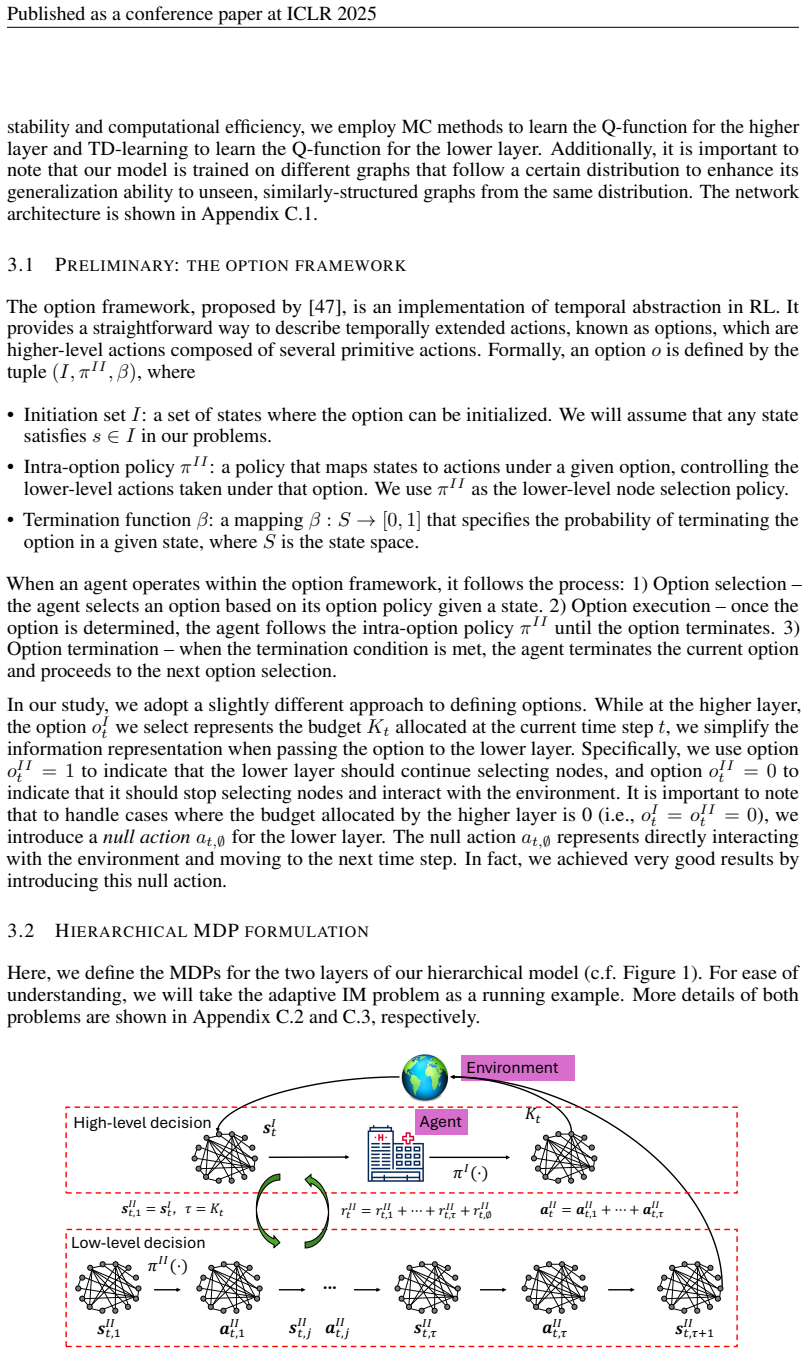
The load-bearing object is the two-layer Markov decision process pair connected by a reward-alignment identity: at each time step the higher layer chooses a budget option $o^I_t = K_t$ and the lower layer selects nodes one at a time, and the lower-layer rewards are scaled marginal rewards $r^{II}_{t,v} = \frac{m_{t,v}}{\sum_{u \in a^{II}_t} m_{t,u}}(r^I_t - r^{II}_{t,\emptyset})$ so that $\sum_u r^{II}_{t,u} + r^{II}_{t,\emptyset} = r^I_t$; the layers therefore optimize exactly the same objective. Around this identity the paper builds three stabilising devices: a wake-sleep training schedule (sleep: freeze the higher layer at an average budget allocation and train the lower layer, then pre-train the higher layer offline on those trajectories; wake: train both layers jointly), a layer-wise learning-method split (Monte Carlo returns for the unbiased higher-layer Q-function, TD/Q-learning for the faster-converging lower layer), and a binary continuation option $o^{II}_t \in \{0,1\}$ with a null action, so the lower layer only needs to know whether to keep selecting nodes rather than the exact budget value. The network also uses an action-in structure for the higher layer so that budget size is an input, not an output layer, which is what lets a model trained on small graphs be evaluated on arbitrarily larger ones.
What would settle it
Train the lower-layer node-selection policy to convergence under several deliberately different budget-allocation policies—all budget on the first day, uniform across days, all budget on the last day—and measure how often the resulting policies choose different nodes in the same state. If they disagree substantially, the similarity assumption behind wake-sleep training is violated; conversely, if joint training from scratch reaches the same final reward as wake-sleep training on a hard instance, the schedule's claimed stabilising role is not essential to the result.
Extended reading notes
Core claim
On the paper's own terms, the central discovery is that the SSCO problem—maximize $\sum_{t=1}^T r_t(S_t)$ subject to $\sum_t K_t \leq K$ and $|S_t| \leq K_t$—is a bi-level optimization, and that a hierarchical value-based agent can solve it stably instead of flattening it into one giant Markov decision process. WS-option treats the per-time-step budget $K_t$ as a higher-layer option and the per-step node set $S_t$ as a sequence of lower-layer actions, and the two layers are trained so that the lower layer's rewards at each time step sum exactly to the higher layer's reward, keeping both levels optimizing the same objective. The paper further claims that its wake-sleep schedule—first training the lower layer under a frozen average budget policy, then fine-tuning both layers together—avoids the divergent Q-value estimates it observes when the layers are trained jointly from scratch, and its two convergence theorems establish Q-learning convergence for each layer in the tabular case assuming the other layer is fixed or optimally responsive. The reported empirical result is that this agent outperforms the average, static, and normal budget policies with degree- or score-based node selection on adaptive influence maximization, and greedy and genetic-algorithm planners on route planning, with all reported differences at $p \leq 0.05$; it also reports that the learned policies generalize to graphs up to 1000 nodes and to a 2500-node real-world power-grid network.
Load-bearing premise
The whole wake-sleep design rests on the claim, stated explicitly in Appendix A.2, that the best node-selection policy is roughly the same no matter how the budget is spread across time steps: if that similarity fails, the lower-layer policy learned in the sleep stage is a poor starting point and nothing guarantees the two layers converge jointly.
Editorial extensions
If this is right
- Uniform budget allocation over the time horizon is suboptimal for sequential stochastic combinatorial optimization; an adaptive budget policy learned jointly with node selection yields higher cumulative reward on adaptive influence maximization and route planning in the reported experiments ($p \leq 0.05$).
- A model trained on graphs of 50–100 nodes transfers to unseen graphs of 200–1000 nodes and to a 2500-node power-grid network without retraining, because the learned networks contain no graph-size-dependent parameters.
- The lower layer's node-selection policy and the higher layer's budget-allocation policy each contribute independently to the gain: holding one layer fixed at its learned policy while swapping the other for a baseline still favors the learned policy.
- The wake-sleep schedule matters: an ablation shows that shortening the sleep stage so the lower layer has not converged (one third of the epochs) degrades final performance, while half and two thirds of the epochs give nearly identical results.
- Using Monte Carlo returns for the higher layer instead of TD bootstrapping prevents the monotone Q-value inflation the paper observes for TD in this coupled setting.
Reading between the lines
- Editorial inference — the reward-alignment identity is a generic credit-assignment recipe: any hierarchical agent that must distribute one aggregate time-step reward across many primitive actions could reuse it, with the marginal contribution of each action estimated by simulation, not just in the two problem instances studied here.
- Editorial inference — the paper's convergence proof is explicitly limited to tabular Q-learning, so an untested question is whether the wake-sleep schedule keeps the function-approximation case stable in regimes beyond the reported $T \le 20$, $K \le 30$ settings, such as very long horizons or budgets large relative to the graph.
- Editorial inference — the comparison set does not include a flat RL baseline that learns budget allocation and node selection as a single joint MDP; testing whether the hierarchy is genuinely necessary rather than merely convenient is an open comparison the paper does not run.
- Editorial inference — the paper's own stated limitation is that each new problem class needs its own graph embedding technique; a testable consequence of its design is that the wake-sleep schedule and the reward-alignment identity, rather than the specific embedding, are what carry the performance gains.
Editorial analysis
A structured set of objections, weighed in public.
Referee Report
Summary. The paper defines sequential stochastic combinatorial optimization (SSCO) as a two-level problem in which a budget is allocated over time steps and a set of nodes is selected at each step. It proposes WS-option, a two-layer option-based hierarchical RL framework, with a wake-sleep training procedure, MC learning for the higher layer, TD learning for the lower layer, and brief convergence theorems. The method is evaluated on adaptive influence maximization and route planning, with ablation studies and tests on larger graphs and a real-world network. The central claim is that WS-option exhibits significantly improved effectiveness and generalizability over traditional methods.
Significance. The problem formulation is a useful and reasonably general way to expose the budget-allocation and node-selection coupling in SSCO, and the option-based hierarchical decomposition is a sensible design. The wake-sleep idea, the use of different learning updates per layer, and the ablations for sleep length and simplified options are worthwhile contributions. If the empirical claim were fully supported, the generalization to larger graphs would be a practical benefit. However, the current evidence for 'significantly improved' is incomplete: the reported margins over the strongest baselines are small, and the paper never gives the run counts, variances, test statistics, or actual p-values behind the blanket 'p-values ≤ 0.05' statements. The theoretical guarantees are also narrower and more assumption-dependent than the text suggests.
major comments (4)
- [§4.1 and Tables 1–4, 7–8] The central empirical claim is not verifiable from the reported numbers. The paper states 'All cases have p-values ≤ 0.05' but never reports the number of independent runs/seeds, standard errors, confidence intervals, test statistics, or the p-values themselves. This matters because the effect sizes are small: in Table 1 the largest advantage over the best score-based baseline is 1.19 out of 74.81 (about 1.6%), and in Table 4 at n=1000 the difference is 221.16 vs 220.81 (about 0.16%). Without per-run statistics, the reader cannot tell whether these differences are within stochastic noise, so the abstract's 'significantly improved effectiveness and generalizability' claim is unsupported as written. The authors should report the number of independent trials, the variance, and the p-values or confidence intervals for at least all headline tables.
- [§3.2.2, Eq. (4)] The lower-layer reward defined in Eq. (4) is not a well-posed per-action reward for the sequential decision process. The reward r^II_{t,v} = m_{t,v} / (Σ_{u∈a^II_t} m_{t,u}) · (r^I_t − r^II_{t,∅}) depends on the full lower-layer action set a^II_t and on the realized total reward r^I_t, both of which are known only after the complete node sequence for time step t has been executed. When Algorithm 2 selects nodes one by one (lines 8–13), the reward retrospectively assigned to an earlier node therefore depends on future choices and on the stochastic outcome of the whole step. The lower-layer transition is then not a Markov transition of the sort assumed in Theorem 1, and the contraction proof in Appendix A.5.1 does not apply to the algorithm as implemented. The sentence in §3.3 that scaling 'does not affect the relative Q value of the actions' is also not justified, because the normalizer varies with the action set and can change the ordering of Q-targets. The authors should either define a causal reward, or explicitly treat Eq. (4) as heuristic reward shaping and remove the convergence guarantee that relies on it.
- [§3.3.3, Theorem 2, and Appendix A.2] The joint convergence claim is not established. Theorem 2 assumes that for every higher-layer policy the lower-layer policy provides the conditionally optimal response, which is precisely the property that the wake-sleep procedure is supposed to deliver. Appendix A.2 adds a further assertion, 'the conditionally optimal lower-layer policy remains similar across different higher-layer policies πI', with no proof and no direct test. The wake-sleep design is load-bearing on this assumption: during the sleep stage the lower layer is trained under the average budget allocation, and during the wake stage it is co-trained with a learned higher-layer policy. If the conditionally optimal lower-layer policies are not similar across high-layer policies, the sleep-stage solution may be a poor initialization and the joint training may not converge. Table 9 only varies sleep duration; it does not test the similarity assumption. The framing of Figure 3 as a Stackelberg game is an analogy, not a proof. I recommend either proving the assumption under explicit conditions, testing it by training the lower layer to convergence under several fixed high-layer policies and comparing the resulting policies, or substantially weakening the convergence claim to match what is actually shown.
- [§4.3, Table 3 and Tables 9–10] The policy-assessment and ablation tables are reported as single point estimates. Table 9 explicitly says 'we use the same random seed as in 4.2', which suggests that at least some results come from a single seed. If that is true, the t-test language in Section 4.1 is internally inconsistent: a two-sample t-test requires a sample of runs, not a single trajectory. The authors should clarify how many seeds underlie each table and, if the ablations are single-seed, label them as illustrative rather than as significance-tested results.
minor comments (5)
- [Title and abstract] The title contains a spelling error: 'Hierarchal' should be 'Hierarchical'; the abstract also has 'opitmization' instead of 'optimization' in one place.
- [Table 1] In the row 'normal-degree', the entry for (T,K=10,20) reads '101.50.34', which appears to be a typo for either 101.50 or 101.34; please correct it.
- [Throughout] There are several typographical errors, including 'transistions' in §3.3, 'repreat' in Appendix A.4.1, 'effiency' in Appendix A.1, and 'Vonference' in reference [22]. A careful proofreading pass is needed.
- [Appendix C.5] The t-test rationale states that standard deviation mainly reflects aleatoric uncertainty, but a t-test still requires multiple independent runs to estimate the sampling distribution. The appendix should state the number of runs, the type of t-test (paired or unpaired), and how the stochastic environment is sampled across runs.
- [Figure 2] The two panels in Figure 2(b) are hard to interpret because the MC and TD plots are shown as separate small curves with no shared axis labels or legend; please provide full axis labels and a single linked figure or a table of the Q-value trajectories.
Circularity Check
Empirical comparisons are benchmarked externally and are not circular, but the convergence analysis that motivates the wake-sleep design reduces to its own assumptions: Theorem 2 assumes the conditionally optimal lower-layer policy, and Theorem 1's proof equates qI with max qII.
-
self definitional
[Theorem 2 / Appendix A.5.2 (Section 3.3.3)]
"Theorem 2. ... converges to the optimal Q-value function qI∗(st, ot) with probability 1, assuming that for any given higher-layer policy, the lower-layer policy always provides the corresponding conditionally optimal response. ... Under the assumption ... the lower-layer policy remains fixed and conditionally optimal at each time step t. ... Consequently, the expected value of the observed return gt matches the Q-value estimate qI_t(st, ot)."
In the paper's own bi-level reformulation (Appendix A.1, Eqs. 5-6), the inner problem is πII*(πI) ∈ arg max J(πI, πII); a conditionally optimal lower-layer policy is exactly the object the hierarchical training is supposed to produce. Theorem 2 assumes that object exists for every higher-layer policy and then concludes qI converges to qI*. Appendix A.5.3 then 'combines' the two theorems to assert global convergence, so the joint convergence of the framework is assumed, not derived. This is load-bearing because Section 3.3.1 says the wake-sleep procedure is 'well-aligned with our theoretical analysis.'
-
self definitional
[Appendix A.5.1, proof of Theorem 1, Eqs. (10)-(11)]
"Note that qI(st+1, ot+1) = max_a qII(st+1, ot+1, a). Therefore, we have ..."
This equality identifies the higher-layer option value with the optimal lower-layer action value, which is precisely the cross-layer optimality/consistency that Theorem 1 is meant to establish. If the equality is taken as a definition, then qI is defined in terms of qII* and the contraction argument presupposes the optimality it claims to prove; if it is not a definition, it is an unproved assertion of the very interdependency the paper identifies as the source of training instability. Either way, the proof reduces to its own target.
full rationale
The paper's central empirical claim — that WS-option outperforms the listed baselines on adaptive influence maximization and route planning — is benchmarked against external, non-self-citation baselines (Tables 1-4, 7-8, e.g., average-score, static-score, greedy, GA), so that part of the evaluation is not circular. The weak statistical reporting (no per-run standard deviations, seed counts, or reported p-values despite 'All cases have p-values ≤ 0.05') is a verifiability and correctness concern, not a circularity concern. The circularity burden lies in the theoretical convergence analysis that motivates the wake-sleep training design. Theorem 2's assumption is the conditionally optimal lower-layer response, which is exactly the inner optimization of the paper's bi-level reformulation, so the option-policy convergence is assumed rather than derived. Theorem 1's proof further asserts qI = max_a qII, an identity that either defines qI through qII* or assumes the cross-layer consistency the theorem is meant to prove. Appendix A.5.3 then 'combines' the two theorems to conclude global convergence; the combination does not prove that the iterative wake-sleep process reaches the assumed conditionally optimal response. The empirical contribution remains substantial and independent, so the paper is not wholly circular, but the formal support for the core training mechanism is partially circular.
Assumptions & free parameters
free parameters (3)
- Sleep-stage duration =
N/2 (10 of 20 epochs)
- Number of simulations for marginal reward estimation =
10
- Route planning constants =
eta=0.1, penalty=5, dmax=1.5*max distance
assumptions (3)
- ad hoc to paper Conditionally optimal lower-layer policies are similar across different higher-layer budget allocation policies.
- ad hoc to paper The normalized marginal reward in Eq. (4) defines a valid per-action reward for the lower-layer MDP.
- domain assumption Independent Cascade model with activation probability p(u,v)=1/d^-(v).
Cite this review
Pith. "Pith review of Sequential Stochastic Combinatorial Optimization Using Hierarchal Reinforcement Learning." pith.science (2026). https://pith.science/paper/NHZ25LOQ
@misc{pith2026250205537,
  author       = {Pith},
  title        = {Pith review of: Sequential Stochastic Combinatorial Optimization Using Hierarchal Reinforcement Learning},
  year         = {2026},
  howpublished = {\url{https://pith.science/paper/NHZ25LOQ}},
  note         = {Machine review of arXiv:2502.05537}
}
read the original abstract
Reinforcement learning (RL) has emerged as a promising tool for combinatorial optimization (CO) problems due to its ability to learn fast, effective, and generalizable solutions. Nonetheless, existing works mostly focus on one-shot deterministic CO, while sequential stochastic CO (SSCO) has rarely been studied despite its broad applications such as adaptive influence maximization (IM) and infectious disease intervention. In this paper, we study the SSCO problem where we first decide the budget (e.g., number of seed nodes in adaptive IM) allocation for all time steps, and then select a set of nodes for each time step. The few existing studies on SSCO simplify the problems by assuming a uniformly distributed budget allocation over the time horizon, yielding suboptimal solutions. We propose a generic hierarchical RL (HRL) framework called wake-sleep option (WS-option), a two-layer option-based framework that simultaneously decides adaptive budget allocation on the higher layer and node selection on the lower layer. WS-option starts with a coherent formulation of the two-layer Markov decision processes (MDPs), capturing the interdependencies between the two layers of decisions. Building on this, WS-option employs several innovative designs to balance the model's training stability and computational efficiency, preventing the vicious cyclic interference issue between the two layers. Empirical results show that WS-option exhibits significantly improved effectiveness and generalizability compared to traditional methods. Moreover, the learned model can be generalized to larger graphs, which significantly reduces the overhead of computational resources.
Figures


Figures from the paper (5 more)


Reference graph
Works this paper leans on
-
[1]
Marcin Andrychowicz, Filip Wolski, Alex Ray, Jonas Schneider, Rachel Fong, Peter Welinder, Bob McGrew, Josh Tobin, OpenAI Pieter Abbeel, and Wojciech Zaremba. Hindsight experience replay. Advances in Neural Information Processing Systems, 30, 2017
work page 2017
-
[2]
Modern graph neural networks do worse than classical greedy algorithms in solving combinatorial optimization problems like maximum independent set
Maria Chiara Angelini and Federico Ricci-Tersenghi. Modern graph neural networks do worse than classical greedy algorithms in solving combinatorial optimization problems like maximum independent set. Nature Machine Intelligence, 5(1):29–31, 2023
2023
-
[3]
The option-critic architecture
Pierre-Luc Bacon, Jean Harb, and Doina Precup. The option-critic architecture. In Proceedings of the AAAI conference on Artificial Intelligence, volume 31, 2017
work page 2017
-
[4]
Neural combina- torial optimization with reinforcement learning
Irwan Bello, Hieu Pham, Quoc V Le, Mohammad Norouzi, and Samy Bengio. Neural combina- torial optimization with reinforcement learning. arXiv preprint arXiv:1611.09940, 2016
arXiv 2016
-
[5]
Machine learning for combinatorial optimization: A methodological tour d’horizon
Yoshua Bengio, Andrea Lodi, and Antoine Prouvost. Machine learning for combinatorial optimization: A methodological tour d’horizon. European Journal of Operational Research, 2020
work page 2020
-
[6]
Rl4co: an extensive reinforcement learning for combina- torial optimization benchmark
Federico Berto, Chuanbo Hua, Junyoung Park, Minsu Kim, Hyeonah Kim, Jiwoo Son, Haeyeon Kim, Joungho Kim, and Jinkyoo Park. Rl4co: an extensive reinforcement learning for combina- torial optimization benchmark. arXiv preprint arXiv:2306.17100, 2023
arXiv 2023
-
[7]
Models and algorithms for combinatorial optimization problems arising in railway applications
Valentina Cacchiani. Models and algorithms for combinatorial optimization problems arising in railway applications. 4OR, 7:109–112, 2009
work page 2009
-
[8]
Applying gis and combinatorial optimization to fiber deployment plans
Buyang Cao, Minghe Sun, and Charles Macleod. Applying gis and combinatorial optimization to fiber deployment plans. Journal of Heuristics, 5:385–402, 1999
work page 1999
Show all 58 references
-
[9]
Improving optimization bounds using machine learning: Decision diagrams meet deep reinforcement learning
Quentin Cappart, Emmanuel Goutierre, David Bergman, and Louis-Martin Rousseau. Improving optimization bounds using machine learning: Decision diagrams meet deep reinforcement learning. In Proceedings of the AAAI Conference on Artificial Intelligence , volume 33, pp. 1443–1451, 2019
2019
-
[10]
Contingency-aware influence maximization: A reinforcement learning approach
Haipeng Chen, Wei Qiu, Han-Ching Ou, Bo An, and Milind Tambe. Contingency-aware influence maximization: A reinforcement learning approach. In Uncertainty in Artificial Intelligence, pp. 1535–1545. PMLR, 2021
2021
-
[11]
Learning to perform local rewriting for combinatorial optimization
Xinyun Chen and Yuandong Tian. Learning to perform local rewriting for combinatorial optimization. Advances in Neural Information Processing Systems, 32, 2019
2019
-
[12]
Discriminative embeddings of latent variable models for structured data
Hanjun Dai, Bo Dai, and Le Song. Discriminative embeddings of latent variable models for structured data. In International Conference on Machine Learning, pp. 2702–2711. PMLR, 2016
2016
-
[13]
Feudal reinforcement learning
Peter Dayan and Geoffrey E Hinton. Feudal reinforcement learning. Advances in Neural Information Processing Systems, 5, 1992
1992
-
[14]
Learning heuristics for the tsp by policy gradient
Michel Deudon, Pierre Cournut, Alexandre Lacoste, Yossiri Adulyasak, and Louis-Martin Rousseau. Learning heuristics for the tsp by policy gradient. In Integration of Constraint Programming, Artificial Intelligence, and Operations Research: 15th International Conference, CPAIOR...
2018
-
[15]
Patrick Emami and S. Ranka. Learning Permutations with Sinkhorn Policy Gradient. ArXiv, abs/1805.07010, 2018. 11 Published as a conference paper at ICLR 2025
2018 arXiv
-
[16]
Generalize a small pre-trained model to arbitrarily large tsp instances
Zhang-Hua Fu, Kai-Bin Qiu, and Hongyuan Zha. Generalize a small pre-trained model to arbitrarily large tsp instances. In Proceedings of the AAAI Conference on Artificial Intelligence, volume 35, pp. 7474–7482, 2021
2021
-
[17]
Deep sensitivity analysis for objective-oriented combinatorial optimiza- tion
Ganga Gireesan, Nisha Pillai, Michael J Rothrock, Bindu Nanduri, Zhiqian Chen, and Ma- halingam Ramkumar. Deep sensitivity analysis for objective-oriented combinatorial optimiza- tion. arXiv preprint arXiv:2403.00016, 2024
2024 arXiv
-
[18]
node2vec: Scalable feature learning for networks
Aditya Grover and Jure Leskovec. node2vec: Scalable feature learning for networks. In Proceedings of the 22nd ACM SIGKDD International Conference on Knowledge Discovery and Data Mining, pp. 855–864, 2016
2016
-
[19]
Double q-learning
Hado Hasselt. Double q-learning. Advances in Neural Information Processing Systems, 23, 2010
2010
-
[20]
Efficient active search for combinatorial optimization problems
Andr´e Hottung, Yeong-Dae Kwon, and Kevin Tierney. Efficient active search for combinatorial optimization problems. In International Conference on Learning Representations, 2021
2021
-
[21]
Convergence of stochastic iterative dynamic programming algorithms
Tommi Jaakkola, Michael Jordan, and Satinder Singh. Convergence of stochastic iterative dynamic programming algorithms. Advances in neural information processing systems, 6, 1993
1993
-
[22]
Deep reinforcement learning approach to solve dynamic vehi- cle routing problem with stochastic customers
Waldy Joe and Hoong Chuin Lau. Deep reinforcement learning approach to solve dynamic vehi- cle routing problem with stochastic customers. In Proceedings of the International Vonference on Automated Planning and Scheduling, volume 30, pp. 394–402, 2020
2020
-
[23]
Maximizing the spread of influence through a social network
David Kempe, Jon Kleinberg, and ´Eva Tardos. Maximizing the spread of influence through a social network. In Proceedings of the ninth ACM SIGKDD International Conference on Knowledge Discovery and Data Mining, pp. 137–146, 2003
2003
-
[24]
Learning combinatorial optimization algorithms over graphs
Elias Khalil, Hanjun Dai, Yuyu Zhang, Bistra Dilkina, and Le Song. Learning combinatorial optimization algorithms over graphs. Advances in Neural Information Processing Systems, 30, 2017
2017
-
[25]
Semi-supervised classification with graph convolutional networks
Thomas N Kipf and Max Welling. Semi-supervised classification with graph convolutional networks. In International Conference on Learning Representations, 2016
2016
-
[26]
Attention, learn to solve routing problems! In International Conference on Learning Representations, 2018
Wouter Kool, Herke van Hoof, and Max Welling. Attention, learn to solve routing problems! In International Conference on Learning Representations, 2018
2018
-
[27]
Hierarchical deep reinforcement learning: Integrating temporal abstraction and intrinsic motivation
Tejas D Kulkarni, Karthik Narasimhan, Ardavan Saeedi, and Josh Tenenbaum. Hierarchical deep reinforcement learning: Integrating temporal abstraction and intrinsic motivation. Advances in Neural Information Processing Systems, 29, 2016
2016
-
[28]
Pomo: Policy optimization with multiple optima for reinforcement learning
Yeong-Dae Kwon, Jinho Choo, Byoungjip Kim, Iljoo Yoon, Youngjune Gwon, and Seungjai Min. Pomo: Policy optimization with multiple optima for reinforcement learning. Advances in Neural Information Processing Systems, 33:21188–21198, 2020
2020
-
[29]
Mind dataset for diet planning and dietary healthcare with machine learning: dataset creation using combinatorial optimization and controllable generation with domain experts
Changhun Lee, Soohyeok Kim, Sehwa Jeong, Chiehyeon Lim, Jayun Kim, Yeji Kim, and Minyoung Jung. Mind dataset for diet planning and dietary healthcare with machine learning: dataset creation using combinatorial optimization and controllable generation with domain experts. In Th...
2021
-
[30]
Learning multi-level hierar- chies with hindsight
Andrew Levy, George Konidaris, Robert Platt, and Kate Saenko. Learning multi-level hierar- chies with hindsight. In International Conference on Learning Representations, 2018
2018
-
[31]
Deeper Insights Into Graph Convolutional Networks for Semi-Supervised Learning
Qimai Li, Zhichao Han, and Xiao-Ming Wu. Deeper Insights Into Graph Convolutional Networks for Semi-Supervised Learning. In AAAI Conference on Artificial Intelligence (AAAI), pp. 3538–3545, 2018
2018
-
[32]
Deep-learning-based wireless resource allocation with application to vehicular networks
Le Liang, Hao Ye, Guanding Yu, and Geoffrey Ye Li. Deep-learning-based wireless resource allocation with application to vehicular networks. Proceedings of the IEEE, 108(2):341–356, 2019. 12 Published as a conference paper at ICLR 2025
2019
-
[33]
Towards graph foundation models: A survey and beyond
Jiawei Liu, Cheng Yang, Zhiyuan Lu, Junze Chen, Yibo Li, Mengmei Zhang, Ting Bai, Yuan Fang, Lichao Sun, Philip S Yu, et al. Towards graph foundation models: A survey and beyond. arXiv preprint arXiv:2310.11829, 2023
2023 arXiv
-
[34]
A learning-based iterative method for solving vehicle routing problems
Hao Lu, Xingwen Zhang, and Shuang Yang. A learning-based iterative method for solving vehicle routing problems. In International Conference on Learning Representations, 2019
2019
-
[35]
Reinforcement learning for combinatorial optimization: A survey
Nina Mazyavkina, Sergey Sviridov, Sergei Ivanov, and Evgeny Burnaev. Reinforcement learning for combinatorial optimization: A survey. Computers & Operations Research, 134:105400, 2021
2021
-
[36]
Playing atari with deep reinforcement learning
V olodymyr Mnih, Koray Kavukcuoglu, David Silver, Alex Graves, Ioannis Antonoglou, Daan Wierstra, and Martin Riedmiller. Playing atari with deep reinforcement learning. arXiv preprint arXiv:1312.5602, 2013
2013 arXiv
-
[37]
Human-level control through deep reinforcement learning
V olodymyr Mnih, Koray Kavukcuoglu, David Silver, Andrei A Rusu, Joel Veness, Marc G Bellemare, Alex Graves, Martin Riedmiller, Andreas K Fidjeland, Georg Ostrovski, et al. Human-level control through deep reinforcement learning. Nature, 2015
2015
-
[38]
Data-efficient hierarchical reinforcement learning
Ofir Nachum, Shixiang Shane Gu, Honglak Lee, and Sergey Levine. Data-efficient hierarchical reinforcement learning. Advances in Neural Information Processing Systems, 31, 2018
2018
-
[39]
Reinforcement learning for solving the vehicle routing problem
Mohammadreza Nazari, Afshin Oroojlooy, Lawrence Snyder, and Martin Tak´ac. Reinforcement learning for solving the vehicle routing problem. Advances in Neural Information Processing Systems, 31, 2018
2018
-
[40]
Solo: search online, learn offline for combinatorial optimization problems
Joel Oren, Chana Ross, Maksym Lefarov, Felix Richter, Ayal Taitler, Zohar Feldman, Dotan Di Castro, and Christian Daniel. Solo: search online, learn offline for combinatorial optimization problems. In Proceedings of the International Symposium on Combinatorial Search, volume 1...
2021
-
[41]
Active screening for recurrent diseases: A reinforcement learning approach
Han-Ching Ou, Haipeng Chen, Shahin Jabbari, and Milind Tambe. Active screening for recurrent diseases: A reinforcement learning approach. In Proceedings of the 20th International Conference on Autonomous Agents and MultiAgent Systems, pp. 992–1000, 2021
2021
-
[42]
Adaptive influence maximization with myopic feedback.Advances in Neural Information Processing Systems, 32, 2019
Binghui Peng and Wei Chen. Adaptive influence maximization with myopic feedback.Advances in Neural Information Processing Systems, 32, 2019
2019
-
[43]
Deepwalk: Online learning of social repre- sentations
Bryan Perozzi, Rami Al-Rfou, and Steven Skiena. Deepwalk: Online learning of social repre- sentations. In Proceedings of the 20th ACM SIGKDD International Conference on Knowledge Discovery and Data Mining, pp. 701–710, 2014
2014
-
[44]
Scarselli, M
F. Scarselli, M. Gori, Ah Chung Tsoi, M. Hagenbuchner, and G. Monfardini. The Graph Neural Network Model. IEEE Transactions on Neural Networks, 20(1):61–80, 2009
2009
-
[45]
Combinatorial optimization with physics-inspired graph neural networks
Martin JA Schuetz, J Kyle Brubaker, and Helmut G Katzgraber. Combinatorial optimization with physics-inspired graph neural networks. Nature Machine Intelligence, 4(4):367–377, 2022
2022
-
[46]
Learning to predict by the methods of temporal differences
Richard S Sutton. Learning to predict by the methods of temporal differences. Machine Learning, 3:9–44, 1988
1988
-
[47]
Between mdps and semi-mdps: A framework for temporal abstraction in reinforcement learning
Richard S Sutton, Doina Precup, and Satinder Singh. Between mdps and semi-mdps: A framework for temporal abstraction in reinforcement learning. Artificial Intelligence, 112(1-2): 181–211, 1999
1999
-
[48]
Time-constrained adaptive influence maximization
Guangmo Tong, Ruiqi Wang, Zheng Dong, and Xiang Li. Time-constrained adaptive influence maximization. IEEE Transactions on Computational Social Systems, 8(1):33–44, 2020
2020
-
[49]
Graph attention networks
Petar Veliˇckovi´c, Guillem Cucurull, Arantxa Casanova, Adriana Romero, Pietro Li`o, and Yoshua Bengio. Graph attention networks. In International Conference on Learning Representations, 2018
2018
-
[50]
Feudal networks for hierarchical reinforcement learning
Alexander Sasha Vezhnevets, Simon Osindero, Tom Schaul, Nicolas Heess, Max Jaderberg, David Silver, and Koray Kavukcuoglu. Feudal networks for hierarchical reinforcement learning. In International Conference on Machine Learning, pp. 3540–3549. PMLR, 2017. 13 Published as a con...
2017
-
[51]
Q-learning
Christopher JCH Watkins and Peter Dayan. Q-learning. Machine Learning, 8:279–292, 1992
1992
-
[52]
On efficiency in hierarchical reinforcement learning
Zheng Wen, Doina Precup, Morteza Ibrahimi, Andre Barreto, Benjamin Van Roy, and Satinder Singh. On efficiency in hierarchical reinforcement learning. Advances in Neural Information Processing Systems, 33:6708–6718, 2020
2020
-
[53]
Zonghan Wu, Shirui Pan, Fengwen Chen, Guodong Long, Chengqi Zhang, and Philip S. Yu. A Comprehensive Survey on Graph Neural Networks. IEEE Transactions on Neural Networks and Learning Systems, 32(1):4–24, 2021
2021
-
[54]
How powerful are graph neural networks? arXiv preprint arXiv:1810.00826, 2018
Keyulu Xu, Weihua Hu, Jure Leskovec, and Stefanie Jegelka. How powerful are graph neural networks? arXiv preprint arXiv:1810.00826, 2018
2018 arXiv
-
[55]
Accelerating Exact Combinatorial Optimization via RL-based Ini- tialization - A Case Study in Scheduling
Jiaqi Yin and Cunxi Yu. Accelerating Exact Combinatorial Optimization via RL-based Ini- tialization - A Case Study in Scheduling. In 2023 IEEE/ACM International Conference on Computer Aided Design (ICCAD). IEEE, 2023
2023
-
[56]
Gnnexplainer: Generating explanations for graph neural networks
Zhitao Ying, Dylan Bourgeois, Jiaxuan You, Marinka Zitnik, and Jure Leskovec. Gnnexplainer: Generating explanations for graph neural networks. Advances in Neural Information Processing Systems, 32, 2019
2019
-
[57]
Graph transformer networks
Seongjun Yun, Minbyul Jeong, Raehyun Kim, Jaewoo Kang, and Hyunwoo J Kim. Graph transformer networks. Advances in Neural Information Processing Systems, 32, 2019
2019
-
[58]
Graph neural networks: A review of methods and applications
Jie Zhou, Ganqu Cui, Shengding Hu, Zhengyan Zhang, Cheng Yang, Zhiyuan Liu, Lifeng Wang, Changcheng Li, and Maosong Sun. Graph neural networks: A review of methods and applications. AI Open, 1:57–81, 2020. 14 Published as a conference paper at ICLR 2025 CONTENTS 1 Introduction...
2020
Reviewed August 8, 2026 · model on record in the stance chip above.
Discussion (0). Continue with ORCID to comment.