REVIEW 4 major objections 8 minor 35 references
PIPA: Preference Alignment as Prior-Informed Statistical Estimation
T0 review · 4 major / 8 minor · reviewed 2026-08-08 · deepseek-v4-flash
Pith's one-line read Offline preference alignment is maximum likelihood estimation with prior constraints, not reward maximization.
desk verdict Solid framework paper with correct DPO/KTO recoveries and mostly-positive gains, but the abstract's '3–10% across all configurations' claim is contradicted by its own Table 1. read the letter →
The pith
A machine-rendered reading of the paper's core claim, the machinery that carries it, and where it could break.
The reading
What carries the argument
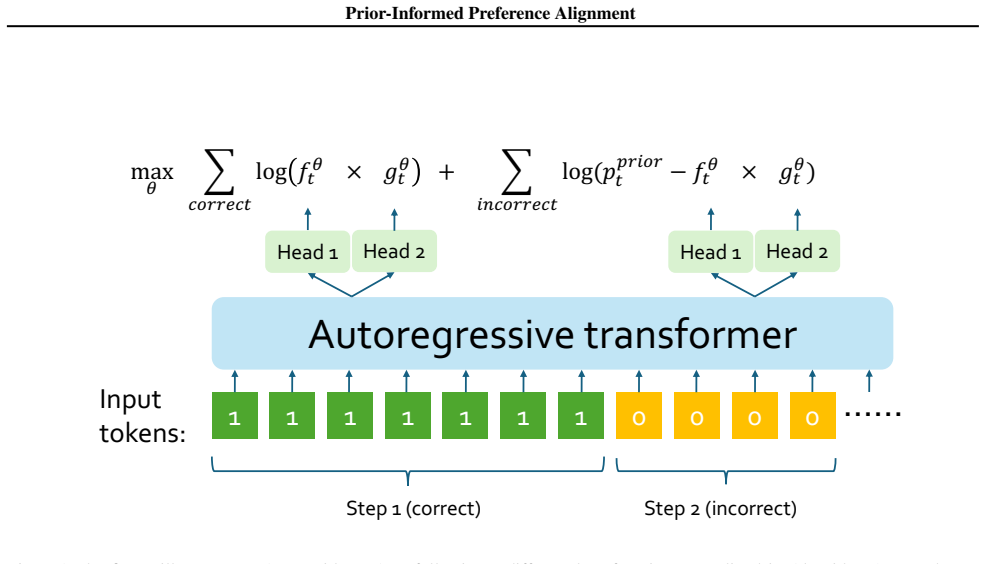
The load-bearing object is the prior-constrained MLE problem of Equation (1): $\max_\theta \mathbb{E}_{p_{\text{data}}} \log p_\theta(c \mid x, y)$ with $p_\theta$ restricted to a prior class. Substituting the Bayes expansion $p_\theta(c \mid x, y) = \frac{p_\theta(y \mid x,c)\,p_\theta(c \mid x)}{p_\theta(y \mid x)}$ and parameterizing the two numerator factors as $f_\theta$ and $g_\theta$ converts each constrained problem into an unconstrained token-level cross-entropy loss. PIPA-M fixes the denominator to the prior marginal; PIPA-N expands the denominator as $p_\theta(y \mid x,c=1)\,p_\theta(c=1 \mid x) + p_{\text{prior}}(y \mid x,c=0)\,p_\theta(c=0 \mid x)$ and fixes the negative term to the prior. This same ratio, applied autoregressively to $c_t$, is what extends both variants from answer-level labels to step-level labels and is what makes DPO and KTO visible as the same machine with different prior constraints.
What would settle it
A negative-control experiment would settle it: take the same training data and model, replace the prior with a deliberately misspecified one (for example, shuffle answer tokens or train the prior on only negative samples), and measure whether PIPA-M's reported gains over DPO and KTO survive. If they survive unchanged, the stated prior constraint is not the active mechanism; if they shrink in the predicted direction, the Bayesian interpretation is validated. The paper's own prior-retraining experiment in Table 3 is the closest existing version of this test and it failed to improve results, leaving the mechanism's empirical signature open.
Extended reading notes
Core claim
The paper's central claim is that offline preference alignment is a statistical estimation problem rather than a decision problem: the target is $p(y \mid x, c=1)$, and the correct estimator maximizes $\mathbb{E}_{p_{\text{data}}} \log p_\theta(c \mid x, y)$ subject to a prior constraint that couples positive and negative probabilities. Enforcing the constraint on the marginal $p_\theta(y \mid x)=p_{\text{prior}}(y \mid x)$ gives PIPA-M; enforcing it on the negative conditional $p_\theta(y \mid x,c=0)=p_{\text{prior}}(y \mid x,c=0)$ gives PIPA-N. Bayes' theorem turns both into direct losses over token-level probabilities $f_\theta(y_t \mid x,y_{<t})$ and step-value probabilities $g_\theta(x,y_{<t})=p_\theta(c_t=1 \mid x,y_{<t})$. The paper proves that DPO is exactly the paired-data special case with a balanced class prior, and KTO is the unpaired case with a KL-based class-ratio assumption, and it reports consistent benchmark gains using the same SFT model as the prior.
Load-bearing premise
The framework's optimality rests on the prior being a valid description of the data: PIPA-M needs $p_{\text{prior}}(y \mid x)$ to be the true marginal and PIPA-N needs $p_{\text{prior}}(y \mid x,c=0)$ to be the true negative distribution, yet the paper uses the SFT model as that prior and its own attempts to learn better priors did not help.
Editorial extensions
If this is right
- DPO and KTO become interchangeable parts of one estimator: their differences are now stated as prior and loss choices, so a practitioner can choose an alignment method by checking which prior assumption matches the data.
- PIPA-M and PIPA-N are plug-in losses: switching a pipeline from DPO or KTO to PIPA requires no new training stage, no paired data, and no extra compute, only a third frozen model that is already the standard SFT reference.
- The learned $g_\theta$ has a defined probabilistic meaning as the per-step correctness value $p_\theta(c_t=1 \mid x,y_{<t})$, so a PIPA-trained model ships with a value head that can be used for inference-time search.
- Step-level annotations, not just answer-level ones, can be consumed by the same loss, including in unpaired datasets; answer-level labels are recovered by setting all $c_t$ equal.
- The framework predicts that estimation quality depends on the prior: a prior closer to the true $p(y \mid x)$ or $p(y \mid x,c=0)$ should improve the estimate, so the paper's failed prior-retraining experiments in Section 3.3.1 are a direct test of the theory rather than a side note.
Reading between the lines
- We would extend the unification to token-level methods like RTO, TDPO, and OREO: each should be expressible as PIPA with a different per-token prior or loss, giving a principled way to compare them on prior quality rather than on algorithm family.
- A practical consequence the authors leave implicit is prior construction: since the SFT model is only a proxy for the true prior, learning $p_{\text{prior}}$ from a wider corpus or through iterative self-training could make the PIPA gains larger, which is a testable next step.
- If $g_\theta$ is well calibrated, PIPA provides a free process reward model: a direct experiment would be to use $g_\theta$ to score or guide beam search at test time and compare against the paper's current results.
- A causal check of the mechanism: corrupt the prior monotonically and track GSM8K accuracy; if gains persist under obvious misspecification, the improvement is driven by the loss shape, not by the Bayesian constraint.
Editorial analysis
A structured set of objections, weighed in public.
Referee Report
Summary. The paper proposes PIPA (Prior-Informed Preference Alignment), a unified probabilistic framework that reformulates offline preference alignment for language models as maximum likelihood estimation subject to prior constraints. The central theoretical contribution is that, under different prior constraints, the framework recovers DPO and KTO as special cases. Building on the framework, the authors propose two variants: PIPA-M, which enforces a prior on the marginal distribution p(y|x), and PIPA-N, which enforces a prior on the negative conditional distribution p(y|x,c=0). The method is extended to step-level annotations and evaluated on GSM8K and MATH with DeepSeek-Math-7B and Qwen2.5-Math-7B across paired/unpaired and answer/step-level configurations. The paper reports that both PIPA variants achieve a 3–10% performance improvement over baselines without additional training or computational cost.
Significance. If the framework's claims hold, the paper offers a useful conceptual unification: it gives a single Bayesian/MLE derivation from which DPO and KTO emerge under different priors, and it naturally extends to unpaired and step-level data. The derivations in Section 2 and Appendices A.1–A.2 appear internally consistent, and the DPO/KTO equivalence proofs are genuine equivalence arguments rather than post-hoc curve fits. The proposed loss functions are simple and carry no extra training overhead, and the value-model head is a reasonable addition. However, the empirical evidence is mixed and does not support the abstract's sweeping claim, and the theoretical optimality rests on an assumption about the prior that the experiments do not validate. The framework is a plausible lens for understanding existing algorithms, but its practical advantage needs more careful empirical support.
major comments (4)
- [Abstract and Table 1] The abstract's claim that 'Both algorithms demonstrate a 3~10% performance enhancement on the GSM8K and MATH benchmarks across all configurations' is directly contradicted by the paper's own Table 1. In the paired answer-wise Qwen setting, PIPA-N scores 70.89 on GSM8K, which is worse than IPO's 72.33, and 47.26 on MATH, which is worse than both DPO (47.78) and IPO (49.96). In the same setting, PIPA-M's GSM8K score of 73.77 versus IPO's 72.33 is a relative improvement of about 2.0%, below the stated 3% lower bound. These are not isolated edge cases; they are configurations explicitly covered by the 'across all configurations' wording. This is load-bearing because the empirical gain is a headline contribution. The claim should be revised to reflect the actual pattern of results, or additional evidence should be provided to support it.
- [Section 3.2 / Table 1] All results in Table 1 are reported as single numbers with no error bars, multiple seeds, or statistical significance tests. Given that many comparisons are close (e.g., PIPA-M 73.77 vs. IPO 72.33 on GSM8K paired answer-wise Qwen; PIPA-N 52.78 vs. 52.22 on unpaired step-wise Deepseek MATH), the reported gains could be within run-to-run variance. The paper should report results over multiple seeds and provide confidence intervals or a significance test, especially for the quantitative claim in the abstract. Without this, the practical advantage of PIPA over existing methods is not established.
- [Section 2.2 and Section 3.3.1] The statistical optimality claim for PIPA-M and PIPA-N is conditional on the prior constraints pθ(y|x)=pprior(y|x) and pθ(y|x,c=0)=pprior(y|x) being correct descriptions of the data. In the experiments, pprior is the SFT model f0, which the authors themselves acknowledge is not the ideal prior (Section 3.3.1). Their attempt to train better priors and use them as pprior did not improve results (Table 3), meaning the empirical gains are obtained under a prior that is not the true one. Consequently, the experiments do not validate the theoretical optimality; the gains may stem from other properties of the loss. The paper should either provide evidence that the SFT model is a sufficiently accurate prior for the theoretical claim, or explicitly frame the theoretical result as conditional and the experiments as a heuristic instantiation.
- [Appendix B and Section 3.1] The baseline labeled 'Step-KTO' in Table 1 is not the original Step-KTO loss. Appendix B states that the original Step-KTO loss 'does not improve performance' and then proposes a modified loss L1, which is used in the experiments. The main text says 'we extract only their loss functions' for a fair comparison, but the Step-KTO row reports a variant, not the published algorithm. This is a fairness issue: the comparison may be favorable to PIPA. The authors should either run the original Step-KTO loss and report its results, or clearly label in Table 1 and the main text that the Step-KTO baseline is a modified version proposed in the paper.
minor comments (8)
- [Abstract] The abstract contains a typo: 'Pior-Informed' should be 'Prior-Informed'.
- [Section 2.2] The notation 'pθ ∈ PriorInfo' is informal; it would be clearer to write 'pθ satisfies the prior constraint' or define the constraint set explicitly.
- [Section 2.3] There is a typo: 'it may not be of suprise' should be 'it may not be a surprise'.
- [Section 3.1] The phrase 'we do grid search' should be 'we perform a grid search'.
- [Figure 5] The axis label in Figure 5 contains a typo: 'Thereshold' should be 'Threshold'.
- [Algorithm 1 / Section 2.6] The clipping operation for PIPA-M negative samples is described only vaguely ('we apply a clipping function'); the exact clipping range and where it is applied should be specified in Algorithm 1 or the text.
- [Appendix A.1] The notation '1{c=1}' is used without definition; it should be stated that it is the indicator function.
- [Appendix A.2.1] The claim that 'PIPA remains faster in practice' is not supported by any runtime measurement; if this is a comparison with KTO, a timing table or statement about measurements would be appropriate.
Circularity Check
No circularity found: PIPA's losses follow from explicitly stated prior constraints via Bayes' rule, and the DPO/KTO equivalences are algebraic reductions rather than fitted predictions.
full rationale
I walked the derivation chain of the paper. The central framework (Equation 1) is a constrained MLE problem, and PIPA-M (Equation 2 with constraint pθ(y|x)=pprior) and PIPA-N (Equation 7 with constraint pθ(y|x,c=0)=pprior) are derived by applying Bayes' rule to pθ(c|x,y) with the stated parameterizations fθ and gθ. The resulting losses are the MLE objectives themselves; no fitted parameter is renamed as a prediction, and no external benchmark number is claimed to follow from the framework. The DPO and KTO special-case claims (Theorems A.1 and A.2) are explicit algebraic rewritings of the respective losses under the stated constraints; they are self-contained derivations, not assumptions smuggled in via self-citation. There is no load-bearing uniqueness theorem from prior work by these authors, and the only unusual citation, 'Anonymous (2025)' in Appendix B, is used merely to attribute the L0 masking loss, which the experiments do not adopt; it is not a premise of the framework. Empirical improvements in Table 1 are measured results, not predictions derived from the framework, and the openly reported grid search over learning rate is standard hyperparameter tuning, not a fitted input masquerading as a prediction. The paper's own limitations, such as the failed attempt to train better priors (Table 3) and the model-dependent performance of PIPA-M versus PIPA-N, are correctness and robustness caveats, not circularity. The abstract's claim of '3~10% performance enhancement across all configurations' is overstated relative to Table 1 for some Qwen paired rows, but this is an empirical consistency issue for the correctness pass, not a reduction of the central claim to its own inputs.
Assumptions & free parameters
free parameters (2)
- Positive-step threshold τ =
0.5 (default; ablated over [0,1])
- Learning rate lr =
Grid-searched over {5e-7, 5e-6, 5e-5}; best per method/model reported
assumptions (3)
- ad hoc to paper The SFT model f0 is a valid prior for p(y|x) (PIPA-M) or p(y|x,c=0) (PIPA-N).
- domain assumption Token-level conditional independence: ct is independent of y>t and c<t given (x,y≤t).
- domain assumption Balanced class prior p(c=1|x)=0.5 for the DPO equivalence.
Cite this review
Pith. "Pith review of PIPA: Preference Alignment as Prior-Informed Statistical Estimation." pith.science (2026). https://pith.science/paper/OV4WD5Q7
@misc{pith2026250205773,
  author       = {Pith},
  title        = {Pith review of: PIPA: Preference Alignment as Prior-Informed Statistical Estimation},
  year         = {2026},
  howpublished = {\url{https://pith.science/paper/OV4WD5Q7}},
  note         = {Machine review of arXiv:2502.05773}
}
abstract
Offline preference alignment for language models such as Direct Preference Optimization (DPO) is favored for its effectiveness and simplicity, eliminating the need for costly reinforcement learning. Various offline algorithms have been developed for different data settings, yet they lack a unified understanding. In this study, we introduce Pior-Informed Preference Alignment (PIPA), a unified, RL-free probabilistic framework that formulates language model preference alignment as a Maximum Likelihood Estimation (MLE) problem with prior constraints. This method effectively accommodates both paired and unpaired data, as well as answer and step-level annotations. We illustrate that DPO and KTO are special cases with different prior constraints within our framework. By integrating different types of prior information, we developed two variations of PIPA: PIPA-M and PIPA-N. Both algorithms demonstrate a $3\sim10\%$ performance enhancement on the GSM8K and MATH benchmarks across all configurations, achieving these gains without additional training or computational costs compared to existing algorithms.
Figures


Figures from the paper (2 more)


Reference graph
Works this paper leans on
-
[1]
T., Hertweck, T., Joshi, R., Oh, J., Bloesch, M., Lampe, T., Heess, N., et al
Abdolmaleki, A., Piot, B., Shahriari, B., Springenberg, J. T., Hertweck, T., Joshi, R., Oh, J., Bloesch, M., Lampe, T., Heess, N., et al. Preference optimization as probabilistic inference. arXiv preprint arXiv:2410.04166,
-
[4]
Alphamath almost zero: process supervision without process
Chen, G., Liao, M., Li, C., and Fan, K. Alphamath almost zero: process supervision without process. arXiv preprint arXiv:2405.03553, 2024a. Chen, G., Liao, M., Li, C., and Fan, K. Step-level value pref- erence optimization for mathematical reasoning. arXiv preprint arXiv:2406.10858, 2024b. Cobbe, K., Kosaraju, V ., Bavarian, M., Chen, M., Jun, H., Kaiser,...
-
[6]
Dubey, A., Jauhri, A., Pandey, A., Kadian, A., Al-Dahle, A., Letman, A., Mathur, A., Schelten, A., Yang, A., Fan, A., et al. The llama 3 herd of models. arXiv preprint arXiv:2407.21783,
-
[7]
Dumoulin, V ., Johnson, D. D., Castro, P. S., Larochelle, H., and Dauphin, Y . A density estimation perspective on learning from pairwise human preferences.arXiv preprint arXiv:2311.14115,
-
[8]
Kto: Model alignment as prospect theoretic optimization
Ethayarajh, K., Xu, W., Muennighoff, N., Jurafsky, D., and Kiela, D. Kto: Model alignment as prospect theoretic optimization. arXiv preprint arXiv:2402.01306,
-
[9]
Tora: A tool-integrated reasoning agent for mathematical problem solving
Gou, Z., Shao, Z., Gong, Y ., Shen, Y ., Yang, Y ., Huang, M., Duan, N., and Chen, W. Tora: A tool-integrated reasoning agent for mathematical problem solving. arXiv preprint arXiv:2309.17452,
-
[10]
L., Liu, Y ., Shang, N., Sun, Y ., Zhu, Y ., Yang, F., and Yang, M
Guan, X., Zhang, L. L., Liu, Y ., Shang, N., Sun, Y ., Zhu, Y ., Yang, F., and Yang, M. rstar-math: Small llms can master math reasoning with self-evolved deep thinking. arXiv preprint arXiv:2501.04519,
-
[12]
Measuring math- ematical problem solving with the math dataset
Hendrycks, D., Burns, C., Kadavath, S., Arora, A., Basart, S., Tang, E., Song, D., and Steinhardt, J. Measuring math- ematical problem solving with the math dataset. arXiv preprint arXiv:2103.03874,
Show all 35 references
-
[13]
J., Shen, Y ., Wallis, P., Allen-Zhu, Z., Li, Y ., Wang, S., Wang, L., and Chen, W
Hu, E. J., Shen, Y ., Wallis, P., Allen-Zhu, Z., Li, Y ., Wang, S., Wang, L., and Chen, W. Lora: Low-rank adaptation of large language models. arXiv preprint arXiv:2106.09685,
-
[14]
Openrlhf: An easy-to-use, scalable and high-performance rlhf framework
Hu, J., Wu, X., Zhu, Z., Xianyu, Wang, W., Zhang, D., and Cao, Y . Openrlhf: An easy-to-use, scalable and high-performance rlhf framework. arXiv preprint arXiv:2405.11143,
-
[15]
A distri- butional approach to controlled text generation
Khalifa, M., Elsahar, H., and Dymetman, M. A distri- butional approach to controlled text generation. arXiv preprint arXiv:2012.11635,
2012 arXiv
-
[17]
Let’s verify step by step
Lightman, H., Kosaraju, V ., Burda, Y ., Edwards, H., Baker, B., Lee, T., Leike, J., Schulman, J., Sutskever, I., and Cobbe, K. Let’s verify step by step. arXiv preprint arXiv:2305.20050,
-
[18]
Step-kto: Optimizing mathematical reasoning through stepwise bi- nary feedback
Lin, Y .-T., Jin, D., Xu, T., Wu, T., Sukhbaatar, S., Zhu, C., He, Y ., Chen, Y .-N., Weston, J., Tian, Y ., et al. Step-kto: Optimizing mathematical reasoning through stepwise bi- nary feedback. arXiv preprint arXiv:2501.10799,
-
[19]
M., Liu, X., Wen, L., et al
Liu, A., Bai, H., Lu, Z., Sun, Y ., Kong, X., Wang, S., Shan, J., Jose, A. M., Liu, X., Wen, L., et al. Tis- dpo: Token-level importance sampling for direct prefer- ence optimization with estimated weights. arXiv preprint arXiv:2410.04350, 2024a. Liu, A., Feng, B., Xue, B., Wa...
-
[20]
Simpo: Simple preference optimization with a reference-free reward
Meng, Y ., Xia, M., and Chen, D. Simpo: Simple preference optimization with a reference-free reward. arXiv preprint arXiv:2405.14734,
-
[21]
Pandey, G., Nandwani, Y ., Naseem, T., Mishra, M., Xu, G., Raghu, D., Joshi, S., Munawar, A., and Astudillo, R. F. Brain: Bayesian reward-conditioned amortized inference for natural language generation from feedback. arXiv preprint arXiv:2402.02479,
-
[22]
Y ., Yuan, W., Cho, K., He, H., Sukhbaatar, S., and Weston, J
Pang, R. Y ., Yuan, W., Cho, K., He, H., Sukhbaatar, S., and Weston, J. Iterative reasoning preference optimization. arXiv preprint arXiv:2404.19733,
-
[23]
Distri- butional reinforcement learning for energy-based sequen- tial models
Parshakova, T., Andreoli, J.-M., and Dymetman, M. Distri- butional reinforcement learning for energy-based sequen- tial models. arXiv preprint arXiv:1912.08517,
1912 arXiv
-
[25]
Unintentional unalignment: Likelihood displacement in direct preference optimization
Razin, N., Malladi, S., Bhaskar, A., Chen, D., Arora, S., and Hanin, B. Unintentional unalignment: Likelihood displacement in direct preference optimization. arXiv preprint arXiv:2410.08847,
-
[26]
Proximal policy optimization algorithms
Schulman, J., Wolski, F., Dhariwal, P., Radford, A., and Klimov, O. Proximal policy optimization algorithms. arXiv preprint arXiv:1707.06347,
-
[28]
D., Zheng, Z., Calandriello, D., Munos, R., Rowland, M., Richemond, P
Tang, Y ., Guo, Z. D., Zheng, Z., Calandriello, D., Munos, R., Rowland, M., Richemond, P. H., Valko, M., Pires, B. ´A., and Piot, B. Generalized preference optimization: A unified approach to offline alignment. arXiv preprint arXiv:2402.05749,
-
[29]
Offline reinforcement learning for llm multi-step reasoning
Wang, H., Hao, S., Dong, H., Zhang, S., Bao, Y ., Yang, Z., and Wu, Y . Offline reinforcement learning for llm multi-step reasoning. arXiv preprint arXiv:2412.16145,
-
[30]
Yang, A., Zhang, B., Hui, B., Gao, B., Yu, B., Li, C., Liu, D., Tu, J., Zhou, J., Lin, J., et al. Qwen2. 5-math techni- cal report: Toward mathematical expert model via self- improvement. arXiv preprint arXiv:2409.12122,
-
[31]
Token-level direct preference optimization
Zeng, Y ., Liu, G., Ma, W., Yang, N., Zhang, H., and Wang, J. Token-level direct preference optimization. arXiv preprint arXiv:2404.11999,
-
[32]
Mario eval: Evaluate your math llm with your math llm–a mathematical dataset evaluation toolkit, 2024a
Zhang, B., Li, C., and Fan, K. Mario eval: Evaluate your math llm with your math llm–a mathematical dataset evaluation toolkit, 2024a. Zhang, D., Zhoubian, S., Hu, Z., Yue, Y ., Dong, Y ., and Tang, J. Rest-mcts*: Llm self-training via process reward guided tree search. arXiv ...
-
[33]
Dpo meets ppo: Reinforced token optimization for rlhf
Zhong, H., Feng, G., Xiong, W., Cheng, X., Zhao, L., He, D., Bian, J., and Wang, L. Dpo meets ppo: Reinforced token optimization for rlhf. arXiv preprint arXiv:2404.18922,
-
[34]
Deepseek-coder- v2: Breaking the barrier of closed-source models in code intelligence
Zhu, Q., Guo, D., Shao, Z., Yang, D., Wang, P., Xu, R., Wu, Y ., Li, Y ., Gao, H., Ma, S., et al. Deepseek-coder- v2: Breaking the barrier of closed-source models in code intelligence. arXiv preprint arXiv:2406.11931,
-
[35]
Treating the sequences as a whole, the original DPO loss is given by LDPO(x, y+, y−, c+, c−) =− log σ X t rt(x, y+) − X t rt(x, y−) !
pprior(yt | x, y<t) . Treating the sequences as a whole, the original DPO loss is given by LDPO(x, y+, y−, c+, c−) =− log σ X t rt(x, y+) − X t rt(x, y−) ! . Given that the positive steps in y− can negatively impact model performance if minimized, a straightforward approach wh...
2025
-
[2017]
Deepseekmath: Push- ing the limits of mathematical reasoning in open language models
Shao, Z., Wang, P., Zhu, Q., Xu, R., Song, J., Bi, X., Zhang, H., Zhang, M., Li, Y ., Wu, Y ., et al. Deepseekmath: Push- ing the limits of mathematical reasoning in open language models. arXiv preprint arXiv:2402.03300,
-
[2019]
Ui-tars: Pioneer- ing automated gui interaction with native agents
Qin, Y ., Ye, Y ., Fang, J., Wang, H., Liang, S., Tian, S., Zhang, J., Li, J., Li, Y ., Huang, S., et al. Ui-tars: Pioneer- ing automated gui interaction with native agents. arXiv preprint arXiv:2501.12326,
-
[2021]
Rlhf workflow: From reward modeling to online rlhf
Dong, H., Xiong, W., Pang, B., Wang, H., Zhao, H., Zhou, Y ., Jiang, N., Sahoo, D., Xiong, C., and Zhang, T. Rlhf workflow: From reward modeling to online rlhf. arXiv preprint arXiv:2405.07863,
-
[2022]
Step-dpo: Step-wise preference optimiza- tion for long-chain reasoning of llms
Lai, X., Tian, Z., Chen, Y ., Yang, S., Peng, X., and Jia, J. Step-dpo: Step-wise preference optimiza- tion for long-chain reasoning of llms. arXiv preprint arXiv:2406.18629,
-
[2023]
Back to basics: Revisiting reinforce style optimization for 9 Prior-Informed Preference Alignment learning from human feedback in llms
Ahmadian, A., Cremer, C., Gall´e, M., Fadaee, M., Kreutzer, J., Pietquin, O., ¨Ust¨un, A., and Hooker, S. Back to basics: Revisiting reinforce style optimization for 9 Prior-Informed Preference Alignment learning from human feedback in llms. arXiv preprint arXiv:2402.14740,
-
[2024]
L., Almeida, D., Altenschmidt, J., Altman, S., Anadkat, S., et al
Achiam, J., Adler, S., Agarwal, S., Ahmad, L., Akkaya, I., Aleman, F. L., Almeida, D., Altenschmidt, J., Altman, S., Anadkat, S., et al. Gpt-4 technical report. arXiv preprint arXiv:2303.08774,
-
[2025]
Deepseek-r1: In- centivizing reasoning capability in llms via reinforcement learning
Guo, D., Yang, D., Zhang, H., Song, J., Zhang, R., Xu, R., Zhu, Q., Ma, S., Wang, P., Bi, X., et al. Deepseek-r1: In- centivizing reasoning capability in llms via reinforcement learning. arXiv preprint arXiv:2501.12948,
Reviewed August 8, 2026 · model on record in the stance chip above.
Discussion (0). Continue with ORCID to comment.