REVIEW 3 major objections 5 minor 3 references
Achieving electrode smoothing by controlling the nucleation phase of metal deposition through polymer-substrate binding
T0 review · 3 major / 5 minor · reviewed 2026-08-08 · deepseek-v4-flash
Pith's one-line read This paper claims that PEO, a common polymer additive, smooths zinc electrodeposits on copper by adsorbing on the copper substrate and biasing nucleation toward flat-lying (002)-oriented zinc platelets, not by binding to zinc ions or to…
desk verdict The paper has a genuinely visible result—PEO flips Zn platelet orientation on Cu—but it overreaches by asserting PEO does not interact with growing Zn, a claim built on oxidized, potential-free surfaces rather than metallic Zn under deposition conditions. read the letter →
The pith
A machine-rendered reading of the paper's core claim, the machinery that carries it, and where it could break.
The reading
What carries the argument
The load-bearing object is the pair of interfaces $\mathrm{Cu}(111)/\mathrm{Zn}(002)$ and $\mathrm{Cu}(111)/\mathrm{Zn}(100)$ in water versus a PEO-saturated environment; DFT computes their relative interfacial energies and shows the solvent reverses which orientation is stable. The kinetic side is carried by the $\mathrm{Zn}^{2+}$ potential of mean force from classical DFT, computed with the adsorbed polymer modeled as a uniform, ion-permeable film of dielectric constant 2, which yields a $\sim0.8$ eV barrier and a depletion zone for $\mathrm{Zn}^{2+}$ near the electrode. Together these two calculations connect the observed platelet orientation bias to a thermodynamic preference plus a shift from reaction-limited to diffusion-limited electrodeposition.
What would settle it
Measure the dielectric constant, thickness, and ion permeability of the PEO layer adsorbed on copper in 0.1 M ZnSO4 using in-situ ellipsometry or neutron reflectometry, then recompute the $\mathrm{Zn}^{2+}$ potential of mean force with the measured film properties; if the barrier is far below 0.8 eV or the PEO environment no longer stabilizes $\mathrm{Cu}(111)/\mathrm{Zn}(002)$ over $\mathrm{Cu}(111)/\mathrm{Zn}(100)$, the proposed mechanism is falsified even if PEO still changes the platelet orientation distribution.
Extended reading notes
Core claim
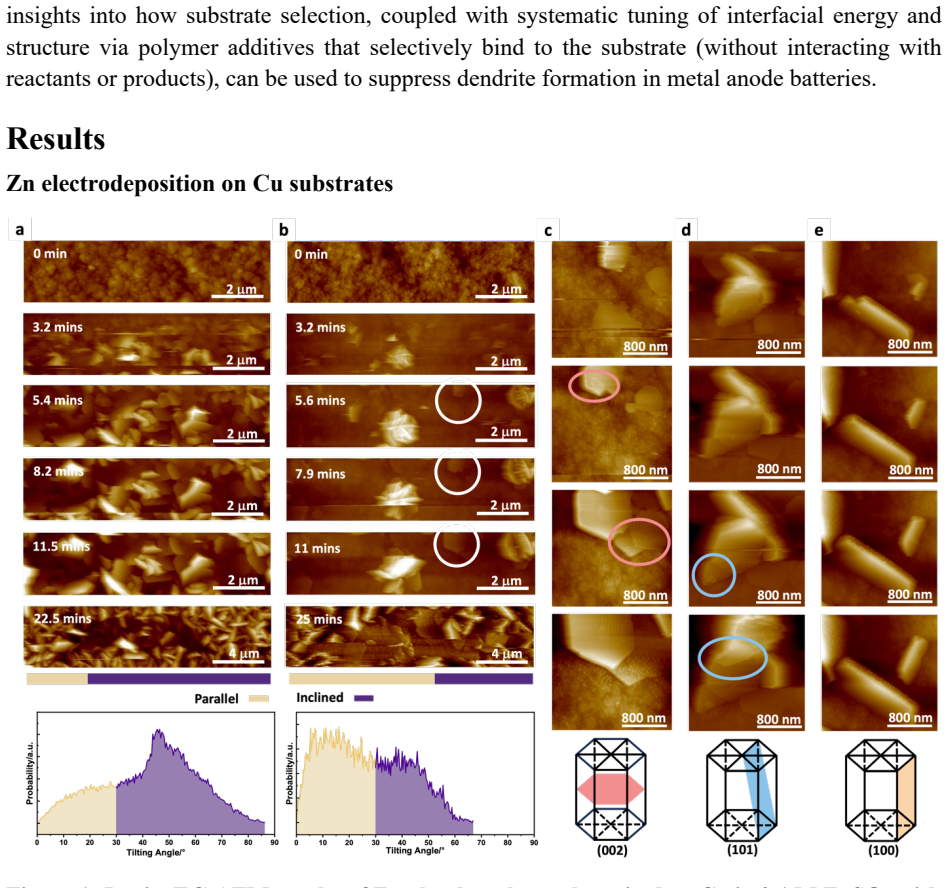
The central claim is that PEO does not regulate zinc morphology by adsorbing on zinc crystal faces or by complexing $\mathrm{Zn}^{2+}$ ions, as earlier studies assumed; it adsorbs selectively on the copper substrate and alters the interfacial energy landscape for nucleation. The experimental evidence shows the first zinc layer determines all subsequent layer-by-layer growth, and that PEO biases this first layer toward $\mathrm{Zn}(002)$ platelets lying parallel to the substrate. EBSD and SEM show no correlation between zinc plate orientation and the crystallographic orientation of the underlying copper grains, ruling out facet-selective polymer adsorption as the cause. DFT places the energy difference $\Delta E = E[\mathrm{Cu}(111)/\mathrm{Zn}(100)] - E[\mathrm{Cu}(111)/\mathrm{Zn}(002)]$ at $-369.9$ kJ/mol in water (favoring vertical $\mathrm{Zn}(100)$) and $+294.2$ kJ/mol in a PEO (diethylene glycol) environment (favoring flat $\mathrm{Zn}(002)$). Combined with cDFT simulations of a low-dielectric polymer film that raises the $\mathrm{Zn}^{2+}$ potential of mean force by about $0.8$ eV, the paper concludes that PEO both thermodynamically stabilizes flat-lying nuclei and kinetically confines deposition to the near-surface region, producing a smooth film by template-controlled Frank–van der Merwe growth.
Load-bearing premise
The load-bearing premise is that the computational representation of PEO—small diethylene glycol molecules standing in for the polymer and a uniform low-dielectric film with dielectric constant 2—faithfully captures how real PEO behaves at the copper–electrolyte interface; if real PEO forms a diffuse or high-dielectric layer, the calculated energy reversal and the 0.8 eV kinetic barrier would not apply.
Editorial extensions
If this is right
- If the mechanism is right, any polymer that binds the current collector more strongly than the deposited metal should be able to flatten electrodeposits, not just PEO on copper.
- The first nucleated layer controls the texture of the whole film, so additives only need to act during nucleation; they can desorb as the metal grows.
- The model predicts that raising current density or lowering $\mathrm{ZnSO}_4$ concentration, which pushes the system toward diffusion-limited deposition, should increase the fraction of flat-lying $\mathrm{Zn}(002)$ plates.
- In aqueous zinc batteries, the smoothing effect of PEO should appear primarily at the early deposition stage on the substrate, not during steady stripping/plating on an established zinc surface.
- The proposed design rule could be used to screen polymer additives for other metal-anode chemistries by measuring polymer–substrate adhesion and computing the interfacial energy reversal for the target metal.
Reading between the lines
- A testable extension would be to measure the dielectric constant and thickness of the adsorbed PEO layer on copper in working electrolyte; if the film is not compact and low-dielectric, the calculated 0.8 eV barrier is an artifact even though the orientation bias could still be real.
- The same substrate-binding logic suggests a synthetic target: polymers with ether or other coordinating groups that bind oxidizable current collectors but not the depositing metal may generalize the effect to lithium, sodium, or calcium anodes.
- Because the paper models PEO by small diethylene glycol molecules, the claim would be stronger if the energy reversal were reproduced with explicit longer-chain polymer conformations on the Cu surface.
- One could also probe the nucleation-bias claim directly by depositing zinc on PEO-patterned copper, where flat platelets should appear preferentially on PEO-covered regions if the mechanism is correct.
Signed reviews
Editorial analysis
A structured set of objections, weighed in public.
Referee Report
Summary. The paper investigates the mechanism by which the polymer additive PEO smooths Zn electrodeposition on Cu substrates. Using in-situ electrochemical atomic force microscopy (EC-AFM), the authors report that 0.1 wt% PEO shifts the orientation distribution of Zn platelets from predominantly inclined/vertical to predominantly flat-lying (002)-oriented, changing the stated ratio of (002)-oriented to (101)- and (100)-oriented plates from 1:3 to 3:2, while leaving platelet sizes and aspect ratios similar. Complementary adhesion-force mapping, PiFM, and contact-angle measurements are used to show that PEO adsorbs on Cu but not on oxidized Zn surfaces. DFT calculations, using diethylene glycol (DEG) as a proxy for PEO, predict that PEO reverses the interfacial energy preference from Cu/Zn(100) in water (ΔE = -369.9 kJ/mol) to Cu/Zn(002) in PEO (ΔE = +294.2 kJ/mol), and coupled PNP/cDFT simulations, modeling the polymer as a uniform dielectric film (ε = 2), predict a 0.8 eV Zn2+ potential-of-mean-force barrier that shifts deposition to a diffusion-limited regime. The authors propose a design principle: polymer additives with strong substrate binding but minimal interaction with the growing metal can smooth electrodes by controlling the nucleation orientation.
Significance. The paper addresses a long-standing question in aqueous Zn batteries and provides a novel, testable design principle: substrate-selective polymer adsorption controls the nucleation orientation of electrodeposited metal, rather than the commonly assumed ion-binding or growing-crystal-binding mechanisms. The experimental work is extensive and includes multiple independent probes of PEO adsorption (CFFM, PiFM, contact angle), in-situ EC-AFM observation, and careful controls excluding side reactions, oxygen effects, pH-induced precipitation, and Cu grain-orientation effects. If the central claims are confirmed, the study would be a valuable contribution to understanding and designing dendrite-suppressing additives. However, the central quantitative claim (the 1:3 to 3:2 orientation-ratio shift) is presented without plate counts or error bars; the computational mechanism rests on strong, untested simplifications (DEG for PEO and a uniform ε = 2 film); and the claim that PEO does not interact with growing Zn is inferred exclusively from experiments on oxidized Zn surfaces after potential removal, not on metallic Zn under cathodic potential.
major comments (3)
- [Zn oxidation and PEO adsorption on Zn (Fig. 3, Fig. S18, S19)] The negative half of the central claim — that 'PEO adsorption does not influence Zn electrodeposition' (final paragraph of this section) — is derived entirely from experiments performed after the deposition potential was removed, where the Zn surface spontaneously oxidizes to Zn(OH)2 or ZHS. The manuscript itself states that 'PEO adsorption on the Zn surface cannot outcompete the natural and spontaneous oxidation of the Zn surface,' but this says nothing about adsorption on metallic Zn under a cathodic potential, where the surface is being actively reduced. The proposed design principle requires that PEO have 'minimal interaction with growing crystals'; if PEO adsorbs on metallic Zn facets under potential, the observed orientation bias could instead arise from facet-specific Zn–PEO interactions rather than PEO–Cu substrate binding. This is a load-bearing point, and it needs to be probed under electrodeposition conditions — for example, by measuring adhesion or mass changes on a Zn electrode held at deposition potential (e.g., EC-AFM-based force mapping on a Zn single crystal or electrochemical quartz crystal microbalance), or by studying PEO adsorption on Zn single-crystal surfaces at controlled potential.
- [Mechanism by which PEO biases the nucleation orientations (Table 1, Fig. 4c)] The computational mechanism rests on two strong representational choices: DFT replaces high-molecular-weight PEO with 14 diethylene glycol (DEG) molecules, and cDFT models the adsorbed polymer as a uniform, ion-permeable film with a dielectric constant of 2. The reversal of the interfacial-energy preference (ΔE from -369.9 to +294.2 kJ/mol in Table 1) and the 0.8 eV Zn2+ PMF barrier in Fig. 4c both depend on these choices, yet the paper does not report sensitivity tests to the number of DEG molecules, the polymer conformation, or the film dielectric constant (bulk hydrated PEO has a substantially higher dielectric response than 2). Without such sensitivity analysis, the simulations cannot be said to quantitatively confirm the experimental observations; they should be presented as qualitative support, or the model should be calibrated against a measured property of the adsorbed PEO film (for example, an ellipsometric or capacitive estimate of the film's dielectric constant and thickness).
- [Results: Zn electrodeposition on Cu substrates (Fig. 1a, b)] The central experimental quantitative claim is that the ratio of Zn(002)-oriented to Zn(101)- and Zn(100)-oriented plates 'increases from 1:3 before adding PEO to 3:2 after,' but the paper does not report the number of plates counted, error bars, or the statistical treatment used to assign the <30° vs. >30° tilt threshold across the image series. The histograms in Fig. 1a and 1b lack count labels, so the reader cannot judge the robustness of the orientation shift. Because this orientation-ratio change is the empirical foundation for the entire proposed mechanism, the authors should provide plate counts, per-image statistics, and a reproducibility statement from at least three independent electrodeposition experiments, along with a precise definition of how the 30° threshold maps to the (002), (101), and (100) orientation classes.
minor comments (5)
- [Mechanism by which PEO biases the nucleation orientations] The sentence 'Thermodynamic preference of certain orientations of the growing particles is not necessarily insufficient to understand the interfacial processes occurring during electrodeposition' contains a double negative and should be rephrased to state the intended logic clearly.
- [Abstract and Results] The 'parallel-to-inclined ratio' mentioned in the abstract and the 'ratio of Zn(002)-oriented to Zn(101)- and Zn(100)-oriented' mentioned in the text are not obviously the same quantity; please define both consistently and explain how the 30° threshold separates the three crystallographic classes.
- [Mechanism by which PEO biases the nucleation orientations] In the sentence referring to Fig. S22, 'Reducing the diffusion rate by lowering ZnSO4 concentration shifts electrodeposition toward a diffusion-limited process, leading to Zn plates with a bigger parallel-to-inclined ratio,' please clarify whether the same statistical analysis protocol as in Fig. 1 was applied to the lower-concentration data.
- [Zn oxidation and PEO adsorption on Zn (Fig. 3j)] The statement that 'the average adhesion force in 0.1 M ZnSO4 increased by roughly 0.1 nN upon addition of 0.1 wt% PEO' may be below the noise floor of the force-curve measurements; please report the force resolution and the statistical significance of this difference.
- [Supplementary Fig. S20 caption] The caption states 'The energy per surface atom is 1.2 times lower for (100) orientation than that for (002) plate,' which is ambiguous; please report the actual computed energy values.
Circularity Check
No circularity: the DFT and cDFT predictions are independent of the measured orientation statistics, and the only self-citation is motivational rather than load-bearing.
full rationale
The derivation chain is self-contained and no circular step is exhibited. The experimental claim rests on EC-AFM statistical analysis, where the ratio of Zn(002)-oriented to Zn(101)- and Zn(100)-oriented plates changes from 1:3 to 3:2; these measured counts are not used as fit targets in the simulations. DFT independently computes Cu(111)/Zn(100) versus Cu(111)/Zn(002) interfacial energies in H2O and DEG environments, giving a sign change in ΔE (Table 1: −369.9 kJ/mol in H2O, +294.2 kJ/mol in PEO/DEG); this is a calculation from relaxed slab structures, not a construction designed to reproduce the AFM ratio. cDFT models adsorbed PEO as a uniform low-dielectric film with ε = 2 and derives a 0.8 eV Zn2+ PMF barrier and a near-surface depletion zone. Although the ε = 2 film is an assumed modeling input rather than a measured or fitted parameter, the PMF barrier is an emergent output of the model, and the paper does not claim that ε was tuned to the observed smoothing. The only self-citation (ref [20], from the same group) is used to motivate PEO as a performance-enhancing additive and to provide cycling data in Fig. S1; the central mechanism—PEO binding to the Cu substrate and biasing nucleation orientation—does not reduce to that citation. The oxidized-Zn experiments address PEO adsorption on Zn(OH)2 and ZHS surfaces after removal of the reducing potential; whether that supports the claim about metallic Zn under cathodic potential is a scope/validity question, not a circularity. No fitted-input-called-prediction, ansatz-smuggled-via-citation, uniqueness-imported-from-authors, or renaming-of-known-result pattern is present.
Assumptions & free parameters
free parameters (3)
- PEO film dielectric constant in cDFT =
2
- DEG molecule count in DFT cell =
14
- Water molecule count in DFT solvation =
74
assumptions (6)
- domain assumption LDA DFT with Gamma-point sampling gives reliable relative interfacial energies for Cu/Zn facet contacts.
- domain assumption The cDFT free energy functional (FMT, MSA, Lifshitz, square-well ion interactions) captures Zn2+ potentials of mean force at the electrified interface.
- domain assumption The thermodynamically preferred Zn facet at the Cu interface dictates the observed nucleation orientation distribution.
- domain assumption PEO adsorption behavior measured on Zn foil after surface oxidation and reorganization represents PEO interaction with growing Zn under applied potential.
- ad hoc to paper High-MW PEO can be represented by DEG molecules in DFT and by a uniform epsilon=2 film in cDFT.
- ad hoc to paper The adsorbed PEO layer is ion-permeable in the cDFT model.
Cite this review
Pith. "Pith review of Achieving electrode smoothing by controlling the nucleation phase of metal deposition through polymer-substrate binding." pith.science (2026). https://pith.science/paper/E5AOMXVB
@misc{pith2026250205809,
  author       = {Pith},
  title        = {Pith review of: Achieving electrode smoothing by controlling the nucleation phase of metal deposition through polymer-substrate binding},
  year         = {2026},
  howpublished = {\url{https://pith.science/paper/E5AOMXVB}},
  note         = {Machine review of arXiv:2502.05809}
}
read the original abstract
Polymer additives [like polyethylene oxide (PEO)] are widely used for smooth electrode deposition in aqueous zinc and a number of other battery systems currently investigated for energy storage applications. However, the precise mechanism by which they regulate morphology and suppress dendrite formation remains unclear. In this study, we address this knowledge gap by using in-situ electrochemical atomic force microscopy (EC-AFM) to directly observe the interfacial evolution during Zn electrodeposition and polymer adsorption on copper (Cu) substrates in the presence of varying concentrations of ZnSO4 and PEO. Contrary to previous literature assumptions which emphasize the binding to the growing Zn crystal surfaces or Zn2+ ions, our results demonstrate that PEO smooths Zn films by promoting nucleation of (002)-oriented Zn platelets through interactions with the Cu substrate. Density functional theory (DFT) simulations support this finding by showing that PEO adsorption on Cu modifies the interfacial energy of Zn/Cu/electrolyte interfaces, favoring the stabilization of Zn (002) on the Cu substrate, as well as confines Zn electrodeposition to a narrow near-surface region. These findings elucidate a novel design principle for electrode smoothing, emphasizing the importance of substrate selection paired with polymer additives that exhibit an attractive interaction with the substrate, but minimal interaction with growing crystals, offering a mechanistic perspective for improved battery performance.
Figures

Reference graph
Works this paper leans on
-
[3]
D. R. Hamann, Phys. Rev. B 1989, 40, 2980–2987. [8] N. Troullier, J. L. Martins, Phys. Rev. B 1991, 43, 1993–2006. [9] L. Kleinman, D. M. Bylander, Phys. Rev. Lett. 1982, 48, 1425–1428. [10] D. Meng, G. Lin, M. L. Sushko, MRS Online Proceedings Library 2012, 1470, 1–5. [11] D. Meng, B. Zheng, G. Lin, M. L. Sushko, Communications in Computational Physics 2...
work page 1989
-
[7]
H. Pan, Y . Shao, P. Yan, Y . Cheng, K. S. Han, Z. Nie, C. Wang, J. Yang, X. Li, P. Bhattacharya, K. T. Mueller, J. Liu, Nature Energy 2016, 1, 16039. [8] X. Yuan, B. Liu, M. Mecklenburg, Y . Li, Nature 2023, 620, 86–91. [9] J. Xiao, Science 2019, 366, 426–427. [10] T. P. Moffat, D. Wheeler, D. Josell, Journal of The Electrochemical Society 2004, 151, C26...
work page 2016
-
[32]
#), electrostatic correlations (𝐹
F. C. Frank, J. H. Van Der Merwe, N. F. Mott, Proceedings of the Royal Society of London. Series A. Mathematical and Physical Sciences 1997, 198, 216–225. [33] S. N. Magonov, D. H. Reneker, Annual Review of Materials Research 1997, 27, 175–222. [34] R. Garcia, Chem. Soc. Rev. 2020, 49, 5850–5884. [35] A. A. Sifat, J. Jahng, E. O. Potma, Chem. Soc. Rev. 20...
work page 1997
Reviewed August 8, 2026 · model on record in the stance chip above.
Discussion (0). Continue with ORCID to comment.