REVIEW 3 major objections 4 minor 2 cited by
Relativistic gas accretion onto supermassive black Hole binaries from inspiral through merger
T0 review · 3 major / 4 minor · reviewed 2026-08-08 · deepseek-v4-flash
Pith's one-line read A 3D general-relativistic magnetohydrodynamics simulation that follows a supermassive black hole binary from a relaxed disk through merger finds a tenfold drop in accretion and a 50 percent electromagnetic brightening at coalescence.
desk verdict Genuine first: a full GRMHD+NR SMBHB inspiral-to-merger from a relaxed CBD at 20M; the bolometric jump is real simulation output but hostage to an ad hoc cooling law, so read the lightcurve numbers as model-dependent. read the letter →
The pith
A machine-rendered reading of the paper's core claim, the machinery that carries it, and where it could break.
The reading
What carries the argument
The argument runs on two pieces of machinery. The first is the 'hand-off' pipeline: a long, roughly 165-orbit equilibration of the circumbinary disk in the SphericalNR GRMHD code, which uses a spherical mesh and a post-Newtonian approximate binary spacetime, followed by interpolation of all MHD primitive fields and the electromagnetic potentials onto a Cartesian grid with box-in-box mesh refinement built around a Bowen-York puncture spacetime matched to the same orbital frequency; the interior of the excised cavity is filled with a smoothly ramped atmosphere and a vector potential that rises from zero between $15M$ and $35M$, so no shock wave is seeded at the hand-off. The second piece is the radiative cooling law of Eqs. (39)--(40): a Keplerian cooling timescale $t_{\rm cool}=2\pi\sqrt{r^3/M}$ and a rate $L_{\rm cool}=(\rho\epsilon/t_{\rm cool})[(s-s_0)/s_0 + |(s-s_0)/s_0|]^q$ with target entropy $s_0=0.01$ and $q=1/2$, which the paper uses to define the electromagnetic luminosity as the volume integral of $L_{\rm cool}$. The mechanism proposed for the magnetic flux behavior is an order-of-magnitude balance between accretion ram pressure and magnetic pressure, giving a horizon flux $\Phi_B\sim f_{\rm geom}\,(\dot{M} c A_{\rm BH})^{1/2}$, which is shown to track both the inspiral decline and the post-merger jump in flux.
What would settle it
Run the same $20M$ equal-mass, nonspinning configuration with a radiation-transport treatment or a much shorter cooling timescale and compare the volume-integrated luminosity within $100M$ of merger: if it no longer rises by about 50 percent in that window, or if the luminosity stops tracking the independently computed heating rate $dQ/dt$ in the $r\le 15M$ sphere, the central lightcurve claim fails. A cheaper check is to double the disk density and test the predicted ram-pressure scaling of horizon flux $\Phi_B \propto (\dot{M} A_{\rm BH})^{1/2}$.
Extended reading notes
Core claim
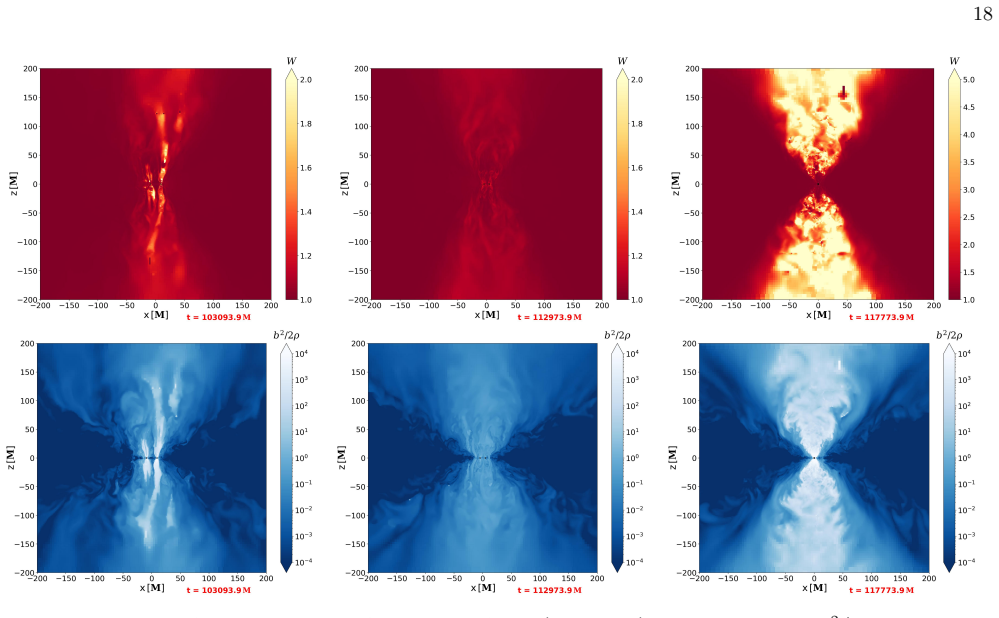
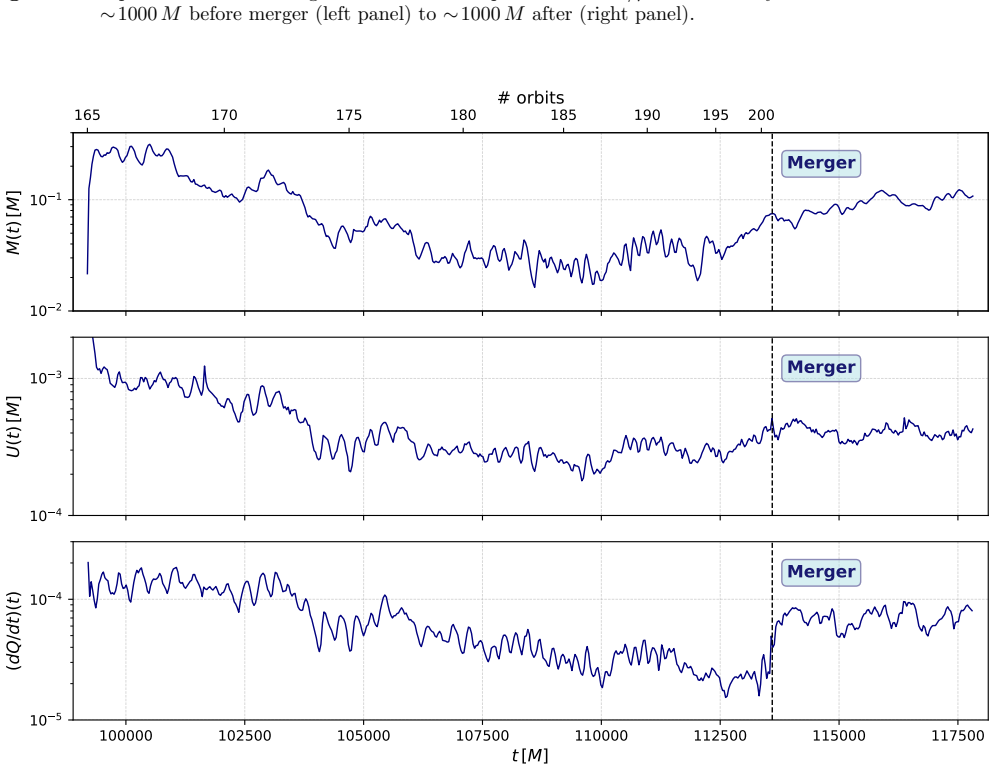
The paper's central claim is that a supermassive black hole binary embedded in gas can now be simulated seamlessly from a realistic, relaxed initial state through merger, and that this full evolution changes the expected phenomenology: the binary does not progressively starve its surroundings. Mass continues to flow inward after the binary decouples from the circumbinary disk, yet the accretion rate onto the black holes falls by about a factor of ten and levels off well before merger; the minidisks oscillate between disk-like and stream-like states, exchange mass through sloshing, and dissolve about $2000M$ before coalescence; and the electromagnetic luminosity, defined through the cooling rate, declines by about a factor of four over the $\sim 10^4M$ inspiral before jumping by about 50 percent within roughly $100M$ of merger, as shocks triggered by the sudden change in the gravitational potential dissipate energy in the remaining gas. The same simulation attributes the magnetic flux evolution to accretion ram pressure: the flux on the horizons falls by a factor of about three while $\dot{M}$ falls tenfold, and at merger roughly $2.5\times$ the pre-merger horizon flux attaches to the remnant, whose spin of about 0.68 then launches a Poynting-flux-dominated jet.
Load-bearing premise
The load-bearing premise is the paper's own cooling prescription (Eqs. 39--40, discussed in Sec. IV B), an ad hoc law that sets a Keplerian cooling timescale and drives every fluid element toward a fixed target entropy, and the electromagnetic luminosity is defined as the integral of that law, so if real gas radiates differently -- for instance because it is optically thick -- the predicted dimming and the 50 percent merger brightening could both change.
Editorial extensions
If this is right
- During the last $\sim 10^4M$ of inspiral the bolometric luminosity should fade by roughly a factor of four, then rise by about 50 percent within a $\sim 100M$ window around merger, with a sharp spectral change as the emission region contracts toward the remnant.
- Near merger the accretion rate is a poor proxy for luminosity: the radiative efficiency jumps by about a factor of four because the abrupt change in the gravitational potential drives dissipative shocks through the remaining gas, while the total accretion rate stays essentially flat.
- The merged remnant accretes at nearly the same rate as the pre-merger binary and, with dimensionless spin about 0.68, launches a mildly relativistic Poynting-flux-dominated jet whose power jumps by roughly a factor of five at merger; a sudden jet turn-on is a possible signature that two slowly spinning black holes have merged.
- Mass is not progressively starved from the gap: the gas within $40M$ of the binary stays roughly constant through the inspiral, and the inner cavity's mass, after falling by a factor of about ten, regains about a quarter of its initial value before merger.
- Simulations started at $10$--$12M$ separations show well-defined accretion streams much longer than this run does, implying that late-inspiral gas morphology is set by the binary's earlier history rather than by the final orbits alone.
Reading between the lines
- A two-point test of the ram-pressure mechanism: rerun the same configuration with the disk density doubled and check whether the horizon flux saturation scales as $\Phi_B \propto \dot{M}^{1/2}$; if the flux does not move with the square root of the accretion rate, the regulation mechanism needs revision.
- Because the luminosity is defined as the integral of the ad hoc cooling law, the 50 percent jump is a prediction about where and how fast gas is heated, not about how photons escape; a radiation-transport rerun is the natural check, and the jump could be softened by optical-depth effects the paper explicitly flags.
- The comparison this paper draws with 2D Newtonian hydrodynamics, which shows a flat post-merger luminosity instead of a step, invites a controlled experiment: evolve the same initial conditions with a Newtonian potential inside the same code to isolate the relativistic origin of the brightening.
- If the brightness jump and spectral flip are generic for equal-mass mergers, EM follow-up of LISA triggers should be planned at day-scale cadence around the expected merger window, since the brightening lasts about half a day for a $10^8\,M_\odot$ system by the paper's own scaling.
Editorial analysis
A structured set of objections, weighed in public.
Referee Report
Summary. The paper presents a multi-stage GRMHD plus numerical relativity framework for supermassive black hole binary accretion. A circumbinary disk is first evolved to a quasi-steady turbulent state with the SphericalNR code in a fixed, post-Newtonian binary spacetime with the inner cavity excised; the evolved MHD fields are then interpolated onto a Cartesian mesh and handed off to IllinoisGRMHD, which evolves the same equal-mass, nonspinning binary through inspiral, merger, and early postmerger using the full Einstein equations. The production run starts from a coordinate separation of about 20M and reaches merger near t≈113600M. The authors report that accretion onto the individual holes declines by roughly a factor of 10 while inflow from the circumbinary disk continues, that the minidisks dissolve about 2000M before merger, that the EM luminosity, defined as the volume integral of the prescribed cooling sink, falls by about a factor of 4 during inspiral and then rises by about 50% at merger, and that the magnetic flux threading the horizons is regulated by accretion ram pressure. The central methodological claim is that this is the first 3D GRMHD plus numerical relativity simulation connecting a relaxed CBD at 20M all the way through merger.
Significance. If the core methodological claim stands, the paper represents a substantial advance: it removes an important limitation of previous work by combining a realistically relaxed circumbinary disk with a full numerical-relativity spacetime through merger, and it provides a foundation for future studies with spins, mass ratios, eccentricity, and more physical radiation treatment. The gas-dynamical results, such as the dissolution of the minidisks, the chaotic multi-stream late inspiral, and the near-continuity of the postmerger accretion rate, are informative and are likely to be more robust to the modeling choices than the luminosity curve. The hand-off consistency checks in Sec. III B and the comparison with earlier work in Sec. IV A 2 lend credibility to the pipeline. However, the quantitative lightcurve is a diagnostic of an ad hoc cooling law rather than a radiation prediction, and the headline numbers come from a single production run without a quantitative convergence study, so the strength of the quantitative observational claims is currently limited.
major comments (3)
- [IV B; Eqs. (39)-(40), (54)] The headline lightcurve is not a prediction from radiation physics but a diagnostic of the prescribed cooling law. Equation (54) defines LEM as the volume integral of Lcool, and Lcool (Eqs. (39)-(40)) is an entropy-damping sink with a Keplerian cooling timescale, a fixed target entropy s0=0.01, exponent q=1/2, and additional ad hoc damping zones near the horizons (Sec. II D 2). The factor ~4 inspiral decline and the ~50% merger jump are therefore properties of this particular cooling prescription. The argument in Sec. III C 3 that LEM closely tracks dQ/dt does not resolve the model dependence, because dQ/dt in Eq. (55) is inferred from an internal-energy budget that contains the same Lcool sink. I request either sensitivity tests varying the normalization of tcool, s0, q, and the damping radii to show that the qualitative lightcurve and the merger jump survive, or an explicit reframing of the lightcurve as a simulation-dependent proxy rather than an observational prediction in the abstract and conclusions.
- [II C 3 and Sec. III] All quantitative claims, including the factor ~10 accretion decline, the factor ~4 luminosity decline, the ~50% merger jump, and the ram-pressure scaling of horizon flux, are taken from a single production run at finest resolution M/64. The only reported variation is a preliminary numerical-relativity run with a smaller refinement box, which is not a resolution study and for which only the total gas mass near merger is compared. Because the paper emphasizes quantitative factors, please provide a convergence assessment for the key diagnostics (accretion rates, minidisk masses, LEM, and horizon magnetic flux), even if only over a shorter time window or at one coarser and one finer resolution.
- [II C 2 and III D 1] The hand-off fills the excised cavity with zero vector potential and ramps Ai from zero at r=15M to the full interpolated values at r=35M, introducing an artificial magnetic-field configuration in precisely the region where the horizon flux and its merger-time evolution are later measured. The paper notes the artificial field in Sec. III B, but does not assess its effect on the claimed ram-pressure regulation of the horizon flux in Sec. III D 1 or on the postmerger Poynting flux. Please add a sensitivity discussion, and ideally a test with a different smoothing radius or initial field topology, to show that the flux evolution is not dominated by the hand-off prescription.
minor comments (4)
- [Eq. (19)] In Eq. (19), the second term in parentheses appears to contain index typos: 'T^{0K}' and '∂iα' should likely read 'T^{0k}∂kα'.
- [III C 3] The sentence 'LEM follows dQ/dt very closely (Fig. 14)' should cite Fig. 17, since dQ/dt is shown there rather than in Fig. 14.
- [II B 1] The initial torus is constructed using a single Kerr spacetime with dimensionless spin χ=1.25, which exceeds the Kerr bound; if this is an intentional pseudo-spin chosen to approximate the binary's quadrupole moment, this should be stated explicitly to avoid confusion.
- [Fig. 6 caption] In the Fig. 6 caption, 'spherical surface centered of coordinate radius' should be 'spherical surface centered at coordinate radius'.
Circularity Check
No significant circularity: the simulation's central results are dynamical outputs of the coupled GRMHD and Einstein equations, and the lightcurve follows from an explicitly labeled ad hoc cooling prescription rather than a fitted or self-defined quantity.
full rationale
The paper's load-bearing claims—the roughly tenfold drop in horizon accretion, the dissolution of minidisks ~2000M before merger, the ram-pressure regulation of horizon magnetic flux, and the postmerger jet—are outputs of the coupled GRMHD and Einstein equations evolved from a prerelaxed circumbinary disk; no parameter is fitted to these target results. The hand-off consistency checks (Figs. 5–6) provide internal evidence that the interpolation step does not encode the final answers, and the comparisons to prior work, including [25], are external benchmarks rather than a self-citation chain. The one quantity that could look self-referential is LEM, defined in Eq. (54) as the volume integral of the cooling sink Lcool, with Lcool given by the entropy-damping prescription in Eqs. (39)–(40). That prescription is indeed ad hoc and not radiation transport, but the paper explicitly says so: Sec. IV B states 'our cooling rate prescription is ad hoc and does not account for the detailed mechanisms of EM radiation,' and Sec. V calls for 'more accurate radiation transport models.' Because tcool, s0, and q are chosen a priori and are not fit to the luminosity decline or the ~50% merger jump, the lightcurve is a forward prediction under a stated modeling assumption, not a reduction of the prediction to its own inputs. This is a physical modeling caveat, not circularity. The paper is heavily self-cited, as is common for a code-and-method extension paper, but no load-bearing argument rests on an unverified self-citation, and no uniqueness theorem is imported from the authors' prior work to forbid alternatives. Therefore no circular step is exhibited.
Assumptions & free parameters
free parameters (6)
- Cooling entropy target and exponent =
s0 = 0.01, q = 1/2
- Cooling timescale normalization =
tcool = 2π sqrt(r^3/M)
- Cooling damping radii near horizons =
0.35M, 1M, 0.9M, 1.2M
- Initial magnetic field strength =
Plasma internal energy / magnetic energy = 100
- Hand-off smoothing radii =
r1 = 13M, r2 = 15M, rA = 35M
- Atmosphere density and pressure floors =
ρfloor = 2e-10, ufloor = 2e-12
assumptions (6)
- domain assumption Ideal MHD with infinite conductivity
- domain assumption Gas does not self-gravitate
- domain assumption Ideal fluid equation of state with Γ = 5/3
- ad hoc to paper The ad hoc cooling sink term represents all radiative losses
- domain assumption The CBD snapshot at t = 99200M is a representative quasi-steady initial condition
- domain assumption The PN spacetime used during CBD equilibration is accurate enough at 20M separation
Cite this review
Pith. "Pith review of Relativistic gas accretion onto supermassive black Hole binaries from inspiral through merger." pith.science (2026). https://pith.science/paper/UQHDUHKT
@misc{pith2026250206389,
  author       = {Pith},
  title        = {Pith review of: Relativistic gas accretion onto supermassive black Hole binaries from inspiral through merger},
  year         = {2026},
  howpublished = {\url{https://pith.science/paper/UQHDUHKT}},
  note         = {Machine review of arXiv:2502.06389}
}
read the original abstract
Accreting supermassive black hole binaries are powerful multimessenger sources emitting both gravitational and EM radiation. Understanding the accretion dynamics of these systems and predicting their distinctive EM signals is crucial to informing and guiding upcoming efforts aimed at detecting gravitational waves produced by these binaries. To this end, accurate numerical modeling is required to describe both the spacetime and the magnetized gas around the black holes. In this paper, we present two key advances in this field of research. First, we have developed a novel 3D GRMHD framework that combines multiple numerical codes to simulate the inspiral and merger of supermassive black hole binaries starting from realistic initial data and running all the way through merger. Throughout the evolution, we adopt a simple but functional prescription to account for gas cooling through photon emission. Next, we have applied our new computational method to follow the time evolution of a circular, equal-mass, nonspinning black hole binary for ~200 orbits, starting from a separation of 20r_g and reaching the postmerger evolutionary stage of the system. We have shown how mass continues to flow toward the binary even after the binary "decouples" from its surrounding disk, but the accretion rate onto the black holes diminishes. We have identified how the minidisks orbiting each black hole are slowly drained and eventually dissolve as the binary compresses. We confirm previous findings that the system's luminosity decreases by a factor of a few during inspiral; however, we observe an abrupt increase by ~50% in this quantity at the time of merger, likely accompanied by an equally abrupt change in spectrum. Finally, we have demonstrated that during the inspiral, fluid ram pressure regulates the fraction of the magnetic flux transported to the binary that attaches to the black holes' horizons.
Figures


Figures from the paper (19 more)






Forward citations
Cited by 2 Pith papers
-
$\textit{BMAD}$-Circumbinary Magnetically Arrested Disks around Stellar or Black Hole Binaries: Hot Accretion Flows, Disk Properties, and Angular Momentum Transfer
Circumbinary accretion disks can enter a magnetically arrested state, and in weakly cooled or adiabatic regimes the resulting magnetic flux eruptions may drive the binary orbit to shrink.
-
The implications of stochastic gas torques for asymmetric binaries in the LISA band
Hydrodynamic stochastic gas torques do not bias the recovered binary parameters of EMRI/IMRI signals in LISA, but they can bias or hide the inferred accretion disk torque amplitude and slope.
Reference graph
Works this paper leans on
-
[1]
poloidal
Character of the magnetic field We now direct our attention to the dynamics of the EM field. The magnetic field changes in a number of ways during inspiral and does so especially dramatically at the time of merger. For example, the relative sizes of the magnetic field’s components near the black hole horizons shift sharply toward a greater contribution fr...
-
[2]
(60) Here Si denotes the Poynting vector which, in the ideal MHD limit, is given by Si = B2vi − vjBj vi
Poynting flux The EM field also generates Poynting flux, whose total amount can be found by a surface integral analogous to that used for magnetic flux: FS ≡ Z S d2σi √−g Si . (60) Here Si denotes the Poynting vector which, in the ideal MHD limit, is given by Si = B2vi − vjBj vi . (61) Note that surfaces appropriate to describing total Poynt- ing flux may...
-
[3]
EM luminosity
Luminosity In this section, we report on the time evolution of the EM luminosity in the inner parts of the system. In the literature, the term “EM luminosity” (or simply “lumi- nosity”) sometimes refers to the volume-integrated cool- ing rate and at other times to the Poynting luminosity; in this work we follow the former convention and define the EM lumi...
-
[4]
decoupling
New features A very large literature now exists regarding the fluid dynamics of binary accretion. Features such as the cav- ity within ∼ 2a of the center of mass and the minidisks around each of the partners in the binary have been ex- tensively discussed. Our simulation has demonstrated that essentially all these features change dramatically when two bla...
-
[5]
de- couples
Contrast with previous work The chaotic gas dynamics in the gap region that we ob- serve close to merger contrasts sharply with some cognate previous work. The most dramatic contrast is with the work of [119], who used 2D Newtonian hydrodynamics combined with orbital evolution given by the quadrupole gravitational wave radiation rate. In their calculation...
-
[6]
Surface integrals We developed CactusSurfaceIntegrals, an MPI- parallel C++ code capable of calculating the integrals of various quantities of physical interest over planar, spherical, or cylindrical surfaces embedded in Cactus grids with Cartesian topology and box-in-box mesh re- finement. Since the main application of the code is (for now) the analysis ...
-
[7]
Each MPI task is assigned a chunk of the integra- tion surface
-
[8]
Each point on the surface chunk is assigned the Cactus grid component with the finest available resolution that overlaps that point
Show all 173 references
-
[9]
All the needed fields are interpolated on each point of the surface chunk using the previously assigned grid patch
-
[10]
A typical binary black hole simulation involves multi- ple MPI processes, so that the GRMHD fields are scat- tered across multiple files (possibly one file per process)
The integral(s) is (are) computed by each MPI rank on the corresponding surface chunk, then the local contributions are summed and written to file. A typical binary black hole simulation involves multi- ple MPI processes, so that the GRMHD fields are scat- tered across multipl...
-
[11]
V olume integrals We also developed CactusVolumeIntegrals, an MPI-parallel C++ code to compute spherical volume in- tegrals over Cactus grids with Cartesian topology and box-in-box mesh refinement. As in CactusSurfaceIn- tegrals, the center of the sphere can either be fixed in...
-
[12]
Note that the code must run as many MPI processes as there are files to read
Each MPI process reads one and only one Cactus HDF5 file containing the information about how the GRMHD fields are laid out in the simulation domain. Note that the code must run as many MPI processes as there are files to read
-
[13]
All grid components in each file are checked for overlap against the integration sphere by means of Arvo’s algorithm [158]
-
[14]
This step in- volves collective MPI operations
All MPI processes must know which grid compo- nents overlap the integration sphere (no matter which files those components belong to), so that only the components with the finest available res- olution are used in the integration. This step in- volves collective MPI operations
-
[15]
The contri- bution from each grid point is weighed by a fac- tor 1 /2rl, where rl ∈ {0, 1, 2,
Each MPI process calculates the integral(s) over all grid components (or part of them) with the finest available resolution that overlap the sphere and be- long to the corresponding HDF5 file. The contri- bution from each grid point is weighed by a fac- tor 1 /2rl, where rl ∈ ...
-
[16]
D. N. Schramm, Nuclear Physics B Proceedings Supple- ments 28, 243 (1992)
1992
-
[17]
P. J. E. Peebles, Principles of Physical Cosmology (Princeton University Press, 1993)
1993
-
[18]
Schneider, Extragalactic Astronomy and Cosmology (Springer, 2006)
P. Schneider, Extragalactic Astronomy and Cosmology (Springer, 2006)
2006
-
[19]
Kormendy and L
J. Kormendy and L. C. Ho, Annual Review of Astron- omy and Astrophysics 51, 511 (2013), arXiv:1304.7762 [astro-ph.CO]
2013 arXiv
-
[20]
Bogdanovi´ c, M
T. Bogdanovi´ c, M. C. Miller, and L. Blecha, Living Reviews in Relativity 25, 3 (2022), arXiv:2109.03262 [astro-ph.HE]
2022 arXiv
-
[21]
Volonteri, F
M. Volonteri, F. Haardt, and P. Madau, Astrophys. J. 582, 559 (2003), arXiv:astro-ph/0207276 [astro-ph]
2003 arXiv
-
[22]
Campanelli, C
M. Campanelli, C. O. Lousto, B. C. Mundim, H. Nakano, Y. Zlochower, and H.-P. Bischof, Clas- sical and Quantum Gravity 27, 084034 (2010), arXiv:1001.3834 [gr-qc]
2010 arXiv
-
[23]
Antoniadis et al
J. Antoniadis et al. (EPTA Collaboration and InPTA Collaboration), Astronomy & Astrosphysics 678, A50 (2023), arXiv:2306.16214 [astro-ph.HE]
2023 arXiv
-
[24]
Colpi et al., arXiv e-prints , arXiv:2402.07571 (2024), arXiv:2402.07571 [astro-ph.CO]
M. Colpi et al., arXiv e-prints , arXiv:2402.07571 (2024), arXiv:2402.07571 [astro-ph.CO]
2024 arXiv
-
[25]
Amaro-Seoane et al
P. Amaro-Seoane et al. , Living Reviews in Relativity 26, 2 (2023), arXiv:2203.06016 [gr-qc]
2023 arXiv
-
[26]
Dal Canton, A
T. Dal Canton, A. Mangiagli, S. C. Noble, J. Schnittman, A. Ptak, A. Klein, A. Sesana, and J. Camp, Astrophys. J. 886, 146 (2019), arXiv:1902.01538 [astro-ph.HE]
2019 arXiv
-
[27]
P. C. Duffell, A. J. Dittmann, D. J. D’Orazio, A. Fran- chini, K. M. Kratter, A. B. T. Penzlin, E. Ragusa, M. Si- wek, C. Tiede, H. Wang, J. Zrake, A. M. Dempsey, Z. Haiman, A. Lupi, M. Pirog, and G. Ryan, Astrophys. J. 970, 156 (2024), arXiv:2402.13039 [astro-ph.SR]
2024 arXiv
-
[28]
E. M. Guti´ errez, L. Combi, and G. Ryan, arXiv e-prints , arXiv:2405.14843 (2024), arXiv:2405.14843 [astro-ph.HE]
2024 arXiv
-
[29]
S. C. Noble and J. H. Krolik, in preparation
-
[30]
J. E. Pringle, Monthly Notices of the Royal Astronom- ical Society 248, 754 (1991)
1991
-
[31]
Artymowicz and S
P. Artymowicz and S. H. Lubow, Astrophys. J. 421, 651 (1994)
1994
-
[32]
A. I. MacFadyen and M. Milosavljevi´ c, Astrophys. J. 672, 83 (2008), arXiv:astro-ph/0607467 [astro-ph]
2008 arXiv
-
[33]
J.-M. Shi, J. H. Krolik, S. H. Lubow, and J. F. Hawley, Astrophys. J. 749, 118 (2012), arXiv:1110.4866 [astro- ph.HE]
2012 arXiv
-
[34]
S. C. Noble, B. C. Mundim, H. Nakano, J. H. Krolik, M. Campanelli, Y. Zlochower, and N. Yunes, Astrophys. J. 755, 51 (2012), arXiv:1204.1073 [astro-ph.HE]
2012 arXiv
-
[35]
B. D. Farris, P. Duffell, A. I. MacFadyen, and Z. Haiman, Astrophys. J. 783, 134 (2014), arXiv:1310.0492 [astro-ph.HE]
2014 arXiv
-
[36]
Shi and J
J.-M. Shi and J. H. Krolik, Astrophys. J. 807, 131 (2015), arXiv:1503.05561 [astro-ph.HE]
2015 arXiv
-
[37]
D. B. Bowen, M. Campanelli, J. H. Krolik, V. Mewes, and S. C. Noble, Astrophys. J. 838, 42 (2017), arXiv:1612.02373 [astro-ph.HE]
2017 arXiv
-
[38]
D. B. Bowen, V. Mewes, S. C. Noble, M. Avara, M. Campanelli, and J. H. Krolik, Astrophys. J. 879, 76 (2019), arXiv:1904.12048 [astro-ph.HE]
2019 arXiv
-
[39]
Artymowicz and S
P. Artymowicz and S. H. Lubow, The Astrophysical Journal Letters 467, L77 (1996)
1996
-
[40]
M. J. Avara, J. H. Krolik, M. Campanelli, S. C. Noble, D. Bowen, and T. Ryu, Astrophys. J. 974, 242 (2024), arXiv:2305.18538 [astro-ph.HE]
2024 arXiv
-
[41]
J. R. Westernacher-Schneider, J. Zrake, A. Mac- Fadyen, and Z. Haiman, Astrophys. J. 962, 76 (2024), arXiv:2307.01154 [astro-ph.HE]
2024 arXiv
-
[42]
Roedig, J
C. Roedig, J. H. Krolik, and M. C. Miller, Astrophys. J. 785, 115 (2014), arXiv:1402.7098 [astro-ph.HE]
2014 arXiv
-
[43]
B. D. Farris, P. Duffell, A. I. MacFadyen, and Z. Haiman, Monthly Notices of the Royal Astronom- ical Society 446, L36 (2015), arXiv:1406.0007 [astro- ph.HE]
2015 arXiv
-
[44]
d’Ascoli, S
S. d’Ascoli, S. C. Noble, D. B. Bowen, M. Campanelli, J. H. Krolik, and V. Mewes, Astrophys. J. 865, 140 (2018), arXiv:1806.05697 [astro-ph.HE]. 35
2018 arXiv
-
[45]
E. M. Guti´ errez, L. Combi, S. C. Noble, M. Campan- elli, J. H. Krolik, F. L´ opez Armengol, and F. Garc ´ ıa, Astrophys. J. 928, 137 (2022), arXiv:2112.09773 [astro- ph.HE]
2022 arXiv
-
[46]
Nagele, J
C. Nagele, J. Krolik, and S. Noble, in preparation
-
[47]
B. E. Kinch, S. C. Noble, J. D. Schnittman, and J. H. Krolik, Astrophys. J. 904, 117 (2020), arXiv:2009.01914 [astro-ph.HE]
2020 arXiv
-
[48]
B. D. Farris, R. Gold, V. Paschalidis, Z. B. Etienne, and S. L. Shapiro, Phys. Rev. Lett. 109, 221102 (2012), arXiv:1207.3354 [astro-ph.HE]
2012 arXiv
-
[49]
R. Gold, V. Paschalidis, Z. B. Etienne, S. L. Shapiro, and H. P. Pfeiffer, Phys. Rev. D 89, 064060 (2014), arXiv:1312.0600 [astro-ph.HE]
2014 arXiv
-
[50]
R. Gold, V. Paschalidis, M. Ruiz, S. L. Shapiro, Z. B. Etienne, and H. P. Pfeiffer, Phys. Rev. D 90, 104030 (2014), arXiv:1410.1543 [astro-ph.GA]
2014 arXiv
-
[51]
Paschalidis, J
V. Paschalidis, J. Bright, M. Ruiz, and R. Gold, The Astrophysical Journal Letters 910, L26 (2021), arXiv:2102.06712 [astro-ph.HE]
2021 arXiv
-
[52]
J. C. Bright and V. Paschalidis, Monthly Notices of the Royal Astronomical Society 520, 392 (2023), arXiv:2210.15686 [astro-ph.HE]
2023 arXiv
-
[53]
Cattorini, B
F. Cattorini, B. Giacomazzo, F. Haardt, and M. Colpi, Phys. Rev. D 103, 103022 (2021), arXiv:2102.13166 [astro-ph.HE]
2021 arXiv
-
[54]
Cattorini, S
F. Cattorini, S. Maggioni, B. Giacomazzo, F. Haardt, M. Colpi, and S. Covino, The Astrophysical Journal Let- ters 930, L1 (2022), arXiv:2202.08282 [astro-ph.HE]
2022 arXiv
-
[55]
Fedrigo, F
G. Fedrigo, F. Cattorini, B. Giacomazzo, and M. Colpi, arXiv e-prints , arXiv:2309.03949 (2023), arXiv:2309.03949 [astro-ph.HE]
2023 arXiv
-
[56]
Cattorini, B
F. Cattorini, B. Giacomazzo, M. Colpi, and F. Haardt, Phys. Rev. D 109, 043004 (2024), arXiv:2309.05738 [astro-ph.HE]
2024 arXiv
-
[57]
Manikantan, V
V. Manikantan, V. Paschalidis, and G. Bozzola, arXiv e-prints , arXiv:2411.11955 (2024), arXiv:2411.11955 [astro-ph.HE]
2024 arXiv
-
[58]
S. C. Noble, J. H. Krolik, M. Campanelli, Y. Zlochower, B. C. Mundim, H. Nakano, and M. Zilh˜ ao, Astrophys. J. 922, 175 (2021), arXiv:2103.12100 [astro-ph.HE]
2021 arXiv
-
[59]
F. G. Lopez Armengol, L. Combi, M. Campanelli, S. C. Noble, J. H. Krolik, D. B. Bowen, M. J. Avara, V. Mewes, and H. Nakano, Astrophys. J.913, 16 (2021), arXiv:2102.00243 [astro-ph.HE]
2021 arXiv
-
[60]
Combi, F
L. Combi, F. G. Lopez Armengol, M. Campanelli, S. C. Noble, M. Avara, J. H. Krolik, and D. Bowen, As- trophys. J. 928, 187 (2022), arXiv:2109.01307 [astro- ph.HE]
2022 arXiv
-
[61]
B. C. Mundim, H. Nakano, N. Yunes, M. Campanelli, S. C. Noble, and Y. Zlochower, Phys. Rev. D89, 084008 (2014), arXiv:1312.6731 [gr-qc]
2014 arXiv
-
[62]
Ireland, B
B. Ireland, B. C. Mundim, H. Nakano, and M. Campan- elli, Phys. Rev. D 93, 104057 (2016)
2016
-
[63]
Nakano, B
H. Nakano, B. Ireland, M. Campanelli, and E. J. West, Classical and Quantum Gravity 33, 247001 (2016), arXiv:1608.01033 [gr-qc]
2016 arXiv
-
[64]
Combi, F
L. Combi, F. G. L. Armengol, M. Campanelli, B. Ire- land, S. C. Noble, H. Nakano, and D. Bowen, Phys. Rev. D 104, 044041 (2021), arXiv:2103.15707 [gr-qc]
2021 arXiv
-
[65]
Combi and S
L. Combi and S. M. Ressler, arXiv e-prints , arXiv:2403.13308 (2024), arXiv:2403.13308 [gr-qc]
2024
-
[66]
Mewes, Y
V. Mewes, Y. Zlochower, M. Campanelli, I. Ruchlin, Z. B. Etienne, and T. W. Baumgarte, Phys. Rev. D 97, 084059 (2018), arXiv:1802.09625 [gr-qc]
2018 arXiv
-
[67]
Mewes, Y
V. Mewes, Y. Zlochower, M. Campanelli, T. W. Baumgarte, Z. B. Etienne, F. G. L. Armengol, and F. Cipolletta, Phys. Rev. D 101, 104007 (2020), arXiv:2002.06225 [gr-qc]
2020 arXiv
-
[68]
L. Ji, V. Mewes, Y. Zlochower, L. Ennoggi, F. G. L. Armengol, M. Campanelli, F. Cipolletta, and Z. B. Etienne, Phys. Rev. D 108, 104005 (2023), arXiv:2305.01537 [gr-qc]
2023 arXiv
-
[69]
Z. B. Etienne, V. Paschalidis, R. Haas, P. M¨ osta, and S. L. Shapiro, Classical and Quantum Gravity 32, 175009 (2015), arXiv:1501.07276 [astro-ph.HE]
2015 arXiv
-
[70]
L. R. Werneck, Z. B. Etienne, A. Murguia-Berthier, R. Haas, F. Cipolletta, S. C. Noble, L. Ennoggi, F. G. Lopez Armengol, B. Giacomazzo, T. Assump¸ c˜ ao, J. Faber, T. Gupte, B. J. Kelly, and J. H. Krolik, Phys. Rev. D 107, 044037 (2023), arXiv:2208.14487 [gr-qc]
2023 arXiv
-
[71]
Darmois, Les ´ equations de la gravitation einsteini- enne, M´ emorial des sciences math´ ematiques No
G. Darmois, Les ´ equations de la gravitation einsteini- enne, M´ emorial des sciences math´ ematiques No. 25 (Gauthier-Villars, 1927)
1927
-
[72]
Four` es-Bruhat, Acta Mathematica88, 141 (1952)
Y. Four` es-Bruhat, Acta Mathematica88, 141 (1952)
1952
-
[73]
Arnowitt, S
R. Arnowitt, S. Deser, and C. W. Misner, General Relativity and Gravitation 40, 1997 (2008), arXiv:gr- qc/0405109 [gr-qc]
2008
-
[74]
Gourgoulhon, 3+1 Formalism in General Relativity: Bases of Numerical Relativity , Lecture Notes in Physics (Springer Berlin Heidelberg, 2012)
´E. Gourgoulhon, 3+1 Formalism in General Relativity: Bases of Numerical Relativity , Lecture Notes in Physics (Springer Berlin Heidelberg, 2012)
2012
-
[75]
T. W. Baumgarte and S. L. Shapiro, Phys. Rev. D 59, 024007 (1998), arXiv:gr-qc/9810065 [gr-qc]
1998 arXiv
-
[76]
Shibata and T
M. Shibata and T. Nakamura, Phys. Rev. D 52, 5428 (1995)
1995
-
[77]
Campanelli, C
M. Campanelli, C. O. Lousto, P. Marronetti, and Y. Zlo- chower, Phys. Rev. Lett. 96, 111101 (2006), arXiv:gr- qc/0511048 [gr-qc]
2006
-
[78]
J. G. Baker, J. Centrella, D.-I. Choi, M. Koppitz, and J. van Meter, Phys. Rev. Lett. 96, 111102 (2006), arXiv:gr-qc/0511103 [gr-qc]
2006 arXiv
-
[79]
Banyuls, J
F. Banyuls, J. A. Font, J. M. Ib´ a˜ nez, J. M. Mart ´ ı, and J. A. Miralles, Astrophys. J. 476, 221 (1997)
1997
-
[80]
Bonazzola, E
S. Bonazzola, E. Gourgoulhon, P. Grandcl´ ement, and J. Novak, Phys. Rev. D 70, 104007 (2004), arXiv:gr- qc/0307082 [gr-qc]
2004
-
[81]
Shibata, K
M. Shibata, K. Ury¯ u, and J. L. Friedman, Phys. Rev. D 70, 044044 (2004), arXiv:gr-qc/0407036 [gr-qc]
2004 arXiv
-
[82]
J. D. Brown, Phys. Rev. D 79, 104029 (2009), arXiv:0902.3652 [gr-qc]
2009 arXiv
-
[83]
P. J. Montero and I. Cordero-Carri´ on, Phys. Rev. D85, 124037 (2012), arXiv:1204.5377 [gr-qc]
2012 arXiv
-
[84]
T. W. Baumgarte, P. J. Montero, I. Cordero-Carri´ on, and E. M¨ uller, Phys. Rev. D 87, 044026 (2013), arXiv:1211.6632 [gr-qc]
2013 arXiv
-
[85]
P. J. Montero, T. W. Baumgarte, and E. M¨ uller, Phys. Rev. D 89, 084043 (2014), arXiv:1309.7808 [gr-qc]
2014 arXiv
-
[86]
Sanchis-Gual, P
N. Sanchis-Gual, P. J. Montero, J. A. Font, E. M¨ uller, and T. W. Baumgarte, Phys. Rev. D 89, 104033 (2014), arXiv:1403.3653 [gr-qc]
2014 arXiv
-
[87]
T. W. Baumgarte, P. J. Montero, and E. M¨ uller, Phys. Rev. D 91, 064035 (2015), arXiv:1501.05259 [gr-qc]
2015 arXiv
-
[88]
Zilh˜ ao, S
M. Zilh˜ ao, S. C. Noble, M. Campanelli, and Y. Zlochower, Phys. Rev. D 91, 024034 (2015), arXiv:1409.4787 [gr-qc]
2015 arXiv
-
[89]
Goodale, G
T. Goodale, G. Allen, G. Lanfermann, J. Mass´ o, T. Radke, E. Seidel, and J. Shalf, in High Perfor- 36 mance Computing for Computational Science — VEC- PAR 2002, edited by J. M. L. M. Palma, A. A. Sousa, J. Dongarra, and V. Hern´ andez (Springer Berlin Heidel- berg, Berlin, He...
2002
-
[90]
L¨ offler, J
F. L¨ offler, J. Faber, E. Bentivegna, T. Bode, P. Di- ener, R. Haas, I. Hinder, B. C. Mundim, C. D. Ott, E. Schnetter, G. Allen, M. Campanelli, and P. Laguna, Classical and Quantum Gravity 29, 115001 (2012), arXiv:1111.3344 [gr-qc]
2012 arXiv
-
[91]
Zilh˜ ao and F
M. Zilh˜ ao and F. L¨ offler, International Journal of Mod- ern Physics A 28, 1340014-126 (2013), arXiv:1305.5299 [gr-qc]
2013 arXiv
-
[92]
Schnetter, S
E. Schnetter, S. H. Hawley, and I. Hawke, Classical and Quantum Gravity 21, 1465 (2004), arXiv:gr-qc/0310042 [gr-qc]
2004 arXiv
-
[93]
Schnetter, P
E. Schnetter, P. Diener, E. N. Dorband, and M. Tiglio, Classical and Quantum Gravity 23, S553 (2006), arXiv:gr-qc/0602104 [gr-qc]
2006 arXiv
-
[94]
Schnetter, Carpet documentation, https: //einsteintoolkit.org/arrangementguide/Carpet/ documentation.html (2003)
E. Schnetter, Carpet documentation, https: //einsteintoolkit.org/arrangementguide/Carpet/ documentation.html (2003)
2003
-
[95]
Schnetter, Carpet bitbucket repository, https:// bitbucket.org/eschnett/carpet/src/master
E. Schnetter, Carpet bitbucket repository, https:// bitbucket.org/eschnett/carpet/src/master
-
[96]
D. S. Balsara, S. Garain, and C.-W. Shu, Journal of Computational Physics 326, 780 (2016)
2016
-
[97]
Castro, B
M. Castro, B. Costa, and W. S. Don, Journal of Com- putational Physics 230, 1766 (2011)
2011
-
[98]
Tchekhovskoy, J
A. Tchekhovskoy, J. C. McKinney, and R. Narayan, Monthly Notices of the Royal Astronomical Society379, 469 (2007), arXiv:0704.2608 [astro-ph]
2007 arXiv
-
[99]
Rembiasz, M
T. Rembiasz, M. Obergaulinger, P. Cerd´ a-Dur´ an, E. M¨ uller, and M. A. Aloy, Monthly Notices of the Royal Astronomical Society 456, 3782 (2016), arXiv:1508.04799 [astro-ph.SR]
2016 arXiv
-
[100]
Rembiasz, M
T. Rembiasz, M. Obergaulinger, P. Cerd´ a-Dur´ an, M.-´A. Aloy, and E. M¨ uller, The Astrophysical Journal Sup- plement Series 230, 18 (2017), arXiv:1611.05858 [astro- ph.IM]
2017 arXiv
-
[101]
J. F. Mahlmann, M. A. Aloy, V. Mewes, and P. Cerd´ a- Dur´ an, Astronomy & Astrophysics 647, A58 (2021), arXiv:2007.06599 [physics.comp-ph]
2021
-
[102]
Harten, P
A. Harten, P. D. Lax, and B. van Leer, SIAM Review 25, 35 (1983), https://doi.org/10.1137/1025002
1983 doi
-
[103]
Kreiss and J
H. Kreiss and J. Oliger, Methods for the approximate so- lution of time dependent problems , GARP Publications Series (SELBSTVERL.) FEBR, 1973)
1973
-
[104]
Schnetter and B
E. Schnetter and B. J. Kelly, Dissipation documen- tation, https://einsteintoolkit.org/thornguide/ CactusNumerical/Dissipation/documentation.html
-
[105]
Hawke, Method of Lines (MoL) bitbucket repository, https://bitbucket.org/cactuscode/ cactusnumerical/src/master/MoL/ ()
I. Hawke, Method of Lines (MoL) bitbucket repository, https://bitbucket.org/cactuscode/ cactusnumerical/src/master/MoL/ ()
-
[106]
Hawke, Method of Lines (MoL) documenta- tion, https://einsteintoolkit.org/thornguide/ CactusNumerical/MoL/documentation.html ()
I. Hawke, Method of Lines (MoL) documenta- tion, https://einsteintoolkit.org/thornguide/ CactusNumerical/MoL/documentation.html ()
-
[107]
R. J. Spiteri and S. J. Ruuth, SIAM Jour- nal on Numerical Analysis 40, 469 (2002), https://doi.org/10.1137/S0036142901389025
2002 doi
-
[108]
Zlochower, H
Y. Zlochower, H. Nakano, B. C. Mundim, M. Campan- elli, S. Noble, and M. Zilh˜ ao, Phys. Rev. D 93, 124072 (2016)
2016
-
[109]
Ireland, O
B. Ireland, O. Birnholtz, H. Nakano, E. West, and M. Campanelli, Phys. Rev. D 100, 024015 (2019), arXiv:1904.03443 [gr-qc]
2019 arXiv
-
[110]
Kastaun and F
W. Kastaun and F. Galeazzi, Phys. Rev. D 91, 064027 (2015), arXiv:1411.7975 [gr-qc]
2015 arXiv
-
[111]
Foucart, P
F. Foucart, P. M¨ osta, T. Ramirez, A. J. Wright, S. Darbha, and D. Kasen, Phys. Rev. D 104, 123010 (2021), arXiv:2109.00565 [astro-ph.HE]
2021 arXiv
-
[112]
J. M. Bowen and J. W. York, Phys. Rev. D 21, 2047 (1980)
1980
-
[113]
Brandt and B
S. Brandt and B. Br¨ ugmann, Phys. Rev. Lett.78, 3606 (1997), arXiv:gr-qc/9703066 [gr-qc]
1997 arXiv
-
[114]
G. B. Cook, Living Reviews in Relativity 3, 5 (2000), arXiv:gr-qc/0007085 [gr-qc]
2000 arXiv
-
[115]
Ansorg, B
M. Ansorg, B. Br¨ ugmann, and W. Tichy, Phys. Rev. D 70, 064011 (2004), arXiv:gr-qc/0404056 [gr-qc]
2004 arXiv
-
[116]
Haas, ReadInterpolate documentation, https://einsteintoolkit.org/thornguide/ EinsteinInitialData/ReadInterpolate/ documentation.html (2020)
R. Haas, ReadInterpolate documentation, https://einsteintoolkit.org/thornguide/ EinsteinInitialData/ReadInterpolate/ documentation.html (2020)
2020
-
[117]
Haas, ReadInterpolate bitbucket reposi- tory, https://bitbucket.org/einsteintoolkit/ einsteininitialdata/src/master/ReadInterpolate
R. Haas, ReadInterpolate bitbucket reposi- tory, https://bitbucket.org/einsteintoolkit/ einsteininitialdata/src/master/ReadInterpolate
-
[118]
The HDF Group, Hierarchical Data Format, version 5, https://github.com/HDFGroup/hdf5
-
[119]
Prasad, A
V. Prasad, A. Gupta, S. Bose, and B. Krishnan, Phys. Rev. D 105, 044019 (2022), arXiv:2106.02595 [gr-qc]
2022 arXiv
-
[120]
Prasad, Phys
V. Prasad, Phys. Rev. D 109, 044033 (2024)
2024
-
[121]
Brown, P
D. Brown, P. Diener, O. Sarbach, E. Schnetter, and M. Tiglio, Phys. Rev. D 79, 044023 (2009), arXiv:0809.3533 [gr-qc]
2009 arXiv
-
[122]
Schnetter, McLachlan documentation, https: //einsteintoolkit.org/arrangementguide/ McLachlan/documentation.html (2009)
E. Schnetter, McLachlan documentation, https: //einsteintoolkit.org/arrangementguide/ McLachlan/documentation.html (2009)
2009
-
[123]
Schnetter, P
E. Schnetter, P. Diener, J. Tao, and I. Hinder, McLachlan bitbucket repository, https://bitbucket. org/einsteintoolkit/mclachlan/src/master
-
[124]
Thornburg, Classical and Quantum Gravity 21, 743 (2004), arXiv:gr-qc/0306056 [gr-qc]
J. Thornburg, Classical and Quantum Gravity 21, 743 (2004), arXiv:gr-qc/0306056 [gr-qc]
2004 arXiv
-
[125]
Thornburg, AHFinderDirect documentation, https://einsteintoolkit.org/thornguide/ EinsteinAnalysis/AHFinderDirect/documentation
J. Thornburg, AHFinderDirect documentation, https://einsteintoolkit.org/thornguide/ EinsteinAnalysis/AHFinderDirect/documentation. html ()
-
[126]
Thornburg, AHFinderDirect bitbucket reposi- tory, https://bitbucket.org/einsteintoolkit/ einsteinanalysis/src/master/AHFinderDirect ()
J. Thornburg, AHFinderDirect bitbucket reposi- tory, https://bitbucket.org/einsteintoolkit/ einsteinanalysis/src/master/AHFinderDirect ()
-
[127]
Dreyer, B
O. Dreyer, B. Krishnan, D. Shoemaker, and E. Schnet- ter, Phys. Rev. D 67, 024018 (2003), arXiv:gr- qc/0206008 [gr-qc]
2003
-
[128]
Schnetter, B
E. Schnetter, B. Krishnan, and F. Beyer, Phys. Rev. D 74, 024028 (2006), arXiv:gr-qc/0604015 [gr-qc]
2006 arXiv
-
[129]
L. B. Szabados, Living Reviews in Relativity7, 4 (2004)
2004
-
[130]
Schnetter and R
E. Schnetter and R. Haas, QuasiLocalMeasures documentation, https://einsteintoolkit.org/ thornguide/EinsteinAnalysis/QuasiLocalMeasures/ documentation.html (2017)
2017
-
[131]
Schnetter and R
E. Schnetter and R. Haas, QuasiLocalMeasures bitbucket repository, https://bitbucket.org/ einsteintoolkit/einsteinanalysis/src/master/ QuasiLocalMeasures
-
[132]
Colella and P
P. Colella and P. R. Woodward, Journal of Computa- tional Physics 54, 174 (1984)
1984
-
[133]
S. C. Noble, C. F. Gammie, J. C. McKinney, and L. Del Zanna, Astrophys. J. 641, 626 (2006), arXiv:astro- ph/0512420 [astro-ph]
2006
-
[134]
L. M. Krauth, J. Davelaar, Z. Haiman, J. R. 37 Westernacher-Schneider, J. Zrake, and A. MacFadyen, Monthly Notices of the Royal Astronomical Society526, 5441 (2023), arXiv:2304.02575 [astro-ph.HE]
2023 arXiv
-
[135]
Welch, IEEE Transactions on Audio and Electroa- coustics 15, 70 (1967)
P. Welch, IEEE Transactions on Audio and Electroa- coustics 15, 70 (1967)
1967
-
[136]
J. C. McKinney and C. F. Gammie, Astrophys. J. 611, 977 (2004), arXiv:astro-ph/0404512 [astro-ph]
2004 arXiv
-
[137]
J. F. Hawley and J. H. Krolik, Astrophys. J. 641, 103 (2006), arXiv:astro-ph/0512227 [astro-ph]
2006 arXiv
-
[138]
Shiokawa, J
H. Shiokawa, J. H. Krolik, R. M. Cheng, T. Pi- ran, and S. C. Noble, Astrophys. J. 804, 85 (2015), arXiv:1501.04365 [astro-ph.HE]
2015 arXiv
-
[139]
Piran, G
T. Piran, G. Svirski, J. Krolik, R. M. Cheng, and H. Sh- iokawa, Astrophys. J.806, 164 (2015), arXiv:1502.05792 [astro-ph.HE]
2015 arXiv
-
[140]
T. Ryu, J. Krolik, T. Piran, S. C. Noble, and M. Avara, Astrophys. J. 957, 12 (2023), arXiv:2305.05333 [astro- ph.HE]
2023 arXiv
-
[141]
Steinberg and N
E. Steinberg and N. C. Stone, Nature (London) 625, 463 (2024), arXiv:2206.10641 [astro-ph.HE]
2024 arXiv
-
[142]
D. J. Price, D. Liptai, I. Mandel, J. Shep- herd, G. Lodato, and Y. Levin, arXiv e-prints , arXiv:2404.09381 (2024), arXiv:2404.09381 [astro- ph.HE]
2024 arXiv
-
[143]
J. H. Krolik, Astrophys. J. 709, 774 (2010), arXiv:0911.5711 [astro-ph.CO]
2010 arXiv
-
[144]
J. D. Schnittman, J. H. Krolik, and S. C. Noble, As- trophys. J. 769, 156 (2013), arXiv:1207.2693 [astro- ph.HE]
2013 arXiv
-
[145]
Milosavljevi´ c and E
M. Milosavljevi´ c and E. S. Phinney, The Astrophys- ical Journal Letters 622, L93 (2005), arXiv:astro- ph/0410343 [astro-ph]
2005
-
[146]
E. M. Guti´ errez, L. Combi, G. E. Romero, and M. Cam- panelli, Monthly Notices of the Royal Astronomical So- ciety 532, 506 (2024), arXiv:2301.04280 [astro-ph.HE]
2024 arXiv
-
[147]
D. J. D’Orazio, Z. Haiman, and A. MacFadyen, Monthly Notices of the Royal Astronomical Society 436, 2997 (2013), arXiv:1210.0536 [astro-ph.GA]
2013 arXiv
-
[148]
P. J. Armitage and P. Natarajan, Astrophys. J. 634, 921 (2005), arXiv:astro-ph/0508493 [astro-ph]
2005 arXiv
-
[149]
M. C. Miller, M. Freitag, D. P. Hamilton, and V. M. Lauburg, The Astrophysical Journal Letters 631, L117 (2005), arXiv:astro-ph/0507133 [astro-ph]
2005 arXiv
-
[150]
Sesana, Classical and Quantum Gravity 30, 224014 (2013), arXiv:1307.2600 [astro-ph.CO]
A. Sesana, Classical and Quantum Gravity 30, 224014 (2013), arXiv:1307.2600 [astro-ph.CO]
2013 arXiv
-
[151]
Gualandris, F
A. Gualandris, F. M. Khan, E. Bortolas, M. Bonetti, A. Sesana, P. Berczik, and K. Holley-Bockelmann, Monthly Notices of the Royal Astronomical Society511, 4753 (2022), arXiv:2201.08646 [astro-ph.GA]
2022 arXiv
-
[152]
Bogdanovi´ c, C
T. Bogdanovi´ c, C. S. Reynolds, and M. C. Miller, The Astrophysical Journal Letters 661, L147 (2007), arXiv:astro-ph/0703054 [astro-ph]
2007 arXiv
-
[153]
M. C. Miller and J. H. Krolik, Astrophys. J. 774, 43 (2013), arXiv:1307.6569 [astro-ph.HE]
2013 arXiv
-
[154]
K. A. Sorathia, J. H. Krolik, and J. F. Hawley, Astro- phys. J. 777, 21 (2013), arXiv:1309.0290 [astro-ph.HE]
2013 arXiv
-
[155]
Campanelli, C
M. Campanelli, C. O. Lousto, and Y. Zlochower, Phys. Rev. D 74, 041501 (2006), arXiv:gr-qc/0604012 [gr-qc]
2006 arXiv
-
[156]
Campanelli, C
M. Campanelli, C. Lousto, Y. Zlochower, and D. Mer- ritt, The Astrophysical Journal Letters 659, L5 (2007), arXiv:gr-qc/0701164 [gr-qc]
2007 arXiv
-
[157]
Keppel, D
D. Keppel, D. A. Nichols, Y. Chen, and K. S. Thorne, Phys. Rev. D 80, 124015 (2009), arXiv:0902.4077 [gr- qc]
2009 arXiv
-
[158]
D. A. Hemberger, G. Lovelace, T. J. Loredo, L. E. Kidder, M. A. Scheel, B. Szil´ agyi, N. W. Taylor, and S. A. Teukolsky, Phys. Rev. D 88, 064014 (2013), arXiv:1305.5991 [gr-qc]
2013 arXiv
-
[159]
S. M. Ressler, L. Combi, B. Ripperda, and E. R. Most, arXiv e-prints , arXiv:2410.10944 (2024), arXiv:2410.10944 [astro-ph.HE]
2024
-
[160]
C. O. Lousto and Y. Zlochower, Phys. Rev. Lett. 107, 231102 (2011), arXiv:1108.2009 [gr-qc]
2011 arXiv
-
[161]
C. O. Lousto and J. Healy, Phys. Rev. Lett.114, 141101 (2015), arXiv:1410.3830 [gr-qc]
2015 arXiv
-
[162]
C. O. Lousto, J. Healy, and H. Nakano, Phys. Rev. D 93, 044031 (2016), arXiv:1506.04768 [gr-qc]
2016 arXiv
-
[163]
Kesden, D
M. Kesden, D. Gerosa, R. O’Shaughnessy, E. Berti, and U. Sperhake, Phys. Rev. Lett. 114, 081103 (2015), arXiv:1411.0674 [gr-qc]
2015 arXiv
-
[164]
C. O. Lousto and J. Healy, Phys. Rev. D 93, 124074 (2016), arXiv:1601.05086 [gr-qc]
2016 arXiv
-
[165]
Healy and C
J. Healy and C. O. Lousto, Phys. Rev. D 97, 084002 (2018), arXiv:1801.08162 [gr-qc]
2018 arXiv
-
[166]
Akiyama et al
K. Akiyama et al. (Event Horizon Telescope Collabora- tion, The Astrophysical Journal Letters 875, L1 (2019), arXiv:1906.11238 [astro-ph.GA]
2019 arXiv
-
[167]
Narayan, I
R. Narayan, I. V. Igumenshchev, and M. A. Abramow- icz, Publications of the Astronomical Society of Japan 55, L69 (2003), arXiv:astro-ph/0305029 [astro-ph]
2003 arXiv
-
[168]
Tchekhovskoy, R
A. Tchekhovskoy, R. Narayan, and J. C. McKinney, Monthly Notices of the Royal Astronomical Society418, L79 (2011), arXiv:1108.0412 [astro-ph.HE]
2011 arXiv
-
[169]
Ripperda, M
B. Ripperda, M. Liska, K. Chatterjee, G. Musoke, A. A. Philippov, S. B. Markoff, A. Tchekhovskoy, and Z. Younsi, The Astrophysical Journal Letters 924, L32 (2022), arXiv:2109.15115 [astro-ph.HE]
2022 arXiv
-
[170]
E. R. Most and H.-Y. Wang, The Astrophysical Jour- nal Letters 973, L19 (2024), arXiv:2408.00757 [astro- ph.HE]
2024 arXiv
-
[171]
J. M. Stone, P. D. Mullen, D. Fielding, P. Grete, M. Guo, P. Kempski, E. R. Most, C. J. White, and G. N. Wong, arXiv e-prints , arXiv:2409.16053 (2024), arXiv:2409.16053 [astro-ph.IM]
2024 arXiv
-
[172]
Tiwari, C.-H
V. Tiwari, C.-H. Chan, T. Bogdanovi´ c, Y.-F. Jiang, S. W. Davis, and S. Ferrel, arXiv e-prints , arXiv:2502.18584 (2025), arXiv:2502.18584 [astro- ph.HE]
2025 arXiv
-
[173]
Arvo, A simple method for box-sphere intersection testing, in Graphics Gems (Academic Press Profes- sional, Inc., USA, 1990) p
J. Arvo, A simple method for box-sphere intersection testing, in Graphics Gems (Academic Press Profes- sional, Inc., USA, 1990) p. 335–339
1990
Reviewed August 8, 2026 · model on record in the stance chip above.
Discussion (0). Continue with ORCID to comment.