REVIEW 6 major objections 7 minor 42 references
CS-SHAP: Extending SHAP to Cyclic-Spectral Domain for Better Interpretability of Intelligent Fault Diagnosis
T0 review · 6 major / 7 minor · reviewed 2026-08-08 · deepseek-v4-flash
Pith's one-line read CS-SHAP extends Shapley-value explanations into the cyclic-spectral domain so that a fault prediction is attributed jointly to the carrier frequency and the modulation frequency, matching the physical mechanism of rotating-machine faults.
desk verdict A useful but overclaimed extension of SHAP to the cyclic-spectral domain; the core idea is fine, but the phase handling under masking and circular validation undercut the central 'clearer and more accurate' claim. read the letter →
The pith
A machine-rendered reading of the paper's core claim, the machinery that carries it, and where it could break.
The reading
What carries the argument
The load-bearing object is the cyclic-spectral transform pair. The forward transform $\mathcal{Z}$ maps a deterministic signal $x(t)$ to $(\mathrm{CS}_x(f,\alpha), \theta_x(f,t))$, where the CS magnitude is the Fourier transform over time of the squared spectrogram, $\mathrm{CS}_x(f,\alpha)=\mathcal{F}_{t\to\alpha}[|\mathrm{STFT}_x(f,t)|^2]$, and $\theta_x$ is the phase of the STFT. The inverse transform $\mathcal{Z}^{-1}$ rebuilds the STFT from that magnitude by taking the inverse Fourier transform over $\alpha$ and re-attaching the stored phase, then applies the inverse STFT. CS-SHAP then explains the integrated model $M\circ\mathcal{Z}^{-1}$ on CS-domain samples, using SHAP's subset-masking in that domain. The pair lets the paper keep the original end-to-end network intact while changing only the representation in which features are attributed.
What would settle it
Run the outer-race experiment again but with background samples for SHAP drawn from a distribution that assigns random phase per masked CS coefficient, instead of using the phase stored in the sample being explained; if the resulting attribution map changes materially, the explanation depends on an untested phase convention rather than on signal content.
Extended reading notes
Core claim
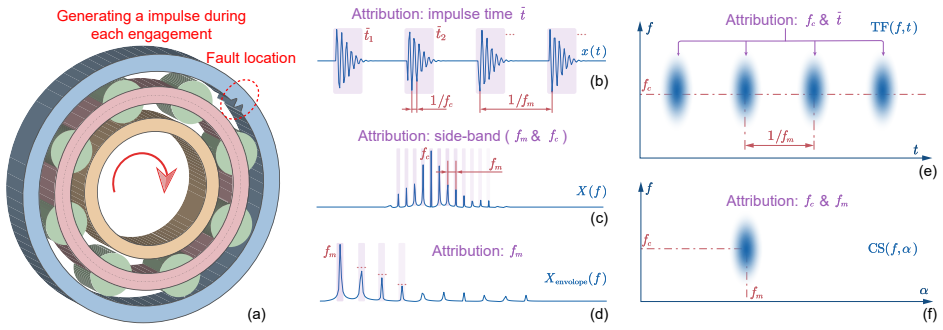
CS-SHAP claims that the right explanation space for intelligent fault diagnosis is the cyclic-spectral domain, because a rotating-machine fault expresses itself as a modulation: a carrier (resonance) frequency $f_c$ and an excitation (modulation) frequency $f_m$. Existing SHAP variants in the time, frequency, time-frequency, or envelope domains expose only one of these two coordinates. The paper's central claim is that attributing in the CS domain, via an integrated model that first maps CS coefficients back to time using the inverse transform, gives Shapley values that simultaneously carry $f_c$ and $f_m$, resolve components that would be conflated in any single-coordinate domain, and remain interpretable under noise.
Load-bearing premise
The inverse CS transform must reconstruct a signal the network can meaningfully score even after SHAP has overwritten parts of the CS magnitude, which in turn assumes the stored phase stays consistent with the sampled magnitudes.
Editorial extensions
If this is right
- Explanations for a trained fault-diagnosis network can report a single two-dimensional attribution map whose axes are carrier frequency and modulation frequency, instead of one-dimensional frequency or time attributions.
- If two fault components share a carrier frequency, or share a modulation frequency, CS-SHAP can still separate their contributions, whereas frequency-only or envelope-only SHAP cannot.
- The method stays post-hoc and model-agnostic: any trained network can be wrapped with the inverse transform and explained without retraining or architectural change.
- CS-SHAP can be applied to any task whose input is a vibration-like signal with a periodic modulation structure, not just the three datasets demonstrated in the paper.
Reading between the lines
- Editorial: The same machinery should transfer to other cyclostationary signals beyond mechanical vibration, such as acoustic emission or motor current signals, where faults also modulate a carrier.
- Editorial: A quantitative interpretability metric that compares SHAP salience against known $(f_c, f_m)$ ground truth would make the claimed advantage testable without human inspection.
- Editorial: The phase-alignment question in the inverse transform suggests a stress test: sample random CS magnitudes consistent with the background distribution and verify that the reconstructed signals are physically plausible before trusting the resulting attributions.
Editorial analysis
A structured set of objections, weighed in public.
Referee Report
Summary. The paper proposes CS-SHAP, a post-hoc explanation method that applies SHAP in the cyclic-spectral (CS) domain to fault-diagnosis classifiers. It derives a CS transform Z and an inverse transform Z^{-1} for deterministic signals, integrates Z^{-1} with a trained end-to-end model, and computes SHAP attributions over CS-domain features. The authors claim that this yields explanations in terms of both carrier frequency f_c and modulation frequency f_m, aligning with fault mechanisms and outperforming time-, frequency-, time-frequency-, and envelope-domain SHAP. Experiments are reported on a simulation dataset, the CWRU bearing dataset, and a private helical gearbox dataset.
Significance. The idea of extending SHAP to the CS domain is timely and potentially useful for rotating-machinery fault diagnosis, where cyclostationary signatures are highly diagnostic. The paper's strengths include a clear problem statement, open-source code, and a simulation dataset with predefined fault logic that provides an explicit ground truth for one experiment. For a single sample, the forward transform identity in Eq. (13) is correct, and the inverse in Eq. (18) is mathematically consistent when the phase is exact. However, the central empirical claim of "clearer and more accurate explanations" is not yet substantiated: the real-data validation is partly circular, the comparisons are qualitative, and the phase-handling procedure under SHAP masking is unspecified. If the phase issue is resolved and quantitative evaluation is added, the method could become a useful benchmark for IFD interpretability.
major comments (6)
- [Section 3.2-3.3, Eq. (18)] The paper does not specify how the phase θ_x(f,t) is obtained when SHAP creates masked CS samples by substituting background values. If the phase of the explained sample is used, as Fig. 3(b) suggests, the reconstructed time signal after iSTFT is a hybrid whose true CS representation does not equal the masked CS; the integrated model is then evaluated on off-manifold inputs, so the computed quantities are not Shapley values over the CS features of the original model. If the phase is taken from a background sample, phase and magnitude are mismatched in the same way. The authors should state the phase policy, prove that the reconstruction preserves the masked CS, or provide evidence that the attributions are insensitive to the phase choice.
- [Eq. (18)] The inverse transform contains sqrt(∫ CS_x(f,α) e^{i2παt} dα), which is only well-defined when the integral is real and non-negative. For arbitrary masked CS inputs, which are mixtures of explained and background CS magnitudes, this condition can fail, and no clamping or projection is described. This is not a purely theoretical edge case: it is the operating regime of every SHAP subset evaluation. The paper needs to explain how the square root is computed numerically and whether the resulting reconstructed signal's CS representation equals the intended masked CS.
- [Section 4.2 and 4.3] The ground-truth fault components for the CWRU and gearbox datasets are identified by visual inspection of the CS representations themselves (e.g., the annotations in Fig. 10(a) and the corresponding statements in Section 4.2), and CS-SHAP is then judged against these CS-derived annotations. This is partially circular. The simulation dataset in Section 4.1 has predefined logic and is therefore the strongest evidence, but the real-data claims should be supported by independent annotations (e.g., bearing characteristic frequencies computed from geometry and speed, or envelope-spectrum peaks) and by quantitative agreement measures.
- [Section 4 and 5] The comparisons are qualitative and based on a single sample per class, with no error bars, no multiple runs, and no numeric metric for explanation quality. The paper's own conclusion acknowledges that validation "relies on subjective human judgment." To support the abstract's claim of "clearer and more accurate explanations," the authors should report quantitative metrics (e.g., detection rate of known fault components, overlap with ground-truth regions, or rank correlation with fault logic) averaged over multiple samples and random seeds.
- [Section 3.1] The novelty claim that the authors are "the first to rigorously derive and formally prove" the CS transform is overstated. Equation (13) is the standard definition of cyclic spectral correlation applied to a deterministic signal, and the derivation follows directly from the Wiener-Khinchin relation in Eq. (12); the paper even cites Literature [41] as having implicitly used the same construction. The contribution should be reframed as an application of known CS analysis to SHAP, rather than a new transform, unless the authors identify a specific technical distinction from existing CSC estimators.
- [Section 3.2] The paper does not define the feature partition in the CS domain (individual (f,α) bins vs. grouped components) nor the SHAP approximation algorithm used (exact enumeration, KernelSHAP, or another estimator). Since the CS domain is two-dimensional and high-dimensional, exact Shapley values over individual bins are computationally prohibitive; without this specification, the results in Figs. 6–19 cannot be reproduced or interpreted as Shapley values of a well-defined game.
minor comments (7)
- [Section 1] There are typos such as "achive" (should be "achieve") and "Negetive" in the Fig. 3 caption; please proofread the text.
- [Section 3.1] The wording "sinc signal" should be "sine signal" in the discussion following Eq. (14).
- [Section 3.3] In step ③, the text says time-domain samples are transformed using the "inverse CS transform Z^{-1}", but the forward transform Z is intended.
- [Eq. (15)] The STFT magnitude of a finite-window sine is not a constant K independent of t; it involves the window's Fourier transform evaluated at f ± f1. Consider revising this illustrative derivation to avoid an incorrect exact statement.
- [Section 4.2] The text says "P 1O and P 2O share the same modulation frequency fBPIO"; the symbol should be fBPFO, consistent with Table 3.
- [Section 5.1] The phrase "significantly impulses the CS-SHAP results" should read "significantly impacts the CS-SHAP results."
- [Figures 6-19] The color maps and labels in the attribution figures are hard to read at the printed resolution; the positive/negative contribution color bars should be made consistent across panels and figure captions should define the units.
Circularity Check
Validation on CWRU and gearbox is partly circular because ground-truth components are identified from the same CS domain that CS-SHAP explains; the simulation dataset provides independent support, so the paper is only partially circular.
-
self definitional
[Section 3.2 (advantage 1); Section 4.2 (CWRU ground-truth identification and CS-SHAP validation)]
"Reliable interpretability label: The CS domain highlights fault information more effectively than the time domain, providing more accurate and reliable ground-truths for interpretability evaluation. ... Unlike the simulation dataset where fault logic (ground truth) is explicitly defined, the CWRU dataset requires the identification of fault characteristics for each class. For clarity, we denote modulated components as P : (a, b), where a (Hz) and b (kHz) represent the carrier fc and modulation fm frequencies, respectively. ... CS-SHAP in Fig."
The reference labels used to judge CS-SHAP on CWRU and the gearbox are obtained by annotating components directly on the CS representation (e.g., P:(fc,fm)). CS-SHAP is then declared accurate because its CS-domain attribution map highlights those same CS components. Since CS-SHAP is, by construction, an attribution over the CS axes (fc, fm), agreement with CS-derived labels is not an independent test: the input representation is being used as its own ground truth. The simulation dataset has an externally defined fault logic, so this circularity is partial rather than total.
full rationale
The core derivation of CS-SHAP is self-contained: Eq. (13) follows from substituting a windowed autocorrelation into Eq. (11) and applying the Wiener-Khinchin relation (12), so the CS transform is not circularly defined in terms of SHAP. The inverse transform (18) is the corresponding Fourier inversion with stored phase; the unspecified phase handling under SHAP masking is a correctness/off-manifold concern, not a logical circularity. The paper's main validation loop is where circularity enters: on CWRU and the gearbox, the 'fault characteristics' used as ground truth are identified from the same CS representation that CS-SHAP outputs, so the qualitative agreement is partly built into the evaluation. The simulation experiment, however, provides an independent ground-truth benchmark, and the method's agreement with that predefined logic is genuine evidence. The novelty claim about being 'first to rigorously derive' the CS transform is a priority overclaim rather than a circular step, since the authors acknowledge the relation was used implicitly in [41]. Overall, the central claim retains independent content but is partially circular in validation; score 4.
Assumptions & free parameters
free parameters (1)
- STFT window h(t)
assumptions (3)
- domain assumption For deterministic signals, the windowed autocorrelation R'_x(τ,t) adequately approximates the second-order cyclostationary moment so that the CSC definition applies.
- ad hoc to paper SHAP's value function over CS-domain features with the integrated model M∘Z^{-1} yields attributions that correspond to the original model's decision basis.
- ad hoc to paper Manually annotated fault components in CS representations constitute valid ground truth for evaluating explanation accuracy.
Cite this review
Pith. "Pith review of CS-SHAP: Extending SHAP to Cyclic-Spectral Domain for Better Interpretability of Intelligent Fault Diagnosis." pith.science (2026). https://pith.science/paper/NU25IPMB
@misc{pith2026250206424,
  author       = {Pith},
  title        = {Pith review of: CS-SHAP: Extending SHAP to Cyclic-Spectral Domain for Better Interpretability of Intelligent Fault Diagnosis},
  year         = {2026},
  howpublished = {\url{https://pith.science/paper/NU25IPMB}},
  note         = {Machine review of arXiv:2502.06424}
}
read the original abstract
Neural networks (NNs), with their powerful nonlinear mapping and end-to-end capabilities, are widely applied in mechanical intelligent fault diagnosis (IFD). However, as typical black-box models, they pose challenges in understanding their decision basis and logic, limiting their deployment in high-reliability scenarios. Hence, various methods have been proposed to enhance the interpretability of IFD. Among these, post-hoc approaches can provide explanations without changing model architecture, preserving its flexibility and scalability. However, existing post-hoc methods often suffer from limitations in explanation forms. They either require preprocessing that disrupts the end-to-end nature or overlook fault mechanisms, leading to suboptimal explanations. To address these issues, we derived the cyclic-spectral (CS) transform and proposed the CS-SHAP by extending Shapley additive explanations (SHAP) to the CS domain. CS-SHAP can evaluate contributions from both carrier and modulation frequencies, aligning more closely with fault mechanisms and delivering clearer and more accurate explanations. Three datasets are utilized to validate the superior interpretability of CS-SHAP, ensuring its correctness, reproducibility, and practical performance. With open-source code and outstanding interpretability, CS-SHAP has the potential to be widely adopted and become the post-hoc interpretability benchmark in IFD, even in other classification tasks. The code is available on https://github.com/ChenQian0618/CS-SHAP.
Figures


Figures from the paper (18 more)


Reference graph
Works this paper leans on
-
[41]
Z. Chen, A. Mauricio, W. Li, K. Gryllias, A deep learning method for bearing fault diagnosis based on Cyclic Spectral Coherence and Convolutional Neural Networks, Mechanical Systems and Signal Processing 140 (2020) 106683. doi:10.1016/j.ymssp.2020.106683
arXiv 2020
-
[1]
Y . Lei, N. Li, L. Guo, N. Li, T. Yan, J. Lin, Machinery health prognostics: A systematic review from data acquisition to RUL prediction, Mechanical Systems and Signal Processing 104 (2018) 799–834.doi:10.1016/ j.ymssp.2017.11.016
work page 2018
- [2]
-
[3]
P. Gangsar, R. Tiwari, Signal based condition monitoring techniques for fault detection and diagnosis of induction motors: A state-of-the-art review, Mechanical Systems and Signal Processing 144 (2020) 106908. doi:10. 1016/j.ymssp.2020.106908
-
[4]
Y . Lei, B. Yang, X. Jiang, F. Jia, N. Li, A. K. Nandi, Applications of machine learning to machine fault diagnosis: A review and roadmap, Mechanical Systems and Signal Processing 138 (2020).doi:10.1016/j.ymssp.2019. 106587
- [5]
-
[6]
M. Hakim, A. A. B. Omran, A. N. Ahmed, M. Al-Waily, A. Abdellatif, A systematic review of rolling bearing fault diagnoses based on deep learning and transfer learning: Taxonomy, overview, application, open challenges, weaknesses and recommendations, Ain Shams Engineering Journal 14 (4) (2023) 101945. doi:10.1016/j. asej.2022.101945. 19
arXiv 2023
- [7]
Show all 42 references
-
[8]
W. Xu, Z. Zhou, T. Li, C. Sun, X. Chen, R. Yan, Physics-Constraint Variational Neural Network for Wear State Assessment of External Gear Pump, IEEE Transactions on Neural Networks and Learning Systems 35 (5) (2024) 5996–6006. doi:10.1109/TNNLS.2022.3213009
2024
-
[9]
B. Yang, Y . Lei, X. Li, N. Li, A. K. Nandi, Label Recovery and Trajectory Designable Network for Transfer Fault Diagnosis of Machines With Incorrect Annotation, IEEE/CAA Journal of Automatica Sinica 11 (4) (2024) 932–945. doi:10.1109/JAS.2023.124083
2024
-
[10]
X. Li, C. Zhang, X. Li, W. Zhang, Federated transfer learning in fault diagnosis under data privacy with target self-adaptation, Journal of Manufacturing Systems 68 (2023) 523–535. doi:10.1016/j.jmsy.2023.05.006
2023 doi
-
[11]
Y . Xu, K. Feng, X. Yan, R. Yan, Q. Ni, B. Sun, Z. Lei, Y . Zhang, Z. Liu, CFCNN: A novel convolutional fusion framework for collaborative fault identification of rotating machinery, Information Fusion 95 (2023) 1–
2023
-
[12]
H. Shao, X. Zhou, J. Lin, B. Liu, Few-Shot Cross-Domain Fault Diagnosis of Bearing Driven By Task-Supervised ANIL, IEEE Internet of Things Journal (2024) 1–1doi:10.1109/JIOT.2024.3360432
2024
-
[13]
X. Li, C. Cheng, Z. Peng, Label-guided contrastive learning with weighted pseudo-labeling: A novel mechanical fault diagnosis method with insufficient annotated data 254 (A) 110597.doi:10.1016/j.ress.2024.110597
2024
-
[14]
Ivanovs, R
M. Ivanovs, R. Kadikis, K. Ozols, Perturbation-based methods for explaining deep neural networks: A survey, Pattern Recognition Letters 150 (2021) 228–234. doi:10.1016/j.patrec.2021.06.030
2021 doi
-
[15]
Z. Zhao, J. Wu, T. Li, C. Sun, R. Yan, X. Chen, Challenges and Opportunities of AI-Enabled Monitoring, Diagnosis & Prognosis: A Review, Chinese Journal of Mechanical Engineering 34 (2021) 56. doi:10.1186/ s10033-021-00570-7
2021
-
[16]
doi:10.1016/j.inffus.2023.02.012
2023 doi
-
[17]
Zhang, P
Y . Zhang, P. Tino, A. Leonardis, K. Tang, A Survey on Neural Network Interpretability, IEEE Transactions on Emerging Topics in Computational Intelligence 5 (5) (2021) 726–742. doi:10.1109/TETCI.2021.3100641
2021
-
[18]
B. An, S. Wang, F. Qin, Z. Zhao, R. Yan, X. Chen, Adversarial Algorithm Unrolling Network for Inter- pretable Mechanical Anomaly Detection, IEEE Transactions on Neural Networks and Learning Systems (2024) 1–14doi:10.1109/TNNLS.2023.3250664
2024
-
[19]
Y . Li, Z. Zhou, C. Sun, X. Chen, R. Yan, Variational Attention-Based Interpretable Transformer Network for Rotary Machine Fault Diagnosis, IEEE Transactions on Neural Networks and Learning Systems (2024) 1– 14doi:10.1109/TNNLS.2022.3202234
2024
-
[20]
D. Wang, Y . Chen, C. Shen, J. Zhong, Z. Peng, C. Li, Fully interpretable neural network for locating reso- nance frequency bands for machine condition monitoring, Mechanical Systems and Signal Processing 168 (2022) 108673. doi:10.1016/j.ymssp.2021.108673
2022
-
[21]
H. Wang, Z. Liu, D. Peng, M. J. Zuo, Interpretable convolutional neural network with multilayer wavelet for Noise-Robust Machinery fault diagnosis, Mechanical Systems and Signal Processing 195 (2023) 110314. doi: 10.1016/j.ymssp.2023.110314
2023
-
[22]
Q. Chen, X. Dong, Z. Peng, Interpreting what typical fault signals look like via prototype-matching, Advanced Engineering Informatics 62 (2024) 102849. doi:10.1016/j.aei.2024.102849
2024
-
[23]
Q. Chen, X. Dong, G. Tu, D. Wang, C. Cheng, B. Zhao, Z. Peng, TFN: An interpretable neural network with time-frequency transform embedded for intelligent fault diagnosis, Mechanical Systems and Signal Processing 207 (2024) 110952. doi:10.1016/j.ymssp.2023.110952
2024
-
[24]
X. Wu, Y . Zhang, C. Cheng, Z. Peng, A hybrid classification autoencoder for semi-supervised fault diagnosis in rotating machinery, Mechanical Systems and Signal Processing 149 (2021) 107327. doi:10.1016/j.ymssp. 2020.107327
2021
-
[25]
Grezmak, J
J. Grezmak, J. Zhang, P. Wang, K. A. Loparo, R. X. Gao, Interpretable Convolutional Neural Network Through Layer-wise Relevance Propagation for Machine Fault Diagnosis, IEEE Sensors Journal 20 (6) (2020) 3172–3181. doi:10.1109/JSEN.2019.2958787
2020
-
[26]
J. Li, Y . Wang, Y . Zi, Z. Zhang, Whitening-Net: A Generalized Network to Diagnose the Faults Among Different Machines and Conditions, IEEE Transactions on Neural Networks and Learning Systems (2021) 1–14 doi:10. 1109/TNNLS.2021.3071564. 20
2021
-
[27]
S. Li, T. Li, C. Sun, R. Yan, X. Chen, Multilayer Grad-CAM: An effective tool towards explainable deep neural networks for intelligent fault diagnosis, Journal of Manufacturing Systems 69 (2023) 20–30. doi:10.1016/j. jmsy.2023.05.027
2023 doi
-
[28]
Zhang, A
C. Zhang, A. A. Mousavi, S. F. Masri, G. Gholipour, K. Yan, X. Li, Vibration feature extraction using signal processing techniques for structural health monitoring: A review, Mechanical Systems and Signal Processing 177 (2022) 109175. doi:10.1016/j.ymssp.2022.109175
2022
-
[29]
R. Yan, Z. Shang, H. Xu, J. Wen, Z. Zhao, X. Chen, R. X. Gao, Wavelet transform for rotary machine fault diagnosis:10 years revisited, Mechanical Systems and Signal Processing 200 (2023) 110545. doi:10.1016/j. ymssp.2023.110545
2023
-
[30]
Borghesani, N
P. Borghesani, N. Herwig, J. Antoni, W. Wang, A Fourier-based explanation of 1D-CNNs for machine condition monitoring applications, Mechanical Systems and Signal Processing 205 (2023) 110865. doi:10.1016/j. ymssp.2023.110865
2023
-
[31]
Q. Wu, X. Ding, L. Zhao, R. Liu, Q. He, Y . Shao, An Interpretable Multiplication-Convolution Sparse Net- work for Equipment Intelligent Diagnosis in Antialiasing and Regularization Constraint, IEEE Transactions on Instrumentation and Measurement 72 (2023) 1–12. doi:10.1109/TI...
2023
-
[32]
M. Gwak, M. S. Kim, J. P. Yun, P. Park, Robust and Explainable Fault Diagnosis With Power-Perturbation-Based Decision Boundary Analysis of Deep Learning Models, IEEE Transactions on Industrial Informatics 19 (5) (2023) 6982–6992. doi:10.1109/TII.2022.3207758
2023
-
[33]
Herwig, P
N. Herwig, P. Borghesani, Explaining deep neural networks processing raw diagnostic signals, Mechanical Sys- tems and Signal Processing 200 (2023) 110584. doi:10.1016/j.ymssp.2023.110584
2023
-
[34]
Decker, M
T. Decker, M. Lebacher, V . Tresp, Does Your Model Think Like an Engineer? Explainable AI for Bearing Fault Detection with Deep Learning, in: ICASSP 2023 - 2023 IEEE International Conference on Acoustics, Speech and Signal Processing (ICASSP), IEEE, Rhodes Island, Greece, 2023...
2023
-
[35]
R. B. Randall, Vibration-Based Condition Monitoring Industrial, Automotive and Aerospace Applications, sec- ond edition Edition, Wiley, Hoboken, NJ, 2022
2022
-
[36]
S. M. Lundberg, S.-I. Lee, A unified approach to interpreting model predictions, in: Proceedings of the 31st International Conference on Neural Information Processing Systems, NIPS’17, Curran Associates Inc., Red Hook, NY , USA, 2017, pp. 4768–4777
2017
-
[37]
L. S. Shapley, A value for n-person games, Contribution to the Theory of Games 2 (1953)
1953
-
[38]
Shap, https://github.com/shap/shap (2024)
2024
-
[39]
Spooner, W
C. Spooner, W. Gardner, The cumulant theory of cyclostationary time-series. II. Development and applications, IEEE Transactions on Signal Processing 42 (12) (Dec./1994) 3409–3429. doi:10.1109/78.340776
1994 doi
-
[40]
Gardner, C
W. Gardner, C. Spooner, The cumulant theory of cyclostationary time-series. I. Foundation, IEEE Transactions on Signal Processing 42 (12) (Dec./1994) 3387–3408. doi:10.1109/78.340775
1994 doi
-
[42]
C. Liu, X. Ma, T. Han, X. Shi, C. Qin, S. Hu, NTScatNet: An interpretable convolutional neural network for domain generalization diagnosis across different transmission paths, Measurement 204 (2022) 112041. doi: 10.1016/j.measurement.2022.112041. 21
2022
Reviewed August 8, 2026 · model on record in the stance chip above.
Discussion (0). Continue with ORCID to comment.