REVIEW 3 major objections 5 minor 53 references
Bridging Traffic State and Trajectory for Dynamic Road Network and Trajectory Representation Learning
T0 review · 3 major / 5 minor · reviewed 2026-08-08 · deepseek-v4-flash
Pith's one-line read TRACK bridges traffic state and trajectory data for dynamic representations.
desk verdict Solid empirical framework for joint road network and trajectory pre-training, but the core dynamic transition probability is never defined, so the central mechanism isn't reproducible from the paper alone. read the letter →
The pith
A machine-rendered reading of the paper's core claim, the machinery that carries it, and where it could break.
The reading
What carries the argument
The central mechanism is a time-aware transition probability $p_{i,j,t}$, introduced as the chance of moving from segment $v_i$ to segment $v_j$ within time slice $t$ using historical trajectories, inserted directly into the attention score of a graph attention network, a graph neural network that weights each neighbor by learned attention. This makes the spatial graph representation shift with time. A traffic transformer encoder, a self-attention sequence model, captures short-term speed and flow dynamics from traffic state sequences. A co-attentional transformer then lets the trajectory view and the traffic-state view exchange features using a distance-decay, gravitivity-style attention kernel. A contrastive trajectory-traffic state matching task forces each trajectory's representation to align with the traffic-state representation of its own time slice rather than another slice, and joint pre-training ties all modules together through masked trajectory prediction, masked and next state prediction, contrastive trajectory learning, and the matching loss.
What would settle it
A concrete check is to inspect the code released with the paper for the computation of $p_{i,j,t}$: if no time-aware transition-probability matrix is built, the mechanism in Equations (7) and (8) is not implemented and the reported gains cannot be attributed to it. If it is implemented, rerun the Xi'an MSTSP experiment with $p_{i,j,t}$ replaced by a constant and ask whether the roughly 0.08 MAE advantage over SSTBAN survives; if it disappears, the transition-probability mechanism is doing the work, and if it does not, the central novelty is not responsible for the reported improvement.
Extended reading notes
Core claim
TRACK claims that jointly modeling traffic state and trajectory data yields dynamic representations for both road segments and trajectories, and that these representations outperform static or single-view alternatives on downstream tasks. On the Xi'an and Chengdu datasets, TRACK reports the best mean absolute error, mean absolute percentage error, and root mean square error among all baselines for both Multi-Step Traffic State Prediction and Travel Time Estimation; for example, Xi'an MSTSP MAE 1.094 versus 1.175 for the best traffic baseline SSTBAN, and TTE MAE 1.426 versus 1.522 for the best trajectory baseline START. The paper also presents case studies showing that learned segment representations track time-varying transition probabilities and that trajectory representations respond to short-term speed changes on visited segments.
Load-bearing premise
The load-bearing premise is that the time-aware transition probability $p_{i,j,t}$ in Equations (7) and (8) can be computed from historical trajectories in a well-defined way; the paper never defines or computes it, so the trajectory-side dynamic spatial modeling rests on an unspecified quantity.
Editorial extensions
If this is right
- Road-segment embeddings become time-indexed rather than fixed, so the same segment can have different representations at different times of day, reflecting changing transition and traffic patterns.
- Trajectory representations depend on traffic state, so two trips along the identical route at different departure times do not collapse to the same vector, which is what travel time estimation needs.
- One pre-trained model can serve both segment-level prediction and trajectory-level regression, reducing the need for task-specific feature engineering in downstream traffic tasks.
- Trajectory data and traffic state data are complementary: trajectories contribute local transition patterns between segments, traffic states contribute short-term dynamics, and the matching task enforces temporal correspondence between the two views.
- On the reported datasets, the improvement over the strongest single-view baselines appears in both cities, suggesting the benefit is not specific to one road network.
Reading between the lines
- Beyond the paper, one could test how sensitive TRACK is to trajectory sampling density: if $p_{i,j,t}$ is estimated from sparse GPS data, transition probabilities become noisy, and smoothing or kernel-based estimation might change results substantially, but the paper does not discuss this.
- The matching task builds negative pairs from trajectories aligned with traffic states of other time slices; a harder extension would add negative pairs from different routes within the same time slice, which could sharpen the alignment between route semantics and traffic state, though this is not proposed in the paper.
- The gravitivity-based co-attention uses geographical distance as the deterrence function; a natural follow-up is to replace it with learned functional road relationships, such as arterial versus local streets, to see whether the dynamic representations reflect road hierarchy rather than mere proximity.
Editorial analysis
A structured set of objections, weighed in public.
Referee Report
Summary. The paper proposes TRACK, a self-supervised framework for jointly learning dynamic road network and trajectory representations from traffic state data and trajectory data. Static road segment features are encoded with a GAT, trajectory representations are learned with a transformer under masked and contrastive objectives, and dynamic spatial segment features are injected into a trajectory transition-aware GAT. A traffic transformer encoder captures spatio-temporal dynamics in traffic state sequences, while a co-attentional transformer and a trajectory-traffic state matching task model cross-view information exchange. The model is pre-trained with a joint loss and evaluated on multi-step traffic state prediction and travel time estimation using two DiDi GAIA datasets. The experiments report consistent improvements over seven baselines per task, and ablation and case studies are used to attribute the gains to the main components.
Significance. The proposed direction, jointly exploiting trajectory transitions and traffic states for dynamic urban representation learning, is timely and practically relevant. The manuscript has several strengths: a released code repository, consistent empirical gains over strong baselines on two real-world datasets, ablations that separately remove each main component, and case studies that visually connect the learned dynamics to actual traffic events. However, the assessment is currently provisional because the core trajectory-side mechanism, the transition probability p_{i,j,t}, is never defined, and the traffic-side loss LTraf is also specified only verbally. These omissions make the method unreproducible from the text, so the significance of the empirical results cannot yet be independently verified.
major comments (3)
- [Modeling Road Segments' Dynamic Features, Equations (7)-(8)] Equations (7) and (8) rely on a time-aware transition probability p_{i,j,t}, but the paper never defines it mathematically. The sentence that p_{i,j,t} 'considers the historical trajectories that occur periodically within the time slice t' is not a definition: no formula, normalization, smoothing, or indexing scheme is provided. Since p_{i,j,t} is the mechanism through which trajectory-derived dynamic spatial features enter the GAT attention weights, this omission makes the central methodological novelty unreproducible from the text. Please give a precise definition of p_{i,j,t}, specify how it is computed from the trajectory set D_t, and discuss how the O(N^2)-per-time-slice quantity is computed or stored in practice. A pointer to the code repository does not cure the omission because the scientific definition must appear in the paper.
- [Experiments, Experimental Setup and Table 2] The setup text states that 'All experiments are repeated 10 times and the average results are reported according to Student's t-test at the 0.01 significance level,' but Table 2 and Figure 4 report only single mean values, with no standard deviations, confidence intervals, or significance markers anywhere. Consequently, the claimed t-test-based significance cannot be checked, and the reader cannot assess the variability of the reported improvements. Please report standard deviations or confidence intervals for all main results, add explicit pairwise significance tests where appropriate, and clarify whether the downstream predictors are trained with frozen or fine-tuned representations, including the training protocol for the downstream tasks.
- [Pre-training Traffic Data Embedding and Traffic Transformer Encoder] The traffic-side loss LTraf is described verbally but never specified by equations. The text states that a sequence of historical traffic states is randomly masked and then predicted from intermediate representations, and that the representations of the next time slice predict the next state, but no loss terms, masking procedures, or weighting scheme are defined. Since LTraf appears in the joint pre-training objective of Equation (16) and is a central component of the traffic modality, this omission is load-bearing for reproducing the model. Please provide the complete mathematical definition of LTraf, including the form of each prediction head and the weighting between the masked-state and next-state terms.
minor comments (5)
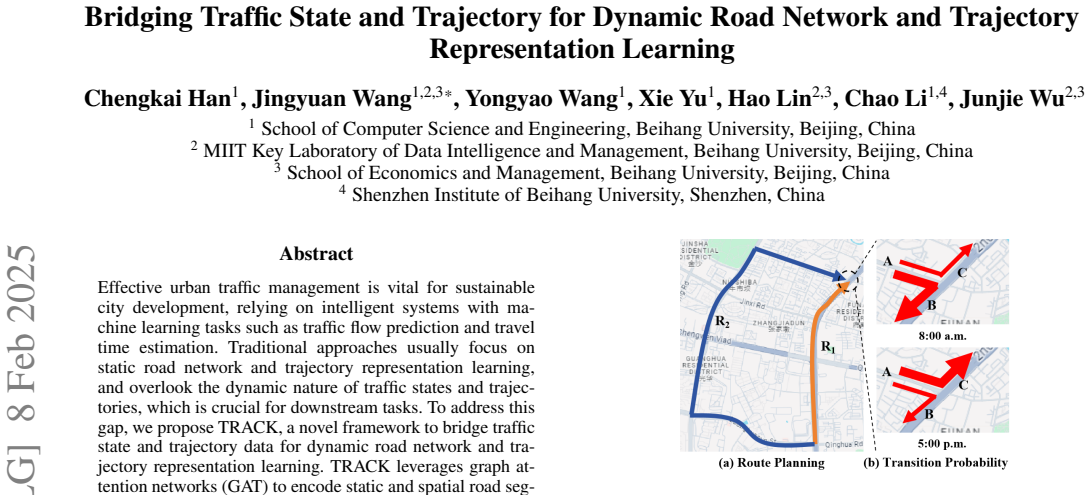
- [Introduction, Figure 1] The second panel is referred to as 'Figure (b)' but should be 'Figure 1(b)'.
- [Equation (13)] In Equation (13), the representation h^{Traf}_{v_i,t} is said to be derived at timestamp t1, but for trajectory visits the natural notation would be the visit timestamp t_i; please clarify the indexing.
- [Table 2] The caption contains a typo: 'Performance Comparsion' should be 'Performance Comparison'.
- [Co-Attentional Transformer Encoder] The term 'gravitivity-based attention' is unusual; consider using 'gravitational' or explicitly defining what is meant by this term.
- [Experiments, Experimental Setup] Details of the downstream evaluation protocol, such as the architecture and training epochs of the downstream predictors, are deferred to the code repository; at least the key choices should be stated in the paper for a self-contained evaluation.
Circularity Check
No significant circularity: TRACK's architecture is trained with self-supervised losses on real data, and its downstream gains reduce to no fitted quantity or self-citation chain.
full rationale
The paper's contribution is an empirical architecture and training procedure rather than an analytical derivation, so there is no derivation chain that could collapse into its inputs. The trajectory-derived transition probability p_{i,j,t} used in Equations (7) and (8) is indeed never formally defined in the manuscript, but it is introduced as an external input feature computed from historical trajectories, not as an output of the model or as a renamed downstream metric; this is a reproducibility defect, not a circular step. The self-supervised losses (masked trajectory prediction, contrastive trajectory learning, mask/next state prediction, and trajectory-traffic state matching) are not defined in terms of the downstream evaluation metrics (MSTSP MAE or TTE MAE), and the experimental comparison is performed against seven external baselines on held-out chronological splits. Self-citations such as START, PDFormer, BIGCity, and LibCity appear as baselines or related work and are not used to justify a load-bearing premise; no uniqueness theorem is imported, and no prediction reduces to a fitted parameter by construction. The undefined transition probability should be supplied for reproducibility, but it does not make the central claim circular.
Assumptions & free parameters
free parameters (4)
- representation dimension d =
searched over {32, 64, 128}, final value not specified
- loss weights lambda_Traj, lambda_Traf, lambda_Match =
not reported
- temperature tau in contrastive losses =
not reported
- K-minute reachable neighborhood set R_vi =
not reported
assumptions (4)
- domain assumption Traffic state data and trajectory data have spatio-temporal correlations and mutual influences.
- domain assumption A road network can be represented as a graph with nodes as road segments and edges based on connectivity.
- domain assumption Self-supervised tasks (masked prediction, contrastive learning) yield useful representations for downstream tasks.
- domain assumption Influence between road segments decreases with geographical distance via a deterrence function.
Cite this review
Pith. "Pith review of Bridging Traffic State and Trajectory for Dynamic Road Network and Trajectory Representation Learning." pith.science (2026). https://pith.science/paper/3QVQHHT4
@misc{pith2026250206870,
  author       = {Pith},
  title        = {Pith review of: Bridging Traffic State and Trajectory for Dynamic Road Network and Trajectory Representation Learning},
  year         = {2026},
  howpublished = {\url{https://pith.science/paper/3QVQHHT4}},
  note         = {Machine review of arXiv:2502.06870}
}
read the original abstract
Effective urban traffic management is vital for sustainable city development, relying on intelligent systems with machine learning tasks such as traffic flow prediction and travel time estimation. Traditional approaches usually focus on static road network and trajectory representation learning, and overlook the dynamic nature of traffic states and trajectories, which is crucial for downstream tasks. To address this gap, we propose TRACK, a novel framework to bridge traffic state and trajectory data for dynamic road network and trajectory representation learning. TRACK leverages graph attention networks (GAT) to encode static and spatial road segment features, and introduces a transformer-based model for trajectory representation learning. By incorporating transition probabilities from trajectory data into GAT attention weights, TRACK captures dynamic spatial features of road segments. Meanwhile, TRACK designs a traffic transformer encoder to capture the spatial-temporal dynamics of road segments from traffic state data. To further enhance dynamic representations, TRACK proposes a co-attentional transformer encoder and a trajectory-traffic state matching task. Extensive experiments on real-life urban traffic datasets demonstrate the superiority of TRACK over state-of-the-art baselines. Case studies confirm TRACK's ability to capture spatial-temporal dynamics effectively.
Figures


Figures from the paper (2 more)


Reference graph
Works this paper leans on
-
[1]
, " * write output.state after.block = add.period write newline
ENTRY address archivePrefix author booktitle chapter edition editor eid eprint howpublished institution isbn journal key month note number organization pages publisher school series title type volume year label extra.label sort.label short.list INTEGERS output.state before.all mid.sentence after.sentence after.block FUNCTION init.state.consts #0 'before.a...
-
[2]
write newline
" write newline "" before.all 'output.state := FUNCTION n.dashify 't := "" t empty not t #1 #1 substring "-" = t #1 #2 substring "--" = not "--" * t #2 global.max substring 't := t #1 #1 substring "-" = "-" * t #2 global.max substring 't := while if t #1 #1 substring * t #2 global.max substring 't := if while FUNCTION word.in bbl.in capitalize " " * FUNCT...
-
[3]
Bai, L.; Yao, L.; Li, C.; Wang, X.; and Wang, C. 2020. Adaptive Graph Convolutional Recurrent Network for Traffic Forecasting. In NeurIPS
work page 2020
-
[4]
Chang, Y.; Tanin, E.; Cao, X.; and Qi, J. 2023. Spatial Structure-Aware Road Network Embedding via Graph Contrastive Learning. In EDBT , 144--156. OpenProceedings.org
work page 2023
-
[5]
Chen, K.; Chu, G.; Lei, K.; Shi, Y.; and Deng, M. 2022. A Multiview Representation Learning Framework for Large-Scale Urban Road Networks. Applied Sciences, 12(13): 6301
work page 2022
-
[6]
Chen, L.; Gao, Y.; Fang, Z.; Miao, X.; Jensen, C. S.; and Guo, C. 2019. Real-time distributed co-movement pattern detection on streaming trajectories. Proceedings of the VLDB Endowment, 12(10): 1208--1220
work page 2019
-
[7]
Chen, L.; Gao, Y.; Li, X.; Jensen, C. S.; and Chen, G. 2017. Efficient Metric Indexing for Similarity Search and Similarity Joins. IEEE Transactions on Knowledge and Data Engineering, 29(3): 556--571
work page 2017
-
[8]
Chen, L.; Zhong, Q.; Xiao, X.; Gao, Y.; Jin, P.; and Jensen, C. S. 2018. Price-and-time-aware dynamic ridesharing. In 2018 IEEE 34th international conference on data engineering (ICDE), 1061--1072. IEEE
work page 2018
Show all 53 references
-
[9]
K.; and Ellison, R
Chen, Y.; Li, X.; Cong, G.; Bao, Z.; Long, C.; Liu, Y.; Chandran, A. K.; and Ellison, R. 2021. Robust Road Network Representation Learning: When Traffic Patterns Meet Traveling Semantics. In CIKM , 211--220. ACM
2021
-
[10]
Deng, J.; Chen, X.; Jiang, R.; Song, X.; and Tsang, I. W. 2021. ST-Norm: Spatial and Temporal Normalization for Multi-variate Time Series Forecasting. In KDD , 269--278. ACM
2021
-
[11]
S.; and Bao, H
Ding, X.; Chen, L.; Gao, Y.; Jensen, C. S.; and Bao, H. 2018. UlTraMan: A unified platform for big trajectory data management and analytics. Proceedings of the VLDB Endowment, 11(7): 787--799
2018
-
[12]
Fang, Z.; Long, Q.; Song, G.; and Xie, K. 2021. Spatial-Temporal Graph ODE Networks for Traffic Flow Forecasting. In KDD , 364--373. ACM
2021
-
[13]
Fu, T.-Y.; and Lee, W.-C. 2020. Trembr: Exploring road networks for trajectory representation learning. ACM Transactions on Intelligent Systems and Technology (TIST), 11(1): 1--25
2020
-
[14]
Grover, A.; and Leskovec, J. 2016. node2vec: Scalable Feature Learning for Networks. In KDD , 855--864. ACM
2016
-
[15]
Guo, S.; Lin, Y.; Gong, L.; Wang, C.; Zhou, Z.; Shen, Z.; Huang, Y.; and Wan, H. 2023. Self-Supervised Spatial-Temporal Bottleneck Attentive Network for Efficient Long-term Traffic Forecasting. In ICDE , 1585--1596. IEEE
2023
-
[16]
L.; Ying, Z.; and Leskovec, J
Hamilton, W. L.; Ying, Z.; and Leskovec, J. 2017. Inductive Representation Learning on Large Graphs. In NIPS , 1024--1034
2017
-
[17]
Ji, J.; Wang, J.; Huang, C.; Wu, J.; Xu, B.; Wu, Z.; Zhang, J.; and Zheng, Y. 2023. Spatio-Temporal Self-Supervised Learning for Traffic Flow Prediction. In AAAI , 4356--4364. AAAI Press
2023
-
[18]
Ji, J.; Wang, J.; Jiang, Z.; Jiang, J.; and Zhang, H. 2022 a . STDEN: Towards Physics-Guided Neural Networks for Traffic Flow Prediction. In AAAI , 4048--4056. AAAI Press
2022
-
[19]
Ji, J.; Wang, J.; Jiang, Z.; Ma, J.; and Zhang, H. 2020. Interpretable spatiotemporal deep learning model for traffic flow prediction based on potential energy fields. In 2020 IEEE international conference on data mining (ICDM), 1076--1081. IEEE
2020
-
[20]
Ji, J.; Wang, J.; Wu, J.; Han, B.; Zhang, J.; and Zheng, Y. 2022 b . Precision CityShield against hazardous chemicals threats via location mining and self-supervised learning. In Proceedings of the 28th ACM SIGKDD Conference on Knowledge Discovery and Data Mining, 3072--3080
2022
-
[21]
X.; and Wang, J
Jiang, J.; Han, C.; Zhao, W. X.; and Wang, J. 2023 a . PDFormer: Propagation Delay-Aware Dynamic Long-Range Transformer for Traffic Flow Prediction. In AAAI , 4365--4373. AAAI Press
2023
-
[22]
X.; and Wang, J
Jiang, J.; Han, C.; Zhao, W. X.; and Wang, J. 2023 b . Unified Data Management and Comprehensive Performance Evaluation for Urban Spatial-Temporal Prediction [Experiment, Analysis & Benchmark]. CoRR, abs/2308.12899
2023 arXiv
-
[23]
Jiang, J.; Pan, D.; Ren, H.; Jiang, X.; Li, C.; and Wang, J. 2023 c . Self-supervised Trajectory Representation Learning with Temporal Regularities and Travel Semantics. In ICDE , 843--855. IEEE
2023
-
[24]
X.; Wang, J.; and Jiang, J
Jiang, W.; Zhao, W. X.; Wang, J.; and Jiang, J. 2023 d . Continuous Trajectory Generation Based on Two-Stage GAN . In AAAI , 4374--4382. AAAI Press
2023
-
[25]
Li, M.; Tong, P.; Li, M.; Jin, Z.; Huang, J.; and Hua, X. 2021. Traffic Flow Prediction with Vehicle Trajectories. In AAAI , 294--302. AAAI Press
2021
-
[26]
S.; and Wei, W
Li, X.; Zhao, K.; Cong, G.; Jensen, C. S.; and Wei, W. 2018 a . Deep Representation Learning for Trajectory Similarity Computation. In ICDE , 617--628. IEEE Computer Society
2018
-
[27]
Li, Y.; Yu, R.; Shahabi, C.; and Liu, Y. 2018 b . Diffusion Convolutional Recurrent Neural Network: Data-Driven Traffic Forecasting. In ICLR (Poster) . OpenReview.net
2018
-
[28]
S.; and Lin, Y
Lin, Y.; Wan, H.; Guo, S.; Hu, J.; Jensen, C. S.; and Lin, Y. 2023. Pre-Training General Trajectory Embeddings With Maximum Multi-View Entropy Coding. IEEE Transactions on Knowledge and Data Engineering
2023
-
[29]
Liu, X.; Tan, X.; Guo, Y.; Chen, Y.; and Zhang, Z. 2022. CSTRM: Contrastive Self-Supervised Trajectory Representation Model for trajectory similarity computation. Comput. Commun., 185: 159--167
2022
-
[30]
Liu, Z.; Wang, J.; Li, Z.; and He, Y. 2024. Full Bayesian Significance Testing for Neural Networks in Traffic Forecasting. In Proceedings of the Thirty-Third International Joint Conference on Artificial Intelligence (IJCAI)
2024
-
[31]
Mao, Z.; Li, Z.; Li, D.; Bai, L.; and Zhao, R. 2022. Jointly Contrastive Representation Learning on Road Network and Trajectory. In CIKM , 1501--1510. ACM
2022
-
[32]
Perozzi, B.; Al - Rfou, R.; and Skiena, S. 2014. DeepWalk: online learning of social representations. In KDD , 701--710. ACM
2014
-
[33]
Simini, F.; Barlacchi, G.; Luca, M.; and Pappalardo, L. 2021. A Deep Gravity model for mobility flows generation. Nature communications, 12(1): 6576
2021
-
[34]
Tang, J.; Qu, M.; Wang, M.; Zhang, M.; Yan, J.; and Mei, Q. 2015. LINE: Large-scale Information Network Embedding. In WWW , 1067--1077. ACM
2015
-
[35]
Van der Maaten, L.; and Hinton, G. 2008. Visualizing data using t-SNE. Journal of machine learning research, 9(11)
2008
-
[36]
N.; Kaiser, L.; and Polosukhin, I
Vaswani, A.; Shazeer, N.; Parmar, N.; Uszkoreit, J.; Jones, L.; Gomez, A. N.; Kaiser, L.; and Polosukhin, I. 2017. Attention is All you Need. In NIPS , 5998--6008
2017
-
[37]
Velickovic, P.; Cucurull, G.; Casanova, A.; Romero, A.; Li \` o , P.; and Bengio, Y. 2018. Graph Attention Networks. In ICLR (Poster) . OpenReview.net
2018
-
[38]
Wang, D.; Zhang, J.; Cao, W.; Li, J.; and Zheng, Y. 2018. When Will You Arrive? Estimating Travel Time Based on Deep Neural Networks. In AAAI , 2500--2507. AAAI Press
2018
-
[39]
Wang, J.; Ji, J.; Jiang, Z.; and Sun, L. 2022. Traffic flow prediction based on spatiotemporal potential energy fields. IEEE Transactions on Knowledge and Data Engineering, 35(9): 9073--9087
2022
-
[40]
Wang, J.; Jiang, J.; Jiang, W.; Li, C.; and Zhao, W. X. 2021. LibCity: An Open Library for Traffic Prediction. In SIGSPATIAL/GIS , 145--148. ACM
2021
-
[41]
X.; Peng, F.; and Lin, X
Wang, J.; Wu, N.; Zhao, W. X.; Peng, F.; and Lin, X. 2019 a . Empowering A* search algorithms with neural networks for personalized route recommendation. In Proceedings of the 25th ACM SIGKDD international conference on knowledge discovery & data mining, 539--547
2019
-
[42]
Wang, M.; Lee, W.; Fu, T.; and Yu, G. 2019 b . Learning Embeddings of Intersections on Road Networks. In SIGSPATIAL/GIS , 309--318. ACM
2019
-
[43]
X.; and Jin, Y
Wu, N.; Wang, J.; Zhao, W. X.; and Jin, Y. 2019 a . Learning to Effectively Estimate the Travel Time for Fastest Route Recommendation. In CIKM , 1923--1932. ACM
2019
-
[44]
X.; Wang, J.; and Pan, D
Wu, N.; Zhao, W. X.; Wang, J.; and Pan, D. 2020 a . Learning Effective Road Network Representation with Hierarchical Graph Neural Networks. In KDD , 6--14. ACM
2020
-
[45]
Wu, Z.; Pan, S.; Long, G.; Jiang, J.; Chang, X.; and Zhang, C. 2020 b . Connecting the Dots: Multivariate Time Series Forecasting with Graph Neural Networks. In KDD , 753--763. ACM
2020
-
[46]
Wu, Z.; Pan, S.; Long, G.; Jiang, J.; and Zhang, C. 2019 b . Graph WaveNet for Deep Spatial-Temporal Graph Modeling. In IJCAI , 1907--1913. ijcai.org
2019
-
[47]
B.; Guo, C.; Hu, J.; Tang, J.; and Yang, B
Yang, S. B.; Guo, C.; Hu, J.; Tang, J.; and Yang, B. 2021. Unsupervised Path Representation Learning with Curriculum Negative Sampling. In Proceedings of the Thirtieth International Joint Conference on Artificial Intelligence, IJCAI 2021 , 3286--3292. ijcai.org
2021
-
[48]
B.; Guo, C.; Hu, J.; Yang, B.; Tang, J.; and Jensen, C
Yang, S. B.; Guo, C.; Hu, J.; Yang, B.; Tang, J.; and Jensen, C. S. 2022. Weakly-supervised Temporal Path Representation Learning with Contrastive Curriculum Learning. In ICDE , 2873--2885. IEEE
2022
-
[49]
Yao, D.; Zhang, C.; Zhu, Z.; Huang, J.; and Bi, J. 2017. Trajectory clustering via deep representation learning. In 2017 international joint conference on neural networks (IJCNN), 3880--3887. IEEE
2017
-
[50]
Yi, Z.; Zhou, Z.; Huang, Q.; Chen, Y.; Yu, L.; Wang, X.; and Wang, Y. 2024. Get Rid of Task Isolation: A Continuous Multi-task Spatio-Temporal Learning Framework. CoRR, abs/2410.10524
2024 arXiv
-
[51]
Yu, X.; Wang, J.; Yang, Y.; Huang, Q.; and Qu, K. 2024. BIGCity: A Universal Spatiotemporal Model for Unified Trajectory and Traffic State Data Analysis. arXiv preprint arXiv:2412.00953
2024 arXiv
-
[52]
Zhu, G.; Sang, Y.; Chen, W.; and Zhao, L. 2022. When Self-attention and Topological Structure Make a Difference: Trajectory Modeling in Road Networks. In APWeb/WAIM (3) , volume 13423 of Lecture Notes in Computer Science, 381--396. Springer
2022
-
[53]
Zou, D.; Wang, S.; Li, X.; Peng, H.; Wang, Y.; Liu, C.; Sheng, K.; and Zhang, B. 2024. MultiSPANS: A Multi-range Spatial-Temporal Transformer Network for Traffic Forecast via Structural Entropy Optimization. In WSDM , 1032--1041. ACM
2024
Reviewed August 8, 2026 · model on record in the stance chip above.
Discussion (0). Continue with ORCID to comment.