REVIEW 4 major objections 7 minor 49 references
NAROCE: A Neural Algorithmic Reasoner Framework for Online Complex Event Detection
T0 review · 4 major / 7 minor · reviewed 2026-08-08 · deepseek-v4-flash
Pith's one-line read NAROCE claims that a Mamba-based reasoner pretrained on synthetic atomic-event traces, frozen and paired with a small sensor adapter, matches the strongest baseline with less than half the labeled sensor data.
desk verdict A well-argued two-stage framework for data-efficient complex event detection, with careful statistics, but the central data-efficiency claim rests on an unvalidated proxy: engineered LLM pseudo-traces whose distributional gap to real sensor sequences is never measured. read the letter →
The pith
A machine-rendered reading of the paper's core claim, the machinery that carries it, and where it could break.
The reading
What carries the argument
The load-bearing object is the frozen latent reasoning space. Stage 1 constructs it: an AE tokenizer maps each atomic event to a token, a learnable embedding encoder projects tokens into 128 dimensions, and a 12-layer Mamba—a selective state-space sequence model suited to long-range dependencies—is trained on pseudo traces with Focal Loss to predict sparse online CE labels. Stage 2 discards the embedding encoder, freezes the Mamba reasoner, and trains a 6-layer Mamba sensor adapter to output 128-dimensional vectors from pretrained audio/IMU embeddings. The pseudo traces are the enabler: they are cheap, abundant, and generated by ten LLM-based simulators per rule, with labels assigned by finite-state machines rather than by the LLM.
What would settle it
Train NAROCE identically but replace the LLM-generated pseudo traces with ground-truth atomic-event sequences from the same simulator that generated the CE sensor dataset; if the data-efficiency advantage over end-to-end Mamba disappears, the result is an artifact of the pseudo-trace distribution rather than of rule/sensor decoupling. A complementary calculation is to estimate the distributional distance between pseudo-trace atomic-event statistics and sensor-derived atomic-event classifier outputs, and check whether NAROCE's accuracy drops as that distance grows.
Extended reading notes
Core claim
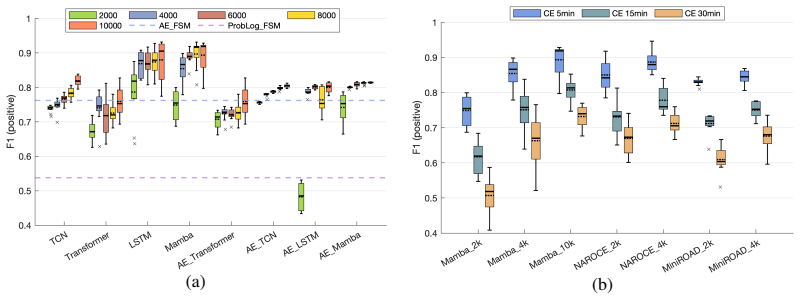
The central discovery is that online complex event detection separates cleanly into rule learning and sensor projection. The authors train a 12-layer Mamba model as a CE reasoner on 40,000 tokenized pseudo atomic-event traces generated by ten LLM-built stochastic simulators, with labels produced by hand-written finite-state machines for ten CE rules. Once trained, that reasoner is frozen and a smaller 6-layer Mamba adapter is trained on 4,000 labeled IMU+audio windows to embed sensor features into the reasoner's latent space. The resulting system's positive F1 is statistically indistinguishable from an end-to-end Mamba trained on 10,000 labeled windows and significantly better than the same model trained on 4,000, while also generalizing to 15- and 30-minute test sequences with longer temporal gaps.
Load-bearing premise
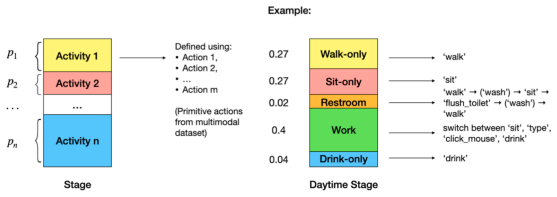
The load-bearing premise is that the LLM-generated pseudo atomic-event traces are a valid stand-in for the atomic-event sequences the sensor adapter will encounter; the prompts in Appendix H explicitly steer the traces toward the target patterns, and the paper does not quantify the gap between this engineered distribution and real activity statistics.
Editorial extensions
If this is right
- NAROCE with 4,000 labeled sensor windows matches an end-to-end Mamba trained on 10,000 windows, and with 2,000 it shows no significant difference from Mamba_4k or MiniROAD_4k on the 5-minute test set.
- Scaling pseudo-trace pretraining from 20,000 to 40,000 and 80,000 traces improves accuracy and generalization to longer out-of-distribution sequences, with the largest gains when sensor labels are scarce.
- Focal Loss at both training stages is necessary for out-of-distribution robustness; without it, performance on 30-minute sequences degrades sharply.
- The adapter's latent space separates atomic-event classes even though it was trained only with CE-level labels, indicating the frozen reasoner imposes atomic-event structure on the sensor stream.
Reading between the lines
- The LLM is not essential: any stochastic simulator that reproduces realistic atomic-event statistics should work, so replacing the LLM synthesizer with a calibrated hand-written simulator is a direct test of whether the pseudo-trace distribution is the active ingredient.
- The frozen CE reasoner could be reused across sensors and modalities, amortizing Stage 1 pretraining and turning it into a reusable rule module for new complex-event tasks.
- Because the adapter learns atomic-event structure from CE labels alone, NAROCE may bootstrap atomic-event semantics in domains without fine-grained annotations, but only within the atomic-event vocabulary encoded in the pseudo traces.
- The fixed 5-second window, closed atomic-event set, and lack of an "other" class are deployment limits; relaxing them would stress the tokenizer and the reasoner's state memory.
Editorial analysis
A structured set of objections, weighed in public.
Referee Report
Summary. The paper proposes NAROCE, a two-stage framework for online complex event detection. Stage 1 trains a Mamba-based neural algorithmic reasoner (CENAR) on LLM-generated pseudo atomic-event (AE) traces paired with FSM-based CE labels, thereby learning CE rules without sensor data. Stage 2 freezes the CENAR and trains a smaller sensor adapter to project pretrained sensor embeddings into the CENAR's latent space using only sparse CE-level labels and Focal Loss. Experiments on a synthetic multimodal (IMU+audio) benchmark with 10 CE classes and 9 AEs claim that NAROCE with 4,000 labeled sensor samples matches an end-to-end Mamba trained on 10,000 samples, and generalizes better to longer (15/30-minute) out-of-distribution sequences.
Significance. If the results hold beyond the synthetic testbed, NAROCE offers a practical way to reduce CE annotation cost by decoupling rule learning from sensor data. The empirical methodology is careful in several respects: 10 random seeds, 2-sigma confidence intervals, Wilcoxon signed-rank tests, and ablations on Focal Loss and pseudo-trace quantity. The finding that adapter embeddings trained with only CE labels exhibit AE-like cluster structure (Appendix B.2) is an interesting interpretability result. The main limitation is that the entire evaluation is on a synthetic dataset, and the pseudo-trace distribution is engineered rather than compared against measured AE statistics; the data-efficiency claim therefore rests on an untested proxy.
major comments (4)
- [Section 6.2] The claim that 'NAROCE_4k significantly outperforms Mamba_4k' is stated without qualification in Section 6.2, but Appendix I.2 reports p=0.30 for the 15-minute test under the null that NAROCE_4k is worse than Mamba_4k. The claim should be restricted to the 5-min and 30-min test sets, or the main-text wording should be adjusted to reflect the non-significant 15-min result. This overstatement is load-bearing because the abstract and introduction assert that NAROCE 'outperforms the strongest baseline' without noting this caveat.
- [Section 4.3 and Appendix H] The pseudo AE traces used to train the CENAR are generated by LLM-prompted simulators whose activity vocabularies are restricted per rule and whose transition probabilities are engineered to force target patterns. For the e1 prompt (Appendix H.2), the user-defined activity set is ['click_mouse', 'flush_toilet', 'sit', 'type', 'walk', 'wash'], omitting 'eat', 'drink', and 'brush_teeth' that appear as distractors in the real e1 sensor sequences of the benchmark. The paper does not quantify the distributional gap between LLM pseudo traces and the sensor-derived AE sequences (Section 5.1), nor does it test sensitivity to the prompt vocabulary or the forced-pattern guarantee. Since Stage 2 relies on a frozen CENAR whose latent space was learned on this engineered distribution, the claimed data-efficiency advantage could be an artifact of the proxy if the adapter must compensate for misaligned token coverage. The authors should add a quantitative comparison of AE statistics (e.g., transition matrices, n-gram frequencies, t-SNE alignment) and ablations varying the prompt constraints.
- [Appendix I.2] The conclusion that 'there is no significant difference between NAROCE_4k and Mamba_10k' is based on two one-sided Wilcoxon tests that both fail to reject the respective nulls. With only 10 seeds, this is not evidence of equivalence; the correct reading is that the data are insufficient to detect a difference. The phrase 'matches or exceeds' in Section 1 and the abstract's 'comparable performance' are acceptable as descriptive of point estimates, but the paper should avoid implying statistical equivalence. An equivalence test or a report of the minimal detectable effect size would strengthen the claim.
- [Section 5.1 and Appendix C] All reported results are on a synthetic benchmark in which sensor data are synthesized by concatenating real IMU/audio clips according to AE sequences produced by the authors' stochastic simulator. The pretrained feature encoder is also trained on these same synthetic AE sensor clips (Appendix E). The conclusion that NAROCE 'reduces reliance on large-scale labeled sensor data' for real-world online CED is therefore not yet supported; the paper's own Discussion (Section 7) identifies real-life CE datasets as future work. At minimum, the abstract and introduction should restrict the claim to the synthetic testbed or add a real-data validation (even a small case study).
minor comments (7)
- [Figure 2] The figure label 'NARCE Framework' should read 'NAROCE Framework'.
- [Table 4] In the note under Table 4, 'user-deinfed' is a typo for 'user-defined'.
- [Appendix I.2] The hypothesis description uses 'narce_4k' in lowercase while the rest of the text uses 'NAROCE_4k'; please make the notation consistent.
- [Section 1] The code and dataset link is given as '/r/naroce-DC82/' without a domain; please provide a complete URL.
- [Section 4.3] The paper says 'we instantiate 10 LLM-based simulators' while Appendix H.2 says 'we use 10 LLM-generated simulators'; unify the terminology and clarify that the LLM produces simulator code that is then executed to generate traces.
- [Section 5.2] The 'Neural AE + FSM' baseline uses the same FSMs as those used for ground-truth labeling; this should be stated explicitly in the main text, as it places that baseline as a near-upper reference rather than a fully learned model.
- [Appendix B.1] Table 7 shows that 'Only Adapter w/o FL' with 4k data reaches F1_pos .86/.75/.68, close to standard NAROCE .89/.77/.71; include a significance test for this ablation to justify the claim that Focal Loss is 'crucial' (Section 6.3).
Circularity Check
No significant circularity: the two-stage pretrain-and-adapt pipeline is evaluated empirically against baselines; the only flagged issues are distributional-fidelity limitations, not circular reductions.
full rationale
NAROCE's derivation chain is not circular. Stage 1 (Section 4.3) trains a Mamba-based CE NAR on LLM-generated pseudo AE traces labeled by hand-written FSMs; Stage 2 (Section 4.4) freezes that network and trains a sensor adapter on CE-labeled sensor embeddings. The paper's central claims—higher positive F1, OOD generalization to 15/30-minute traces, and data efficiency—are empirical comparisons against LSTM/TCN/Transformer/Mamba/MiniROAD baselines on a shared synthetic test set. Neither the CE NAR nor the adapter is fitted to the test outcome; no parameter estimated from a subset is later reported as a prediction of a closely related quantity. The CE rules used to label pseudo traces are the same task definition used to label the synthetic sensor test set, which is a standard supervised setup rather than a constructed equivalence. The LLM prompt in Appendix H forces target CE patterns into pseudo traces (step 5: 'guarantee at least one group in the sequence'), and the example prompt omits three benchmark AEs, but these affect the pretraining distribution's fidelity—an external-validity/domain-gap concern, not a circular reduction. The authors themselves acknowledge the synthetic-to-real gap in Section 7 ('Future work includes collecting real-life CE datasets to evaluate NAROCE'). The only self-citations ([16]) justify Mamba's suitability and the decision not to use LLMs for labeling; these are not load-bearing for the central result. No equation or fitted value is shown to equal its input by construction.
Assumptions & free parameters
free parameters (3)
- Focal loss alpha_0 (majority class weight) =
0.005
- Focal loss alpha_y (positive class weight) =
0.25
- Focal loss gamma (focusing parameter) =
2
assumptions (5)
- domain assumption Complex event patterns are representable as finite state machines with finite states and bounded temporal constraints.
- domain assumption LLM-generated pseudo atomic event traces are a valid proxy for real atomic event sequences from sensor data.
- domain assumption The pretrained feature encoder (BEATs + LIMU-BERT + fusion) produces embeddings that preserve enough atomic event information for the sensor adapter to map into the reasoner space.
- domain assumption The synthetic multimodal dataset (concatenated WISDM and ESC-70 clips following a stochastic simulator) captures the online CED challenge realistically.
- standard math Standard mathematical definitions of focal loss, Mamba, and online classification are taken as given.
Cite this review
Pith. "Pith review of NAROCE: A Neural Algorithmic Reasoner Framework for Online Complex Event Detection." pith.science (2026). https://pith.science/paper/YF5ZWJBT
@misc{pith2026250207250,
  author       = {Pith},
  title        = {Pith review of: NAROCE: A Neural Algorithmic Reasoner Framework for Online Complex Event Detection},
  year         = {2026},
  howpublished = {\url{https://pith.science/paper/YF5ZWJBT}},
  note         = {Machine review of arXiv:2502.07250}
}
read the original abstract
Modern machine learning models excel at detecting individual actions, objects, or scene attributes from short, local observations. However, many real-world tasks, such as in smart cities and healthcare, require reasoning over complex events (CEs): (spatio)temporal, rule-governed patterns of short-term atomic events (AEs) that reflect high-level understanding and critical changes in the environment. These CEs are difficult to detect online: they are often rare, require long-range reasoning over noisy sensor data, must generalize rules beyond fixed-length traces, and suffer from limited real-world datasets due to the high annotation burden. We propose NAROCE, a Neural Algorithmic Reasoning framework for Online CE detection that separates the task into two stages: (i) learning CE rules from large-scale, low-cost pseudo AE concept traces generated by simulators or LLMs, and (ii) training an adapter to map real sensor data into the learned reasoning space using fewer labeled sensor samples. Experiments show that NAROCE outperforms the strongest baseline in accuracy, generalization to longer, unseen sequences, and data efficiency, achieving comparable performance with less than half the labeled data. These results suggest that decoupling CE rule learning from raw sensor inputs improves both data efficiency and robustness.
Figures


Figures from the paper (10 more)




Reference graph
Works this paper leans on
-
[16]
Toward foundation models for online complex event detection in cps-iot: A case study
Liying Han, Gaofeng Dong, Xiaomin Ouyang, Lance Kaplan, Federico Cerutti, and Mani Srivastava. Toward foundation models for online complex event detection in cps-iot: A case study. InProceedings of the 2nd International Workshop on Foundation Models for Cyber- Physical Systems & Internet of Things, SenSys ’25, page 1–6. ACM, May 2025
work page 2025
-
[1]
Miniroad: Minimal rnn framework for online action detection
Joungbin An, Hyolim Kang, Su Ho Han, Ming-Hsuan Yang, and Seon Joo Kim. Miniroad: Minimal rnn framework for online action detection. In2023 IEEE/CVF International Conference on Computer Vision (ICCV), pages 10307–10316, 2023
work page 2023
-
[2]
Zico Kolter, and Vladlen Koltun
Shaojie Bai, J. Zico Kolter, and Vladlen Koltun. An empirical evaluation of generic convolu- tional and recurrent networks for sequence modeling.CoRR, abs/1803.01271, 2018
arXiv 2018
-
[3]
Multimodal machine learn- ing: A survey and taxonomy.CoRR, abs/1705.09406, 2017
Tadas Baltrusaitis, Chaitanya Ahuja, and Louis-Philippe Morency. Multimodal machine learn- ing: A survey and taxonomy.CoRR, abs/1705.09406, 2017
arXiv 2017
-
[4]
Hamrick, Larisa Markeeva, Alex Vitvitskyi, Razvan Pascanu, and Petar Veli ˇckovi´c
Wilfried Bounsi, Borja Ibarz, Andrew Dudzik, Jessica B. Hamrick, Larisa Markeeva, Alex Vitvitskyi, Razvan Pascanu, and Petar Veli ˇckovi´c. Transformers meet neural algorithmic reasoners, 2024
work page 2024
-
[5]
E2e-load: End-to-end long-form online action detection, 2023
Shuqiang Cao, Weixin Luo, Bairui Wang, Wei Zhang, and Lin Ma. E2e-load: End-to-end long-form online action detection, 2023
work page 2023
-
[6]
Gatehub: Gated history unit with background suppression for online action detection, 2022
Junwen Chen, Gaurav Mittal, Ye Yu, Yu Kong, and Mei Chen. Gatehub: Gated history unit with background suppression for online action detection, 2022
work page 2022
-
[7]
Beats: Audio pre-training with acoustic tokenizers, 2022
Sanyuan Chen, Yu Wu, Chengyi Wang, Shujie Liu, Daniel Tompkins, Zhuo Chen, and Furu Wei. Beats: Audio pre-training with acoustic tokenizers, 2022
work page 2022
Show all 49 references
-
[8]
Processing flows of information: From data stream to complex event processing.ACM Comput
Gianpaolo Cugola and Alessandro Margara. Processing flows of information: From data stream to complex event processing.ACM Comput. Surv., 44(3), jun 2012
2012
-
[9]
Transformers are ssms: Generalized models and efficient algorithms through structured state space duality, 2024
Tri Dao and Albert Gu. Transformers are ssms: Generalized models and efficient algorithms through structured state space duality, 2024
2024
-
[10]
Problog: a probabilistic prolog and its application in link discovery
Luc De Raedt, Angelika Kimmig, and Hannu Toivonen. Problog: a probabilistic prolog and its application in link discovery. InProceedings of the 20th International Joint Conference on Artifical Intelligence, IJCAI’07, page 2468–2473, San Francisco, CA, USA, 2007. Morgan Kaufmann...
2007
-
[11]
Aggregation and correlation of intrusion-detection alerts
Hervé Debar and Andreas Wespi. Aggregation and correlation of intrusion-detection alerts. In Lecture Notes in Computer Science, pages 85–103. Springer Berlin Heidelberg, 2001
2001
-
[12]
Activitynet: A large-scale video benchmark for human activity understanding
Bernard Ghanem Fabian Caba Heilbron, Victor Escorcia and Juan Carlos Niebles. Activitynet: A large-scale video benchmark for human activity understanding. InProceedings of the IEEE Conference on Computer Vision and Pattern Recognition, pages 961–970, 2015
2015
-
[13]
Online action detection, 2016
Roeland De Geest, Efstratios Gavves, Amir Ghodrati, Zhenyang Li, Cees Snoek, and Tinne Tuytelaars. Online action detection, 2016
2016
-
[14]
Mamba: Linear-time sequence modeling with selective state spaces, 2024
Albert Gu and Tri Dao. Mamba: Linear-time sequence modeling with selective state spaces, 2024
2024
-
[15]
Efficiently modeling long sequences with structured state spaces, 2022
Albert Gu, Karan Goel, and Christopher Ré. Efficiently modeling long sequences with structured state spaces, 2022
2022
-
[17]
Long short-term memory.Neural computation, 9(8):1735–1780, 1997
Sepp Hochreiter and Jürgen Schmidhuber. Long short-term memory.Neural computation, 9(8):1735–1780, 1997
1997
-
[18]
A generalist neural algorithmic learner, 2022
Borja Ibarz, Vitaly Kurin, George Papamakarios, Kyriacos Nikiforou, Mehdi Bennani, Róbert Csordás, Andrew Dudzik, Matko Bošnjak, Alex Vitvitskyi, Yulia Rubanova, Andreea Deac, Beatrice Bevilacqua, Yaroslav Ganin, Charles Blundell, and Petar Veli ˇckovi´c. A generalist neural a...
2022
-
[19]
Jiang, J
Y .-G. Jiang, J. Liu, A. Roshan Zamir, G. Toderici, I. Laptev, M. Shah, and R. Sukthankar. THUMOS challenge: Action recognition with a large number of classes. http://crcv.ucf. edu/THUMOS14/, 2014
2014
-
[20]
Girshick, Kaiming He, and Piotr Dollár
Tsung-Yi Lin, Priya Goyal, Ross B. Girshick, Kaiming He, and Piotr Dollár. Focal loss for dense object detection.CoRR, abs/1708.02002, 2017
2017 arXiv
-
[21]
Deepproblog: Neural probabilistic logic programming
Robin Manhaeve, Sebastijan Dumancic, Angelika Kimmig, Thomas Demeester, and Luc De Raedt. Deepproblog: Neural probabilistic logic programming. In S. Bengio, H. Wallach, H. Larochelle, K. Grauman, N. Cesa-Bianchi, and R. Garnett, editors,Advances in Neural Information Processin...
2018
-
[22]
Deepproblog: Neural probabilistic logic programming.CoRR, abs/1907.08194, 2019
Robin Manhaeve, Sebastijan Dumancic, Angelika Kimmig, Thomas Demeester, and Luc De Raedt. Deepproblog: Neural probabilistic logic programming.CoRR, abs/1907.08194, 2019
1907 arXiv
-
[23]
Benchmark for kitchen20, a daily life dataset for audio-based human action recognition
Marc Moreaux, Michael Garcia Ortiz, Isabelle Ferrané, and Frederic Lerasle. Benchmark for kitchen20, a daily life dataset for audio-based human action recognition. In2019 International Conference on Content-Based Multimedia Indexing (CBMI), pages 1–6, 2019
2019
-
[24]
Human activity recognition using deep learning models on smartphones and smartwatches sensor data, 2021
Bolu Oluwalade, Sunil Neela, Judy Wawira, Tobiloba Adejumo, and Saptarshi Purkayastha. Human activity recognition using deep learning models on smartphones and smartwatches sensor data, 2021
2021
-
[25]
Karol J. Piczak. ESC: Dataset for Environmental Sound Classification. InProceedings of the 23rd Annual ACM Conference on Multimedia, pages 1015–1018. ACM Press, 2015
2015
-
[26]
Deepprobcep: A neuro-symbolic approach for complex event processing in adversarial settings.Expert Systems with Applications, 215:119376, 2023
Marc Roig Vilamala, Tianwei Xing, Harrison Taylor, Luis Garcia, Mani Srivastava, Lance Kaplan, Alun Preece, Angelika Kimmig, and Federico Cerutti. Deepprobcep: A neuro-symbolic approach for complex event processing in adversarial settings.Expert Systems with Applications, 215:...
2023
-
[27]
Distributed complex event processing with query rewriting
Nicholas Schultz-Møller, Matteo Migliavacca, and Peter Pietzuch. Distributed complex event processing with query rewriting. InProceedings of the Third ACM International Conference on Distributed Event-Based Systems, 07 2009
2009
-
[28]
Gomez, Lukasz Kaiser, and Illia Polosukhin
Ashish Vaswani, Noam Shazeer, Niki Parmar, Jakob Uszkoreit, Llion Jones, Aidan N. Gomez, Lukasz Kaiser, and Illia Polosukhin. Attention is all you need.CoRR, abs/1706.03762, 2017
2017 arXiv
-
[29]
Neural algorithmic reasoning.CoRR, abs/2105.02761, 2021
Petar Velickovic and Charles Blundell. Neural algorithmic reasoning.CoRR, abs/2105.02761, 2021
2021 arXiv
-
[30]
The clrs algorithmic reasoning benchmark, 2022
Petar Veliˇckovi´c, Adrià Puigdomènech Badia, David Budden, Razvan Pascanu, Andrea Ban- ino, Misha Dashevskiy, Raia Hadsell, and Charles Blundell. The clrs algorithmic reasoning benchmark, 2022
2022
-
[31]
Adapting complex event detection to perceptual domain shifts
Brian Wang, Julian de Gortari Briseno, Liying Han, Henry Phillips, Jeffrey Craighead, Ben Purman, Lance Kaplan, and Mani Srivastava. Adapting complex event detection to perceptual domain shifts. InMILCOM 2024 - 2024 IEEE Military Communications Conference (MILCOM), pages 1–6, 2024
2024
-
[32]
Memory-and-anticipation transformer for online action understanding, 2023
Jiahao Wang, Guo Chen, Yifei Huang, Limin Wang, and Tong Lu. Memory-and-anticipation transformer for online action understanding, 2023
2023
-
[33]
Oadtr: Online action detection with transformers, 2021
Xiang Wang, Shiwei Zhang, Zhiwu Qing, Yuanjie Shao, Zhengrong Zuo, Changxin Gao, and Nong Sang. Oadtr: Online action detection with transformers, 2021
2021
-
[34]
WISDM Smartphone and Smartwatch Activity and Biometrics Dataset
Gary Weiss. WISDM Smartphone and Smartwatch Activity and Biometrics Dataset . UCI Machine Learning Repository, 2019. DOI: https://doi.org/10.24432/C5HK59
2019 doi
-
[35]
Wilcoxon signed-rank test.Encyclopedia of Biostatistics, 8, 2005
Robert F Woolson. Wilcoxon signed-rank test.Encyclopedia of Biostatistics, 8, 2005
2005
-
[36]
Neuroplex: Learning to detect complex events in sensor networks through knowledge injection
Tianwei Xing, Luis Garcia, Marc Roig Vilamala, Federico Cerutti, Lance Kaplan, Alun Preece, and Mani Srivastava. Neuroplex: Learning to detect complex events in sensor networks through knowledge injection. InProceedings of the 18th Conference on Embedded Networked Sensor Syste...
2020
-
[37]
Deepcep: Deep complex event processing using distributed multimodal information
Tianwei Xing, Marc Roig Vilamala, Luis Garcia, Federico Cerutti, Lance Kaplan, Alun Preece, and Mani Srivastava. Deepcep: Deep complex event processing using distributed multimodal information. In2019 IEEE International Conference on Smart Computing (SMARTCOMP), pages 87–92, 2019
2019
-
[38]
Limu-bert: Unleashing the potential of unlabeled data for imu sensing applications
Huatao Xu, Pengfei Zhou, Rui Tan, Mo Li, and Guobin Shen. Limu-bert: Unleashing the potential of unlabeled data for imu sensing applications. InProceedings of the 19th ACM Conference on Embedded Networked Sensor Systems, SenSys ’21, page 220–233, New York, NY , USA, 2021. Asso...
2021
-
[39]
Long short-term transformer for online action detection
Mingze Xu, Yuanjun Xiong, Hao Chen, Xinyu Li, Wei Xia, Zhuowen Tu, and Stefano Soatto. Long short-term transformer for online action detection. In M. Ranzato, A. Beygelzimer, Y . Dauphin, P.S. Liang, and J. Wortman Vaughan, editors,Advances in Neural Information Processing Sys...
2021
-
[40]
Wash hands continuously for at least 20 seconds
Yue Zhao and Philipp Krähenbühl. Real-time online video detection with temporal smoothing transformers, 2022. 13 A Complex Event Dataset Classes A.1 Complex Event Patterns Table 4: Category of Complex Event Patterns. CECategory Features Examples Sequential Patterns -Relaxed Ke...
2022
-
[47]
Each group should include all activities commonly associated with it in realistic scenarios
Design different semantic groups (e.g., hygiene, restroom, work...) that contain related activities. Each group should include all activities commonly associated with it in realistic scenarios
-
[48]
Design different range of time durations for both semantic groups and the activities in each group
-
[49]
Some semantic group may have higher frequency while some may happen only once in some period of time
Design the transition between semantic groups probabilistically governed by realistic probabilities. Some semantic group may have higher frequency while some may happen only once in some period of time. Also design a distribution of the initial group
-
[50]
sit" for some time before
Design the sub-transitions within a semantic group using realistic probabilities, (e.g., one usually "sit" for some time before "flush_toilet"). Also, in reality, some activity may appear only once in the semantic group, use a dynamic weight adjustment so that the probability ...
-
[51]
Double check if the transition will give us activity patterns of interest. For instance, for events related to some semantic group, guarantee at least one group in the sequence (e.g., adjust probabilities dynamically to increase the probability of 25 selecting this group after...
-
[52]
click_mouse
Add a small portion of random noise or perturbation during the generation to increase the sequence variability. 12 13// User - defined input starts here 14Now, we are interested in an event related to: workspace sanitary protocol. A person may or may not start working without ...
-
[83]
Some semantic group may have 24 higher frequency while some may happen only once in some period of time
Design the transition between semantic groups probabilistically governed by realistic probabilities. Some semantic group may have 24 higher frequency while some may happen only once in some period of time. Also design a distribution of the initial group
-
[105]
Double check if the transition will give us activity patterns of interest. For instance, for events related to some semantic group, guarantee at least one group in the sequence (e.g., adjust probabilities dynamically to increase the probability of selecting this group after a ...
-
[116]
Add a small portion of random noise or perturbation during the generation to increase the sequence variability. 12 13// User - defined input starts here 14Now, we are interested in an event related to: 15 [USER-PROVIDED EVENT DESCRIPTION] 16 17// User - defined activity set 18...
Reviewed August 8, 2026 · model on record in the stance chip above.
Discussion (0). Continue with ORCID to comment.