REVIEW 4 major objections 5 minor 51 references
On Iterative Evaluation and Enhancement of Code Quality Using GPT-4o
T0 review · 4 major / 5 minor · reviewed 2026-08-08 · deepseek-v4-flash
Pith's one-line read An LLM that scores code on ten quality dimensions and only accepts rewrites that score higher can evaluate and improve code, yielding a mean relative improvement of 52.6% on 42 Python/JavaScript examples.
desk verdict A cleanly written LLM code-quality loop whose headline improvement number is mostly a self-scoring artifact; the framework and qualitative results are worth a look, but the 52.6% claim doesn't survive contact with its own acceptance rule. read the letter →
The pith
A machine-rendered reading of the paper's core claim, the machinery that carries it, and where it could break.
The reading
What carries the argument
The load-bearing mechanism is the Evaluator-Optimizer loop with its acceptance rule. The Evaluator decomposes code quality into ten named dimensions—Readability, Maintainability, Testability, Efficiency, Robustness, Security, Documentation, Modularity, Scalability, Portability—and for each dimension asks five questions answerable only by 'True', 'False', or 'Not Applicable'; mapping those to $+1$, $-1$, and $0$ and averaging yields a code-level score in $[-5,5]$. The Optimizer feeds the qualitative dimension feedback back to GPT-4o, rewrites the code, rejects rewrites that fail compilation or supplied tests, and keeps a rewrite only if its overall CodeQUEST score does not drop relative to the last accepted version. That acceptance rule is what makes improvement monotone by construction; the external proxy metrics validate the scores but do not participate in the loop.
What would settle it
Have expert programmers blindly rate the original and final versions of the 138 improved Python outputs; if experts do not prefer the final versions, or if a control loop that replaces CodeQUEST's score with a random score produces a similar 52.6% 'improvement', then the reported gain is an artifact of the acceptance rule rather than real quality improvement.
Extended reading notes
Core claim
On the paper's own terms, the central discovery is that LLM-based code-quality assessment is prompt-sensitive in a fixable way: a dimension-decomposed, forced-choice evaluation produces more comprehensive qualitative feedback and better-calibrated scores than a simple chain-of-thought rating, and those scores can drive a monotonic improvement loop. The framework's Evaluator produces a code-level score as the average of ten dimension scores, each in $[-5,5]$; the Optimizer rewrites code from the dimension feedback, validates that the rewrite compiles and passes available tests, and rejects any version whose overall score falls. Across the curated dataset, 41 of 42 examples improved, the mean relative percentage improvement was $52.6\% \pm 17.9\%$, and the per-iteration change in CodeQUEST scores correlated with per-iteration changes in Pylint, Radon, and Bandit proxies more strongly than the baseline did. The paper also reports that CodeQUEST caught hardcoded API keys in SecurityEval examples that Bandit reported as clean, indicating the LLM evaluator can complement static analyzers.
Load-bearing premise
The load-bearing premise is that the GPT-4o-generated numerical score genuinely tracks code quality, so a higher score after rewriting means better code and not merely a version the model prefers.
Editorial extensions
If this is right
- Most of the quality gain arrives in the first iteration cycle (about 2 code-quality units on average), with later iterations adding 0.52, 0.27, and then below 0.1 units, so a one- or two-iteration budget captures most of the benefit at lower API cost.
- Because the Optimizer rejects any rewrite whose overall CodeQUEST score falls, the final delivered version is guaranteed by construction to score at least as high as the original on the framework's own scale.
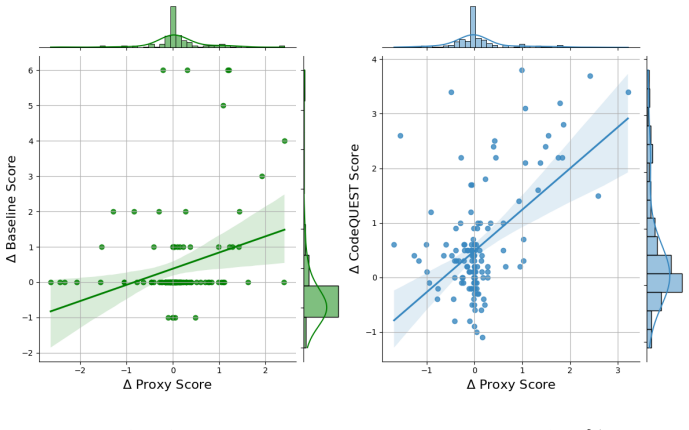
- The framework's per-iteration score changes correlate with changes in Pylint, Radon Maintainability Index, and Bandit proxies (Pearson $r = 0.53$ for CodeQUEST versus $0.27$ for the baseline), suggesting the evaluator tracks externally measurable quality shifts better than a generic chain-of-thought prompt does.
- On the SecurityEval examples, CodeQUEST flagged hardcoded API keys that Bandit missed, so an LLM-based evaluator can complement rather than replace static analysis security tools.
Reading between the lines
- A natural next experiment, not run here, would swap the Evaluator's score for a random score while keeping the same acceptance rule; if the reported improvement persists, the acceptance rule—not genuine quality tracking—would be doing the work.
- The same judge-and-accept loop could be repurposed for other quality targets, such as performance budgets or accessibility, by replacing the ten dimensions; the paper's generality claim would then be testable without new machinery.
- The paper's own threat-to-validity section concedes hallucination, stochasticity, small dataset size, and dependence on GPT-4o's training coverage; those caveats mean the 52.6% figure is better read as evidence for the recipe than as a guarantee for arbitrary codebases.
Editorial analysis
A structured set of objections, weighed in public.
Referee Report
Summary. The manuscript introduces CodeQUEST, a GPT-4o-based framework for evaluating and iteratively improving code quality across ten dimensions (e.g., readability, maintainability, efficiency, security). The Evaluator produces per-dimension quantitative scores and qualitative feedback; the Optimizer uses that feedback to rewrite code, validates compilation, and accepts only rewrites whose CodeQUEST score increases relative to the previous accepted version. On a hand-curated dataset of 42 examples (28 Python, 14 JavaScript), the authors report that 41 of 42 examples improved under their framework, with a mean relative percentage improvement (RPI) of 52.6%. They also compare CodeQUEST's scores against proxy metrics (Pylint, Radon, Bandit), reporting correlations between per-iteration changes in the CodeQUEST score and the proxy score, and they provide qualitative examples, including a security-focused case study.
Significance. If the claims were supported, CodeQUEST would be a practically useful contribution: an open-source, configurable LLM pipeline for automated code-quality assessment and iterative improvement. The paper's strengths include the detailed description of the ten-dimension evaluation rubric, the explicit optimization loop with code validation, the release of code, and the SecurityEval examples showing that CodeQUEST detects hard-coded secrets that Bandit misses. However, the empirical evidence as presented does not establish the central claims. The improvement result is to a large degree a consequence of the acceptance criterion, and the external validation is based on non-independent observations with modest correlations and no human evaluation or functional testing for most examples. The potential of the approach is real, but the current manuscript does not convincingly demonstrate that CodeQUEST reliably improves actual code quality or that its aggregate score is a valid measure of code quality.
major comments (4)
- [Section 2.2.3 and Section 4.2] The reported improvement (41/42 examples, mean RPI 52.6%) is a direct consequence of the Optimizer's acceptance rule, which only accepts a new version if its CodeQUEST score, produced by the same GPT-4o evaluator that generated the feedback, is higher than the previous accepted version. The paper acknowledges this in Section 4.2 ("by design, ensures a monotonic improvement"), but this monotonicity is a property of the selection rule, not evidence about actual code quality. To support the headline claim, the authors would need to compare initial and final code versions against external quality measures (e.g., proxy scores, test outcomes, human judges) rather than against the same model's score.
- [Section 4.3, Table 3] The proxy validation is too weak to break the circularity around the improvement claim. The correlations are computed over 138 incremental observations that are not independent, since they come from only 28 Python examples across up to five iterations each. The strongest relationship is Pearson rp=0.53, while the Spearman rank correlation is only rs=0.23, and the analysis excludes two invalid attempts (footnote 6). No confidence intervals or clustered/mixed-effects analysis are provided. This does not establish that the CodeQUEST aggregate score is a valid measure of code quality, and it offers no direct evidence for the JavaScript portion of the dataset. A more informative test would be to report whether the proxy scores themselves improve from the original to the final version.
- [Section 2.2.2 and Section 4.2] Semantic preservation is verified only for the 8 MBPP examples, which have test cases; for the other 34 examples, only compilation (or syntactic validity) is checked. Given that the Optimizer is instructed to make "meaningful changes" across all ten quality dimensions, the accepted rewrites may improve the GPT-4o score while changing or breaking intended behavior. The paper's own Section 5 acknowledges the hallucination risk, but no mitigation is reported for the non-MBPP examples. The authors should either run functional tests or provide a manual semantic check for all 42 examples before claiming that code quality improved.
- [Section 4.1] The claim that CodeQUEST "can effectively and robustly evaluate code quality" is supported mainly by qualitative comparison on a single example (Table 2) and a figure showing score distributions. No quantitative accuracy measure against ground-truth quality labels is provided. The proxy correlations in Section 4.3 are the only quantitative evidence, and they are modest. The authors should consider a more direct validation, such as agreement with human quality ratings on a larger sample.
minor comments (5)
- [Section 2.1, footnote 2] The description of the optional self-consistency mechanism is placed in a footnote that interrupts the discussion of the prompt; move it to the main text or an appendix for readability.
- [Table 1] The column heading "T est cases" contains an erroneous space; additionally, the use of "True" and "False" in that column is unconventional and should be replaced with "Yes"/"No" or with a count of test cases.
- [Section 4.3, Table 3] Report 95% confidence intervals for the Pearson and Spearman correlations and state whether the p-values are one- or two-sided.
- [Appendices A and D] The code listings contain numerous OCR-like artifacts (e.g., "__ in it_ _", "C o n s t r u c t s", "m a x _ h e i g h t"); these should be cleaned to match the actual source code.
- [Section 3.2] The baseline prompt asks for a score on the same −5 to 5 scale as a single dimension, while CodeQUEST's overall score is an average over ten dimensions; the comparison of absolute scores between baseline and CodeQUEST may be misleading and should be clarified.
Circularity Check
The 52.6% mean RPI is produced by a self-scoring acceptance rule; the reported code-quality improvement is defined and measured by the same GPT-4o-based Evaluator that gates acceptance, with only weak external proxy validation.
-
self definitional
[Section 2.2.3 (Evaluator Assessment) and Section 4.2 (Eq. 1)]
"if the overall quality score of the new code version drops relatively to the one of the previous version indicates that no overall improvement was achieved. ... Otherwise, if the overall quality score of the new code increases relative to the last successful version, the iteration is deemed successful. ... We also verified that while our setup, by design, ensures a monotonic improvement of overall code quality"
The acceptance rule defines 'improvement' as an increase in the CodeQUEST/GPT-4o score; rewritten code is kept only when that score rises. Section 4.2 then reports RPI = 100(s_f - s_i)/(s_max - s_i) using those same CodeQUEST scores, yielding 52.6% mean RPI. Positive RPI is therefore guaranteed by the selection criterion (up to the s_max ceiling), not by any externally measured change in code quality. The loop is closed: the model scores, the model rewrites to raise that score, and the same score is used as the outcome measure.
full rationale
The paper's headline quantitative result—41 of 42 examples improved, mean RPI 52.6%—is computed from CodeQUEST's own GPT-4o quality scores. Because Section 2.2.3 makes an increase in that same score the necessary and sufficient condition for accepting a rewritten version, the reported improvement is enforced by the algorithm rather than measured against an independent standard. The paper even states 'by design, ensures a monotonic improvement of overall code quality.' The external proxy validation in Section 4.3 does not break this: it covers only 28 Python examples, uses 138 non-independent delta observations, and achieves only Pearson rp=0.53 and Spearman rs=0.23 between CodeQUEST and proxy deltas, with no human evaluation and semantic preservation checked only for the 8 MBPP examples. The SecurityEval examples in Appendix E show that CodeQUEST can flag hardcoded API keys, but they do not validate the 50-point aggregate score used to compute RPI. No self-citation chain is load-bearing here; the circularity is internal, between the optimizer's acceptance rule and the evaluation metric. Score 7 reflects that the central improvement claim reduces by construction, while the weak external proxy evidence prevents a higher score.
Assumptions & free parameters
free parameters (4)
- Answer score mapping =
+1 / -1 / 0
- Maximum optimization iterations =
5
- Quality dimensions and statements =
10 dimensions, 5 statements each
- Code-level score aggregation =
arithmetic mean of dimension scores
assumptions (5)
- domain assumption GPT-4o's True/False/Not Applicable answers accurately reflect code quality.
- ad hoc to paper A higher CodeQUEST score after rewriting means better code.
- domain assumption Compilation is a sufficient validity check for code correctness.
- domain assumption Pylint, Radon, and Bandit are valid proxies for the code quality dimensions.
- domain assumption Hand-curated and manually degraded examples are representative of real code quality problems.
Cite this review
Pith. "Pith review of On Iterative Evaluation and Enhancement of Code Quality Using GPT-4o." pith.science (2026). https://pith.science/paper/EAOD4OP6
@misc{pith2026250207399,
  author       = {Pith},
  title        = {Pith review of: On Iterative Evaluation and Enhancement of Code Quality Using GPT-4o},
  year         = {2026},
  howpublished = {\url{https://pith.science/paper/EAOD4OP6}},
  note         = {Machine review of arXiv:2502.07399}
}
read the original abstract
This paper introduces CodeQUEST, a novel framework leveraging Large Language Models (LLMs) to iteratively evaluate and enhance code quality across multiple dimensions, including readability, maintainability, efficiency, and security. The framework is divided into two main components: an Evaluator that assesses code quality across ten dimensions, providing both quantitative scores and qualitative summaries, and an Optimizer that iteratively improves the code based on the Evaluator's feedback. Our study demonstrates that CodeQUEST can effectively and robustly evaluate code quality, with its assessments aligning closely with established code quality metrics. Through a series of experiments using a curated dataset of Python and JavaScript examples, CodeQUEST demonstrated significant improvements in code quality, achieving a mean relative percentage improvement of 52.6%. The framework's evaluations were validated against a set of proxy metrics comprising of Pylint Score, Radon Maintainability Index, and Bandit output logs, showing a meaningful correlation. This highlights the potential of LLMs in automating code quality evaluation and improvement processes, presenting a significant advancement toward enhancing software development practices. The code implementation of the framework is available at: https://github.com/jpmorganchase/CodeQuest.
Figures


Figures from the paper (2 more)

Reference graph
Works this paper leans on
-
[1]
Josh Achiam, Steven Adler, Sandhini Agarwal, Lama Ahmad, Ilge Akkaya, Florencia Leoni Aleman, Diogo Almeida, Janko Altenschmidt, Sam Alt- man, Shyamal Anadkat, et al. Gpt-4 technical report. arXiv preprint arXiv:2303.08774, 2023
arXiv 2023
-
[2]
Jie Li Angus Yang, Zehan Li. Advancing genai assisted programming–a comparative study on prompt efficiency and code quality between gpt-4 and glm-4. ArXiv, abs/2402.12782, 2024
work page Pith review arXiv 2024
-
[3]
Enhancing decision-making of large language models via actor-critic
Anonymous. Enhancing decision-making of large language models via actor-critic. In Submitted to The Thirteenth International Conference on Learning Representations, 2024. under review
work page 2024
-
[4]
Program synthesis with large language models
Jacob Austin, Augustus Odena, Maxwell Nye, Maarten Bosma, Henryk Michalewski, David Dohan, Ellen Jiang, Carrie Cai, Michael Terry, Quoc Le, et al. Program synthesis with large language models. arXiv preprint arXiv:2108.07732, 2021. 16
arXiv 2021
-
[5]
https://github.com/auth0/node-jsonwebtoken
auth0. https://github.com/auth0/node-jsonwebtoken
-
[6]
Cdk examples https://github.com/aws-samples/aws-cdk-examples
A WS. Cdk examples https://github.com/aws-samples/aws-cdk-examples
- [7]
-
[8]
Is gpt-4 a reliable rater? evaluating consistency in gpt-4’s text ratings
Veronika Hackl, Alexandra Elena M¨ uller, Michael Granitzer, and Maxim- ilian Sailer. Is gpt-4 a reliable rater? evaluating consistency in gpt-4’s text ratings. Frontiers in Education, 8, December 2023
work page 2023
Show all 51 references
-
[9]
A survey on hallucination in large language models: Principles, taxonomy, challenges, and open questions, 2023
Lei Huang, Weijiang Yu, Weitao Ma, Weihong Zhong, Zhangyin Feng, Hao- tian Wang, Qianglong Chen, Weihua Peng, Xiaocheng Feng, Bing Qin, and Ting Liu. A survey on hallucination in large language models: Principles, taxonomy, challenges, and open questions, 2023
2023
-
[10]
Re- view of recent systems for automatic assessment of programming assign- ments
Petri Ihantola, Tuukka Ahoniemi, Ville Karavirta, and Otto Sepp¨ al¨ a. Re- view of recent systems for automatic assessment of programming assign- ments. In Proceedings of the 10th Koli Calling International Conference on Computing Education Research , Koli Calling ’10, page 8...
2010
-
[11]
Science-js https://github.com/jasondavies/science.js/
Davies Jason. Science-js https://github.com/jasondavies/science.js/
-
[12]
A latent space theory for emergent abilities in large language models, 2023
Hui Jiang. A latent space theory for emergent abilities in large language models, 2023
2023
-
[13]
Large language models are zero-shot reasoners, 2023
Takeshi Kojima, Shixiang Shane Gu, Machel Reid, Yutaka Matsuo, and Yusuke Iwasawa. Large language models are zero-shot reasoners, 2023
2023
-
[14]
Actor-critic algorithms
Vijay Konda and John Tsitsiklis. Actor-critic algorithms. In S. Solla, T. Leen, and K. M¨ uller, editors,Advances in Neural Information Processing Systems, volume 12. MIT Press, 1999
1999
-
[15]
Gpt understands, too
Xiao Liu, Yanan Zheng, Zhengxiao Du, Ming Ding, Yujie Qian, Zhilin Yang, and Jie Tang. Gpt understands, too. AI Open, 2023
2023
-
[16]
Le, and David Lo
Yue Liu, Thanh Le-Cong, Ratnadira Widyasari, Chakkrit Tantithamtha- vorn, Li Li, Xuan-Bach D. Le, and David Lo. Refining chatgpt-generated code: Characterizing and mitigating code quality issues. ACM Transactions on Software Engineering and Methodology, Volume 33, Issue 5, Art...
2024
-
[17]
Code quality assessment using trans- formers, 2023
Mosleh Mahamud and Isak Samsten. Code quality assessment using trans- formers, 2023
2023
-
[18]
On faithfulness and factuality in abstractive summarization
Joshua Maynez, Shashi Narayan, Bernd Bohnet, and Ryan McDonald. On faithfulness and factuality in abstractive summarization. In Dan Jurafsky, Joyce Chai, Natalie Schluter, and Joel Tetreault, editors, Proceedings of the 58th Annual Meeting of the Association for Computational ...
1906
-
[19]
Radon mi https://radon.readthedocs.io/en/latest/intro.html
Lacchia Michele. Radon mi https://radon.readthedocs.io/en/latest/intro.html
-
[20]
Ndukwe, Sherlock A
Ifeanyi G. Ndukwe, Sherlock A. Licorish, Amjed Tahir, and Stephen G. MacDonell. How have views on software quality differed over time? research and practice viewpoints. Journal of Systems and Software , 195:111524, 2023
2023
-
[21]
Llm is like a box of chocolates: the non-determinism of chatgpt in code generation
Shuyin Ouyang, Jie M Zhang, Mark Harman, and Meng Wang. Llm is like a box of chocolates: the non-determinism of chatgpt in code generation. arXiv preprint arXiv:2308.02828 , 2023
2023 arXiv
-
[22]
Pedregosa, G
F. Pedregosa, G. Varoquaux, A. Gramfort, V. Michel, B. Thirion, O. Grisel, M. Blondel, P. Prettenhofer, R. Weiss, V. Dubourg, J. Vanderplas, A. Pas- sos, D. Cournapeau, M. Brucher, M. Perrot, and E. Duchesnay. Scikit- learn: Machine learning in Python. Journal of Machine Learn...
2011
-
[23]
Poldrack, Thomas Lu, and G
Russel A. Poldrack, Thomas Lu, and G. Beguˇ s. Ai-assisted coding: Exper- iments with gpt-4. ArXiv, abs/2304.13187, 2023
2023 arXiv
-
[24]
https://github.com/fportantier/vulpy
Fabian Martinez Portantier. https://github.com/fportantier/vulpy
-
[25]
Assessing code review quality with chatgpt: A survey of automated reviewer assignment methods and ex- perimental outcomes
Jaros law Protasiewicz Przemys law Zydro´ n. Assessing code review quality with chatgpt: A survey of automated reviewer assignment methods and ex- perimental outcomes. Digital Interaction and Machine Intelligence. MIDI
-
[26]
https://github.com/snoopysecurity/vulnerable-code- snippets
Sam Sanoop. https://github.com/snoopysecurity/vulnerable-code- snippets
-
[27]
Qscored: A large dataset of code smells and quality metrics
Tushar Sharma and Marouane Kessentini. Qscored: A large dataset of code smells and quality metrics. In 2021 IEEE/ACM 18th international conference on mining software repositories (MSR) , pages 590–594. IEEE, 2021
2021
-
[28]
Reflexion: language agents with verbal reinforcement learning
Noah Shinn, Federico Cassano, Ashwin Gopinath, Karthik Narasimhan, and Shunyu Yao. Reflexion: language agents with verbal reinforcement learning. In A. Oh, T. Naumann, A. Globerson, K. Saenko, M. Hardt, and S. Levine, editors, Advances in Neural Information Processing Systems ...
2023
-
[29]
Mohammed Latif Siddiq and Joanna C. S. Santos. Securityeval dataset: Mining vulnerability examples to evaluate machine learning-based code generation techniques. In Proceedings of the 1st International Workshop on Mining Software Repositories Applications for Privacy and Secur...
2022
-
[30]
Calibration and correctness of language models for code, 2024
Claudio Spiess, David Gros, Kunal Suresh Pai, Michael Pradel, Md Rafiqul Islam Rabin, Amin Alipour, Susmit Jha, Prem Devanbu, and Toufique Ahmed. Calibration and correctness of language models for code, 2024. 18
2024
-
[31]
Pylint: https://github.com/pylint-dev/pylint
Sylvain Th´ enault. Pylint: https://github.com/pylint-dev/pylint
-
[32]
Why can large language models generate correct chain-of- thoughts?, 2024
Rasul Tutunov, Antoine Grosnit, Juliusz Ziomek, Jun Wang, and Haitham Bou-Ammar. Why can large language models generate correct chain-of- thoughts?, 2024
2024
-
[33]
Oliphant, Matt Haberland, Tyler Reddy, David Cournapeau, Evgeni Burovski, Pearu Peterson, War- ren Weckesser, Jonathan Bright, St´ efan J
Pauli Virtanen, Ralf Gommers, Travis E. Oliphant, Matt Haberland, Tyler Reddy, David Cournapeau, Evgeni Burovski, Pearu Peterson, War- ren Weckesser, Jonathan Bright, St´ efan J. van der Walt, Matthew Brett, Joshua Wilson, K. Jarrod Millman, Nikolay Mayorov, Andrew R. J. Nelso...
2020
-
[34]
Chi, Sha- ran Narang, Aakanksha Chowdhery, and Denny Zhou
Xuezhi Wang, Jason Wei, Dale Schuurmans, Quoc V Le, Ed H. Chi, Sha- ran Narang, Aakanksha Chowdhery, and Denny Zhou. Self-consistency improves chain of thought reasoning in language models. In The Eleventh International Conference on Learning Representations , 2023
2023
-
[35]
Chain-of-thought prompting elicits reasoning in large language models
Jason Wei, Xuezhi Wang, Dale Schuurmans, Maarten Bosma, brian ichter, Fei Xia, Ed Chi, Quoc V Le, and Denny Zhou. Chain-of-thought prompting elicits reasoning in large language models. In S. Koyejo, S. Mohamed, A. Agarwal, D. Belgrave, K. Cho, and A. Oh, editors, Advances in N...
2022
-
[36]
Testing, checking, linting, pages 51–101
Matthew Wilkes. Testing, checking, linting, pages 51–101. Apress, Berkeley, CA, 2020
2020
-
[37]
Controlling large language model-based agents for large-scale decision- making: An actor-critic approach, 2024
Bin Zhang, Hangyu Mao, Jingqing Ruan, Ying Wen, Yang Li, Shao Zhang, Zhiwei Xu, Dapeng Li, Ziyue Li, Rui Zhao, Lijuan Li, and Guoliang Fan. Controlling large language model-based agents for large-scale decision- making: An actor-critic approach, 2024
2024
-
[38]
degraded in quality
Yuze Zhao, Zhenya Huang, Yixiao Ma, Rui Li, Kai Zhang, Hao Jiang, Qi Liu, Linbo Zhu, and Yu Su. RePair: Automated program repair with process-based feedback. In Lun-Wei Ku, Andre Martins, and Vivek Sriku- mar, editors, Findings of the Association for Computational Linguistics:...
2024
-
[40]
- The code consistently follows a single specific code style guide
Readability - Both, variable and function names are descriptive and meaningful. - The code consistently follows a single specific code style guide. - There are comments that clearly explain complex or non-obvious parts of the code provided, without assuming prior knowledge. - ...
-
[41]
- The code provided strictly adheres to the DRY (Do not Repeat Your- self) principle, avoiding unnecessary repetition
Maintainability - The code provided is organized in a logical and understandable man- ner, allowing for easy comprehension. - The code provided strictly adheres to the DRY (Do not Repeat Your- self) principle, avoiding unnecessary repetition. - Code features can be added or mo...
-
[42]
- The code provided produces consistent and predictable outputs for specific inputs
Testability - The structure of the code provided facilitates easy mocking of depen- dencies. - The code provided produces consistent and predictable outputs for specific inputs. - The code provided is free of global states and variables. - The code provided is free from deep n...
-
[43]
- The code provided avoids creating unnecessary objects or data
Efficiency - The code provided makes efficient use of data structures. - The code provided avoids creating unnecessary objects or data. - The code provided avoids suboptimal computations, such as unnec- essary loops or repeated operations that could be optimized. - The code pr...
-
[44]
Robustness - Does the code provided validate and sanitize inputs in all relevant scenarios? - Does the code provided handle edge cases and unexpected inputs gracefully in all relevant scenarios? - Are there appropriate error handling and exception handling mech- anisms in plac...
-
[45]
- The code provided is completely free of hardcoded sensitive data, such as passwords and API keys
Security - The code provided consistently sanitizes user inputs to prevent in- jection attacks. - The code provided is completely free of hardcoded sensitive data, such as passwords and API keys. - The code provided adheres to established best practices for secure coding. - Th...
-
[46]
- There is a concise and clear description of the code’s functionality
Documentation - Comments are provided to explain non-obvious parts of the code. - There is a concise and clear description of the code’s functionality. - Input parameters are documented. - Output values are documented. - Side effects are documented
-
[47]
- Individual parts of the code provided can be used, modified, and tested independently without affecting other parts
Modularity - The code provided is divided into small, independent functions that perform specific tasks. - Individual parts of the code provided can be used, modified, and tested independently without affecting other parts. - The code provided avoids deep nesting and complex c...
-
[48]
- The code provided is designed to handle an increased number of users efficiently, or can it be easily adapted to do so
Scalability - The code provided is designed to handle increased data loads effi- ciently, or can it be easily adapted to do so. - The code provided is designed to handle an increased number of users efficiently, or can it be easily adapted to do so. - The code provided makes e...
-
[49]
"" 13 def __ in it_ _ ( self , data ) : 14
Portability - The code provided avoids relying on any platform-specific features or behavior. - The code provided can run in different environments without requir- ing major changes. - The code provided is free of hardcoded file paths or URLs that would limit portability. - Th...
-
[50]
sk - H n 0 V p J 4 a M 2 X 7 a A y T 3 m N r 3 7 t M M W g J j 1 7 z j r x l p b j K g M H e 5 P V
cwe-321-author-2.py from Security Eval: 1 import openai 2 3 def g e t _ e m b e d d i n g s ( text ) : 4 ’’’ 5 C a l c u l a t e the e m b e d d i n g s for the text pr ovi de d as p a r a m e t e r using the OpenAI ’s ’ text - embedding - ada -002 ’ model . 6 Then , return a ...
-
[51]
"" 12 I n i t i a l i z e and return a Canvas in st anc e . 13
cwe-321-author-1.py from Security Eval: 1 from c a n v a s a p i import Canvas 2 3 def g e t _ a s s i g n m e n t s ( c o u r s e _ i d ) : 4 ’’’ 5 Return a list of all the a s s i g n m e n t s in a Canvas course , 6 with an id equals to the id s p e c i f i e d as p a r a m...
-
[2023]
Springer, Cham , 1076, 2024
Lecture Notes in Networks and Systems. Springer, Cham , 1076, 2024
2024
Reviewed August 8, 2026 · model on record in the stance chip above.
Discussion (0). Continue with ORCID to comment.