REVIEW 4 major objections 5 minor 1 cited by
HGTUL: A Hypergraph-based Model For Trajectory User Linking
T0 review · 4 major / 5 minor · reviewed 2026-08-08 · deepseek-v4-flash
Pith's one-line read Modeling trajectories as hyperedges over shared POIs, HGTUL links anonymous trajectories to their users with ACC@1 gains of 2.57%–20.09% and Macro-F1 gains of 5.68%–26.00% over the best baselines.
desk verdict Competent TUL paper with a real hypergraph novelty and a useful data-balancing analysis, but the headline gains may rest on an undisclosed transductive evaluation that needs to be clarified before the results are taken at face value. read the letter →
The pith
A machine-rendered reading of the paper's core claim, the machinery that carries it, and where it could break.
The reading
What carries the argument
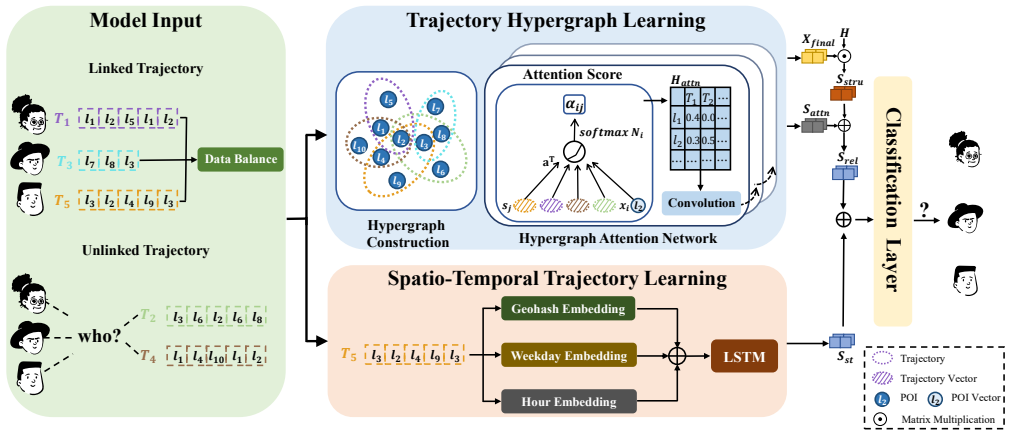
The central object is the trajectory hypergraph: a graph whose vertices are points of interest and whose hyperedges are trajectories, so a single edge can connect any number of POIs at once and several trajectories that share several locations form one high-order structure. Its incidence matrix $H$ feeds a hypergraph attention network built on the standard hypergraph convolution operator with symmetric normalization $D^{-1/2} H B^{-1} H^{T} D^{-1/2}$, where $D$ and $B$ are the vertex-degree and hyperedge-degree matrices; an attention module re-weights $H$ into an attentive incidence matrix $H_{\mathrm{attn}}$ and learns a learnable embedding per trajectory, so the model can express that a restaurant POI matters more to a user who visits it often than a park POI she visits occasionally. Around this core sit two supporting mechanisms: the structural representation $S_{\mathrm{struct}} = X_{\mathrm{final}} \cdot H$, which sums the learned POI embeddings over each trajectory, and a spatio-temporal encoder that feeds Geohash spatial embeddings plus hour-slot and weekday embeddings into an LSTM. The data-balancing step completes the machinery: training trajectories are replicated up to the average per-user count and trimmed above $(1 + \theta_t)$ times that average, with $\theta_t = 0.5$.
What would settle it
Run the model in an inductive regime: remove the test trajectories from the hypergraph and from the learned per-trajectory embeddings before training, then classify them using only the structural and spatio-temporal views. If ACC@1 and Macro-F1 fall back to within noise of S2TUL-R, the reported margins come from transductive access to the test set rather than from a generalizable representation; if they hold, the relational structure generalizes to unseen trajectories.
Extended reading notes
Core claim
The paper's central claim is that high-order inter-trajectory relationships—patterns in which multiple trajectories co-occur at multiple shared POIs—carry information that ordinary pairwise edges discard, and that a hypergraph whose vertices are POIs and whose hyperedges are trajectories captures them. On that structure HGTUL runs a hypergraph attention network that learns an attentive incidence matrix and a per-trajectory embedding, so the same POI can matter more to one trajectory than to another; the model adds a structural trajectory representation (the sum of the POI embeddings each trajectory contains), fuses this relational view with a spatio-temporal view from an LSTM over Geohash, hour-slot, and weekday embeddings, and classifies through one fully connected layer. The paper further claims that its preprocessing step—replicating rare users' trajectories up to the per-user average and trimming the most active users' trajectories beyond a threshold—improves Macro-F1 for all tested models, including the baselines, and that HGTUL's largest advantages appear for cold-start (inactive) users. Extensive experiments on Gowalla, NYC, and JKT at 500 and 1000 users support the headline result: ACC@1 improves by 2.57% to 20.09% and Macro-F1 by 5.68% to 26.00% relative to the runner-up baselines, with the biggest margins on JKT.
Load-bearing premise
The load-bearing premise is that the trajectory hypergraph is built over all trajectories, test trajectories included, and that a learned per-trajectory embedding is available for every trajectory during training; the paper never states that evaluation is transductive, so if the intended setting is really inductive—truly new trajectories that were absent from training—the reported advantage would need an inference procedure the paper does not describe.
Editorial extensions
If this is right
- ACC@1 and Macro-F1 improve on every dataset and user count tested, so representing trajectories as hyperedges over shared POIs yields a better trajectory-to-user mapping than pairwise graph or sequence-only models.
- Removing any component—attentive representation, structural representation, spatio-temporal LSTM, or the hypergraph itself—degrades performance, with removal of the hypergraph module causing the largest drop, so every perspective contributes.
- The data-balancing step improves Macro-F1 not only for HGTUL but also for DeepTUL, AttnTUL, and Bi-TULER, so class imbalance is a general obstacle in TUL rather than a quirk of one model.
- HGTUL's largest Macro-F1 gains over its strongest baseline occur for inactive (cold-start) users, meaning the relational view partially compensates for a lack of personal history.
- Because all gains hold at both 500 and 1000 users, the method's advantage persists as the classification task grows harder.
Reading between the lines
- The construction generalizes beyond TUL: any task with group co-occurrence structure—next-POI recommendation, cross-platform user mapping, or mobility-anomaly detection—could reuse the same incidence-matrix-plus-attention machinery, since nothing in the mechanism is specific to user linking.
- The data-balancing rule is a model-agnostic preprocessing step, and its threshold $\theta_t$ is fixed at 0.5 without a sensitivity study; a natural extension is to tune the replication and trimming ratios per dataset and to test whether the gains come from resampling itself or from the added minority-class supervision.
- The paper's cold-start analysis still assumes each user's historical trajectories are present during training; a deployment-oriented extension would feed the relational embeddings into a few-shot classifier so a brand-new user's first few trajectories bootstrap a profile.
Signed reviews
Editorial analysis
A structured set of objections, weighed in public.
Referee Report
Summary. The paper proposes HGTUL, a trajectory-user linking (TUL) model that combines a trajectory hypergraph with a hypergraph attention network, a spatio-temporal LSTM encoder, and a data-balancing preprocessing step. The authors claim that modeling high-order inter-trajectory relations through hyperedges improves TUL, reporting ACC@1 improvements of 2.57%–20.09% and Macro-F1 improvements of 5.68%–26.00% over baselines on Gowalla, NYC, and JKT datasets. The contribution is primarily empirical, with ablations and cold-start analyses intended to show the value of each component.
Significance. If the results hold, the paper would make a useful contribution by introducing hypergraph-based higher-order trajectory modeling to TUL and by drawing attention to class imbalance. The empirical study is broad: three datasets, two user-population sizes, multiple baselines, and ablations. However, the central claim of being a general TUL method is currently undermined by the apparent transductive evaluation, in which test trajectories participate in the hypergraph and in the learnable per-trajectory embedding matrix. The idea itself is reasonable and the data-balancing analysis is a positive addition, but the empirical evidence as reported does not yet support the stated generalization claim.
major comments (4)
- [Section 3.2.1 and Section 3.2.2, Eq. (4)] The hypergraph is constructed over all trajectories, E = T ∪ T, and S_attn ∈ R^{N×d} contains one learnable embedding per trajectory. The paper never states that evaluation is transductive, and it does not specify an inference procedure for a trajectory that is not in the training hypergraph. Because test hyperedges and test rows of S_attn participate in the attention convolution (Eq. 4) and in the softmax normalization of Eq. (3), test-time structure is visible during training and gradients can flow to test rows. The reported improvements in Table 2 are therefore not interpretable as evidence of generalization. Please either (a) describe and evaluate an inductive protocol, for example by freezing S_attn for new trajectories and reconstructing only the test hypergraph, or (b) explicitly define the setting as transductive and compare with transductive baselines.
- [Section 3.2.2, Eq. (8)] The relational trajectory representation S_rel = S_attn + S_stru includes S_attn, a matrix with N×d free parameters and one row per trajectory. For training trajectories, the model can in principle store user identity in these parameters, and the reported gain over the HGTUL-A ablation may reflect extra capacity rather than the attention mechanism. Please report the parameter count of each variant, compare HGTUL-Ap with matched parameter capacity, and check whether the advantage persists under stronger regularization or when S_attn is removed at test time.
- [Section 4.3, Table 3] The description of the ablation HGTUL-H is ambiguous. If removing the trajectory hypergraph module also removes S_attn and the structural aggregation S_stru, then the ablation conflates the hypergraph convolution with the trajectory-level parameters. Please specify exactly which components remain in each ablation row and clarify how the trajectory representation is computed in HGTUL-H.
- [Section 3.5] The data-balancing procedure is applied to the training set, but the paper does not state whether the validation set used for early stopping and model selection is also balanced. If training is balanced while validation remains imbalanced, the distribution shift should be discussed. The authors should also report the size of the training set before and after balancing for each dataset, since the cross-entropy loss in Eq. (14) uses N_t, whose value changes under balancing.
minor comments (5)
- [Section 1] There is a typo in the sentence 'On th other hand' that should read 'On the other hand'.
- [Section 3.2.2, Eq. (2) and Eq. (4)] The similarity function in Eq. (2) uses a learnable vector a, but the paper does not state whether a is shared across layers or recomputed at each layer; since Eq. (4) uses H_attn^(m), please clarify how the attention scores evolve across the M layers.
- [Section 4.1.4] The reported software version 'PyTorch 1.7.11' appears to be a typo; please verify the correct PyTorch version.
- [Table 2] The 'Improvement' rows report relative improvements over the second-best baseline; please state this explicitly in the table caption.
- [Section 3.4] In Eq. (13), Wc ∈ R^{Q×d} and bc ∈ R^Q are defined, but the softmax in Eq. (14) is applied to y_i; please clarify whether y_i already contains logits and whether the softmax is applied once in the loss only.
Circularity Check
No circularity found; the derivation chain is self-contained, with transductive evaluation as a generalization risk rather than a circular step.
full rationale
The paper's central claim is that HGTUL outperforms TUL baselines through a hypergraph attention representation, a spatio-temporal LSTM, and a data-balancing preprocessing step. None of these components is defined in terms of the target labels or the reported metrics. The trajectory hypergraph is built over all trajectories (E = T ∪ T in Section 3.2.1) and S_attn is a learnable per-trajectory embedding matrix, so evaluation is transductive; this is a generalization-risk concern, not a circularity, because the TUL problem formulation in Section 3.1 defines the unlinked trajectories as known inputs and the test labels are never used to construct S_attn or the classifier. The hypergraph convolution and attention operators are cited from the external work [1] rather than from the authors' own prior results, and no fitted quantity is renamed as a prediction. The data-balancing method is applied to the training set before training and evaluated on held-out test labels, so it does not reduce to a fit of the evaluation target. No self-citation is load-bearing, and no equation in the paper defines an output as equivalent to an input by construction. Therefore the derivation is self-contained and no circular step can be exhibited from the paper's own equations.
Assumptions & free parameters
free parameters (4)
- Trajectory embedding matrix S_attn =
learned N x d matrix (N trajectories, d=128)
- Data balancing threshold θ_t =
0.5
- Hypergraph layer count M =
2
- Embedding dimension d =
128
assumptions (6)
- domain assumption Trajectories can be represented as hyperedges over POI vertices
- domain assumption Co-occurrence of POIs across trajectories carries user-identity signal
- standard math Hypergraph convolution and attention (Eq. 1 and Eq. 4) work as feature propagation operators
- domain assumption Random replication and removal of trajectories preserves the task distribution
- domain assumption 7-character Geohash encoding is a sufficient spatial representation
- ad hoc to paper θ_t=0.5 is a reasonable balance between over- and under-sampling
Cite this review
Pith. "Pith review of HGTUL: A Hypergraph-based Model For Trajectory User Linking." pith.science (2026). https://pith.science/paper/2B4HPPH7
@misc{pith2026250207549,
  author       = {Pith},
  title        = {Pith review of: HGTUL: A Hypergraph-based Model For Trajectory User Linking},
  year         = {2026},
  howpublished = {\url{https://pith.science/paper/2B4HPPH7}},
  note         = {Machine review of arXiv:2502.07549}
}
read the original abstract
Trajectory User Linking (TUL), which links anonymous trajectories with users who generate them, plays a crucial role in modeling human mobility. Despite significant advancements in this field, existing studies primarily neglect the high-order inter-trajectory relationships, which represent complex associations among multiple trajectories, manifested through multi-location co-occurrence patterns emerging when trajectories intersect at various Points of Interest (POIs). Furthermore, they also overlook the variable influence of POIs on different trajectories, as well as the user class imbalance problem caused by disparities in user activity levels and check-in frequencies. To address these limitations, we propose a novel HyperGraph-based multi-perspective Trajectory User Linking model (HGTUL). Our model learns trajectory representations from both relational and spatio-temporal perspectives: (1) it captures high-order associations among trajectories by constructing a trajectory hypergraph and leverages a hypergraph attention network to learn the variable impact of POIs on trajectories; (2) it models the spatio-temporal characteristics of trajectories by incorporating their temporal and spatial information into a sequential encoder. Moreover, we design a data balancing method to effectively address the user class imbalance problem and experimentally validate its significance in TUL. Extensive experiments on three real-world datasets demonstrate that HGTUL outperforms state-of-the-art baselines, achieving improvements of 2.57%~20.09% and 5.68%~26.00% in ACC@1 and Macro-F1 metrics, respectively.
Figures


Forward citations
Cited by 1 Pith paper
-
GCN-TULHOR: Trajectory-User Linking Leveraging GCNs and Higher-Order Spatial Representations
GCN-TULHOR stacks a graph convolutional network onto a hex-tessellated trajectory model and reports 1-8% relative accuracy gains for trajectory-user linking, with some gains below 1% and no error bars.
Reference graph
Works this paper leans on
-
[1]
Song Bai, Feihu Zhang, and Philip H.S. Torr. 2021. Hypergraph convolution and hypergraph attention. Pattern Recognition 110 (2021), 107637. https://doi.org/10. 1016/j.patcog.2020.107637
arXiv 2021
-
[2]
Hyungho Byun, Younhyuk Choi, and Chong-Kwon Kim. 2023. Aspect-oriented unsupervised social link inference on user trajectory data. Information Sciences 626 (2023), 249–261. https://doi.org/10.1016/j.ins.2023.01.022
-
[3]
Wei Chen, Chao Huang, Yanwei Yu, Yongguo Jiang, and Junyu Dong. 2024. Trajectory-User Linking via Hierarchical Spatio-Temporal Attention Networks. ACM Trans. Knowl. Discov. Data 18, 4, Article 85 (Feb. 2024), 22 pages. https: //doi.org/10.1145/3635718
-
[4]
Eunjoon Cho, Seth A. Myers, and Jure Leskovec. 2011. Friendship and mobility: user movement in location-based social networks. InProceedings of the 17th ACM SIGKDD International Conference on Knowledge Discovery and Data Mining (San Diego, California, USA) (KDD ’11). Association for Computing Machinery, New York, NY, USA, 1082–1090. https://doi.org/10.114...
arXiv 2011
-
[5]
Junyoung Chung, Caglar Gulcehre, KyungHyun Cho, and Yoshua Bengio. 2014. Empirical Evaluation of Gated Recurrent Neural Networks on Sequence Modeling. arXiv:1412.3555 [cs.NE] https://arxiv.org/abs/1412.3555
arXiv 2014
-
[6]
Liwei Deng, Hao Sun, Yan Zhao, Shuncheng Liu, and Kai Zheng. 2023. S2TUL: A Semi-Supervised Framework for Trajectory-User Linking. In Proceedings of the Sixteenth ACM International Conference on Web Search and Data Mining (Singapore, Singapore) (WSDM ’23). Association for Computing Machinery, New York, NY, USA, 375–383. https://doi.org/10.1145/3539597.3570410
arXiv 2023
-
[7]
Jie Feng, Yong Li, Chao Zhang, Funing Sun, Fanchao Meng, Ang Guo, and Depeng Jin. 2018. DeepMove: Predicting Human Mobility with Attentional Recurrent Networks. In Proceedings of the 2018 World Wide Web Conference (Lyon, France) (WWW ’18). International World Wide Web Conferences Steering Committee, Republic and Canton of Geneva, CHE, 1459–1468. https://d...
arXiv 2018
-
[8]
Yifan Feng, Haoxuan You, Zizhao Zhang, Rongrong Ji, and Yue Gao. 2019. Hy- pergraph neural networks. In Proceedings of the Thirty-Third AAAI Conference on Artificial Intelligence and Thirty-First Innovative Applications of Artificial In- telligence Conference and Ninth AAAI Symposium on Educational Advances in Artificial Intelligence (Honolulu, Hawaii, US...
Show all 26 references
-
[9]
Qiang Gao, Fan Zhou, Kunpeng Zhang, Goce Trajcevski, Xucheng Luo, and Fengli Zhang. 2017. Identifying human mobility via trajectory embeddings. In Proceedings of the 26th International Joint Conference on Artificial Intelligence (Melbourne, Australia) (IJCAI’17). AAAI Press, 1689–1695
2017
-
[10]
Yue Gao, Yifan Feng, Shuyi Ji, and Rongrong Ji. 2023. HGNN+: General Hy- pergraph Neural Networks. IEEE Transactions on Pattern Analysis and Machine Intelligence 45, 3 (2023), 3181–3199. https://doi.org/10.1109/TPAMI.2022.3182052
2023
-
[11]
Letian Gong, Youfang Lin, Shengnan Guo, Yan Lin, Tianyi Wang, Erwen Zheng, Zeyu Zhou, and Huaiyu Wan. 2023. Contrastive pre-training with adversarial perturbations for check-in sequence representation learning. InProceedings of the Thirty-Seventh AAAI Conference on Artificial ...
2023
-
[12]
González, César A
Marta C. González, César A. Hidalgo, and Albert Ĺaszló Barabási. 2009. Un- derstanding individual human mobility patterns. Nature 458 (2009), 238–238. https://api.semanticscholar.org/CorpusID:265038091
2009
-
[13]
Albert Gu and Tri Dao. 2024. Mamba: Linear-Time Sequence Modeling with Selective State Spaces. arXiv:2312.00752 [cs.LG] https://arxiv.org/abs/2312.00752
2024 arXiv
-
[14]
Sepp Hochreiter and Jürgen Schmidhuber. 1997. Long Short-Term Memory. Neural Comput. 9, 8 (Nov. 1997), 1735–1780. https://doi.org/10.1162/neco.1997.9. 8.1735
1997 doi
-
[15]
Kingma and Jimmy Ba
Diederik P. Kingma and Jimmy Ba. 2017. Adam: A Method for Stochastic Opti- mization. arXiv:1412.6980 [cs.LG] https://arxiv.org/abs/1412.6980
2017 arXiv
-
[16]
Congcong Miao, Jilong Wang, Heng Yu, Weichen Zhang, and Yinyao Qi. 2020. Trajectory-User Linking with Attentive Recurrent Network. In Proceedings of the 19th International Conference on Autonomous Agents and MultiAgent Sys- tems (Auckland, New Zealand) (AAMAS ’20). Internation...
2020
-
[17]
Tomas Mikolov, Kai Chen, Greg Corrado, and Jeffrey Dean. 2013. Efficient Estimation of Word Representations in Vector Space. Computer Science (2013)
2013
-
[18]
Schuster and K.K
M. Schuster and K.K. Paliwal. 1997. Bidirectional recurrent neural networks. IEEE Transactions on Signal Processing 45, 11 (1997), 2673–2681. https://doi.org/ 10.1109/78.650093
1997 doi
-
[19]
Gomez, Łukasz Kaiser, and Illia Polosukhin
Ashish Vaswani, Noam Shazeer, Niki Parmar, Jakob Uszkoreit, Llion Jones, Aidan N. Gomez, Łukasz Kaiser, and Illia Polosukhin. 2017. Attention is all you need. In Proceedings of the 31st International Conference on Neural Information Processing Systems (Long Beach, California, ...
2017
-
[20]
Xiaodong Yan, Tengwei Song, Yifeng Jiao, Jianshan He, Jiaotuan Wang, Ruopeng Li, and Wei Chu. 2023. Spatio-Temporal Hypergraph Learning for Next POI Recommendation. In Proceedings of the 46th International ACM SIGIR Conference on Research and Development in Information Retriev...
2023
-
[21]
Zheng, and Zhiyong Yu
Dingqi Yang, Daqing Zhang, Vincent W. Zheng, and Zhiyong Yu. 2015. Modeling User Activity Preference by Leveraging User Spatial Temporal Characteristics in LBSNs. IEEE Transactions on Systems, Man, and Cybernetics: Systems 45, 1 (2015), 129–142. https://doi.org/10.1109/TSMC.20...
2015
-
[22]
Jing Yuan, Yu Zheng, Chengyang Zhang, Wenlei Xie, Xing Xie, Guangzhong Sun, and Yan Huang. 2010. T-drive: driving directions based on taxi trajectories. In Proceedings of the 18th SIGSPATIAL International Conference on Advances in Geographic Information Systems (San Jose, Cali...
2010
-
[23]
Wei Zhao, Shulong Tan, Ziyu Guan, Boxuan Zhang, Maoguo Gong, Zhengwen Cao, and Quan Wang. 2018. Learning to Map Social Network Users by Unified Manifold Alignment on Hypergraph. IEEE Transactions on Neural Networks and Learning Systems 29, 12 (2018), 5834–5846. https://doi.org...
2018 doi
-
[24]
Chang Zhou, Huimei Lu, Yong Xiang, Jingbang Wu, and Feng Wang. 2020. GeohashTile: Vector Geographic Data Display Method Based on Geohash. ISPRS International Journal of Geo-Information 9, 7 (2020). https://doi.org/10.3390/ ijgi9070418 10
2020
-
[25]
Fan Zhou, Shupei Chen, Jin Wu, Chengtai Cao, and Shengming Zhang. 2021. Trajectory-User Linking via Graph Neural Network. In ICC 2021 - IEEE Interna- tional Conference on Communications . 1–6. https://doi.org/10.1109/ICC42927. 2021.9500836
2021
-
[26]
Fan Zhou, Qiang Gao, Goce Trajcevski, Kunpeng Zhang, Ting Zhong, and Fengli Zhang. 2018. Trajectory-user linking via variational autoencoder. In Proceedings of the 27th International Joint Conference on Artificial Intelligence (Stockholm, Sweden) (IJCAI’18). AAAI Press, 3212–3218. 11
2018
Reviewed August 8, 2026 · model on record in the stance chip above.
Discussion (0). Continue with ORCID to comment.