REVIEW 4 major objections 5 minor 17 references
Generative Risk Minimization for Out-of-Distribution Generalization on Graphs
T0 review · 4 major / 5 minor · reviewed 2026-08-08 · deepseek-v4-flash
Pith's one-line read Graph OOD generalization improves when invariant subgraphs are generated continuously rather than extracted as discrete structures.
desk verdict Continuous generation of invariant subgraphs is a real and well-tested idea, but the theoretical guarantee doesn't follow because the theorem drops the label term from the objective. read the letter →
The pith
A machine-rendered reading of the paper's core claim, the machinery that carries it, and where it could break.
The reading
What carries the argument
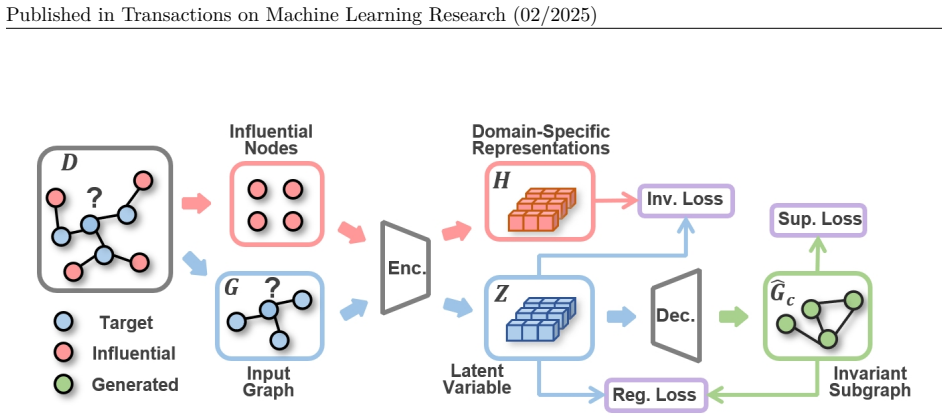
The machine is a Variational Graph Auto-Encoder (VGAE) used as the generator. The encoder maps each input graph $G$ to per-node Gaussian latent variables $Z=\{z_1,\dots,z_{|V|}\}$; the decoder projects $Z$ into continuous node features $\hat{X}$ and soft edge weights $\hat{e}_{ij}=\sigma(f_e(z_i)^\top f_e(z_j))$, producing a full-node, continuous-weight invariant subgraph $\hat{G}_c$. Around this generator, Theorem 3.1 converts the intractable GRM objective into four terms: a reconstruction/supervision term, a KL term regularizing $Z$ toward a Gaussian prior, a KL term regularizing generated edges and features toward Bernoulli and Gaussian priors, and an invariance term that pulls $Z$ toward domain-specific representations learned from influential neighbor nodes. These terms are realized as the supervision loss $L_s$, regularization loss $L_r$, and invariance loss $L_d$, and the combination steers the generator to preserve invariant information while suppressing domain-related spurious information.
What would settle it
Construct a synthetic graph dataset with a known invariant motif and a spurious base pattern, and make the training-domain label perfectly predictable from the spurious pattern while the motif is uninformative; if GRM's label-proxy supervision drives the generator, it will learn the spurious pattern and accuracy on a flipped-correlation test domain will collapse to chance, whereas a method that truly recovers the invariant subgraph would still identify the motif.
Extended reading notes
Core claim
The central claim is that the optimal invariant subgraph should be generated, not extracted, and that a tractable variational objective can learn it without ground-truth invariant subgraphs. GRM keeps every node of the input graph, assigns continuous weights to every edge, and produces new node representations from a latent causal variable $Z$ learned by a variational graph autoencoder. The paper's Theorem 3.1 gives an evidence lower bound for the objective $\max \mathbb{E}[\log P(\hat{G}_c|G)] - I(\hat{G}_c;D)$, and the three resulting losses make the generator focus on label-predictive content while reducing mutual information with the domain. The authors report that this continuous generator consistently exceeds extraction-based invariant subgraph methods on node classification under artificial, cross-domain, and temporal shifts, and on graph classification benchmarks.
Load-bearing premise
The load-bearing premise is that the observed label $Y$ can substitute for the unobserved optimal invariant subgraph $G_c$ in the supervision loss, so if training labels are themselves confounded with spurious features, the generator is trained toward label-predictive content rather than truly invariant content.
Editorial extensions
If this is right
- Retaining all nodes with continuous edge weights means invariant information that discrete edge-dropping would discard can survive, so graph OOD classifiers no longer need a hard decision about which edges are spurious.
- The variational derivation removes the need for ground-truth invariant subgraphs, and the domain-specific representations let the method run with a single training domain, which existing multi-domain invariant methods cannot.
- The method transfers to graph-level classification, where the same node-influence domain encoding yields gains on SP-Motif, MNIST-75sp, Graph-SST2, and Molhiv.
- Ablations show the invariance loss is the most critical component, especially when training domains are few, implying the approach buys robustness mainly from domain-perturbation matching rather than from data diversity.
- The largest reported improvement is on Elliptic, which has many test domains, suggesting continuous generation is most useful when the test-time shift is highly varied.
Reading between the lines
- Because the supervision loss uses the label $Y$ as a proxy for the unobserved invariant subgraph, GRM inherits an implicit reliance on label-predictive content; a natural stress test is to flip spurious correlations between training and test and see whether the generator tracks the label or the true invariant structure.
- The paper leaves edge-level tasks untested; since continuous edge weights are the method's distinctive output, edge-level OOD problems such as link prediction under shift would be a direct and informative extension.
- The domain representation is built from influence-selected neighbors using shortest-path statistics; a learnable or attention-based domain encoder could be tested to see whether invariance improves when training domains are scarce.
- The variational generation setup could be reused outside classification, for example to produce counterfactual or augmented graphs that are invariant to domain, rather than only to feed a classifier.
Editorial analysis
A structured set of objections, weighed in public.
Referee Report
Summary. The paper proposes Generative Risk Minimization (GRM), a framework for out-of-distribution generalization on graphs. Instead of extracting a discrete invariant subgraph, GRM uses a VGAE-based generator to produce a continuous invariant subgraph (same node set, continuous edge weights and node features) for each input graph. The authors motivate the method with an objective that maximizes the mutual information between the generated subgraph and the label subject to domain independence, then introduce a latent causal variable Z and derive an ELBO (Theorem 3.1) from which they design three losses: a supervision loss, a regularization loss, and an invariance loss. Experiments on six node-level datasets and four graph-level datasets show consistent improvements over the compared baselines, with the largest gains on Elliptic and Arxiv.
Significance. If the theoretical claims held, GRM would be a meaningful advance over discrete invariant-subgraph extraction, because continuous generation could preserve more invariant information and reduce spurious information. The empirical study is broad, covers both node-level and graph-level shifts, and the code is released. The strengths of the paper are the clear presentation of the generative idea, the extensive comparisons, and the reproducible experimental setup. However, the central theoretical narrative is not currently supported: the jump from Eq. (1) to Eq. (2) drops the label term, and the three optimized losses are only loosely connected to Theorem 3.1. The empirical results are good enough to justify a major revision, but the theoretical claims need to be either repaired or explicitly repositioned as heuristic motivations.
major comments (4)
- [Section 3.1, Eqs. (1)-(2)] The transition from the stated objective max I(Ĝc;Y) subject to Ĝc⊥D to the proposed GRM objective max E[log P(Ĝc|G)] − I(Ĝc;D) removes the label Y entirely. No inequality or equivalence is provided to show that optimizing the latter preserves or bounds the former. Since the paper's central claim that generated subgraphs 'maximally involve invariant information' is defined through Y in Eq. (1), this replacement is load-bearing and currently unsupported.
- [Appendix A.1, Eq. (20)] In the proof of Theorem 3.1, the decomposition of I(Ĝc;Z|D) yields E[log P(Z|D,Ĝc)] + H(Z|D), and the entropy term is dropped with the assertion that P(Z|D) is a deterministic distribution for each D. This is a substantive assumption that is not stated in Theorem 3.1 and is not justified for the learned VGAE encoder, which outputs a Gaussian distribution over Z. The proof is therefore incomplete at a critical step.
- [Section 3.3, Eqs. (7) and (13)] The supervision loss Ls is defined as a cross-entropy between p(y|G) and p(y|Ĝc), using the label Y as a proxy for the unobserved optimal invariant subgraph Gc. This is not the reconstruction term E[log P(Ĝc|G,Z)] that appears in Theorem 3.1. The label-proxy assumption is particularly risky in OOD settings where labels may be confounded with spurious features, and no argument is given for why optimizing Ls preserves the invariant-information guarantee. Consequently, the overall objective in Eq. (13) is not the objective for which Theorem 3.1 provides an ELBO.
- [Section 3.3, Eqs. (10)-(12)] The invariance loss Ld is an Euclidean distance between zi and hi, where hi is computed from nodes selected by the thresholds L* and P* and by one-hop neighborhoods. This is a heuristic surrogate for E[log P(Z|D,Ĝc)] and for the mutual information term in Eq. (1). The paper does not show that this distance upper-bounds, lower-bounds, or otherwise approximates the mutual information. The claim that optimizing Ld 'directly minimizes the mutual information between the invariant subgraph and the domains' is therefore not established by the presented analysis.
minor comments (5)
- [Section 3.1 vs. Appendix A.1] The notation for the variational distribution is inconsistent: Theorem 3.1 in the main text writes KL(Q(Z)∥P(Z|G)), while the appendix version in Eq. (16) writes KL(Q(Z|G)∥P(Z|G)). The two are not the same quantity.
- [Section 3.3, Invariance Loss] The word 'thrid' in the sentence introducing the invariance loss is a typo and should be 'third'.
- [Appendix A.1] The word 'dereive' in the sentence 'Then we dereive the lower bound for the second term' is a typo and should be 'derive'.
- [Section 3.3, Eq. (10)] The hyperparameters L* and P* are not ablated or discussed beyond the single setting L*=3 and P*=1.5 reported in Section 4.1; given that they control the domain-specific representation used in the invariance loss, a sensitivity study would strengthen the paper.
- [Appendix F, Limitations] The limitations section lists only data sufficiency and the lack of edge-level evaluation; it does not mention the gap between the stated theoretical objective and the implemented losses, which is the main weakness identified in this report.
Circularity Check
No circularity found: GRM's objective and losses are not defined in terms of the target result, and the authors' self-citations are not load-bearing.
full rationale
The claimed derivation chain runs from Eq. (1) (max I(Gc;Y) with Gc⊥D) to Eq. (2) (max E[log P(Gc|G)] − I(Gc;D)) to Theorem 3.1 (an ELBO over a latent variable Z) to the three losses L_s, L_r, L_d and the final objective Eq. (13). No step in this chain equates the prediction or the evaluation outcome to a fitted input. Eq. (2) is asserted as a feasible surrogate for Eq. (1), and Theorem 3.1 is an ELBO for Eq. (2); the label term from Eq. (1) is re-introduced only heuristically in the supervision loss, where Y proxies the unobserved Gc. Substituting classification cross-entropy for a reconstruction log-likelihood and an L2 distance for the log-likelihood E[log P(Z|D,Gc)] are approximations that loosen the theory, and Appendix F does not flag these gaps, but they are fidelity gaps, not circular reductions. The regularization and invariance losses use the model's own encoder outputs, not the test labels or the benchmark metric. Self-citations (e.g., Tan et al. 2022, Wang et al. 2023, 2024) occur in related-work and tool contexts and are not load-bearing; no uniqueness theorem or prior author result is invoked to force the design. Because the empirical comparison is against held-out test domains and external baselines, the paper is self-contained for circularity purposes.
Assumptions & free parameters
free parameters (6)
- alpha (loss weight for Lr) =
not reported in text
- beta (loss weight for Ld) =
not reported in text
- theta (Bernoulli prior) =
not reported
- L* (path-length threshold) =
3
- P* (path-count threshold) =
1.5
- latent dimension dz =
128
assumptions (4)
- domain assumption Graphs are generated from independent latent causal variable Z and spurious variable S, with Y determined by Z (the SCM in Fig. 1).
- ad hoc to paper P(Z|D) is a deterministic distribution for each domain D.
- ad hoc to paper The label Y is a sufficient proxy for the optimal invariant subgraph Gc.
- domain assumption The influence of one node on another decreases exponentially with graph distance, so one-hop neighbors are sufficient for learning domain representation.
invented entities (1)
-
Latent causal variable Z
Cite this review
Pith. "Pith review of Generative Risk Minimization for Out-of-Distribution Generalization on Graphs." pith.science (2026). https://pith.science/paper/KDQHFOKT
@misc{pith2026250207968,
  author       = {Pith},
  title        = {Pith review of: Generative Risk Minimization for Out-of-Distribution Generalization on Graphs},
  year         = {2026},
  howpublished = {\url{https://pith.science/paper/KDQHFOKT}},
  note         = {Machine review of arXiv:2502.07968}
}
read the original abstract
Out-of-distribution (OOD) generalization on graphs aims at dealing with scenarios where the test graph distribution differs from the training graph distributions. Compared to i.i.d. data like images, the OOD generalization problem on graph-structured data remains challenging due to the non-i.i.d. property and complex structural information on graphs. Recently, several works on graph OOD generalization have explored extracting invariant subgraphs that share crucial classification information across different distributions. Nevertheless, such a strategy could be suboptimal for entirely capturing the invariant information, as the extraction of discrete structures could potentially lead to the loss of invariant information or the involvement of spurious information. In this paper, we propose an innovative framework, named Generative Risk Minimization (GRM), designed to generate an invariant subgraph for each input graph to be classified, instead of extraction. To address the challenge of optimization in the absence of optimal invariant subgraphs (i.e., ground truths), we derive a tractable form of the proposed GRM objective by introducing a latent causal variable, and its effectiveness is validated by our theoretical analysis. We further conduct extensive experiments across a variety of real-world graph datasets for both node-level and graph-level OOD generalization, and the results demonstrate the superiority of our framework GRM.
Figures


Figures from the paper (1 more)

Reference graph
Works this paper leans on
-
[1]
In particular, Cora is a citation network, where nodes represent papers and edges indicate the citation relation- ship between them. On the other hand,Photo is a co-purchasing network, with nodes representing specific goods and edges denoting frequent co-purchases of two goods. In the original dataset, the provided node features exhibit a strong correlati...
work page 2017
-
[2]
Molgan: An implicit generative model for small molecular graphs
Nicola De Cao and Thomas Kipf. Molgan: An implicit generative model for small molecular graphs. arXiv:1805.11973,
-
[6]
Out-of-distribution generalization on graphs: A survey
12 Published in Transactions on Machine Learning Research (02/2025) Haoyang Li, Xin Wang, Ziwei Zhang, and Wenwu Zhu. Out-of-distribution generalization on graphs: A survey. arXiv preprint arXiv:2202.07987, 2022a. Haoyang Li, Ziwei Zhang, Xin Wang, and Wenwu Zhu. Learning invariant graph representations for out-of- distribution generalization. InNeurIPS, ...
arXiv 2025
-
[9]
E Created Datasets with Different Degrees of Distribution Shifts In this section, we introduce the details of the datasetCora-Mix used in Sec. 4.3. Specifically, we aim to manually control the degree of distribution shifts across different domains. However, the original datasetCora provided in EERM (Wu et al., 2022a) creates distribution shifts via the co...
work page 2025
-
[10]
Kexin Zhang, Shuhan Liu, Song Wang, Weili Shi, Chen Chen, Pan Li, Sheng Li, Jundong Li, and Kaize Ding. A survey of deep graph learning under distribution shifts: from graph out-of-distribution generalization to adaptation. arXiv preprint arXiv:2410.19265,
-
[11]
MARIO: Model Agnostic Recipe for Improving OOD Generalization of Graph Contrastive Learning
Yun Zhu, Haizhou Shi, Zhenshuo Zhang, and Siliang Tang. Mario: Model agnostic recipe for improving ood generalization of graph contrastive learning.arXiv:2307.13055,
-
[12]
14 Published in Transactions on Machine Learning Research (02/2025) A Theoretical Analysis A.1 Theorem 3.1 and Proof In this section, we provide proof for Theorem 3.1. Theorem 3.1. An evidence lower bound (ELBO) for optimization of the GRM objective, by introducing a latent causal variableZ and a variational approximationQ(ˆGc), is as follows: max E [ log...
work page 2025
-
[16]
We follow the parameter setting in their code and set the learning rate as 0.01
• IS-GIB (Yang et al., 2023): IS-GIB aims to discard spurious features while learning invariant features from a high-order perspective via preserving class relationships under various distribution shifts. We follow the parameter setting in their code and set the learning rate as 0.01. • MARIO (Zhu et al., 2023): MARIO proposes to simultaneously achieve ge...
work page 2023
Show all 17 references
-
[50]
• DRNN (Koh et al., 2021): DRNN aims to tackle the distribution shift problem by ensuring that the distribution minority receives sufficient training
Furthermore, for ARM-CML, the number of context channels is set as three. • DRNN (Koh et al., 2021): DRNN aims to tackle the distribution shift problem by ensuring that the distribution minority receives sufficient training. Following the setting in ARM, we set the learning ra...
2021
-
[2005]
In our experiments, we utilize fourteen networks: John Hopkins, Caltech, Amherst, Bingham, Duke, Princeton, WashU, Brandeis, Carnegie, Cornell, Yale, Penn, Brown, and Texas
Here each network contains nodes that represent Facebook users from a specific American university. In our experiments, we utilize fourteen networks: John Hopkins, Caltech, Amherst, Bingham, Duke, Princeton, WashU, Brandeis, Carnegie, Cornell, Yale, Penn, Brown, and Texas. The...
2020
-
[2013]
Representation learning with contrastive predictive coding
Aaron van den Oord, Yazhe Li, and Oriol Vinyals. Representation learning with contrastive predictive coding. In arXiv:1807.03748,
-
[2015]
Auto-encoding variational bayes.arXiv:1312.6114,
Diederik P Kingma and Max Welling. Auto-encoding variational bayes.arXiv:1312.6114,
-
[2016]
Graph few-shot class-incremental learning
Zhen Tan, Kaize Ding, Ruocheng Guo, and Huan Liu. Graph few-shot class-incremental learning. InWSDM, 2022a. Zhen Tan, Kaize Ding, Ruocheng Guo, and Huan Liu. Supervised graph contrastive learning for few-shot node classification. In Joint European Conference on Machine Learnin...
2025
-
[2018]
Invariant risk minimization
Martin Arjovsky, Léon Bottou, Ishaan Gulrajani, and David Lopez-Paz. Invariant risk minimization. arXiv:1907.02893,
1907 arXiv
-
[2019]
Variational graph auto-encoders.arXiv:1611.07308,
Thomas N Kipf and Max Welling. Variational graph auto-encoders.arXiv:1611.07308,
-
[2020]
Collective spammer detection in evolving multi-relational social networks
11 Published in Transactions on Machine Learning Research (02/2025) Shobeir Fakhraei, James Foulds, Madhusudana Shashanka, and Lise Getoor. Collective spammer detection in evolving multi-relational social networks. InSIGKDD,
2025
-
[2023]
Safety in graph machine learning: Threats and safeguards.arXiv preprint arXiv:2405.11034,
Song Wang, Yushun Dong, Binchi Zhang, Zihan Chen, Xingbo Fu, Yinhan He, Cong Shen, Chuxu Zhang, Nitesh V Chawla, and Jundong Li. Safety in graph machine learning: Threats and safeguards.arXiv preprint arXiv:2405.11034,
Reviewed August 8, 2026 · model on record in the stance chip above.
Discussion (0). Continue with ORCID to comment.