REVIEW 5 major objections 6 minor 55 references
Local Differential Privacy is Not Enough: A Sample Reconstruction Attack against Federated Learning with Local Differential Privacy
T0 review · 5 major / 6 minor · reviewed 2026-08-08 · deepseek-v4-flash
Pith's one-line read One clipped, noised gradient can reveal a victim's training image.
desk verdict Novel reverse-index separation attack that works at weak privacy (epsilon=10), but collision risk and evaluation gaps keep it from being the 'only attack' it claims to be. read the letter →
The pith
A machine-rendered reading of the paper's core claim, the machinery that carries it, and where it could break.
The reading
What carries the argument
The load-bearing object is the separation layer: a fully connected layer with all weight vectors equal and biases set from the quantile function of a Laplace distribution, followed by taking the minimal positive activation. This creates, for each sample, a unique reverse unit whose output is the minimal positive value; backpropagation makes the sample's gradients vanish in every other unit, so weight and bias gradients of that unit satisfy x = grad_w / grad_b. The separation layer confines nonzero gradients to at most batch-size units, so enlarging it does not expand the gradient norm, and this is the key to surviving LDP clipping. Two supporting structures carry the noise handling: a bias layer that repeats the bias gradient many times so averaging cancels perturbation noise, and a convolution layer that injects known zero gradients so the adversary can estimate the Gaussian noise scale and build a confidence interval for filtering. A metric layer imprints sample statistics and reverse-unit indices into gradients to guide optimization of the reconstructed samples.
What would settle it
Run the attack on a batch of 16 images with a 2048-unit separation layer, deliberately choosing two images whose projections fall in the same reverse interval; if the reconstructed output is a linear mixture rather than either original, the distinctness requirement is confirmed as load-bearing. On ordinary batches, count how often the reverse-unit indices reconstructed from the metric layer are non-distinct and check whether those batches' reconstructions show visibly lower CW-SSIM.
Extended reading notes
Core claim
The central claim is the existence of a practical sample reconstruction attack against LDP-protected federated learning that works with any target model and with batch sizes larger than one. The authors prove that a fully connected layer whose weights are all equal and whose biases are Laplace quantiles acts as a separation layer: for each input sample there is a reverse unit, and the sample's weight and bias gradients exist only in that unit, so weight gradients divided entry-wise by bias gradients recover the sample, provided two samples do not share a reverse unit. Because at most batch-size units carry nonzero gradients, adding more units improves separation without inflating the gradient norm, which keeps the gradient from being destroyed by clipping. The attack then removes background pixels using an image segmentation model, averages repeated bias gradients to cancel noise, estimates the noise scale from zero gradients it inserted, filters background noise with a confidence interval, and refines the reconstruction against imprinted sample-wise mean, variance, and total variation. The paper reports that this is the only evaluated attack that reconstructs meaningful training samples from LDP-protected gradients at epsilon=10, with negligible effect on model accuracy.
Load-bearing premise
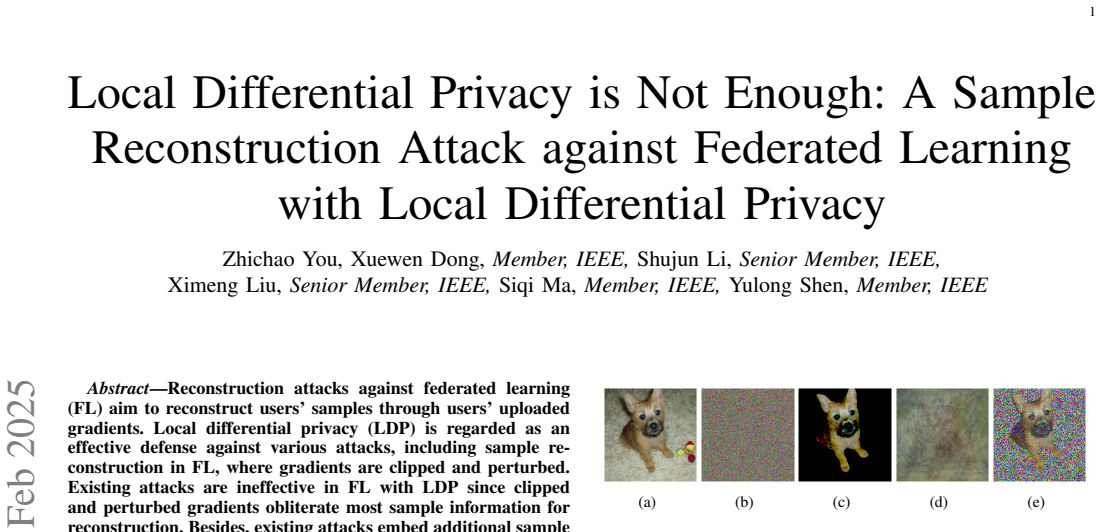
The attack recovers a clean image only if every image in the victim's batch lands in a different reverse unit of the separation layer; that separation is probabilistic, and when two images share a unit the reconstruction is a blend that may show neither image.
Editorial extensions
If this is right
- In federated learning with LDP at epsilon around 10, a malicious server that controls model design can recover the main subject of a victim's training image from a single clipped, noised gradient, so LDP alone is not a sufficient defense.
- Clipping alone cannot stop the attack: since the same clipping factor scales both weight and bias gradients, the ratio that reconstructs the sample is unchanged.
- Increasing batch size makes reconstruction harder because each sample's share of the clipped gradient shrinks, but the paper shows the attack still operates at batch size 16 and larger.
- The attack's model modifications can be made nearly invisible: non-target users receive a structure with a tiny output coefficient, and dropping the victim's gradient from aggregation has negligible effect when the federation has many users.
- Noise-based defenses can be reverse-engineered: by injecting zero gradients, the adversary estimates the privacy noise scale and filters much of it out.
Reading between the lines
- The paper establishes the attack at epsilon=10, but an implication the authors do not pursue is that at smaller epsilon the noise estimate becomes less reliable and attack quality should degrade sharply; testing epsilons below roughly 3 would map the actual privacy frontier.
- The reverse-unit uniqueness assumption implies a collision budget: with 16 samples and 2048 units, a meaningful fraction of batches should contain a collision that yields a blurred mixture, and a practical attacker could detect and discard such batches using the metric layer's reconstructed reverse-unit indices.
- The same separation-layer idea could be probed against LDP mechanisms with non-Gaussian noise or against secure aggregation that hides individual gradients; the paper only addresses the unprotected-gradient setting.
- Because the attack needs a custom global model, a testable defense is client-side verification of model components, such as checking that the first layers produce sample-dependent activations; the paper lists this idea as future work rather than demonstrating it.
Editorial analysis
A structured set of objections, weighed in public.
Referee Report
Summary. The paper proposes an active sample reconstruction attack against federated learning with local differential privacy (LDP), where users clip and perturb gradients before upload. The malicious server embeds a 'separation layer' (an FCL with shared weights and Laplace-quantile biases) before an arbitrary target model so that each training sample's gradient is confined to a single 'reverse unit' determined by the smallest positive activation. The sample is then recovered as the ratio of weight-gradient to bias-gradient for that unit. The paper adds SAM-based background removal, a zero-gradient structure to estimate the LDP noise scale, and a metric-imprinting layer to support optimization-based quality improvement. Theorems 1-4 analyze the primary attack, gradient separation, and the improved separation layer. Evaluations on ImageNet, CIFAR-100, Caltech-256, and Flowers102 compare the attack with five prior attacks and report high reconstruction quality at epsilon=10, with minimal impact on the target model's accuracy. The paper claims to be the first and only attack that reconstructs victims' training samples in LDP-based FL.
Significance. If the central claims hold, the paper would demonstrate that LDP-protected FL with a malicious server is vulnerable to sample reconstruction at moderate privacy levels (epsilon=10), thereby questioning the common assumption that clipping plus perturbation suffices to prevent gradient inversion. The separation-layer construction is a genuine technical novelty: it concentrates each sample's gradient in one unit without increasing the gradient norm as the number of units grows. The zero-gradient noise estimation and the metric-imprinting mechanism are also clever and are supported by ablation experiments. The evaluation is relatively extensive, comparing five prior attacks across four datasets and including ablations for the optimization and denoising components. However, the core separation guarantee is only probabilistic in the finite-unit regime, and the headline quality metrics are computed against the SAM-masked training samples rather than the original samples, so the abstract's claim of reconstructing 'victims' training samples' is overstated as written.
major comments (5)
- [Section V-A, Theorem 3; Section VII] The finite-K collision probability for the separation layer is not quantified, and the evaluation does not report it. Because all units in the separation layer share the same weight vector, the reverse index is a function of the one-dimensional statistic w^T x; two samples in the same batch that map to the same reverse unit produce a weighted mixture in the reconstructed image, which is exactly the failure mode the paper itself identifies in Theorem 1 and Fig. 1(d). Theorem 3 only proves that doubling K splits reverse intervals and thus reduces the probability of collision; it provides no bound for the finite values K=1024 or K=2048 used in the evaluation. Under a uniform-bin approximation, the probability of at least one collision is roughly 3% for batch size 16 with K=2048 and roughly 63% for batch size 64 with K=2048, and the probability can be much higher if the distribution of w^T x is concentrated relative to the quantile bin widths. Table IV averages quality metrics over batches without separating collision-free from collision-containing cases, and Fig. 10 reports 'separation ratio' without linking it to reconstruction fidelity. The central claim that individual victim samples are recovered therefore rests on an unverified probabilistic assumption. Please provide empirical collision rates for the evaluated settings, a bound for the collision probability, and either restrict the headline claims to collision-free batches or demonstrate that collisions do not materially degrade the reconstructions.
- [Section VII-A and Table IV] The quality metrics (MSE, PSNR, CW-SSIM) are computed between the reconstructed samples and the SAM-masked training samples, not the original training images. The attack deliberately sets background pixels to zero, so a near-perfect reconstruction of the masked subject does not imply that the victim's original training image has been recovered. The abstract and the introduction state that the attack 'reconstructs victims' training samples' and is 'the only attack that reconstructs victims' training samples in LDP-based FL'. These claims should be qualified to state that the reconstruction target is the subject-masked version of the sample, and the paper should discuss what information about the original sample (e.g., subject identity, background context) is or is not revealed. This is not a fatal flaw given the paper's stated focus on subject information, but the claims need to match the evaluation.
- [Section IV-B, Eqs. (4)-(6), Theorem 1] The derivation of Theorem 1 assumes that the derivative of the loss with respect to the FCL output is identical for every sample in the batch. This is not true in general; the correct statement is that the primary attack returns a weighted average of samples with weights proportional to the per-sample loss derivatives (∂L_i/∂y_i), not the unweighted average shown in Eq. (6). The conclusion that the primary attack produces a mixture of samples is directionally correct, but the proof as written is incorrect and should be corrected, since Theorem 1 is used to motivate the need for the separation layer.
- [Section V-D, Eq. (24)] The metric-based optimization uses as targets the sample statistics (μ, σ², TV) reconstructed from the metric-layer gradients, which are noisy estimates obtained from the same clipped and perturbed gradient signal. The paper does not quantify the noise in these targets or demonstrate that optimizing against them cannot bias the reconstructed sample away from the true sample. Since the metric layer is a key component for improving reconstruction quality, please provide an analysis of the noise in the reconstructed metrics or an ablation that compares the current approach against using ground-truth (clean) sample statistics.
- [Section VII-A and Table VIII] The attack relies on several hand-tuned hyperparameters, including the separation-layer weight and the Laplace scale s, which are set to different values for CIFAR-100 and the other datasets. These parameters determine whether the unknown distribution of w^T x aligns with the reverse intervals; if they are poorly chosen, the collision probability increases significantly. The paper does not analyze the sensitivity of the attack to these parameters, nor does it provide guidance for an adversary who does not know the victim's data distribution in advance. Please add a sensitivity analysis or a robustness argument to support the claim that the attack is flexible and applicable to 'any target models' and various learning scenarios.
minor comments (6)
- [Section IV-A] The sentence 'We considers gradient protection with LDP' contains a typo and should be 'We consider gradient protection with LDP'.
- [Section I, Contributions] The claim that the proposed attack is the first reconstruction attack in LDP-based FL should be reconciled with reference [15] (Boenisch et al., 'Reconstructing individual data points in federated learning hardened with differential privacy and secure aggregation'), which is cited in the reference list but not discussed in the related-work section; if that work already demonstrates reconstruction under DP-hardened FL, the novelty statement needs to be positioned more carefully.
- [Section VII-C, Fig. 10] The 'separation ratio' is described only as the proportion of separated reconstructed images; please provide a precise definition, the number of seeds, and error bars, since this metric is central to the collision discussion.
- [Section VII-D] The results for the privacy parameter ε and the clipping bound are shown only in figures without numeric values in the text; please add tables or report the exact PSNR/CW-SSIM values for the tested settings.
- [Section V-C, Eqs. (17)-(18)] The symbol ω is used both for the clipping scale in Eqs. (17)-(18) and for model parameters in Section III; please use a distinct symbol for the clipping scale to avoid confusion.
- [Abstract and Conclusion] The evaluation focuses on ε=10 with δ=0.01, which is a relatively weak privacy regime; the paper should state more explicitly that the attack is demonstrated only for such settings and may not apply when ε is much smaller.
Circularity Check
No significant circularity: the reconstruction is a chain-rule inversion of the separation layer's own min-output construction, and the noise estimate comes from an independent zero-gradient channel.
full rationale
The paper's central derivation is self-contained rather than circular. Lemma 1 (Eqs. 2-3) states the standard fact, attributed to Geiping et al. [35], that the input of a fully connected layer with batch size one is the entry-wise ratio of weight gradient to bias gradient. Theorem 1 then shows that with batch size B the same ratio is a batch average; this is a genuine derivation, not a restatement of the input. The separation layer (Section V-A) is built so that the output is the minimal positive pre-activation; a sample's reverse unit is defined as the argmin unit, and Theorem 2 is exactly backpropagation through that min operation. When a unit receives exactly one sample's gradient, Eq. 23 reconstructs that sample by the chain rule; this is a constructional identity between the layer's forward computation and its inversion, not a fitted parameter renamed as a prediction. The collision limitation is real but is a probabilistic robustness condition, not a circular one: Theorem 3 only proves that doubling units splits reverse intervals, and the paper does not bound the finite-K collision probability; if two samples share a reverse unit the reconstruction becomes a weighted mixture (the paper's own Fig. 1(d)). That is a correctness risk, not a derivation that assumes its conclusion. Noise estimation (Section V-C) uses extra all-zero input channels whose gradients contain only perturbation noise; inferring sigma from the half-normal statistics of that independent channel is external evidence, and averaging repeated bias gradients is justified by the law of large numbers. The metric-based optimization (Section V-D) is the most self-referential component: sample statistics are imprinted in a metric layer, recovered from the victim's own gradients, and then used as targets in Eq. 24. This does not manufacture the reconstruction by definition, because the metrics are side information separate from the weight-gradient ratio that defines the reconstructed sample, but it can propagate noise from the same gradient into the optimization objective. That is an evaluation-quality caveat, not a circular step. Citations to the authors' prior work [2], [3] appear only as contextual FL references and are not load-bearing; the paper's attack premise relies on external prior art [10], [11], [35], not on a self-citation chain. Overall, the derivation chain is not circular.
Assumptions & free parameters
free parameters (5)
- Separation layer weight w (shared across units) =
1e-5 (ImageNet, Caltech-256, Flowers102); 2e-4 (CIFAR-100)
- Laplace scale s for bias quantiles =
3e-3 (most datasets); 1.3e-3 (CIFAR-100)
- Metric optimization weights w_mu, w_sigma, w_TV =
1e6, 2e4, 1e-6
- Metric output scale factors (mean, variance, TV) =
1, 10, 1e-3
- Inference structure output coefficient for non-target users =
Not specified (described as 'small')
assumptions (4)
- domain assumption Users apply the Gaussian-mechanism LDP in Algorithm 1: clip the gradient norm to C, then add Gaussian noise with scale sigma.
- standard math The 'minimum positive value' operation over the separation layer units has gradient equal to the gradient of the selected (reverse) unit's pre-activation and zero elsewhere.
- domain assumption The malicious server can distribute different model variants to different users, such as a large inference-structure output to the victim and a small one to others.
- domain assumption The reverse indices of the samples in a batch are distinct with high probability, which depends on the distribution of w^T x over the data.
Cite this review
Pith. "Pith review of Local Differential Privacy is Not Enough: A Sample Reconstruction Attack against Federated Learning with Local Differential Privacy." pith.science (2026). https://pith.science/paper/WCYJEC6W
@misc{pith2026250208151,
  author       = {Pith},
  title        = {Pith review of: Local Differential Privacy is Not Enough: A Sample Reconstruction Attack against Federated Learning with Local Differential Privacy},
  year         = {2026},
  howpublished = {\url{https://pith.science/paper/WCYJEC6W}},
  note         = {Machine review of arXiv:2502.08151}
}
read the original abstract
Reconstruction attacks against federated learning (FL) aim to reconstruct users' samples through users' uploaded gradients. Local differential privacy (LDP) is regarded as an effective defense against various attacks, including sample reconstruction in FL, where gradients are clipped and perturbed. Existing attacks are ineffective in FL with LDP since clipped and perturbed gradients obliterate most sample information for reconstruction. Besides, existing attacks embed additional sample information into gradients to improve the attack effect and cause gradient expansion, leading to a more severe gradient clipping in FL with LDP. In this paper, we propose a sample reconstruction attack against LDP-based FL with any target models to reconstruct victims' sensitive samples to illustrate that FL with LDP is not flawless. Considering gradient expansion in reconstruction attacks and noise in LDP, the core of the proposed attack is gradient compression and reconstructed sample denoising. For gradient compression, an inference structure based on sample characteristics is presented to reduce redundant gradients against LDP. For reconstructed sample denoising, we artificially introduce zero gradients to observe noise distribution and scale confidence interval to filter the noise. Theoretical proof guarantees the effectiveness of the proposed attack. Evaluations show that the proposed attack is the only attack that reconstructs victims' training samples in LDP-based FL and has little impact on the target model's accuracy. We conclude that LDP-based FL needs further improvements to defend against sample reconstruction attacks effectively.
Figures


Figures from the paper (8 more)


Reference graph
Works this paper leans on
-
[1]
Advances and open problems in federated learning,
P. Kairouz, H. B. McMahan, B. Avent, A. Bellet, M. Bennis, A. N. Bhagoji, K. A. Bonawitz, Z. Charles, G. Cormode, R. Cummings, R. G. L. D’Oliveira, S. E. Rouayheb, D. Evans, J. Gardner, Z. Garrett, A. Gasc ´on, B. Ghazi, P. B. Gibbons, M. Gruteser, Z. Harchaoui, C. He, L. He, Z. Huo, B. Hutchinson, J. Hsu, M. Jaggi, T. Javidi, G. Joshi, M. Khodak, J. Kone...
arXiv 1912
-
[2]
Feddmc: Efficient and robust federated learning via detecting malicious clients,
X. Mu, K. Cheng, Y . Shen, X. Li, Z. Chang, T. Zhang, and X. Ma, “Feddmc: Efficient and robust federated learning via detecting malicious clients,” IEEE Transactions on Dependable and Secure Computing , 2024
2024
-
[3]
Fedproc: Prototypical contrastive federated learning on non-iid data,
X. Mu, Y . Shen, K. Cheng, X. Geng, J. Fu, T. Zhang, and Z. Zhang, “Fedproc: Prototypical contrastive federated learning on non-iid data,” Future Generation Computer Systems , vol. 143, pp. 93–104, 2023
2023
-
[4]
Federated learning: Collaborative ma- chine learning without centralized training data,
B. McMahan and D. Ramage, “Federated learning: Collaborative ma- chine learning without centralized training data,” 2017
work page 2017
-
[5]
Federated evaluation and tuning for on-device personalization: System design & and applications,
M. Paulik, M. Seigel, H. Mason, D. Telaar, J. Kluivers, R. van Dalen, C. W. Lau, L. Carlson, F. Granqvist, C. Vandevelde, S. Agarwal, J. Freudiger, A. Byde, A. Bhowmick, G. Kapoor, S. Beaumont, A. Cahill, D. Hughes, O. Javidbakht, F. Dong, R. Rishi, and S. Hung, “Federated evaluation and tuning for on-device personalization: System design & and applicatio...
work page 2021
-
[6]
Fate: An industrial grade platform for collaborative learning with data protection,
Y . Liu, T. Fan, T. Chen, Q. Xu, and Q. Yang, “Fate: An industrial grade platform for collaborative learning with data protection,” Journal of Machine Learning Research , vol. 22, no. 226, pp. 1–6, 2021
2021
-
[7]
L. Zhu, Z. Liu, and S. Han, “Deep leakage from gradients,” in Advances in Neural Information Processing Systems (H. Wallach, H. Larochelle, A. Beygelzimer, F. d'Alch ´e-Buc, E. Fox, and R. Garnett, eds.), vol. 32, Curran Associates, Inc., 2019
work page 2019
-
[8]
Using highly compressed gradients in federated learning for data reconstruction attacks,
H. Yang, M. Ge, K. Xiang, and J. Li, “Using highly compressed gradients in federated learning for data reconstruction attacks,” IEEE Transactions on Information Forensics and Security , vol. 18, pp. 818– 830, 2023
work page 2023
Show all 55 references
-
[9]
See through gradients: Image batch recovery via gradinversion,
H. Yin, A. Mallya, A. Vahdat, J. M. Alvarez, J. Kautz, and P. Molchanov, “See through gradients: Image batch recovery via gradinversion,” in Proceedings of the IEEE/CVF Conference on Computer Vision and Pattern Recognition, pp. 16337–16346, 2021
2021
-
[10]
Robbing the fed: Directly obtaining private data in federated learn- ing with modified models,
L. H. Fowl, J. Geiping, W. Czaja, M. Goldblum, and T. Goldstein, “Robbing the fed: Directly obtaining private data in federated learn- ing with modified models,” in International Conference on Learning Representations, 2022
2022
-
[11]
When the curious abandon honesty: Federated learn- ing is not private,
F. Boenisch, A. Dziedzic, R. Schuster, A. S. Shamsabadi, I. Shumailov, and N. Papernot, “When the curious abandon honesty: Federated learn- ing is not private,” 2021
2021
-
[12]
A framework for evaluating gradient leakage attacks in federated learning,
W. Wei, L. Liu, M. Loper, K.-H. Chow, M. E. Gursoy, S. Truex, and Y . Wu, “A framework for evaluating gradient leakage attacks in federated learning,” 2020
2020
-
[13]
Eluding secure aggregation in federated learning via model inconsistency,
D. Pasquini, D. Francati, and G. Ateniese, “Eluding secure aggregation in federated learning via model inconsistency,” in Proceedings of the 2022 ACM SIGSAC Conference on Computer and Communications Security, CCS ’22, (New York, NY , USA), p. 2429–2443, Association for Computi...
2022
-
[14]
Dreaming to distill: Data-free knowledge transfer via deepinversion,
H. Yin, P. Molchanov, J. M. Alvarez, Z. Li, A. Mallya, D. Hoiem, N. K. Jha, and J. Kautz, “Dreaming to distill: Data-free knowledge transfer via deepinversion,” in Proceedings of the IEEE/CVF Conference on Computer Vision and Pattern Recognition , pp. 8715–8724, 2020
2020
-
[15]
Reconstructing individual data points in federated learning hardened with differential privacy and secure aggregation,
F. Boenisch, A. Dziedzic, R. Schuster, A. S. Shamsabadi, I. Shumailov, and N. Papernot, “Reconstructing individual data points in federated learning hardened with differential privacy and secure aggregation,” in 2023 IEEE 8th European Symposium on Security and Privacy , (Los A...
2023
-
[16]
Gradient inversion with generative image prior,
J. Jeon, K. Lee, S. Oh, J. Ok, et al., “Gradient inversion with generative image prior,” Advances in Neural Information Processing Systems , vol. 34, pp. 29898–29908, 2021
2021
-
[17]
Gradvit: Gradient inversion of vision transformers,
A. Hatamizadeh, H. Yin, H. R. Roth, W. Li, J. Kautz, D. Xu, and P. Molchanov, “Gradvit: Gradient inversion of vision transformers,” in Proceedings of the IEEE/CVF Conference on Computer Vision and Pattern Recognition (CVPR), pp. 10021–10030, June 2022
2022
-
[18]
Analyzing user-level privacy attack against federated learning,
M. Song, Z. Wang, Z. Zhang, Y . Song, Q. Wang, J. Ren, and H. Qi, “Analyzing user-level privacy attack against federated learning,” IEEE Journal on Selected Areas in Communications, vol. 38, no. 10, pp. 2430– 2444, 2020
2020
-
[19]
Cafe: Catas- trophic data leakage in vertical federated learning,
X. Jin, P.-Y . Chen, C.-Y . Hsu, C.-M. Yu, and T. Chen, “Cafe: Catas- trophic data leakage in vertical federated learning,” Advances in Neural Information Processing Systems , vol. 34, pp. 994–1006, 2021
2021
-
[20]
R-gap: Recursive gradient attack on privacy,
J. Zhu and M. Blaschko, “R-gap: Recursive gradient attack on privacy,” 2021
2021
-
[21]
Federated learning with differential privacy: Algorithms and performance analysis,
K. Wei, J. Li, M. Ding, C. Ma, H. H. Yang, F. Farokhi, S. Jin, T. Q. S. Quek, and H. Vincent Poor, “Federated learning with differential privacy: Algorithms and performance analysis,” IEEE Transactions on Information Forensics and Security , vol. 15, pp. 3454–3469, 2020
2020
-
[22]
A differentially private federated learning model against poisoning attacks in edge computing,
J. Zhou, N. Wu, Y . Wang, S. Gu, Z. Cao, X. Dong, and K.-K. R. Choo, “A differentially private federated learning model against poisoning attacks in edge computing,” IEEE Transactions on Dependable and Secure Computing, pp. 1–1, 2022
2022
-
[23]
Personalized federated learning with differential privacy,
R. Hu, Y . Guo, H. Li, Q. Pei, and Y . Gong, “Personalized federated learning with differential privacy,” IEEE Internet of Things Journal , vol. 7, no. 10, pp. 9530–9539, 2020
2020
-
[24]
Efficient differentially private secure aggregation for federated learning via hardness of learning with errors,
T. Stevens, C. Skalka, C. Vincent, J. Ring, S. Clark, and J. Near, “Efficient differentially private secure aggregation for federated learning via hardness of learning with errors,” in 31st USENIX Security Sympo- sium (USENIX Security 22) , (Boston, MA), pp. 1379–1395, USENIX ...
2022
-
[25]
Exploring the security boundary of data reconstruction via neuron exclusivity analysis,
X. Pan, M. Zhang, Y . Yan, J. Zhu, and Z. Yang, “Exploring the security boundary of data reconstruction via neuron exclusivity analysis,” in 31st USENIX Security Symposium (USENIX Security 22) , (Boston, MA), pp. 3989–4006, USENIX Association, Aug. 2022
2022
-
[26]
Model inversion attack by integration of deep generative models: Privacy-sensitive face generation from a face recognition system,
M. Khosravy, K. Nakamura, Y . Hirose, N. Nitta, and N. Babaguchi, “Model inversion attack by integration of deep generative models: Privacy-sensitive face generation from a face recognition system,” IEEE Transactions on Information Forensics and Security , vol. 17, pp. 357– 372, 2022
2022
-
[27]
On the inadequacy of similarity- based privacy metrics: Reconstruction attacks against
G. Ganev and E. D. Cristofaro, “On the inadequacy of similarity- based privacy metrics: Reconstruction attacks against ”truly anonymous synthetic data”,” 2023
2023
-
[28]
Beyond class-level privacy leakage: Breaking record-level privacy in federated learning,
X. Yuan, X. Ma, L. Zhang, Y . Fang, and D. Wu, “Beyond class-level privacy leakage: Breaking record-level privacy in federated learning,” IEEE Internet of Things Journal , vol. 9, no. 4, pp. 2555–2565, 2021
2021
-
[29]
Generative adversarial networks,
I. J. Goodfellow, J. Pouget-Abadie, M. Mirza, B. Xu, D. Warde-Farley, S. Ozair, A. Courville, and Y . Bengio, “Generative adversarial networks,” 2014
2014
-
[30]
Communication-Efficient Learning of Deep Networks from Decentral- ized Data,
B. McMahan, E. Moore, D. Ramage, S. Hampson, and B. A. y. Arcas, “Communication-Efficient Learning of Deep Networks from Decentral- ized Data,” in Proceedings of the 20th International Conference on Artificial Intelligence and Statistics (A. Singh and J. Zhu, eds.), vol. 54 of...
2017
-
[31]
The algorithmic foundations of differential privacy,
C. Dwork, A. Roth, et al., “The algorithmic foundations of differential privacy,” Foundations and Trends® in Theoretical Computer Science , vol. 9, no. 3–4, pp. 211–407, 2014
2014
-
[32]
Learning differ- entially private recurrent language models,
H. B. McMahan, D. Ramage, K. Talwar, and L. Zhang, “Learning differ- entially private recurrent language models,” in International Conference on Learning Representations , 2018. 16
2018
-
[33]
Local and central differential privacy for robustness and privacy in federated learning,
M. Naseri, J. Hayes, and E. De Cristofaro, “Local and central differential privacy for robustness and privacy in federated learning,” 2022
2022
-
[34]
Eluding secure aggregation in federated learning via model inconsistency,
D. Pasquini, D. Francati, and G. Ateniese, “Eluding secure aggregation in federated learning via model inconsistency,” in Proceedings of the 2022 ACM SIGSAC Conference on Computer and Communications Security, pp. 2429–2443, 2022
2022
-
[35]
Inverting gradi- ents - how easy is it to break privacy in federated learning?,
J. Geiping, H. Bauermeister, H. Dr ¨oge, and M. Moeller, “Inverting gradi- ents - how easy is it to break privacy in federated learning?,” inAdvances in Neural Information Processing Systems (H. Larochelle, M. Ranzato, R. Hadsell, M. Balcan, and H. Lin, eds.), vol. 33, pp. 169...
2020
-
[36]
ImageNet Large Scale Visual Recognition Challenge,
O. Russakovsky, J. Deng, H. Su, J. Krause, S. Satheesh, S. Ma, Z. Huang, A. Karpathy, A. Khosla, M. Bernstein, A. C. Berg, and L. Fei-Fei, “ImageNet Large Scale Visual Recognition Challenge,” International Journal of Computer Vision (IJCV) , vol. 115, no. 3, pp. 211–252, 2015
2015
-
[37]
Segment anything,
A. Kirillov, E. Mintun, N. Ravi, H. Mao, C. Rolland, L. Gustafson, T. Xiao, S. Whitehead, A. C. Berg, W.-Y . Lo,et al., “Segment anything,” arXiv preprint arXiv:2304.02643 , 2023
2023 arXiv
-
[38]
A comprehensive survey on segment anything model for vision and beyond,
C. Zhang, L. Liu, Y . Cui, G. Huang, W. Lin, Y . Yang, and Y . Hu, “A comprehensive survey on segment anything model for vision and beyond,” arXiv preprint arXiv:2305.08196 , 2023
2023 arXiv
-
[39]
Segment anything in medical images,
J. Ma, Y . He, F. Li, L. Han, C. You, and B. Wang, “Segment anything in medical images,” 2023
2023
-
[40]
Segment anything in non-euclidean domains: Challenges and opportunities,
Y . Jing, X. Wang, and D. Tao, “Segment anything in non-euclidean domains: Challenges and opportunities,” 2023
2023
-
[41]
A generalization of the half-normal distribution with applications to lifetime data,
K. Cooray and M. M. Ananda, “A generalization of the half-normal distribution with applications to lifetime data,” Communications in Statistics—Theory and Methods , vol. 37, no. 9, pp. 1323–1337, 2008
2008
-
[42]
F. M. Dekking, C. Kraaikamp, H. P. Lopuha ¨a, and L. E. Meester, A Modern Introduction to Probability and Statistics: Understanding why and how, vol. 488. Springer, 2005
2005
-
[43]
Foreseeing recon- struction quality of gradient inversion: An optimization perspective,
H. G. Hong, Y . Cho, H. Cho, J. Ahn, and J. Kim, “Foreseeing recon- struction quality of gradient inversion: An optimization perspective,” in Proceedings of the AAAI Conference on Artificial Intelligence , vol. 38, pp. 12473–12481, 2024
2024
-
[44]
Learning multiple layers of features from tiny images,
A. Krizhevsky, G. Hinton, et al., “Learning multiple layers of features from tiny images,” 2009
2009
-
[45]
Caltech-256 object category dataset,
G. Griffin, A. Holub, and P. Perona, “Caltech-256 object category dataset,” 2007
2007
-
[46]
Automated flower classification over a large number of classes,
M.-E. Nilsback and A. Zisserman, “Automated flower classification over a large number of classes,” in2008 Sixth Indian Conference on Computer Vision, Graphics & Image Processing , pp. 722–729, IEEE, 2008
2008
-
[47]
Deep residual learning for image recognition,
K. He, X. Zhang, S. Ren, and J. Sun, “Deep residual learning for image recognition,” in Proceedings of the IEEE conference on computer vision and pattern recognition , pp. 770–778, 2016
2016
-
[48]
Complex wavelet structural similarity: A new image similarity index,
M. P. Sampat, Z. Wang, S. Gupta, A. C. Bovik, and M. K. Markey, “Complex wavelet structural similarity: A new image similarity index,” IEEE Transactions on Image Processing, vol. 18, no. 11, pp. 2385–2401, 2009
2009
-
[49]
Preserving privacy and security in federated learning,
T. Nguyen and M. T. Thai, “Preserving privacy and security in federated learning,” IEEE/ACM Transactions on Networking , vol. 32, no. 1, pp. 833–843, 2024
2024
-
[50]
L-secnet: Towards secure and lightweight deep neural network inference,
A. Song, J. Fu, X. Mu, X. Zhu, and K. Cheng, “L-secnet: Towards secure and lightweight deep neural network inference,” Journal of Networking and Network Applications , no. 4, pp. 171–181, 2023
2023
-
[51]
A convnet for the 2020s,
Z. Liu, H. Mao, C.-Y . Wu, C. Feichtenhofer, T. Darrell, and S. Xie, “A convnet for the 2020s,” 2022
2022
-
[52]
Densely connected convolutional networks,
G. Huang, Z. Liu, L. van der Maaten, and K. Q. Weinberger, “Densely connected convolutional networks,” 2018
2018
-
[53]
Efficientnet: Rethinking model scaling for convolutional neural networks,
M. Tan and Q. V . Le, “Efficientnet: Rethinking model scaling for convolutional neural networks,” 2020
2020
-
[54]
Going deeper with convolutions,
C. Szegedy, W. Liu, Y . Jia, P. Sermanet, S. Reed, D. Anguelov, D. Erhan, V . Vanhoucke, and A. Rabinovich, “Going deeper with convolutions,” 2014. Zhichao You received his B.E. degree in Informa- tion and Computing Science from South China Agri- cultural University, Guangzhou...
2014
-
[2018]
She is currently a Senior Lecturer with the University of New South Wales, Canberra Campus, Australia
She was a Research Fellow with the Dis- tinguished System Security Group, CSIRO. She is currently a Senior Lecturer with the University of New South Wales, Canberra Campus, Australia. Her current research interests include data security, the IoT security, and software security...
2002
Reviewed August 8, 2026 · model on record in the stance chip above.
Discussion (0). Continue with ORCID to comment.