REVIEW 3 major objections 6 minor 35 references
CoDynTrust: Robust Asynchronous Collaborative Perception via Dynamic Feature Trust Modulus
T0 review · 3 major / 6 minor · reviewed 2026-08-08 · deepseek-v4-flash
Pith's one-line read CoDynTrust — an asynchronous collaborative-perception framework — claims that per-region dynamic feature trust moduli, derived from aleatoric and epistemic uncertainty, suppress low-quality features and keep 3D detection accurate under…
desk verdict A promising idea for uncertainty-gated asynchronous fusion is undermined by test-set normalization in Eq. (4); the SOTA claim is not supported as written, though the fix is straightforward. read the letter →
The pith
A machine-rendered reading of the paper's core claim, the machinery that carries it, and where it could break.
The reading
What carries the argument
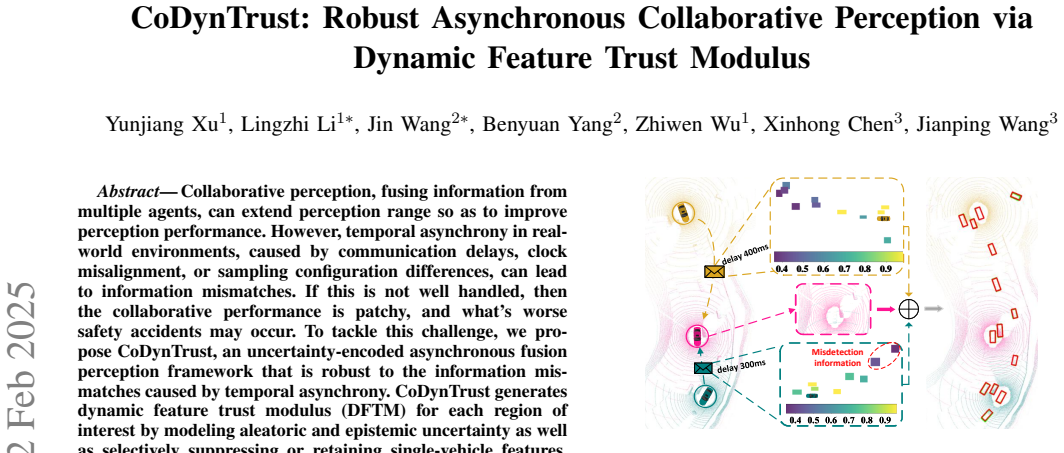
The Dynamic Feature Trust Modulus (DFTM), a per-ROI scalar in [0,1] generated by a residual network from the averaged confidence and averaged aleatoric/epistemic uncertainties of the two most recent frames, multiplied by a delay decay factor exp(−0.02·Δt), is the central object. DFTM is scattered back onto the sparse BEV feature map and multiplies each ROI's features after the flow-based motion compensation, so features that are uncertain or stale are scaled down before multi-scale hybrid fusion. The complementary machinery is the uncertainty quantification itself: direct modeling for aleatoric uncertainty (Gaussian box center, von Mises yaw, Gaussian classification logit with the reparameterization trick) and Monte-Carlo dropout for epistemic uncertainty, unified by a rescaling step. The hybrid fusion module combines MAXOUT and AVGOUT branches with spatial and channel weighting to handle the sparse, scaled features DFTM produces.
What would settle it
Re-run the three dataset evaluations with the normalization statistics in Eq. (4) computed only from a training or validation split, then check whether CoDynTrust still beats CoBEVFlow at 300 ms and 500 ms expected delays by the margins in Table I; if the margins vanish, the state-of-the-art claim is an artifact of test-set normalization.
Extended reading notes
Core claim
The central claim is that per-ROI uncertainty, properly rescaled and merged with confidence, is a sufficient signal to make asynchronous collaborative perception robust. To get that signal, CoDynTrust models aleatoric uncertainty by treating the bounding-box center as a Gaussian random variable, the yaw angle as von Mises distributed, and the classification logit as Gaussian, while epistemic uncertainty comes from T Monte-Carlo dropout inferences. After rescaling, averaged confidence and uncertainty feed a small network that outputs a trust modulus in [0,1]; a decay factor d_f = exp(−k·Δt) with k = 0.02 further lowers trust for older frames. The trust modulus is scattered back onto the sparse feature map, whose grids are shifted by a BEV flow map built from linear extrapolation of ROI positions over two frames. On DAIR-V2X, V2XSet, and OPV2V, the resulting pipeline retains more detection accuracy at 300–500 ms expected delays than V2VNet, V2X-ViT, Where2comm+SyncNet, and CoBEVFlow, and it stays ahead when Gaussian pose noise is added.
Load-bearing premise
The rescaling in Eq. (4) uses the mean and variance of raw uncertainty and confidence scores computed from positive samples in the test set; if those statistics instead have to come from a validation set (to avoid test-set leakage), the normalized uncertainties—and therefore the reported AP gains—would change.
Editorial extensions
If this is right
- At expected delays up to 500 ms, detection AP drops far less than with prior delay-compensation networks, so vehicles can fuse data from agents with different clock phases or congested channels without retraining.
- Because the trust modulus is computed from confidence and uncertainty alone, the same mechanism applies to any ROI-based detector; the paper's ablation shows the gain comes specifically from combining uncertainty with DFTM rather than uncertainty alone.
- The transmitted message is sparse features, ROIs, and uncertainty, which the bandwidth-vs-AP experiments show reaches strong detection performance at lower communication volume than Where2comm on V2XSet.
- With pose noise up to 0.4 m / 0.4°, CoDynTrust remains ahead of CoBEVFlow, so the robustness is not bought at the cost of sensitivity to misalignment.
- DFTM can be propagated to planning and control, since it is an interpretable per-object reliability score rather than a fixed network weight.
Reading between the lines
- If the rescaling statistics in Eq. (4) must be computed on a validation set rather than the test set, the normalized uncertainty changes, and the reported AP margins are the thing to re-check; this is the paper's single most testable vulnerability.
- A natural extension the paper does not explore is applying DFTM to tracking or prediction heads: a per-ROI trust signal could gate association or weigh trajectory forecasts, not just spatial features.
- The linear-extrapolation assumption limits the approach to moderate, roughly constant-velocity motion; at longer delays or with maneuvering agents, an extension would need to compare the decay factor k=0.02 against learned delay-decay schedules.
- Comparing CoDynTrust against a stronger motion model (e.g., the learned flow in CoBEVFlow) at delays beyond 500 ms would show whether the decay factor or the trust modulus is doing the heavy lifting.
Signed reviews
Editorial analysis
A structured set of objections, weighed in public.
Referee Report
Summary. The paper proposes CoDynTrust, a collaborative perception framework for LiDAR-based 3D object detection under temporal asynchrony. The method quantifies aleatoric and epistemic uncertainty for each region of interest, rescales these uncertainties, and uses them with confidence scores to generate a dynamic feature trust modulus (DFTM) that weights features before asynchronous fusion. Motion compensation is done by linear extrapolation, and a multi-scale hybrid fusion module aggregates the weighted features. Experiments on DAIR-V2X, V2XSet, and OPV2V report state-of-the-art AP under expected delays from 0 ms to 500 ms, along with ablations and robustness tests under pose noise.
Significance. If the reported results are valid, the uncertainty-guided trust-modulus idea is a useful addition to asynchronous collaborative perception: it is architecturally simple, interpretable, and the released code would let others reproduce and extend the work. The paper also makes a reasonable move by propagating uncertainty to fusion rather than only to downstream planning. However, the empirical contribution is currently undermined by the normalization in Eq. (4), which explicitly uses test-set statistics computed from positive samples. This leaks label information into the evaluation and affects every reported AP in Tables I, II, and III. The significance of the paper therefore cannot be assessed from the numbers as presented; a clean re-run with validation-set normalization is required before the state-of-the-art claim is credible.
major comments (3)
- [§IV-B, Eq. (4)] The rescaling operation in Eq. (4) uses µu, σu, µs, and σs, which the text defines as the mean and variance of raw classification uncertainty and confidence scores for positive samples in the test set. Because this rescaling is applied to every ROI before DFTM generation, the trust weights are calibrated using the evaluation split and, more seriously, using ground-truth positive/negative labels. This leaks test information into the model at inference and contaminates every AP in Tables I and II, as well as every row of the ablation in Table III. The state-of-the-art claim is therefore not supported by a clean held-out evaluation. The authors should recompute all normalization statistics from the training or validation split only, state the split explicitly, and rerun the experiments.
- [Table III] The ablation does not isolate whether the uncertainty input to DFTM is the source of the reported gains. Row 3 (Uncertainty + DFTM) adds both DFTM and the leaky rescaled uncertainty relative to Row 2, and Row 2 itself uses the same test-set normalization. There is no condition with confidence-only DFTM, and no condition that removes the test-set statistics while keeping the uncertainty model. Consequently, the improvement attributed to uncertainty could instead come from the confidence term or from adaptation to the test set. Additional controlled ablations are needed, at minimum confidence-only versus confidence-plus-uncertainty, both with and without the leaky normalization.
- [Table I] The claim of state-of-the-art performance is not uniform even in the presented table: on V2XSet at 0 ms expected delay, CoDynTrust achieves AP@0.5 = 0.8780, which is below Where2comm (0.8918) and V2X-ViT (0.8785). The abstract and conclusion state that CoDynTrust achieves state-of-the-art performance 'even with temporal asynchrony,' but this should be qualified to delay settings, or the zero-delay comparison should be discussed explicitly. This issue is secondary to the normalization problem but affects how the headline claim is stated.
minor comments (6)
- [Table I] The table formatting is inconsistent: the 'Single' row appears to list three values only under the DAIR-V2X columns, with no corresponding entries for V2XSet or OPV2V. Please align the columns and clarify whether 'Single' is delay-independent or re-evaluated at each delay.
- [Eq. (4)] The left-hand side ucls and the raw input ucls_raw are notationally confusing; use a distinct symbol such as ucls_rescaled for the output of the rescaling operation.
- [Eq. (4)] The confidence score sc is used in Eq. (4) but is not defined in the text; please define it as the ROI classification confidence and specify how it is obtained.
- [II and V] There are several typos and formatting issues: 'Impelment Details' should be 'Implementation Details'; 'have be given' should be 'have been given'; the conclusion contains an incomplete sentence ('demonstrates strong robust'); and 'A VGOUT' should be 'AVGOUT'.
- [References] Reference [29] is attributed only to 'Kingma' but is the standard variational autoencoder paper by Kingma and Welling; the author list should be completed.
- [III] The notation in the problem formulation, such as Xti n n and Yti n n, is difficult to parse because subscripts and superscripts are not clearly distinguished; please clean up the typesetting.
Circularity Check
Test-set normalization in Eq. (4) leaks evaluation data into the model, so the reported APs are not clean held-out numbers.
-
other
[Section IV-B, Eq. (4); Tables I-III]
"µu, σu, µs, and σs are the mean and variance of raw classification uncertainty and confidence scores for positive samples in the test set."
Equation (4) rescales raw classification uncertainty before it is used to generate the Dynamic Feature Trust Modulus, and the DFTM gates or suppresses each ROI feature during fusion. Because the normalization constants are computed on the same test split whose AP is reported in Tables I-III, the model's inference-time feature weighting is calibrated on the evaluation data. The test set is thus used twice: once to set normalization statistics and once to measure performance. This makes the reported state-of-the-art numbers self-referential rather than independent held-out measurements, and the SOTA claim is not supported as written.
full rationale
The architectural derivation of CoDynTrust is not equation-level circular: the DFTM is produced by a learned network from uncertainty and confidence estimates, not from the ground-truth detection output, and the fusion and motion-compensation steps are each defined from inputs that do not include the final detection labels. No uniqueness theorem or load-bearing self-citation forces the design. The one significant issue is evaluative: the rescaling in Eq. (4) explicitly uses statistics of the test set, and those statistics enter every reported result through the trust modulus. This is a data-leakage/self-referential evaluation problem rather than a derivation that reduces to its inputs, so the central architecture retains independent content. Because the main empirical claim is weakened by this protocol flaw, but the method itself is not circular by construction, a moderate score of 4 is appropriate.
Assumptions & free parameters
free parameters (2)
- delay decay factor k =
0.02
- test-set normalization statistics (mu_u, sigma_u, mu_s, sigma_s) =
computed from test set positive samples
assumptions (4)
- domain assumption Linear extrapolation of ROI motion accurately predicts vehicle displacement over 0-0.5s delays.
- domain assumption Binomial sampling of frame intervals reproduces realistic temporal asynchrony.
- domain assumption Uncertainty from MC dropout and direct modeling is a meaningful indicator of ROI feature quality.
- standard math Gaussian and von Mises distributions adequately model bounding box regression noise.
Cite this review
Pith. "Pith review of CoDynTrust: Robust Asynchronous Collaborative Perception via Dynamic Feature Trust Modulus." pith.science (2026). https://pith.science/paper/HSB47KRX
@misc{pith2026250208169,
  author       = {Pith},
  title        = {Pith review of: CoDynTrust: Robust Asynchronous Collaborative Perception via Dynamic Feature Trust Modulus},
  year         = {2026},
  howpublished = {\url{https://pith.science/paper/HSB47KRX}},
  note         = {Machine review of arXiv:2502.08169}
}
read the original abstract
Collaborative perception, fusing information from multiple agents, can extend perception range so as to improve perception performance. However, temporal asynchrony in real-world environments, caused by communication delays, clock misalignment, or sampling configuration differences, can lead to information mismatches. If this is not well handled, then the collaborative performance is patchy, and what's worse safety accidents may occur. To tackle this challenge, we propose CoDynTrust, an uncertainty-encoded asynchronous fusion perception framework that is robust to the information mismatches caused by temporal asynchrony. CoDynTrust generates dynamic feature trust modulus (DFTM) for each region of interest by modeling aleatoric and epistemic uncertainty as well as selectively suppressing or retaining single-vehicle features, thereby mitigating information mismatches. We then design a multi-scale fusion module to handle multi-scale feature maps processed by DFTM. Compared to existing works that also consider asynchronous collaborative perception, CoDynTrust combats various low-quality information in temporally asynchronous scenarios and allows uncertainty to be propagated to downstream tasks such as planning and control. Experimental results demonstrate that CoDynTrust significantly reduces performance degradation caused by temporal asynchrony across multiple datasets, achieving state-of-the-art detection performance even with temporal asynchrony. The code is available at https://github.com/CrazyShout/CoDynTrust.
Figures


Figures from the paper (1 more)

Reference graph
Works this paper leans on
-
[1]
Pointpillars: Fast encoders for object detection from point clouds,
A. H. Lang, S. V ora, H. Caesar, L. Zhou, J. Yang, and O. Beijbom, “Pointpillars: Fast encoders for object detection from point clouds,” in Proceedings of the IEEE/CVF Conference on Computer Vision and Pattern Recognition (CVPR), 2019, pp. 12 697–12 705
work page 2019
-
[2]
S. Chen, B. Liu, C. Feng, C. Vallespi-Gonzalez, and C. Wellington, “3d point cloud processing and learning for autonomous driving: Impacting map creation, localization, and perception,” IEEE Signal Processing Magazine, vol. 38, no. 1, pp. 68–86, 2020
work page 2020
-
[3]
Safdnet: A simple and effective network for fully sparse 3d object detection,
G. Zhang, J. Chen, G. Gao, J. Li, S. Liu, and X. Hu, “Safdnet: A simple and effective network for fully sparse 3d object detection,” in Proceedings of the IEEE/CVF Conference on Computer Vision and Pattern Recognition (CVPR), 2024, pp. 14 477–14 486
work page 2024
-
[4]
Temporal- channel transformer for 3d lidar-based video object detection for autonomous driving,
Z. Yuan, X. Song, L. Bai, Z. Wang, and W. Ouyang, “Temporal- channel transformer for 3d lidar-based video object detection for autonomous driving,” IEEE Transactions on Circuits and Systems for Video Technology, vol. 32, no. 4, pp. 2068–2078, 2021
work page 2021
-
[5]
Safe occlusion-aware autonomous driving via game-theoretic active perception,
Z. Zhang and J. F. Fisac, “Safe occlusion-aware autonomous driving via game-theoretic active perception,” arXiv preprint arXiv:2105.08169, 2021
arXiv 2021
-
[6]
Quest: Query stream for practical cooperative perception,
S. Fan, H. Yu, W. Yang, J. Yuan, and Z. Nie, “Quest: Query stream for practical cooperative perception,” in Proceedings of the International Conference on Robotics and Automation (ICRA) . IEEE, 2024, pp. 18 436–18 442
work page 2024
-
[7]
W. Su, L. Chen, Y . Bai, X. Lin, G. Li, Z. Qu, and P. Zhou, “What makes good collaborative views? contrastive mutual information max- imization for multi-agent perception,” in Proceedings of the AAAI Conference on Artificial Intelligence, vol. 38, no. 16, 2024, pp. 17 550– 17 558
work page 2024
-
[8]
Spatio-temporal domain awareness for multi-agent col- laborative perception,
K. Yang, D. Yang, J. Zhang, M. Li, Y . Liu, J. Liu, H. Wang, P. Sun, and L. Song, “Spatio-temporal domain awareness for multi-agent col- laborative perception,” in Proceedings of the IEEE/CVF International Conference on Computer Vision (ICCV) , 2023, pp. 23 383–23 392
work page 2023
Show all 35 references
-
[9]
Robust collaborative 3d object detection in presence of pose errors,
Y . Lu, Q. Li, B. Liu, M. Dianati, C. Feng, S. Chen, and Y . Wang, “Robust collaborative 3d object detection in presence of pose errors,” in Proceedings of the International Conference on Robotics and Automation (ICRA). IEEE, 2023, pp. 4812–4818
2023
-
[10]
Where2comm: Communication-efficient collaborative perception via spatial confi- dence maps,
Y . Hu, S. Fang, Z. Lei, Y . Zhong, and S. Chen, “Where2comm: Communication-efficient collaborative perception via spatial confi- dence maps,” in Advances in neural information processing systems (NeurIPS), vol. 35, 2022, pp. 4874–4886
2022
-
[11]
Latency-aware collaborative perception,
Z. Lei, S. Ren, Y . Hu, W. Zhang, and S. Chen, “Latency-aware collaborative perception,” in Proceedings of the European Conference on Computer Vision (ECCV) . Springer, 2022, pp. 316–332
2022
-
[12]
V2vnet: Vehicle-to-vehicle communication for joint per- ception and prediction,
T.-H. Wang, S. Manivasagam, M. Liang, B. Yang, W. Zeng, and R. Urtasun, “V2vnet: Vehicle-to-vehicle communication for joint per- ception and prediction,” in Proceedings of the European Conference on Computer Vision (ECCV) . Springer, 2020, pp. 605–621
2020
-
[13]
V2x-vit: Vehicle-to-everything cooperative perception with vision transformer,
R. Xu, H. Xiang, Z. Tu, X. Xia, M.-H. Yang, and J. Ma, “V2x-vit: Vehicle-to-everything cooperative perception with vision transformer,” in Proceedings of the European Conference on Computer Vision (ECCV). Springer, 2022, pp. 107–124
2022
-
[14]
Flow-based feature fusion for vehicle-infrastructure cooperative 3d object detection,
H. Yu, Y . Tang, E. Xie, J. Mao, P. Luo, and Z. Nie, “Flow-based feature fusion for vehicle-infrastructure cooperative 3d object detection,” in Advances in Neural Information Processing Systems (NeurIPS) , vol. 36, 2023, pp. 34 493–34 503
2023
-
[15]
Asynchrony-robust collaborative perception via bird’s eye view flow,
S. Wei, Y . Wei, Y . Hu, Y . Lu, Y . Zhong, S. Chen, and Y . Zhang, “Asynchrony-robust collaborative perception via bird’s eye view flow,” in Advances in Neural Information Processing Systems (NeurIPS) , vol. 36, 2023, pp. 28 462–28 477
2023
-
[16]
Dair-v2x: A large-scale dataset for vehicle- infrastructure cooperative 3d object detection,
H. Yu, Y . Luo, M. Shu, Y . Huo, Z. Yang, Y . Shi, Z. Guo, H. Li, X. Hu, J. Yuan, and Z. Nie, “Dair-v2x: A large-scale dataset for vehicle- infrastructure cooperative 3d object detection,” in Proceedings of the IEEE/CVF Conference on Computer Vision and Pattern Recognition (CV...
2022
-
[17]
Opv2v: An open benchmark dataset and fusion pipeline for perception with vehicle-to- vehicle communication,
R. Xu, H. Xiang, X. Xia, J. L. Xu Han, and J. Ma, “Opv2v: An open benchmark dataset and fusion pipeline for perception with vehicle-to- vehicle communication,” in Proceedings of the International Confer- ence on Robotics and Automation (ICRA) , 2022, pp. 2583–2589
2022
-
[18]
V2x- sim: Multi-agent collaborative perception dataset and benchmark for autonomous driving,
Y . Li, D. Ma, Z. An, Z. Wang, Y . Zhong, S. Chen, and C. Feng, “V2x- sim: Multi-agent collaborative perception dataset and benchmark for autonomous driving,” IEEE Robotics and Automation Letters , vol. 7, no. 4, pp. 10 914–10 921, 2022
2022
-
[19]
Learning distilled collaboration graph for multi-agent perception,
Y . Li, S. Ren, P. Wu, S. Chen, C. Feng, and W. Zhang, “Learning distilled collaboration graph for multi-agent perception,” in Advances in Neural Information Processing Systems (NeurIPS) , vol. 34, 2021, pp. 29 541–29 552
2021
-
[20]
Convolutional lstm network: A machine learning approach for precipitation nowcasting,
X. Shi, Z. Chen, H. Wang, D.-Y . Yeung, W.-K. Wong, and W.-c. Woo, “Convolutional lstm network: A machine learning approach for precipitation nowcasting,” in Advances in neural information processing systems (NeurIPS) , vol. 28, 2015, p. 802
2015
-
[21]
Uncertainty in deep learning,
Y . Gal et al., “Uncertainty in deep learning,” phd thesis, University of Cambridge, 2016
2016
-
[22]
Dropout as a bayesian approximation: Representing model uncertainty in deep learning,
Y . Gal and Z. Ghahramani, “Dropout as a bayesian approximation: Representing model uncertainty in deep learning,” in international conference on machine learning . PMLR, 2016, pp. 1050–1059
2016
-
[23]
Simple and scalable predictive uncertainty estimation using deep ensembles,
B. Lakshminarayanan, A. Pritzel, and C. Blundell, “Simple and scalable predictive uncertainty estimation using deep ensembles,” in Advances in neural information processing systems (NeurIPS), vol. 30, 2017, pp. 6405–6416
2017
-
[24]
Uncertainty-encoded multi-modal fusion for robust object detection in autonomous driving,
Y . Lou, Q. Song, Q. Xu, R. Tan, and J. Wang, “Uncertainty-encoded multi-modal fusion for robust object detection in autonomous driving,” in European Conference on Artificial Intelligence (ECAI). IOS Press, 2023, pp. 1593–1600
2023
-
[25]
Leveraging uncertainties for deep multi-modal object detection in autonomous driving,
D. Feng, Y . Cao, L. Rosenbaum, F. Timm, and K. Dietmayer, “Leveraging uncertainties for deep multi-modal object detection in autonomous driving,” in 2020 IEEE Intelligent Vehicles Symposium (IV). IEEE, 2020, pp. 877–884
2020
-
[26]
Uncertainty quantification of collaborative detection for self-driving,
S. Su, Y . Li, S. He, S. Han, C. Feng, C. Ding, and F. Miao, “Uncertainty quantification of collaborative detection for self-driving,” in Proceedings of the International Conference on Robotics and Automation (ICRA). IEEE, 2023, pp. 5588–5594
2023
-
[27]
Collab- orative multi-object tracking with conformal uncertainty propagation,
S. Su, S. Han, Y . Li, Z. Zhang, C. Feng, C. Ding, and F. Miao, “Collab- orative multi-object tracking with conformal uncertainty propagation,” IEEE Robotics and Automation Letters , 2024
2024
-
[28]
What uncertainties do we need in bayesian deep learning for computer vision?
A. Kendall and Y . Gal, “What uncertainties do we need in bayesian deep learning for computer vision?” in Advances in neural information processing systems (NeurIPS) , vol. 30, 2017, pp. 5580–5590
2017
-
[29]
Auto-encoding variational bayes,
D. P. Kingma, “Auto-encoding variational bayes,” arXiv preprint arXiv:1312.6114, 2013
2013 arXiv
-
[30]
F-cooper: Feature based cooperative perception for autonomous vehicle edge computing system using 3d point clouds,
Q. Chen, X. Ma, S. Tang, J. Guo, Q. Yang, and S. Fu, “F-cooper: Feature based cooperative perception for autonomous vehicle edge computing system using 3d point clouds,” in Proceedings of the ACM/IEEE Symposium on Edge Computing , 2019, pp. 88–100
2019
-
[31]
Mish: A self regularized non-monotonic activation func- tion,
D. Misra, “Mish: A self regularized non-monotonic activation func- tion,” arXiv preprint arXiv:1908.08681 , 2019
1908 arXiv
-
[32]
Carla: An open urban driving simulator,
A. Dosovitskiy, G. Ros, F. Codevilla, A. Lopez, and V . Koltun, “Carla: An open urban driving simulator,” in Proceedings of the Conference on robot learning . PMLR, 2017, pp. 1–16
2017
-
[33]
Opencda: an open cooperative driving automation framework integrated with co-simulation,
R. Xu, Y . Guo, X. Han, X. Xia, H. Xiang, and J. Ma, “Opencda: an open cooperative driving automation framework integrated with co-simulation,” in Proceedings of the IEEE International Intelligent Transportation Systems Conference (ITSC) . IEEE, 2021, pp. 1155– 1162
2021
-
[34]
Focal loss for dense object detection,
T.-Y . Lin, P. Goyal, R. Girshick, K. He, and P. Doll ´ar, “Focal loss for dense object detection,” in Proceedings of the IEEE/CVF International conference on computer vision (ICCV) , 2017, pp. 2980–2988
2017
-
[35]
Decoupled weight decay regularization,
I. Loshchilov and F. Hutter, “Decoupled weight decay regularization,” in Proceedings of the International Conference on Learning Repre- sentations (ICLR), 2019
2019
Reviewed August 8, 2026 · model on record in the stance chip above.
Discussion (0). Continue with ORCID to comment.