REVIEW 3 major objections 3 minor 3 cited by
PDRs4All XI. Detection of infrared CH$^+$ and CH$_3^+$ rovibrational emission in the Orion Bar and disk d203-506: evidence of chemical pumping
T0 review · 3 major / 3 minor · reviewed 2026-08-08 · deepseek-v4-flash
Pith's one-line read Infrared CH+ lines in the Orion Bar and disk d203-506 are lit by the chemical reaction that forms them, not by gas temperature.
desk verdict A genuinely new detection and a clever, transparent chemical pumping analysis that will be influential, though the rate extrapolation makes the quantitative density diagnostic provisional. read the letter →
The pith
A machine-rendered reading of the paper's core claim, the machinery that carries it, and where it could break.
The reading
What carries the argument
The load-bearing object is the chemical formation pumping model: a master-equation cascade in which CH+ is born in a nascent state distribution $f_i$ from the reaction C$^+$ + H$_2$ with state-to-state rate coefficients, then radiatively cascades down a rotational ladder with leakage through $v\to v-1$ transitions. The nascent distribution is fixed by the observed H$_2$ level populations and by reaction rate coefficients from quantum-dynamical calculations, extended by a published energy-based extrapolation to all unmeasured H$_2$ levels. The model's output is a set of normalized line intensities depending only on the nascent distribution and Einstein $A$ coefficients, so observed intensities can be converted directly into CH$^+$ formation rates and, with an H$_2$ column and C$^+$ abundance, into gas density.
What would settle it
Compute state-to-state rate coefficients for C+ + H2 starting from high-J pure rotational levels, for example v'=0, J'=8-15, and from v'=1-2 levels, then predict CH+ v=1 J populations; if the predictions with the true rates disagree with the JWST excitation diagrams, the energy-based extrapolation and the derived densities are wrong.
Extended reading notes
Core claim
The central discovery is that the vibrationally excited CH+ and, by extension, CH3+ seen by JWST in two very different irradiated environments is produced and excited in the gas phase through the hydrogen-abstraction chain starting from C+ + H2. The observed CH+ v=1 and v=2 line intensities in the Orion Bar and d203-506 are reproduced by a chemical-formation-pumping model in which the nascent CH+ state distribution is set by state-to-state rate coefficients for C+ + H2(v',J') -> CH+(v,J) + H and by the measured H2 level populations. The same model explains the counterintuitive ordering of excitation temperatures: in the Bar, FUV-pumped high-energy H2 levels dominate and populate high-J CH+ states, giving about 1500 K, while in d203-506, collisionally excited pure rotational H2 levels dominate and populate lower-J states, giving about 850 K. The paper therefore concludes that the rovibrational emission is a small, non-thermal, formation-driven component, and that combining CH+ intensities with chemical-pumping models yields the local density.
Load-bearing premise
The argument hinges on treating every excited state of H2 as equally reactive once its energy is known, so a rotationally excited H2 molecule is assumed to behave like a vibrationally excited one of the same energy.
Editorial extensions
If this is right
- CH+ v=1 and v=2 line intensities become direct measures of the CH+ formation rate via C+ + H2*, so JWST spectra can quantify gas-phase hydrocarbon formation in action.
- Because the excitation is non-thermal and set by H2 level populations, the same lines can diagnose the local gas density at the H/H2 transition: about 10^6 cm^-3 in the Bar and about 10^7 cm^-3 in d203-506.
- The co-spatiality of CH+, CH3+, and highly excited H2 supports a gas-phase hydrogen-abstraction chain C+ -> CH+ -> CH2+ -> CH3+ as the dominant route, with no need for PAH photodestruction.
- The difference in excitation temperature between regions is a signature of which H2 reservoir feeds the reaction: collisionally populated rotational levels in warm dense gas versus FUV-pumped high-energy levels in lower-density irradiated gas.
- If the same pumping mechanism holds for CH3+, its blended 7-micron Q-branch shape can be used as a thermometer of the pumping H2 distribution, though state-resolved CH2+ + H2 rates are needed to confirm.
Reading between the lines
- If the energy-based rate extrapolation is validated by future quantum calculations, CH+ line ratios would become a general remote thermometer of the H2 level population distribution, separating FUV pumping from collisional excitation.
- The same chemical-pumping logic that converts CH+ intensities into density could be extended to other reactive hydrides formed from H2, giving a family of JWST-accessible density and formation-rate diagnostics.
- The non-detection of CH2+ may not contradict the chain: if CH2+ is born in an excited electronic state, its strongest emission would be vibronic in the near-infrared, where the paper notes unidentified lines remain.
- A full depth-dependent PDR model that includes CH+ chemical pumping could test whether the inferred higher thermal pressure in the Bar is real or an artifact of averaging H2 populations over a large aperture.
Signed reviews
Editorial analysis
A structured set of objections, weighed in public.
Referee Report
Summary. This paper reports JWST NIRSpec/MIRI-MRS detections of CH+ and CH3+ rovibrational emission in the Orion Bar dissociation front DF3 and in the externally irradiated disk d203-506. The authors measure line intensities and excitation temperatures (Tex ~ 1500 K in the Bar versus ~ 800–850 K in d203-506), show that the emitting column densities are a tiny fraction of the total predicted CH+/CH3+ column densities, and demonstrate that the CH+ emission is spatially correlated with highly excited H2. They develop a zero-dimensional chemical-formation-pumping model in which CH+ is formed by C+ + H2* and subsequently radiatively cascades, and they show that the model reproduces the relative intensities of the observed CH+ v=1 and v=2 lines in both environments. They further use the model to derive CH+ formation rates and to propose a gas-density diagnostic. CH3+ is analyzed through LTE fits to the unresolved Q branch, and a non-detection of CH2+ is discussed.
Significance. The observational dataset is valuable and appears carefully reduced: line intensities are tabulated with S/N >= 3, extinction corrections are described, and the CH+ emission in a PDR and a disk is compared at JWST angular resolution. The relative line-intensity predictions of the chemical-pumping model are not fitted to the CH+ data, which is a strength, and the paper explicitly identifies the main theoretical uncertainty. If the chemical-pumping interpretation survives scrutiny, the paper would establish a new diagnostic of local density and support gas-phase formation of small hydrocarbons in UV-irradiated regions. However, the quantitative conclusions — in particular the formation rates, the density estimates, and the Bar/disk excitation-temperature dichotomy — rest on state-to-state rate coefficients that are computed for only three H2 levels and extrapolated to all others on the basis of energy alone. That assumption is load-bearing and currently limits confidence in the quantitative claims.
major comments (3)
- [§5.2.1, Eq. (5); §5.2.2; Fig. 8] The chemical-pumping calculation uses state-to-state rate coefficients for only three H2 levels (v'=1, J'=0,1 and v'=2, J'=0), and the Neufeld et al. (2021) extrapolation assigns rates to all other levels according to energy alone, treating rotational and vibrational H2 levels at similar energy as equivalent. This assumption is load-bearing for the central interpretation: the predicted line ratios in Fig. 8, the statement in §5.2.2 that CH+ in d203-506 is excited primarily through pure rotational H2 levels (v'=0, J'=5-10), and the 'lower excitation temperature' explanation all change if rotational H2 has different reactivity than vibrational H2 of similar energy. Because the manuscript itself states (Sect. 5.2.1 and Conclusion) that this extrapolation is unvalidated, the quantitative results should be presented as conditional. I ask the authors to add sensitivity tests that vary the relative rates for high-J v'=0 levels versus v'>0 levels over a plausible range, and to mark the affected values in Table 1, Eq. (13), and conclusion item 5 as dependent on this assumption.
- [§6.1.2, Eq. (13)] The density diagnostic nH = R / [k N(H2) x(C+)] inherits the extrapolated rates through both R (Eq. 10) and k (Eq. 12). The derived Bar density (nH = 0.6-1.5×10^6 cm^-3, Pgas ~ 3-7×10^8 K cm^-3) already exceeds the H2-derived pressure by a factor of 3-7, and the manuscript attributes part of this to aperture averaging; an unquantified systematic error in the rate extrapolation would shift nH by a comparable or larger factor. Before the paper can claim that 'observed CH+ intensities ... provide a diagnostic tool to trace the local density' (abstract and Conclusion item 7), the sensitivity of nH to the rate extrapolation should be quantified, or the diagnostic should be framed as preliminary.
- [§5.2.2 and Conclusion, item 5] The conclusion that in d203-506 the excitation of CH+ is 'mostly driven by H2 rotational levels populated by collisions' and in the Bar by FUV-pumped levels is stated as a quantitative result, but it remains a hypothesis because all rates for the pure rotational H2 levels involved are extrapolated, not computed. The comparison in Fig. B.1 shows the model's sensitivity to the assumed H2 level distribution, but not to the rate coefficients themselves. The paper should either provide or cite state-to-state rates for H2(v'=0, high-J) or present this environmental dichotomy as a qualitative prediction that awaits quantum calculations.
minor comments (3)
- [Throughout] There are numerous typographical errors, e.g., 'di fferent', 'a ffected', 'were ˜Ii j' in the text after Eq. (8), and 'ont of the origin' in §6.3.3; the manuscript needs a careful proofreading pass.
- [Table C.1] Table C.1 lists the v=2→1 R(7) line with intensity 1.12 ± 0.84 (S/N ~ 1.3), which is below the stated S/N ≥ 3 threshold used elsewhere in §5.1.1; please clarify whether this line is used in the excitation analysis or included only for completeness.
- [§5.1.2] The CH3+ excitation temperature is derived from only two line ratios under an LTE model, and no state-to-state chemical-pumping model is presented for CH3+; the text should state explicitly that the CH3+ analysis is an LTE-based temperature estimate and that the chemical-pumping evidence for CH3+ is only indirect.
Circularity Check
The CH+ chemical-pumping prediction is not fitted to CH+ data, but its key qualitative output is imported via the energy-based Neufeld et al. (2021) rate extrapolation, a load-bearing self-cited ansatz.
-
ansatz smuggled in via citation
[Sect. 5.2.1, Eq. (5) and following text; Appendix E, Fig. E.1]
"Hence, this study is based solely on the energy of H2 levels, without taking into account the difference between rotation and vibration. For the other levels of H2 and CH+, we used the extrapolation proposed by Neufeld et al. (2021) and we normalize it to the rate coefficient of the reaction C+ + H2 (v′ = 1, J′ = 0)→ CH+ (v = 1, J = 0) + H."
Only three H2 levels have quantum state-to-state rates; for all other levels the model adopts an energy-only extrapolation from Neufeld et al. (2021), a paper with overlapping authorship (Godard). The extrapolation treats rotational and vibrational H2 energy as equivalent and imposes a cone-like mapping from H2 energy to CH+ product J (Fig. E.1). The central explanation—higher CH+ excitation temperature in the Bar because FUV-pumped high-energy H2 levels dominate—is therefore largely a consequence of that assumed energy scaling, not an independent test of the chemistry.
full rationale
The paper's forward model is otherwise self-contained: the nascent CH+ distribution fi in Eq. (5) is computed from published quantum rate coefficients (Zanchet et al. 2013; Faure et al. 2017) and observed H2 level populations, and the cascade equations (6)-(9) contain no adjustable constants for the line ratios. The absolute intensity normalization in Eq. (8) treats the formation rate R as a derived quantity, not a fit, and the derived densities in Eq. (13) follow from independently measured H2 column densities and abundances. No CH+ line intensity is fitted to force the Bar/disk excitation-temperature difference. The only load-bearing reduction is the rate input: for all H2 levels except v'=1, J'=0,1 and v'=2, J'=0, the state-to-state rates are taken from the energy-based extrapolation of Neufeld et al. (2021), which itself is an ansatz rather than a machine-checked or externally validated quantum result. Because that extrapolation encodes the energy-to-J mapping, the model's qualitative prediction that higher-energy H2 populations yield higher-J CH+ and hence higher Tex is substantially built into the cited assumption. This is a correctness and circularity concern of moderate weight: the central claim still has independent content from the observed H2 distributions and the unadjusted cascade calculation, but the quantitative Bar versus disk difference cannot be regarded as a first-principles prediction until the extrapolated rates are replaced by actual calculations.
Assumptions & free parameters
free parameters (2)
- H2 high-level population plateau =
Eup < 30,000 K populated at the last observed level of each vibrational mode (upper limit)
- x(C+) ionized carbon abundance =
1.4e-4
assumptions (5)
- domain assumption The quantum state-to-state rate coefficients of Zanchet et al. (2013) and Faure et al. (2017) for C+ + H2(v'=1,J'=0,1) and (v'=2,J'=0) are accurate.
- ad hoc to paper The energy-based extrapolation of Neufeld et al. (2021) approximates rates for all unmeasured H2 levels, treating rotational and vibrational levels with similar energy as equivalent.
- domain assumption The observed CH+ rovibrational levels are excited only by chemical pumping and radiative cascade, with negligible contributions from collisions, IR pumping, and UV pumping.
- domain assumption A single-layer, zero-dimensional model is a valid approximation for the line-forming region.
- domain assumption H2 level populations measured with JWST, plus the adopted extrapolation, represent the populations at the CH+ formation site.
Cite this review
Pith. "Pith review of PDRs4All XI. Detection of infrared CH$^+$ and CH$_3^+$ rovibrational emission in the Orion Bar and disk d203-506: evidence of chemical pumping." pith.science (2026). https://pith.science/paper/E53TSWHJ
@misc{pith2026250208354,
  author       = {Pith},
  title        = {Pith review of: PDRs4All XI. Detection of infrared CH$^+$ and CH$_3^+$ rovibrational emission in the Orion Bar and disk d203-506: evidence of chemical pumping},
  year         = {2026},
  howpublished = {\url{https://pith.science/paper/E53TSWHJ}},
  note         = {Machine review of arXiv:2502.08354}
}
abstract
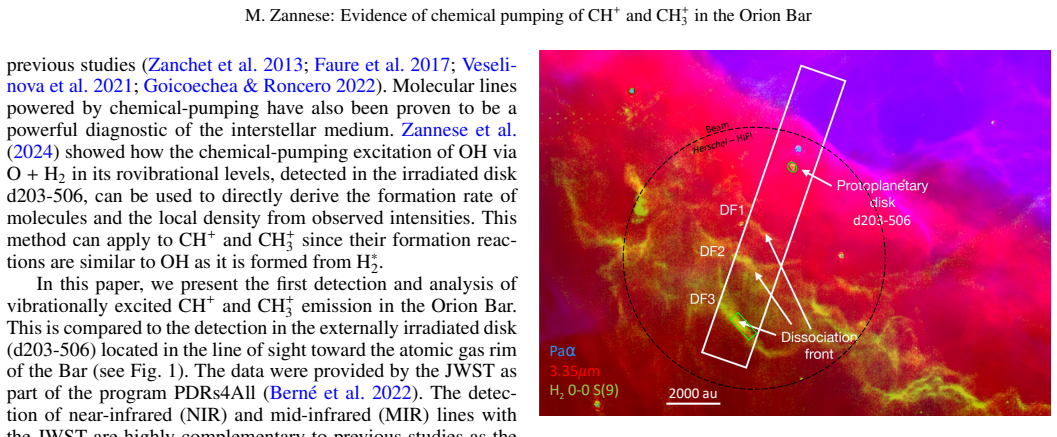
The methylidyne cation (CH$^+$) and the methyl cation (CH$_3^+$) are building blocks of organic molecules, yet their coupled formation and excitation mechanisms remain mainly unprobed. The James Webb Space Telescope (JWST), with its high spatial resolution and good spectral resolution, provides unique access to the detection of these molecules. Our goal is to use the first detection of CH$^+$ and CH$_3^+$ rovibrational emission in the Orion Bar and in the protoplanetary disk d203-506, irradiated by the Trapezium cluster, to probe their formation and excitation mechanisms and constrain the physico-chemical conditions. We use spectro-imaging acquired using both the NIRSpec and MIRI-MRS instruments to study the CH$^+$ and CH$_3^+$ spatial distribution at very small scales, and compare it to excited H$_2$ emission. CH$^+$ and CH$_3^+$ emissions originate from the same region as highly excited H$_2$. Our comparison between the Bar and d203-506 reveals that both CH$^+$ and CH$_3^+$ excitation and/or formation are highly dependent on gas density. The excitation temperature of the observed CH$^+$ and CH$_3^+$ rovibrational lines is around $T$ ~ 1500 K in the Bar and $T$ ~ 800 K in d203-506. Moreover, the column densities derived from the rovibrational emission are less than 0.1 % of the total known (CH$^+$) and expected (CH$_3^+$) column densities. These results show that CH$^+$ and CH$_3^+$ level populations strongly deviate from ETL. CH$^+$ rovibrational emission can be explained by chemical formation pumping with excited H$_2$ via C$^+$ + H$_2^*$ = CH$^+$ + H. These results support a gas phase formation pathway of CH$^+$ and CH$_3^+$ via successive hydrogen abstraction reactions. However, we do not find any evidence of CH$_2^+$ emission in the JWST spectrum. Finally, observed CH$^+$ intensities coupled with chemical formation pumping model provide a diagnostic tool to trace the local density.
Figures


Figures from the paper (8 more)


Forward citations
Cited by 3 Pith papers
-
Resolving dense photo-dissociation regions: the structure of photochemical fronts in three-dimensional gas distributions
A three-dimensional PDR model shows that overlapping H2 dissociation and C+ recombination fronts, plus the arc-like H2 emission seen in the Orion Bar, arise from shadowing by dense clumps in a fractal gas distribution.
-
XUE. JWST spectroscopy of externally irradiated disks around young intermediate-mass stars
Externally irradiated intermediate-mass disks in NGC 6357 retain molecular richness comparable to isolated T Tauri disks, with hot water common and no clear irradiation chemistry.
-
JWST/MIRI Detection of Molecular H$_2$ Winds from an Edge-on Class II Source HV Tau C
The edge-on Class II disk HV Tau C hosts a spatially extended, wide-angled molecular hydrogen wind with warm (~600 K) and hot (~2000 K) components and a mass-loss rate near 1e-8 solar masses per year.
Reference graph
Works this paper leans on
-
[1]
, " * write output.state after.block = add.period write newline
ENTRY address archiveprefix author booktitle chapter edition editor howpublished institution eprint journal key month note number organization pages publisher school series title type volume year label extra.label sort.label short.list INTEGERS output.state before.all mid.sentence after.sentence after.block FUNCTION init.state.consts #0 'before.all := #1 ...
-
[2]
write newline
" write newline "" before.all 'output.state := FUNCTION n.dashify 't := "" t empty not t #1 #1 substring "-" = t #1 #2 substring "--" = not "--" * t #2 global.max substring 't := t #1 #1 substring "-" = "-" * t #2 global.max substring 't := while if t #1 #1 substring * t #2 global.max substring 't := if while FUNCTION word.in bbl.in " " * FUNCTION format....
-
[3]
R., Cernicharo , J., Faure , A., & Roueff , E
Ag \'u ndez , M., Goicoechea , J. R., Cernicharo , J., Faure , A., & Roueff , E. 2010, , 713, 662
2010
-
[4]
A., Mu \ n oz Caro , G
Alata , I., Cruz-Diaz , G. A., Mu \ n oz Caro , G. M., & Dartois , E. 2014, , 569, A119
2014
-
[5]
2015, , 584, A123
Alata , I., Jallat , A., Gavilan , L., et al. 2015, , 584, A123
2015
-
[6]
2018, Journal of Molecular Spectroscopy, 347, 1
Asvany, O., Thorwirth, S., Redlich, B., & Schlemmer, S. 2018, Journal of Molecular Spectroscopy, 347, 1
2018
-
[7]
2022, , 134, 054301
Bern \'e , O., Habart , \'E ., Peeters , E., et al. 2022, , 134, 054301
2022
-
[8]
2024, Science, 383, 988
Bern \'e , O., Habart , E., Peeters , E., et al. 2024, Science, 383, 988
2024
Show all 90 references
-
[9]
2023, , 621, 56
Bern \'e , O., Martin-Drumel , M.-A., Schroetter , I., et al. 2023, , 621, 56
2023
-
[10]
Black , J. H. 1998, Faraday Discussions, 109, 257
1998
-
[11]
R., & Cernicharo , J
Bron , E., Ag \'u ndez , M., Goicoechea , J. R., & Cernicharo , J. 2018, arXiv e-prints, arXiv:1801.01547
2018 arXiv
-
[12]
O., van Dishoeck , E
Bruderer , S., Benz , A. O., van Dishoeck , E. F., et al. 2010, , 521, L44
2010
-
[13]
2001, Chemical physics letters, 341, 358
Bunker, P., Chan, M., Kraemer, W., & Jensen, P. 2001, Chemical physics letters, 341, 358
2001
-
[14]
R., Kraemer , W
Bunker , P. R., Kraemer , W. P., Yurchenko , S. N., et al. 2007, Molecular Physics, 105, 1369
2007
-
[15]
W., Gonz \'a lez-Alfonso , E., et al
Cernicharo , J., Liu , X. W., Gonz \'a lez-Alfonso , E., et al. 1997, , 483, L65
1997
-
[16]
B., Chen , N
Changala , P. B., Chen , N. L., Le , H. L., et al. 2023, , 680, A19
2023
-
[17]
B., Neufeld , D
Changala , P. B., Neufeld , D. A., & Godard , B. 2021, , 917, 16
2021
-
[18]
2024, , 685, A75
Chown , R., Sidhu, Ameek , Peeters, Els , et al. 2024, , 685, A75
2024
-
[19]
2018, The Journal of Chemical Physics, 149
Coudert, L., Gans, B., Holzmeier, F., et al. 2018, The Journal of Chemical Physics, 149
2018
-
[20]
R., Pilleri , P., et al
Cuadrado , S., Goicoechea , J. R., Pilleri , P., et al. 2015, , 579, C1
2015
-
[21]
K., Alcaraz, C., Elhanine, M., et al
Cunha de Miranda, B. K., Alcaraz, C., Elhanine, M., et al. 2010, The Journal of Physical Chemistry A, 114, 4818, pMID: 20218643
2010
-
[22]
B., Hamilton, P
Davies, P. B., Hamilton, P. A., & Rothwell, W. J. 1984, The Journal of Chemical Physics, 81, 1598
1984
-
[23]
Douglas , A. E. & Herzberg , G. 1941, , 94, 381
1941
-
[24]
2010, , 521, L15
Falgarone , E., Godard , B., Cernicharo , J., et al. 2010, , 521, L15
2010
-
[25]
2017, , 469, 612
Faure, A., Halvick, P., Stoecklin, T., et al. 2017, , 469, 612
2017
-
[26]
2023, Monthly Notices of the Royal Astronomical Society, 527
Forer, J., Hvizdoš, D., Ayouz, M., Greene, C., & Kokoouline, V. 2023, Monthly Notices of the Royal Astronomical Society, 527
2023
-
[27]
C., McKellar , A
Foster , S. C., McKellar , A. R. W., & Sears , T. J. 1984, , 81, 578
1984
-
[28]
R., Tielens , A
Geballe , T. R., Tielens , A. G. G. M., Allamandola , L. J., Moorhouse , A., & Brand , P. W. J. L. 1989, , 341, 278
1989
-
[29]
A., & Goicoechea , J
Gerin , M., Neufeld , D. A., & Goicoechea , J. R. 2016, , 54, 181
2016
-
[30]
& Cernicharo , J
Godard , B. & Cernicharo , J. 2013, , 550, A8
2013
-
[31]
R., Le Bourlot , J., Black , J
Goicoechea , J. R., Le Bourlot , J., Black , J. H., et al. 2024, , 689, L4
2024
-
[32]
R., Pety , J., Cuadrado , S., et al
Goicoechea , J. R., Pety , J., Cuadrado , S., et al. 2025, , submitted
2025
-
[33]
R., Pety , J., Cuadrado , S., et al
Goicoechea , J. R., Pety , J., Cuadrado , S., et al. 2016, , 537, 207
2016
-
[34]
Goicoechea , J. R. & Roncero , O. 2022, , 664, A190
2022
-
[35]
R., Santa-Maria , M
Goicoechea , J. R., Santa-Maria , M. G., Bron , E., et al. 2019, , 622, A91
2019
-
[36]
D., Clayton , G
Gordon , K. D., Clayton , G. C., Decleir , M., et al. 2023, , 950, 86
2023
-
[37]
Gottfried, J. L. & Oka, T. 2004, The Journal of chemical physics, 121, 11527
2004
-
[38]
V., Pety , J., Goicoechea , J
Guzm \'a n , V. V., Pety , J., Goicoechea , J. R., et al. 2015, , 800, L33
2015
-
[39]
2010, , 518, L116
Habart , E., Dartois , E., Abergel , A., et al. 2010, , 518, L116
2010
-
[40]
2023, , 673, A149
Habart , E., Le Gal , R., Alvarez , C., et al. 2023, , 673, A149
2023
-
[41]
2024, , 685, A73
Habart , E., Peeters, Els , Berné, Olivier , et al. 2024, , 685, A73
2024
-
[42]
Habing , H. J. 1968, , 19, 421
1968
-
[43]
C., & St \"a uber , P
Hammami , K., Owono Owono , L. C., & St \"a uber , P. 2009, , 507, 1083
2009
-
[44]
J., Reiter , M., O'Dell , C
Haworth , T. J., Reiter , M., O'Dell , C. R., et al. 2023, , 525, 4129
2023
-
[45]
2024, , 136, 054302
Henning , T., Kamp , I., Samland , M., et al. 2024, , 136, 054302
2024
-
[46]
2021, Frontiers in Astronomy and Space Sciences, 8, 207
Herbst , E. 2021, Frontiers in Astronomy and Space Sciences, 8, 207
2021
-
[47]
M., Morris , R
Hierl , P. M., Morris , R. A., & Viggiano , A. A. 1997, , 106, 10145
1997
-
[48]
Hollenbach , D. J. & Tielens , A. G. G. M. 1997, , 35, 179
1997
-
[49]
2020, , 497, 5061
Inoguchi , M., Hosokawa , T., Mineshige , S., & Kim , J.-G. 2020, , 497, 5061
2020
-
[50]
1995, Journal of Molecular Spectroscopy, 172, 194
Jensen, P., Brumm, M., Kraemer, W., & Bunker, P. 1995, Journal of Molecular Spectroscopy, 172, 194
1995
-
[51]
H., Cortona, P., Ayouz, M., & Kokoouline, V
Jiang, X., Yuen, C. H., Cortona, P., Ayouz, M., & Kokoouline, V. 2019, Phys. Rev. A, 100, 062711
2019
-
[52]
2018, , 615, A129
Joblin , C., Bron , E., Pinto , C., et al. 2018, , 615, A129
2018
-
[53]
Joblin , C., Tielens , A. G. G. M., Allamandola , L. J., & Geballe , T. R. 1996, , 458, 610
1996
-
[54]
E., Barlow, S., Ellison, G., & Ferguson, E
Jones, M. E., Barlow, S., Ellison, G., & Ferguson, E. 1986, Chemical Physics Letters, 130, 218
1986
-
[55]
F., Dinerstein, H
Kaplan, K. F., Dinerstein, H. L., Kim, H., & Jaffe, D. T. 2021, The Astrophysical Journal, 919, 27
2021
-
[56]
F., Dinerstein , H
Kaplan , K. F., Dinerstein , H. L., Oh , H., et al. 2017, , 838, 152
2017
-
[57]
2009, Molecular Physics, 107, 1283
Keceli , M., Shiozaki , T., Yagi , K., & Hirata , S. 2009, Molecular Physics, 107, 1283
2009
-
[58]
1994, Canadian Journal of Physics, 72, 871
Kraemer, W., Jensen, P., & Bunker, P. 1994, Canadian Journal of Physics, 72, 871
1994
-
[59]
& Špirko, V
Kraemer, W. & Špirko, V. 1991, Journal of Molecular Spectroscopy, 149, 235
1991
-
[60]
2006, , 164, 506
Le Petit , F., Nehm \'e , C., Le Bourlot , J., & Roueff , E. 2006, , 164, 506
2006
-
[61]
d., Aguado , A., Goicoechea , J
Mazo-Sevillano , P. d., Aguado , A., Goicoechea , J. R., & Roncero , O. 2024, , 160, 184307
2024
-
[62]
M., Reid , M
Menten , K. M., Reid , M. J., Forbrich , J., & Brunthaler , A. 2007, , 474, 515
2007
-
[63]
Nagy , Z., Ossenkopf , V., Van der Tak , F. F. S., et al. 2015, , 578, A124
2015
-
[64]
Nagy , Z., Van der Tak , F. F. S., Ossenkopf , V., et al. 2013, , 550, A96
2013
-
[65]
A., Dartois , E., Habart , E., et al
Naylor , D. A., Dartois , E., Habart , E., et al. 2010, , 518, L117
2010
-
[66]
A., Godard , B., Bryan Changala , P., et al
Neufeld , D. A., Godard , B., Bryan Changala , P., et al. 2021, , 917, 15
2021
-
[67]
R., Jensen , P., & Kraemer , W
Osmann , G., Bunker , P. R., Jensen , P., & Kraemer , W. P. 1997, Chemical Physics, 225, 33
1997
-
[68]
2017, , 599, A20
Parikka , A., Habart , E., Bernard-Salas , J., et al. 2017, , 599, A20
2017
-
[69]
2024, , 685, A74
Peeters , E., Habart, Emilie , Berné, Olivier , et al. 2024, , 685, A74
2024
-
[70]
2005, , 435, 885
Pety , J., Teyssier , D., Foss \'e , D., et al. 2005, , 435, 885
2005
-
[71]
R., Glenn , J., et al
Rangwala , N., Maloney , P. R., Glenn , J., et al. 2014, , 788, 147
2014
-
[72]
1992, Journal of molecular spectroscopy (Print), 153, 738
R \"o sslein, M., Gabrys, C., Jagod, M.-F., & Oka, T. 1992, Journal of molecular spectroscopy (Print), 153, 738
1992
-
[73]
1992, Chemical Reviews, 92, 1473
Smith, D. 1992, Chemical Reviews, 92, 1473
1992
-
[74]
J., Cardelli , J
Sofia , U. J., Cardelli , J. A., Guerin , K. P., & Meyer , D. M. 1997, , 482, L105
1997
-
[75]
2012, , 758, 108
Spinoglio , L., Pereira-Santaella , M., Busquet , G., et al. 2012, , 758, 108
2012
-
[76]
Stecher , T. P. & Williams , D. A. 1972, , 177, L141
1972
-
[77]
& Dalgarno , A
Sternberg , A. & Dalgarno , A. 1995, , 99, 565
1995
-
[78]
C., van Dishoeck , E
Tabone , B., van Hemert , M. C., van Dishoeck , E. F., & Black , J. H. 2021, , 650, A192
2021
-
[79]
F., M \'e nard , F., Meeus , G., et al
Thi , W. F., M \'e nard , F., Meeus , G., et al. 2011, , 530, L2
2011
-
[80]
2024, , 687, A86
Van De Putte , D., Meshaka , R., Trahin , B., et al. 2024, , 687, A86
2024
-
[81]
van der Tak , F. F. S., Nagy , Z., Ossenkopf , V., et al. 2013, , 560, A95
2013
-
[82]
R., et al
Veselinova , A., Ag \'u ndez , M., Goicoechea , J. R., et al. 2021, , 648, A76
2021
-
[83]
F., Morong , C
Wang , H., Neese , C. F., Morong , C. P., Kleshcheva , M., & Oka , T. 2013, Journal of Physical Chemistry A, 117, 9908
2013
-
[84]
J., et al
Wesson , R., Cernicharo , J., Barlow , M. J., et al. 2010, , 518, L144
2010
-
[85]
& Merkt, F
Willitsch, S. & Merkt, F. 2003, The Journal of chemical physics, 118, 2235
2003
-
[86]
G., Vallini , L., & Chevance , M
Wolfire , M. G., Vallini , L., & Chevance , M. 2022, , 60, 247
2022
-
[87]
2013, , 766, 80
Zanchet , A., Godard , B., Bulut , N., et al. 2013, , 766, 80
2013
-
[88]
2024, Nature Astronomy, 8, 577
Zannese , M., Tabone , B., Habart , E., et al. 2024, Nature Astronomy, 8, 577
2024
-
[89]
2023, , 671, A41
Zannese , M., Tabone , B., Habart , E., et al. 2023, , 671, A41
2023
-
[90]
Zhen , J., Castellanos , P., Linnartz , H., & Tielens , A. G. G. M. 2016, Molecular Astrophysics, 5, 1
2016
Reviewed August 8, 2026 · model on record in the stance chip above.
Discussion (0). Continue with ORCID to comment.