REVIEW 6 major objections 6 minor 13 references
A Novel Approach to for Multimodal Emotion Recognition : Multimodal semantic information fusion
T0 review · 6 major / 6 minor · reviewed 2026-08-08 · deepseek-v4-flash
Pith's one-line read DeepMSI-MER, a multimodal emotion recognition model that couples contrastive learning with visual sequence compression, reports average accuracy and F1 of 84.7% on IEMOCAP and 69.4%/67.9% on MELD, above every baseline compared.
desk verdict Incremental engineering paper whose benchmark evidence is not load-bearing because the evaluation protocol is under-specified and likely leaks dialogue context; desk reject, though a careful re-run could salvage a narrower claim. read the letter →
The pith
A machine-rendered reading of the paper's core claim, the machinery that carries it, and where it could break.
The reading
What carries the argument
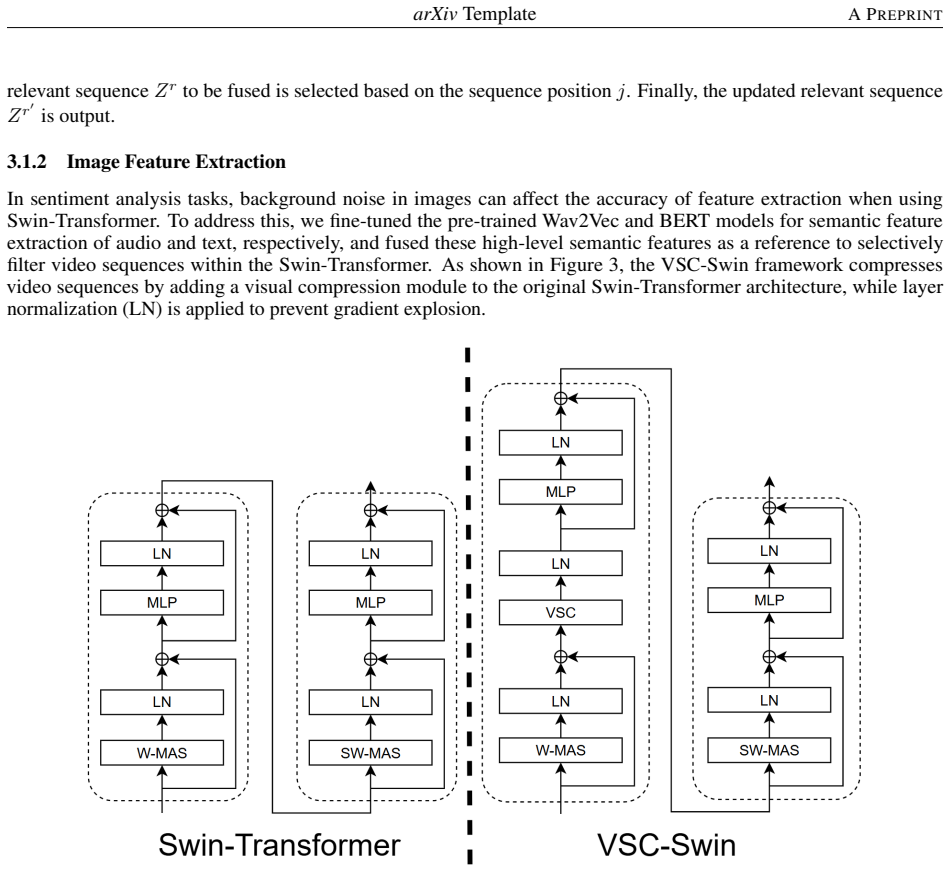
The load-bearing mechanism is the coupling of two modules. First, VSC-Swin, a visual sequence compression module attached to the Swin Transformer, computes a similarity matrix $S^{N\times N}=V^{N\times d}(M^{N\times d})^T/\tau$ between the video frame sequence and a multimodal semantic vector broadcast over frames; a threshold $\gamma$ splits frames into relevant ($Z^r$) and irrelevant ($Z^{lr}$) sets, and the method re-fuses the most similar irrelevant frames back into the relevant sequence. Second, a late-fusion contrastive loss $L_{cl}$ uses batch labels to define positive and negative sample masks, pulling same-label cross-modal embeddings together while pushing different-label ones apart. The former reduces visual redundancy; the latter aligns the modalities. Their joint training objective is $L=\alpha_{ce}L_{ce}+\beta_{cl}L_{cl}$, with 10-fold cross-validation for evaluation.
What would settle it
Re-run each baseline in Tables 1 and 2 under the exact 10-fold cross-validation splits and preprocessing used for DeepMSI-MER; if any baseline reaches or exceeds 84.7% accuracy/F1 on IEMOCAP or 69.4% accuracy on MELD, the claimed improvement over that baseline is not established.
Extended reading notes
Core claim
The paper's central claim is that multimodal emotion recognition improves when cross-modal fusion is guided by contrastive learning and when the visual stream is compressed using semantic information from the other modalities. Concretely, DeepMSI-MER first fuses fine-tuned BERT text features with fine-tuned Wav2Vec audio features into a high-level semantic vector; this vector is added to pooled visual features and used to score every video frame against the pooled semantic summary. Frames below a similarity threshold are treated as irrelevant and re-fused only if they match a relevant frame, reducing background noise. In late fusion, a supervised contrastive loss built from current-batch labels separates same-emotion pairs from different-emotion pairs. The authors report average accuracy and F1 of 84.7% on IEMOCAP and 69.4%/67.9% on MELD, above all baselines listed in Tables 1 and 2, and an ablation table showing the three-modality combination outperforms unimodal and two-modality combinations.
Load-bearing premise
The claim that DeepMSI-MER outperforms the baselines depends on the baseline numbers being directly comparable, meaning the same preprocessing, same train/validation splits, and same evaluation protocol, and the paper does not state that the baselines were re-run under its own 10-fold procedure.
Editorial extensions
If this is right
- If the reported numbers are reproducible, DeepMSI-MER beats all thirteen listed baselines on IEMOCAP and all ten on MELD, with especially large margins on the Sad, Angry, and Frustrated classes.
- The visual sequence compression module filters redundant frames before temporal modeling, so the model processes a smaller effective visual sequence; this is a direct efficiency gain for video-based recognition.
- The ablation study shows the three-modality combination is necessary: adding audio to text+video raises accuracy from 78.46% to 84.75% on IEMOCAP, even though audio alone is the weakest unimodal stream.
- Because the method relies on standard pretrained encoders and 15 sampled frames per video, it offers a comparatively light recipe for multimodal emotion recognition.
Reading between the lines
- Extension: the comparison is conditional on protocol matching; since the paper does not report re-running baselines under its own 10-fold splits, reproducing those baselines under identical preprocessing is the immediate test of the claimed margins.
- Extension: semantic-guided visual compression is a general idea and could be transferred to other video understanding tasks, such as action recognition or video summarization, where frame redundancy is also a bottleneck.
- Extension: the contrastive loss uses current-batch labels, so it is a supervised objective; a natural follow-up is whether the same architecture helps when labels are scarce or replaced by pseudo-labels.
Editorial analysis
A structured set of objections, weighed in public.
Referee Report
Summary. The paper proposes DeepMSI-MER, a tri-modal (text, audio, video) emotion recognition model that combines contrastive learning with a visual sequence compression module. The method extracts features with BERT, Wav2Vec, and Swin Transformer, fuses audio and text semantic features to guide visual frame selection, adds a contrastive loss at the late fusion stage, and uses a TCN for temporal modeling. Experiments on IEMOCAP and MELD report average accuracy/F1 of 84.7%/84.7% and 69.4%/67.9%, respectively, and the paper claims that these results significantly improve on state-of-the-art baselines.
Significance. If the reported results were supported, the paper would offer a practical recipe for multimodal emotion recognition with a semantically guided visual compression mechanism. However, the claimed improvements are not substantiated by the evidence as presented: the evaluation protocol is underspecified and may leak conversational context, the method equations contain internal inconsistencies, the ablation table is misread, and no confidence intervals or reproducibility artifacts are provided. The underlying ideas are plausible and worth testing, but the manuscript in its current form does not provide reliable evidence for its central claim.
major comments (6)
- [Section 3.3; Tables 1–2] The evaluation protocol is not specified precisely enough to support the headline comparison. The paper says only that the dataset is 'randomly divided into 10 subsets' and does not state whether the split is at the utterance level or grouped by conversation/session, nor whether the baseline numbers in Tables 1 and 2 were produced under the same split and preprocessing. IEMOCAP and MELD are conversational datasets; an utterance-level random split can place same-dialogue, same-speaker utterances in both training and test, inflating scores through speaker and lexical leakage. IEMOCAP is normally evaluated leave-one-session-out and MELD with its official train/dev/test split, and the cited baselines are typically reported under those protocols. Please state the exact split, rerun all baselines under identical conditions, and report standard deviations or significance tests; otherwise the claimed gains and the word 'significantly' are unsupported.
- [Section 3.1.1, Eq. (2)] Equation (2) is internally inconsistent: because M^{N×d} is built by broadcasting the scalar m_cls to every row, each row of S^{N×N}=V^{N×d}(M^{N×d})^T/τ is identical, so the per-frame similarity vector S^{N×1} contains the same value for every frame. Such a vector cannot separate 'relevant' from 'irrelevant' frames, making the visual sequence compression vacuous. The mechanism only becomes meaningful with a per-frame semantic fusion, e.g., fusing G_cls with each frame feature v_t rather than with the pooled v_cls. The threshold γ also needs a concrete value or selection rule.
- [Section 3.2, Eq. (5)] Equation (5) does not implement the label-mask contrastive loss described in the text. The numerator uses only the self-similarity cos(x_i,x_i), and the denominator sums over every j in the batch without masking positive pairs, so the formula never uses the positive/negative sample masks said to be created from current batch labels. As written, this loss would push same-label pairs apart rather than aligning cross-modal representations of the same class. The loss should be written with label-aware positive sets or an explicit mask, and the double-sum normalization should be checked.
- [Section 3.1.1, Eq. (3)] Equation (3) also has indexing problems: j is defined as the result of max, not argmax, and the expression for Z^{r'} mixes indices j, i, and row/column notation without defining the summation range. Because Z^r and Z^{lr} are formed by thresholding the same visual sequence, the formula's dimensions and the meaning of α must be clarified before the compression step can be implemented.
- [Section 4.5, Table 3] The ablation discussion misreads Table 3: the text says 'visual features performed the best, with an accuracy of 78.46% and an F1 score of 78.46%', but the row at 78.46 is T+V (text plus visual). No V-only row is reported, so the isolated contribution of the visual modality and of the proposed VSC-Swin compression cannot be assessed.
- [Sections 3.1–3.3] The hyperparameters γ, α, τ, α_ce, β_cl, and the 15-frame sampling choice are introduced without values, ranges, or sensitivity analysis. The paper also provides no standard deviations, no model complexity comparison, and the external code/data links are unversioned (GitHub) and without checksums (Baidu Pan). Because the entire contribution rests on the reported numerical gaps, this missing information blocks verification and reproduction.
minor comments (6)
- [Title and Abstract] The title contains a grammatical error ('A Novel Approach to for Multimodal Emotion Recognition'); the Abstract also says the model 'consists of three stages' but then lists four components.
- [Section 3.1.1, Eq. (3)] The notation N−L appears without defining L; please define it as the number of filtered irrelevant frames.
- [Figure 7] The confusion matrices show counts, but the axis labels and normalization are not described; please specify whether values are raw counts and how they were aggregated over the 10 folds.
- [Table 2] The table alternates 'Acc.' and 'Acc' in column headers; please use consistent formatting.
- [Section 3.1.3] The claim that 15 frames are justified by 'emotional change cycles' is unsupported by any citation or experiment; please provide a sensitivity study or remove the claim.
- [Section 3.1] The text says 'fine-tune the pre-trained models BERT and Wav2Vec on the audio and text data, respectively', but BERT is a text model and Wav2Vec is an audio model; the wording should be swapped.
Circularity Check
No significant circularity: the central claim is an empirical benchmark result with external grounding, and no derivation step reduces by construction to its own inputs.
full rationale
The central claim that DeepMSI-MER improves emotion recognition accuracy on IEMOCAP and MELD is an empirical claim supported by training and evaluation, not by a derivation that folds its inputs back into its outputs. Sections 3.1-3.3 define modality-specific extraction, early fusion, visual sequence compression, late fusion, and the training loss; Section 4 reports benchmark numbers against external baselines. None of Equations (1)-(7) constructs the reported metric from the quantity it claims to predict: Equation 1 defines a fused semantic feature, Equation 2 uses that feature to select relevant and irrelevant visual sequences, Equation 3 merges the selected and non-selected sequences, and Equations 5-7 define contrastive and cross-entropy losses. The hyperparameters gamma, alpha, tau, alpha_ce, beta_cl, and the 15-frame choice are design choices whose values and tuning procedure are not reported, but the paper does not rename a fitted quantity as a prediction, and no fitted value is claimed to be derived from the test results. There is no load-bearing self-citation chain, no imported uniqueness theorem, and no ansatz smuggled in via citation. The concern that baselines may not have been re-run under identical evaluation protocols is a validity issue about the empirical comparison, not a circularity in the derivation. The mathematical inconsistencies in Equations 2-3 and the confusing ablation description are correctness and clarity risks, not evidence that the result is equivalent to its inputs by definition. The finding is therefore no significant circularity.
Assumptions & free parameters
free parameters (5)
- similarity threshold gamma =
not reported
- fusion weight alpha =
not reported
- temperature tau =
not reported
- loss weights alpha_ce and beta_cl =
not reported
- number of sampled video frames =
15
assumptions (5)
- domain assumption Pre-trained BERT and Wav2Vec embeddings carry the emotion-relevant semantics of text and audio.
- ad hoc to paper Similarity thresholding in Eq 2 separates emotion-relevant from irrelevant visual frames.
- domain assumption The reported baseline numbers in Tables 1 and 2 are comparable to DeepMSI-MER under the same protocol.
- domain assumption TCN captures temporal emotion dynamics from 15 frame-level features.
- domain assumption Cross-validation is implemented without speaker or utterance leakage between folds.
invented entities (1)
-
VSC-Swin visual sequence compression module
Cite this review
Pith. "Pith review of A Novel Approach to for Multimodal Emotion Recognition : Multimodal semantic information fusion." pith.science (2026). https://pith.science/paper/3WXZV66B
@misc{pith2026250208573,
  author       = {Pith},
  title        = {Pith review of: A Novel Approach to for Multimodal Emotion Recognition : Multimodal semantic information fusion},
  year         = {2026},
  howpublished = {\url{https://pith.science/paper/3WXZV66B}},
  note         = {Machine review of arXiv:2502.08573}
}
read the original abstract
With the advancement of artificial intelligence and computer vision technologies, multimodal emotion recognition has become a prominent research topic. However, existing methods face challenges such as heterogeneous data fusion and the effective utilization of modality correlations. This paper proposes a novel multimodal emotion recognition approach, DeepMSI-MER, based on the integration of contrastive learning and visual sequence compression. The proposed method enhances cross-modal feature fusion through contrastive learning and reduces redundancy in the visual modality by leveraging visual sequence compression. Experimental results on two public datasets, IEMOCAP and MELD, demonstrate that DeepMSI-MER significantly improves the accuracy and robustness of emotion recognition, validating the effectiveness of multimodal feature fusion and the proposed approach.
Figures


Figures from the paper (4 more)


Reference graph
Works this paper leans on
-
[1]
S. Poria, E. Cambria, R. Bajpai, and A. Hussain. A review of affective computing: From unimodal analysis to multimodal fusion. Information Fusion, 37:98–125, 2017a. R. Hadsell, S. Chopra, and Y . LeCun. Dimensionality reduction by learning an invariant mapping. In 2006 IEEE Computer Society Conference on Computer Vision and Pattern Recognition (CVPR’06), ...
work page 2006
- [5]
-
[9]
D. Hazarika, S. Poria, R. Mihalcea, E. Cambria, and R. Zimmermann. Icon: Interactive conversational memory network for multimodal emotion detection. In Proceedings of the 2018 Conference on Empirical Methods in Natural Language Processing, pages 2594–2604, 2018b. 12 arXiv Template A PREPRINT D. Ghosal, N. Majumder, S. Poria, N. Chhaya, and A. Gelbukh. Dia...
work page 2018
-
[10]
T. Ishiwatari, Y . Yasuda, T. Miyazaki, and J. Goto. Relation-aware graph attention networks with relational position encodings for emotion recognition in conversations. In Proceedings of the 2020 Conference on Empirical Methods in Natural Language Processing (EMNLP), pages 7360–7370,
work page 2020
-
[11]
W. Ai, Y . Shou, T. Meng, and K. Li. Der-gcn: Dialogue and event relation-aware graph convolutional neural network for multimodal dialogue emotion recognition. arXiv preprint arXiv:2312.10579,
-
[12]
Y . Shou, W. Ai, J. Du, T. Meng, H. Liu, and N. Yin. Efficient long-distance latent relation-aware graph neural network for multi-modal emotion recognition in conversations. arXiv preprint arXiv:2407.00119,
-
[13]
T. Meng, F. Zhang, Y . Shou, W. Ai, N. Yin, and K. Li. Revisiting multimodal emotion recognition in conversation from the perspective of graph spectrum. arXiv preprint arXiv:2404.17862,
- [2017]
Show all 13 references
-
[2018]
Hazarika, S
D. Hazarika, S. Poria, A. Zadeh, E. Cambria, L.-P. Morency, and R. Zimmermann. Conversational memory network for emotion recognition in dyadic dialogue videos. In Proceedings of the conference on Association for Computational Linguistics, volume 2018, page 2122, 2018a. S. Pori...
2018
-
[2019]
Baevski, Y
A. Baevski, Y . Zhou, and M. Auli. wav2vec 2.0: A framework for self-supervised learning of speech representations. In Proceedings of NeurIPS 2020, volume 33, pages 12449–12460,
2020
-
[2020]
S. Bai, X. Zhan, and W. Cheng. An empirical evaluation of generic convolutional and recurrent networks for sequence modeling. In Proceedings of NeurIPS 2018, volume 31, pages 1–11,
2018
-
[2021]
Gupta, T
A. Gupta, T. Likhomanenko, K. D. Yang, R. H. Bai, Z. Aldeneh, and N. Jaitly. Visatronic: A multimodal decoder-only model for speech synthesis. arXiv preprint arXiv:2411.17690,
-
[2023]
J. Hu, Y . Liu, J. Zhao, and Q. Jin. Mmgcn: Multimodal fusion via deep graph convolution network for emotion recognition in conversation. arXiv preprint arXiv:2107.06779,
Reviewed August 8, 2026 · model on record in the stance chip above.
Discussion (0). Continue with ORCID to comment.